
What is BNB? A Beginner's Guide


Key Takeaways
- BNB (coin) is the asset; BNB Smart Chain (BSC) is the blockchain-based EVM execution layer where most dApps in this ecosystem run; BNB Beacon Chain handles governance/staking functions.
- BNB is the gas token on BSC — if you hold BEP-20 tokens but zero BNB, transactions fail.
- BNB utility splits into two environments: on-chain (gas, staking, governance, DeFi) vs Binance platform (fee discounts and programs).
Disclaimer
This article is informational content, not financial, tax, or legal advice. Rules differ by country, and readers should consult qualified professionals in their local jurisdiction before making financial decisions or interpreting tax obligations. Nothing on this page constitutes a recommendation to buy, sell, or hold BNB.
Some readers may already know it as Binance Coin, but officially BNB hasn’t been called that for a while. And for a good reason: by now, it is one of the main alternatives to Ethereum, sporting utility much more versatile than simply being Binance’s token. If you’re not yet convinced, hopefully, this guide clears the picture, and if you are only just getting to know BNB, learn more about it right here and now!
Binance Coin (BNB)
Origin
BNB began as “Binance Coin” within the Binance ecosystem and functions today as the native coin powering the BNB Chain ecosystem — a collection of interconnected blockchain networks including BNB Smart Chain, opBNB, and BNB Greenfield.
Initially an Ethereum token, it entered circulation through an initial coin offering (ICO) conducted in July 2017, two weeks before the Binance exchange itself launched. The ICO raised funds by selling BNB at a fixed price, distributing the initial allocation across three participant categories: angel investors, founding team, and ICO participants. The latter exchanged ETH or BTC for BNB at predetermined ratios, and tokens were delivered shortly after the sale concluded.

In April 2019, BNB migrated from its original ERC-20 implementation on Ethereum to Binance’s proprietary blockchain network, initially known as Binance Chain. This migration marked the moment BNB stopped being “a token on someone else’s chain” and became the native coin of an independent blockchain — the base layer for what later became the multi-chain BNB Chain ecosystem.
Timeline
- July 2017 — BNB ICO completes, raising $15 million across three allocation tiers before exchange launch
- September 2017 — Binance exchange goes live; BNB trading fee discount structure activates immediately
- April 2019 — BNB migrates from Ethereum ERC-20 to Binance Chain as native coin
- September 2020 — Binance Smart Chain (later rebranded BNB Smart Chain) launches as a parallel network
- February 2021 — BNB market cap surpasses $40 billion during broader altcoin rally
- February 2022 — “Binance Coin” rebrands to BNB, keeping the original ticker but adopting a new name, officially standing for “Build and Build”
- 2023–2024 — Ecosystem expands to include BNB Smart Chain, opBNB (Layer 2 scaling), and BNB Greenfield (decentralized storage)
BNB Chain
BNB Chain represents the full blockchain ecosystem originally launched by Binance in 2019, consisting of multiple interconnected networks that serve different technical purposes within a unified brand architecture. Instead of forcing everything onto a single chain, the ecosystem splits responsibilities across specialized layers that share a common token and brand but maintain distinct technical functions.
The design is a response to a real constraint: Binance first needed a fast, simple chain for trading operations, which became BNB Beacon Chain. Decentralized finance (DeFi) and smart contract demand then required a parallel EVM-compatible execution layer — BNB Smart Chain. From there, additional components were introduced to address scaling and storage needs while preserving interoperability via standards, bridges, and the shared utility of BNB.
BNB Smart Chain
BNB Smart Chain is the primary execution layer for EVM-compatible smart contracts within the BNB Chain ecosystem. It is where most of its dApps live: DeFi protocols, NFT platforms, on-chain games, and anything that needs a Turing-complete environment.
From a security standpoint, BSC relies on Proof of Staked Authority (PoSA) — a hybrid model combining delegated proof-of-stake elements with validator authority mechanics. The result is fast blocks and low fees, with the explicit tradeoff that the active validator set is relatively small: BNB Smart Chain maintains 45 active validators at any given time, selected from a larger pool of validator candidates.
To become a validator candidate on BSC, participants must stake a minimum of their own 2,000 BNB tokens, which at the time of writing translates to a sizable $1,200,000 commitment of capital. From there on, however, voting power can be further accrued and the stake increased by collecting delegated BNB from other users.
In addition to staking, BNB is the native gas token on BNB Smart Chain. Every transaction fee (simple transfers, contract deployment, swaps, claims) is paid in BNB. For all intents and purposes, it is the default “base asset” that many pairs route through in BSC liquidity.
BNB Beacon Chain
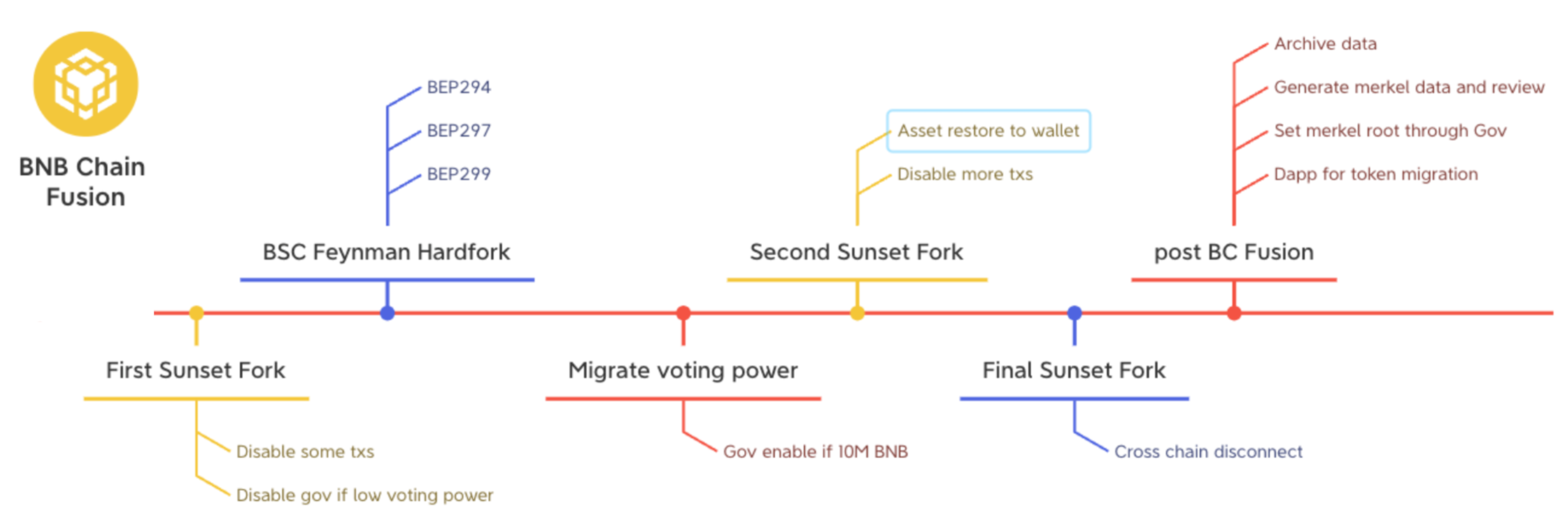
BNB Beacon Chain functions as the governance and staking layer within the broader BNB Chain architecture, with a deliberately simplified design compared to BNB Smart Chain’s full programmability. Historically, it was built to facilitate fast, low-cost trading operations on Binance’s decentralized exchange, so it prioritizes speed and token operations over general-purpose computation.
Beacon Chain did not support the full Ethereum Virtual Machine, which is precisely why it did not host the typical DeFi/NFT smart contract stack. Its role was narrower and more infrastructure-oriented: governance flows, staking-related mechanics, and basic asset movement. Since 2024, BNB Beacon Chain and BSC have been merged into a single-layer blockchain structure.
Architecture
The BNB Chain ecosystem currently consists of three primary components that each address distinct technical requirements:
- BNB Smart Chain
- opBNB — a Layer 2 scaling solution built with Optimism’s OP Stack technology, optimized for high-throughput applications with low fees and fast confirmation.
- BNB Greenfield — a data storage and availability network targeting decentralized storage and data-intensive applications.
Each component has different assumptions, different validator infrastructure, and different performance targets. What connects them is interoperability tooling and the shared role of BNB across network operations.
DeFi protocols typically deploy on BNB Smart Chain for EVM compatibility and liquidity. High-frequency applications (for example, gaming microtransactions) are natural candidates for opBNB. Projects storing large media assets can use BNB Greenfield while minting and trading tokens on BSC.
BNB remains a unifying asset across the stack, but the security and finality characteristics vary by layer.
How BNB Chain Works
BNB is the native cryptocurrency of BNB Chain, but the two are not the same thing — one is the token, the other is the network that processes it. The core mechanics worth understanding are consensus, validator economics, and transaction fee behavior, because they define what “security” and “finality” mean in practice.
Consensus
BNB Chain uses Proof of Staking Authority (PoSA), combining delegated Proof of Stake elements with Proof of Authority logic to produce blocks efficiently while controlling who participates in validation.
Validator selection is staking-based. Any entity can become a validator candidate, but only the top 45 candidates by total delegated stake are active at any given time. These 45 validators rotate block production duties. If a validator fails to produce blocks or behaves maliciously, slashing (stake reduction) can apply, creating an economic incentive to remain operational and honest.
This design is optimizing for throughput and latency at the cost of real decentralization. Fewer validators means faster coordination; faster coordination means lower confirmation times; but fewer independent operators also lowers the cost of coordinated disruption.
Validators
A validator on BNB Smart Chain is responsible for block production, transaction ordering, and transaction validation. In practice, any BSC validator you delegate to is part of the small cohort that directly affects uptime, censorship-resistance assumptions, and reward distribution.
The network distinguishes between the active validator set of top 45 candidates and the rest of validator candidates: entities that have staked at least 2,000 BNB and can enter the active set if their total stake rises enough.
Transaction Fees
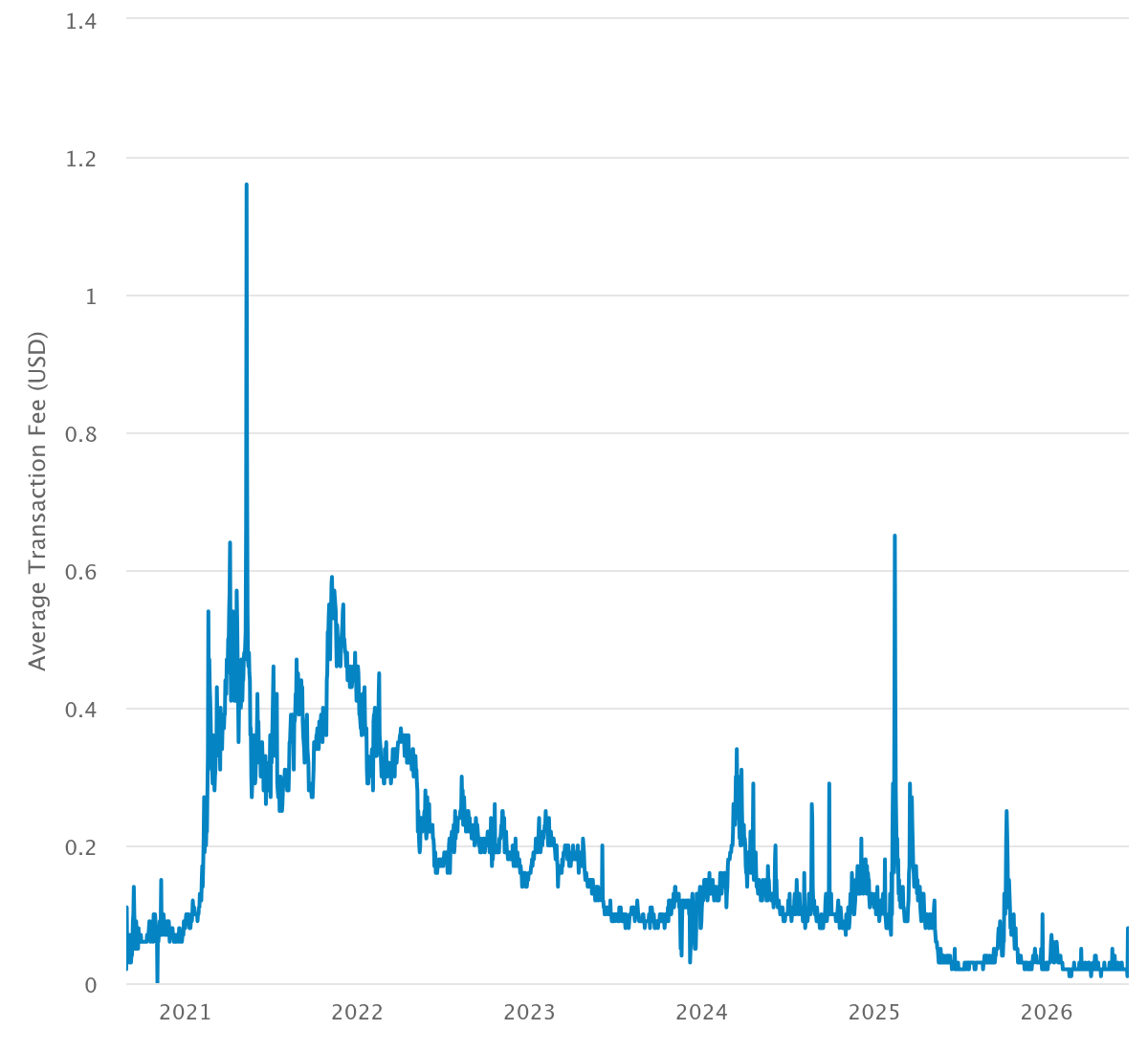
Users pay transaction fees on BNB Chain in BNB. Fees cover computational resources (like gas fees in Ethereum) and network bandwidth. Complexity drives gas usage: a simple transfer is cheap while multi-contract DeFi interactions consume far more gas per transaction.
On the user’s end, a wallet estimates gas usage for the type of transaction they are about to sign;
If they accept a suggested gas price (also presented in Gwei like in Ethereum) by proceeding they sign the transaction with their private key. Wallet broadcasts; validators include the transaction based on fee priority: the higher the tip is, the better the chances to get into the next block if there is a queue but the block times are the same for all.
If the attached gas price is too low, a transaction can remain pending until network demand drops or the user replaces it with a higher-fee transaction.
Transactions per Second (TPS)
TPS is a common measurement of throughput in blockchains; therefore, confirmation time is latency. Users care about both, but confusing them leads to bad expectations.
BNB Smart Chain transactions are confirmed in approximately 3 seconds, which is the practical user-facing speed. TPS varies based on transaction mix and measurement methodology: e.g. stress-test peak vs sustained real-world usage. For example: according to BscScan at the time of writing, this blockchain is processing 203.7 TPS, and this is real usage; opBNB is described as a scaling solution with a potential throughput of 5,000 TPS.
BNB Supply Mechanics
Supply
BNB operates with a maximum supply cap of 200,000,000 tokens. Maximum supply is not the same as circulating supply: not the hard ceiling but BNB actively available for trading, staking, and use. Another metric, total supply counts issued minus burned, including locked/restricted tokens.
This distinction matters because token burns reduce total supply, while circulating supply can shift due to burns, unlocks, or releases from reserves.
Initial allocation followed the 2017 ICO distribution model:
- Angel investors received 10%
- The founding team was allocated 40%
- 50% was distributed across ICO participants and early adopters
Those percentages still matter years later because token concentration and unlock dynamics affect liquidity and sell pressure risk. Unlike many 2017-era token launches, Binance did not introduce vesting schedules for the team allocation at the outset, a decision that later became a point of scrutiny as the token’s value climbed.
Burn Mechanism
A token burn is the transfer of tokens to an address from which they can never be retrieved. Rather than be destroyed, they are removed from future supply accounting.
BNB’s Auto-Burn system calculates the quarterly burn amount based on two variables: BNB’s average price during the quarter and the total number of blocks produced on the BNB Chain during that period. The target endpoint is 100,000,000 BNB total supply, meaning burns are supposed to continue until total supply reaches that level.
Deflation

Since deflation in economics is the opposite of inflation, meaning reduction in money circulating in an economy, “deflationary” in crypto often means total supply decreases over time. It does not necessarily mean “price goes up” without any other factor. Supply reduction and price appreciation are linked only if demand holds or increases.
- Burns reduce supply, but the per-token value of BNB rises only if usage and demand do not contract faster.
- Burns increase each token’s share of a fixed activity base, but only if the activity base is stable.
- Quarterly burns vary with price and block production; deflation is not linear.
- Regulation, competition, liquidity migration, and macro conditions can overtake the influence of this particular supply dynamic.
- The mechanism can eventually reduce the total supply to 100 million without guaranteeing any price outcome.
What is BNB Used For?
BNB is best understood as a utility asset spanning two worlds: exchange token on Binance (fee discounts, platform programs) and on-chain utility across BNB Chain (gas, staking, governance, DeFi).
Gas
Gas on BNB Smart Chain is the computational fee required to execute transactions and smart contract operations on-chain. If your wallet holds only a BEP-20 token (for example, USDT) but contains zero BNB, transactions fail with “insufficient gas” errors. This is the most common first-time failure mode after moving assets from a centralized exchange (CEX) to self-custody.
Gas cost scales with computation complexity:
- Simple transfers: ~21,000 gas units.
- AMM swaps (e.g., PancakeSwap): often 150,000–300,000 gas units.
- Complex DeFi operations: can exceed 1,000,000 gas units.
Binance Exchange Fees
BNB can be used to pay trading fees on Binance with a discount (historically 25%, though subject to change by region, account type, and program terms). This use case is exchange-specific and jurisdiction-dependent.
Additionally, Binance exposes other BNB-adjacent utilities that users often confuse with “staking”, including Binance Liquid Swap (liquidity pool exposure with its own risk profile) and allocation-style programs like Binance Launchpool.
Governance
Governance in the BNB Chain context is protocol governance: parameter tuning, validator rules, and upgrade proposals. Not to be confused with governance of Binance the company. Staking credit holders are eligible to take part, whether directly or indirectly.
Depending on the proposal type, voting can be direct token-weighted voting or validator-mediated (where delegators influence outcomes via validator choice). Delegators can participate indirectly by choosing a validator which can vote in their best interest; such delegated voting power does not incur penalties for missing voting but relinquishes full control over where the vote goes.
Staking
Network security staking (delegation) on BNB Smart Chain via PoSA validators is not the same as custodial or DeFi “earn” programs that may be labeled “staking” but function as deposits, liquidity provision, or strategy allocation.
Delegators earn a share of block rewards and fees minus validator commission. The unbonding period, during which the stake is inactive but the assets are not yet fully liquid, is seven days.
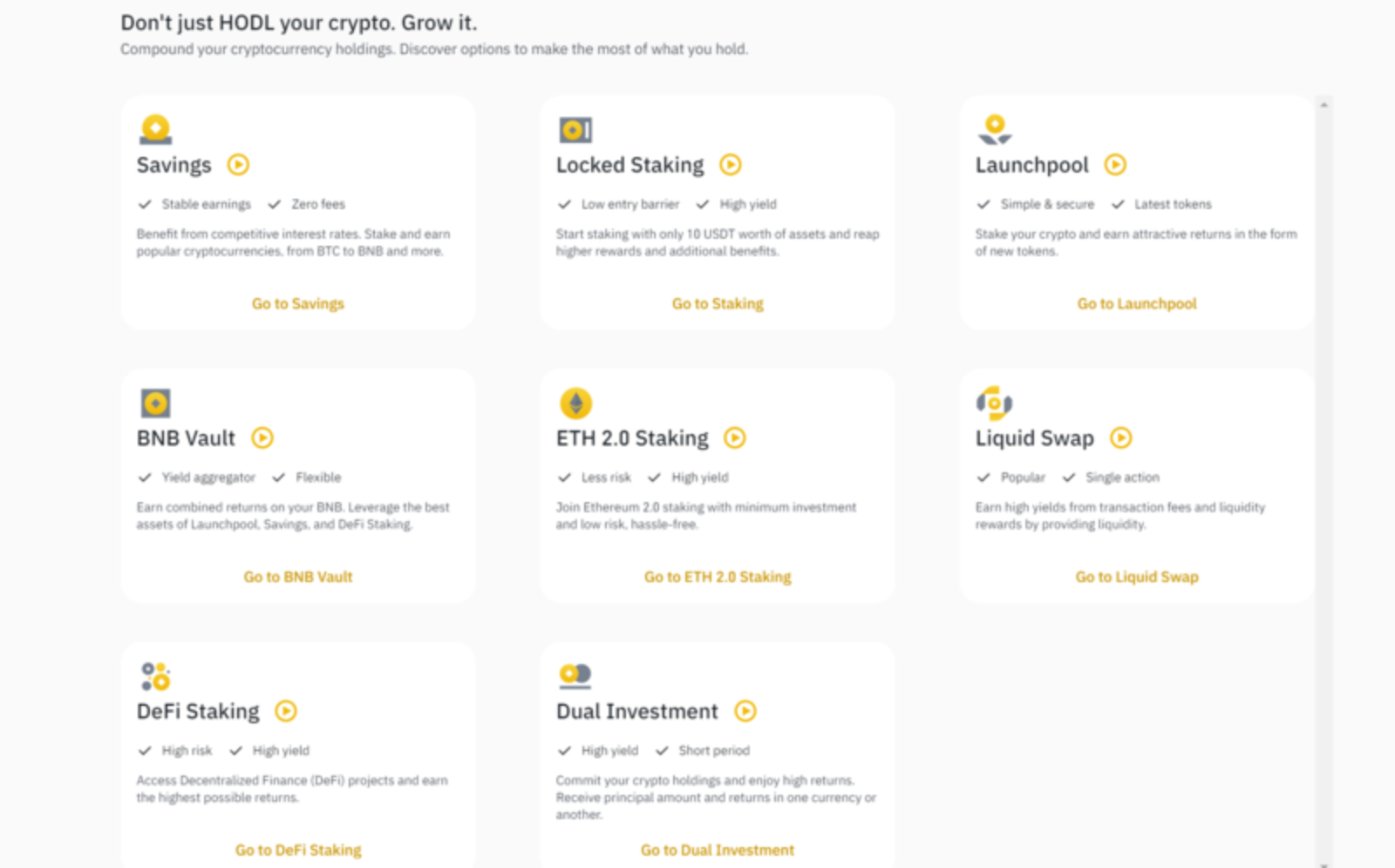
On the liquid staking side, you will often receive a Liquid Staking Token representing staked BNB exposure. Examples explicitly include slisBNB and clisBNB. These instruments add smart contract risk and peg/liquidity risk on top of validator performance risk. Read more about these protocols in our guide to how liquid staking works.
On Binance, staking-style allocation can also appear as structured programs such as Trust Wallet Launchpool, which sits closer to “platform incentive distribution” than base-layer consensus participation.
BNB Chain vs Ethereum
| Criterion | BNB Chain | Ethereum |
|---|---|---|
| Consensus model | Proof of Staking Authority (PoSA) — delegated Proof-of-Stake combined with Proof-of-Authority | Proof of Stake (PoS) with distributed validator participation |
| Validator set | 45 active validators secure BNB Smart Chain; candidacy requires staking threshold, limiting participation | Thousands of independent validators globally; permissionless entry with 32 ETH stake |
| Confirmation experience | 3-second block time; near-instant finality for most user-facing applications | 12-second block time; probabilistic finality until epochs complete |
| Transaction fee predictability | Consistently low base fees; minimal variance under normal network load | EIP-1559 base fee model introduces predictable burn but fees spike during congestion |
| EVM compatibility | Full EVM bytecode compatibility; Solidity contracts deploy without modification | Native EVM; all Ethereum tooling (Hardhat, Foundry, Remix) originates here |
| Ecosystem depth | Growing DeFi TVL and NFT activity; fewer established protocols than Ethereum | Deepest liquidity pools, most battle-tested protocols, largest NFT marketplaces |
| Governance & upgrade coordination | Centralized decision-making through BNB Chain core team and validator set | Ethereum Improvement Proposal (EIP) process; decentralized social consensus among node operators |
| Censorship-resistance assumptions | 21-validator model concentrates control; susceptible to coordinated censorship by operator majority | Large, geographically distributed validator set raises censorship cost significantly |
| Risk surface | Smart contract risk inherited from EVM; chain-level risk elevated by smaller validator cohort | Smart contract risk mitigated by extensive auditing culture; chain-level risk lower due to decentralization |
| Best-fit user profiles | High-frequency traders prioritizing speed and low cost; consumer dApps with microtransaction models; projects requiring predictable economics | DeFi protocols valuing composability and liquidity depth; security-sensitive applications; builders prioritizing censorship resistance and decentralization guarantees |
When BNB Chain is the better fit
- BNB Chain delivers 3-second block confirmations, which allows the network to finalize transactions nearly instantly. A use case example when this can be relevant is a high-frequency trading bot that needs to arbitrage price differences across decentralized exchanges within a single block window.
- Transaction fee predictability on BNB Chain remains tight under normal network conditions because the lower transaction volume relative to Ethereum reduces competition for block space, which translates to consistently low gas prices for developers modeling application economics. A microtransaction-heavy social dApp distributing daily rewards to 100,000 active users would not be able to afford Ethereum’s variable fee structure but can budget confidently on BNB Chain, where gas costs remain stable enough to automate batch payouts without economic risk.
- BNB Chain offers full EVM compatibility and Solidity portability, meaning any smart contract written for Ethereum compiles and deploys on BNB Smart Chain without modification, preserving existing codebase, audits, and developer expertise. A project that passed three audits on Ethereum can redeploy those exact audited contracts to BNB Chain and market the security pedigree without incurring new audit costs, accelerating time-to-market for multi-chain expansion.
- BNB Chain fits enterprises and projects that require predictable governance timelines because the centralized decision-making structure coordinated by the BNB Chain core team and 21-validator cohort allows for faster consensus on upgrades, bug fixes, and protocol changes compared to Ethereum’s decentralized EIP process.
When Ethereum is the better fit
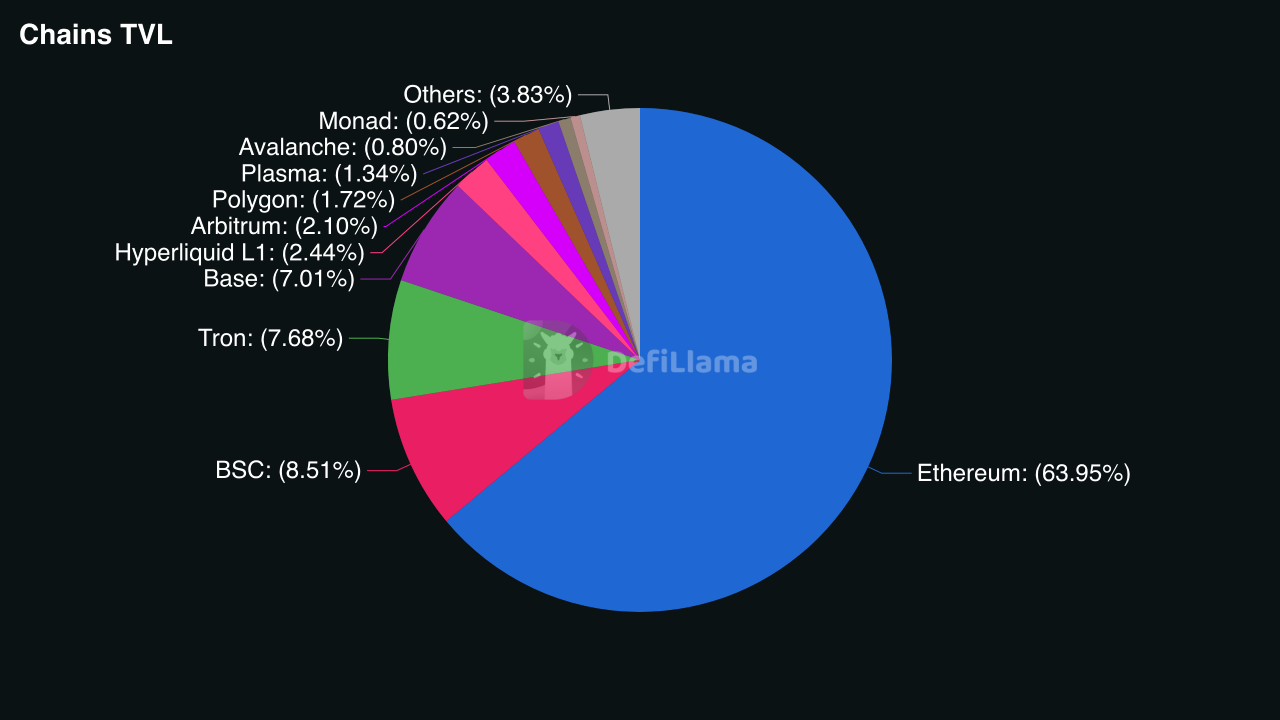
- Ethereum’s thousands of geographically distributed validators reduce censorship risk because no single jurisdiction or operator cohort controls enough stake to selectively exclude transactions.
- Ethereum’s ecosystem depth creates irreplaceable liquidity and composability advantages because the largest DeFi protocols, most liquid automated market makers, and deepest stablecoin reserves all originate and concentrate on Ethereum. If you are building a yield aggregator that routes capital across multiple lending protocols to maximize returns, the strategy only works when you can access Aave, Compound, MakerDAO, and Uniswap simultaneously — those protocols exist on BNB Chain as forks, but their liquidity is fractional, so your yield optimization algorithm produces inferior results.
- Ethereum’s Proof of Stake security model distributes chain-level risk across a larger validator set, meaning that compromising network integrity requires attacking thousands of independent nodes rather than convincing or coercing 45 known entities, which reduces the probability of catastrophic consensus failures.
How to Store BNB?
Before transferring BNB to any wallet, resolve two operational questions that determine whether funds arrive intact:
- Who controls the private keys? (custodial vs non-custodial)
- Which network is the address on? (BNB Smart Chain vs BNB Beacon Chain vs other routes)
As is the case with most cryptocurrencies, BNB transactions are irreversible. One mistake can lock your funds in a dead address forever.
Custodial Wallets
Custodial storage fits traders who want liquidity and speed on the same platform that does the key management. It fits long-term holders far less, because custody introduces platform risk: insolvency, freezes, withdrawals paused, account access disputes.
Before depositing to a custodial platform, verify:
- Network selection in the deposit interface
- Memo or tag field requirements
- Minimum deposit threshold
- Confirmation requirements
- Wrong-network recovery policy
- Withdrawal lockup periods
- Account verification status
Depositing BNB and other crypto assets to third-party custody means giving up private key custody, unilateral withdrawal authority, iIndependence from account-access systems. As far as the blockchain is concerned, whoever manages the complete key pair is the owner of assets at a given address, and if you authorize a transaction, the blockchain will confirm it as valid even if it was fraud in the real world.
Non-Custodial Wallets
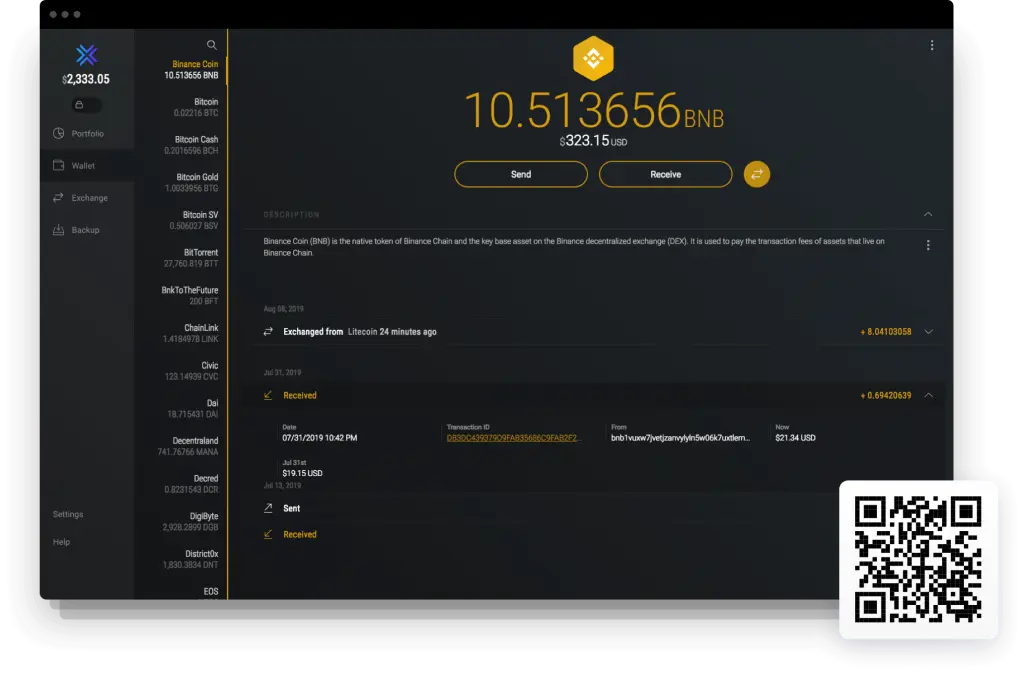
Non-custodial wallets, also known as self-custodial, give you control but also make you the security perimeter. The private key and wallet’s seed phrase is the ownership proof; lose it and the BNB is gone.
If you are setting up a blockchain wallet for the first time, take some time to read our guide. Short version: install all apps from official sources; upon first launch, generate a new seed phrase and write it down on paper—never store it digitally. When withdrawing to a self-custody address, verify the destination on device, perform smaller test transactions if possible.
It is a good idea to make strong backup copies for secure seed phrase storage but before you do, make sure you can restore the wallet from this seed phrase. Screenshots introduce cloud auto-upload and malware risk, clipboard and notes apps introduce exfiltration risk—treat the seed as offline-only.
Hardware Wallets
Hardware wallets reduce key-exfiltration risk by isolating private keys and forcing on-device transaction verification. It comes at the cost of friction: more steps per transaction, firmware maintenance, and device handling. Hardware crypto wallets also introduce a supply chain attack risk, so it is not the most beginner-friendly option and definitely not a secure one without you putting in the work to employ the security best practices for wallets.
No matter which device you choose from even the best hardware wallet options, a lost device is not as catastrophic as a lost seed phrase; at least, the former can be restored with the latter.
Address Formats
BNB Smart Chain uses EVM-style 0x... addresses. Beacon Chain uses bnb1... Bech32 addresses. The address string can look “valid” while still being on the wrong network, because identical 0x- addresses can exist on multiple chains as separate destinations.
Therefore, before you send BNB anywhere, double-check the network, address prefix and length, asset standard, and gas balance while you are at it. To verify a transfer went through as intended, cross-check with a blockchain explorer such as BscScan. If you are not familiar with how to use a block explorer, catch up with our guide.
How to Buy BNB?
You can buy BNB on centralized exchanges via fiat on-ramps and active trading interfaces. You can also use a crypto on-ramp to buy it directly to your self-custody wallet.
CEX selection starts with jurisdictional availability and customer identification constraints. After that, compare:
- Funding rails (card, ACH, SEPA, wire, crypto)
- Maker/taker fees vs instant buy spreads
- Withdrawal fees and supported withdrawal networks
- Proof-of-reserves and operational transparency
The highest-risk moment is the withdrawal screen. Match the network shown in the receiving wallet (“BNB Smart Chain”, “BEP-20”, “BSC”) to the network chosen on the exchange.
Fiat-to-crypto on-ramps outside of exchanges deliver to self-custody but impose their own friction: higher card fees, ID verification, and settlement delays for bank transfers. The operational checklist is the same: ensure the wallet is set to BNB Smart Chain, confirm address format, confirm backups, and keep a gas buffer available.
Trading via order books becomes preferable when you care about spread, slippage, and execution control. Market orders guarantee execution but can slip; limit orders control price but may not fill. After execution, confirm the ticker is BNB (not a wrapped substitute unless intentional), then decide on custody.
Conclusion
The days of Binance Coin are long gone but the name sticks with BNB regardless. It has evolved past its utility as the exchange token: BNB is the native cryptocurrency of the BNB Chain ecosystem, functioning as both a tradable asset and the fuel for decentralized applications across three protocol layers—BNB Smart Chain for EVM-compatible smart contracts, opBNB for Layer 2 scaling, and BNB Greenfield for decentralized storage.
Let us know if you find the article useful! You can do it on our Twitter, Telegram or Facebook. To not miss out on more guides, news and articles, subscribe to ChangeHero blog. Take care!
Frequently Asked Questions
Who Created BNB?
BNB was created and launched by Binance, the centralized cryptocurrency exchange founded in 2017. The token originated as part of Binance’s initial coin offering (ICO) and was deployed on the Ethereum network before migrating to Binance’s own BNB Chain infrastructure. While Changpeng Zhao (CZ) is frequently associated with Binance as its former CEO and public figure, BNB itself is a Binance-launched asset, not the creation of a single individual developer.
What Does BNB Stand For in Crypto?
BNB originally stood for “Binance Coin” when the token launched in 2017, but the project now uses “BNB” as a standalone brand name, apparently standing for “Build N’ Build”. The shift reflects BNB’s evolution from a single-exchange utility token to the native coin of the broader BNB Chain ecosystem, which includes BNB Smart Chain, opBNB, and BNB Greenfield. The historical “Binance Coin” label still appears in older documentation and some exchanges, but current branding treats BNB as the primary identifier.
What Consensus Mechanism Does BNB Use?
BNB Chain operates using Proof of Staking Authority (PoSA), a hybrid consensus model that combines delegated Proof of Stake (DPoS) with Proof of Authority (PoA) elements. Under this mechanism, 21 validators are elected through a staking process where BNB holders delegate their tokens to validator candidates, and these validators take turns producing blocks in a round-robin fashion. The design prioritizes transaction speed and finality, with BNB Smart Chain confirming transactions in approximately three seconds.
Is BNB the Same as BNB Smart Chain?
No, BNB (the coin) and BNB Smart Chain (the execution layer) are distinct but interconnected components of the BNB Chain ecosystem. BNB is the native cryptocurrency that functions as the medium of exchange, gas fee payment method, and staking asset across the entire ecosystem. BNB Smart Chain is one of the blockchain networks within BNB Chain—specifically, the EVM-compatible execution layer where smart contracts run and decentralized applications operate. The umbrella term “BNB Chain” encompasses BNB Smart Chain alongside opBNB (a Layer 2 scaling solution) and BNB Greenfield (a decentralized storage network).
What Can You Use BNB For?
BNB functions as the multi-purpose utility token for the BNB Chain ecosystem, primarily serving four roles: gas fee payment for transactions on BNB Smart Chain and related networks, trading fee discounts on the Binance centralized exchange, governance voting for network proposals, and staking to earn rewards or participate in validator delegation. Each use case operates in a different environment—on-chain activity (gas, staking, governance) happens through self-custody wallets connected to BNB Chain, while exchange-based benefits (trading fee discounts) require holding BNB in your Binance account balance.
How Does the BNB Burn Mechanism Work?
BNB employs an Auto-Burn system that automatically reduces total token supply toward a target of 100,000,000 BNB, using a formula based on the token’s price and the number of blocks produced on BNB Smart Chain during each quarter. Unlike manual burns that rely on community contributions or one-off events, Auto-Burn executes programmatically every quarter without requiring governance approval or team intervention. The mechanism calculates the burn amount using the formula: N = (P × B) ÷ 10,000, where N is the number of BNB burned, P is the average BNB price in USD during the quarter, and B is the number of blocks produced on BNB Smart Chain in that period.
How Many Transactions Per Second Can BNB Chain Process?
BNB Chain’s transaction throughput is variable and depends on network conditions, validator performance, and block gas limits, rather than a single fixed TPS figure. Reported TPS estimates for BNB Smart Chain range from approximately 160 to over 2,000 transactions per second in various sources, but these numbers reflect theoretical capacity under optimal conditions rather than sustained real-world averages.
Is BNB a Good Investment?
Whether BNB is a suitable investment depends on individual risk tolerance, time horizon, and evaluation of four key factors: utility demand within the BNB Chain ecosystem, ecosystem growth and developer activity, tokenomics including the Auto-Burn mechanism’s impact on supply, and regulatory/centralization risk tied to Binance’s legal status. This is not financial advice, and no cryptocurrency investment is guaranteed to produce positive returns. BNB’s value proposition rests on its dual role as both an exchange-native token for Binance users and the gas/staking asset for BNB Chain’s expanding DeFi, NFT, and Layer 2 infrastructure.
To track the current BNB price and review scenario-based analysis such as a BNB price prediction, use live market data and clearly separate short-term volatility from long-term utility factors.