
What is Gas Fee and How Does It Work? Beginner’s Guide

Key Takeaways
- ⛽️ Gas fee = the execution cost to run a transaction on a smart-contract blockchain (send ETH, swap tokens, mint NFTs), and it fluctuates minute-by-minute with congestion and computation demand.
- ⛽️ Gas fee ≠ the amount you’re transferring. The transfer value and the validator payment are separate lines—confusing them is how people misread wallet prompts.
- ⛽️ The core math is multiplicative: Total fee = Gas used × Gas price (priced in gwei, paid in ETH). Your gas limit is a ceiling but you only pay what’s actually used.
- ⛽️ Paying more usually buys speed, not guarantees. A higher fee improves inclusion priority, but it doesn’t prevent a revert if the contract logic fails.
- ⛽️ Failed transactions can still cost gas. If execution reverts or runs out of gas, validators still did work—so you can pay fees even when the transaction doesn’t do what you wanted.
- ⛽️ “Gas” is Ethereum-style; Bitcoin is different. Bitcoin fees are sat/vB based on transaction size, not execution metering; “Bitcoin gas fee” is a misnomer.
Most crypto users are very familiar with the idea of gas fees, and anyone considering picking up crypto has to be aware of it too. It is the cost you have to pay to execute a transaction on a blockchain network—sending ETH from one wallet to another, swapping tokens on a decentralized exchange, or minting an NFT all trigger a charge determined by network congestion and the computational complexity of your request. Unlike a fixed service fee, gas fees fluctuate minute-by-minute as demand for block space rises and falls, and the same operation can cost pennies during a quiet afternoon or several dollars during a network spike. Why is that and how do you control transaction costs and avoid overpaying?
This article focuses on blockchain transaction execution fees, particularly the Ethereum-style gas model, and separates Ethereum's mechanics from Bitcoin's fee structure, which does not really use the term "gas" at all. Heads up: don’t expect this guide to tell you a way of getting around gas fees because there is no legitimate one. By the end of this guide, you will be able to estimate gas fees before you submit a transaction, choose appropriate fee settings to balance transaction speed and cost, recognize when a transaction is likely to fail or stall, and reduce your total spending by timing operations carefully, leveraging Layer 2 networks, and using the right monitoring tools.
Definitions and Key Terms
“Gas fee”, “network fee” and “transaction fee” warrant an explanation because in practice these terms overlap and are too often used interchangeably.
This article will apply strict boundaries: "gas fee" will refer specifically to Ethereum-style execution costs, "network fee" will serve as the umbrella term for inclusion and processing costs across chain types, and "transaction fee" will describe the user-facing cost label that may encompass both. Where sources or wallets blur these lines, we will clarify the actual component being measured.
Gas Fee
A gas fee is the cost paid by a transaction sender to compensate validators (or miners) for the computational work and storage required to execute operations on a smart-contract blockchain. The more complex an operation is, the more resources are required and the higher the fee. Sending ETH from one wallet to another consumes far less gas than deploying a multi-contract decentralized exchange, because the latter requires more computation, more storage writes, and more verification steps.
Gas on Ethereum is denominated in gwei—one billionth of an ETH (1 gwei = 0.000000001 ETH), which is in turn derived from the smallest unit of ETH, wei. Because 1 wei is 0.000000000000000001 or 10^-18 ETH, a gigawei, shortened as gwei or Gwei, is 10^9 wei, which is in turn, 10^-9 ETH.
Expressing fees in wei rightfully seems impractical but using whole ETH units likewise would require unwieldy decimal notations even for typical transactions; Gwei turned out to be quite a workable denomination.
Wallet interfaces label gas-related costs as "Gas," "Max fee," "Priority fee," or "Gas limit × Gas price"; block explorers display "Gas used" and "Gas price" fields for every Ethereum transaction; and DeFi interfaces often surface "Estimated gas" before you confirm a swap or stake.
Not the same as:
- Network fee — gas fee is a subset of network fee on Ethereum, but on non-smart-contract chains like Bitcoin, network fee exists without any gas concept
- Transaction fee — gas fee measures execution cost; transaction fee is the user-visible total that may include gas plus other components, depending on chain architecture
- Priority fee (tip) — the priority fee is the portion of gas cost that incentivizes faster inclusion, not the entire gas fee itself
Network Fee
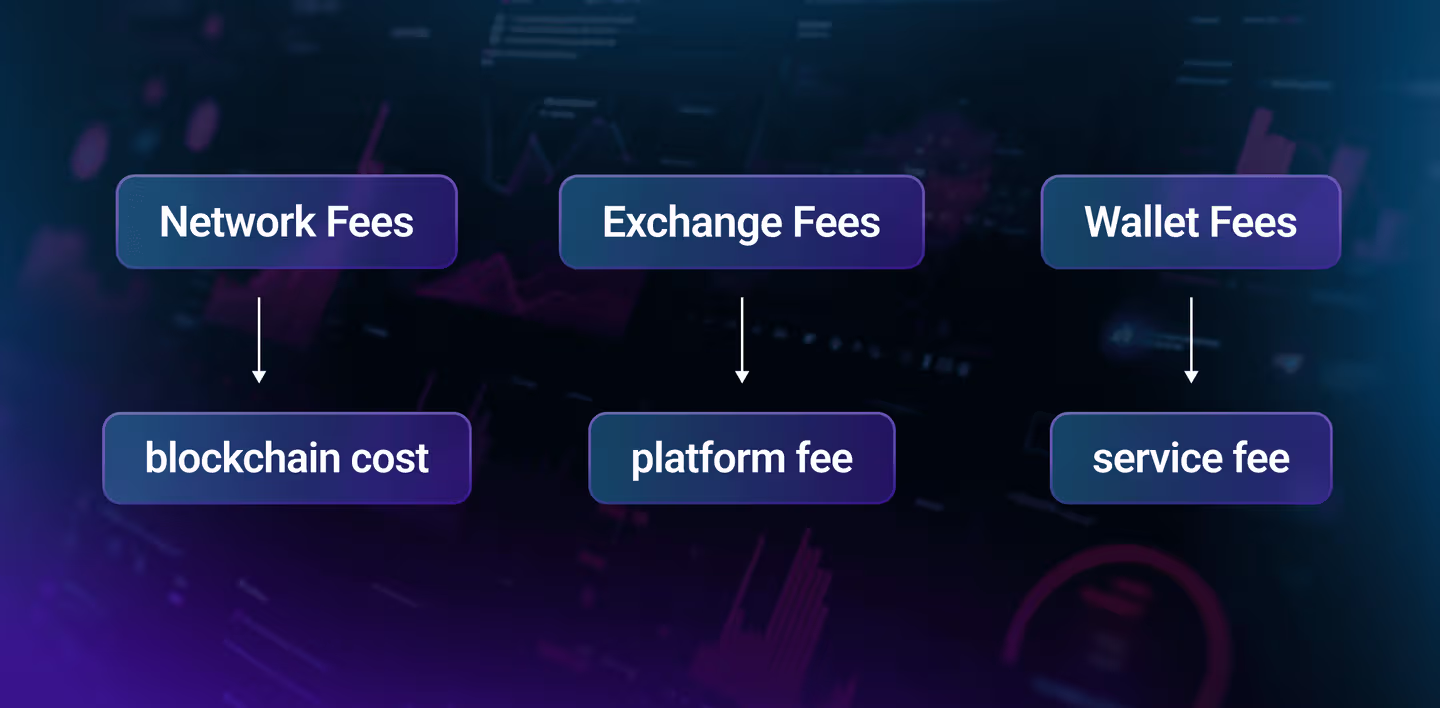
The more common term “network fee” is an umbrella term for the cost required to have a transaction included in a block and processed by the network's consensus mechanism. What this fee actually covers depends on the blockchain's design: execution costs such as gas, inclusion incentives such as tips, data availability charges, or relay fees can all fall under "network fee" depending on context.
The label "network fee" surfaces in wallet UIs, exchange withdrawal forms, and block explorers, but the actual fee structure it describes requires checking the chain's architecture. When verifying a reported network fee, identify which chain you are examining and which fee components that chain's consensus model requires.
Transaction Fee
Transaction fee is the fee attached to a transaction when a user submits it for inclusion and processing. On UTXO-based chains like Bitcoin, "transaction fee" and "network fee" are effectively synonymous: both refer to the miner fee paid for inclusion. On account-based smart-contract chains like Ethereum, "transaction fee" serves as a broader label that may include gas costs, priority tips, and in some architectures, additional data availability or relay charges.
In this article, we will use "transaction fee" as the user-facing label for the total cost shown in a wallet or block explorer, and we will specify which components—gas, priority fee, L1 data cost—make up that total when the distinction matters. On Bitcoin, "transaction fee" and "network fee" are interchangeable. On Ethereum, "transaction fee" is the sum of base fee and priority fee, both of which are gas-related costs. On Layer 2s, "transaction fee" may describe a bundled cost that includes both L2 execution gas and L1 data posting fees.
Before we move further into definitions and calculations, let’s clear up four common misconceptions that cause beginners to misread wallet prompts and misinterpret on-chain behavior:
- Gas fee ≠ amount being transferred. The fee is a separate charge paid to validators; the token or ETH you are sending is an independent value.
- A higher fee usually affects inclusion speed, not "success" guarantees. Paying more moves your transaction higher in the priority queue but does not prevent a revert if the contract logic fails.
- Failed transactions can still cost gas. Even if your transaction runs out of gas mid-execution or encounters a contract error, validators still have consumed computational resources and you still pay for the work performed up to the failure point.
- Wallet "estimated fee" is an estimate that can change with congestion. The figure your wallet displays is a forecast based on recent block data; by the time your transaction reaches the mempool, network conditions may have shifted and the actual cost can differ.
For additional background on core cryptocurrency concepts and a deeper primer on what is Ethereum, review those guides before applying the fee-setting strategies in this article.
Why Gas Fees Exist

Gas fees in blockchain design are not a monetization mechanism—they exist as a necessary structural component to solve three interrelated problems that threaten any public, permissionless network: how to sustain the validation process, how to allocate finite computational resources fairly, and how to prevent malicious actors from overloading the system. Each of these problems connects to a core truth about how blockchain networks operate: computational capacity is not free, block space is scarce, and open access creates vulnerability to abuse.
Network Security
Gas fees are a direct economic compensation validators receive for processing and including transactions in blocks; due to these fees, it becomes economically rational to process legitimate activity and economically painful to attack. On Ethereum, for example, validators earn a base fee and a priority fee. Without gas fees, validators would have no economic reason to prioritize one transaction over another during periods of congestion, and in proof-of-stake systems, fee revenue supplements staking rewards to maintain validator participation. Gas fees augment consensus mechanisms like proof-of-work or proof-of-stake by ensuring that validators remain motivated to sustain network liveness and correctly order transactions even when base protocol rewards are low or diluted by a large validator set.
When a user broadcasts a transaction and includes a fee, validators compete to include high-fee transactions in the next block to maximize their returns. The validator who produces the block receives the fees, so ongoing profitability depends on continued inclusion activity.
Validators are rewarded because they maintain the blockchain's history, prevent double-spends, and enforce execution rules. The question "who pays for computation and storage" becomes operationally urgent when fees are absent: if users don't pay, the network either slows to accommodate free demand or collapses under spam.
Resource Allocation
Put simply, every blockchain has finite block space and finite execution capacity within each block, and gas fees price access to these scarce resources. On Ethereum, block space is constrained by the block gas limit—currently around 30 million gas per block—and blocks are produced approximately every 13 seconds, meaning the network has periodic, time-bounded opportunities to process transactions.
On a more technical level, gas serves as the proxy unit for several additional types of resource consumption: CPU cycles required to execute EVM bytecode (each opcode has a gas cost), persistent storage writes to the blockchain state (SSTORE operations are expensive), and calldata bytes (data included in the transaction payload).
A simple ETH transfer consumes 21,000 gas because it involves minimal computation and no state changes beyond balance updates. A smart contract interaction, by contrast, can consume hundreds of thousands of gas because it triggers execution logic, reads and writes storage slots, emits events, and potentially calls other contracts.
Resource scarcity is supposed to create competition. When demand for block space exceeds supply, for example, when more transactions want inclusion than a single block can accommodate, users who attach higher fees signal their willingness to pay for priority, and validators preferentially include those transactions to maximize their revenue. Smart contract execution competes more heavily for constrained resources than simple transfers because each additional step in contract logic consumes incremental gas, and the cumulative cost determines how much block space that transaction occupies. A computationally intensive contract call can crowd out dozens of simple transfers if they all compete for the same block. Gas fees, therefore, function as a market-clearing price: they allocate finite execution capacity to the users who value inclusion most, measured by their willingness to pay.
Spam Prevention

Last but not least, gas fees make large-scale abuse expensive by forcing attackers to pay per attempted transaction and per unit of computation, which limits two primary attack vectors: transaction flooding and state bloat. If submitting a transaction was free, a malicious actor could flood the mempool with millions of low-value or meaningless transactions, overwhelming validators and crowding out legitimate users.
An attacker could broadcast thousands of transactions with slightly higher fees than the prevailing rate, forcing legitimate transactions to wait or pay even more. However, the per-transaction cost and the per-compute cost make this economically unattractive unless the attacker has an external incentive to disrupt the network. Similarly, repeated failed contract calls—where the transaction consumes gas but reverts without achieving its intended state change—still cost the sender gas, discouraging trial-and-error attacks or attempts to probe contract vulnerabilities at scale. The cost component that makes spam unattractive is not just the per-transaction base cost but also the incremental cost of execution: the more computational steps an attack transaction requires, the higher its gas consumption, and therefore the higher its total cost.
How Gas Fees Are Calculated
Gas fees are calculated by multiplying the amount of computational work required (gas used) by the price per unit of that work (gas price), with the total expressed in Ethereum (ETH). What trips up most users is the difference between "gas used" — the actual computation your transaction consumed — and "gas limit," which is simply the maximum you authorized the network to charge. If your transaction uses less gas than your limit, you pay only for what was used; if it runs out before completing, the transaction fails, and you still pay for the work attempted up to that point.
Gas Units
Unless a crypto project specifies otherwise, gas is an abstract unit of computational work, not a currency. It measures the complexity of the operation your transaction asks the network such as Ethereum to perform, independent of what you pay for that work.
A simple ETH transfer from one wallet to another typically consumes 21,000 gas units because it involves minimal computation: updating two account balances in the network's state database. A token swap through a decentralized exchange smart contract, by contrast, may consume 150,000 gas or more. Why? The swap requires the contract to check allowances, calculate exchange rates, update multiple token balances, emit event logs, and potentially interact with liquidity pool contracts. The same transaction type will always consume roughly the same gas, but different transaction types impose vastly different computational burdens.
Gas Limit
Gas limit is the maximum number of gas units you authorize a transaction to consume. You set the limit, and the network charges only for the gas actually used. If you set a limit of 50,000 gas but your transaction uses 21,000, you pay for 21,000 — the unused 29,000 is never deducted from your wallet.
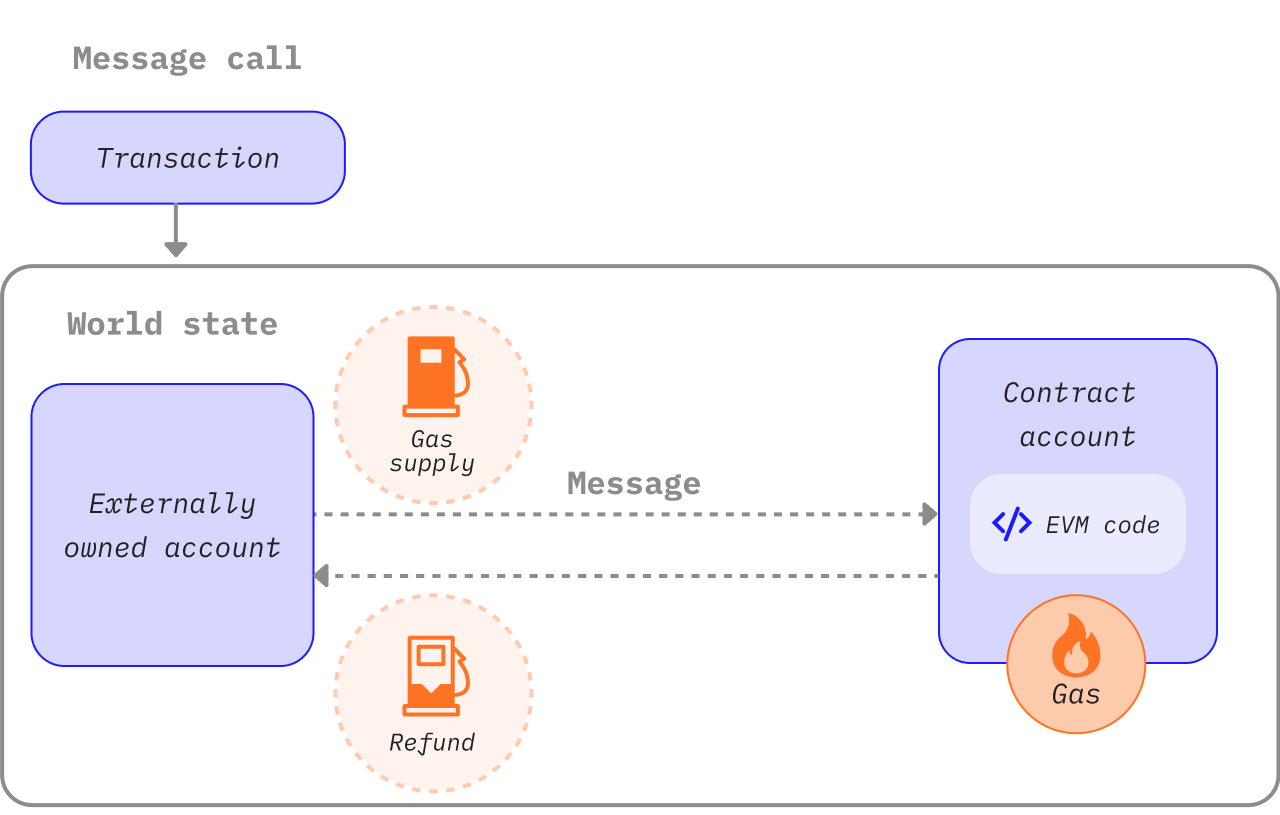
The limit exists as a safety mechanism, not a pricing lever. Set it too low and your transaction runs out of gas mid-execution. When that happens, the transaction fails, but you still pay for the computation performed before it stopped.
Set the limit higher than necessary and nothing bad happens — the cap simply sits there unused, though some wallet interfaces may warn you about unnecessarily high limits as a sanity check.
Gas Price
Gas price is the amount you pay per unit of gas, denominated in gwei on Ethereum: for example, a gas price of 30 gwei means you're paying 0.000000030 ETH per gas unit.
Gas prices fluctuate based on network demand. When many users compete for block space, prices rise; during quiet periods, they drop. Your wallet or interface would typically suggest a gas price based on recent network activity, but you can adjust it manually wherever possible. Pay more and validators prioritize your transaction; pay less and it waits longer or may not get included at all if demand spikes.
The final fee you pay is always calculated in ETH, but the intermediate step — the per-unit price — is quoted in gwei purely for readability.
Total Fee
As a result, calculating the total fee requires three inputs: gas used, gas price, and the conversion factor from gwei to ETH. Start with the gas your transaction consumed — for this example, assume a standard ETH transfer that used 21,000 gas units. Next, take the gas price at the time of execution — say, 30 gwei per unit. Multiply those two figures: 21,000 gas × 30 gwei = 630,000 gwei. That's your fee.
To convert to ETH, multiply by 10⁻⁹: 630,000 gwei × 0.000000001 = 0.00063 ETH. That 0.00063 ETH is what leaves your wallet to pay validators for including and executing your transaction.
This is the on-chain transaction fee, and it's entirely separate from any additional service fees a wallet provider or centralized exchange may layer on top. If your exchange charges a "network fee" that seems higher, check whether they're bundling their own markup; the blockchain itself only took 0.00063 ETH in this example.
Ethereum Gas Fees Post-EIP-1559
Ethereum's EIP-1559 mechanism divides each transaction fee into a base fee (burned from supply) and a priority fee (paid to validators), while the max fee parameter caps the user's per-gas payment ceiling. This structure replaced the previous gas price auction model in August 2021, introducing more predictable fee calculation and deflationary tokenomics to the Ethereum blockchain.
Ethereum Virtual Machine (EVM)
The EVM serves as the runtime environment for executing smart contracts and processing transactions, where every computational step—reading storage, performing arithmetic, or writing data—consumes a measured amount of gas.
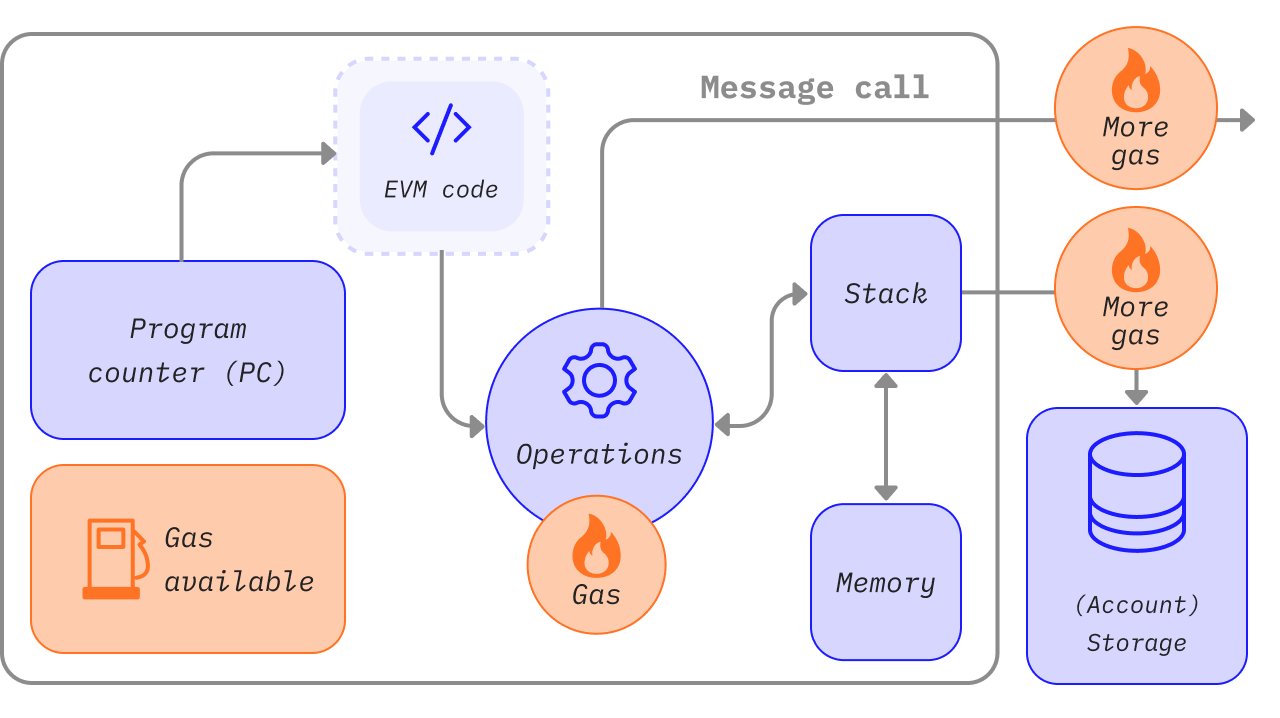
Gas serves as a mechanism governing the distribution of finite network resources for the EVM: validators must store state changes, propagate blocks, and prevent infinite loops or denial-of-service attacks through code that never terminates. The "gas used" figure represents actual computation performed during execution, while the "gas limit" acts as a safety cap set by the transaction sender to prevent runaway execution from draining their account unexpectedly.
When a transaction runs out of gas mid-execution, the EVM halts all state changes from that transaction and reverts to the pre-execution state, but the gas consumed up to that point is still paid to the validator.
Base Fee
The base fee is set per block by the Ethereum protocol itself, not by users or validators, and it adjusts automatically based on how full the previous block was relative to the target gas limit.
Ethereum targets 15 million gas per block; when a block exceeds that target, the base fee for the next block increases by a maximum of 12.5%, and when usage falls below target, the base fee decreases by up to 12.5%. This per-block adjustment cap means the base fee cannot spike or crash arbitrarily fast; even during extreme congestion events, it takes several consecutive full blocks to double the fee, providing a degree of predictability that the pre-EIP-1559 auction model lacked.
"Base fee per gas" is not the same as "total base fee paid": the base fee per gas is a rate, measured in gwei, that applies uniformly to every gas unit consumed in a block. If the current base fee is 30 gwei and your transaction uses 50,000 gas, your total base fee paid equals 30 gwei × 50,000 = 1,500,000 gwei, or 0.0015 ETH.
Priority Fee
The priority fee, often called the "tip", is the per-gas amount you voluntarily pay to validators as an incentive to prioritize your transaction within the block they're assembling. Like the base fee, it's denominated per gas unit, so the absolute tip paid scales linearly with gas used: if you set a 2 gwei priority fee and your transaction consumes 30,000 gas, you'll pay 60,000 gwei (0.00006 ETH) in tips.
When does a higher tip meaningfully improve your inclusion probability? During periods of sustained network congestion, when pending transactions exceed available block space and validators must choose which subset to include, a competitive priority fee can speed up inclusion by moving your transaction from the mempool into the next block instead of making it wait for several blocks.
If the mempool shows fewer than 50,000 pending transactions and the base fee is stable or declining, a minimal priority fee suffices.
Max Fee

Finally, the max fee parameter defines your per-gas willingness to pay, functioning as an upper bound that caps total transaction cost regardless of how the base fee and priority fee interact. For your transaction to be eligible for inclusion in a given block, your max fee must satisfy this condition: max fee ≥ (base fee + priority fee). Setting a max fee below this sum results in immediate rejection.
What actually gets charged when your max fee exceeds the necessary sum? You pay exactly (base fee + priority fee) per gas, not the max fee. This refund mechanism prevents overpayment during fee volatility: you can set a conservatively high max fee to guarantee inclusion even if the base fee spikes unexpectedly.
Gas Fees Across Blockchains
| Network | What the fee is called | Fee unit users see | What asset pays the fee | Settlement mechanism | Primary fee driver | Common user pitfall |
|---|---|---|---|---|---|---|
| Ethereum | Gas fee | gwei | ETH | Layer 1 (validators process and finalize blocks) | Block space demand and computational complexity | Assuming token transfers cost the same as ETH transfers |
Arbitrum/ Optimism/ Base | L2 gas fee | gwei | ETH | Layer 2 (execution on L2, data posting to Ethereum) | Execution cost on L2 plus Ethereum data availability cost | Comparing fees solely by the displayed gas price without accounting for L1 data cost |
| Bitcoin | Transaction fee (not "gas") | sat/vB (satoshis per virtual byte) | BTC | Layer 1 (miners include transactions in blocks) | Transaction size in bytes and mempool congestion | Ignoring that UTXO consolidation increases transaction byte size and therefore cost |
| ERC-20 Tokens | Gas fee (on underlying EVM chain) | gwei | ETH (or native token of the EVM chain) | Depends on the EVM chain hosting the token contract | Block space demand plus contract execution/storage overhead | Not realizing that token transfers require more gas than simple ETH sends due to contract calls |
Layer-2 Scaling Solutions: Arbitrum, Optimism, Base
Fee payer asset: ETH
Metering unit: gwei
What changes the fee most: Execution cost on the L2 network plus the cost of posting transaction data to Ethereum for settlement
What users get wrong: Judging total cost by the displayed gas price alone without accounting for the separate L1 data fee component
Arbitrum and Optimism are Ethereum Layer 2 optimistic rollup networks that execute transactions off-chain and periodically post compressed transaction data to Ethereum for security and finality. The wallet interface displays gas prices in gwei—the same unit Ethereum uses—but the total fee a user pays consists of two distinct charges: the L2 execution fee (the computational cost of running your transaction inside the L2 sequencer) and the L1 data fee (the cost of writing a batch of transactions to Ethereum's mainnet for dispute resolution and data availability). Even when the displayed gas price appears far lower than Ethereum's, the L1 data component can represent a significant fraction of the total cost, especially for smaller transactions.
The wallet UX abstracts these two components into a single estimated fee, which can make L2s and L1 feel identical from a user perspective—same MetaMask interface, same gwei units—but the economic reality diverges. Users migrating from Ethereum to Arbitrum sometimes expect fees to drop by 95% across all transaction types, but complex DeFi interactions with large calldata payloads (such as multi-hop swaps) may see smaller savings because the L1 data cost scales with transaction complexity, not just with computational load.
Bitcoin

Fee payer asset: BTC
Metering unit: satoshis per virtual byte (sat/vB)
What changes the fee most: Transaction size in bytes (determined by the number of inputs and outputs) and real-time mempool congestion reflecting demand for inclusion in the next block
What users get wrong: Overlooking that consolidating many small unspent transaction outputs (UTXO) into fewer larger ones increases transaction byte size and therefore raises the absolute fee
As we mentioned, Bitcoin does not use the term "gas." Instead, transaction fees are expressed in satoshis per virtual byte (sat/vB), where one satoshi is the smallest unit of bitcoin (0.00000001 BTC) and virtual bytes account for the Segregated Witness (SegWit) discount applied to certain transaction data. A transaction's total fee equals its size in virtual bytes multiplied by the sat/vB rate the user selects.
Unlike Ethereum's gas model, which meters computational complexity, Bitcoin's fee model meters data size: the more inputs and outputs your transaction includes, the larger it becomes in bytes, and the more you pay.
The mempool—Bitcoin's queue of unconfirmed transactions—functions as an open auction for block space. Miners prioritize transactions offering higher sat/vB fees because their revenue per block is maximized by including the highest-paying transactions first. During periods of high demand (exchange deposit rushes, ordinal inscription waves, or generalized network congestion), sat/vB rates can climb from single digits to triple digits, turning a routine transaction into a costly operation.
The common pitfall involves users who accumulate many small UTXO fragments over time, for example, from frequent small deposits or mining payouts, and later discover that spending those fragments in a single transaction produces an unexpectedly high fee. UTXO management is a consideration not just on Bitcoin but for other networks that use the model: consolidating UTXOs during low-fee periods reduces future costs, but failing to do so can make even modest transfers prohibitively expensive during congestion spikes.
ERC-20 Tokens
Fee payer asset: ETH (or the native token of the underlying EVM chain hosting the token contract)
Metering unit: gwei
What changes the fee most: Block space demand on the underlying EVM chain plus the additional gas consumed by contract execution, storage updates, and event logs inherent to ERC-20 transfers
What users get wrong: Expecting token transfers to cost the same as or less than simple ETH sends, when in reality they require more gas due to smart contract interaction overhead
ERC-20 tokens by definition do not exist on their own blockchain. They are smart contracts deployed on Ethereum (or another EVM-compatible chain), and every token transfer is a function call to that contract's transfer or transferFrom method. Because these operations involve contract execution—reading the sender's balance, subtracting the transfer amount, reading the recipient's balance, adding the transfer amount, and emitting a Transfer event—the gas cost exceeds the baseline required for a simple ETH send.
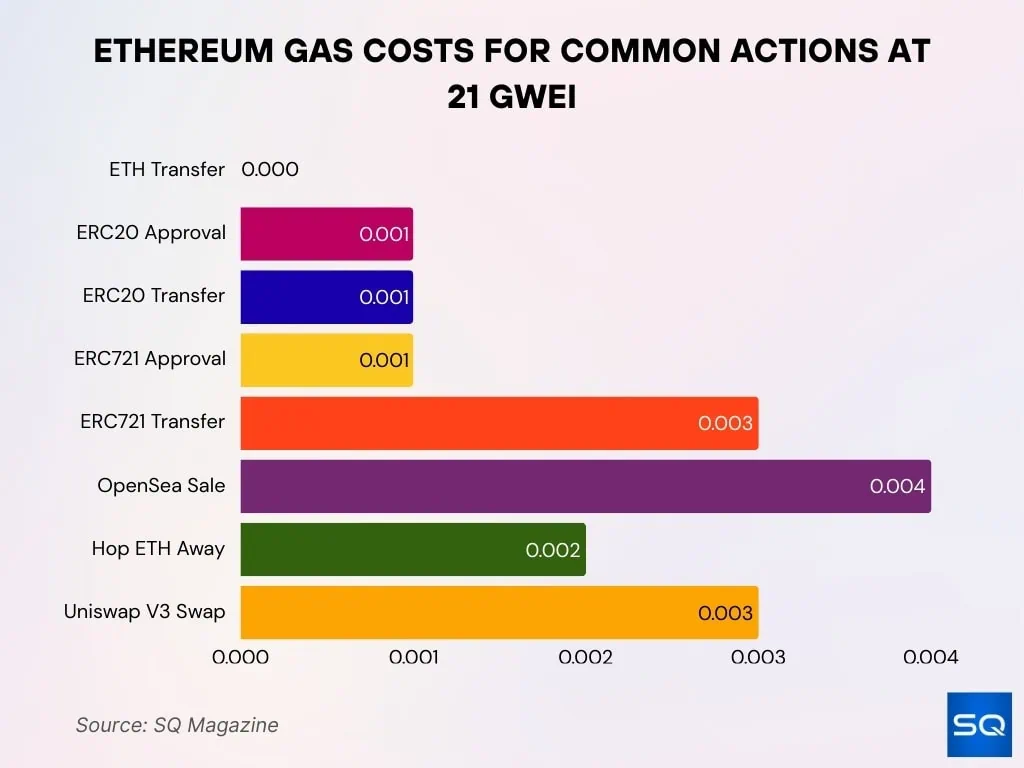
A typical ERC-20 transfer consumes approximately 65,000 gas units, roughly three times the cost of sending ETH directly. This difference stems entirely from the computational and storage overhead of interacting with the token contract, not from any inherent property of the token itself. The fee is paid in ETH (or the chain's native asset) regardless of which token is being transferred, just as on Ethereum mainnet.
When ERC-20 tokens are deployed on Layer 2 networks like Arbitrum or Optimism, the same logic applies: the token transfer is a contract call on the L2 EVM, and the fee is paid in that L2's native asset (ETH, in both cases). The gas unit consumption remains higher than a simple value transfer, and the total cost still includes both L2 execution and L1 data components. Users migrating from centralized exchanges to self-custody wallets often encounter this discrepancy for the first time when they attempt to move USDT or USDC and observe a fee multiple times higher than the wallet's estimate for an equivalent ETH send. The contract overhead is unavoidable: ERC-20 tokens trade convenience and interoperability for slightly higher per-transaction costs, and that tradeoff is baked into the token standard itself.
How to Reduce Gas Fees
Reducing gas fees means choosing which lever to pull: when you transact, how you price the transaction, where you execute it, and whether you bundle multiple operations. Each lever comes with a tradeoff—speed versus cost, certainty versus risk—and "cheapest" does not always mean fastest or most reliable. Setting fees too low can leave a transaction stuck in the mempool, while waiting for the perfect timing window can mean missing an opportunity entirely.
Timing
By now, network activity follows predictable rhythms, and three concrete signals can guide your timing decisions without requiring highly specialized tools.
First, when the mempool backlog shows a rising pending transaction count—visible on most block explorers as "transactions waiting"—it signals that demand is outpacing block capacity, which pushes fees higher.
Second, recent blocks running at full capacity (gas used approaching the gas limit) indicate sustained congestion, while blocks with unused gas space suggest room for cheaper transactions.
Third, predictable events like NFT mint windows, major token launches, or airdrop claims create temporary fee spikes as participants rush to claim limited allocations; recognizing these patterns lets you avoid the surge or plan around it.
If fees spike after you've already initiated a transaction, you face three options: wait for congestion to ease and hope your transaction eventually confirms, replace the transaction with a higher-fee version using the same nonce, or cancel it outright by sending a zero-value transaction to yourself with the same nonce and a higher fee. The choice depends on urgency and whether the original fee is competitive enough to clear within your acceptable timeframe.
Fee Settings
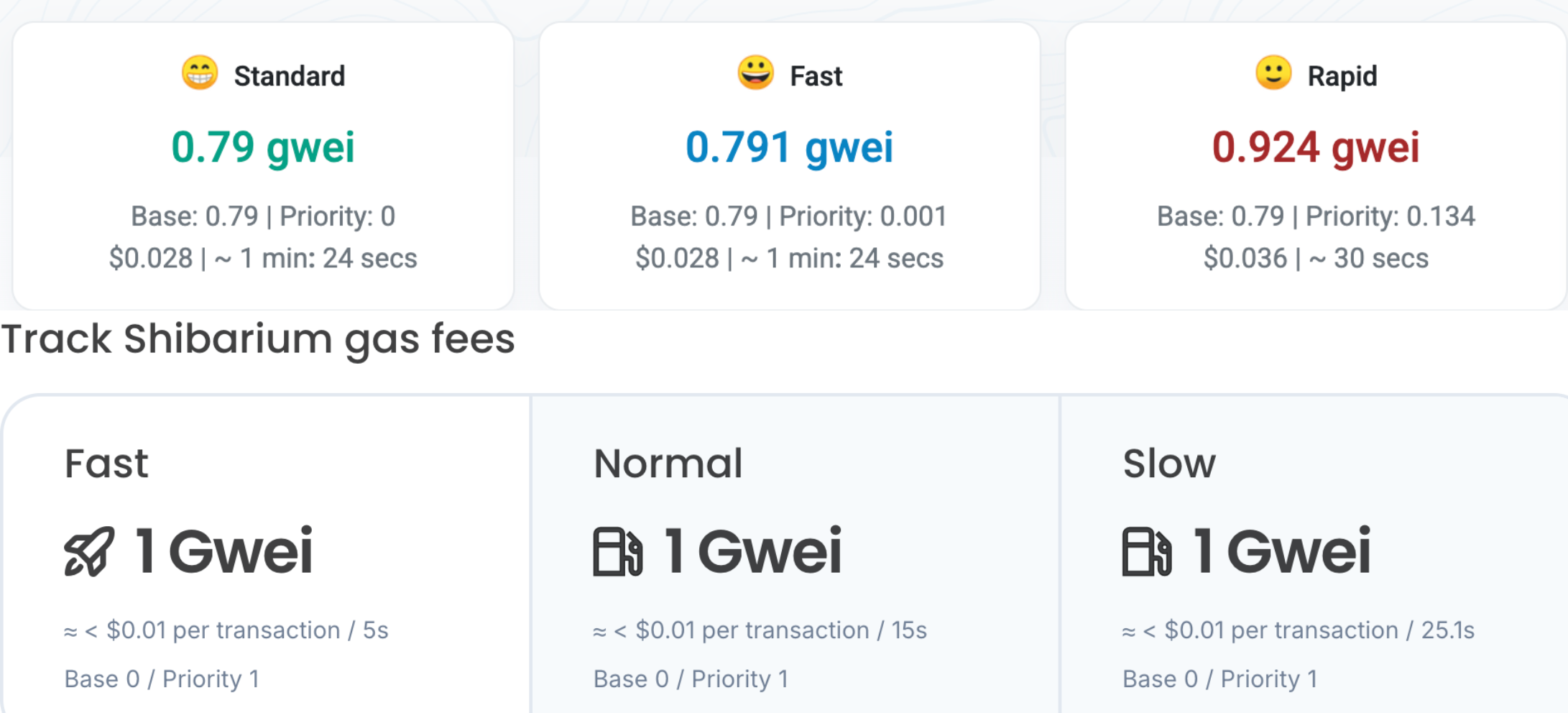
Wallet-level controls do not influence gas costs on the protocol level but let you adjust gas parameters before signing a transaction. Look for these generic toggles across wallet interfaces: gas preset modes labeled as "slow," "market," or "fast," which auto-populate fee fields based on recent network activity; custom fee entry, which lets you override presets with your own; and advanced fields that expose granular controls like gas limit adjustments for contract interactions.
EIP-1559 wallets require two inputs: a max fee and a priority fee. Setting a high max fee with a minimal priority fee works for non-urgent transfers, because the transaction will wait until the base fee drops below your max ceiling. Time-sensitive operations—swap or bridge transactions, or competitive mints—demand a higher priority fee to ensure validators include your transaction quickly, even when the mempool is crowded.
Legacy gas price wallets use a single gas price figure that combines both the base cost and the incentive, so you're bidding a flat rate per gas unit without the flexibility to separate urgency from cost tolerance.
Underpricing in either model can strand your transaction: it sits unconfirmed, consuming no gas but blocking subsequent transactions with the same nonce until it clears or gets replaced.
Fortunately, public and free fee estimation tools like Etherscan's Gas Tracker show real-time base fee trends and suggest competitive priority fees based on current network conditions.
Every now and then someone posts a transaction with an outrageously high fee, and almost always purely by mistake. To avoid this, first, confirm the unit displayed: some wallets show fees in gwei, others in ETH directly—confusing the two can result in severe overpayment. Second, verify the fiat equivalent displayed at confirmation: most wallets convert the total fee into USD or your local fiat currency, and a quick sanity check catches unit errors or inflated presets. These checks take seconds but prevent irreversible mistakes.
Transaction Batching
Batching consolidates multiple operations into a single on-chain transaction, reducing the total gas spent compared to executing each action separately. User-side batching means combining related actions within one session—for example, approving multiple ERC-20 token contracts and executing a multi-token swap in sequence, or sending payments to several recipients in one bundled operation instead of initiating individual transfers. Smart-contract batching uses multicall contracts or protocol-native batch functions to execute multiple contract interactions atomically; a common example is a DeFi aggregator that bundles token approvals, swaps across multiple pools, and staking deposits into a single transaction hash. Both approaches save gas by eliminating redundant transaction overhead and reducing repeated state changes.
The constraint here is if any step in a batched transaction reverts due to slippage, insufficient balance, or a failing contract call, the entire batch fails, and you still pay gas for the computation performed up to the revert point. Testing with small amounts before batching high-value operations reduces the risk of costly failures. Additionally, batching complex operations increases gas consumption per transaction, so the savings come from fewer transactions, not necessarily lower gas per action.
Layer-2 Networks
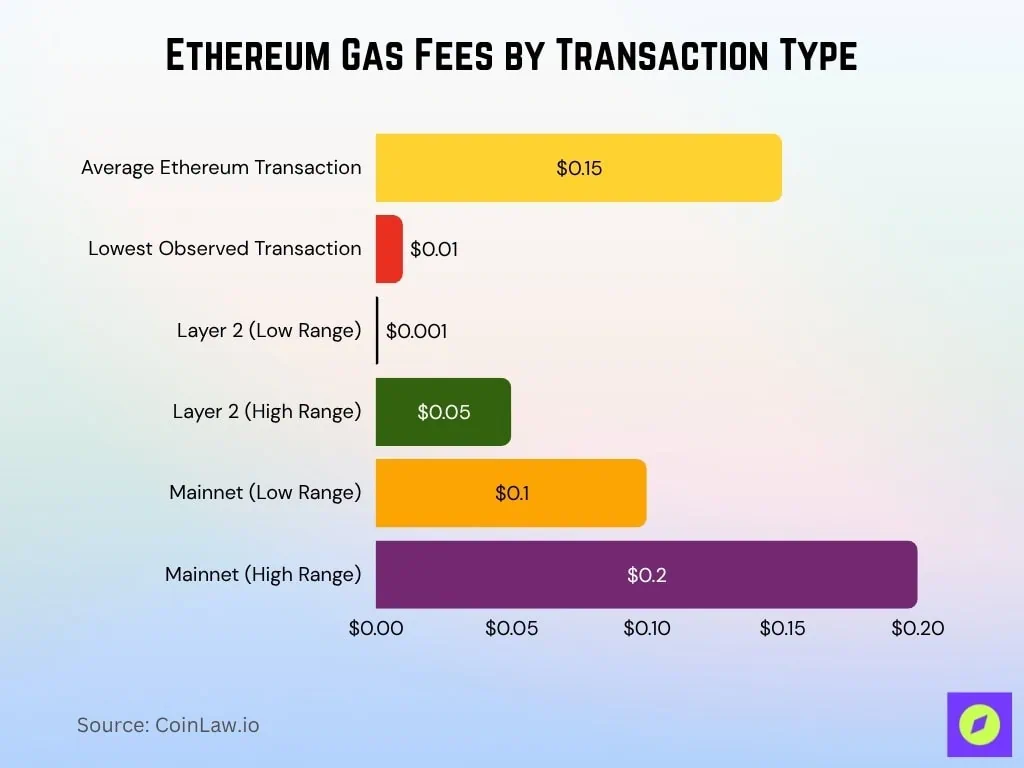
Layer-2 networks are often pitched as a cost-saving solution because they reduce gas requirements by processing transactions off Ethereum's main chain and periodically settling batches of activity back to Layer 1.
L2s won't help if the action must occur on Ethereum mainnet—certain NFT mints restricted to L1 contracts, governance votes tied to L1 token balances, or protocols with no L2 deployment. In those cases, fall back to timing strategies and fee-setting adjustments to minimize L1 costs.
Protocol Upgrades
Protocol-level upgrades reduce fees generally and indirectly by improving Ethereum's throughput, optimizing the fee market, or introducing efficiency gains that lower the computational cost of common operations. Users do not control when upgrades happen, but they can respond to the changed environment by keeping wallet software and client versions updated. Outdated wallets may not support newer fee mechanisms (such as EIP-1559) or may estimate fees poorly if they rely on pre-upgrade assumptions about base fee behavior.
Gas Monitoring Tools
Gas Trackers
Gas trackers, arguably, the most useful tools to handle those fees, serve a dual function: they display current fee rates and project near-term fee trends based on network congestion patterns. When interpreting tracker output, for one, confirm whether the displayed gwei value represents the base fee alone, the priority fee suggestion, or the total max fee you would set in your transaction.
The dedicated gas tracker most popular at its time, EthGasStation.info shut down in 2022, and the alternatives that have been most widely adopted since then are hosted by Ethereum block explorers: Etherscan’s Gas Tracker and beaconcha.in’s GasNow implementation.
The practical workflow for using a gas tracker correctly follows this sequence: first, check current network conditions to establish the baseline congestion level. Second, identify your target confirmation speed—whether you need the transaction included in the next block, within several minutes, or can tolerate a thirty-minute wait. Third, cross-check the recommended fee on a second independent tracker to eliminate single-source errors or temporary data outages. A discrepancy between two trackers often signals either a mempool indexing delay on one platform or differing methodologies for calculating the priority fee suggestion, and if speed matters, go for the higher estimate.
If a tracker shows a base fee of 25 gwei and suggests a 2 gwei priority tip, the calculation runs: (25 + 2) × 21,000 = 567,000 gwei, which converts to 0.000567 ETH. For a contract interaction—say, a token swap that uses 150,000 gas—the same 27 gwei total fee yields (27 × 150,000) = 4,050,000 gwei or 0.00405 ETH. Trackers display the rate; you supply the operation's gas consumption to complete the equation.
A word of caution: gas trackers are common and trustworthy enough to attract copycats. Legitimate trackers never request wallet seed phrases, private keys, or direct wallet connections to display fee data. Bookmark the correct URLs for the trackers you use and verify domain spelling character-by-character before each visit—phishing domains often substitute visually similar letters or add extra subdomains. Trackers linked directly from official blockchain explorer sites or ecosystem documentation are more trustworthy than sponsored search results. Besides, the service has to be paid for, so ad placements are common; do not blindly trust anything advertised even on a reputable web platform.
Wallet Estimators

Wallet estimators display a fee value before you confirm a transaction, but that value represents a ceiling estimate under EIP-1559 logic—not a guaranteed final charge. The wallet calculates a max fee per gas you authorize, sets a max priority fee component, and simulates the transaction to estimate total gas consumption. What you actually pay depends on where the base fee lands when your transaction is mined, which can shift if network conditions change between submission and inclusion.
Before you click confirm, verify in order: first, confirm the network matches your intent—switching between Ethereum mainnet and a Layer 2 by accident is a common error. Second, verify the fee speed preset (often labeled slow, medium, fast) aligns with your urgency. Third, if your wallet exposes nonce settings or transaction replacement flags, confirm those values match expected behavior—especially if you have pending transactions or are intentionally replacing a stuck one. A mismatched nonce will guarantee failure even if everything else is correct.
Block Explorers
For a gas fee review after the fact, you can use a block explorer. To confirm transaction outcome, locate the transaction hash and paste it into the explorer search.
First, check transaction status—"Success" confirms execution; "Failed" means the transaction reverted but still consumed gas; "Pending" indicates it has not been mined. Second, if it did not fail, note the block number and timestamp to establish when it was included and how many blocks have passed since. Third, compare gas used versus gas limit—gas used shows actual consumption; gas limit shows the ceiling you authorized; if they match exactly, the transaction may have run out of gas and failed. Fourth, examine effective gas price or total fee paid, which reflects the realized cost after base fee and priority tip.
Diagnosing stuck, pending, or dropped transactions requires combining explorer data with mempool visibility where available. "Pending" on an explorer means the transaction reached the mempool but has not been included in a block; this happens when your fee is below the current inclusion threshold or when network congestion is extreme. Wait if you set a reasonable fee and congestion is temporary. Consider replacement if hours have passed and the mempool continues to clear higher-fee transactions ahead of yours. "Dropped" means the transaction left the mempool without inclusion, typically because it was pending too long or replaced by a higher-nonce transaction; explorers may not show dropped transactions at all, which is why mempool trackers are the definitive source for pending status.
When you send an ERC-20 token, the top-level transaction "To" field shows the token contract address, not the destination wallet address. The actual token movement appears in the internal transaction logs under a "Token Transfers" tab or "Logs" section. To confirm delivery, locate the Transfer event in the logs, verify the "From" address is yours, the "To" address matches your intended recipient, and the token value matches your send amount. Block explorers parse these logs into human-readable tables, but the underlying data structure is an event emitted by the contract, not a native ETH transfer. This distinction explains why a successful transaction status does not always mean your tokens arrived—you must verify the log entry to confirm the contract executed the transfer as expected.
Key Considerations and Risks

Gas fees on the Ethereum blockchain create a complex risk surface that extends far beyond the simple cost of execution. Failed transactions, MEV attacks, stuck transactions, smart contract vulnerabilities, and social-engineering scams each represent distinct failure modes where users lose time, tokens, or both—even when they believe they are simply overpaying for speed.
Failed Transactions and Lost Fees
Transaction failures on Ethereum produce distinct outcomes with different cost implications and user experiences. A reverted transaction executes on-chain, attempts to change state, encounters a condition that halts execution (such as a failed assertion in a smart contract or slippage limits exceeded in a DEX swap), and rolls back all state changes—but the gas consumed up to the point of failure is still paid to validators. Reverted transactions are frequently caused by slippage tolerance set too tight on DEX swaps, failed require() or assert() statements in smart contracts, insufficient token balances at execution time, or deadline parameters that expire before the transaction is mined.
A dropped or not propagated transaction never makes it into a block at all; in this case, no on-chain record exists, no gas is paid, but the user has lost time and may need to resubmit. Dropped transactions occur when gas prices are set below the current base fee, when the user's RPC node fails to propagate the transaction to the wider mempool, or when a transaction sits pending for too long and is eventually evicted from the mempool without ever being included in a block.
An out of gas failure occurs when the gas limit is lower than the actual computational cost required to complete the transaction; the EVM executes operations until the gas runs out, then halts and reverts, consuming the full gas limit without completing the intended action. Out-of-gas failures happen when users manually lower the gas limit below the required threshold (often in an attempt to save on fees), when interacting with complex contracts whose gas consumption is difficult to estimate in advance, or when contract logic includes loops or recursive calls that exceed the anticipated computational cost.
MEV, Front-Running, and Sandwich Attacks
MEV (Maximal Extractable Value) attacks exploit the public visibility of pending transactions in the Ethereum mempool combined with measurable price impact on decentralized exchanges to extract value from users before their transactions are confirmed. Here is how it goes: a user submits a DEX swap that will move the price of a token pair, the transaction sits in the public mempool where bots can observe it, and the bot operator has the ability to submit transactions with higher priority fees to ensure their transactions are ordered before and/or after the victim's transaction. What the user experiences is not a failed transaction or an explicit error, but worse execution—slippage higher than expected, an effective price per token that is worse than the quoted rate, and a higher total cost even if the gas fee itself was within normal ranges.

The most common kind is the sandwich attack: a bot detects a pending DEX swap, submits a buy transaction with a higher priority fee to front-run the victim and push the price up, allows the victim's transaction to execute at the now-inflated price, then immediately submits a sell transaction to capture the price difference as profit. The affected user pays more per token than they should have, the bot extracts value from the spread, and the entire sequence happens within the same block, making it invisible to users who only monitor transaction success and gas fees. The attack is most profitable on swaps with high price impact (to mitigate, use lower price impact routes), illiquid token pairs (avoid swapping illiquid pairs during peak congestion), and users who set wide slippage tolerances (set realistic slippage ceilings). When available, use private transaction submission or MEV-protected RPC options.
Stuck Transactions and Replacement Risks
A transaction becomes "stuck" when it is broadcast to the Ethereum network but remains unconfirmed indefinitely, blocking all subsequent transactions from the same address. The mechanism is nonce-based: every transaction from an Ethereum address includes a sequential nonce (starting at 0 and incrementing by 1 with each transaction), and validators will only process transactions in strict nonce order. If you submit transaction nonce 5 with a gas fee too low to be competitive, then submit transaction nonce 6 with a higher fee, nonce 6 will remain pending—validators will not process it until nonce 5 is either confirmed or replaced.
You have the option to "replace" by submitting a new version of the same transaction (same nonce, same function call) with higher fees to achieve the original intent; or "cancel" by submitting a zero-value transaction to yourself with the same nonce and higher fees, effectively overwriting the stuck transaction with a no-op. Increase both max fee and priority fee sufficiently—the replacement must offer validators a better deal than the original; increases of even 10-20% often fail because the fee difference does not justify replacing the transaction in the mempool; aim for at least a 50% increase or consult current gas tracker recommendations.
Wallet interfaces that automate replacement (such as MetaMask's "Speed Up" and "Cancel" buttons) handle nonce matching automatically, but users performing manual replacement via custom RPC calls or alternate wallets must verify the nonce explicitly before submitting.
Smart Contract Risks and Approval Risks
Smart contract risk and gas fee risk occupy different layers of the transaction lifecycle, but they intersect in ways that amplify cost and exposure. Transaction risk refers to the gas costs, fee volatility, and potential for failed or stuck transactions discussed in prior sections—these are protocol-level and user-parameter risks. Contract risk refers to vulnerabilities in the contract logic itself: bugs that allow funds to be drained, admin keys that permit upgrades or pauses, upgradeability patterns that introduce uncertainty about future behavior, and malicious logic that can be disguised in bytecode. The tie-back to fees is straightforward: interacting with unsafe or poorly designed contracts often leads to repeated paid transactions—initial approvals, failed function calls that revert after consuming gas, recovery attempts, revocation transactions, and in the worst cases, multiple failed rescue operations as users attempt to withdraw funds from a compromised contract.
Scams, Fake Gas Trackers, and Malicious Links
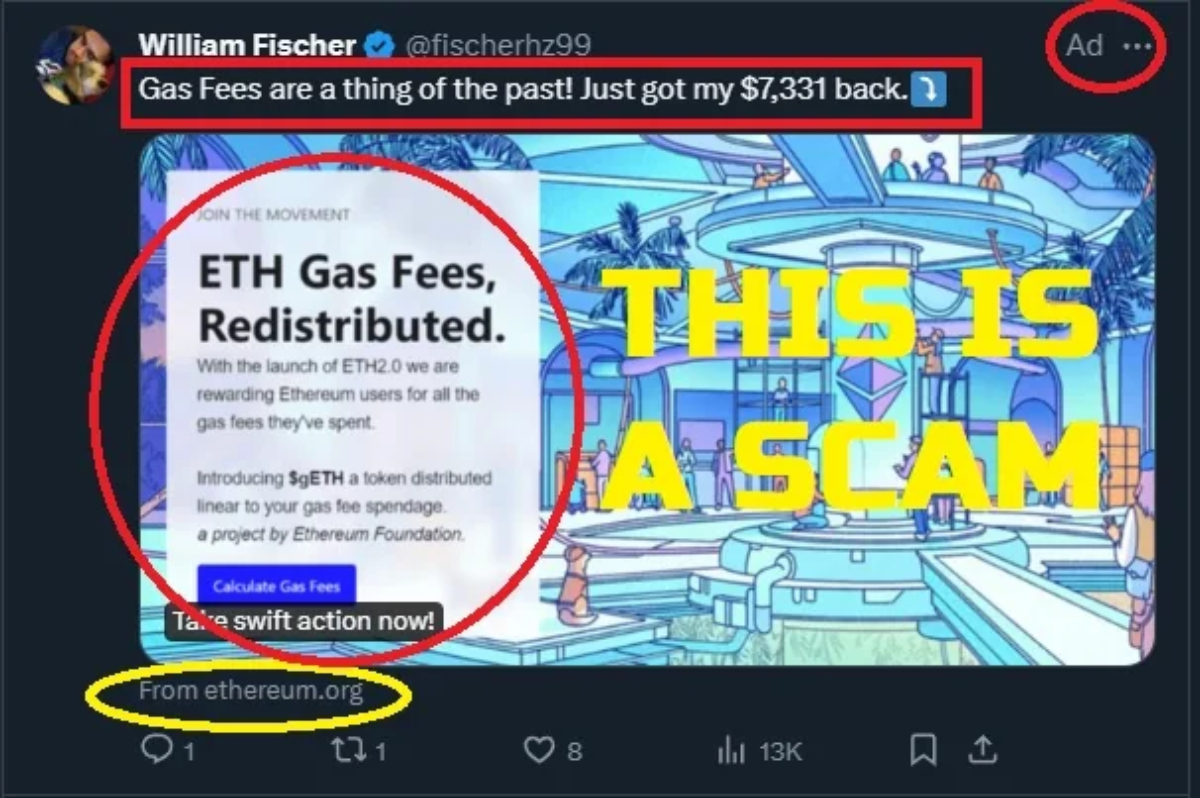
The scam patterns that concern gas fees in particular include fake "gas refund" claims that ask users to connect wallets and sign approval transactions, impersonated explorers or trackers that display incorrect gas prices to induce panic or urgency, malicious wallet popups that appear during legitimate transactions but request approvals for unrelated contracts, and "speed up your transaction" sites that ask for seed phrases or private keys under the guise of helping users replace stuck transactions. The attack vector is not technical exploitation of the protocol—it is exploitation of user behavior under time pressure, uncertainty, or incomplete knowledge.
Confirm domain spelling character by character: attackers register domains that are one letter off from legitimate services; always type the URL manually or use a bookmarked link rather than clicking search results or social media links. Use bookmarked official explorer URLs: add Etherscan, the network's canonical block explorer, to your browser bookmarks and access it exclusively from that bookmark; this eliminates the risk of landing on a phishing clone. Never enter seed phrases or private keys into any website: no legitimate gas tracker, explorer, or fee estimation tool requires seed phrase access; if a site asks for this information, it is a scam without exception. Opt for in-wallet or well-known tools for fee estimates: wallets like MetaMask, Rabby, and Frame include built-in gas estimation that pulls from reputable node providers; external trackers should only be used as supplementary data, not as the sole source of truth.
Conclusion
Gas fees are an unavoidable computational cost users pay for processing transactions on a blockchain network. Across chains, fees vary dramatically: Bitcoin charges per transaction byte rather than computational steps, while Layer 2 solutions like Arbitrum and Optimism bundle hundreds of transactions to share the Ethereum settlement cost, reducing individual fees to fractions of a cent.
Frequently Asked Questions
When do "gas fee" and "network fee" mean the same and when they do not?
In casual conversation, "gas fee" and "network fee" are treated as synonyms — both refer to the cost required to process a transaction on a blockchain. However, the terms are not technically interchangeable in all contexts. "Gas fee" specifically originates from Ethereum's execution-metering model, where "gas" is a unit that measures the computational effort required to execute operations like smart contract interactions or token transfers.
Where do gas fees and network fees actually go?
Where fees go depends entirely on the blockchain's consensus model and tokenomics design. On Bitcoin, transaction fees go directly to miners who include your transaction in a block, acting as supplemental income on top of the block subsidy; no portion is burned or diverted to a protocol treasury. On Ethereum post-EIP-1559, the fee structure is split: the base fee is burned (permanently removed from supply), reducing circulating ETH with every transaction, while the priority tip goes to validators as direct compensation for block inclusion. Some Layer 2 networks and sidechains introduce additional fee destinations, such as sequencer operators, relay nodes, or protocol development funds.
Why did my wallet show a higher fee than what was finally paid?
When you submit a transaction, your wallet calculates the worst-case scenario by multiplying the max fee by the gas limit, showing you the largest possible charge. However, the actual fee paid depends on the base fee at the moment your transaction is included in a block, plus whatever portion of your priority tip was necessary to secure inclusion. If the base fee was 30 gwei when your transaction was mined, but you set a max fee of 50 gwei, you only pay the 30 gwei base plus your priority tip — the unused authorization does not get charged.
Does Bitcoin use "gas" like Ethereum?
Bitcoin's fee model operates on transaction size and priority, not computational metering. Bitcoin fees are priced in satoshis per virtual byte (sat/vB), where one satoshi is the smallest unit of Bitcoin (0.00000001 BTC) and virtual byte accounts for transaction weight after SegWit adjustments.
Why can two Bitcoin transactions sending the same BTC amount have completely different fees?
Bitcoin transaction fees are not tied to the value being transferred; they are tied to the transaction's data size, which is determined by the number of inputs and outputs, not the amount of BTC moving. If you send 0.1 BTC using one unspent transaction output (UTXO) as an input and one output to the recipient, the transaction is small and the fee is low. If you send the same 0.1 BTC but your wallet must combine ten smaller UTXOs to reach that amount, the transaction's byte size increases proportionally, and so does the fee. Each input you add requires signature data, which increases the transaction's weight; each output also adds bytes, though inputs typically dominate the size calculation. This is why consolidating UTXOs during low-fee periods can save money later.
Can a Bitcoin transaction fail and still cost fees?
Bitcoin does not support complex execution paths that can abort partway through; a Bitcoin transaction is either valid and confirmed, or it is invalid and never enters a block. If a Bitcoin transaction is invalid (due to insufficient balance, malformed signatures, or other consensus violations), it is rejected by nodes and never makes it to the mempool, meaning no fee is paid because no miner included it in a block.
How do I identify low-fee windows on Ethereum using on-chain indicators?
Etherscan's gas tracker displays the current base fee in gwei and categorizes it into "low," "average," and "high" bands; when the tracker shows sustained readings below 20 gwei, you are in a statistically favorable window.
What to watch to time an Ethereum transaction?
Ethereum base fees adjust every 12 seconds and can shift 100%+ in two minutes — refresh estimates every 30–60 seconds when network conditions are volatile. To time a transaction effectively, watch two indicators: the real-time base fee on Etherscan's gas tracker (refresh every 30 seconds if you are preparing to submit) and the rolling average of block fullness over the last five blocks.
What is the difference between lowering gas price/tip and lowering gas limit, and which one can I safely adjust?
Lower gas price/tip to save money and accept slower inclusion; never lower gas limit below the wallet's estimate, or your transaction will fail and you will still pay fees.
How do I distinguish congestion-driven fee spikes from contract-complexity-driven spikes?
Congestion-driven spikes occur when many users compete for limited block space simultaneously, pushing base fees and priority tips higher as wallets bid against each other for inclusion. Contract-complexity-driven spikes occur when individual transactions require unusually high gas limits due to complex smart contract logic (multi-step swaps, NFT batch mints, liquidity provision with multiple token approvals), resulting in higher total fees even if the per-unit price is moderate. To distinguish the two, open the transaction receipt on a block explorer and examine two fields: Gas Used and Effective Gas Price. If Gas Used is near standard levels (21,000 for ETH transfers, 50,000–100,000 for token swaps) but Effective Gas Price is elevated (base fee + priority fee combined exceed 50 gwei), you are seeing congestion. If Gas Used is abnormally high (200,000+ units) but Effective Gas Price is moderate (under 30 gwei), the total fee burden came from complexity, not competition. Congestion affects all users uniformly; complexity affects only transactions interacting with gas-intensive contracts.
Why did fees spike immediately after I submitted my transaction?
Fees can spike immediately after submission due to base fee competition dynamics and replacement transaction behavior. When you broadcast a transaction with a specific max fee, other users' wallets simultaneously adjust their bids based on the same mempool signals you saw. If a high-priority event occurs — a token launch, a liquidation wave, or a viral NFT mint — hundreds or thousands of transactions flood the mempool within seconds, all competing for the next block.
What to watch to anticipate fee spikes?
- Token drops and airdrops — When a high-profile token becomes claimable, thousands of users rush to claim simultaneously, saturating the network within minutes. Mitigation: Delay your claim by 2–4 hours after announcement; claim activity typically peaks in the first hour and subsides significantly afterward.
- Liquidation cascades — During sharp price drops, DeFi lending protocols trigger mass liquidations, generating hundreds of transactions from liquidator bots bidding aggressively for priority. Mitigation: Avoid submitting non-urgent transactions during 10%+ price swings in major assets; wait for volatility to stabilize.
- Popular NFT mints — Limited-supply NFT launches create artificial scarcity, prompting buyers to set extreme priority tips to guarantee inclusion in the mint window. Mitigation: Use Layer 2 solutions for NFT activity when possible, or wait until post-mint secondary market activity rather than competing in the initial sale.
- Market volatility windows — Sudden macro news or exchange outages push traders to execute swaps, withdrawals, or hedges on-chain simultaneously. Mitigation: Set max fee and tip buffers 20–30% above current readings if you must transact during breaking news events.
- Weekday peak hours (14:00–18:00 UTC) — Overlapping European afternoon and U.S. morning activity creates consistent daily congestion. Mitigation: Schedule non-urgent transactions for weekend mornings (Saturday/Sunday 04:00–10:00 UTC) to exploit statistically lower base fees.
No trigger guarantees a spike, but each raises the probability significantly. For real-time spike detection, set alerts on Etherscan's gas tracker for base fee thresholds above 50 gwei.

