
How Does Monero Mining Work? Beginner’s Guide to XMR Mining


Key Takeaways
- RandomX favors CPUs and consumer hardware because it is intentionally ASIC resistant, which is why a CPU-first setup is the practical starting point for most readers rather than chasing specialized hardware.
- Payout variance differs sharply between solo mining (rare but full block reward), pool mining (frequent, proportional shares), and P2Pool (0% fee, very low minimum payout, no pool operator risk)—know which variance profile you can tolerate before you start.
- Profitability is dominated by electricity rate, network difficulty, and uptime—these three variables outweigh almost every other factor, including hashrate optimizations.
Contents
- 1. What Is Monero (XMR)?
- 2. Monero Mining Process: From Transactions to Block Rewards
- 3. Monero Mining Requirements
- 4. Mining Methods
- 5. Is XMR Mining Worth It? Profitability and Mining Economics in 2026
- 6. Risks, Drawbacks, and Key Considerations
- 7. Legal and Compliance Considerations in the United States
- 8. Conclusion
Monero mining is the process that secures the Monero blockchain and issues new XMR through proof-of-work. This guide explains Monero’s RandomX mining mechanics and walks through practical setup at a high level. It does not provide financial, tax, or legal advice, and it does not guarantee profitability. Your results will depend on your hardware, electricity costs, and network conditions at the time you mine.
The information here prioritizes primary protocol and project documentation first, followed by reputable third-party explainers. Because Monero undergoes scheduled network upgrades, parameters such as block reward schedules and algorithm specifications can change; nothing on this page should be read as an official endorsement by the Monero project or any affiliated organization.
What Is Monero (XMR)?
Overview
What is Monero? It is an open-source, privacy-focused cryptocurrency built on its own blockchain — a decentralized network — designed so that financial transactions would leave no publicly readable trail. XMR is the native currency ticker for that network, the actual unit of value you send, receive, or earn as a block reward. Where most blockchains record transaction details in a transparent ledger anyone can audit, Monero was built from the ground up to make that data unreadable to outside observers. The Monero Project, the open-source community maintaining the protocol, treats privacy not as a feature you opt into but as a baseline guarantee baked into every transaction.

Key properties relevant to miners:
- Proof-of-work consensus: XMR is issued and the network is secured through computational work, not staking or validator seats.
- CPU-friendly design: The network's proof-of-work algorithm, RandomX, is explicitly optimized for consumer CPUs, meaning standard desktop and server hardware is competitive.
- ASIC resistance: RandomX is engineered to be ASIC-resistant, preventing the hardware specialization that has concentrated mining power in Bitcoin and similar networks.
- ~2-minute block cadence: Blocks are targeted to arrive roughly every two minutes, setting the rhythm for reward payouts and difficulty adjustments covered in later sections.
- Perpetual block subsidy: Unlike networks with a hard supply cap and shrinking rewards, Monero's tail emission keeps a minimum block reward in place indefinitely, preserving long-term miner incentives.
Privacy and Security
Unlike many other privacy coins that offer it as an option, Monero enforces "privacy by default" at the protocol layer, meaning no participant can opt out of it and no transaction ever exposes its full details on the public ledger. Three specific fields are protected on every transaction:
- Sender — Ring signatures obscure which wallet actually signed and broadcast the transaction.
- Receiver — Stealth addresses generate a one-time destination so the recipient's real address never appears on-chain.
- Amount — Confidential transactions (RingCT) hide the value being transferred behind cryptographic commitments.
The implications of this design that apply to mining XMR in particular are numerous: it does not mean the act of mining is anonymous or that the network is unmonitored, miners still compete to validate transaction batches and append blocks, even though the transaction details inside those blocks are cryptographically obscured. Block producers (miners) do not need to read transaction amounts or addresses to validate them; the cryptographic proofs embedded in each transaction allow verification without disclosure.
Tail Emission
Most proof-of-work cryptocurrencies follow a Bitcoin-like halving schedule in which the block reward drops by a fixed percentage at set intervals, eventually approaching zero. Monero does not. Instead, the Monero Project implemented a perpetual minimum block subsidy — called tail emission — that kicked in once the main emission curve concluded. From that point forward, every block carries a fixed reward of 0.6 XMR, regardless of how much time has passed or how high the transaction fee market climbs.
To make that tangible: with a ~2-minute block interval, the network produces approximately 30 blocks per hour (assumption: 60 minutes ÷ 2 minutes per block = 30 blocks). That works out to roughly 18 XMR issued per hour, or about 432 XMR per day in baseline block subsidies across the entire network.
Why does this matter? Two reasons. First, it gives miners a predictable minimum revenue floor that never disappears — a direct contrast to networks where block subsidies eventually hit zero and miners are supposed to survive on transaction fees alone. Second, it sustains the economic incentive for miners to keep the network's distributed consensus honest over the long run. Miner compensation on Monero is always the sum of the tail emission subsidy plus transaction fees collected in that block, meaning both components contribute to the reward.
Monero Mining Process: From Transactions to Block Rewards

Mining becomes much easier to reason about once you separate three layers: transaction validation (what the network will even accept), block creation (what miners are actually hashing), and block rewards (how compensation is paid).
Transaction Validation
Before any transaction touches a block, it passes through a filtering process that separates what the network will accept from what it discards. Understanding this pipeline helps clarify what your mining software is actually waiting on before it can start working.
The lifecycle of a Monero transaction moves through four distinct states:
- Received — A node sees an incoming transaction broadcast from a wallet or another node.
- Accepted into the mempool — The transaction passes a series of checks and is held in a local waiting area. The mempool (memory pool) is a node's temporary holding queue for valid, unconfirmed transactions waiting to be included in a block.
- Selected for a block template — A miner's software pulls eligible transactions from the mempool to assemble a candidate block, typically prioritizing by fee rate.
- Confirmed — A block confirmation occurs each time a new block is added on top of the block containing that transaction, deepening its finality in the chain.
At the acceptance stage, nodes and miners apply several concrete checks before a transaction earns its place in the mempool: basic structure and syntax (the transaction must be well-formed and parseable), fee sufficiency (the attached network fee must meet or exceed the minimum threshold the node or pool will relay), conflict and double-spend rejection (if the transaction's inputs have already been spent by another transaction in the mempool or the chain, it is rejected), size and weight constraints (transactions exceeding protocol size limits are dropped), and optionally, policy filters — Individual nodes may apply local relay policies on top of consensus rules to their discretion.
No cryptographic proof-of-work math happens here — this is purely bookkeeping, ensuring only clean, fee-paying, non-conflicting transactions advance.
Block Creation
Once a miner is ready to work, it requests a candidate block — also called a block template — from either its connected node or a mining pool. This template is a fully assembled, ready-to-hash proposed block that the miner will attempt to validate through proof of work.
A candidate block contains three main components: a batch of pending, fee-paying transactions selected from the mempool chosen to fill the block, the previous block's hash called block header and its metadata — timestamp, the current difficulty target, and other protocol fields. Thirdly, it includes a special coinbase-style miner's reward transaction crediting the block reward and collected fees to the miner's address.
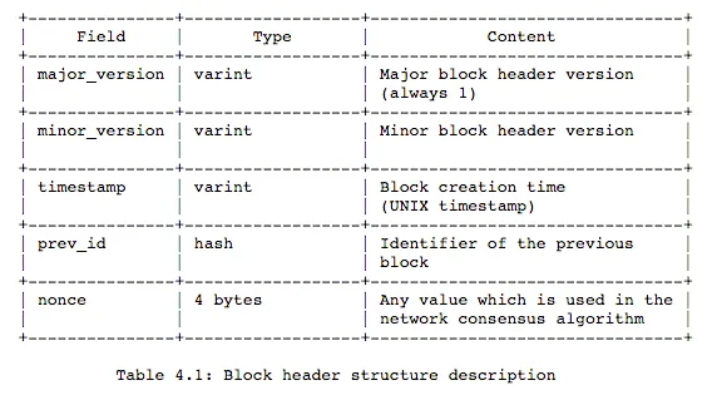
With the template in hand, the miner enters the proof-of-work loop. Monero uses RandomX, a proof-of-work algorithm designed to run efficiently on consumer CPUs and resist ASIC hardware, as documented by the official Monero project (getmonero.org). In practical terms, the miner repeatedly modifies a small changing value — the nonce or extra data field — feeds the entire block header into the RandomX hash function, and compares the resulting output against the current difficulty target. If the hash value falls below the target, the miner has found a valid block. If not, it increments the nonce and tries again — potentially millions of times per second.
When a valid block is found, the miner broadcasts it to peers across the network. Each receiving node independently verifies the block against consensus rules before accepting it. Once accepted, the block is appended to the chain, extending distributed consensus and burying prior transactions deeper into finality.
Because the Monero network has many miners hashing simultaneously, two miners occasionally find a valid block at nearly the same moment. Both solutions are technically correct, but only one can extend the canonical chain — the network converges on whichever block propagates fastest and accumulates the next block on top of it first. The losing block becomes an orphaned block (sometimes called a stale block). The miner who found the orphaned block receives no reward, even though their proof of work was valid — the race was lost to network propagation delay. This is one of the core reasons mining pools exist: by combining hashrate, pools find blocks more frequently and distribute smaller, steadier payouts to members, reducing the feast-or-famine variance that solo miners experience.
Block Rewards
And speaking of those, every successfully mined block in Monero carries two distinct streams of compensation for the miner who finds it: freshly created 0.6 XMR issued by the protocol itself as an incentive for securing the network and the sum of all network fees attached to the transactions included in that block.
Who actually receives these funds depends on how you're mining:
- Solo miner — The full reward goes directly to the address specified in the block template you built. You keep everything, but you only get paid when you personally find a block.
- Pool miner — The pool finds the block on behalf of all contributing members and distributes the reward according to its payout scheme — the specific formula a pool uses to divide earnings among participants based on their contributed work.
Hashrate Contribution
Hashrate is the rate at which your hardware produces hash attempts per second or in the context of the whole network, the total that secures it.
The model is straightforward: mining is a probability game. If the entire Monero network is producing a combined hashrate of, say, 1,000,000 hashes per second, and your machine contributes 10,000 hashes per second, you control roughly 1% of the total hashrate. Over a long enough time horizon, you'd expect to find approximately 1% of all blocks. The protocol's difficulty adjustment mechanism ensures this stays proportional as more or fewer miners join: when total network hashrate rises, difficulty rises to keep the average block interval near its ~2-minute target; when hashrate drops, difficulty eases.

As a result, in the short term, variance (or simply luck) dominates. Even a miner contributing a whole 1% of hashrate might go several times longer than expected between block finds, or might find blocks in a burst. The expected value is correct over many trials, but any individual window can look nothing like the average — which is precisely why many miners join a mining pool to smooth out that variance into more predictable, incremental payouts.
Monero Mining Requirements
Despite the popular preconception, mining setup is not too hard but it is unforgiving: a wrong wallet address, a compromised download, or a throttling laptop can turn “it runs” into “it earns nothing” or “it breaks hardware.” The cleanest way to avoid that is to treat the requirements as a dependency chain: wallet first, then hardware readiness, then software integrity and configuration.
Wallet
At minimum, you need a valid XMR address to receive mining payouts. That's your entry point. But understanding what that address does—and doesn't—do for you shapes every decision after it.
What you need and when:
- A valid XMR receiving address is required from day one; this goes into your miner config as the payout destination
- A full wallet with spending capability is needed only when you want to move, convert, or spend funds; not required to start receiving payouts
- Your seed phrase stored offline — write it down on paper, store it somewhere physically secure; if you lose it, you lose access to your funds permanently
- Optional: hardware wallet for long-term storage. Consider moving mined XMR into a hardware wallet workflow once you have enough balance to justify the operational overhead; mining payouts typically land in a software wallet first, then are transferred for cold storage
What you should never do is use a third-party account (exchange deposit address, custodial wallet) as your mining payout address. If that platform freezes withdrawals, goes offline, or closes your account, your mined Monero is theirs. A non-custodial wallet keeps you in control of your keys—and therefore your funds—regardless of what any external service does.
Before you paste your address into any miner config:
- Copy your XMR address from your wallet, then paste it into a plain text editor and visually confirm the first and last several characters before using it anywhere else
- If your wallet supports QR codes, scan it on a second device to cross-verify the address string rather than relying solely on a manual copy/paste
- Send a test payout at the pool's minimum threshold before committing to long mining sessions—confirm it arrives in your wallet before assuming the config is correct
- Be aware of clipboard hijacking malware that silently replaces copied addresses; always re-verify a pasted address immediately before saving your config
- Use only your own wallet-generated address—avoid address generators or third-party tools that claim to create XMR addresses for you
Hardware
RandomX is intentionally designed to be ASIC-resistant and to perform well on consumer CPUs, making general-purpose processors the primary and most practical hardware for Monero mining. RandomX is broadly targeted at modern x86 CPUs and many GPUs, but CPUs remain the recommended fit for most miners due to how the algorithm uses memory and cache.
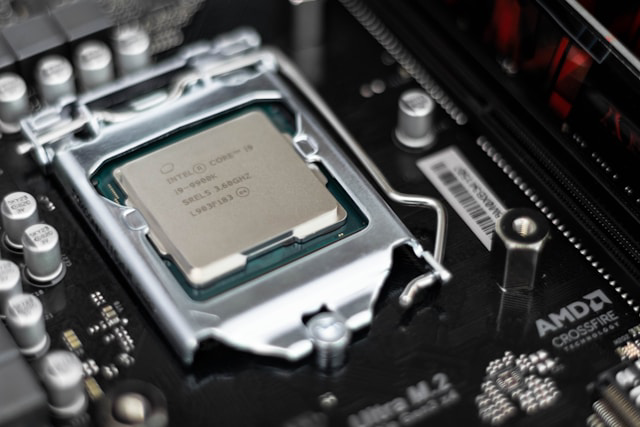
What matters most for RandomX CPU mining is RAM capacity, memory bandwidth, cache size, available RAM headroom and instruction set support. Raw core count, especially if RAM can’t feed each thread, or clock speed in isolation do not matter as much.
Some hardware, CPU or not, is an outright poor fit for effective Monero mining. Low-power mobile CPUs have insufficient memory bandwidth, sustained CPU load will trigger thermal throttling within minutes on machines with inadequate cooling, very old CPUs lacking AES-NI or SSE4 support produce dramatically lower hash rates, and RandomX in full mode cannot run properly on RAM-constrained systems with less than 4 GB total (or less than 2 GB free).
To perform a stress test before attempting to mine XMR, open your system monitor, run a CPU stress test for five minutes, and watch your temperatures. Confirm how much RAM is free with all your usual background apps running. Expect fan noise under sustained mining load—if your machine throttles during a simple stress test, it will throttle while mining.
Software
Once you sort the hardware matters out, your software stack doesn't need to be complex, but every component needs to be correctly sourced and configured. Missing one piece—or downloading the wrong version—creates security gaps or covert performance problems.
XMRig is the most widely used open-source option for CPU mining; this is your core requirement. If you're pool mining, you need your pool's stratum address and port; if using P2Pool, you need the P2Pool connection details instead of a traditional pool. Some extras that are not just nice to have are firewall or antivirus exceptions for your miner's executable, monitoring for hashrate and CPU temperature in real time and, optionally, a full node setup.
Third-party software repackaged from unofficial sources is one of the most common vectors for mining malware. Download XMRig or any other third-party software exclusively from its official repository or the project's verified official site. After downloading, check the provided SHA-256 hash or GPG signature against the value published on the official release page—do not skip this step even if the file looks correct.
Never use installer packages from third-party download aggregators, mirror sites, or forum links that don't trace back to the official project. If a site offers a "pre-configured" version of XMRig or any other miner, treat it as untrusted until you can verify it against the official release hash. Run a quick virus scan on the downloaded file before extracting, understanding that false positives are common but a verified hash takes precedence over AV detection for known-good releases.
Mining Methods
Choosing a mining method should come even before setting up to avoid getting stuck with the wrong tradeoff. The protocol is the same, the RandomX work is the same, but your payout variance, trust model, and operational burden change dramatically depending on whether you mine solo, through a pool, or via P2Pool.
| Criteria | Solo Mining | Pool Mining | P2Pool |
|---|---|---|---|
| Setup complexity | High (full node + miner config) | Low (account + miner config) | Medium (full node + P2Pool daemon + miner) |
| Required infrastructure | Synced full node (local) | Remote node (pool-managed) | Synced full node (local) |
| Payout variance | Very high | Low–Medium | Medium |
| Typical payout frequency | Rare (weeks to months or never for low hashrate) | Regular (hours to days, threshold-dependent) | More frequent than solo; threshold-triggered |
| Fees | 0% | 0.5%–2%+ pool fee + miner dev fee (e.g., ~1% XMRig) | 0% pool fee + miner dev fee (e.g., ~1% XMRig) |
| Trust model | Fully trustless; non-custodial | Custodial until payout; operator holds rewards | Non-custodial; decentralized; no single operator |
| Metadata exposure | Minimal — only your local node sees your activity | Pool operator sees your IP, worker name, hashrate timing | Reduced — no central operator, though peers see hashrate contribution |
| Best for | High-hashrate miners prioritizing trustlessness | Beginners or low-hashrate miners wanting consistent payouts | Privacy-conscious miners who can run a node but want lower variance than solo |
| Main failure modes | Node out of sync, RPC misconfiguration, throttled hardware | Pool downtime, payout threshold never reached, operator risk | Stale shares from unstable connection, node desync, sparse payouts at very low hashrate |
Solo Mining
Solo mining means your miner competes directly against the entire Monero network to find a block, with no intermediary. Every XMR block reward goes entirely to you — if and when you find one.
Before you start, a solo miner needs to have a synced full node, a wallet address for payouts and miner software plus hardware to power it, pointing to their local node. It does not sound as much until you remember that the competition is everyone else also mining XMR.
Solo mining is effectively a lottery. Your probability of finding a block in any given period is proportional to your personal hashrate divided by the total network hashrate (network difficulty expressed as a rate). The number to watch is your hashrate relative to current network difficulty, not daily income projections.
Pool Mining
A mining pool aggregates hashrate from many individual miners and submits work collectively to the Monero network. The gist is, when the pool finds a block, the reward is split among contributors proportionally.
In more detail, when you mine in a pool, your miner continuously submits shares — units of proof-of-work that demonstrate you are contributing hashrate, even when no block is found. The pool tracks your shares over time. When the pool collectively discovers a Monero block, the block reward is distributed to miners through proportional distribution — each miner receives a fraction of the reward corresponding to the shares they contributed during the relevant window. The exact calculation depends on the pool's payout scheme (e.g., PPLNS, PPS, PROP), which determines how far back shares are counted and how variance is smoothed across miners.
Not all pools are the same. Choose with the payout scheme, fees, minimum threshold, server location, transparency, and payment method in mind. PPLNS (Pay Per Last N Shares) rewards loyal miners and reduces pool-hopping; PPS (Pay Per Share) gives more predictable per-share income but shifts variance risk to the pool operator. Distinguish the pool fee (taken from block rewards before distribution, typically 0.5%–2%) from the miner software dev fee (e.g., XMRig charges ~1% by default, separate from pool fees). Some pools require you to accumulate 0.1 XMR or more before paying out, and at low hashrate, this can mean weeks of waiting. Choose a pool with servers geographically close to you because high latency increases stale share rate. Reputable pools expose real-time stats: total pool hashrate, block find frequency, payout history. Avoid pools with no verifiable public data.
Also keep in mind that when you join a mining pool, you are sharing information with a centralized operator. The pool can observe your IP address, worker names, and hashrate contribution timing. This is structural and cannot be avoided in traditional pool mining. What the pool cannot control is your wallet custody, provided payouts go directly to a wallet address you own. Your XMR lands in your wallet; the pool never holds it indefinitely.
P2Pool
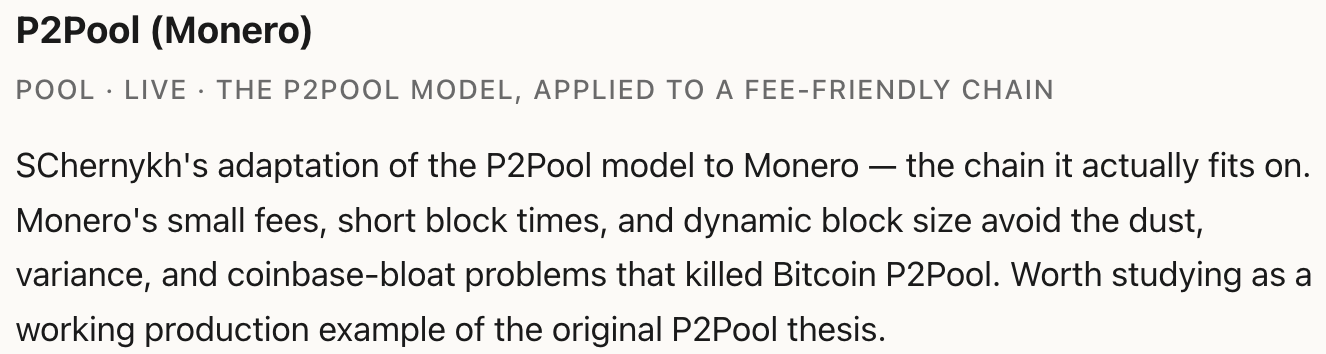
P2Pool is a decentralized, permissionless mining pool protocol built specifically for Monero. It occupies a unique position: it gives miners the lower variance of pool mining while preserving the trustless, non-custodial properties of solo mining.
Unlike a traditional mining pool, P2Pool has no single operator holding rewards on behalf of miners. Instead, it operates a sidechain — a parallel chain of "mini-blocks" — where miners earn shares by finding mini-blocks on this sidechain. When the P2Pool sidechain collectively finds a Monero main-chain block, payouts are encoded directly into the block's coinbase transaction and distributed to contributing miners' wallet addresses automatically. There is no pool account, no operator holding your XMR, and no permission required to join. This makes P2Pool a hybrid from a trust perspective: it has the payout smoothing of a pool and the trustless, non-custodial structure of solo mining.
P2Pool is not the right choice for every miner. If your contribution is minimal relative to the P2Pool sidechain difficulty, payouts will be sparse and infrequent. A traditional mining pool with a low minimum payout threshold may serve you better in the short term. Moreover, P2Pool requires a synced, locally running Monero full node. If you cannot keep a node online consistently, P2Pool will not function correctly and the rate of stale shares will grow.
Is XMR Mining Worth It? Profitability and Mining Economics in 2026
Profitability is where most Monero mining narratives get distorted. Not because the math is complicated, but because inputs get mixed: peak hashrate vs sustained hashrate, CPU TDP vs wall power, or “expected value” vs the reality of variance.
This section keeps the model measurable: how much hashrate you produce, what the network does with difficulty, and what your electricity turns that into in net terms.
Hashrate
Before plugging numbers into any calculator, it helps to get the units straight—this is one of the most common places where profitability estimates go wrong. H/s (hashes per second) is the base unit but kH/s (kilohashes per second) or 1,000 H/s is a more common one because a mid-range desktop CPU typically lands in the 1–10 kH/s range. RandomX is intentionally GPU-resistant, so MH/s (megahash per second) figures are not typical for CPU miners and should raise a flag if you see them quoted for Monero.
XMRig reports multiple averages—a short-window figure (roughly 10–60 seconds) and a longer-term average. For profitability estimates, always use the long-term average. Short benchmark runs capture only the best-case thermal state of your CPU; over hours of continuous mining, frequencies can drop as the chip heats up, and the effective hashrate you actually sustain will often be lower than the peak number XMRig flashes at startup.
Background CPU load from other applications and thermal throttling are two of the most common causes of inflated profitability projections. If your CPU is sharing cycles with other processes or if cooling is marginal, your effective hashrate—and therefore your real expected XMR output—will be meaningfully lower than a clean benchmark suggests.
Network Difficulty
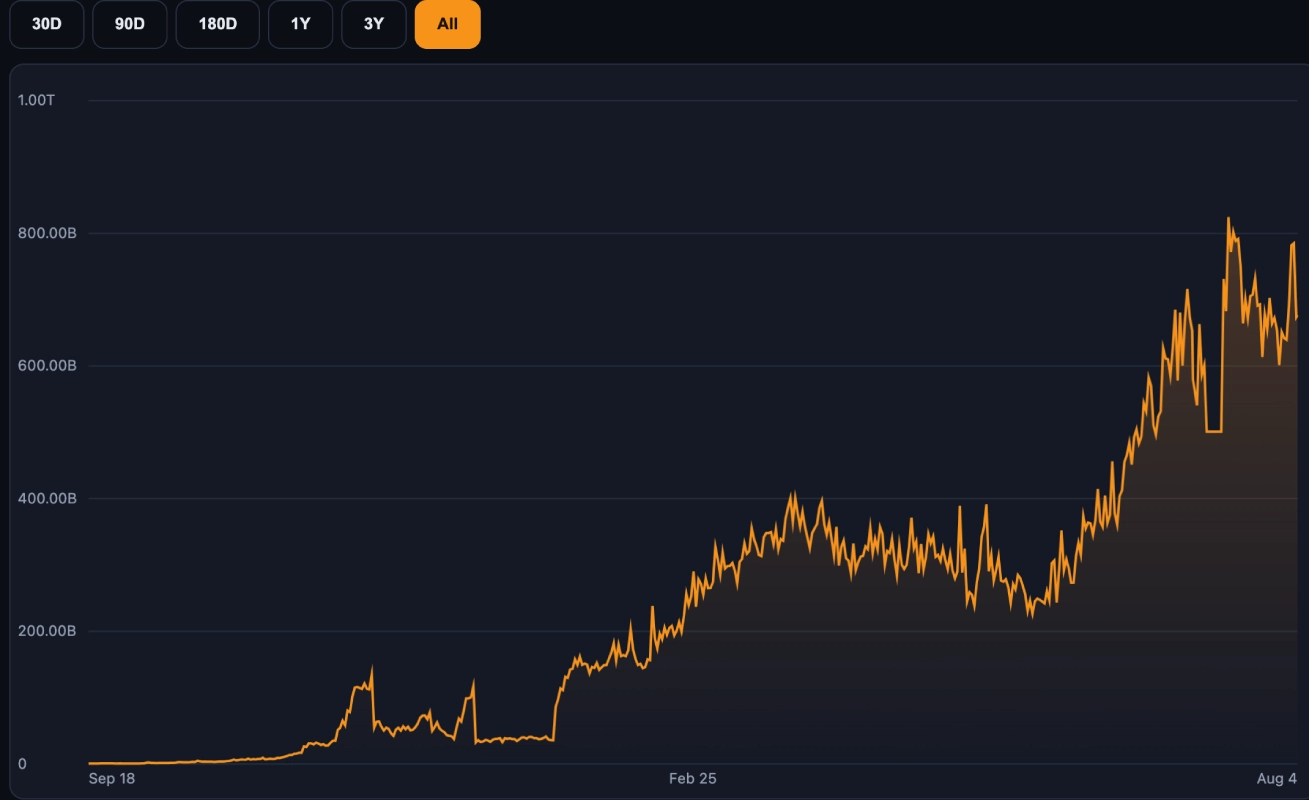
Monero's network difficulty adjusts continuously to target an average block interval of approximately 2 minutes per block. This self-correcting mechanism means that as more computing power joins the network, blocks don't arrive faster—difficulty rises to compensate, keeping the block schedule roughly on target.
What this means for your expected earnings is straightforward: your share of block rewards is proportional to your hashrate relative to the total network hashrate. If the network's total hashrate doubles while yours stays the same, your expected XMR/day is cut roughly in half, even though nothing changed on your end. Conversely, if miners leave the network and difficulty drops, your relative share increases.
The practical takeaway is that expected XMR/day is not a fixed output of your hardware—it is a moving target tied directly to what everyone else on the network is doing. When difficulty rises and your hashrate is unchanged, expected XMR/day falls.
Time-to-Mine Estimates
There are two meaningfully different ways to think about "how long will it take me to earn XMR" and you can probably already guess why.
If you mine solo, you are competing against the entire network to find the next valid block. Your expected time to find a block is roughly: (Network hashrate ÷ Your hashrate) × 2 minutes. For most CPU miners, this works out to weeks, months, or longer. Critically, this is a statistical expectation—you might get lucky and find a block sooner, or go far longer than the expected value without finding one. The variance is high enough that solo mining is impractical for the vast majority of individual miners.
Mining through a pool or P2Pool aggregates your hashrate with others, so shares of work are credited continuously rather than in all-or-nothing block finds. The long-run expected XMR earned is mathematically similar to solo mining (minus pool fees), but payouts arrive far more regularly, smoothing the variance considerably. When any miner in the pool finds a valid block, that miner—or the pool collectively—earns the block reward plus any transaction fees included in that block, which are then distributed to contributors according to the pool's payout scheme.
Even with pool mining, actual day-to-day results can differ from your long-run expected value. A day with fewer shares than average or a run of bad luck on block finds is normal. Judge performance over weeks, not hours.
Profitability Drivers
The following drivers are ranked by how much leverage they give a typical CPU miner running RandomX. For each, there is at least one thing you can act on and one thing that is outside your control.
- 1️⃣ Electricity rate (kWh price)
- What you can change: Shop providers, mine during off-peak rate windows, or relocate to a lower-cost region.
- What you can't control: Utility rate structures, grid pricing events, regulatory changes to energy costs.
- 2️⃣ CPU efficiency (H/s per watt)
- What you can change: Undervolting your CPU to reduce power draw without proportionally reducing hashrate; selecting hardware with a strong RandomX performance-per-watt ratio.
- What you can't control: The underlying silicon efficiency of the CPU you already own.
- 3️⃣ Uptime and thermal limits
- What you can change: Improve case airflow, clean dust filters, set conservative temperature thresholds in your OS or XMRig to avoid throttling-induced hashrate loss.
- What you can't control: Ambient temperature in your environment, hardware failure rates.
- 4️⃣ Pool fees and payout scheme
- What you can change: Select a pool with a fee structure and payout scheme (PPLNS, PPS, etc.) that matches your risk preference; P2Pool offers a zero-fee decentralized alternative.
- What you can't control: Pool operators changing fee structures after you join.
- 5️⃣ XMR price volatility
- What you can change: Timing of when you convert mined XMR to fiat, if that is your goal; holding strategy.
- What you can't control: Market price of Monero on any given day.
- 6️⃣ Transaction fees component
- What you can change: Awareness of fee income as an upside variable—blocks with higher transaction volume pay more to the miner who finds them.
- What you can't control: Network transaction volume and the fee market on Monero at any given time.
Risks, Drawbacks, and Key Considerations
Monero or not, mining problems usually do not announce themselves as “problems.” They show up as a miner that runs but never gets paid, a machine that slowly degrades, or a setup that is technically functional but operationally unsafe. The risk categories below are the ones that repeatedly cause avoidable losses.
Unofficial Downloads
Sourcing miner software from anywhere other than the official project repository is one of the fastest ways to compromise your machine and your funds. The supply-chain risk is real and specific: malicious actors repackage legitimate tools like XMRig inside infected installers, upload them to file-sharing sites, and wait.
- Use official project pages. Download XMRig exclusively from github.com/xmrig/xmrig or the project's own domain. For pool-specific clients, start from the pool's official documentation page.
- Validate the download origin. Confirm the exact domain and that the connection is TLS-secured (HTTPS). A single character difference in a domain name—xmrig-download.com versus github.com/xmrig—is a red flag.
- Verify release signatures and checksums. When the project provides SHA-256 checksums or GPG-signed releases, verify them before executing anything. XMRig publishes checksums alongside each release on GitHub.
- Avoid repacked APKs, EXEs, and "one-click miners." These formats have no verifiable build chain. If you cannot trace the binary back to a signed, public release commit, do not run it.
Some of the red flags that can disqualify software are, for example: the installer or software requests your wallet seed phrase or private keys. Legitimate mining software never needs these. Setup instructions tell you to disable antivirus, Windows Defender, or Secure Boot before installing. After installation, you notice unknown background services or processes with randomized names consuming CPU or network.

Beyond generic malware, miners face threats such as clipboard hijackers that covertly replace your copied XMR wallet address with an attacker-controlled address. Every payout you configure goes to them, not you. Always verify the address displayed in your pool dashboard matches your wallet after pasting. Silent miners bundled in installers use your computing power to mine to the attacker's wallet while you see nothing unusual on the surface. Remote-access trojans (RATs) are used to persist on mining rigs, exfiltrate configuration files containing wallet addresses, and pivot to other machines on the same network.
If you suspect a compromised miner is running, act immediately:
- Disconnect from the network (pull ethernet, disable Wi-Fi) to stop any active exfiltration or remote control.
- Do not reboot into the same OS session first. Note running processes if you safely can, then shut down.
- Scan from a clean environment—boot a trusted live OS or use an offline scanner to assess the drive.
- Reinstall from a clean image. Do not trust the existing OS installation.
- Change all passwords associated with accounts accessible from that machine.
- Generate a new wallet if your seed was ever exposed or entered on that machine. XMR transactions are irreversible; a compromised seed means permanent loss of any funds sent to addresses derived from it.
Unsupported Devices
For the purposes of this guide, "unsupported" does not mean the device lacks an official compatibility list. It means the device cannot sustain stable RandomX workloads—either because it lacks thermal headroom, cannot maintain sustained CPU frequencies without throttling, or lacks the RAM bandwidth that RandomX demands (it requires approximately 2 GB of memory per mining thread for the full dataset).
Once again, avoid running Monero mining software on low-end or older smartphones (especially those with passive or minimal cooling), passively cooled mini PCs and NUCs not designed for sustained 100% CPU utilization, devices with locked bootloaders or enterprise MDM profiles where you cannot adjust power limits, thermal profiles, or background process behavior, laptops with degraded or swollen batteries, or simply any device where you cannot monitor CPU temperature in real time.
Can the device run RandomX without immediately throttling? Does the device have active cooling in working condition? Can you monitor and interrupt the process at any time? Only if all these checks are passed, proceed. If your goal is to learn rather than to earn, and you do not intend to push the hardware too far, use reduced threads and monitor actively.
Configuration Omissions
Misconfiguration is the most common cause of silent losses and instability in new mining setups—and most of the critical settings have nothing to do with maximizing hash rate.
Most-missed settings that affect safety and stability:
- Wallet address and payment ID correctness. XMR addresses are long and easy to truncate or mistype. A wrong address means payouts go somewhere else—permanently and irreversibly. Copy, do not type, and verify character-by-character after pasting. Some pools also require a payment ID for exchange-hosted wallets; missing it means lost funds.
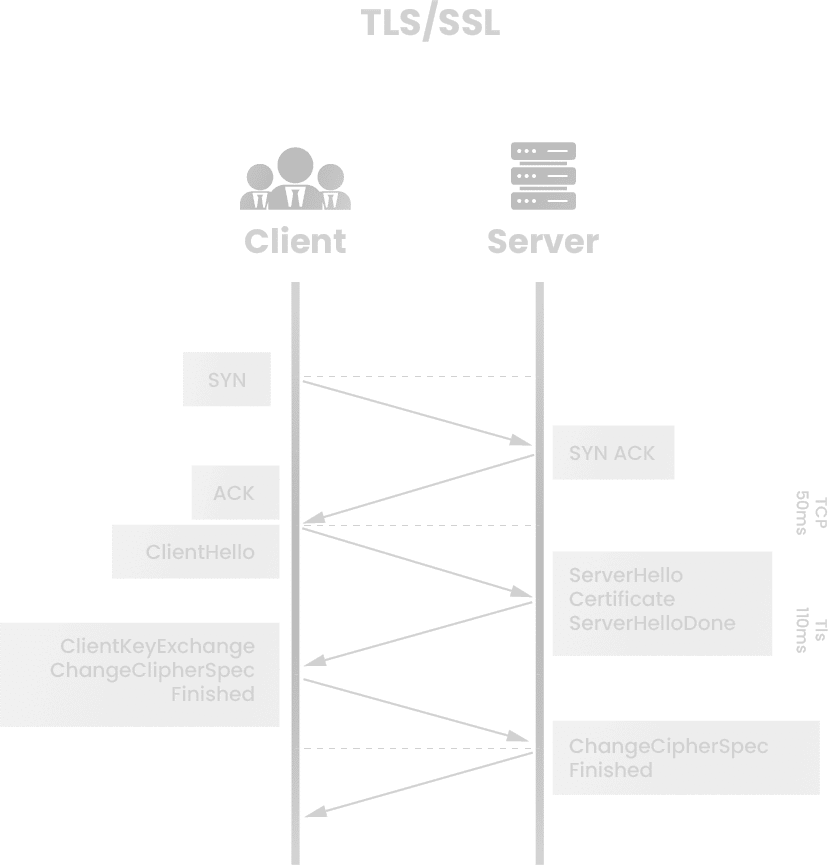
- Pool URL and SSL/TLS selection. Always prefer the pool's SSL/TLS port (typically 443 or a dedicated SSL port). Unencrypted pool connections expose your wallet address and share submissions in transit. When using P2Pool, confirm you are connecting to the correct P2Pool mini or main tier for your hash rate.
- Startup persistence—and when NOT to enable it. Configuring XMRig to start on boot makes sense for dedicated mining machines. On shared computers, work laptops, or family devices, it creates a persistent background load that affects everyone using the machine and can be difficult to notice or remove. Only enable autostart when you fully control the device.
- Log retention. Enable logging to a file. Without logs, diagnosing a crash, a sudden hash rate drop, or a pool rejection reason is significantly harder. Set a reasonable rotation limit so logs do not fill the drive.
- Thread and CPU usage limits. Running XMRig at 100% of available threads on a machine you also use for other tasks causes thermal throttling and system instability. Limit threads explicitly in the config, and consider setting a CPU usage cap (XMRig supports this natively). Leaving this uncapped on a laptop is one of the most common causes of overheating complaints.
Hardware Wear
RandomX is a CPU-bound algorithm, which means the wear profile of Monero mining differs from GPU mining. What actually tends to wear with sustained CPU mining?
- Cooling fans accumulate dust faster under sustained high RPM and will eventually fail if not maintained. This is the most commonly replaced component on long-running mining machines.
- VRMs (voltage regulator modules) on budget motherboards are not always rated for sustained 100% CPU load. Prolonged high-current draw accelerates capacitor aging.
- Laptop hinges, ports, and chassis experience thermal expansion and contraction cycles from repeated heat-up and cool-down. Over time this can loosen connectors and stress solder joints near heat sources.
- Thermal interface material (TIM) between the CPU and cooler degrades with heat cycles, increasing thermal resistance over time.
CPU silicon itself, when operated within manufacturer thermal and voltage specifications, is generally resilient to sustained load. The risk is not the load itself but the heat—if temperatures stay within spec, the CPU typically survives. The hardware damage scenario is almost always a cooling failure, not the CPU being used at full load.
Clean the fans, set aggressive fan curves to preemptively cool the processors, use the power limit to reduce heat output, and occasionally reapply thermal interface material to mitigate the wear. Another thing to keep in mind is that mining is very likely to null warranty on a device due to its intensity on hardware.
Battery and Thermal Risks
Mining on battery—rather than plugged in—creates a compounding risk that goes beyond shortened runtimes. The battery is simultaneously being discharged rapidly under high load and, in many devices, being heated by the CPU and VRM heat it sits near. Lithium-ion and lithium-polymer cells degrade faster when cycled under heat. Sustained high-load discharge at elevated temperatures accelerates cycle life degradation, and in severe or prolonged cases, contributes to cell swelling. A swollen battery is a safety hazard, not just a capacity problem.
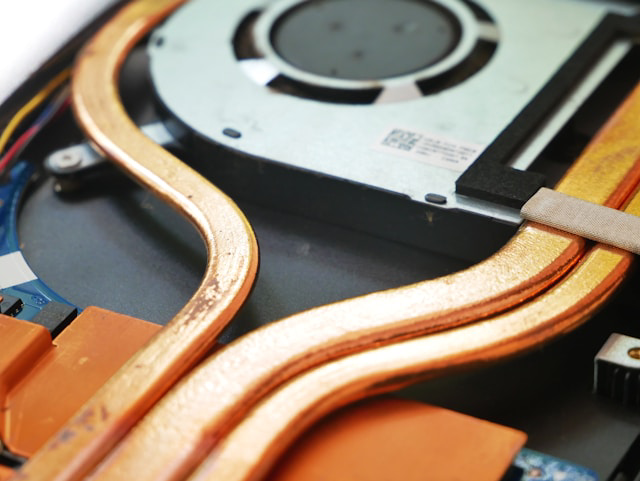
If you choose to mine on a phone or laptop despite these risks, apply these operating constraints without exception: never mine on battery, cap CPU usage to well below maximum (50–70% of threads is a reasonable starting ceiling; adjust down if the device stays hot), ensure airflow around the device, and stop if you notice heating, throttling or extensive battery usage. It bears repeating that mining on these devices is only good for educational purposes.
Legal and Compliance Considerations in the United States
The bigger elephant in the room is the question whether it is even legal to mine a privacy coin, US or not. The short answer is not explicitly, as long as these specific assets are not banned; as far as mining is concerned, legal, tax, and utility constraints should still be on your radar.
This section applies to US-based miners only and is not legal or tax advice. If you have significant Monero mining income or operate at scale, consult a qualified tax professional or attorney before making decisions.
Tax Treatment
Mining XMR creates several distinct tax moments, and knowing which records correspond to each one is the practical starting point for staying compliant.
- Is XMR received as a mining reward? The IRS treats mined cryptocurrency as ordinary income at the moment of receipt. Record the fair market value of each XMR payout in USD at the time it hit your wallet or pool account, the timestamp of that event, the exchange rate source you used, and the wallet address or pool payout log confirming receipt.
- Is mined XMR sold, swapped, or spent? Each of those is a separate taxable event—a capital gain or loss calculated from the cost basis established at receipt. Retain records of the disposal date, the proceeds received, and the original cost basis for each unit disposed of.
- Are rewards held without disposal? No additional tax event occurs at this moment beyond the income recognized at receipt. However, maintaining continuous records now makes any future disposal far easier to document accurately.
Even when using self-custody wallets, the following can and should be documented: transaction IDs for each payout, wallet addresses used to receive funds, payout statements or pool dashboard exports (CSV or screenshots) showing dates and amounts, the price source used to determine fair market value at receipt (e.g., a named exchange or aggregator), electricity and hardware invoices supporting any expense deductions, and where applicable, pool dashboard exports or payout confirmation emails.
Retain all records for the standard IRS retention period. Keeping organized documentation is not about disclosure of every on-chain detail—it is about being able to reconstruct your income and basis if questioned.
Business Use
Not every mining operation is treated the same way for tax and legal purposes. Whether your activity looks more like a hobby or a business affects what you can deduct, how income is classified, and what obligations apply.

Do you mine consistently, with ongoing attention to uptime and performance? Are decisions driven by the expectation of profit—including hardware upgrades, efficiency improvements, and cost tracking? Is mining hardware designated specifically for that purpose, in a defined space? Do you track income and expenses for mining independently from personal finances? Does the operation represent a meaningful level of investment and output relative to personal finances? Depending on the answers, your mining can be either a hobby or a business venture.
Mining as a business typically implies the need to maintain a separate bank account and bookkeeping records dedicated to the operation, document all deductible expenses—hardware, electricity rate costs, internet, repairs—with receipts and invoices, and recognition that net profit may be subject to self-employment taxes, not just income tax (consult a professional on the specifics).
Energy and Utility Policies
Mining hardware draws significant sustained power, and utilities notice. The friction points differ depending on whether you are mining at home or in a small commercial or warehouse space.
Unusually high kWh usage at home can trigger utility inquiries or flagging under residential rate plan terms since residential electricity rate plans are not always designed for continuous high-draw loads; some utilities restrict or reclassify accounts exceeding defined usage thresholds. More than that, adding dedicated circuits without permits can void homeowner's insurance and create code violations. Not to mention that heat and noise from equipment in living spaces create practical limits on scale.
Small commercial or warehouse mining seems like the obvious solution but is still one that requires consideration of other details. Demand charges (billed on peak power draw, not just total kWh) can significantly increase effective electricity rate costs and must be factored into profitability models, and utilities may require formal load addition requests or upgrades to service entry before you increase draw substantially. Tariff and rate plan changes happen; locking in assumptions without reviewing current utility schedules creates profitability risk. Finally, local code compliance for electrical infrastructure, ventilation, and fire suppression becomes even more critical at this scale.
Before expanding capacity, confirm if electrical panel capacity is sufficient for the intended load, verified by a licensed electrician; any new circuits are installed by a licensed electrician and permitted under local code; heat (ventilation, cooling) and noise mitigation measures meet local requirements and lease or zoning conditions; and power consumption assumptions are documented explicitly and tied to your profitability calculations—so that a rate change or demand charge is visible in the model.
This checklist is fundamentally about compliance and safety, not optimization. An unpermitted circuit or an overloaded panel creates legal liability risk that no hashrate calculation accounts for.
Conclusion
Monero mining in 2026 is realistically accessible to anyone willing to start with hardware they already own, but accessible does not mean effortless or automatically profitable. The decisions you make before you run your first miner—how you source software, what pool structure you choose, whether you run a node, and how you track costs—determine more of your outcome than any single configuration tweak.
Subscribe to our Telegram, X, and Facebook to not miss out on any crypto news! Explore the crypto world with experts’ insights in our blog.
Frequently Asked Questions
Is CPU Mining Monero Feasible?
RandomX is specifically designed to be ASIC-resistant and optimized for consumer CPUs, meaning CPU mining on Monero is not an outdated fallback — it is the intended proof-of-work model. Unlike most algorithms where GPUs dominate by orders of magnitude, RandomX's memory-hard design narrows the efficiency gap considerably.
How much Wear on Hardware Does Monero Mining Cause?
Mining runs your hardware at sustained, near-maximum load for hours or days continuously — a workload most consumer hardware was not designed to endure indefinitely.
Sustained all-core loads stress VRMs beyond typical desktop use; motherboard quality matters as much as the CPU itself. Cooling fans accumulate the most mechanical wear under continuous high-RPM operation. Running a PSU at 80–90% of rated capacity continuously degrades capacitors faster than intermittent loads.Is XMR mining legal?
In the United States, Monero mining exists across three distinct legal layers that carry different obligations. Mining itself (running XMRig, earning block rewards) is legal in the U.S. under federal law. Receiving payouts in XMR constitutes taxable income at fair market value at time of receipt, per IRS guidance. Converting XMR to USD (or another asset) triggers a separate capital gains event based on your cost basis.
What is the Block Reward for Mining Monero?
When a miner or pool finds a valid block on the Monero network, the block reward consists of two components: the protocol block subsidy (newly minted XMR) plus any transaction fees collected from transactions included in that block. The subsidy issued by the Monero network itself. Monero has no hard cap; instead, it transitioned to a tail emission of 0.6 XMR per block — a permanent, predictable floor that ensures miners always have an incentive to secure the network.