How Many Satoshis in 1 BTC? Bitcoin’s Smallest Unit Explained

Key Takeaways
- 💧 There are 100,000,000 satoshis in 1 Bitcoin. Therefore, 1 satoshi equals 0.00000001 BTC;
- 💧 Satoshis, often shortened to sats, are the smallest on-chain Bitcoin unit and make small payments easier to read than long BTC decimals;
- 💧 Bitcoin’s 21 million BTC maximum supply equals 2.1 quadrillion satoshis, a figure enforced in Bitcoin Core through the MAX_MONEY constant;
- 💧 Sats are especially useful for everyday Bitcoin transactions, Lightning Network micropayments, stacking sats, and understanding fees quoted in sats per vbyte.
Disclaimer
This article is for educational purposes only and does not constitute investment, financial, tax, or legal advice. Bitcoin prices move continuously, so any USD examples are illustrative snapshots rather than fixed values. Always verify the unit displayed in a wallet, exchange, calculator, or spreadsheet before sending funds, because confusing BTC with sats can create a 100,000,000x magnitude error.
When you buy, hold or move Bitcoin, there is no need to deal with the whole unit. There are 100,000,000 satoshis in 1 bitcoin, which means a single satoshi equals 0.00000001 BTC. Thinking in satoshis makes everyday pricing and sending amounts easier to handle, since you can work with whole numbers instead of long strings of bitcoin decimals.
To no one’s surprise, the name comes from the anonymous creator of Bitcoin’s protocol: Satoshi Nakamoto. A satoshi is not a separate asset from Bitcoin. It is simply the smallest denomination of BTC, just as cents are a smaller denomination of dollars. The difference is scale: Bitcoin divides into eight decimal places, and the satoshi sits at the very end of that precision ladder.
Satoshi to Bitcoin Conversion
A satoshi-to-bitcoin conversion is straightforward once you keep the denominator fixed: 100,000,000 sats = 1 BTC. Everything else is only decimal placement.
100,000,000 Satoshis per Bitcoin
The conversion rule is: BTC = satoshis ÷ 100,000,000
Since satoshis are the base unit of Bitcoin, nearly every BTC amount can be expressed as a whole number of sats. For example:
- 1 BTC = 100,000,000 sats
- 0.1 BTC = 10,000,000 sats
- 0.01 BTC = 1,000,000 sats
Non-round amounts work the same way. If you divide 12,345,678 sats by 100,000,000, you get 0.12345678 BTC, with each digit occupying its own decimal place.
0.00000001 BTC per Satoshi
Going the other direction, the formula is: satoshis = BTC × 100,000,000
Multiplying any BTC amount by 100,000,000 shifts the decimal point eight places to the right.
For example:
- 0.00025000 BTC × 100,000,000 = 25,000 sats
The trailing zeros in 0.00025000 BTC do not add value. They are formatting only, and the underlying amount converts the same as 0.00025 BTC.
Satoshis as Bitcoin Decimal Places
Satoshis occupy the eighth decimal place of BTC, making them the smallest subunit of the currency. You can visualize the place-value ladder like this:
- 1 BTC
- 0.1 BTC
- 0.01 BTC
- 0.001 BTC
- 0.0001 BTC
- 0.00001 BTC
- 0.000001 BTC
- 0.0000001 BTC
- 0.00000001 BTC = 1 satoshi
Each step down represents a tenfold decrease, with the satoshi sitting at the most granular level recognized by the base protocol.
To convert satoshi into Bitcoin and other currencies without doing the math mentally and risking a mistake, use online calculators. Our team has found the converter tool by CoinMarketCap and Finder’s online satoshi converter particularly helpful.
One formatting issue deserves attention: many wallets display BTC with fewer than eight decimal places, or switch to showing sats automatically once amounts get small. This is only a display choice. Bitcoin’s underlying precision still extends to the full eight decimal places, so a rounded interface does not mean the actual value changes.
Bitcoin Denominations
This and other Bitcoin denominations exist because different transaction sizes call for different unit labels. Whole BTC makes sense for portfolio-level balances, while sats are more useful for small payments, tips, and Lightning Network activity.
Bitcoin, Millibitcoin, Microbitcoin, and Satoshi
Beyond the whole bitcoin, the network uses several smaller denominations that make amounts easier to communicate at different scales. Each subunit sits at a fixed power-of-ten distance from BTC, and most wallets, exchanges, and calculators let you switch between them.
Aside from its smallest unit – satoshi, bitcoin operates with several smaller units. With the exception of another unit called finney, after Hal Finney, the other units mirror the International System of Units with metric prefixes.

The denomination ladder is:
- 1 BTC — the base unit of account, commonly used in price quotes and total portfolio balances.
- 1 mBTC (millibitcoin) = 0.001 BTC = 100,000 sats — useful for moderate transfers between wallets or exchange balances.
- 1 μBTC (microbitcoin) = 0.000001 BTC = 100 sats — useful when a balance is too small to read comfortably in BTC but still larger than a raw sat count.
- 1 sat (satoshi) = 0.00000001 BTC — the smallest denomination, common in small payments and granular wallet displays.
Each step changes the scale, which is why interfaces often let you toggle the display unit rather than forcing you to read long decimal strings every time.
Unit Names and Abbreviations
Because Bitcoin denominations might appear in several formats across apps and platforms, the notation matters.
- mBTC vs MBTC — lowercase “m” denotes milli- or 0.001 BTC. An uppercase “M” would imply mega- or 1,000,000 BTC in standard SI notation. Platforms use lowercase mBTC for millibitcoin; treat uppercase variants as likely typos.
- μBTC vs uBTC — the Greek “μ” is the proper SI symbol for micro-, but since many keyboards and fonts do not render it cleanly, uBTC is commonly used as a plain-text substitute. Both refer to the same 0.000001 BTC denomination.
- sats — unlike BTC, mBTC, or μBTC, “sats” is not a formal ticker symbol. It is shorthand for satoshi, adopted informally by the Bitcoin community.
The practical rule is simple: when copying amounts between wallets, exchanges, or spreadsheets, always keep the unit label attached to the number. A bare “500” means something very different depending on whether it refers to 500 BTC, 500 mBTC, or 500 sats.
Smallest Bitcoin Unit
The satoshi is the smallest on-chain base unit used to express Bitcoin amounts. There is no smaller fraction that the base protocol recognizes for recording a balance. This limit is not arbitrary: Bitcoin’s divisibility is capped at exactly eight decimal places on-chain, which is why the satoshi sits at that eighth position.
The wallet UX implication is important. The same underlying satoshi amount might appear as a rounded BTC figure in one app and as a precise sat count in another. If a balance looks different after switching wallets or display settings, check whether the unit changed from BTC to sats before assuming the actual amount moved.
Satoshi Value in USD and Common Conversions
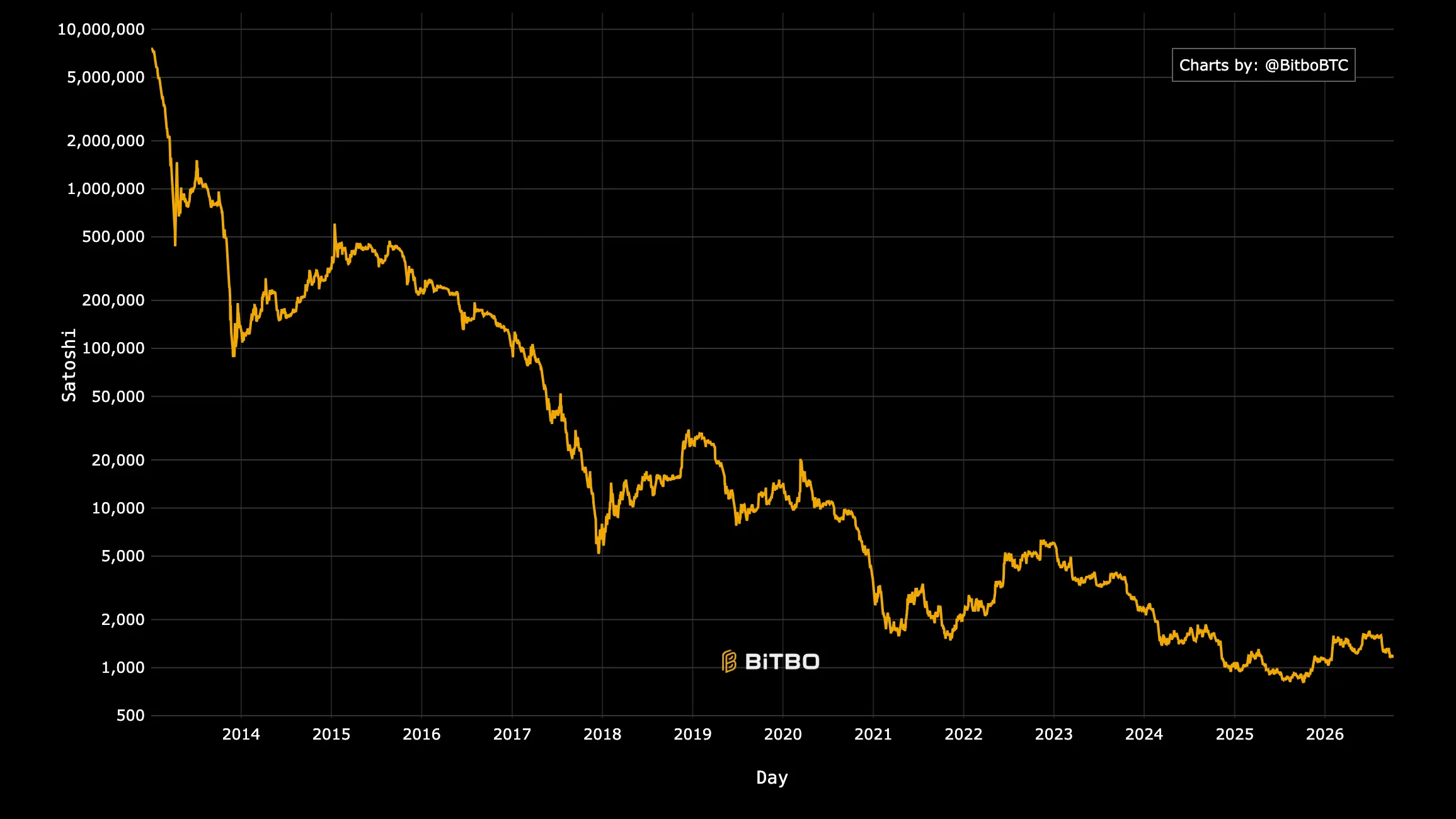
Satoshis have a fixed relationship to BTC but a variable relationship to USD, just like the original unit. The satoshi count does not change, but its dollar value moves with the Bitcoin price.
Current Bitcoin Price Formula
Since satoshis are a fixed fraction of a bitcoin, their dollar value depends on where BTC is trading at the moment of conversion.
Two formulas cover both directions:
- USD value of sats = (sats ÷ 100,000,000) × BTC_price_USD
- sats for a USD amount = (USD_amount ÷ BTC_price_USD) × 100,000,000
Here:
- sats is the satoshi amount being converted;
- BTC_price_USD is the current market price of one bitcoin in dollars;
- USD_amount is the dollar figure being converted into sats.
Worked example if we assume BTC = $80,000:
- 50,000 sats ÷ 100,000,000 = 0.0005 BTC
- 0.0005 BTC × $80,000 = $40
Because BTC acts as the unit of account here, plug in the live BTC price at the moment you check the conversion. The same two-step logic will hold.
A precision note: wallets and exchanges typically round fiat values to two decimal places. Therefore, a very small sat balance can show as $0.00 even though it technically has fractional-cent value. If the figure looks like it disappeared, switch the display to sats or BTC before assuming something is wrong.
1 Satoshi in USD
The value of 1 satoshi in USD is best expressed as a formula: 1 sat in USD = BTC_price_USD ÷ 100,000,000
At most realistic BTC prices, this is a tiny fraction of a cent. That is why a single sat can appear as $0.00 in apps that use standard currency formatting.
1,000 Satoshis to Bitcoin
1,000 sats = 0.00001 BTC
The check is simple: since 100,000,000 sats make 1 BTC, shifting the decimal point for 1,000 sats gives you 0.00001 BTC.
1,000,000 Satoshis to Bitcoin
1,000,000 sats = 0.01 BTC
Since 1,000,000 is one-hundredth of 100,000,000, the result lines up with 0.01 BTC. This is the amount stacking a million sats will get you.
Dollar Amounts to Satoshis
Using the same hypothetical price as above — BTC = $80,000 — common dollar amounts convert into sats as follows. Although not the case for this example, figures should be rounded to the nearest satoshi because fractional sats do not exist on-chain.
- $1 → (1 ÷ 80,000) × 100,000,000 = 1,250 sats
- $5 → (5 ÷ 80,000) × 100,000,000 = 6,250 sats
- $10 → (10 ÷ 80,000) × 100,000,000 = 12,500 sats
- $100 → (100 ÷ 80,000) × 100,000,000 = 125,000 sats
These figures shift as soon as BTC_price_USD changes, so treat them as a snapshot tied to the $80,000 example rather than fixed reference points.
One gotcha is worth flagging: double-check whether a converter output is labeled in sats or BTC before using it elsewhere. Mistaking 0.0001 BTC for 0.0001 sats is not a small rounding error — it is a 100,000,000x unit error. 0.0001 BTC is actually 10,000 sats, not a fraction of one. Always confirm the unit label, not just the number.
Bitcoin Supply in Satoshis
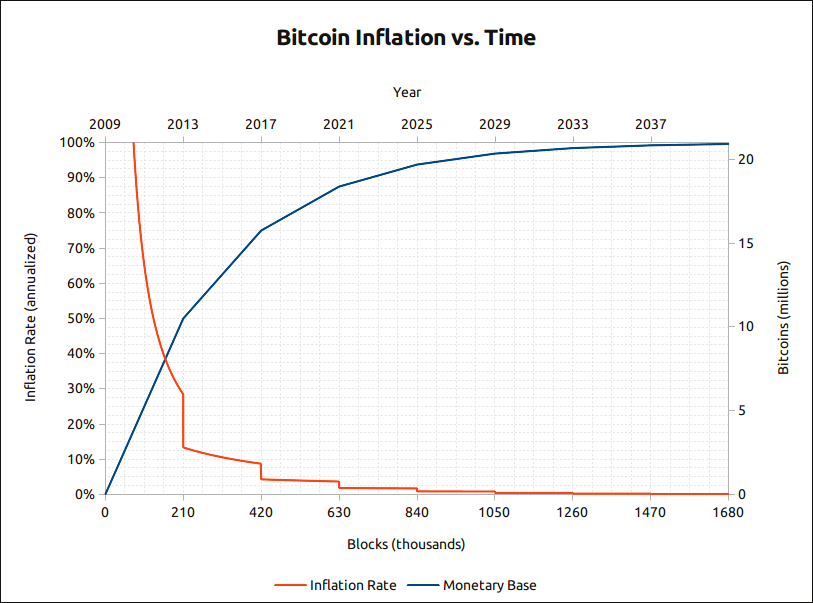
Bitcoin scarcity is usually discussed in BTC, but the same cap can be expressed in satoshis. Changing the denomination changes the count; it does not change the capped supply.
21 Million Bitcoin Supply Cap = 2.1 Quadrillion Total Satoshis
Bitcoin’s protocol enforces a hard cap of 21 million BTC as the maximum supply that will ever exist (not to be confused with circulating supply of currently mined coins).
Since each bitcoin divides into 100,000,000 satoshis, the same 21 million cap can be expressed entirely in sats: 21,000,000 × 100,000,000 = 2,100,000,000,000,000 satoshis
Spoken aloud, that is 2.1 quadrillion sats. Writing out the full integer with separators helps avoid misreading the zeros, while the spoken form gives a faster scale check.
This is not just a conceptual exercise. Bitcoin Core defines this exact figure as the MAX_MONEY constant, the canonical implementation-level ceiling on total satoshis that the reference client enforces. In other words, the 2.1 quadrillion sat cap is not just a derived explanation; it is the literal value the network’s consensus code treats as the upper bound.
Scarcity at the Satoshi Level
Satoshis are the smallest denomination of the same asset, so the scarcity argument that applies to 1 BTC applies identically, just scaled down, to any amount of sats. The cap is on total units of value, not on how finely those units are sliced.
For example: 10,000,000 sats = 0.1 BTC
That amount works out to roughly 0.00000476% of the total 2,100,000,000,000,000 sats defined by MAX_MONEY. The percentage is tiny, but it is scarce in proportional terms for the same reason a larger BTC balance is scarce: the ratio to the capped total remains fixed regardless of which unit you use.
The sheer size of the satoshi count — 2.1 quadrillion units — does not make Bitcoin’s supply effectively infinite or inflationary. Divisibility only changes the size of the unit being counted. It does not add value to the supply. Whether measured in BTC or sats, the ceiling is the same fixed quantity.
Satoshi Use Cases
Sats are not just a cleaner way to write small numbers. They are the practical unit for many Bitcoin interactions where BTC decimals become unreadable or error-prone.
Everyday Bitcoin Transactions
Sats show up most naturally in small, everyday payments where pricing in BTC would mean staring at a string of leading zeros.
Buying a coffee or small item. A $4 coffee currently converts to around 4,640 sats or 0.0000464 BTC. Typing “4,640 sats” into a wallet is easier to read and verify than “0.0000464 BTC,” which is why crypto payment providers often default to sats for purchases in this range.
Splitting a bill with friends. If a shared dinner comes out to 20,000 sats per person or 0.0002 BTC, sending that whole-number amount avoids the awkwardness of asking someone to “send me zero point zero zero zero two bitcoin.” Whole sat figures are simply less error-prone to read aloud or type into a send field.

Tipping for content or a service. A tip of 1,000 sats or 0.00001 BTC is a sensible denomination in tipping culture. Wallets favor sats here because tipping amounts are often small and repetitive, and fewer decimal places means fewer chances to fat-finger an extra zero.
In each case, the reason is the same: sats let wallets display small values as clean whole numbers instead of long decimal strings.
Lightning Network Micropayments
On-chain Bitcoin transactions settle directly on the blockchain and are typically used for larger or less frequent transfers. The Lightning Network is a payment layer built for sending value quickly and cheaply off-chain, with final balances reconciled on-chain later.
Lightning tends to be used when payments are small and frequent:
- streaming tips;
- pay-per-article content;
- in-app micropayments;
- small transfers where speed matters.
In that context, expressing amounts in sats is more natural than working in BTC decimals. As with any cryptocurrency payment method, the practical check is whether both sender and receiver support the network and whether instant settlement matters. For larger, infrequent payments where neither side needs speed, a standard on-chain Bitcoin transaction is often the simpler choice.
Stacking Sats
Speaking of “stacking sats” we dropped earlier, it describes the habit of gradually accumulating Bitcoin in small increments rather than buying it all at once. In practice, this can look like:
- scheduled recurring buys, where a fixed dollar amount is converted into sats on a regular basis;
- auto-roundup features, where everyday purchases are rounded up and the difference is swept into sats;
- periodically consolidating many small UTXOs into fewer, larger outputs to keep a wallet easier to manage.
That consolidation step is a concept worth knowing, not something to execute blindly. It can affect privacy and fee efficiency depending on timing and wallet behavior.
The important distinction is that stacking sats is a unit preference. The asset being accumulated is still BTC; it is simply tracked and discussed in smaller, whole-number increments. This framing is why the habit resonates. Saying “I added 15,000 sats this week” is easier to process than tracking a small fractional BTC decimal.
Fees, Dust Limits, and Practical Limits
Satoshis also appear in the less glamorous side of Bitcoin: fees, dust, and minimum practical transaction amounts. This is where the difference between protocol possibility and economic practicality becomes visible.
In Bitcoin terminology, “dust” refers to a transaction output so small that it is typically uneconomical to spend once fees are factored in. The cost to move it can exceed the value it represents. Payments of less than 546 satoshi are usually referred to as dust and are generally not relayed or mined, though this exact threshold is a commonly cited policy default that can vary across nodes and software versions.
Every Bitcoin transaction carries a transaction fee, and that fee is often calculated based on a fee rate expressed in sats per virtual byte (vbyte) rather than as a flat amount. For very small sat amounts, the fee required to move a UTXO can exceed the value being sent. At that point, spending the output can be impractical or pointless from a cost standpoint.

Because of this dust limit and fee dynamic, many wallets prevent users from creating dust outputs, or warn when an amount falls below what is practically spendable. In day-to-day use, expect minimum send and receive thresholds to vary depending on wallet software and current network conditions rather than a single fixed number across all of Bitcoin.
One final unit issue: some apps quote fees and mempool conditions in sats per vbyte, which is a different “sats” context than a payment amount. One measures data size on the blockchain; the other measures value being sent. Do not confuse a high fee rate reading with a large payment figure when reviewing wallet or mempool data.
Conclusion
So far we have established the core rule: 1 Bitcoin equals 100,000,000 satoshis. From that point, most conversions are decimal placement rather than complex math. Divide sats by 100,000,000 to get BTC; multiply BTC by 100,000,000 to get sats.
The larger lesson is that satoshis make Bitcoin more usable. They reduce the cognitive load of reading small payments, make Lightning Network amounts easier to communicate, help users track incremental accumulation, and clarify how the 21 million BTC supply cap translates into 2.1 quadrillion smallest units.
In summary, sats do not change what Bitcoin is. They make its smallest usable unit visible.
Learn more to go beyond the Bitcoin basics in our blog! Subscribe to updates and insights from the ChangeHero team on social media: X, Facebook, and Telegram.
Frequently Asked Questions
How many satoshis are in a Bitcoin?
There are exactly 100,000,000 satoshis in 1 Bitcoin (BTC). Conversely, 1 satoshi equals 0.00000001 BTC, making it the smallest on-chain unit recognized by the protocol.
How much is 1 Satoshi in USD?
The USD value of 1 satoshi is not fixed. It moves continuously with the live BTC/USD market price. Use this formula:
BTC_price_USD ÷ 100,000,000Most wallets and exchanges round fiat figures to two decimal places, so a single sat can show as $0.00 even though it technically has fractional-cent value.
Can you buy less than one Bitcoin?
Yes, you can buy less than one Bitcoin. Most exchanges and many wallets support fractional BTC purchases because Bitcoin is divisible down to the satoshi level. Always confirm which unit is displayed at the moment of purchase or withdrawal — BTC or sats — because misreading the label can cause a 100,000,000x magnitude error.
Can you send 1 satoshi?
In principle, yes. Bitcoin’s protocol lets amounts be denominated down to a single satoshi. In practice, on-chain relaying, mining policies, and wallet-level restrictions can prevent extremely small outputs from being broadcast or accepted. The practical floor depends on dust limits, fees, wallet software, and network conditions.