
What Does HODL Mean in Crypto? Definition & Explanation

Key Takeaways
- ✊ HODL means intentionally holding a cryptocurrency or digital asset through market volatility instead of reacting to short-term price swings;
- ✊ The term started as a typo in a 2013 Bitcointalk post by GameKyuubi, then later gained the backronym “Hold On for Dear Life”;
- ✊ HODLing is not the same as active trading, staking, or a formal order type. It is a behavioral stance built around long-term conviction, risk tolerance, and resistance to panic selling;
- ✊ A serious HODL strategy still needs position sizing, custody planning, review cadence, and exit triggers. “Never selling” is not a strategy.
Disclaimer
Nothing on this page constitutes investment advice, tax advice, or a recommendation to buy, sell, or hold any cryptocurrency. Crypto assets are volatile, and HODLing can involve large drawdowns, long underwater periods, and permanent capital loss if the asset thesis fails. Tax treatment depends on jurisdiction, holding period, lot selection, and reporting rules, so readers should consult a qualified tax professional before making sale decisions.
HODL Meaning
Over the years, it has come to mean more than just “hold” in crypto circles. HODL in particular describes the practice of deliberately retaining a cryptocurrency or digital asset through periods of market volatility rather than selling in response to short-term price drops or spikes. It is a stance taken by investors who choose patience over panic when prices swing.
In other words, HODL is not a formal trading rule with defined entry and exit points. It is usage-based crypto slang that describes a behavior and mindset. While the term is most closely associated with Bitcoin, it is used across the broader cryptocurrency and blockchain space to describe holding any digital asset through turbulent price action.
“Hold On for Dear Life” Backronym
If you think it stands for “Hold On for Dear Life”, this actually is a backronym, not the original acronym. The phrase was fitted to the existing word “HODL” after the term was already in circulation, rather than the other way around.
That does not make the phrase useless. It works as a mnemonic and community in-joke that reinforces the core idea: stay the course during market volatility instead of selling out of fear. However, it is not where the word came from.
HODLer Meaning
If HODLing turned into a verb means holding through it all, a HODLer is someone who does so through price swings rather than trading in and out based on short-term movements or even long-term. What qualifies someone as a HODLer is not a single transaction but a repeated pattern: choosing to hold through drawdowns and rallies alike instead of reacting to every candle on the chart.
Pronunciation and Spelling Variations
You will encounter the term in several forms:
- HODL
- hodl
- HODLing / hodling
- HODLer / hodler
All refer to the same underlying concept, with capitalization varying by context or writer preference. Pronunciation-wise, it is typically read as “hodl,” rhyming loosely with “waddle,” although some say it closer to “hold” because that is the word it echoes.
Hodl Hodl Platform vs HODL Term
“Hodl Hodl” is a proper noun — the name of a peer-to-peer cryptocurrency platform. “HODL” is the slang term describing the hold-through-volatility behavior.
These are unrelated beyond sharing similar letters. Using capitalization consistently helps avoid confusion: HODL for the term, Hodl Hodl for the platform or brand.
In a sentence: HODL is crypto slang for choosing to keep your Bitcoin or other digital assets rather than selling when the market gets rocky.
Origin of HODL
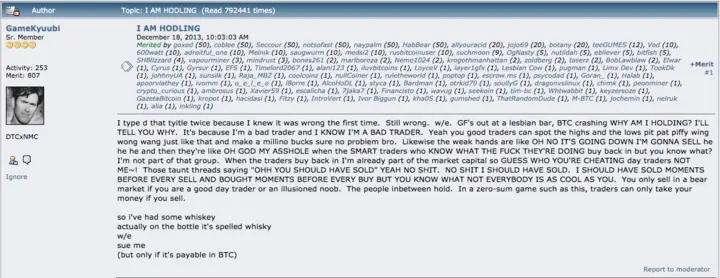
The term traces back to a single, specific moment in Bitcoin’s history. On 18 December 2013, a user going by the handle GameKyuubi published a post on the Bitcointalk forum titled “I AM HODLING.”
The post appeared on a day when Bitcoin was in freefall. The price had dropped from roughly $716 to $438, a decline of about 39%, over a short span. That same-day drawdown is why the post struck a nerve: it was written in the heat of a panic, by someone openly admitting they were too rattled, and reportedly had been drinking, to spell “holding” correctly — yet still defiantly refusing to sell.
From Typo to Meme
First, GameKyuubi misspelled “holding” as “HODLING” in the heat of the moment. Second, other users on Bitcointalk and beyond started quoting and repeating the misspelling, not to correct it, but because it captured a feeling the community recognized: holding on through market volatility even when everything says to sell. Third, through that repetition, the typo stabilized into a meme-term with its own identity.
In other words, HODL did not start life as an acronym. It began purely as a misspelling. The “Hold On for Dear Life” interpretation came later, invented by the community after the meme had already spread.
Crypto Community Rallying Cry

Today, “HODL” functions less as a literal instruction and more as a social signal within the crypto community.
A few common uses:
- As a caption or comment during a sharp drawdown — someone posts “HODL” under a red candle chart as a way of signaling calm rather than panic.
- As a label for conviction — traders or investors describe themselves as “HODLers” to communicate that they are not easily swayed by short-term price action.
- As a shorthand for refusing to be shaken out — when a community member sees others selling in a downturn, dropping “HODL” in a thread or group chat is a quick way of saying, “I am not budging.”
What started as a single typo on a Bitcointalk forum during a brutal Bitcoin crash has become a shared piece of community identity. It lets people signal, to each other and to themselves, that they intend to hold through volatility rather than react to it.
“Diamond hands” that originated on r/WallStreetBets shares a similar origin, viral spread and even meaning. The differences are pretty superficial: “diamond hands” was never crypto-specific in the way HODL is, and it is a more recent term that sprung in slightly different circumstances.
HODL Philosophy
To Bitcoiners, HODLing is not just a term. It is a mindset built on a specific set of beliefs and behavioral commitments. Its main purpose is to protect the holder from panic, impulsive timing decisions, and the emotional noise that floods the crypto community during sharp price swings.
Long-Term Value Belief
At its core, HODL philosophy draws a line between two very different mental postures.
The first is believing in an asset’s underlying thesis playing out over multi-year market cycles, treating short-term price action as noise layered on top of a longer trajectory. The second is reacting to short-term price discovery, where every uptick or downtick is treated as new information that demands a response.
HODLing deliberately sits in the first camp.
HODLer’s attention tends to gravitate toward long-horizon catalysts rather than daily price movement. For example:
- Adoption and utility growth — more real-world usage, merchants, or applications building on top of a network over time.
- Network effects — the idea that a protocol or asset becomes more valuable as more participants, developers, and liquidity accumulate around it.
- Protocol development — ongoing technical upgrades, scaling improvements, or ecosystem expansion that unfold over years, not days.
This is not yet the question of how to pick which coins to hold or how to structure a portfolio around these catalysts. That discussion belongs under HODL as Strategy. The point here is simpler: HODL philosophy orients belief toward slower-moving signals instead of short-term price discovery.
Practically speaking, conviction means pre-committing to a time horizon before volatility hits and accepting that volatility itself is the cost of exposure to the asset. The conviction is set before the storm, not during it.
Panic Selling Avoidance
HODL philosophy is specifically built to resist one recognizable decision pattern: selling after a sharp drawdown just to “stop the pain,” only to watch the asset recover later.

The sequence is familiar:
- Price drops sharply;
- The holder sells out of emotional discomfort;
- The market rebounds without them;
- A paper loss becomes a realized loss, and the recovery is missed.
However, avoiding panic selling does not mean a HODLer can never sell under any circumstances. Selling on sharp surges is part of the philosophy too, although not a central one. The key distinction is between an emotion-driven exit and a reasoned plan. Selling because the drawdown feels unbearable is not the same as selling because a predefined trigger has been reached.
Market Timing Rejection
“Timing the market” normally describes frequent in-and-out trading based on short-term predictions — trying to sell before a dip and buy back before a rally, repeated again and again based on guesses about near-term direction.
HODL philosophy rejects this approach in favor of simply holding through volatility in either direction. The belief is that consistently predicting short-term moves is unreliable and that the attempt itself introduces more risk than it removes.
This is not a discussion of dollar-cost averaging, rebalancing, or specific entry tactics. Here, the rejection of market timing is purely a mindset: do not try to out-guess short-term price action.
The catch is obvious but worth stating directly. Crypto volatility can be extreme, with price swings exceeding 20% in a single day, according to sources like Investopedia. That is precisely why this mindset leans so heavily on emotional discipline. Rejecting market timing only works if the holder can genuinely tolerate large interim drawdowns without abandoning the plan midway through.
FUD and Diamond Hands
Two pieces of community shorthand capture the emotional pressure HODL philosophy is designed to withstand: FUD and diamond hands.
FUD — fear, uncertainty, and doubt — refers to the wave of negative sentiment, rumors, or alarming headlines that can make holders question their thesis during a downturn. Diamond hands describes the opposite instinct: holding firm through that pressure instead of folding.
There is a necessary distinction here. Diamond hands as a concept is meant to signal conviction, not denial. Holding through FUD because you have reasoned through the thesis and accepted the volatility is different from refusing to reconsider anything regardless of new information. One is steadfastness; the other is just stubbornness wearing the same label.
As Milk Road notes, a hodler may have to watch a portfolio drop 50% or more without selling. That is where the diamond hands idea faces its real test, well beyond tolerating a rough week in Bitcoin’s price chart.
HODL Strategy
Turning HODL from a mindset into a strategy means being explicit about when it applies, how to structure the mechanics around it, and what trade-offs are accepted by choosing to hold rather than act.
Suitable Market Conditions

Despite the original intent, HODL tends to be a more reasonable fit when the following checks come back “yes.” Treat them as self-assessment questions, not motivational prompts:
- Multi-year time horizon: Can you honestly say you will not need this capital for at least 3–5 years, regardless of what the market does in between?
- Tolerance for deep drawdowns without forced selling: If the position dropped 60–80% tomorrow, would you be able to leave it alone rather than liquidating?
- Low near-term liquidity need: Is this money separate from funds earmarked for rent, debt payments, emergencies, or any other fixed obligation?
- Willingness to ignore short-term catalysts: Can you skip reacting to a single bad headline, a regulatory rumor, or a 20% single-day move without checking the chart every hour?
- No reliance on leverage to hold the position: Is the asset fully owned outright, with no margin or borrowed capital keeping it in place?
A HODL plan typically breaks down in predictable ways. Leverage or margin exposure is one of the most common: if the position is financed with borrowed funds, a drawdown can trigger a margin call or forced liquidation regardless of your intentions. The “hold through volatility” premise never gets tested because the position is closed for you.
Needing cash on a fixed deadline is another failure mode. A holder who must fund a deadline-driven expense is forced to sell at whatever price the market happens to offer that day, which turns a long-term thesis into an involuntary short-term trade. Overconcentration in a single volatile asset compounds both problems, since a large drawdown in one position can force a sale even when the broader portfolio is fine.
This is why HODL is easiest to execute when the capital involved has no fixed-timeline obligation attached to it. The strategy depends on the holder being free to wait, not just willing to.
Portfolio and Wallet Practices
A minimal, repeatable workflow separates four decisions that are often blended into one vague “just hold it” instruction:
- Choose target allocation or position size — decide what percentage of your overall portfolio this HODL position represents before adding to it, so sizing is deliberate rather than accidental.
- Choose a custody approach — decide between leaving the asset on a crypto exchange, which is convenient but means the exchange controls the keys, versus moving it to a non-custodial wallet, where you hold the private keys directly.
- Choose storage tiering based on access needs — split holdings between a hot wallet, which is connected and easier to access, and a cold wallet, which is offline and used for the bulk of long-term holdings you do not intend to touch.
- Set a review cadence — pick a fixed interval, such as quarterly, to check the position and portfolio weighting rather than checking prices daily.
Additionally, portfolio hygiene matters more as the holding period stretches across years:
- Track cost basis per purchase lot — price, date, and amount — so future selling or tax reporting does not require reconstructing history from memory.
- Keep a written record of which addresses, wallets, or exchange accounts hold which assets.
- Note which wallet or custody method each position lives in, especially if holdings are split across a crypto exchange and a non-custodial wallet.
- Pre-commit to what would make you add to the position, such as a specific price level or dollar-cost averaging schedule, versus what would make you do nothing.
- Avoid ad hoc transfers between hot and cold storage outside your planned review cadence; each move is a chance to introduce error or drift from the plan.
- Revisit your original thesis at each review point, not to second-guess it reactively, but to confirm it still holds.
Dollar-Cost Averaging Pairing
Dollar-cost averaging and HODL serve two different jobs in the same plan. DCA is the entry and accumulation mechanism — how you build the position over time. HODL is the holding and exit restraint — what you do, or rather do not do, once the position exists.
They pair naturally because DCA removes the pressure to pick a single “right” entry price, and HODL removes the pressure to pick a single “right” exit moment.
A few example schedules:
- Weekly: a fixed dollar amount purchased every week, regardless of price.
- Biweekly: the same fixed amount every two weeks, aligned with a pay cycle.
- Monthly: a single fixed purchase once a month, suited to holders who want fewer transactions to track.
One rule matters more than the schedule itself: keep the cadence constant through volatility. Pausing purchases because prices dropped, or doubling up because prices spiked, undermines the reason DCA was chosen in the first place. Consistency, not timing, is the mechanism doing the work.
This combination can still mislead. DCA reduces timing risk — the risk of putting a lump sum in at a single bad price — but it does not eliminate drawdowns, and it does not guarantee profit. A consistent purchase schedule paired with a HODL mindset still depends entirely on the underlying asset’s thesis playing out and on the holder’s time horizon being long enough to see it through.
Benefits, Risks, and Trade-Offs
Treating HODL as a strategy has real advantages, but they are not free. The trade-off is lower decision churn in exchange for accepting long periods of uncertainty.
Benefits:
- Reduced transaction churn → fewer buy/sell actions means fewer fees, fewer taxable events to track, and less operational overhead.
- Reduced decision fatigue → not re-evaluating the position daily frees up mental bandwidth for other decisions.
- Avoiding whipsaw from short-term volatility → sitting out the back-and-forth of short-term price swings reduces the chance of selling low and buying back high on the same asset.

Risks and trade-offs:
- Opportunity cost vs. redeploying capital → capital locked into a HODL position is not available to deploy into other opportunities that may arise.
- Concentration risk → holding a large position in a single volatile asset means its fate is disproportionately tied to that one asset’s performance.
- Long underwater periods → multi-year bear markets can leave a position below its purchase price for extended stretches.
- Psychological toll of large drawdowns → watching a position drop sharply and stay down is genuinely difficult, even when the plan calls for it.
Time horizon is not a fixed input you set once and forget. Circumstances change, and a horizon that made sense years ago may not still apply. HODL is a holding rule, not a permanent one, and even the most committed holding plan still needs pre-defined exit triggers.
Selling After HODLing
Even the most committed HODLer, unless completely unreasonable, eventually needs a framework for selling. That is not a betrayal of the strategy; it is its logical completion. Holding without any exit plan is conviction but at its worst.
Profit-Taking Triggers
The point of defining triggers before volatility hits is straightforward: decisions made in a calm moment are more reliable than decisions made while staring at a red or green candle.
A workable trigger set separates cleanly into price-based, time-based, and thesis-based categories:
- Price-based: If the asset reaches a pre-set price level, then sell a predetermined portion of the position.
- Price-based allocation drift: If the position’s allocation exceeds a set percentage of the total portfolio, for example growing from 10% to 25%, then sell enough to return to target.
- Time-based: If a set holding period elapses, such as annually at a fixed review date, then reassess position size regardless of price action.
- Time-based horizon check: If the original time horizon set at purchase has passed, then decide deliberately whether to continue holding or begin reducing exposure.
- Thesis-based: If a thesis-breaking event occurs, such as the underlying network being abandoned or a core assumption behind the investment no longer holding, then reduce or exit the position.
- Thesis-based confirmation: If the original long-term thesis plays out as expected and the catalyst has materialized, then treat that as a legitimate, pre-planned reason to take profit.
One useful pattern is scaling out in tranches rather than selling the entire position at once. For example, a holder might plan to sell 20% of the position at each of several predetermined price thresholds as the asset rises, rather than trying to pick a single “best” exit point.
This tranche plan is not an attempt to predict the market top. It is a mechanism for controlling position size reduction in a structured way, so no single decision carries the full weight of being right or wrong.
Rebalancing and Liquidity Needs
Selling for portfolio management or liquidity reasons looks very different from panic selling, provided it follows a repeatable process.

A simple, platform-agnostic workflow:
- Identify the constraint. Determine whether the sale is driven by allocation drift or a near-term cash need.
- Calculate the amount to sell. Express this both in units of the asset and as a percentage of the current position, so the sale size is explicit rather than approximate.
- Choose an execution method. Decide between a single market or limit order versus staged orders executed over several intervals, depending on position size and price sensitivity.
- Define what “done” looks like. For a rebalancing sell, done means the position allocation is back within its target band. For a liquidity sell, done means the required cash reserve has been restored.
A useful way to separate a rebalancing sell from a panic sell is to look at observable intent and process rather than the outcome. The former follows a pre-planned target band or known cash need. The latter is a reaction to a price candle or wave of market sentiment, with the amount and timing decided at a given moment. Same action — selling — but a completely different process behind it.
Much of what forces a HODLer into an unplanned sale during a drawdown can be prevented with liquidity planning done well before volatility appears:
- Maintain a separate emergency fund outside of crypto holdings.
- Avoid leverage or margin on the position, since borrowed capital introduces liquidation risk.
- Size the position so it does not represent money needed for a known, upcoming expense within the planned holding period.
- Keep a portion of the portfolio in stable, liquid assets separate from the HODL position.
- Revisit liquidity needs at each portfolio review, adjusting position size proactively rather than reactively if circumstances change.
Tax Implications
Taxes change the real economics of a sale, which is why they belong in any exit plan rather than being an afterthought.
A gain only becomes taxable once it is realized or more simply, sold. Before that point, the gain is an unrealized gain that exists on paper but has not triggered any tax consequence yet. Once a cryptocurrency is sold, the realized gain gets measured against its cost basis: the original price paid for that specific unit, including any fees.
Because a position is often built from multiple purchases at different prices and dates, each purchase forms its own lot. Choosing which lot to sell directly affects the capital gains calculated on that sale.
How long a given lot was held also matters. As a general rule of thumb, holding an investment for more than a year may qualify it for long-term capital gains tax treatment, which is often taxed more favorably than a short-term gain. However, the specifics depend heavily on jurisdiction and should be confirmed against local rules rather than assumed.
Before selling anything, it is worth choosing a lot-identification method, such as first-in-first-out or specifically identifying which lot is being sold, and keeping exportable records of purchase dates, prices, and amounts.

The timing gotcha is simple: the same nominal profit can produce very different after-tax outcomes depending on which lot is sold and how long it was held.
Say a holder bought one unit of an asset for $100 a year and a half ago, and another unit for $400 three months ago, and the asset is now worth $600. Selling the older lot realizes a $500 gain, likely taxed at the long-term rate. Selling the newer lot realizes a $200 gain, but taxed at the short-term rate, which is often higher.
Same asset, same current price — different lot choice, different taxable gain, different treatment. That is not a reason to avoid selling. It is a reason to know which lot is being sold before the order goes through.
In summary, triggers, workflows, and tax mechanics are what separate a HODL strategy from a HODL meme. A plan for how and when to sell is what makes holding a deliberate choice rather than inertia.
HODL Compared With Other Investing Strategies
HODLing on its own is only half the picture. The real test is knowing when it is the right tool and when a different approach fits better.
HODL vs Active Trading
HODL and active trading start from opposite assumptions about where returns come from, and that single difference cascades into everything else.
- Primary edge assumed: Active trading assumes an edge in timing and skill — the ability to read short-term price action and act faster or more accurately than the market. HODL assumes patience and conviction in a long-term thesis matter more than timing entries and exits.
- Workload and operational complexity: Active trading requires near-constant monitoring, familiarity with order types such as limit, stop-loss, and trailing stop, and disciplined recordkeeping for every position opened and closed. HODL requires a review cadence measured in months or quarters, not minutes.
- Error modes: The characteristic failure in active trading is overtrading — getting whipsawed by volatility, entering and exiting positions based on noise rather than signal, and compounding small losses through fees. The characteristic failure in HODL is holding through a genuine thesis break.
- Cost drag categories: Active trading accumulates fees, spreads, and slippage across a high volume of transactions. HODL’s cost is mostly opportunity cost: capital sitting in one position instead of being redeployed elsewhere.
Before choosing a side, answer honestly:
- Can you realistically commit time daily to monitoring price action and news flow?
- Are you comfortable absorbing frequent small losses as a normal cost of an active approach?
- Do you need near-term liquidity that active trading’s in-and-out cycles would help provide?
- Can you execute calmly under fast-moving volatility, placing and adjusting orders in real time without hesitation?
- Would losing access to markets for a few hours create meaningful stress about missed trades?
A majority of “no” answers points toward HODL. A majority of “yes” answers suggests active trading may suit your temperament and schedule better. For pointers on how to start trading crypto, read our guide!
HODL vs Buy and Hold

These two terms are used interchangeably so often that the distinction is worth drawing precisely. It is a difference in terminology and context more than tactics.
“HODL” is crypto-native slang with a cultural and behavioral connotation. It carries meme history, community signaling, and a specific defiance toward panic selling during drawdowns.
“Buy and hold” is the broader, older label used across traditional investing — stocks, index funds, bonds — to describe a long-term, low-turnover posture without the same cultural baggage.
The second distinction sits in discipline mechanics. HODL implies holding through unusually sharp volatility while absorbing community signaling: the FUD, the diamond-hands rhetoric, and the social pressure in both directions. Buy and hold may still involve scheduled rebalancing or periodic thesis reviews as a normal part of the strategy, without the same expectation of white-knuckling through extreme single-asset swings.
Over a long enough horizon with low turnover, a HODL position and a traditional buy-and-hold position look functionally identical — capital committed once, left alone, and reviewed infrequently. At the same time, crypto’s narrative-driven swings and the speed at which sentiment shifts can push HODL into territory buy and hold rarely encounters. A position can move sharply within a single trading session, driven by a headline or social-media narrative rather than earnings or macro data.
HODL vs Staking
Given that the term originated in 2013, staking as a more recent phenomenon would not be a natural part of its original meaning. Staking is an on-chain participation mechanism — committing assets to help secure or validate a network — that may generate yield in return. That yield component changes the comparison.
- Return profile: HODL offers exposure to price movement alone. Staking adds a yield component on top of price exposure, meaning returns come from appreciation or depreciation plus staking rewards.
- Liquidity constraints: Staked assets are frequently subject to lockups or unbonding periods before they can be withdrawn or sold. That can directly clash with a “hold freely” HODL posture.
- Added operational risk: Staking introduces risks pure holding does not carry — smart contract vulnerabilities, validator slashing penalties, or protocol-level failures — on top of market risk.
Before calling staking “HODLing,” ask two questions:
- Can I withdraw at will, or am I locked into an unbonding period?
- What new risks — smart contract, validator, or protocol-level — am I accepting in exchange for the yield?
If the answer to the first is “no” and the second has a real answer attached, you are not simply HODLing anymore. You have taken on a different risk profile in pursuit of additional return.
HODL Across Cryptocurrencies and Stocks
HODL behavior maps onto stocks in a fairly direct way, which manifested in the term “diamond hands.” A long-term equity holder who ignores quarterly noise and rides out drawdowns is practicing something that closely resembles traditional buy and hold, just without the crypto-specific slang attached to it.
The underlying discipline transfers cleanly between asset classes: patience, a long time horizon, and resistance to reactive selling.

What makes crypto HODLing distinct is a set of structural differences stocks do not share. Crypto markets trade 24/7, with no closing bell to pause volatility overnight or over a weekend. Retail-driven sentiment swings tend to be larger and faster than in equities, often amplified by social media narratives. Self-custody is possible through a non-custodial wallet rather than relying on a brokerage. Token-specific mechanics, like forks or airdrops on networks such as Ethereum, can also alter a position’s composition during a long holding period in ways a share of stock never does.
These differences matter for portfolio diversification decisions. Crypto’s always-on volatility and liquidity profile behave differently enough from equities that treating them identically in a broader portfolio can understate the real risk being taken on.
For further comparison between crypto vs stocks, check out our article.
| Strategy Pair | Time Horizon | Effort / Attention | Primary Risks | Best Fit For |
|---|---|---|---|---|
| HODL vs Active Trading | Multi-year vs. intraday-to-weeks | Quarterly review vs. daily/hourly monitoring | Holding through a broken thesis vs. overtrading and whipsaw losses | Investors with conviction and limited time vs. those who can actively manage positions |
| HODL vs Buy and Hold | Functionally equivalent at long horizons | Similar once converged; differs in community signaling exposure | Narrative-driven crypto swings vs. standard market risk | Crypto-native holders seeking cultural framing vs. traditional long-term investors |
| HODL vs Staking | Same horizon, but liquidity window shrinks with staking | Slightly higher setup effort for staking, including lockup terms and validator choice | Price risk alone vs. price risk plus smart contract/validator risk | Those wanting pure exposure vs. those willing to trade liquidity for yield |
| HODL Across Cryptocurrencies and Stocks | Comparable long-term horizon in both | Similar low-touch approach once established | Token-specific events, forks/airdrops, and 24/7 volatility vs. standard equity market risk | Holders diversifying across asset classes with different liquidity and custody needs |
Conclusion
Long story short, HODL is the same as “hold”, just with crypto-specific baggage. Attempts were made to recapture this cultural moment but none have stuck like this one. It is safe to say that this part of the crypto dictionary is one that unites crypto OGs and newcomers alike.
How is your HODLing journey going? Let us and other crypto enthusiasts know in the comments on our social networks: X, Facebook, and Telegram! Stay tuned to updates from the crypto market and explore other digital assets in the ChangeHero blog.
Frequently Asked Questions
What does HODL stand for?
HODL does not originally stand for anything. It began as a misspelling of “hold,” typed in a moment of panic rather than coined as an acronym.
“Hold On for Dear Life” is a later backronym, invented by the community after the term had already spread. It functions as a mnemonic or in-joke rather than the term’s true origin.
Is it good to HODL?
It depends. HODLing suits some situations and not others, so there is no universal yes or no.
The decision hinges on whether your time horizon is long enough and your tolerance for market volatility is high enough that you will not be forced into an emotional exit before your thesis has a chance to play out. If either of those is shaky, HODL may not be the right fit for that position.
Does HODL mean never selling?
No. HODL is about avoiding emotion-driven selling, not refusing to sell under any circumstances.
Selling can still be rational when it follows predefined triggers. The distinction is between reacting to fear and acting on a plan.
What does HODL mean in trading?
In a trading context, HODL means deliberately choosing not to trade short-term swings. It is conscious non-action rather than a passive default.
It is not a formal order type or technical indicator. It is a stance and a piece of community shorthand that signals intent rather than executing a specific instruction.
Can you HODL stocks?
Yes. In behavior, HODLing stocks closely resembles traditional buy and hold, since both involve holding through volatility instead of reacting to short-term price moves.
The nuance is cultural. “HODL” is crypto-native slang, so in a cryptocurrency context people say HODL. In stock contexts, the same behavior is usually called buy and hold.