Crypto vs Bitcoin: What is the Difference?

Key Takeaways
- 🆚 Bitcoin is a cryptocurrency; cryptocurrency is the broader category. Mixing those terms leads to wrong assumptions about supply rules, security models, and governance.
- 🆚 Blockchain is the technology layer, not the asset. Bitcoin runs on a blockchain, but blockchain systems can exist without any public coin.
- 🆚 Most “crypto” risk is not “Bitcoin” risk. Token risk, smart-contract risk, bridge risk, and governance risk tend to cluster outside BTC’s narrow design.
- 🆚 Access has bifurcated. You can hold BTC directly (self-custody or exchange custody) or via regulated wrappers like spot Bitcoin ETFs, each with distinct operational tradeoffs.
Three misconceptions this article corrects:
- 🆚 "Bitcoin and blockchain are the same thing" — Bitcoin runs on a blockchain, but blockchain is a technology that thousands of other networks also use.
- 🆚 "All crypto works like Bitcoin" — Supply caps, consensus mechanisms, governance models, and use cases vary dramatically across different cryptocurrencies.
- 🆚 "Coins, tokens, and stablecoins are interchangeable terms" — These are distinct categories with different technical foundations and risk profiles.
Throughout this article, "Bitcoin" or "BTC" refers specifically to the Bitcoin asset and its network. "Cryptocurrency" or "crypto" refers to the broader category of digital assets. "Blockchain" refers to the underlying distributed-ledger technology — not any single coin or network. These naming conventions hold for the entire piece.
This article is educational and does not constitute financial, tax, or legal advice; any exchanges, ETFs, or other products mentioned are cited as illustrative examples only. Tax treatment and regulatory status vary by jurisdiction — consult a qualified professional in your region before acting on any information here.
Contents
- 1. Definitions: Cryptocurrency vs Bitcoin vs Blockchain
- 2. How Bitcoin, Cryptocurrency, and Blockchain Relate
- 3. Cryptocurrency Explained (Altcoins, Stablecoins, Tokens)
- 4. Blockchain Technology Explained
- 5. History and Development (Updated Through 2026)
- 6. Investment Considerations and Key Risks
- 7. Conclusion
Cryptocurrency, pioneered by Bitcoin, is no longer a niche experiment. Global crypto owners reached 737 million as of November 2025, according to Crypto.com's 2025 Review, and Bitcoin has also gained mainstream distribution through regulated products — including U.S.-listed spot Bitcoin ETFs. Nevertheless, despite the market, which has grown into an industry, existing for at least fifteen years by now, in the mainstream, some confusion between “crypto vs bitcoin” persists. It is not helped by the fact that even some Bitcoin users insist that this dichotomy is real.

In particular, what gets mixed up is Bitcoin and blockchain, Bitcoin and Ethereum (for example, in conversations surrounding NFTs and environmental impact), and different types of digital assets that crypto and blockchain gave way to: tokens, stablecoins, etc. Before we go deeper, these confusions will be addressed.
Definitions: Cryptocurrency vs Bitcoin vs Blockchain
Cryptocurrency represents a broad category of digital assets secured by cryptography.
Bitcoin is one specific cryptocurrency operating under a fixed-supply design.
Blockchain provides the distributed ledger infrastructure that most of these assets run on.
For simplicity, think of it like the financial system at large (cryptocurrency as an asset class), a single stock like Apple within that market (Bitcoin as one specific asset), and the exchange and clearing infrastructure that settles trades (blockchain as the underlying infrastructure).
Cryptocurrency
What it is: A digital asset that uses cryptographic techniques to secure transactions and control the creation of new units, typically operating on a decentralized network rather than through a central bank or government.
What it isn't: Cryptocurrency is not a single asset, not a company's stock, and not synonymous with Bitcoin specifically or blockchain technology broadly.
The term "cryptocurrency" covers both assets used as money—think of everyday payment use cases—and tokens used for access or governance inside decentralized networks. Not every crypto asset is designed to be a currency; many exist solely to represent rights or resource claims within a particular system.
Bitcoin
Definition in one sentence: Bitcoin is a specific cryptocurrency (ticker: BTC) launched in 2009 as the first decentralized peer-to-peer digital cash system.
Design intent:
- Scarcity policy: The protocol enforces a hard maximum of 21 million BTC that can ever exist, making absolute scarcity a core and definitive attribute of the asset.
- Peer-to-peer transfer without a central operator: Transactions move directly between participants across a peer-to-peer network without requiring a bank, payment processor, or any other intermediary to authorize them.
- Conservative change process: Bitcoin's governance deliberately resists rapid protocol changes, prioritizing stability and predictability over new feature velocity.
Blockchain
Mechanism: The meaning of blockchain is a type of distributed ledger (DLT, where “T” stands for “technology”) in which data is grouped into sequentially linked blocks, each cryptographically chained to the one before it, so the historical record cannot be altered without major implications for the whole network.
How updates happen: New blocks are proposed by network participants and accepted only when the network reaches consensus according to pre-defined rules; no single party can unilaterally append data.
Why it matters: The chained, distributed structure means that no central authority holds or controls the ledger, and any attempt to rewrite history is too expensive or a waste of resources.
All of this to say, blockchain and cryptocurrency are related but distinct. A blockchain can exist without a native currency—for example, private, permissioned, or consortium chains used by enterprises or governments carry no token at all. Conversely, a cryptocurrency typically relies on a blockchain or similar distributed ledger to record ownership and transfers, but the digital asset itself and the ledger technology that underlies it are separate concepts.
How Bitcoin, Cryptocurrency, and Blockchain Relate

Short version: Bitcoin is a subset of cryptocurrency, which is itself a subset of the broader digital asset category. Bitcoin is a cryptocurrency, which are digital assets, but not the other way around. Bitcoin runs on a blockchain, but blockchain is a technology that can exist entirely without cryptocurrency.
A Quick Taxonomy Across Layers
Somewhat adding to the confusion, not all crypto assets occupy the same structural position. There are:
- Coins — a native asset of its own blockchain. Bitcoin (BTC) is the native coin of the Bitcoin network; Ether (ETH) is the native coin of the Ethereum network.
- Tokens — an asset issued on top of another blockchain rather than having its own. A governance token for a DeFi protocol built on Ethereum, for example, is a token — it inherits Ethereum's infrastructure but does not constitute a separate network layer.
- Stablecoins — a coin or token whose value is pegged to an external reference (typically a fiat currency like USD). A stablecoin can be issued natively on one chain or as a token on another; the peg mechanism, not the layer it sits on, defines it.
The key relationship: coins are the network's incentive layer; tokens depend on an existing coin network to function. Once it becomes clear, mixing them up is hard.
The Layer Model
The full stack of cryptocurrencies, from infrastructure to application, looks like this:
| Layer | What It Is | Named Entity |
|---|---|---|
| Technology Layer | The blockchain or distributed ledger protocol itself | Blockchain |
| Network Layer | Peer-to-peer nodes executing consensus rules | Peer-to-peer network |
| Asset Layer | Coins and tokens that exist and transfer value on the network | Cryptocurrency (BTC, ETH, stablecoins) |
| Application Layer | Products and services built on top — payments, trading, lending | DeFi, crypto exchange |
The table above sorts the layers so that each layer depends on the one below it. An application like a DeFi protocol cannot function without an asset layer; the asset layer cannot exist without a live network; the network has no coordination without the underlying protocol.
Common Confusions
- "Blockchain is Bitcoin." False. Blockchain is a data structure and coordination technology. Bitcoin is one asset that uses one specific blockchain. Thousands of other assets and applications use different blockchains entirely.
- "All cryptocurrencies use a blockchain." Not strictly true. Some distributed ledger systems use other architectures, such as directed acyclic graph (DAG), rather than a chain of blocks. Although not as common, they confirm that "blockchain" and "cryptocurrency network" are not synonymous by definition.
- "All blockchains are public and permissionless." False. Enterprise and institutional deployments frequently use private or permissioned blockchains, where participation requires authorization and the ledger is not openly readable. Bitcoin's blockchain is public and permissionless; many enterprise ledgers are neither.
- "Owning cryptocurrency means participating in the network." False. Holding BTC in a wallet means you own an asset recorded on the Bitcoin blockchain. Running a node or validator means you are actively participating in network consensus. These are distinct activities; most holders do neither.
Why the Relationship Matters in Practice

Practically speaking, separating the terms is necessary to prevent avoidable risk exposure: from mispricing to user errors. Protocol risk (a flaw in Ethereum's base layer) is categorically different from token risk (a flaw in a specific smart contract issuing a token on Ethereum). If you treat them as the same, you cannot correctly attribute where a failure would originate.
Unless you conflate crypto with Bitcoin, it is clear that BTC held on the Bitcoin network requires Bitcoin-compatible custody. The margin for error widens in the case of tokens: a token issued on Ethereum requires an Ethereum-compatible wallet or custodian and sometimes, token import support in the app. Sending assets to an incompatible address is a common — and usually irreversible — error that stems directly from not understanding which layer an asset lives on. Additionally, things like gas fees require you to be aware of the distinction at all times.
Cryptocurrency Explained (Altcoins, Stablecoins, Tokens)
Frankly, “crypto” becomes a misleading shorthand once you realize how many different asset types it collapses into one word. So far we have established that BTC is one coin with a specific security model and monetary policy. Everything else — altcoins, tokens, stablecoins — must be evaluated on its own rules, not by analogy to Bitcoin.
Altcoins
"Altcoin" is one of those terms that means different things depending on who is using it. In its broadest sense, an altcoin is any cryptocurrency that is not Bitcoin. In a narrower technical sense, it refers specifically to non-Bitcoin coins that run on their own independent blockchain and consensus mechanism — excluding tokens that live on top of another chain. Both meanings are in active use, which creates understandable confusion.
Altcoins broadly fall into a few functional categories:
- Payment coins — designed primarily to transfer value. Litecoin is a classic example: it forked from Bitcoin's codebase with faster block times and a different hashing algorithm, but the primary use case remains peer-to-peer payments.
- Smart-contract platform coins — the native assets of programmable blockchains. Ethereum (ETH) is the defining example. ETH is the fuel required to run all computation on the Ethereum network, from simple token transfers to DeFi protocols and NFT contracts. Solana's SOL plays an equivalent role on its own chain.
- DeFi protocol tokens — tokens that represent ownership or governance rights inside a specific decentralized finance application. These often run as smart contracts on Ethereum or competing platforms rather than on their own chains.
- Meme and speculative coins — assets whose primary driver is community momentum and narrative rather than a defined technical function. Dogecoin started as a joke but on its own proof-of-work chain, which technically makes it a coin by the strict definition.
Even if the market uses "coin" and "token" interchangeably as a marketing choice, it’s the technical definition that matters. A project will call its asset a "coin" to suggest maturity and independence, even when it is a smart-contract token on Ethereum.
Stablecoins

A stablecoin is a cryptocurrency designed to maintain a stable value relative to a reference asset — most commonly the US dollar, though pegs to other currencies, commodities (gold) and currency baskets also exist. The mechanism used to maintain that peg is the single most important variable for assessing a stablecoin's risk profile. If you are interested in learning more about what stablecoins are, read our dedicated article.
| Peg Target | Stabilization Mechanism | Typical Failure Mode (Depeg Drivers) | Transparency / Audit Expectations | Where Commonly Encountered |
|---|---|---|---|---|
| US Dollar | Fiat / treasury-backed (e.g., USDC, USDT) | Banking counterparty failure; reserve quality doubts; redemption bottlenecks | Regular attestations or audits of cash and short-term treasury reserves; should publish reserve reports | Centralized exchanges, payments, remittances |
| Crypto-collateralized (e.g., USDS) | Collateral value crash causing under-collateralization; oracle manipulation | On-chain collateral ratios publicly verifiable; governance votes on risk parameters | DeFi protocols, lending platforms | |
| Algorithmic (e.g., USDD) | Loss of confidence triggering a death-spiral between the stablecoin and its paired asset; no hard collateral backstop | Minimal traditional auditing; dependent on protocol code being open-source | DeFi, speculative yield platforms | |
| Commodity (gold) | Asset-backed (physical or tokenized) | Storage/custody failure; verification fraud; liquidity thin markets | Third-party custody audits; proof-of-reserves | Crypto exchanges, web3 wealth management |
| Currency basket | Algorithmic or mixed | Basket rebalancing failures; correlated asset drawdowns | Governance documentation; on-chain transparency varies | Experimental DeFi protocols |
Platform Tokens
Not all tokens associated with a blockchain platform serve the same function. Conflating them is one of the most common mistakes new participants make in crypto and web3 ecosystems.
Native gas assets are the base-layer cryptocurrencies required to pay for computation and transaction validation on a given network. ETH on Ethereum is the canonical example: every transaction, every smart-contract execution, every DeFi interaction on Ethereum consumes ETH as a fee. Thus, the demand for ETH is structurally tied to demand for Ethereum blockspace — as network usage grows, so does the need for the gas asset.
Application and protocol tokens are issued by specific decentralized applications or protocols running on top of a base layer. Uniswap's UNI token, for instance, runs as a smart contract on Ethereum and grants holders governance rights over the Uniswap protocol — but it is not required to use Uniswap for trading (gas in ETH still is). Therefore, the value of these tokens depends on the utility or governance rights they confer within a specific dApp, which is a narrower and often more fragile value proposition than a gas asset.
Wrapped and bridged representations are tokens that represent an asset from one chain, locked and mirrored on another. Wrapped Bitcoin (WBTC) on Ethereum lets Bitcoin be used in Ethereum DeFi, but the WBTC holder is exposed to the custodian risk from the entity holding the underlying BTC and the bridge mechanism itself. So, bridge risk is distinct from the underlying asset risk — bridge contracts have been among the largest exploit targets in crypto history.
Composability risk deserves explicit attention. In DeFi and web3, a single token's behavior can depend on a chain of smart-contract dependencies: the oracle that prices its collateral, the bridge that brought it from another chain, and the liquidity pool that enables its exchange. A failure at any link in that chain — an oracle manipulation, a bridge exploit, a liquidity withdrawal — can affect the token's value or accessibility even when the token's own contract is functioning correctly. This is fundamentally different from Bitcoin's model, where the asset has no smart-contract dependencies; its security model is narrower, simpler, and does not inherit risk from external protocols.
Blockchain Technology Explained

A blockchain is a distributed ledger replicated across a peer-to-peer network of computers, where no single party controls the canonical record. The clean way to understand it is to separate three questions: what is stored and how it is linked (ledger structure), who is allowed to add new data and why they can be trusted (consensus, via mining or validators), and what kinds of logic can be encoded directly on-chain (smart contracts). Each layer shapes the security properties and use cases of any given blockchain protocol.
Ledger Structure
As the name implies, a blockchain is composed of blocks chained together in sequence. Each block has two logical parts: a header and a body. The body contains the transaction list — the raw set of transfers, contract calls, or other network state changes included in that block. The header contains the metadata that makes the chain tamper-evident:
- Previous-block hash: A cryptographic hash of the preceding block's header. Changing any historical block invalidates every header that follows it, since the hashes no longer match.
- Merkle root: A single hash that summarizes all transactions in the block body, derived by hashing pairs of transactions recursively up a binary tree (a Merkle tree). This structure lets anyone prove a transaction is included without downloading everything — a small proof against the root is sufficient.
- Timestamp: The approximate time the block was produced.
- Nonce (in Proof-of-Work chains): A number miners iterate through to find a valid block hash below the network's difficulty target.
Together, hash linking and Merkle trees give the chain two critical properties: tamper-evidence (altering old data breaks the chain of hashes) and efficient verification (a light client can confirm inclusion with a short cryptographic path rather than the full transaction set).
Not every participant in a blockchain network is involved or committed to the same extent: only full nodes and archival nodes download every block; the former also validate every transaction against the protocol rules and store the current (and often recent historical) state to independently verify the integrity of the chain. Light clients, which limit themselves to only block headers and Merkle proofs, accept an additional trust assumption, which is often a reasonable tradeoff for mobile wallets.
Mining
The ledger structure defines what is stored. Consensus determines who gets to write the next block — and under what conditions that write can be trusted. Mining is the original mechanism Bitcoin introduced to solve the trust problem without a central authority.
Mining is the process by which nodes (miners) compete to add the next block by solving a computationally expensive puzzle: finding a nonce such that the block's hash falls below a target value. The key property is costliness — producing a valid block requires real-world expenditure (electricity, hardware). This expenditure is what makes rewriting history economically irrational: to alter a past block, an attacker would need to redo the Proof-of-Work for that block and every block since, faster than the honest network continues to extend the chain.
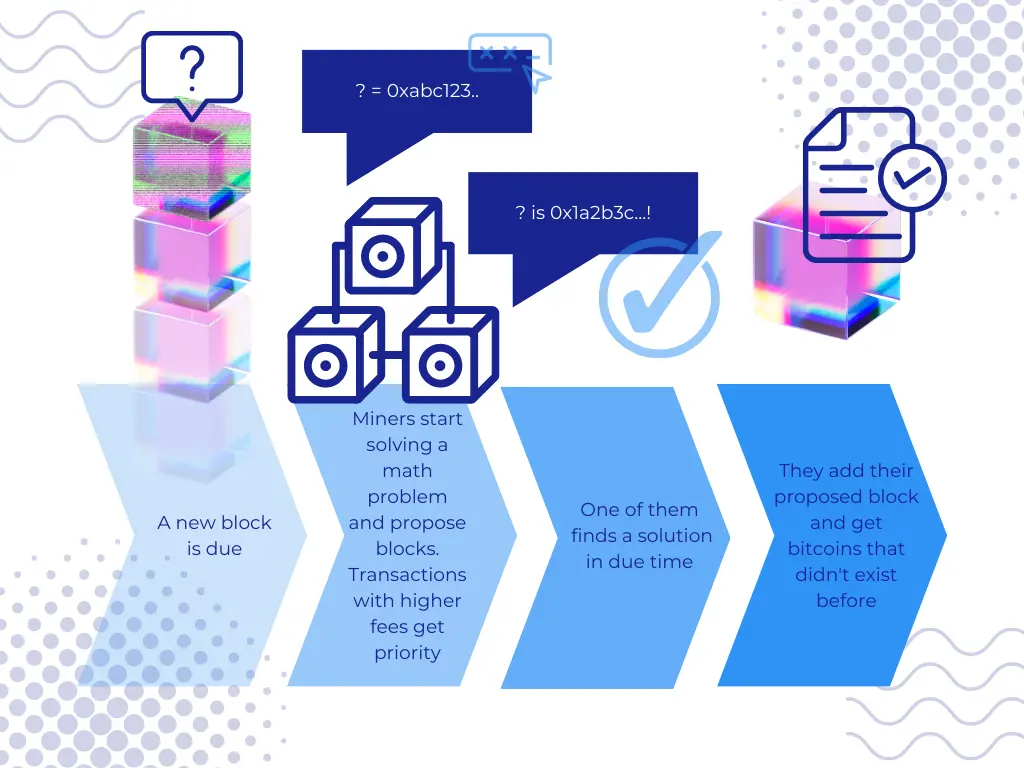
The network maintains a consistent block interval through difficulty adjustment — a periodic recalibration of the target hash value based on how quickly recent blocks were found. If miners join the network and blocks arrive too fast, difficulty increases; if miners leave and blocks slow down, difficulty decreases. This keeps the block rate stable regardless of total mining power (hashrate).
Bitcoin is the prime example of a mineable cryptocurrency but neither it is the only one nor PoW is the only consensus mechanism in crypto. Which is why at the height of the NFT boom, a common criticism that NFTs are environmentally damaging because of Bitcoin’s mining expenditure was a misconception. By the way, we have a complete crypto mining guide if you would like to learn more.
Validators
Speaking of the alternatives, Proof-of-Stake systems replace miners with validators — participants who propose and attest to new blocks based on bonded collateral (hence “stake”) rather than computational work. The transition from mining to validators changes not just the energy profile of a blockchain but the entire structure of attack costs and finality guarantees.
A miner's job is to hash until a valid block is found, then broadcast it. A validator's job is more operational:
- Propose blocks when selected (typically via pseudorandomization weighted by stake).
- Attest to blocks proposed by others — signing off that a block looks valid.
- Maintain uptime — validators must be online and responsive during their assigned duties.
- Sign messages correctly and consistently — signing contradictory messages (equivocation) is detectable.
Staking refers to the act of locking up a minimum amount of the network's native token as collateral (bonded stake) to participate as a validator. This stake earns rewards for the validation job but is also at risk should a validator fail or misbehave.
Smart Contracts
Consensus determines who writes the next block. Smart contracts determine what state changes that block is permitted to contain — encoding rules directly into the blockchain that execute automatically when invoked.
A smart contract is a deterministic program deployed to a blockchain and stored at a specific address. It updates on-chain state when invoked by a transaction — transferring tokens, recording data, triggering other contracts. Determinism is non-negotiable: given the same inputs and starting state, every node must reach exactly the same output. This is why all nodes re-execute the contract logic independently to verify each transaction. The computational cost of that re-execution is why systems like Ethereum charge gas — a fee proportional to the computation required.
Here is why it matters: on Ethereum, most tokens (ERC-20, ERC-721, etc.) are accounting entries maintained by a smart contract — a mapping of addresses to balances updated by transfer functions. The chain does not have a built-in “token balance” primitive the way it has ETH balances. As a result, token reliability is bounded by contract design, upgradeability choices, oracle dependencies, and composability pathways.
History and Development (Updated Through 2026)

Cryptocurrency’s history is a decades-long sequence of eras: early e-cash research, Bitcoin’s proof-of-work breakthrough, exchange-driven market infrastructure, smart-contract ecosystems, and then regulated wrappers that let investors hold exposure without touching a private key. Each era expanded what “crypto” meant — and widened the gap between Bitcoin and the rest of the asset class.
Crypto Before Bitcoin
Long before Bitcoin, researchers and activists were working on digital money. The cypherpunk movement of the 1980s and 1990s produced e-cash proposals (David Chaum's DigiCash, Wei Dai's b-money, Nick Szabo's bit gold) that combined public-key cryptography with distributed systems to attempt privacy-preserving electronic payments. These were real innovations, but they depended on centralized or partially trusted intermediaries to prevent double-spending, and none achieved a self-sustaining network.
Bitcoin did not invent cryptography or the idea of digital money. What did not exist yet before 2008 was a blockchain-based cryptocurrency: a system that used a distributed ledger, proof-of-work consensus, and a native token to create digital scarcity without any central authority.
Bitcoin White Paper
In October 2008, an author using the pseudonym Satoshi Nakamoto published Bitcoin: A Peer-to-Peer Electronic Cash System, proposing a solution to the problems that had blocked prior e-cash attempts. Three things were technically novel:
- Double-spend solution via proof-of-work and the longest chain: Instead of a trusted third party validating transactions, miners compete to solve computationally expensive puzzles. The chain with the most accumulated work is treated as the valid history.
- Permissionless peer-to-peer value transfer: Anyone with an internet connection can send BTC directly to anyone else without approval from a bank, government, or clearinghouse.
- Incentive design for security: Miners receive newly issued bitcoin and transaction fees for honest participation.
This architecture carries a deliberate tradeoff: proof-of-work makes Bitcoin tamper-resistant but limits throughput to roughly 7 transactions per second, a constraint that later altcoins and layer-2 networks would try to address.
Early Exchanges
For Bitcoin to acquire a numerical price and become usable beyond a developer circle, intermediaries that could match buyers and sellers, accept fiat currency, and hold BTC on customers' behalf had to emerge. The first generation of crypto exchanges—including early platforms that preceded the better-known names of Coinbase and Binance—introduced order books, fiat on/off-ramps, and custodial wallets, enabling liquidity and price discovery.
One could imagine some pushback from the earliest adopters but this infrastructure was essential, even if it reintroduced a risk the protocol itself had removed: counterparty exposure. Early exchange failure modes included custodial insolvency, hacks targeting hot wallets, and unilateral withdrawal freezes. The collapse of Mt. Gox in 2014 is the origin point of “not your keys, not your coins” as a widely internalized norm.
Altcoin Expansion
Bitcoin proved a blockchain-based cryptocurrency could survive and grow. Within a few years, developers launched altcoins that used the same architecture to pursue different goals: payment coins (such as Litecoin), smart-contract platforms (most significantly Ethereum, with its native asset ETH), stablecoins, and tokens issued on top of existing platforms.
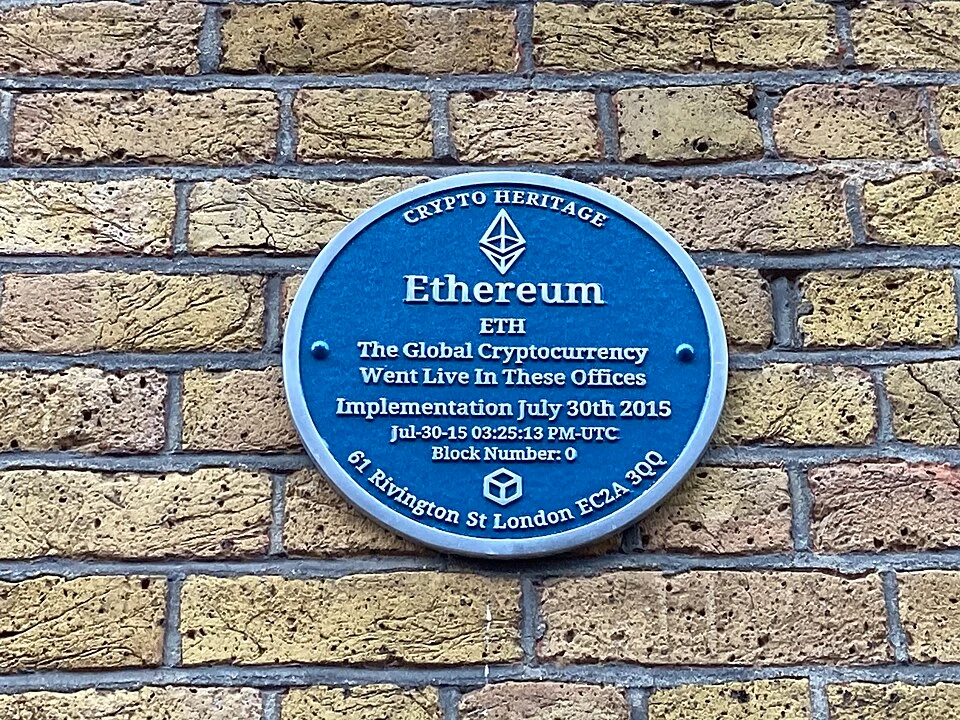
Not that every project succeeded; in fact, most did not. Nevertheless, “cryptocurrency” became a multi-network industry with distinct layers, risks, and use cases — meaning “crypto vs bitcoin” became an analysis requirement, not a branding preference.
Bitcoin ETFs
For most of Bitcoin’s history, gaining exposure meant direct interaction: wallets, private keys, and crypto exchanges. Spot Bitcoin ETFs, approved by the U.S. SEC and launched on January 11, 2024, changed access in a structural way. A spot ETF holds actual BTC with the difference that the custodian manages the private keys and security infrastructure. Investors buy shares through a brokerage account, gaining price exposure without self-custody, and using standard brokerage tax-reporting workflows.
What spot ETFs do not change matters just as much: the Bitcoin protocol is unaffected, the 21 million BTC supply cap remains enforced on-chain, and the network operates identically whether or not ETF shares are trading.
The distribution effect was immediate. In 2025, U.S. crypto ETFs recorded approximately $65.3 billion in net inflows, with BlackRock's IBIT alone accounting for roughly $37.9 billion of that total—more than half of all U.S. crypto ETF inflows for the year.
Through 2026: Where the Industry Is Now
By the end of 2025 and into 2026, blockchain development trends, adoption and market infrastructure looked meaningfully more mature. Global cryptocurrency ownership reached approximately 659 million people as of November 2025. ETF AUM and sustained inflows reflect distribution rails that did not exist five years earlier.
At the same time, core operational risks did not disappear. Exchange hacks, protocol exploits, and custodial failures have continued to occur throughout this period. In summary, cryptocurrency has moved from a niche technical experiment to a regulated, institutionally accessible asset class — while carrying forward structural vulnerabilities that have existed since the beginning.
Investment Considerations and Key Risks
No matter if you are a Bitcoin purist or crypto degen, in practice, crypto investors absorb multiple risk layers simultaneously: volatility, liquidity, custody, fees, taxes, and regulation.
Volatility
Bitcoin's price infamously can move 10–20% in a single session, and the broader crypto market can swing even harder. Two structural drivers explain why Bitcoin and the rest of crypto behave differently under stress.
First, protocol maturity and liquidity depth: Bitcoin has the deepest order books across the most venues globally, so large trades move the price less than equivalent-sized trades in newer digital assets. Altcoins and tokens often trade on thinner books, meaning a single large sell can gap price substantially.
Second, token-specific reflexivity: many altcoins are subject to scheduled token unlocks, liquidity-mining incentives, or governance emissions that can flood the market with new supply on a known date, creating reflexive sell pressure that has no direct analogue in Bitcoin's fixed-issuance model.
Crypto trades 24/7, but institutional crypto market-making desks thin out over weekends. When a sudden move triggers leveraged positions on platforms like Binance, cascading liquidations can amplify a modest 5% dip into a 20%+ air pocket within minutes—disproportionately in altcoins with shallower books.

Alternatively, when a major stablecoin loses its peg, collateral values across DeFi protocols compress simultaneously. Even if Bitcoin's fundamentals are unchanged, forced selling of BTC to meet margin calls or redeem stablecoin positions pushes BTC price lower as a secondary effect.
Liquidity
Liquidity determines how quickly and cheaply you can convert a position to cash without moving the market against yourself. Bitcoin spot markets on major crypto exchanges are among the most liquid in the digital asset space but many tokens do not have this privilege.
Liquidity can disappear during stress for many reasons, namely because market makers pull quotes, leveraged traders are forced to sell simultaneously, and stablecoin instability reduces available buying capital.
For Bitcoin, liquidity risk is primarily about venue selection and order sizing; for small-cap tokens, treat thin liquidity as a permanent feature rather than an edge case, and plan exit size and timing before entering the position.
Fees
Bitcoin or altcoin, fees compound before you know it. Breaking them into three categories makes the total cost of ownership visible before you commit capital.
1. Trading fees (maker/taker + spread)
Most centralized crypto exchanges charge a maker fee (adding liquidity) and a taker fee (removing liquidity), typically ranging from 0.01% to 0.60% per side depending on volume tier and platform. The hidden fee pitfall is the spread on market orders: on low-liquidity pairs or during volatility, the bid-ask spread can exceed the stated commission.
2. Holding fees (fund expense ratios for wrappers)
Bitcoin ETFs and crypto-linked funds charge annual expense ratios that range from under 0.20% for competitive spot Bitcoin ETFs to over 2% for some actively managed products. The hidden fee pitfall is tracking error combined with wrapper fees: a product may show a low stated expense ratio but still deviate from spot BTC performance due to roll costs, rebalancing friction, or management spread.
3. Network fees (on-chain transaction fees)
Moving BTC or ETH on-chain requires paying a network fee that fluctuates with demand. The hidden fee pitfall is priority fees during congestion: during periods of high on-chain activity, low fee limits may stall transactions, and correcting this can require replacement transactions.
Taxes
This section provides a jurisdiction-agnostic framework only. It is not legal or tax advice. Consult a qualified tax professional in your jurisdiction.
Most crypto tax frameworks distinguish events that trigger a realized gain or loss from those that do not:
- Taxable disposal events typically include: selling crypto for fiat, swapping one token for another, and spending crypto to purchase goods or services.
- Non-taxable transfers typically include: moving the same asset between wallets or accounts you own, provided no change of beneficial ownership occurs.
For each position, maintain recordkeeping: (1) acquisition date and cost basis (purchase price plus fees), (2) lot-level detail if you acquired the same asset at multiple prices, (3) timestamps for every transaction, and (4) fee amounts paid.

In most jurisdictions, cases like exchanging ETH for a DeFi governance token is treated as a disposal of ETH at fair market value at the moment of the swap, followed by acquisition of the new token. Paying with BTC or a stablecoin is generally treated as disposing of that crypto at fair market value on the date of the transaction.
Regulation
Last but not least, the regulatory environment for crypto is not uniform—it varies by asset type, venue, product structure, and jurisdiction. Treating regulation as a static background is a common investor mistake.
Regulatory risk manifests as:
(1) Asset-level classification risk (security vs commodity / payment token)
Classification determines which regulator oversees an asset, what disclosures apply, and whether it can legally be offered to retail investors. Bitcoin has broadly received commodity treatment in major markets but many other tokens face classification uncertainty. Moreover, reclassification or new reporting rules can change what must be reported and how gains are calculated.
(2) Venue risk (exchange licensing and delistings)
Exchanges also tend to operate under different licensing regimes globally. Regulatory actions can lead to delistings, liquidity loss, and restricted access in affected jurisdictions. When regulators require a crypto exchange to delist a token, holders may have a narrow window to exit before the order book closes.
(3) Product risk (ETF/fund access vs. restrictions)
Regulated products like spot Bitcoin ETFs exist in some jurisdictions and are absent in others. Access, legal structures, and tax treatment can shift with policy changes.
Before choosing to invest or Bitcoin or any other cryptocurrency, verify (a) how the asset is classified in your jurisdiction, (b) whether your intended venue holds applicable licenses and has a clean regulatory history, and (c) whether the product structure you are using (direct crypto exchange vs. fund wrapper) gives you uninterrupted access if the regulatory environment shifts. Bitcoin's commodity classification in major markets provides relatively more regulatory clarity than most other tokens, but venue and product risks apply equally.
Conclusion
As of mid-2026, total cryptocurrency market capitalization and Bitcoin dominance figures continue to reflect the structural dynamic discussed across this article: BTC's share of total market cap, fluctuating in the 55–65% range (Source: Crypto Market Capitalization Report 2026), remains a persistent reason the Bitcoin-vs-crypto framing isn't merely discursive. Bitcoin remains the poster child for all cryptocurrencies, and cryptocurrencies are arguably the best-known example of digital assets. Regardless, digital assets extend way beyond just crypto, and cryptocurrencies have a lot more to offer by now than just BTC.
Frequently Asked Questions
What is the difference between Bitcoin vs Ethereum?
Bitcoin (BTC) stores value using a fixed-supply, proof-of-work model, while Ethereum (ETH) enables programmable settlement through smart contracts. BTC targets long-term wealth preservation; ETH powers decentralized applications. Both are cryptocurrencies, but their primary purposes diverge sharply from the protocol level down to everyday user experience. Bitcoin prioritizes security and simplicity; Ethereum prioritizes flexibility, which introduces more surface area for complexity and fee variability.
What is the difference between Bitcoin vs Stablecoins?
Stablecoins peg their value to an external reference—typically the US dollar—while Bitcoin (BTC) derives value from decentralized scarcity and network consensus. Stablecoins solve the volatility problem for payments; Bitcoin does not attempt to hold a fixed price. The difference in design intent is fundamental, not cosmetic.
Stablecoins are best for payments, cross-border settlement, or staying liquid in crypto rails; BTC for long-term, non-custodial value holding.
How do Bitcoin vs Meme Coins compare?
Meme coins derive value primarily from narrative and virality rather than network utility or technical differentiation, while Bitcoin (BTC) is backed by a decade-plus security record and measurable network activity. Evaluating meme coins requires going beyond community enthusiasm and applying objective criteria to token structure and market dynamics.
Is there a difference between Blockchain vs Cryptocurrency?
A blockchain is a data structure and distributed network; a cryptocurrency is its optional native asset used to incentivize participants and pay for network operations. The two terms are related but not interchangeable—one describes the infrastructure, the other describes an asset class that runs on it.
Why is Bitcoin Transaction Speed so low?
Bitcoin processes transactions at a pace set by its ~10-minute block time, but finality expectations depend on confirmation depth, not just whether a transaction appears on-chain. Speed is contextual—what counts as "settled" varies by use case and who is accepting the payment.
Bitcoin's throughput (~7 transactions per second on-chain) is intentionally limited to preserve decentralization. The tradeoff is that settlement assurance—not raw speed—is Bitcoin's design priority. Other cryptocurrencies, for example, Solana have devised sound methods to solve the problems Bitcoin’s protocol was trying to solve and offer significantly faster transaction processing.
What is Bitcoin’s Energy Usage?
Bitcoin's proof-of-work consensus consumes significant energy by design—that energy expenditure is what makes the network's transaction history costly to rewrite. High energy use is not exactly wasted energy. Energy used to secure a global settlement network is a deliberate design choice with an explicit security function—the value judgment is about whether that function justifies the cost, not whether electricity was "burned for nothing."