
How to Report Crypto on Tax Forms? Beginner’s Guide

Disclaimer
The content on this page is general educational information only — it is not legal or tax advice. If your situation involves high-volume DeFi activity, business entities, cross-border transactions, or amended prior-year returns, consult a qualified tax professional before filing.
Contents
- 1. What Counts as Cryptocurrency and Digital Assets
- 2. Taxable vs Non-Taxable Crypto Events
- 3. Reporting Requirements and Thresholds
- 4. Records and Cost Basis Documentation
- 5. IRS Forms for Crypto Reporting
- 6. Activity Types: How Different Crypto Income Is Reported
- 7. Risks, Penalties, and Key Compliance Considerations
- 8. Tools and Methods for Reporting Crypto Taxes
- 9. Conclusion
Filing crypto taxes can feel overwhelming the first time, but the underlying structure is consistent: the Internal Revenue Service (IRS) expects you to (1) answer the digital asset question, (2) report taxable dispositions and income on the correct forms, and (3) keep records that support your cost basis and fair market value (FMV).
Crypto reporting is not one-size-fits-all, so route yourself based on your activity:
- If you only bought and held crypto — and did nothing else — focus on the digital asset question and the non-taxable events section so you can confirm what does not need to be reported as a disposal.
- If you traded, earned, or spent crypto — go directly to the taxable events and IRS forms sections, because you’ll need a disposition ledger (Form 8949) and likely an income schedule (Schedule 1 or Schedule C).
Broker reporting is moving toward more standardized third-party forms. Broker reporting on Form 1099-DA begins for transactions occurring on or after January 1, 2025, with additional cost-basis reporting on certain transactions phasing in later — meaning you should expect more tax forms from your platforms in coming years. (Source: IRS Digital Assets)
What Counts as Cryptocurrency and Digital Assets
Definition
For tax purposes, "cryptocurrency" refers to a digital representation of value that uses cryptography and operates on a distributed ledger. The Internal Revenue Service treats any digital asset—including coins, tokens, stablecoins, and wrapped tokens—as property, making every exchange, sale, or disposition a potentially taxable event.
Included as digital assets:
- Cryptocurrencies (Bitcoin, Ether, and similar coins)
- Stablecoins (USDC, USDT—still property regardless of price stability)
- Wrapped tokens (e.g., wBTC—a new token with its own cost basis)
- Governance tokens (voting tokens with determinable fair market value)
Not included as digital assets:
- Fiat currency held in a bank account or digital wallet (USD, EUR)
- Reward points or airline miles with no open-market exchange value
- In-game currency that cannot be transferred or exchanged outside a closed platform
- Traditional securities held in brokerage accounts (stocks, bonds)
The IRS uses the term convertible virtual currency as the umbrella term in its official guidance—most notably in Notice 2014-21. When you see "convertible virtual currency" in IRS publications, it maps directly to what most people call crypto coins and tokens: any digital currency that has an equivalent value in real currency or acts as a substitute for real currency.
Property Classification
The IRS classification of digital assets as property—not currency—drives the entire reporting framework:
- Cost basis tracking is required — every acquisition creates a new lot with a purchase price that must be recorded.
- Fair market value at disposition determines gain or loss — the USD value at the moment of sale, exchange, or spend is your proceeds figure.
- Holding period is relevant — how long you hold the asset before disposing of it determines whether the gain is short-term or long-term.
Digital Assets
The IRS definition of digital assets is broad. Here is a practical taxonomy of what still needs to be tracked:
| Digital Asset Category | Tax Tracking Implication |
|---|---|
| Cryptocurrencies (coins/tokens) | Has determinable fair market value and can be sold or exchanged; every disposition is a taxable event. |
| NFTs (non-fungible tokens) | Represents unique property with a market price; sale or exchange triggers capital gain or loss recognition. |
| DeFi positions / LP tokens | Liquidity pool tokens represent an ownership interest with FMV; depositing and withdrawing may each constitute a taxable exchange. |
| Staking reward tokens | Received tokens have FMV at receipt; treated as income upon receipt and subject to capital gains tracking on later sale. |
| Airdropped tokens | Tokens received without direct purchase still have FMV at receipt and can be sold or transferred, making them in-scope property. |
| Forked assets | New tokens created by a chain split are generally income at FMV when received and establish a cost basis for future dispositions. |
Taxable vs Non-Taxable Crypto Events
A clean reporting workflow starts with one filter: did you dispose of property, or did you receive value? If yes to either, you are usually in taxable territory. If not, the transaction is generally non-taxable—but still often trackable.
Also note the critical nuance: taxable does not mean you owe tax. You can realize a loss, net to zero, or offset gains elsewhere. The event is still reportable.
Core Taxable Events

- Selling crypto for fiat (USD or any national currency): You dispose of a capital asset; the difference between your sale price and cost basis is a capital gain or loss.
- Swapping crypto-to-crypto: Exchanging one cryptocurrency for another is treated as a disposition of the first asset; the gain or loss is calculated as a capital gain or loss at the moment of the swap.
- Using crypto to pay for goods or services: Spending crypto is a disposition at fair market value on the date of payment; the spread between that value and your cost basis is a capital gain or loss.
- Receiving crypto as compensation: When an employer or client pays you in cryptocurrency, the fair market value at receipt is ordinary income (subject to income and payroll taxes).
- Mining income: Newly mined coins are ordinary income at their fair market value on the date of receipt; a subsequent sale creates an additional capital gain or loss.
- Staking rewards: The Internal Revenue Service (IRS) treats staking rewards as ordinary income at fair market value when received, consistent with its position on mining income.
- Airdrops: Tokens received via an airdrop are ordinary income at fair market value on the date you gain dominion and control over them.
- Fork-related receipts: Coins received from a hard fork are ordinary income at their fair market value at the time you receive and can access them.
⚠ Edge-case flags that still count as a disposition:
- Spending stablecoins: Even though a stablecoin's value appears fixed at $1, spending it is technically a disposition; a fractional gain or loss may apply if your cost basis differs slightly from $1.
- Swapping via DEX aggregators: Routing a swap through a decentralized exchange aggregator may execute multiple intermediate token-to-token trades under the hood—each leg can be a separate taxable event.
- Converting wrapped tokens: Wrapping or unwrapping a token (e.g., ETH → WETH) may or may not trigger a taxable disposition depending on whether it changes your beneficial ownership or economic exposure—treat this as a caution requiring case-by-case review, not a universal rule.
Non-Taxable Events
These actions are generally not taxable because they do not involve a disposition or the receipt of new value. However, they are still common sources of broken cost basis if you ignore them.
- Buying crypto with USD or other fiat currency: Purchasing cryptocurrency establishes your cost basis and acquisition date; no taxable event occurs at purchase. Still track it because: your cost basis and holding period begin here and determine future gain/loss calculations.
- Holding crypto: Simply holding an asset, regardless of how much it appreciates or depreciates in value, is not a taxable event. Still track it because: the unrealized gain or loss will matter the moment you dispose of the asset.
- Transferring crypto between your own wallets or accounts (same ownership): Moving crypto from one wallet or exchange account to another that you control is not a disposition. Still track it because: cost basis and acquisition date must carry over to the receiving wallet; transfer fees may affect your basis.
- Moving crypto between exchanges you control: Like wallet-to-wallet transfers, shifting holdings between two exchange accounts both owned by you does not trigger a taxable event. Still track it because: exchange records may not automatically link the cost basis, creating reconciliation gaps later.
- Gifting crypto (recipient side): The person receiving a gift of cryptocurrency does not recognize income at the time of receipt. Still track it because: the recipient inherits the donor's cost basis and acquisition date (carryover basis), which will determine their gain or loss upon a future sale.

Wallet-to-wallet transfers become taxable if ownership changes or it's a payment. The moment a transfer goes to a wallet you do not own—whether as a purchase, payment for services, or gift to another person—it is a disposition, and you must calculate gain or loss.
Similarly, gifts become taxable when the recipient disposes of the asset. The recipient carries over the donor's original cost basis; when they eventually sell or swap the gifted crypto, that carryover basis determines the taxable gain or loss. (The specifics of carryover basis calculation are worth reviewing separately before filing.)
Reporting Requirements and Thresholds
Before you touch Form 8949 or open a tax software import, get the basics in one place. You can refine and reconcile later, but you can’t report accurately without a complete data map.
- A list of every exchange and wallet you used during the tax year
- Access to CSV or API transaction exports from each platform
- Your prior-year federal income tax return, especially if you have capital loss carryforwards
- A clear sense of your activity type — were you investing, or did you receive crypto as income from self-employment, staking, or mining?
- Any 1099 forms already issued by exchanges or brokers
Reporting Thresholds
“Threshold” gets used loosely in crypto tax talk. In practice, you are dealing with at least three separate ideas: the first is the tax return reporting requirement. If you had a taxable event during the year (a sale, a swap, receiving payment in crypto, earning staking rewards), you are required to report it on your federal income tax return regardless of the amount involved and regardless of whether any form was issued to you. The Internal Revenue Service does not provide a de minimis exemption for small crypto gains.
Exchanges and other brokers may issue 1099-type forms summarizing your activity. Whether a form is issued depends on the platform's obligations and your account characteristics—not on whether you have a reporting obligation. If no form arrives, your obligation to report does not disappear.
Certain transactions trigger their own reporting tracks. Donating appreciated crypto to a qualified charity, for example, is governed by charitable contribution rules rather than standard disposition rules.
The point that stays true across all of this: your obligation is determined by the tax code, not by whether an exchange generated a 1099.
The Internal Revenue Service places a digital asset question at the top of Form 1040, Form 1040-SR, and Form 1040-NR. Every taxpayer filing one of these returns must answer it. The question asks whether, at any point during the tax year, you received, sold, exchanged, or otherwise disposed of any digital asset. Treat this checkbox as a threshold reminder: if the honest answer is "Yes," your return must reflect that activity.
Common Misconceptions
These are the beliefs that on the surface sound reasonable but then cause people to misfile.
1. "I didn't cash out dollars, so I have nothing to report."
Converting crypto to fiat is not the trigger—disposing of crypto is, and a crypto-to-crypto swap is a disposition.

Example: You trade ETH for SOL directly on a decentralized exchange. No dollars ever touch your bank account. That swap is still a taxable disposition: you recognize a gain or loss based on ETH's fair market value in USD at the moment of the trade versus your cost basis in the ETH.
2. "Swapping into a stablecoin is basically the same as holding."
A stablecoin is a separate digital asset; exchanging your crypto for a stablecoin is a taxable disposition of the original asset, not a tax-free hold.
Example: You swap BTC for USDC because you expect volatility. At the moment of that swap, you have disposed of BTC. If BTC had appreciated since you acquired it, you have a capital gain to report—even though your USDC balance will sit idle for months.
3. "Small profits don't matter; the IRS isn't going to care about $50."
There is no statutory de minimis threshold for crypto capital gains; every gain is reportable regardless of size, and the reporting obligation exists independently of audit probability.
Example: You earn $12 in staking rewards across several small transactions over the year. Each reward is ordinary income at the fair market value when received. The total is small, but omitting it is still technically an underreporting of income on your federal income tax return.
4. "No 1099 from my exchange means no reporting required."
A taxpayer's obligation to report income and gains is set by the Internal Revenue Code, not by whether a third party issued an information return.
Example: You used a decentralized exchange that issued no forms whatsoever. Every swap you executed is still a taxable event. The absence of a 1099 does not create a reporting exemption—it just means your records are the only documentation of those transactions.
5. "Using crypto to buy something isn't really a 'sale.'"
Spending crypto on goods or services is treated by the IRS as a disposition of property, triggering gain or loss recognition at the point of purchase.
Example: You use 0.01 BTC to pay for a software subscription. At the moment of payment, you have disposed of that BTC at its current fair market value. If you acquired that BTC at a lower price, the difference is a capital gain you must report, even though you never "sold" anything in the conventional sense.
6. "An airdrop I didn't ask for can't be income—I didn't do anything to earn it."
The IRS position is that airdrops of new tokens generally constitute ordinary income at the fair market value of the tokens at the time the taxpayer has dominion and control over them, regardless of whether the taxpayer solicited the airdrop.
Example: A protocol you interacted with last year distributes a governance token airdrop to your wallet. You did not request it and you have not sold it. Nevertheless, the fair market value of those tokens at the time they became accessible to you is likely reportable as ordinary income in the year received.
Reporting Without Selling or Withdrawing

So far, we have established that the “I never withdrew to my bank, so nothing happened” mindset is the fastest way to miss reportable events.
Admittedly, transferring crypto between wallets you own is not a taxable event, but it is a frequent source of downstream errors because it creates “mystery deposits” in exchange logs.
For every transfer between your own wallets, capture and retain:
- Date and time of the transfer
- Transaction hash (blockchain confirmation ID)
- Sending and receiving wallet addresses
- Any network fees paid (fees paid in crypto are themselves small dispositions if the fee token has a cost basis)
- A notation confirming both wallets belong to you
Now, these actions generate reportable income or gains regardless of whether you ever convert to dollars:
- Crypto-to-crypto trades: Each trade is a disposition of the asset you gave up. You need the USD fair market value of the asset relinquished at the exact time of the trade.
- Spending crypto on goods or services: Disposal at fair market value at time of transaction.
- Receiving staking rewards, mining proceeds, or referral bonuses in crypto: Ordinary income at fair market value at the time each reward is received and accessible.
- Receiving payment in crypto for work or services: Ordinary income at fair market value at receipt; also potentially subject to self-employment tax depending on circumstances.
A stablecoin-to-stablecoin exchange is still a crypto-to-crypto trade. The gain or loss is often tiny, but the transaction is still a taxable event.
Depositing to Coinbase, withdrawing from Kraken or otherwise moving your assets between exchanges is not a taxable event by itself. However, it is one of the most common reasons taxpayers end up with zero-basis lots on exchange-generated tax reporting.
Records and Cost Basis Documentation
It goes without saying that assembling an audit-ready crypto record set is the foundation of every defensible Form 8949 and Schedule D filing.
Transaction History
Every taxable disposition should have a minimum viable dataset. For each line item, capture:
- Acquired date/time (to the second where available)
- Disposed date/time (to the second where available)
- Asset and quantity (e.g., 0.5 BTC)
- Counter-asset (USD, ETH, or other crypto received)
- Transaction ID / hash (on-chain identifier)
- Platform (exchange name or wallet label)
- Gross proceeds (in USD at time of disposal)
- Fees (amount, currency, and type)
- USD values at acquisition and disposal (FMV at each event)
- Evidence link (URL to block explorer, exchange confirmation, or stored screenshot)
When the same transaction appears in both an exchange CSV export and an on-chain block explorer export, define a dedupe key composed of txid/hash + timestamp + amount. Any record matching on all three fields is a duplicate; keep one canonical version and flag the other as a duplicate in your reconciliation log.

Missing deposits, missing withdrawals, and internal transfers misclassified as disposals are among the most common issues that break a reconciliation. Before finalizing records, run these tests:
- Reconcile starting and ending balances per wallet for the tax year—unexplained differences signal missing data.
- Identify unmatched inflows (deposits with no corresponding source) and unmatched outflows (withdrawals with no destination record).
- Confirm that internal transfers share the same transaction hash on both the sending and receiving side.
- Check that asset quantities transferred off-chain match what arrived on-chain after accounting for network fees.
- Flag any zero-cost-basis lots, which often indicate a missing acquisition record rather than a genuine zero-basis asset.
Cost Basis
Proving basis depends on the acquisition path. Keep the following records for each type:
- Fiat purchases: Bank, ACH, or card receipt showing the amount debited, plus the exchange fill confirmation showing the asset quantity, price, and timestamp.
- Crypto-to-crypto swaps: The basis of the prior lot being disposed of, plus the fair market value of the received asset at the moment of the swap (exchange trade confirmation or timestamped price source).
- Income (mining, staking, airdrops, referrals): The FMV at the time of receipt becomes the cost basis. Retain any income statement, wallet transaction record, or exchange credit confirmation showing the asset, quantity, and date received.
- Gifts and inheritances: Basis rules for received gifts and inherited assets differ from standard purchase basis and require separate substantiation. Flag these lots clearly and retain any documentation of the donor's original basis, the FMV at date of gift or death, and the date of transfer.
For each acquisition, maintain a lot identity record containing: (1) a unique acquisition lot ID, (2) quantity remaining in that lot, and (3) the wallet or account where the lot currently resides. This record connects directly to the lot selection method you apply at disposal time.
If your records prior to Jan. 1, 2025 are incomplete, document any basis allocation adjustments that are permissible under Internal Revenue Service guidance as of that date. Retain the worksheets, exports, or supporting schedules used to calculate those allocations. The IRS has published guidance on digital asset recordkeeping; consult it when reconstructing historical basis and keep a copy of the guidance version you relied on.
Fair Market Value (FMV)
Document one consistent FMV sourcing policy and apply it across all transactions. Acceptable approaches include: the exchange spot price at the exact timestamp of the transaction, a recognized pricing index (such as a volume-weighted average from a major data aggregator), or the actual executed trade price shown on the exchange fill confirmation. Whichever source you choose, retain the evidence:
- Timestamped price source (exchange rate page, API response, or data aggregator export)
- Screenshot or PDF export of the price at the relevant time
- API log or JSON export with timestamp and price field visible
- Exchange trade confirmation showing the executed price
And don’t mix the time zones up. Record timestamps in a consistent timezone (UTC is recommended) and capture prices to the nearest second where possible. If your source only provides per-minute or per-hour data, document that limitation and apply it consistently across all transactions.
Fees

Fee records are not interchangeable—different fee types affect your records differently and have different evidence sources.
- Trading fees: Typically deducted from the trade proceeds or added to the acquisition cost. Proof: the fee column in your exchange trade CSV or order history export.
- Network / gas fees: Paid to miners or validators to execute on-chain transactions. Proof: the on-chain transaction receipt, which itemizes the gas fee separately from the transferred amount.
- Withdrawal fees: Charged by the exchange when moving assets off-platform. Proof: the withdrawal history export or account statement line item.
For each fee, also capture which asset the fee was paid in—base asset, quote asset, or a third-party fee token. This matters for reconciliation: a fee paid in a third token is a separate outflow that must be tracked as its own event in your ledger.
Exchange Reports
Where available, exports are the core of an exchange record set:
| Export Type | What It Contains | Primary Use |
|---|---|---|
| Trades / fills | Executed buy/sell pairs, price, quantity, timestamp | Form 8949 disposals |
| Deposits / withdrawals | Asset movements on and off the exchange | Reconcile inflows/outflows |
| Rewards / income | Staking, lending, referral, and airdrop credits | Ordinary income reporting |
| Fees | Fee amounts per transaction | Cost basis and proceeds adjustments |
| Year-end statements | Summarized activity for the tax year | Cross-check and audit support |
| Realized gain reports | Exchange-calculated gains/losses | Reference only—validate methodology before relying on figures |
A recordkeeping tip: retain both the original raw export and any cleaned or normalized version. Raw files should remain unmodified. Use a simple versioning convention for file names: YYYYMMDD-platform-exporttype (e.g., 20241231-coinbase-trades.csv). If you reprocess or normalize a file, save the cleaned version with the same convention plus a -cleaned suffix.
Wallet Records
For every self-custody wallet, which a serious crypto user has, maintain:
- List of wallet addresses associated with your activity, labeled by wallet name or purpose
- Chain / network for each address (e.g., Ethereum mainnet, Bitcoin, Solana)
- Export method: block explorer link (e.g., Etherscan, Blockchain.com), wallet software export, or node/API pull—document which method you used and when
For audit defensibility, retain at least one of the following for each wallet: the wallet setup record (date created, software version), a signed message screenshot proving control of the private key, or a custody statement if the wallet is held through a custodial service.
Cross-chain transfers, bridges, and wrapped assets are a common documentation gap. When you move assets across chains using a bridge, retain:
- The bridge transaction hash on the originating chain
- The bridge transaction hash on the destination chain
- The token contract addresses for both the original and wrapped/bridged asset (e.g., WBTC contract address vs. native BTC transaction reference)
- A mapping document or note connecting the wrapped asset to the underlying asset
Without this, a bridge can look like a taxable outflow on one chain and an unexplained inflow on another.
IRS Forms for Crypto Reporting
Your whole process should look like this: complete Form 8949 first, then carry totals to Schedule D, then to Form 1040. Income flows separately through Schedule 1 and/or Schedule C to Form 1040. Mind that Form 8949 is not filed independently.

Form 1040 Digital Asset Question
The Internal Revenue Service places a digital asset question at the very top of your federal income tax return—before income is even entered.
Answer "Yes" if you:
- Received convertible virtual currency as payment for goods or services
- Received crypto as a reward, airdrop, or from staking
- Sold crypto for cash or exchanged it for another digital asset
- Used crypto to purchase something (goods, services, or another asset)
- Disposed of any digital asset in any other way
Answer "No" only if the sole activity in your account was holding—you bought or transferred crypto and did nothing else that constitutes a taxable or reportable event.
The digital asset question appears at the top of Forms 1040, 1040-SR, and 1040-NR, so this requirement is not limited to a standard Form 1040. If you file as a senior taxpayer or as a nonresident alien with U.S. filing obligations, the same question applies to your return.
Form 8949
Form 8949 is the transaction ledger for dispositions. A “disposition” includes sales, swaps, and spending crypto—not just cash-outs.
What you must have ready for each line item (form-field aligned):
- Description of property — token name and quantity (e.g., "0.5 BTC")
- Date acquired — the exact date you originally received or purchased the asset
- Date sold or disposed — the date of the swap, sale, spend, or other disposition
- Proceeds — fair market value received at the time of disposition
- Cost basis — what you originally paid, including fees
- Adjustments — applicable IRS code (e.g., B, T, W) and adjustment amount if proceeds or basis reported on a 1099 differ from your records
- Gain or loss — the net result calculated from the fields above
Holding-period classification is based on whether you held the asset for one year or less (short-term) or more than one year (long-term).
For calendar year 2025 (reported in 2026), the IRS will not impose penalties if the broker makes a good faith effort to file and furnish the form correctly and on time. Receiving a 1099-DA does not replace your responsibility to report every disposition accurately on Form 8949. (Source: IRS.gov — Digital Assets)
Schedule D
Schedule D is where Form 8949 totals are netted into short-term and long-term group, then carried to Form 1040.
How the flow works:
- Completed Form 8949 lines are totaled separately for short-term (Part I) and long-term (Part II) dispositions.
- Those totals transfer directly to the corresponding parts of Schedule D.
- Schedule D nets gains against losses and produces the figures that carry to Form 1040.
One common mismatch is totals won’t reconcile if you omit adjustment codes/amounts on Form 8949 or mix short-term and long-term classifications.
Schedule 1
Schedule 1, Part I, Line 8 ("Other Income") is where certain crypto-related income lands when it is not business income. This typically applies to:
- Hobby income from mining or staking (where no profit-motive business exists)
- One-time or irregular airdrops received outside of a business context
- Miscellaneous crypto rewards not connected to a trade or business

The principle is straightforward. If the activity is non-business in nature, report the income on Schedule 1. If the activity rises to the level of a trade or business, it routes to Schedule C instead.
Schedule C
This one is for crypto income earned through a trade or business.
Business vs. not-a-business — key factors:
- Profit motive
- Regularity and continuity
- Recordkeeping
- Intent
If it belongs on Schedule C, it is generally subject to self-employment tax, and eligible expenses may be deductible.
Activity Types: How Different Crypto Income Is Reported
Every crypto activity maps to three reporting decisions: (1) how the Internal Revenue Service characterizes the income or gain (capital vs. ordinary), (2) the precise moment a taxable event is triggered, and (3) which form or schedule on Form 1040 captures the amount. How is that three-part structure applied to the most common transaction types?
Before we delve into the details, there is a throughline that can help you see the big picture. Several activities in this section follow a recurring two-step structure that affects how you count reportable events:
- Step 1 — Income at receipt: When you first receive crypto from mining, staking, airdrops, forks, or compensation, you report ordinary income at that moment based on USD FMV.
- Step 2 — Capital gain or loss at disposal: When you later sell, swap, or spend those same units, you report a second event—a capital disposition—using the Step 1 FMV as your cost basis.
- The same unit is reported twice: Once as income when received, and again as a capital transaction when disposed of. These are separate entries on separate forms.
- Holding period starts at receipt: The one-year threshold for short-term vs. long-term treatment begins on the date the units were received (and income was recognized), not on any earlier date.
Buying and Selling
Typical tax treatment: Buying cryptocurrency is not a taxable event. Selling, swapping, or spending it is a disposition that produces a capital gain or capital loss.
What counts as a taxable moment:
- Selling crypto for U.S. dollars or another fiat currency
- Swapping one cryptocurrency for another
- Using crypto to pay for goods or services
What to record: Date/time of acquisition and disposal; units disposed; USD FMV at disposal; fees; counterparty or exchange; transaction hash.
Where it goes on the return: Form 8949; net totals to Schedule D.
Mining
Typical tax treatment: Mined coins are ordinary income at the moment of receipt, valued at USD FMV when received. Schedule 1 vs. Schedule C depends on whether it is a hobby or business.
What counts as a taxable moment:
- Receipt of newly mined coins into a wallet under your control
- The block reward or transaction fee credited to you
What to record: Date/time received; units; USD FMV; pool fees; wallet; transaction hash.
Where it goes on the return: Ordinary income → Schedule 1 or Schedule C. Later disposal → Form 8949 + Schedule D.
Staking
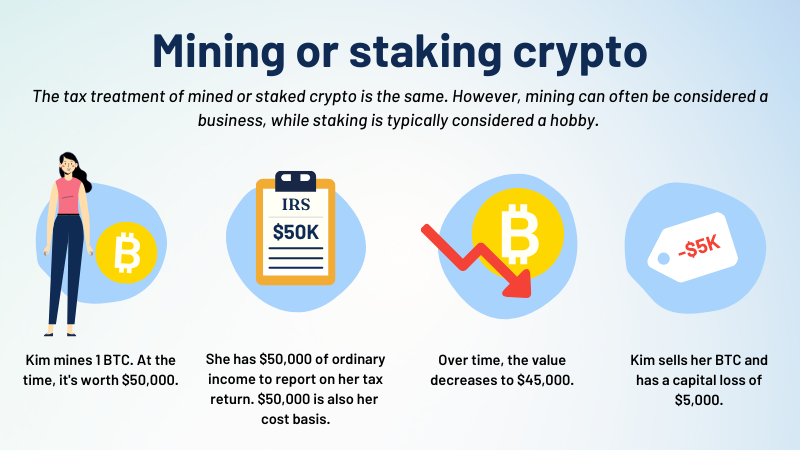
Typical tax treatment: Two-step reporting:
- (a) Reward receipt: ordinary income at receipt (FMV at the time of receipt).
- (b) Later disposal: capital gain or loss; basis is the FMV used at receipt.
What counts as a taxable moment:
- The moment rewards are credited to a wallet you control
- Any subsequent sale or swap of those reward tokens
Where it goes on the return: Reward income → Schedule 1 or Schedule C. Disposal → Form 8949 + Schedule D.
Airdrops
Typical tax treatment: Also a two-step pattern:
- (a) Receipt as income: ordinary income when you obtain dominion and control.
- (b) Later disposal: capital gain/loss using FMV at receipt as basis.
Where it goes on the return: Airdrop income → Schedule 1. Disposal → Form 8949 + Schedule D.
Forks
Typical tax treatment: Two outcomes, different treatment:
- Protocol fork with new units received: ordinary income at FMV when received (dominion and control).
- Fork with no new assets received: no immediate income event.
Where it goes on the return: New units received → Schedule 1. Disposal → Form 8949 + Schedule D.
Payroll and Contractor Payments
Typical tax treatment: Crypto compensation is ordinary income. The route depends on the relationship:
- Employee wages: W-2 income (FMV at payment).
- Contractor/self-employment compensation: Schedule C (FMV at payment).
Any later sale of the received crypto is a separate capital event.
DeFi
Typical tax treatment: DeFi activity unsurprisingly rather often contains multiple legs. Each leg is best treated as its own recordable event.
| DeFi Action | Typical Tax Characterization |
|---|---|
| Swap (token-to-token) | Disposition of outgoing token (capital gain/loss, holding period applies: short-term if held 1 year or less, long-term if held more than 1 year); receipt of incoming token at FMV as new cost basis |
| Liquidity add (providing to a pool) | Often treated as a disposition of the contributed tokens; receipt of LP tokens at FMV |
| Liquidity remove (withdrawing from a pool) | Disposition of LP tokens; receipt of underlying tokens creates new cost basis positions |
| Yield/interest/reward tokens | Income at receipt (ordinary income, FMV at time credited to your wallet) |
| Lending interest received | Income at receipt (ordinary income) |
| Borrowing (collateralized loans) | Generally not a taxable event at borrowing; liquidation or disposal of collateral may be a disposition—depends on facts |
| Wrapped tokens | Wrapping/unwrapping may or may not be a disposition depending on facts; treat as a potential taxable swap and document accordingly |
Where it goes on the return: Income legs → Schedule 1 or Schedule C. Capital legs → Form 8949 + Schedule D.
NFTs
Typical tax treatment: Three reportable situations:
- (a) Creating/minting and selling as a creator (business-like activity): typically ordinary income on Schedule C.
- (b) Buying, holding, selling as a collector/investor: capital gain/loss on Form 8949 + Schedule D.
- (c) Paying with crypto to mint or buy an NFT: a separate crypto disposition (capital gain/loss) on Form 8949 + Schedule D.
Risks, Penalties, and Key Compliance Considerations
Broker Reporting
The broker-filed Form 1099-DA information return flows to the Internal Revenue Service independently of what you report on your federal income tax return — and that distinction matters.
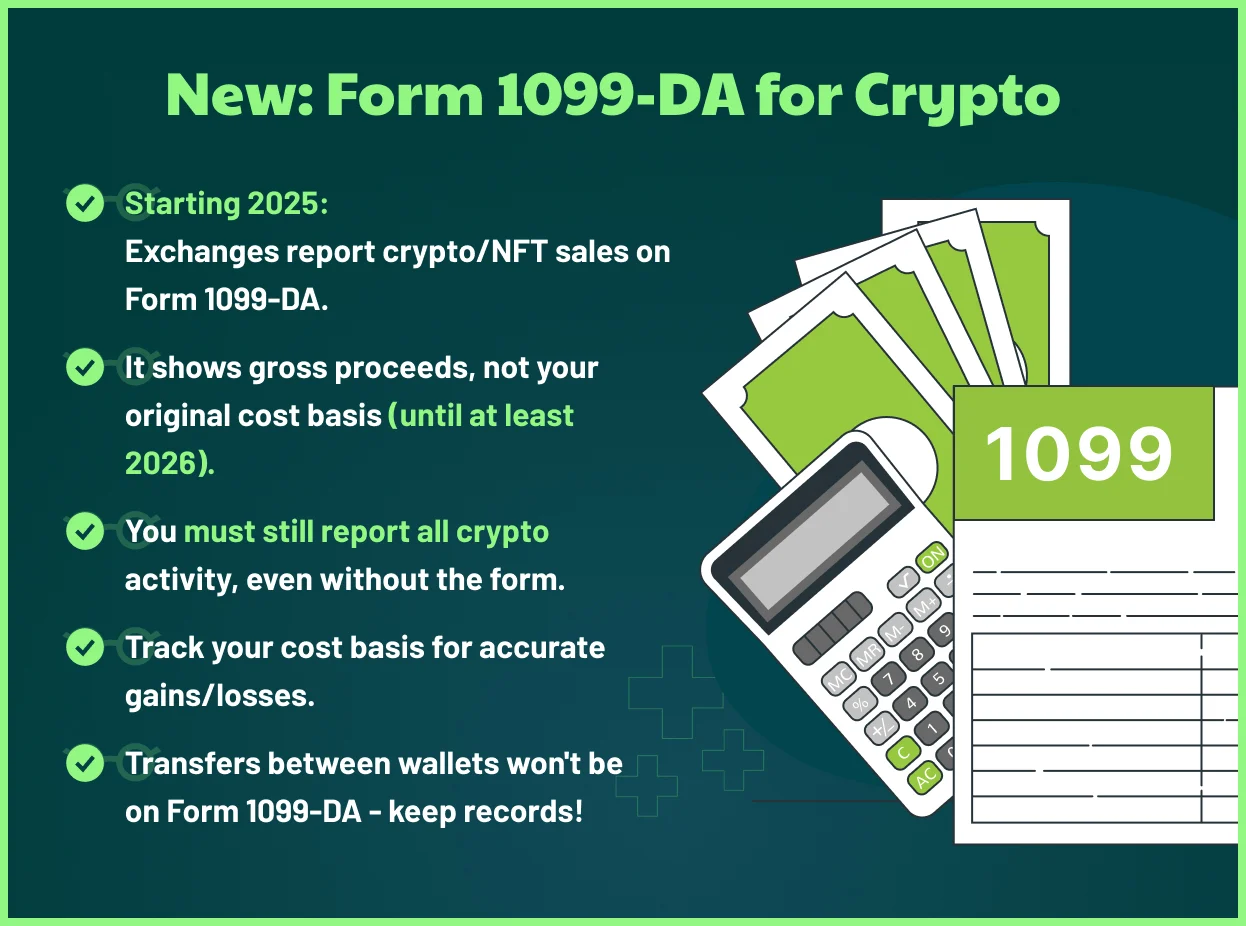
The rollout is phased. For transactions effected on or after January 1, 2025, brokers must report gross proceeds. Basis reporting on certain transactions doesn't kick in until transactions effected on or after January 1, 2026. That gap creates a mismatch risk: when the IRS receives a 1099-DA showing proceeds but no basis, an automated match can treat proceeds as gain. If your records show a higher cost basis, you must substantiate it on Form 8949.
There is transition relief for the first cycle: for calendar year 2025 transactions reported in 2026, penalties are not imposed for failure to file or furnish a 1099-DA if the broker makes a good faith effort to file and furnish correctly and on time. This does not change taxpayer obligations.
When a 1099-DA arrives, work through this checklist before filing:
- Verify that the identity and account information on the form match your records
- Reconcile the proceeds lines on the 1099-DA to your Form 8949 totals, line by line
- Investigate any missing or incorrect basis figures — these will need to be reconstructed from your own records
- Maintain a reconciliation worksheet that documents how each 1099-DA line maps to your 8949 entries, and retain it with your return
IRS Detection
Cryptocurrency is a topic more obfuscated than truly complicated and similarly, most crypto issues are not “mystery investigations” but just mismatches.
(a) Digital asset question inconsistency. The digital asset question appears at the top of Forms 1040, 1040-SR, and 1040-NR. Checking "No" while attaching Form 8949 or Schedule D that reflects digital asset activity creates an internal inconsistency.
(b) Information-return matching. When a broker files a 1099-DA, the IRS has proceeds. If your Schedule D totals don’t reconcile in aggregate, a mismatch can generate a CP2000 notice without an audit.
(c) Documentation gaps that surface on response. Many problems emerge only after a notice arrives. If you cannot prove basis, holding period, or valuation methodology, the issue becomes substantiation—not just reporting.
Audit Triggers
These patterns tend to create document requests because they are hard to trace without clean records:
- Large volume or high-frequency trading with incomplete lot history
- Assets moved across multiple wallets or exchanges without tracking transfers
- Reporting proceeds with $0 basis due to missing records
- DeFi or NFT activity with unclear income categorization
- Large year-over-year swings in reported gains or losses
Penalties
The consequences of intentional or unintentional mistakes when filing taxes are a spectrum. Think in scenarios:
1. Failure to report a taxable transaction entirely
Typically an accuracy-related penalty issue. Remediation often starts with an amended return and prompt payment.
2. Underreporting (reported, but understated gain or overstated basis)
Also typically accuracy-related penalty territory. Unsupported lot identification is a common driver here.
3. Filing late
Failure-to-file penalty. File as soon as possible; penalties accrue over time.
4. Failing to pay on time
Failure-to-pay penalty. Partial payment still reduces the penalty base.
Early action usually lowers total cost.
Amended Returns

That being said, this is not the case when any mistake is terminal. Amending is often correct—especially when transactions were omitted or classified incorrectly—but it should be deliberate.
When to amend:
- Missing transactions
- Wrong cost basis or holding period
- Misclassified income vs. capital
- Corrected broker form received after filing
Keep versioned transaction exports, reconciliation worksheets, and timestamped notes as an audit trail. On amended returns, ensure the digital asset question on Forms 1040, 1040-SR, or 1040-NR matches the schedules you attach.
However, if the change is immaterial and does not affect tax owed, an amendment may not be warranted. If you are under examination, consult a tax professional first.
Tools and Methods for Reporting Crypto Taxes
Manual Reporting
Filling your forms and reports manually works when your history is short, clean, and limited to one or two platforms.
To remind you about the required fields per taxable disposition:
- Date acquired
- Date disposed
- Proceeds
- Cost basis
- Fees
- FMV source
As for handling partial fills and multiple lots: each partial fill is its own lot. Apply FIFO, HIFO, or specific identification consistently and document which lots were consumed.
Manual is a bad fit when:
- You have more than 50–100 transactions
- You used more than two exchanges or multiple self-custody wallets
- You have DeFi activity, cross-chain bridges, wrapped tokens, or NFTs
- You received airdrops, hard fork coins, or staking rewards that require income recognition at FMV
Software Reporting
Software can automate ingestion and cost basis tracking, but it does not automate away everything: you still have to validate outputs.
Features you should evaluate in crypto tax tracking software:
- Lot selection method support
- Transfer vs. disposition handling
- Reconciliation tools
- DeFi and NFT parsing
- Category editing
- Audit trail and exportable reports
- Fee treatment
- Form readiness
Verify before you file: the 10 largest gain transactions individually and all transactions flagged as "unknown," "uncategorized," or "missing cost basis"; reconcile ending token balances in the software against your actual balances. Confirm no internal transfers are classified as dispositions and all staking/airdrop income is captured and categorized correctly.
Run these checks on your finalized dataset before exporting any tax forms:
- Unknown or uncategorized transaction count is zero (or explicitly reviewed and resolved)
- Missing cost basis count is zero (or flagged with a documented fallback method)
- No negative holdings flags (negative balance on any asset signals a data gap)
- Duplicate transaction check complete (same TXID appearing from both exchange and wallet import)
- Large outliers reviewed (any single transaction representing >10% of total gain/loss individually confirmed)
- Transfer labeling complete (every deposit has a matched withdrawal; unmatched flows are flagged)
- Income transaction categories confirmed (staking, airdrops, mining, referral rewards each in correct income category)
Professional Preparation
A CPA or enrolled agent can handle complexity that might be challenging even with decent software, but in this case as well, their output quality depends on your intake quality.
Bring to a crypto tax professional your exchange CSV exports or API access, the list of all wallet addresses used, DeFi protocol history, prior-year carryovers, 1099 forms received and if any, edge case documentation.

What you, the taxpayer, must still confirm:
- Completeness of your address and account list
- Whether activity is investment vs. Schedule C vs. hobby
- Whether mining, staking, or trading rises to the level of a trade or business under IRS standards
Crypto Tax Calculators
Calculators are related tools to the ones we reviewed above but they are useful for a single-lot sanity check, not for filing. Calculators can help with estimating gain/loss on a single simple trade, quick tax liability estimates for a single asset position, or an understanding of holding period differences.
Calculators fail at correctly unpacking transfers between wallets/exchanges, multi-lot tracking across FIFO, HIFO, or specific identification; they won’t provide Form 8949-ready output or can’t separate income events from capital gains, or flag missing basis.
Exchange Integrations
CSV and API ingestion are both useful, and at the same time both can miss data.
| Issue | CSV Export | API Connection |
|---|---|---|
| History window limits | Many exchanges cap CSV exports at 1–3 years; older history requires manual requests or support tickets | APIs often share the same window limits; older records may simply not be returned |
| Delisted assets | Transactions involving delisted tokens may be omitted from exports entirely | Same limitation; delisted asset trades may be missing from API responses |
| Staking and rewards visibility | Staking rewards, referral bonuses, and dust conversions are often in separate report types — easy to miss | API endpoints for reward types vary; confirm which endpoints your software actually queries |
| Cost basis gaps after migrations | Receiving exchange has no knowledge of original purchase price | API does not solve this; basis must be imported |
| Transfers appearing as taxable events | Withdrawals/deposits can look like sells/buys unless labeled | Same issue; software must map internal transfers |
No matter which tools you use, how do you reconcile exchange data? Match withdrawals to deposits across platforms, label matched pairs as “internal transfer”, investigate unmatched inflows/outflows, and confirm rewards appear as income lines, not silent basis adjustments.
Wallet Integrations
Doing your crypto taxes in MetaMask is still a pipe dream (or a nightmare scenario, depending on who you ask.) Wallet syncing shows on-chain activity and nothing else.
In particular, wallet syncing can let you see on-chain transactions, contract interactions, swaps; transaction hashes with timestamps, and token balances.
Off-chain fills on centralized exchanges, non-standard DeFi events in some protocols, or clean interpretation of wrap/unwrap, LP token mints/burns, and bridge flows without manual review are entirely out of scope here.
Label your addresses before syncing so internal transfers are easier to identify and compare balances in your tax software to what you see in the wallet or on a block explorer.
Tax Form Exports
When your dataset is reconciled, exports should be predictable:
- Form 8949 export → transaction-level dispositions feeding Schedule D
- Schedule D summary → net capital gains/losses flowing to Form 1040
- Income reports → staking, airdrops, mining, referral bonuses to Schedule 1 or Schedule C depending on facts
- Manual totals review → confirm proceeds, basis, and net results are consistent with your activity
If you connected the same account multiple ways (CSV + API) or imported both exchange and wallet data that overlap, do not forget or neglect to dedupe before filing.
Conclusion
Accurate crypto reporting is not about chasing forms—it is about mapping activity to the correct category and proving the numbers. Before you file, make sure you can do three things cleanly:
- Classify each transaction as capital gain/loss versus ordinary income
- Support cost basis and fair market value for every reported position
- Route each number to the correct IRS form: the digital asset question on Form 1040, 1040-SR, or 1040-NR; Form 8949; Schedule D; Schedule 1; and Schedule C
Frequently Asked Questions
Do I Need to Report Small Profits?
Taxpayers report small crypto gains on Form 8949 and summarize them on Schedule D, regardless of the dollar amount involved. The Internal Revenue Service provides no practical "de minimis" exception: if a disposal occurred, it belongs in capital gains reporting. Even a $2 gain must be reported. The digital asset question appears at the top of Forms 1040, 1040-SR, and 1040-NR—answering "Yes" triggers full reporting obligations. Any disposal—sale, swap, or using crypto to purchase goods or services—creates a reportable event.
Do I Need to Report Losses?
Taxpayers report realized crypto losses on Form 8949 and Schedule D; unrealized declines and missing-basis situations follow different paths and require separate decisions before anything is entered on a return.
What to Do with Missing Cost Basis?
Taxpayers without cost basis records must attempt to reconstruct them using available sources before filing; defaulting basis to $0 overstates gains and creates an inflated tax liability that an amended return may later be required to correct.
How to Report Crypto on Multiple Exchanges and Wallets?
Taxpayers consolidate all crypto disposals across every exchange and wallet into a single Form 8949 and Schedule D set; reporting is per taxpayer, not per platform, so every disposal from every account rolls into one unified capital gains report.
It does not matter whether you used three exchanges and two self-custody wallets. All disposals go onto one Form 8949 (or an attached summary statement) and feed into Schedule D on your Form 1040.
What Happens if My Tax Forms are Late?
Taxpayers who file late or discover missed crypto transactions after filing face two distinct situations—each with a different required action—and the arrival of new information returns after the filing deadline is a separate trigger that demands prompt attention.
If you filed your report late, penalties generally accrue from the original due date.
If you discover missed transactions after filing, an amended return needs to be filed.
Do I Need to Report Crypto Activity with International Accounts?
U.S. taxpayers with crypto activity tied to foreign exchanges or platforms must separate two distinct obligations: U.S. income tax reporting of disposals and income, which applies to all U.S. persons on worldwide income, and potential informational reporting that may apply because of where accounts are held or how assets are custodied.