
Beginner's Guide to Crypto Arbitrage


Key Takeaways
- ♻️ Crypto arbitrage means buying a cryptocurrency asset on one market and selling it on another to capture a price discrepancy. However, the visible spread is only theoretical until fees, slippage, transfer time, and liquidity are accounted for.
- ♻️ The main types of crypto arbitrage include cross-exchange arbitrage, triangular arbitrage, DEX and CEX arbitrage, and statistical arbitrage.
- ♻️ In 2026, the durable edge is rarely finding a secret price gap. It is operational efficiency: pre-positioned inventory, lower maker/taker fees, faster execution, deeper liquidity, and disciplined risk controls.
- ♻️ Transfer-based arbitrage is usually slower and riskier than inventory-based arbitrage because blockchain confirmations, withdrawal queues, and exchange deposit crediting can erase the spread before the sell leg executes.
- ♻️ Arbitrage bots and trading APIs can improve execution speed, but automation does not remove the need to manage partial fills, frozen withdrawals, slippage, MEV/front-running exposure, and exchange restrictions.
Disclaimer
Crypto arbitrage is not risk-free profit. Every spread should be tested against executable bid/ask prices, order book depth, AMM price impact, maker/taker fees, network fees, withdrawal limits, and settlement timing before capital is committed. Nothing in this article constitutes investment, legal, tax, or financial advice. Regulations, exchange Terms of Service, fee schedules, and withdrawal policies can vary by jurisdiction and change without warning, so readers should verify all conditions directly before trading.
What does arbitrage mean in crypto? The short answer is buying an asset on one market and selling it on another to capture a price difference. However, that gap only becomes real profit after fees, slippage, and transfer time are accounted for, all specific in the crypto context. This can happen across centralized exchanges (CEXs) and decentralized exchanges (DEXs), each with its own price quirks and execution constraints.
At its core, arbitrage is not a simple pricing trick. It is an execution problem. Fees, spreads, transfer speed, liquidity, and account readiness determine whether a visible gap ever turns into money in your wallet. For the long answer to what crypto arbitrage is, read this guide!
Crypto Arbitrage Mechanics
Price Gaps Across Markets
The same cryptocurrency asset rarely trades at exactly the same price everywhere at the same moment. The reasons are structural, not random.
First, liquidity fragmentation is the biggest driver. Capital is split across dozens of CEXs and DEXs, so no single order book or AMM pool reflects total global demand. These gaps can persist for minutes or longer because moving size between fragmented pools takes time and capital.
Second, different quote currencies also create apparent mispricing. An asset priced in USDT may look cheaper or more expensive than the same asset priced in USD because the stablecoin itself is trading at $0.998 or $1.002. These gaps are usually fleeting because stablecoin pegs tend to self-correct quickly.
Third, regional demand imbalances can be more persistent. The historical “Kimchi premium” on South Korean exchanges is the best-known example: local buying pressure outruns local supply, while capital controls and KYC friction prevent easy arbitrage.
Fourth, different fee tiers matter as well. Two venues can show identical raw prices but very different net-executable prices once maker/taker fees are applied. This gap is structural. It will not close on its own.
Finally, latency in price discovery creates brief gaps. One exchange’s order book updates milliseconds before another’s, and by the time a human trader sees the spread, bots have often already closed it.
On top of that, it is worth separating three prices that traders often conflate:
- Last price — the most recent executed trade. It does not tell you what you can currently buy or sell for.
- Best bid/ask — the top of the order book: the highest price a buyer will pay and the lowest price a seller will accept right now.
- Executable VWAP — the volume-weighted average price you actually receive once your order size consumes multiple price levels.
For example, Exchange A shows a last trade at $30,100 and Exchange B shows $30,000. On screen, that looks like a clean $100 spread. But Exchange A’s best ask may actually be $30,150 because the last trade is stale. If you need to buy 2 BTC, and only 0.5 BTC is available at $30,150 before the next level jumps to $30,300, your VWAP becomes roughly $30,262. Sell into Exchange B’s best bid of $29,980, and the “$100 spread” has already turned into a loss before fees are counted.
Where else do price discrepancies come from? For one, CEX pricing is almost always order-book driven. Buyers and sellers post limit orders, and price is discovered by matching the highest bid with the lowest ask. Market depth at each price level determines how much size can trade without moving the market.
DEX pricing on an AMM works differently. There is no order book. Price is set algorithmically by a curve, commonly x·y=k, based on the ratio of two assets in a liquidity pool. A $50,000 trade against a $500,000 pool will move price meaningfully, while the same trade against a $50 million pool may barely move it. Pool size directly determines how much slippage you absorb.
Buy-Low Sell-High Execution

Cross-venue arbitrage follows a basic execution path:
- Choose venues and pairs. Pick two exchanges quoting the same asset pair where you have confirmed a price discrepancy net of typical fees.
- Check depth for your intended size. Use market depth on CEX order books or pool reserves on a DEX to estimate realistic VWAP.
- Place orders. Decide between a limit order, which offers better price but non-fill risk, or a market order, which offers immediate execution but worse price.
- Move or pre-position inventory. Either transfer assets between venues after the trade or hold balances on both exchanges in advance.
- Confirm net profit. Recalculate realized proceeds after fees, slippage, and conversion costs before calling the trade profitable.
Speaking of, this is where the difference between inventory-based arbitrage and transfer-based execution becomes important.
Inventory-based arbitrage means holding capital on both exchanges ahead of time. This lets you execute both legs almost simultaneously and close fleeting gaps before they vanish.
Transfer-based execution means buying on one venue, withdrawing, depositing on another, and then selling. It is sometimes necessary, but it introduces timing risk: withdrawal queues, blockchain confirmations, exchange deposit crediting, and network congestion can take minutes to hours.
Even with a correct read on price, several mechanical failure modes can turn a “sure thing” into a loss:
- Partial fills — your order executes for only part of the intended size, leaving one side exposed.
- Order book moving during fill — the best bid/ask changes before your order completes.
- Withdrawal queues — exchanges batch or delay withdrawals during high volume.
- Deposit confirmation delays — funds may require multiple block confirmations before they become tradable.
- Quote currency conversion friction — converting between USD, USDT, USDC, or other quote currencies can add spread and fees.
Fees and Spread Impact
Anyway, the real test of any arbitrage opportunity is not the headline spread. It is the net-profit formula: Net Profit = Gross Spread − (Maker/Taker Fees on Both Legs + Withdrawal/Deposit/Network Fees + Slippage/Price Impact + Conversion Fees)
Suppose BTC shows a gross spread of $80 between two exchanges. Taker fees at 0.1% per leg on a $30,000 notional cost $30 each side, or $60 total. A network withdrawal fee costs $15. Slippage from walking through the order book costs another $20. Converting between quote currencies adds $5. Total costs are $100 against an $80 gross spread. The trade loses $20 despite looking attractive on screen.
Maker vs taker fees matter directly:
- Taker fee — applies when you cross the spread with a market order. It improves fill certainty but costs more.
- Maker fee — applies when you post a limit order that rests in the book. It is often lower, but the gap may disappear before your order fills.
It is also important to separate bid-ask spread from slippage/price impact. The bid-ask spread is the static gap between the best bid and best ask at one moment. Slippage is the additional cost caused by your order size consuming multiple levels of the order book or moving an AMM curve.
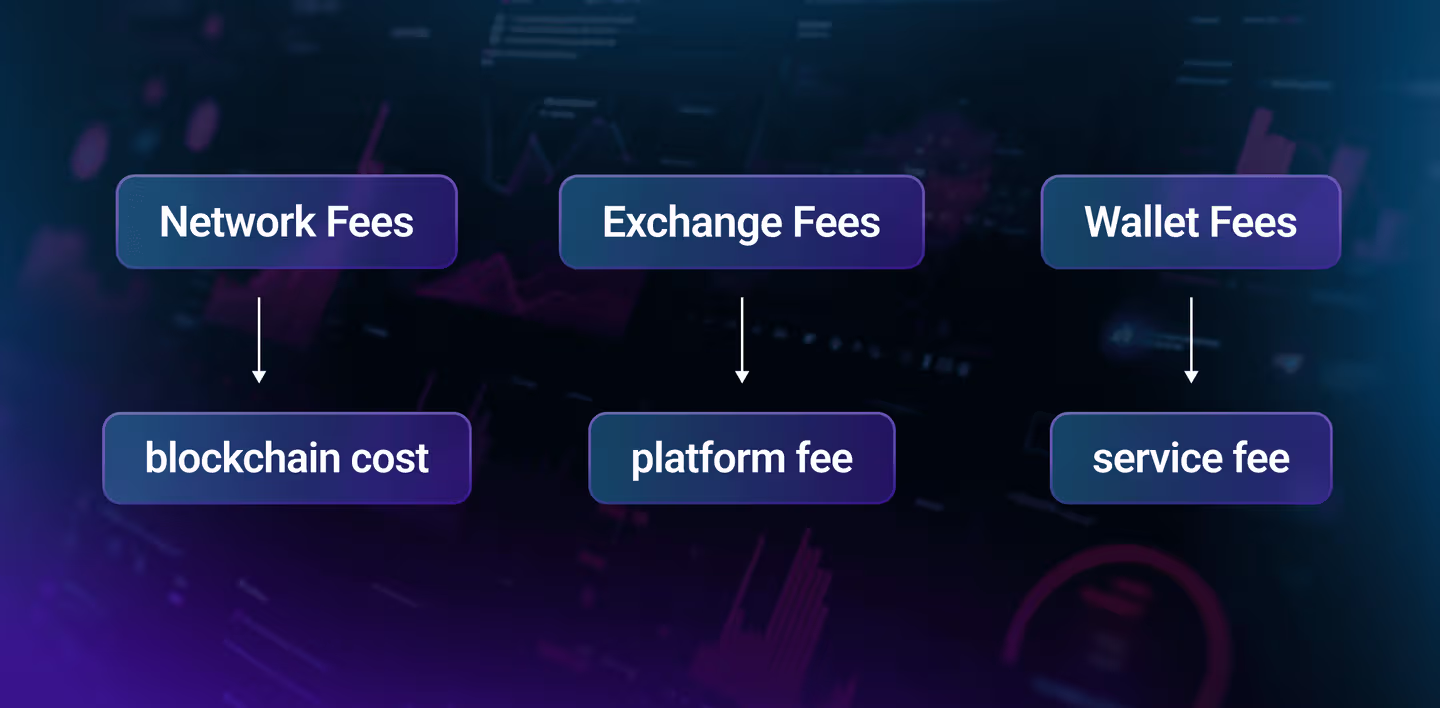
DEX arbitrage adds its own elaborate cost layer:
- Gas fees — network fees paid per transaction, which can spike during congestion.
- MEV/front-running exposure — bots can see pending transactions in the mempool and trade ahead of them.
- Bridge cost — cross-chain arbitrage adds bridge fees and settlement delay.
- AMM price impact — shallow pools move against your trade as size increases.
So far we have established the mechanical channel: spreads are visible, but execution determines whether they can be captured. The next step is choosing which arbitrage type actually matches your setup.
Main Types of Crypto Arbitrage
Which arbitrage type to pursue? It comes down to settling on one execution bottleneck for each kind.
- Cross-exchange arbitrage is gated by transfer speed and inventory positioning.
- Triangular arbitrage is gated by fee compounding and sequential execution risk.
- DEX and CEX arbitrage is gated by blockchain execution time, MEV exposure, and exchange withdrawal timing.
- Statistical arbitrage is gated by model quality and convergence risk.
Use this lens, not the size of the headline spread, to decide which type fits your infrastructure.
Cross-Exchange Arbitrage
This is where the inventory or transfer choice comes into play once again. Inventory-based cross-exchange arbitrage requires balances of both the asset and the quote currency on each exchange before the gap appears. There is no time spent moving funds mid-trade. The gating requirement is capital duplication: money sits idle across multiple venues so it can be used instantly.
The most common failure point is stale price data. You may execute against a top-of-book quote that is no longer available by the time both legs fire. This mode is best suited to fast-closing gaps in liquid pairs, where the spread may last only seconds.
Transfer-based cross-exchange arbitrage follows a buy, withdraw, deposit, and sell sequence. It is the fallback when you do not have capital pre-positioned on the receiving exchange. The gating requirement is account readiness rather than capital duplication: verified accounts, supported networks, and enough withdrawal limit headroom.
The primary failure point in this case is timing risk. Withdrawal delays, blockchain confirmations, or network congestion can eat minutes to hours, during which the gap can close or reverse. This mode is better suited to structural, slower-closing gaps, such as regional premiums or persistent fee-tier mismatches.
In any case, before committing capital to a cross-exchange trade, ask:
- Is the spread measured against executable bid/ask levels, not stale last-traded prices?
- Does order book or pool depth support your intended trade size?
- Have you counted fees on both legs?
- Have you selected the fastest and cheapest withdrawal route or network?
- Is there a reasonable basis to expect the gap to persist through the full execution window?
Triangular Arbitrage
Triangular arbitrage stays inside a single exchange and exploits a mismatch between three related trading pairs, usually expressed as A/B → B/C → C/A. The opportunity exists when the implied cross-rate from two markets diverges from the directly quoted rate in the third.
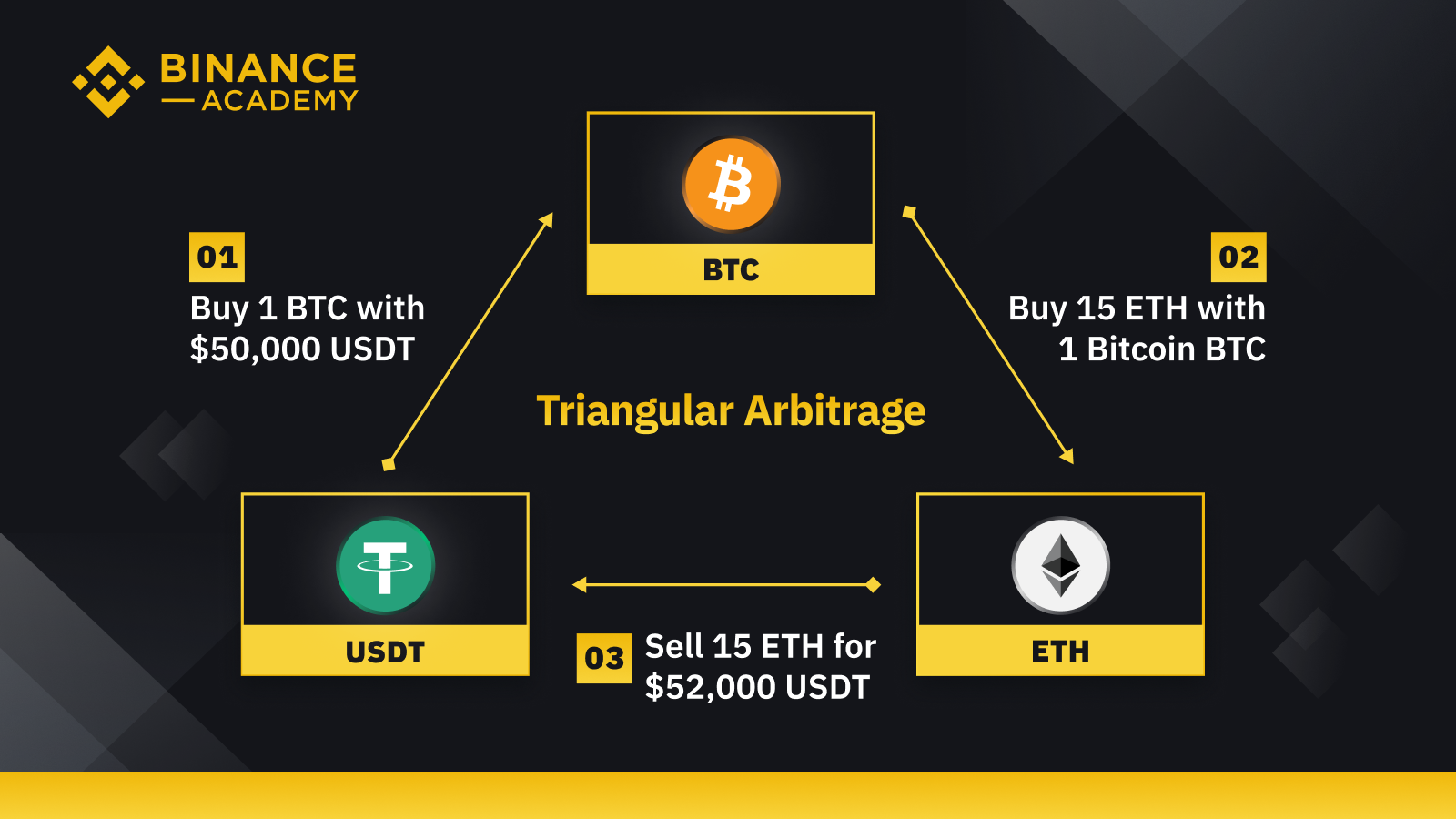
For example, start with 1 unit of Coin A. Trade A/B and receive 20 units of Coin B. Trade B/C and receive 4 units of Coin C. Trade C/A and end with 1.02 units of Coin A. That is a 2% gain after three trades.
However, each leg carries its own fee and spread. A taker fee of even 0.3% per trade, applied three times, can erase most of that edge. This is why triangular arbitrage is unusually sensitive to fee schedules, live spreads, and routing sequence.
DEX vs CEX Arbitrage
Naturally, cross-platform arbitrage means you can match different types of them. DEX→CEX arbitrage means buying an asset on a decentralized exchange where it is trading below the broader market price, then selling it on a centralized exchange. The dominant friction is blockchain execution itself: gas costs, mempool visibility, MEV bots, and on-chain confirmation time before the asset becomes usable on the CEX side.
CEX→DEX arbitrage flips the direction. The trader buys on a centralized exchange and sells into a liquidity pool on a DEX where the asset is priced higher. Here, the friction is CEX withdrawal timing. Manual review, batched withdrawal processing, or network congestion can let the gap close before the DEX leg is placed.
Practical DEX↔CEX gotchas include:
- AMM price impact does not scale linearly with trade size.
- MEV exposure means the trade you signed is not always the trade that gets included.
- Token-level quirks, such as non-standard decimals, transfer taxes, or rebasing mechanics, can break assumptions.
- Chain choice affects timing risk because confirmation predictability varies across networks.
Statistical Arbitrage
Statistical arbitrage is model-driven and often market-neutral. Instead of chasing one visible price gap, it takes offsetting long and short positions and profits when the relationship between them reverts to its historical norm.
Pairs or cointegration-style spread trading monitors two historically correlated assets or venues. Entry is triggered when the spread widens beyond its normal range, with the expectation of convergence. Exit happens once the spread reverts. The primary risk is a regime shift or correlation breakdown.
Index versus constituents arbitrage works at a portfolio level. A trader tracks a basket or index proxy against the combined value of its underlying components and acts when the proxy drifts away from fair value. The same risk applies: if constituents stop tracking the index as they historically have, convergence may not happen.
In practice, statistical arbitrage usually requires automated execution (e.g. with an AI trading bot), clean data feeds, and disciplined risk limits. Holding periods can run from minutes to several days because profit depends on convergence rather than instantaneous correction.
Profitability of Arbitraging in 2026
Realistic Profit Margins
From the discussions and formulas above, you already know that profit calculation is a bit more complicated than the visible spread. There are a few inputs that can lead you to the realistic output.

Gross spread observed is the number a scanner shows you. For example, a 0.4% difference between the same asset on two CEXs. This is useful for surfacing candidates, but it does not reflect depth or cost.
Executable spread is what remains after checking best bid/ask and market depth for the size you intend to trade. A 0.4% gross spread may only support a small fraction of your intended size before price moves against you. A trader targeting a $20,000 position might realistically capture 0.15–0.25% once depth is accounted for.
Net profit is what remains after fees, slippage, and timing risk. A 0.2% executable spread can shrink quickly after 0.1% in combined trading fees and 0.05–0.08% in slippage. The remaining edge may be only 0.02–0.05%, thin enough that one mistimed fill erases it.
Professional arbitrageurs optimize several variables to make those thin margins repeatable:
- Fee tiers and volume discounts — lower maker/taker rates widen net margin.
- Maker-vs-taker execution choice — posting liquidity can reduce cost when time allows.
- Pre-positioned inventory — balances on both venues remove transfer timing risk.
- Pairs with reliable depth — deeper markets reduce slippage.
Capital Requirements
The inventory vs. transfer split becomes relevant again when estimating capital to start with and position sizing.
Inventory-based execution usually requires more total capital because funds are split across multiple exchanges. You need both fiat or stablecoin and the asset itself ready on every venue you trade. A buffer is also needed to absorb fees and adverse price movement. The common failure mode is a partial fill: one leg completes, the second leg does not fill at the expected price, and you inherit unwanted exposure.
Transfer-based execution can start with less on-exchange capital because you are not duplicating balances across venues. You fund one side, execute, and then move assets to the other. However, it requires a larger spread buffer because the market can move during the transfer window. The trade often breaks when the receiving venue’s order book has thinned out by the time funds arrive.
Three related terms cause some confusion if not clearly established:
- Capital — total funds available across venues.
- Position size — how much is committed to one arbitrage attempt.
- Risk budget — the maximum drawdown you are willing to accept if a cycle fails.
A practical rule of thumb is to size each attempt so that even a failed cycle — including fees, slippage, and a stuck position — does not consume more than a small fraction of total capital.
Market Conditions
Does your arbitraging revenue depend on market conditions? Obviously but not in a way that you might think. Profit can be made in any market regime.
High volatility / news shocks create more visible gaps because venues react unevenly. However, execution risk rises at the same time: slippage widens, exchanges may pause trading or withdrawals, and liquidity can vanish from the book. The decision implication is clear: put a larger buffer in place or avoid new transfer-based positions until liquidity stabilizes.
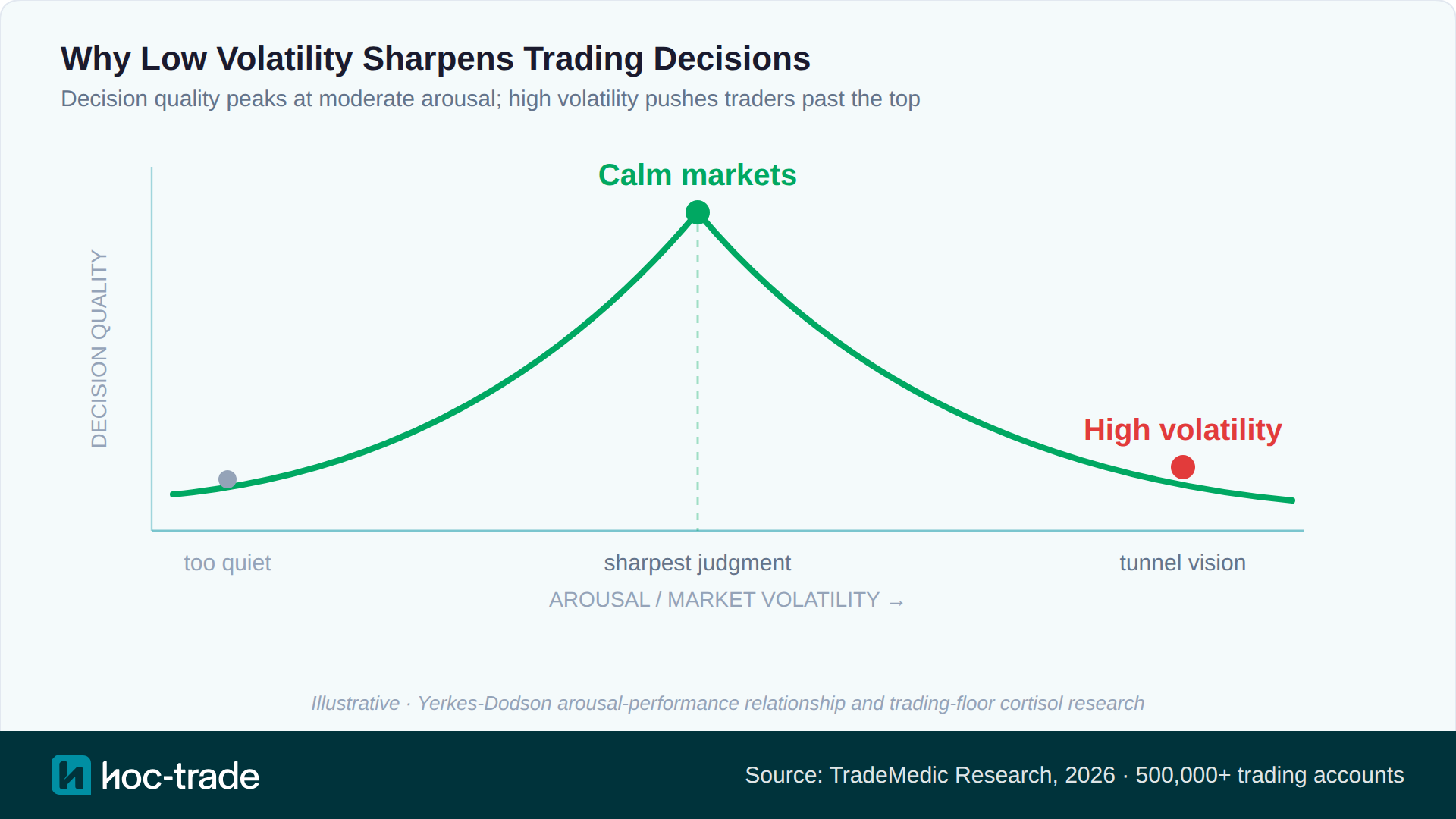
Low volatility / tight markets produce fewer and smaller gaps. In this regime, only low-cost setups with low fees, low latency, and deep markets tend to clear the cost hurdle.
Fragmented liquidity across venues/chains can create persistent discrepancies, similar to historical regional premiums. However, settlement and bridge friction often dominate the outcome. This regime usually favors inventory-based execution over transfer-based execution.
Easy arbitrage rarely stays easy. Market makers, well-capitalized bots, and low-latency infrastructure compete away obvious spreads almost as soon as they appear, especially on liquid CEX and DEX pairs. In 2026, the durable edge is not discovering a secret spread. It is having a faster execution path, cheaper fee tiers, and better inventory management than the next participant.
Exchange Selection for Crypto Arbitrage
This choice is really about removing execution bottlenecks: fills, costs, settlement, and account constraints. Treat each of the checks below as a gate an exchange must pass before it earns a place in your arbitrage setup.
Liquidity and Asset Coverage
Before trusting a quoted price, run the exchange and pair through an executability check:
- Do not anchor on 24h volume. High daily volume does not guarantee usable depth right now.
- Check top-of-book bid/ask for the specific pair. BTC/USDT and BTC/USD can have very different depth on the same exchange.
- Confirm quote currency and settlement asset. USD, USDT, and USDC are not interchangeable without conversion cost.
- Verify deposit and withdrawal network variants. The same ticker can exist on multiple chains.
- Sanity-check market quality. Frequent wicks, gaps, thin books, or large jumps between levels signal execution risk.
Suppose you want to trade $15,000 into an asset showing a clean spread between two exchanges. The best ask on Exchange A looks attractive, but only $4,000 is available at that level before the next tier jumps higher. Filling the remaining $11,000 raises your average entry enough to consume most of the spread. Market depth, not the top-of-book quote, decides the outcome.
Trading Fees and Withdrawal Costs
Build a total cost map before assuming a spread is profit:
- Trading fees — maker and taker rates on both legs.
- Conversion costs — spreads or fees between fiat, stablecoin, or alt quote currencies.
- Transfer costs — withdrawal fee plus network fee for moving the asset.
Fee schedules are not fixed reference points. They vary by VIP tier, order type, and asset. A schedule that looks acceptable at first glance can turn a strategy unprofitable once actual tier-based rates and withdrawal fees are applied.
A practical decision rule follows from this. When chasing tiny gaps, prioritize predictable and minimized fees. When chasing large dislocations, taker fees may be acceptable because guaranteed execution matters more than cost efficiency.
Transfer Speed and Network Support
Execution across the inventory vs. transfer split has two distinct states.
Inventory-based execution means capital already sits on both exchanges. There is no withdrawal or deposit step in the critical path. Speed depends on order placement and fill time.

Transfer-based execution means assets move from the buy venue to the sell venue mid-trade. Speed depends on exchange processing time, blockchain confirmations, and current network congestion.
Before relying on any transfer, confirm:
- Current network availability on both exchanges.
- Required confirmations for the specific asset and network.
- Deposit crediting behavior after confirmations.
- Whether the exchange disables withdrawals during volatility spikes or scheduled maintenance.
Withdrawal Limits and Account Restrictions
Several restrictions can quietly block an arbitrage attempt:
- Identity/region constraints — KYC level, regional access, and restricted pairs.
- Financial rails constraints — fiat support, stablecoin support, and crypto-only funding.
- Limit mechanics — daily withdrawal caps, monthly caps, and per-transaction minimums.
- Operational restrictions — new-account cooldowns, travel-rule checks, IP-based flags, and automated risk controls.
These restrictions matter because of how they fail. A daily withdrawal cap can prevent you from moving your full position before the gap closes. A new-account cooldown can block the second leg entirely. A compliance flag can trap inventory on one exchange and turn a short-term arbitrage position into an indefinite holding.
Crypto Arbitrage Tools and Execution Methods
Your execution mode determines which tooling stack makes sense. A trader running fast inventory-based cycles across two CEXs needs different tools than one executing transfer-based arbitrage across chains.
Whatever stack you choose, judge it by three criteria:
- How much latency it adds between signal and execution.
- How much depth visibility it gives before committing size.
- How much operational overhead it requires to run safely.
Manual Price Tracking
Manual tracking is slow, but it can still be repeatable if you follow the same process every time:
- Open both exchange order books side by side and read best bid/ask, not last-traded price.
- Check depth at your intended size on both books.
- Confirm your fee tier on each exchange and the withdrawal cost for the asset/network.
- Recalculate net spread after fees and estimated slippage.
- Decide order type for each leg.
- Place the first leg, then immediately re-check the second venue’s book.
- Execute the second leg and record both fill timestamps.
- Screenshot order confirmations and order book state for post-trade review.
Manual tracking has tool-specific failure modes:
- Stale quotes from UI caching — displayed prices may lag the live book.
- Mismatched quote currencies — USD vs USDT can create a false spread.
- Hidden depth or iceberg behavior — visible size can appear or vanish unexpectedly.
- Human reaction time — the spread may close before the order is confirmed.
Arbitrage Bots
Bots are not one category of tool. Their distinct types come with different inputs and bottlenecks.
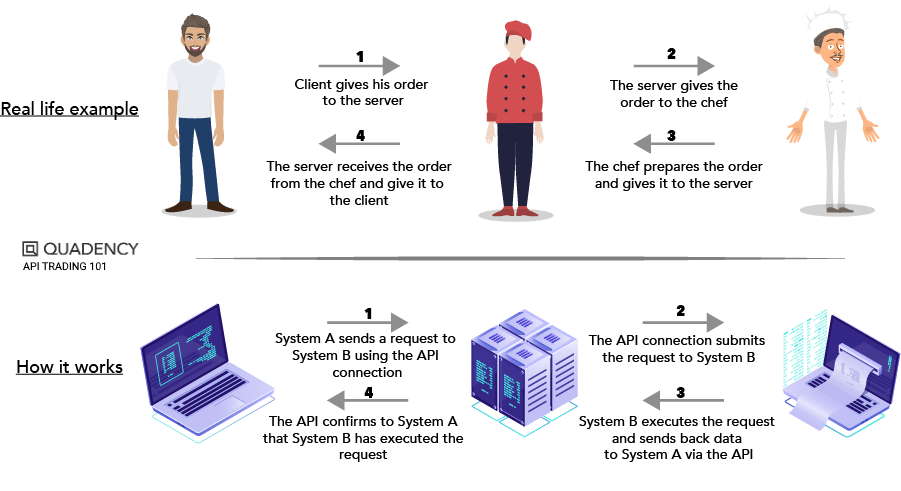
Cross-exchange inventory rebalancing bots run simultaneous buy/sell orders across venues using pre-funded balances. They require live price feeds via API and trading permissions on each exchange. They optimize for latency. The primary bottleneck is capital lock-up.
Single-venue triangular bots route through three legs inside one exchange. They require one exchange’s API feed across all three pairs. They optimize fee-tier efficiency and routing order. The primary bottleneck is sequential execution risk.
On-chain/DEX executors operate with mempool and inclusion awareness. They require an RPC connection, wallet credentials, and gas price estimation logic. They optimize transaction inclusion and ordering. The primary bottleneck is gas cost volatility combined with MEV competition.
Before building or renting a bot, check:
- Trade frequency — if opportunities appear multiple times per hour, manual execution will struggle.
- Spread size vs total costs — thin margins require speed.
- Continuous monitoring need — around-the-clock strategies need automation.
- Partial fill and retry handling — manual recovery gets error-prone quickly.
Execution controls are non-negotiable:
- Order sizing based on live depth, not fixed notional size.
- Max slippage or price-band guardrails.
- Fee-aware profitability checks immediately before order submission.
- Retry and cancel logic for partial fills.
- Logging of inputs, orders, fills, and net result.
APIs and Alerts
When it comes to alerts or crypto exchange APIs, data-only alerting and execution via trading APIs are not the same thing.
A data-only alert pulls prices through an API and notifies you when a spread crosses a threshold. It can surface candidates quickly, but it cannot place orders, check depth, or confirm whether the fee-adjusted spread is real.
Execution via a trading API lets a script submit, cancel, or modify orders. This is what turns a flagged opportunity into a filled trade.
A useful alert should include enough fields to judge executability at a glance:
- Pair
- Venue
- Best bid/ask
- Spread percentage
- Depth at intended size
- Assumed fee rate
- Timestamp
- Direct order book link
Rate limits and data quality matter as well. Polling caps, exchange throttling, and delayed websocket feeds can create false positives or false negatives. A practical mitigation is to require confirmation from a second data source or trigger only after a spread persists for a set number of seconds.
Custody and Security Setup
Custody structure changes the execution speed and flexibility available to you.
A CEX-heavy setup splits balances across multiple exchanges to support fast inventory-based execution. The operational focus is account access hygiene: strong credentials, 2FA, and withdrawal address lists.
A self-custody plus CEX setup uses a wallet for the DEX leg and one or more CEX accounts for the centralized leg. The focus shifts to transaction signing flow and keeping enough gas available. A DEX leg that fails because of an empty gas balance can strand the other side of the arbitrage trade.
Before running live cycles, confirm:
- Withdrawal addresses are whitelisted and active.
- A 2FA method is enabled and backed up.
- API key permissions are narrowly scoped, with withdrawals disabled unless required.
- Stablecoin or fiat buffers exist on each venue.
- On-chain gas buffers are available for DEX execution.
- A rebalancing plan exists for inventory drift.
Crypto Arbitrage Risks and Pitfalls
Transaction Delays
Evidently, transfer-based arbitrage lives or dies on a latency chain with three links.
First, exchange withdrawal processing is the time between clicking withdraw and the transaction broadcasting to the network. This depends on internal queues, risk checks, and batching.
Second, blockchain confirmation variability is the time required for the transaction to be picked up and confirmed. You can sometimes improve priority by paying a higher network fee, but network congestion and validator throughput remain outside your control.
Third, exchange deposit crediting is the time between on-chain confirmation and tradable balance. This varies by exchange policy and asset.

A simple timing budget turns this from guesswork into a decision tool. Record five timestamps on every transfer-based attempt:
- Withdrawal initiated
- Transaction broadcast
- First confirmation seen
- Deposit credited
- Sell executed
After a few cycles, you will have a realistic median and worst-case duration for that asset/network route. If the worst-case window is longer than the typical lifespan of the price gaps you chase, transfer-based arbitrage is not viable on that route.
Before a transfer-based cycle, check:
- Public congestion trackers or gas-fee spikes.
- Changes in required block confirmations.
- Status banners or maintenance notices.
- Your own recent transfer times on the same route.
- Active news or volatility conditions.
Inventory-based arbitrage removes the in-flight transfer window but introduces rebalancing drift. Transfer-based arbitrage avoids duplicated balances but concentrates risk into the period between withdrawal and deposit crediting.
Slippage and Volatility
Two mechanisms, which are already annoying enough when you are just trading, erode a spread during arbitrage execution.
Slippage from thin books or AMM price impact is structural. Your order size is too large for the liquidity at the best price, so it fills through worse levels.
Adverse selection from fast price moves is timing-based. The market shifts while your order is filling, regardless of your order size.
For example, the screen shows a $60 spread on a $20,000 notional: buy at $100.00, sell at $100.30. You send a market order, but only 60% fills at $100.00 and the rest fills at $100.15. While this happens, the sell venue drifts down to $100.10. Your realized buy average is $100.06 and your realized sell is $100.10. The expected $0.30 spread becomes $0.04 before fees.
Execution controls can limit this exposure:
- Set max slippage or price-band limits.
- Use limit orders with IOC or FOK time-in-force.
- Size trades to fit visible top-of-book depth.
- Require the spread to persist for a short observation window.
Volatility spikes widen slippage and raise the odds of exchange withdrawal review or blockchain congestion at the same time. During news shocks, widen buffers or avoid transfer-based legs until conditions settle.
Frozen Withdrawals
To add insult to injury, a centralized platform can easily throw a wrench into your time-sensitive play with a withdrawal freeze, for a few reasons.
Exchange risk controls and compliance reviews trap inventory on one venue, making the second leg impossible.
Platform maintenance or wallet upgrades pause specific withdrawal rails. These are often announced, but only if you check status pages.
Volatility-driven protective throttling can happen without warning during extreme price swings.
If a freeze happens mid-cycle, use a containment playbook:
- Hedge or neutralize exposure where possible.
- Stop initiating new cycles and assess net inventory across all venues.
- Rebalance only after withdrawals have visibly normalized.
Before starting a cycle, verify:
- Withdrawal address whitelist status.
- Daily withdrawal limit headroom.
- Specific network availability for the asset.
- Recent small test withdrawal completion on the same route.
Insights and Examples
Kimchi Premium
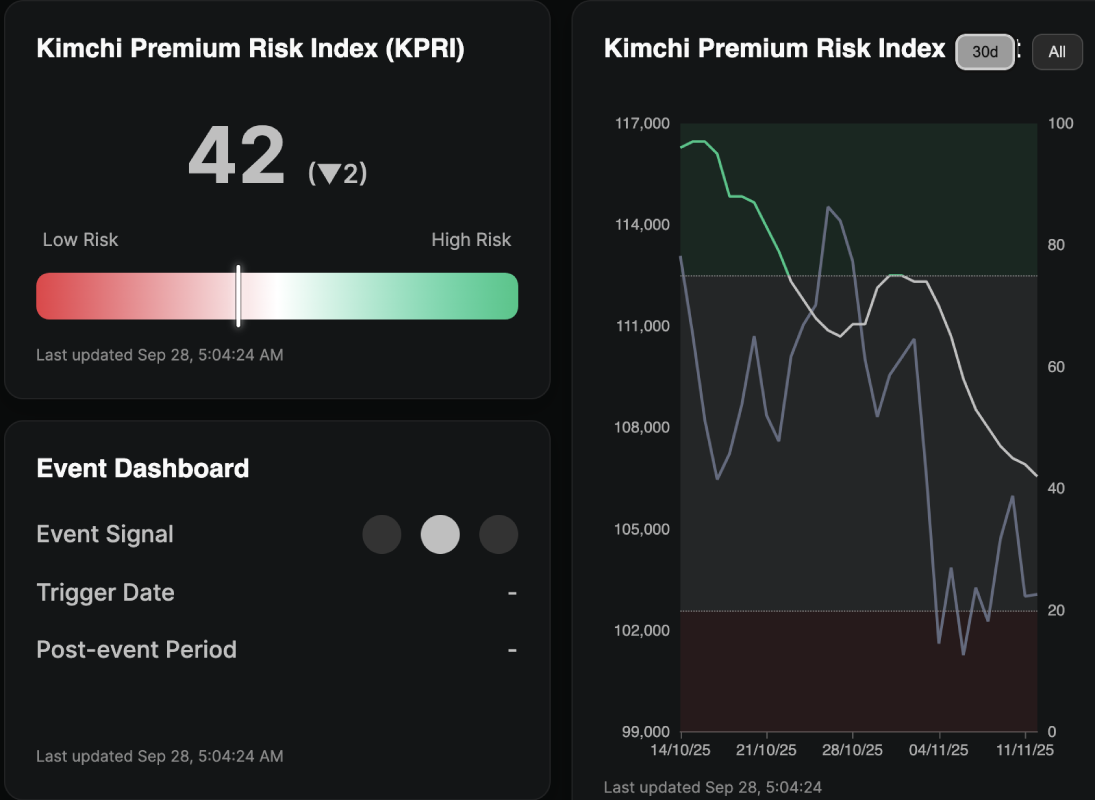
The Kimchi premium is a case study in regional price discrepancy. The same cryptocurrency asset can trade at a persistently higher price on South Korean exchanges than on international venues. That gap is not a quoting error. It is a standing divergence.
Two forces drive it: restrictions on moving Korean won in and out of the country, and domestic retail demand that can outpace local supply. For an outsider trying to capture it, the practical barriers are the whole point. KRW conversion restrictions, KYC/region gating, and settlement timing make the premium difficult or impossible to access.
The lesson here is straightforward: not every visible gap is retail-accessible. Some spreads are structural and sit outside the flows that would normally arbitrage them away.
Flash Loan Arbitrage
Flash loan arbitrage is a DeFi-native case study built around one constraint: the entire sequence — borrow, trade across one or more AMM pools, repay the loan — has to be completed inside one blockchain transaction. If any step fails, the whole transaction reverts.
As a result, there is no partial outcome. Either every step succeeds atomically or none of it does. This removes traditional counterparty and default risk but replaces it with execution risk.
For flash loan arbitrage to be viable, three conditions need to line up:
- Enough on-chain liquidity across the full route.
- Fees, gas costs, and MEV risk low enough not to consume the gap.
- A genuine pricing inefficiency that remains intact until inclusion in a block.
Common failure points include:
- MEV competition — a searcher bot sees the transaction and captures the opportunity.
- Slippage from route size — the loan amount pushes price impact higher than modeled.
- Gas spikes — network congestion turns a profitable route unprofitable before confirmation.
Conclusion
Crypto arbitrage comes down to one test: does a price gap survive the real costs of capturing it?
Whether the setup is cross-exchange, triangular, DEX-to-CEX, or statistical, the visible spread is only a starting signal. What determines profitability is execution: fees on both legs, slippage through order book depth or AMM curves, transfer and confirmation timing, and the operational readiness of the accounts involved.
Frequently Asked Questions
Is crypto arbitrage legal?
Yes, crypto arbitrage is legal in most jurisdictions because it involves buying and selling an asset you are permitted to trade. However, legality still depends on your location and each exchange’s Terms of Service. Some platforms restrict automated or high-frequency trading, and some regions impose licensing or tax rules on frequent trading. Check local regulations and exchange rules before running any bot or high-frequency setup.
Is crypto arbitrage still profitable in 2026?
Yes, but only for traders who actively control execution costs and timing risk. Fees, slippage, and transfer delays consume most visible spreads, so a wide screen-level gap and genuine net profit are different things. Traders who pre-fund inventory, secure better fee tiers, and route through deep liquidity are best positioned to capture thin margins consistently.
How much money do you need for crypto arbitrage?
There is no fixed minimum. Capital requirements depend on execution setup. Inventory-based execution requires more working capital because balances of both the asset and quote currency must sit ready on each venue. Transfer-based execution can start smaller, but it needs a larger spread buffer to absorb transfer timing risk. Minimum order sizes, withdrawal minimums, and fee buffers also matter.
Can crypto arbitrage be automated?
Yes. Crypto arbitrage can be automated with bots and trading APIs, and automation is common among active arbitrageurs. Automation improves speed and consistency, but it does not remove constraints such as thin liquidity, fee schedules, partial fills, transfer delays, or frozen withdrawals. A bot still needs monitoring, risk controls, and failure-handling logic.