
What Is Bonk Coin? A Beginner's Guide

Key Takeaways
- 🐶 Bonk Coin (BONK) is a Solana-native SPL token and a dog-themed meme coin built around community participation rather than a centralized product roadmap.
- 🐶 BONK launched on December 25, 2022, through an airdrop that distributed 50% of its 100 trillion total supply to the Solana community.
- 🐶 Its utility spans tipping, trading, dApps, gaming platforms, rewards, and DeFi activity, but not every “integration” represents the same level of real usage.
- 🐶 BONK is not mineable, and “staking BONK” usually refers to third-party DeFi or platform programs rather than protocol-native staking.
Disclaimer
This article is for informational purposes only and does not constitute investment advice. Meme coins are highly volatile assets, and community momentum does not remove market, liquidity, smart-contract, governance, or custody risk. Supply figures can vary across trackers depending on indexing methods and timestamps, so readers should cross-check important data against Solana block explorers and official project resources before making financial decisions.
As far as dog coins go, by now Bonk is a well-known example. For the Solana community in particular, it is a meme coin that needs no introduction. But what makes Bonk remarkable among so many meme coins?
In this guide, we will break down BONK’s fundamentals, its background and launch context, how it works mechanically, its real-world utility, tokenomics and supply structure, and the practical steps for buying, storing, and earning BONK.
Bonk Coin Fundamentals
BONK is best understood through three layers: the chain it runs on, the category it belongs to, and the community-first premise behind its launch.
Solana Blockchain Foundation
BONK is a Solana-native token, meaning it was created and lives entirely within the Solana blockchain’s infrastructure rather than existing on its own separate chain. This matters because BONK uses Solana’s SPL token standard, the same technical framework that governs thousands of other assets on the network.

What it means for you in practice is BONK integrates natively with Solana wallets, decentralized exchanges (DEXs), and dApps as a first-class asset rather than a bridged or wrapped substitute. Anywhere the Solana ecosystem is present, BONK can theoretically show up as a supported asset, since it does not need special adapters or cross-chain workarounds to function within that environment.
For the purposes of this Beginner’s guide, it would not hurt to mention that BONK is not technically a coin but a token. The SOL coin is Solana’s native network asset, used to pay transaction fees and secure the blockchain itself. BONK, by contrast, is an SPL token — an asset issued on top of Solana’s infrastructure rather than the infrastructure’s own currency. However, the term “meme coin”, which appeared after Dogecoin, has stuck around and eventually started to be applied to tokens too.
Dog-Themed Meme Coin Category
Actually, a meme coin (whether a true coin or token) is a category of cryptocurrency whose demand is driven primarily by community sentiment, cultural relevance, and social momentum rather than by a defined technical use case or enterprise application. Put in another way, the emphasis is on the “meme” part.
This distinguishes meme coins from utility-first tokens, which usually derive value from solving a specific problem — powering a platform, enabling a service, or backing a protocol.
With meme coins, value tends to be reflexive: attention and participation feed further attention and participation. The coin’s identity is often inseparable from its branding, humor, or online culture. Understanding this distinction matters because it reframes what “success” or “activity” looks like for BONK compared to a purely utility-driven asset.
Quite a few telling signs will prove that you are looking at a meme coin:
- Branding-first positioning — the coin’s identity, including its name, mascot, and theme, is central to its marketing and community presence.
- Community-led distribution narratives — the story of how the coin reached holders is emphasized as much as, or more than, technical specifications.
- Heavy social engagement — activity on social platforms, forums, and messaging apps tends to be disproportionately high relative to the project’s technical documentation or codebase.
- Rapid sentiment cycles — attention and price interest can shift quickly based on cultural trends or online events rather than gradual, utility-driven adoption.
Community-First Purpose
At the fundamentals level, “community-first” describes an operational orientation rather than a marketing slogan. It means BONK’s growth and relevance depend on broad, decentralized participation across the Solana ecosystem rather than a single company’s product roadmap or a centralized team directing every decision.
This shows up as grassroots adoption loops: individual users, developers, and communities within Solana independently choose to integrate, share, or use BONK. In this sense, BONK’s community-first framing is less about a specific feature and more about how influence and momentum are distributed across many participants instead of concentrated in a corporate structure.

Common misconceptions worth clarifying early:
- Community-first does not mean risk-free. Broad participation and decentralized momentum do not eliminate the volatility or uncertainty associated with cryptocurrency.
- Meme coin does not mean no on-chain utility. Being categorized as a meme coin refers to demand drivers, not necessarily an absence of functional use within its blockchain ecosystem.
- Solana-based does not mean SOL-backed. BONK’s existence on the Solana blockchain does not imply that its value is collateralized by or tied to SOL’s price. It is a distinct token with its own market dynamics.
Background and Launch
Do you wonder why the Bonk coin means something for Solana users? BONK’s origin story is tightly connected to the post-FTX period, which is why the token is usually discussed not only as a meme coin but also as a Solana community revival symbol.
Christmas Day 2022 Launch
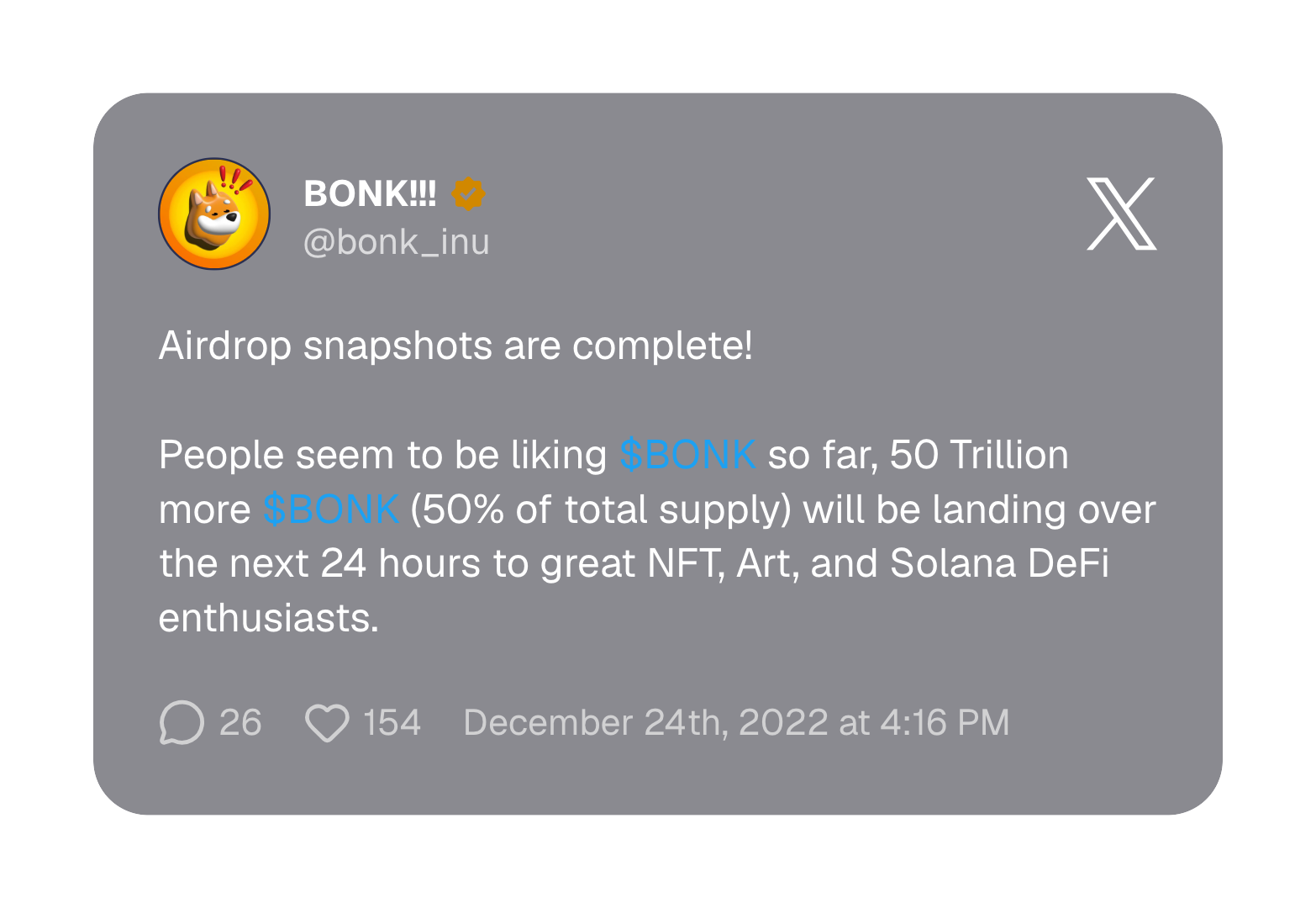
BONK launched on December 25, 2022 as an airdrop on the Solana blockchain, distributing 50% of its 100 trillion total supply directly to the community rather than reserving the bulk of tokens for a team or private investors. On December 30, 2022 trading in BONK officially began, five days after the airdrop, as the token moved from wallet distribution into open market activity.
Within the first week of trading BONK rose over 2,000% following its listings on exchanges, an early market reaction that signaled outsized attention relative to a typical new token debut.
This sequence — airdrop, trading, then rapid price reaction — is the historical backbone of BONK’s launch.
Solana Ecosystem Revival
BONK did not launch in a vacuum. It arrived during a period when Solana’s ecosystem was dealing with a serious sentiment problem following the collapse of the FTX exchange, which was closely tied to Solana’s early growth and visibility.
That collapse had knock-on effects on how outsiders and long-time participants perceived Solana. It raised doubts about ecosystem morale, dampened liquidity, and slowed the everyday activity that gives a blockchain network its sense of momentum.
Against that backdrop, BONK’s airdrop was positioned less as a typical token launch and more as a grassroots signal: a way to re-engage existing Solana users and give the community something to rally around. “Revival” meant restarting activity loops — people transacting, sharing, and participating again — rather than delivering a single technical fix or protocol upgrade.
The token itself became a proof point that the Solana community could still generate organic energy on its own terms.
Community Airdrop Distribution
Of BONK’s total 100 trillion token supply, the airdrop distributed 50% with the stated intent of reaching the broader Solana community: everyday users, developers, and active participants across the ecosystem.
This distribution choice matters for a few concrete reasons:
- Broad initial ownership — spreading half the supply across a wide base of recipients reduced the concentration risk typical of team- or VC-heavy token launches.
- Meme and community propagation — because many people held BONK from day one, sharing and discussing the token became a natural extension of simply owning it.
- Incentive alignment with Solana users — by targeting people already active in the Solana ecosystem, the airdrop tied BONK’s early holder base directly to the network it was meant to energize.
Nevertheless, it is worth drawing a clear line between launch narrative and investment thesis. The airdrop-and-revival story explains why BONK found rapid adoption and community attention in its first days and weeks. It does not, on its own, prove that this adoption translates into durable long-term value.
How Bonk Mechanics Work
Mechanically, BONK behaves like other SPL tokens on Solana. The interesting part is not that transfers are complex — they are not — but that users need to understand which asset does what.
Fast and Low-Cost Transactions
When BONK moves from one wallet to another, what is happening under the hood is an SPL token transfer. It is an instruction recorded on the Solana blockchain that updates the token balances of the sender and receiver; there are no physical or virtual tokens that move anywhere.
Plus, every transaction on Solana, including a BONK transfer, requires a small amount of SOL to cover the network’s gas fee. BONK itself is not used to pay for its own movement; SOL is the asset that compensates validators for processing and confirming the transaction. Additionally, since a token transfer is a program call, it is slightly more pricey than a native SOL transfer.
From a user’s perspective, the sequence is straightforward:
- The wallet signs the transaction.
- The network confirms it, typically within seconds.
- The result becomes publicly viewable on a Solana blockchain explorer.
That is the entire mechanical loop — sign, confirm, record — without any additional steps specific to BONK as an asset.
BonkDAO Governance
As is appropriate for a community-first project, BonkDAO represents BONK’s approach to community governance: a structure in which token holders can influence decisions rather than leaving them entirely to a centralized team.
In practical terms, a token-governed DAO like this may control decisions such as treasury allocation, partnerships, incentive programs, operational parameters, and token burns. At a high level, anyone holding enough governance-eligible tokens can generally propose an initiative, while a broader base of token holders votes to approve or reject it.
A passed proposal is not just a symbolic outcome. It typically triggers an execution step, meaning approved proposals can result in real funds or permissions moving based on the vote. This is where governance shifts from discussion to operational action.
However, that execution step creates a distinct governance risk surface. Because on-chain governance ties voting outcomes directly to real actions — fund transfers, permission changes, or contract interactions — the proposal design, voting power concentration, and execution permissions all become potential points of failure.
A concrete illustration of this risk is that the BonkDAO treasury was drained of approximately $20 million through a governance proposal that was voted through and subsequently executed maliciously. This incident shows that a proposal “passing” a community vote does not guarantee the outcome is safe. Execution risk can exist even when the governance process itself was followed.
Token Burns
A token burn directly reduces total supply (see further sections for exact definitions), but it does not automatically translate to a higher BONK price prediction. Burning changes the supply side of the equation only. It does nothing by itself to increase demand, and price movement depends on both factors together.
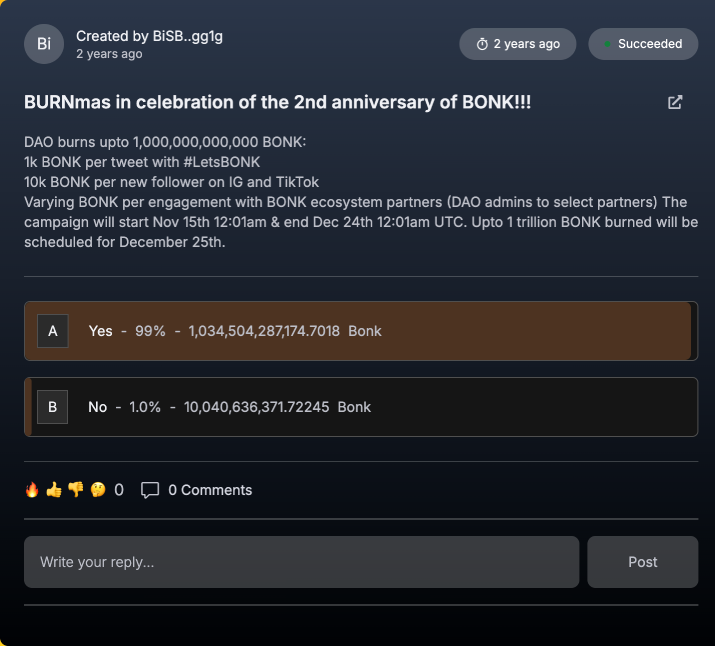
BONK has a concrete example of a discrete burn event: the “BURNmas” event burned approximately 1.69 trillion BONK tokens, valued at over $51 million at the time, permanently removing that amount from total supply in a single coordinated action.
At the end of day, the narrative channel — whether the market cares — is separate from the burn mechanics.
Bonk Ecosystem Utility
BONK positions itself as more than a cultural token, reporting 400+ integrations and 1.1M+ holders across the Solana ecosystem. Those numbers are useful as high-level adoption signals, but they should not be treated as evidence of uniform utility. An “integration” can mean anything from a token being selectable in a dropdown menu to serving as a core in-app currency. The difference matters.
dApp Integrations
Within Solana’s network of decentralized apps (dApps), BONK tends to appear in several recurring roles:
- In-app currency — BONK is spent directly within an application as its primary unit of exchange.
- Payments — some dApps accept BONK as a settlement method for goods, services, or subscriptions.
- Discounts and perks — holding or spending BONK can unlock reduced fees, bonus features, or preferential treatment.
- Gated access — certain apps require holding a minimum BONK balance to unlock tiers, communities, or functionality.
- Rewards and incentives — dApps distribute BONK as an incentive for participation, referrals, or activity milestones.
- DeFi collateral or liquidity — within DeFi protocols, BONK can be deposited as collateral for loans or supplied to liquidity pools on a decentralized exchange (DEX).
There is one distinction that should not be blurred: using BONK inside a dApp is different from swapping for BONK. Swapping is the acquisition step — converting another asset into BONK on a DEX. Usage is what happens afterward, whether that means spending, staking, tipping, or unlocking access.
Incidentally, what even counts as an integration? Not all integrations carry the same weight, and headline counts can flatten that difference. A useful way to judge depth is to look for two signals:
- Whether the token supports recurring in-app flows, meaning repeated functional use rather than a one-time listing.
- Whether there is meaningful volume or active-user engagement behind that flow.
Gaming Platforms
Solana-based games have adopted BONK in a few recognizable economic patterns:
- Entry fees and prize pools — players stake BONK to join a match or tournament, with winnings paid out in the same token.
- Cosmetic and NFT marketplace currency — BONK is used to buy skins, items, or in-game NFTs listed on a marketplace.
- Quest rewards and airdrops — completing in-game tasks or milestones triggers a BONK payout to the player’s wallet.
There is a practical volatility point here. Games that price items in-token, meaning a fixed BONK amount, can see that cost swing significantly in USD terms. Games that price in USD-equivalent, adjusting the BONK amount to match a stable dollar value, shift the volatility risk onto the token amount instead. Neither model removes volatility; it only relocates it.
Tipping and Trading

Tipping is one of BONK’s most visible community use cases. It can mean sending small amounts as a reaction to a social media post, as direct support for a creator, or as a reward within a community channel.
Low-friction transfers matter here because tipping only works as a casual, repeated behavior if the cost and speed of sending tokens stay negligible. Solana’s fast confirmation times make this kind of frequent micro-payment practical in a way that would be difficult on a slower or costlier network.
Trading covers a different set of activities. Spot trading refers to buying or selling BONK at its current market price, typically on a centralized exchange (CEX). Swapping on a DEX means exchanging BONK for another token directly through a decentralized exchange’s liquidity pools rather than an order book. Providing liquidity is a further step where a holder deposits BONK, usually paired with another asset, into a pool to facilitate swaps for others in exchange for a share of trading fees.
In either case, keep in mind:
- SOL is needed to cover transaction fees, even when sending or tipping BONK itself.
- DEX swaps carry their own fee, separate from the network gas fee.
- Thin liquidity on certain trading pairs can lead to noticeable slippage or price impact on larger swaps.
- Network conditions or RPC delays can occasionally slow confirmation times for trades or transfers.
Wallet and Exchange Support
Wallet support means a wallet can hold, send, and receive BONK, while correctly displaying the token’s balance and identity. Exchange support means a platform allows deposits and withdrawals of BONK and lists it against active trading pairs, whether on a CEX or DEX.
Before assuming either type of support, check the following:
- Deposits and withdrawals for BONK are actually enabled, not just trading.
- The correct network, Solana, is selected when depositing or withdrawing.
- Minimum deposit or withdrawal amounts are clearly stated.
- Memo or tag requirements are checked, if the platform requires one for BONK transactions.
- The token’s contract address is verified inside the wallet or exchange interface.
Custody changes the experience. Custodial exchanges abstract away on-chain mechanics entirely, so users interact with an internal balance rather than signing Solana transactions directly. Non-custodial wallets expose the blockchain layer, which means users need SOL on hand to cover transaction fees for any BONK transfer they initiate themselves.
BONK Tokenomics and Supply
BONK’s tokenomics are not just about the total number of tokens. The more useful questions are where supply sits, whether it is circulating, who controls it, and how future movement could affect market conditions.
Token Allocation
Despite a popular misconception, BONK’s tokenomics extend beyond the initial launch distribution into allocation categories that shape incentives and potential sell-pressure dynamics.
One documented allocation detail worth highlighting: 20% of BONK’s distribution was allocated to 40 Solana NFT collections. This deliberately routed a meaningful share of supply toward holders already embedded in Solana’s NFT community rather than toward a generic public sale or a small group of insiders.
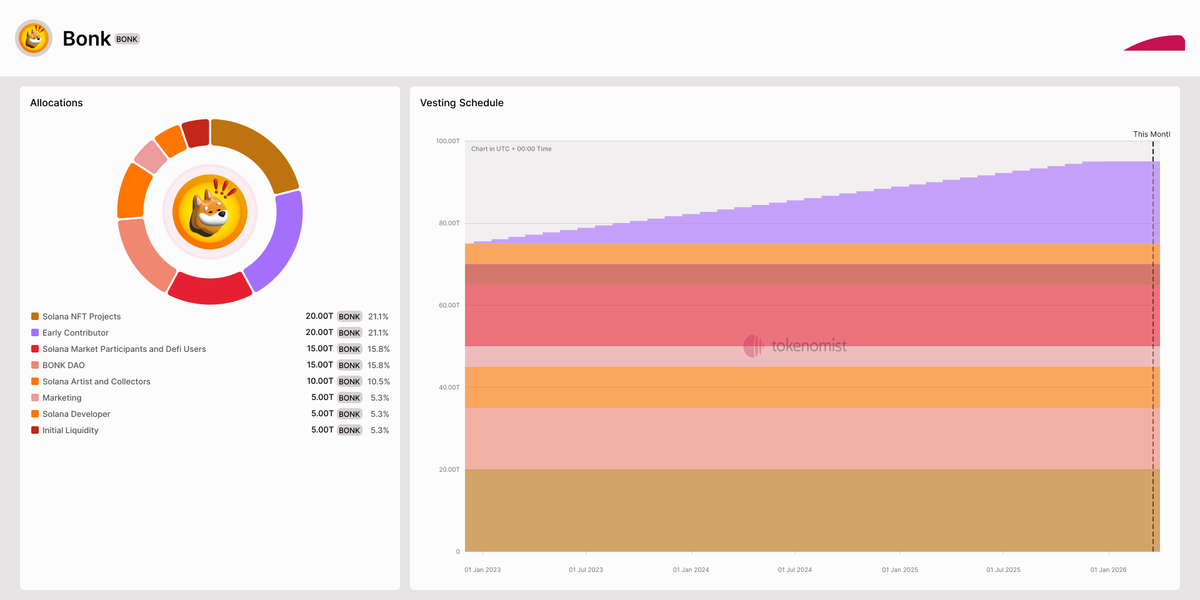
That matters for holder composition. Recipients tied to NFT collections tend to have existing on-chain engagement and community affiliation with Solana, which can support organic distribution. However, it also concentrates that slice of supply among a narrower set of NFT-holder wallets rather than spreading it evenly across the broader token-holder base.
Beyond that NFT-linked holder base, allocation frameworks for tokens like BONK typically separate supply into categories such as:
- Community distribution;
- Ecosystem incentives, including grants, liquidity programs, and partnership rewards;
- Treasury or DAO-controlled reserves earmarked for future initiatives.
When we talk about tokenomics, instead of focusing on allocation alone, proper analysis considers incentive alignment. Community-distributed tokens tend to disperse across many independent holders with varied time horizons. Ecosystem-incentive tokens are usually released to recipients who complete specific actions and may sell shortly after receipt. Treasury or DAO-held tokens remain under collective governance control until a proposal directs their use.
How to read allocation risk:
- Single-category concentration — when a large share of supply sits in one group’s pockets, them selling can move prices in a correlated way.
- Unclear vesting terms — if a release schedule is not publicly documented, it is harder to anticipate when that supply might enter circulation.
- Treasury/DAO dependency on governance — tokens held under DAO or treasury control are only as safe from abrupt movement as the governance safeguards protecting them.
- Recipient behavior varies by bucket — community airdrop recipients, NFT-linked recipients, and incentive-program recipients do not necessarily hold or sell on the same timeline.
- Cross-referencing allocation against circulating supply — allocation that looks large in isolation matters less if everything is already fully circulating.
Circulating Supply
That being said, supply dynamics are still an important part of analyzing a crypto project.
Once again, maximum supply is the absolute ceiling on how many tokens can ever exist. For BONK, that figure is 88,872,433,754,423 tokens. Total supply refers to tokens that have actually been minted or created up to the maximum, adjusted downward if tokens have been burned. Circulating supply is narrower still: it is the portion of total supply actively available to the public and trading in the market, excluding tokens that are locked, reserved, or otherwise not yet released.
For Bonk coin, measuring its market capitalization against fully diluted valuation (FDV) is not crucial, as 99% of its total supply is already in circulation. It owes this part of its fundamentals to the community-focused initial distribution, which is a frequent case for meme tokens.
Holder Distribution
BONK reports 1.1M+ holders, a figure commonly cited as a headline adoption signal. More wallets holding a token generally suggests broader distribution and grassroots reach than a token concentrated among a small handful of addresses.
That being said, holder count alone does not describe concentration. Concentration asks a different question: how much of the supply sits in the hands of a small number of large holders, regardless of how many total addresses exist. If you have heard about “whales”, those are the holders in question.
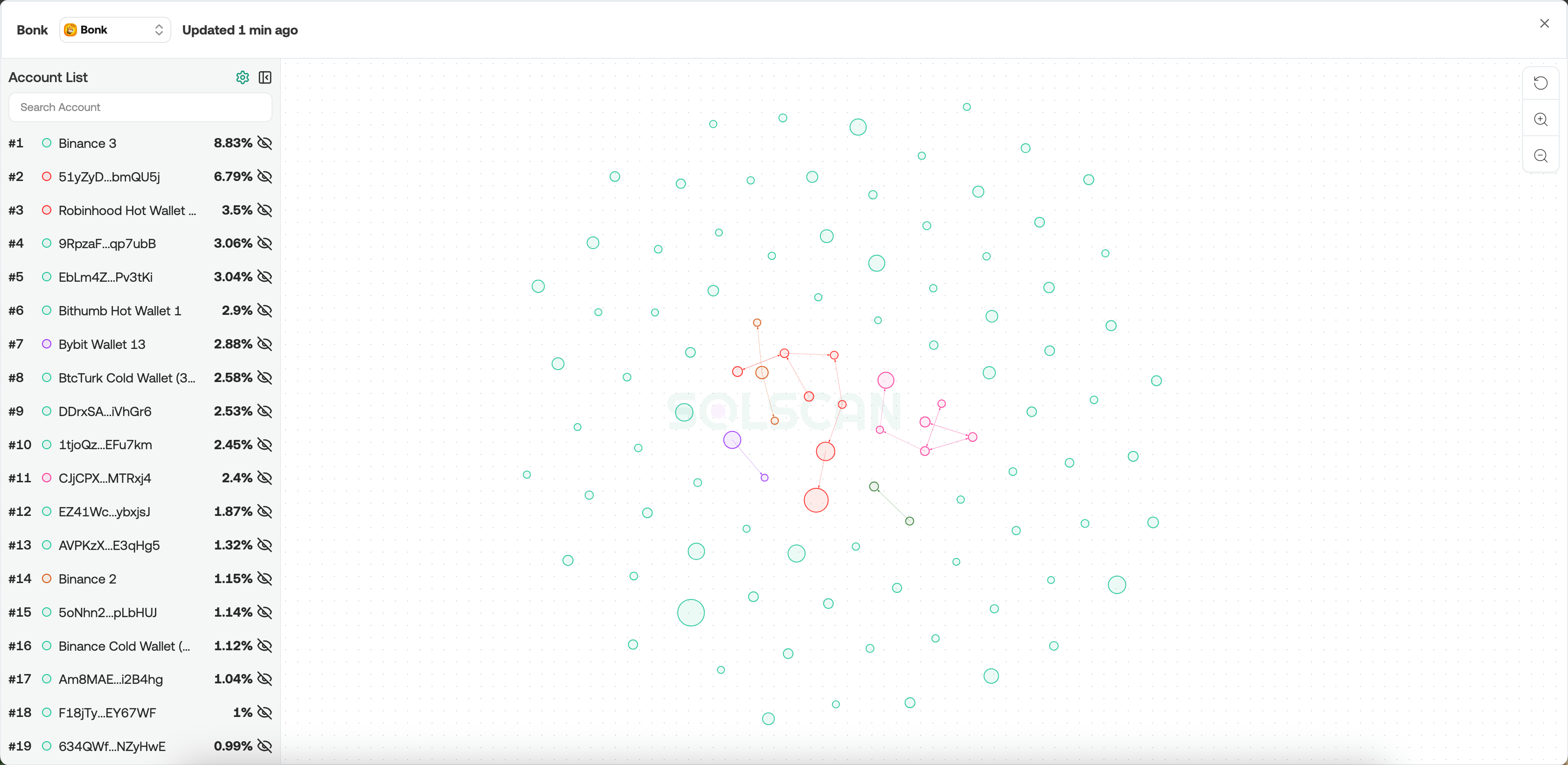
It is entirely possible for a token to show both a high holder count and high concentration at the same time. Dust addresses — wallets holding negligible, often unusable amounts left over from airdrops or dispersed rewards — can inflate raw holder count without representing meaningful economic participation. Exchange custody wallets add another layer: a single wallet address on an exchange can represent the pooled holdings of thousands of individual users. When you go to a blockchain explorer and see “Top 10 holders collectively own 38.54% (33.9T Tokens) of total supply”, you will rather quickly notice that exchange wallets indeed rank quite high in these lists.
Buying, Storing, and Earning BONK
Good news: BONK can be acquired, stored, and used through the same broad infrastructure that supports other Solana SPL tokens. The operational details still matter because a small mistake — wrong network, wrong token, no SOL for gas — can be expensive.
Exchange Availability
Acquiring BONK generally comes down to two practical paths: centralized exchanges (often abbreviated as CEX) and Solana DEX (decentralized exchange) swapping.
Before buying on a CEX, a user typically needs a verified account and a funding method, either a fiat deposit or another crypto asset already held on the platform. Once set up, the CEX path allows straightforward buying, selling, and trading of BONK against other listed pairs. It may also allow deposits from an external wallet and withdrawals to one.
The tradeoffs are structural. The exchange holds custody of your BONK while it sits on the platform, meaning you trust the venue’s solvency and security rather than controlling private keys yourself. Fees are usually predictable, execution tends to be fast due to internal order matching, and the main failure points are platform-side: maintenance windows, withdrawal suspensions, or account verification delays.
In turn, before swapping on a decentralized exchange (DEX), a user needs a non-custodial wallet funded with SOL to cover network fees, plus whatever asset they intend to swap into BONK.
On a DEX, the core action is swapping one token for another directly through liquidity pools rather than through an order book. Compared with a CEX, the tradeoffs shift: you retain custody of your tokens, but execution depends on available liquidity. Fees include both the DEX’s swap fee and Solana’s network gas fee.
The main failure points are price impact on thin pairs, wallet connection issues, or insufficient SOL to complete a transaction.
Wallet Storage
Storage decisions, at least for when you are just starting out in crypto, come down to custody.
With custodial storage, it is usually the exchange that holds the private keys and BONK exists as an internal balance rather than something the user directly controls on-chain.
This kind of storage suits frequent traders who prioritize convenience and speed of access over direct control. There is no need to manage keys or sign transactions, for one.
With a non-custodial wallet, the user holds the private keys directly, and BONK exists as an on-chain balance tied to that wallet’s address. This is also called “self-custody”.
The decision rule is the inverse: non-custodial wallets suit users who prioritize self-custody and direct control over their assets, accepting the added responsibility of managing keys and initiating their own transactions.
When choosing an app to manage BONK, the wallet has to:
- support SPL tokens, since BONK is issued under Solana’s SPL standard.
- allow custom tokens to be displayed if BONK does not appear automatically.
- support sending and receiving on the Solana network specifically.
- show token mint or contract address details.
- and finally, topped up with a small SOL balance to cover transaction fees.
For an SPL token like BONK, the distinction between hot and cold storage comes down to where the private key lives and where transactions are signed, not where the token itself resides. BONK always lives on the Solana blockchain regardless of storage method.
A hot wallet keeps keys accessible on an internet-connected device and signs transactions directly within that environment. Cold storage keeps keys offline, requiring a separate signing step before a transaction is broadcast to the network. What changes is the signing environment and its exposure. The underlying token balance, SPL structure, and on-chain record remain identical either way.
Staking and Earning Options
What about staking BONK? Sadly, there is no protocol-native, base-layer staking mechanism the way staking SOL does to secure Solana’s network. Instead, earning opportunities involving BONK typically come through staking-like programs, DeFi protocols, or platform-level incentive schemes.
Readers should treat any BONK “staking” offer as a third-party program with its own terms, not an inherent feature of the token.
Common earning methods include:
- DeFi yield via liquidity provision — depositing BONK, usually paired with another asset, into a decentralized exchange’s liquidity pool in exchange for a share of trading fees. The primary risk is impermanent loss, where the value of deposited assets diverges from simply holding them.
- Lending/borrowing markets where available — supplying BONK to a lending protocol to earn interest, or using it as collateral to borrow against. The primary risk is liquidation, where collateral can be seized if its value falls below a required threshold.
- Ecosystem incentives/rewards programs — earning BONK through platform-specific reward schemes, referral programs, or promotional campaigns. The primary risk is smart-contract or platform risk, since rewards depend on the continued operation and security of the program distributing them.
BONK is not mineable. As an SPL token on Solana, BONK does not have its own proof-of-work network to secure by mining. Solana itself uses a proof-of-stake consensus model, and BONK rides on top of that infrastructure as a token rather than operating as a mineable asset with its own blockchain.
What users often confuse with “mining” tends to be one of three adjacent activities:
- Airdrop campaigns that distribute tokens based on eligibility criteria;
- Liquidity mining programs that reward users for supplying assets to a pool;
- Broader reward programs tied to platform activity.
Conclusion
BONK’s story brings together several distinct threads: a Solana-native SPL token born from a Christmas Day 2022 airdrop, built to reinvigorate a community shaken by the FTX collapse, and structured from the outset around broad grassroots distribution rather than insider allocation.
BONK’s community-first launch gave it an unusually organic start. Sustained relevance, however, depends on the same fundamentals that apply to any token: real usage, transparent supply dynamics, and governance safeguards that hold up under pressure.
If you enjoyed our beginner’s guide, check out the ChangeHero blog for more. Follow ChangeHero on X, Facebook, and Telegram for daily updates and more content.
Frequently Asked Questions
How Many Bonk Coins Are There in Circulation?
For live BONK price, market cap and circulating supply figures, check out our coin page for BONK.
What Makes Bonk Unique?
BONK’s positioning as a community-first, Solana-native meme token sets it apart from projects driven primarily by a founding team or corporate roadmap.
Beyond that, BONK stands out for the breadth of its ecosystem usage. It functions as a general-purpose community asset across dApps, games, tipping, trading, and DeFi rather than being confined to a single niche.
That said, “unique” describes positioning and usage breadth. It is not a guarantee of sustained demand or price performance.
How Does Bonk Compare Against Its Peers?
Comparing BONK against other meme coins comes down to three reusable axes:
- Chain/ecosystem dependence — Solana-native versus multi-chain or separate-chain models, as with Dogecoin’s own chain or SHIB’s Ethereum roots.
- Real usage footprint — spending, tipping, and utility versus primarily trading activity.
- Supply dynamics — how burns, unlocks, and circulating supply behave over time.
Naming peers like Dogecoin and SHIB helps anchor the comparison, but the useful work is in applying the same framework consistently.
Where Can You Buy Bonk?
One can buy BONK through two main routes: buying directly on a centralized exchange, or swapping into it on a Solana-based decentralized exchange using an existing token. Platforms like ChangeHero act as a middle ground, simplifying away exchange accounts and complicated DEX mechanics.
Before acting on any path, confirm the venue supports BONK deposits and withdrawals on the Solana network specifically. Mismatched network selection can result in lost funds.