
What are Market Makers in Crypto? Beginner's Guide


Key Takeaways
- ↔️ A crypto market maker provides continuous buy and sell quotes so traders can execute without waiting for a natural counterparty to appear;
- ↔️ In centralized exchanges, market makers usually operate through order books, while decentralized exchanges often use automated market maker (AMM) pools instead;
- ↔️ Market makers can improve liquidity, tighten bid-ask spreads, reduce slippage, and support price stability, but they also introduce inventory risk, conflicts of interest, and potential manipulation concerns;
- ↔️ Market makers earn through bid-ask spread capture, exchange fee rebates, arbitrage and inventory gains, and token project retainers;
- ↔️ The most practical way to evaluate liquidity quality is to watch spreads, depth, quote stability, slippage, and whether liquidity remains present during volatility.
Disclaimer
This article is for educational purposes only and does not constitute investment, trading, legal, or financial advice. Crypto markets are volatile, market-making arrangements vary by venue, and execution quality can change quickly during periods of stress. Before trading, users should review the relevant exchange rules, fee schedule, liquidity conditions, and counterparty risks directly.
You may or may not realize this but a market maker is what stands between you and an empty order book. Instead of waiting for another trader to show up and take the other side of your trade, you get immediate execution because someone — or something — is already quoting a price to buy and a price to sell.
In crypto, this function appears in two very different environments. On centralized exchanges, human- or algorithm-run entities manage order books directly. On decentralized exchanges, automated market maker (AMM) protocols perform the same broad role through code rather than discretion on the blockchain.
This affects the spreads and slippage you see, the execution quality you receive when swapping tokens, and the controversies that continue to surround crypto market structure—and this is what this guide will shed some light on.
Crypto Market Maker Definition and Role

A crypto market maker provides continuous two-sided quotes and stands ready to trade, posting simultaneous buy and sell orders on a CEX order book to keep a cryptocurrency market functional even when no natural counterparty is immediately available. Rather than waiting passively for buyers and sellers to align on price and timing, this participant — whether a specialized trading firm or an automated system — commits capital on both sides of the book so that other traders can execute near-instantly.
Buy and Sell Quotes
A quote is a resting limit order (one that does not execute immediately, by definition). For example, a market maker might place an order to buy 1 BTC at an exact price of $61,900 and another to sell 1 BTC at $62,050, with both orders sitting on the order book waiting to be filled.
This is fundamentally different from a market taker, who submits a market order that immediately matches against whatever is already resting there. On most exchange interfaces, you can observe this distinction directly:
- Market maker quotes appear as stacked limit orders at multiple price levels;
- These orders appear on both sides of the book;
- They update frequently, sometimes many times per second;
- The maker adjusts quotes as new information, volatility, and inventory risk change.
Bid-Ask Spread
The bid-ask spread is the difference between the best ask and the best bid. If the highest bid is $61,900 and the lowest ask is $62,050, the spread is $150.
A tighter spread means a trader can buy and sell almost simultaneously with minimal cost difference. A wider spread signals higher immediate execution cost, because a market order must cross a larger gap to get filled.
Order Books and Trade Matching
Market makers supply the resting liquidity, and market takers remove it. Every time a taker’s market order executes, it consumes one or more of the maker’s limit orders sitting in the book.
Two order book terms matter here:
- Top of book — the best available bid and ask prices at that moment;
- Depth — the total volume resting at price levels beyond the top of the book.
A book can look deep in aggregate but still have thin top-of-book liquidity. In that case, the first few trades may execute cleanly, while anything larger quickly runs into gaps.
Liquidity, Market Depth, and Slippage Reduction
Here is how that plays out in practice. Imagine a large market order to buy 10 BTC arrives, but only 2 BTC is available at the best ask price. The order then “walks the book,” filling the remaining 8 BTC at progressively higher price levels until it is complete.
The average execution price ends up worse than the price quoted at the moment the order was placed. That difference is slippage.
Slippage is not the same as another similar effect, price impact. Slippage is the gap between expected and realized execution price for that specific order. Price impact, or market impact, refers to the lasting shift in the market price itself caused by the trade.

When market makers post additional resting size across multiple price levels — not just at the top of book but several ticks deep — large orders have more volume to absorb before they need to move to worse prices. This directly reduces the slippage a trader experiences.
Price Stability
Market makers help make prices more stable but how exactly? In this context, stability means reduced short-term volatility and fewer abrupt price gaps between trades. It does not mean any promise about long-term price direction.
The mechanism is straightforward: continuous quoting helps absorb order-flow shocks. A sudden burst of buying or selling has resting orders to trade against instead of moving directly to the next available price far away. Credible market-making operations often aim for high quoting uptime — maintaining active, continuous quotes across a large share of trading hours — precisely because gaps in coverage undermine this stabilizing effect.
However, this stability has limits. During fast, volatile moves, market makers can widen their spreads or pull their quotes entirely to manage risk. The same mechanism that stabilizes prices in calm conditions can temporarily disappear when it is needed most.
Crypto Market Maker Models
Crypto or not, not every market maker operates in the same way. Some are large firms quoting across dozens of venues. Others hold a formal contract with an exchange. Some are not firms at all but pieces of code running on a decentralized exchange.
The four models below differ by where they operate, who they work with, and what they optimize for.
Institutional Market Makers
Institutional market makers are professional trading firms that provide liquidity across multiple venues at once. This usually includes CEX order books, derivatives venues such as futures and perpetuals, and OTC desks for large block trades. Examples include Wintermute or DWF Labs.
Their typical counterparties include:
- Exchanges;
- Token issuers looking for launch-day liquidity;
- Brokers routing client flow;
- Other traders on the other side of their quotes.
What they optimize for depends on the venue and the moment: tight spreads and deep order books on a busy CEX pair, continuous quoting on a newly listed token, or discreet size absorption in an OTC block trade.
What separates an institutional operation from a smaller participant is not just capital. It is infrastructure:
- Multi-venue connectivity — simultaneous API access to dozens of exchanges, allowing quotes to be posted and pulled across venues in milliseconds.
- Risk and inventory management systems — real-time position tracking and automated hedging to avoid accumulating unwanted directional exposure.
- Round-the-clock operations coverage — crypto markets trade 24/7, so institutional desks run shift-based monitoring or fully automated systems that never go dark.
- Simultaneous multi-pair and multi-venue support — the ability to quote hundreds of trading pairs across spot and derivatives markets at the same time, rather than focusing on a single book.
Designated Market Makers
A designated market maker is not just any firm providing liquidity. It is a role formally sponsored by an exchange or venue, usually attached to a specific listing or trading pair, with explicit quoting obligations and performance targets.

This is different from a firm that simply chooses to quote because it sees an opportunity. A designated maker has agreed, often contractually, to meet defined standards in exchange for benefits such as reduced fees or priority access.
Those obligations typically fall into a few recognizable categories:
- Minimum percentage of time spent at the top of the book;
- Maximum allowable spread width;
- Minimum quote size the maker must maintain.
One common operational target referenced in crypto market-making programs is 95%+ quoting availability, although this is not a universal rule and exact thresholds vary by exchange and agreement. These programs are not unique to crypto or informal in nature, either. Regulated markets formalize designated roles through actual exchange filings with defined start and end windows, as seen in the CFTC's published rule filing (cftc.gov) and a corresponding CME Group rule filing (cmegroup.com), both of which illustrate how a designated program can be scoped, dated, and eventually retired rather than running indefinitely.
Principal Market Makers
Principal refers to how the trade is booked, not how prominent the firm is. A principal market maker trades using the firm’s own capital and takes on the resulting inventory risk directly, rather than simply matching two other parties’ orders and stepping out of the position.
You will typically see this label attached to:
- Exchange-sponsored market-making programs;
- Liquidity agreements between a firm and a token issuer or venue;
- Internal trading desks at exchanges or brokerages that hold and manage their own book.
The practical implication is discretion. Because the firm’s own capital is at risk, a principal maker has more latitude to widen spreads, reduce size, or pull quotes altogether when volatility spikes. Those decisions are harder to justify for a purely matching, riskless intermediary.
Automated Market Makers
Standing completely separate from the types described above, an automated market maker (AMM) is a protocol mechanism — a piece of software running on a decentralized exchange (DEX) that replaces the order book entirely.
Instead of stacked limit orders, an AMM relies on a liquidity pool: capital contributed by liquidity providers and priced according to a deterministic pricing curve that adjusts automatically as trades occur. No human or firm actively decides where to quote in the moment.
That structural shift comes with its own tradeoffs:
- Slippage on an AMM depends heavily on how deep the pool is relative to trade size;
- Liquidity providers funding the pool take on impermanent loss;
- Impermanent loss does not have a direct equivalent in order-book market making.
If you are curious, we have an entire guide dedicated to how liquidity pools work on DEXs.
So far we have established the main split: institutional, designated, and principal market makers operate through order books, whether on a centralized exchange or a regulated derivatives venue. AMMs replace discretion with a pool and a formula.
Both get called market makers because both perform the same underlying function — standing ready to take the other side of a trade — even though one does it through order placement and the other through code.
How Crypto Market Makers Make Money

Why would anyone go out of their way to be a market maker, though? The reason has to be more than “maker fees are lower”.
Market makers do not earn money by simply predicting price direction either. They earn by managing the mechanics of continuous quoting. Each revenue stream below has its own conditions for working and its own way of turning into a loss.
Bid-Ask Spread Profits
The bid-ask spread you see on an order book is not guaranteed profit. It is more accurate to separate the quoted spread from the realized spread.
- Quoted spread — the visible gap between the best bid and best ask;
- Realized spread — what a market maker actually captures after both sides of a trade fill.
A quoted spread only turns into a realized spread if the maker gets filled on both the buy and the sell leg at favorable prices. If fills are one-sided — for example, only the buy order executes while the market keeps falling — the maker is left holding inventory at a loss instead of pocketing the spread.
Quotes can also move before the second leg fills. Adverse selection, meaning getting picked off by traders with better or faster information, can turn an expected gain into a realized loss.
A compact numeric example makes this concrete: on a crypto exchange quoting BTC, a market maker buys 1 BTC at $100,000 and sells 1 BTC at $100,050 in a single round-trip, capturing a gross spread of $50. It is calculated before fees and before any inventory effects from the time between the buy and the sell, both of which can shrink or erase it entirely.
Exchange Fee Rebates
Speaking of lower fees, this is a part of the reasoning still. Beyond spread capture, market makers earn or lose money through maker-taker fee structures, which most crypto exchanges use to incentivize liquidity provision.
Posting a resting limit order that adds liquidity qualifies as a maker fee transaction. On many venues, this does not cost the maker anything; it actually pays a rebate. A trader who removes that liquidity with a market order pays a taker fee instead, and the exchange effectively funds the maker’s rebate out of the taker’s fee.
This matters because rebates can meaningfully change the economics of a strategy that would otherwise look marginal on spread capture alone. A maker earning even a fraction of a basis point per trade in rebates, multiplied across high volume, adds up.
High-volume tiers and dedicated market-maker programs can amplify this further, offering steeper rebates or lower fee floors to firms that commit to consistent quoting.
The tradeoff is equally important. Chasing rebates by posting aggressively on both sides can increase inventory risk if fills become imbalanced. The incentive to keep quoting for rebate income can outweigh the discipline of pulling back when one side of the book fills faster than the other.
Arbitrage and Inventory Gains
Arbitrage and inventory gains are two distinct sources of profit, although they are often conflated.
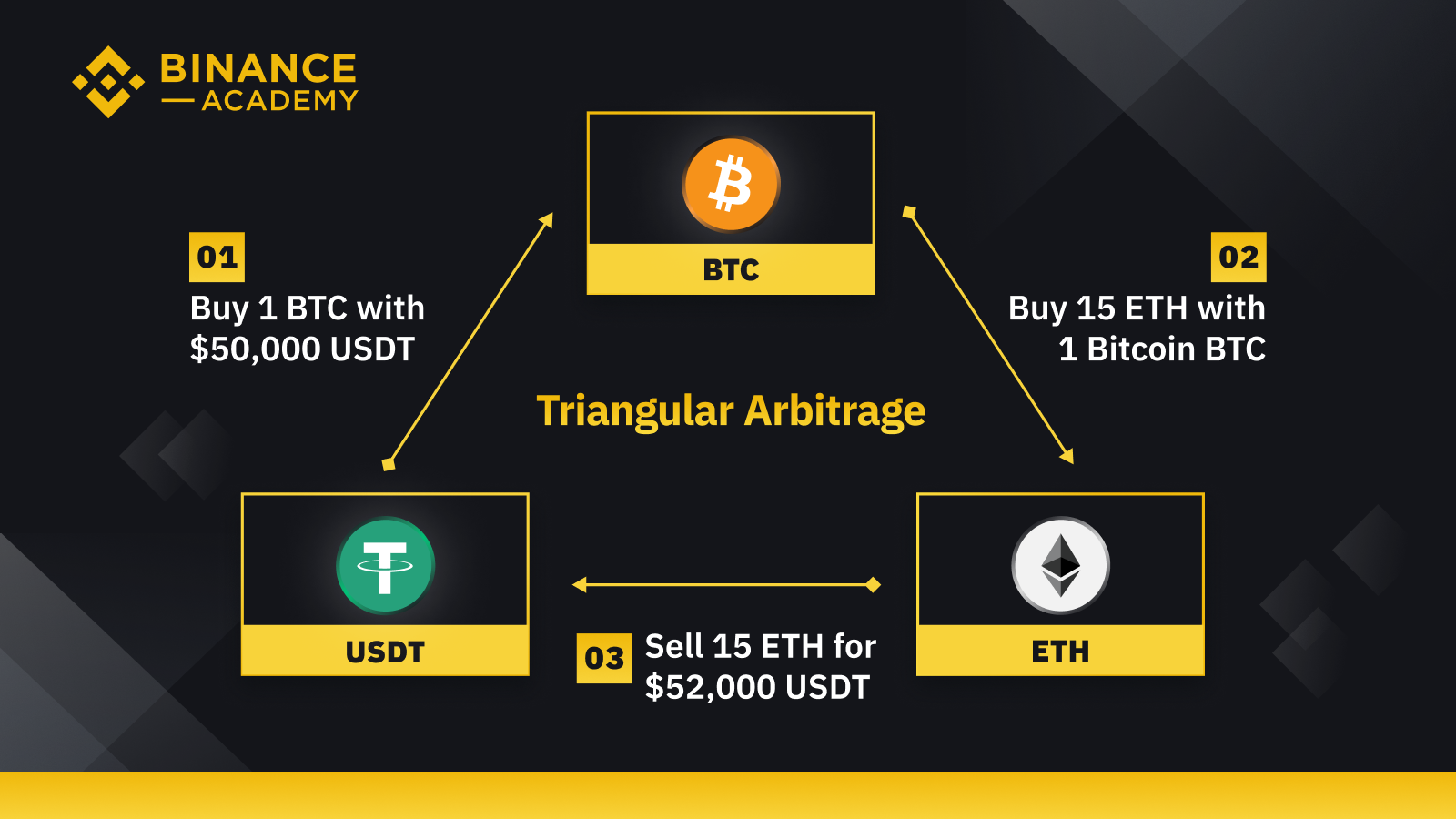
Arbitrage refers to exploiting price discrepancies that appear across venues or related instruments. Crypto arbitrage examples include:
- Buying on one exchange while simultaneously selling on another where the price is briefly higher;
- Trading the difference between a spot price and a perpetual futures price;
- Cycling through three related pairs to capture a triangular arbitrage inconsistency.
These opportunities are typically tiny on a per-trade basis — fractions of a percent — but they recur constantly across a fragmented market. The “micro but repeatable” framing is more realistic than expecting large one-off windfalls.
Inventory gains and losses are different. They are the mark-to-market profit or loss on whatever a market maker happens to be holding while it quotes.
If a maker is net long 2 BTC and the price rises from $100,000 to $101,000 before that inventory is offloaded, the unrealized appreciation of $2,000 adds directly to P&L. This is independent of any spread captured.
The counter-example is just as real. If that same maker is holding 2 BTC and the price drops to $99,000, the position marks down by $2,000. That loss can offset or exceed everything earned from spreads and rebates that same day.
What compresses arbitrage in practice?
- Latency — the gap can close before both legs are filled;
- Trading fees — each leg eats into a margin that may only be a few basis points wide;
- Withdrawal and settlement friction — moving assets between venues can take time and cost money;
- Liquidity fragmentation — the size available at the favorable price is often smaller than it looks.
In other words, the opportunity on a screen rarely equals the profit in a wallet.
Token Project Retainers
Finally, a retainer is fundamentally different from the three revenue streams above. Rather than being paid through trading outcomes, this market maker is paid a fee — often fixed, sometimes tied to performance benchmarks — by a token project in exchange for specific quoting commitments.
Operationally, this can cover:
- Maintaining a minimum quoted depth on the order book;
- Keeping spreads within an agreed range;
- Providing coverage across multiple venues and trading pairs;
- Running 24/7 monitoring so quotes do not go dark outside standard business hours;
- Delivering regular reporting back to the project on quoting performance.
The key distinction is that retainer revenue is contractual income. It is paid regardless of whether the market maker’s own trading that day was profitable.
Spread capture, rebates, arbitrage, and inventory gains are trading P&L. Retainers are contractual revenue. This distinction matters because retainer arrangements can create incentive conflicts between the market maker and the token holders it is ostensibly serving.
In summary, market makers monetize immediacy and continuous liquidity provision, not price prediction. Whether gross revenue survives as net profit depends on execution costs, maker and taker fees, inventory risk management, and how much competition is compressing the spread being fought over in the first place.
Market Makers vs Liquidity Providers vs Brokers
Even if the crypto market players use these labels loosely, they are not interchangeable. The differences matter because each role changes who is taking risk, where liquidity sits, and how much of the execution process the user can actually see.
| Dimension | Market Makers | Liquidity Providers | Brokers |
|---|---|---|---|
| Role (principal/agent) | Principal — trades on own capital | Principal — capital deposited into a pool or venue | Agent — executes on behalf of the user |
| Where liquidity is posted | CEX order book (resting limit orders) | AMM pool (smart contract) or OTC/venue liquidity | Not posted directly — sourced from other venues |
| How prices are formed/quoted | Continuous bid/ask quotes set by the maker | Algorithmic curve (AMM) or negotiated OTC price | All-in quote built from sourced liquidity plus markup |
| Who is the counterparty to the user | The market maker itself | The pool (AMM) or the LP entity (OTC) | The broker, or whoever the broker routes to |
| Primary revenue mechanics (high-level) | Spread capture, rebates | Pool trading fees, yield | Commission and/or spread markup |
| Typical venues | CEX order book | DEX pool / OTC crypto exchange | Broker platform routing to CEX/DEX/OTC |
| What the user can observe (UI artifacts) | Stacked limit orders, live bid/ask | Pool reserves, price impact estimate | Single all-in quote, no underlying book |
| Key user tradeoff | Transparent pricing, but requires reading the book | Passive exposure, but price impact and impermanent loss | Simple UX, but limited visibility into execution |
Market Makers
On an order-book venue, a market maker is identifiable by behavior, not by label. Nobody announces the role in the interface, so you infer it from how orders appear in the book.
Common signs include:
- Continuous two-sided resting limit orders — simultaneous buy and sell quotes maintained rather than a single order placed and left alone;
- Presence across multiple price levels, not just the top of book;
- Frequent quote updates, sometimes within fractions of a second;
- Visible, recurring contribution to top-of-book liquidity;
- Quote behavior that adjusts quickly around volatility, widening, thinning, or briefly pulling back rather than remaining static.
This is strictly a role-based reading of the order book. It is separate from why that behavior is profitable, which comes down to spread economics, rebates, arbitrage, and inventory control.
Liquidity Providers
Liquidity provider, or LP, is used loosely in crypto. There are two distinct cases worth separating.
The first is the AMM pool LP. This participant deposits paired assets into a smart-contract pool. From that point on, the pool itself — not the depositor — determines the price through its pricing curve. Every trade against the pool causes price impact proportional to trade size relative to pool depth, and the depositor has no active say in how or when quotes update.
The second is the off-chain/venue LP. This kind of crypto exchange liquidity providers is an entity supplying liquidity provision to a centralized venue or an OTC crypto exchange, which may or may not actively quote the way a market maker does. Some venue LPs run continuous two-sided quoting strategies indistinguishable from market making. Others simply commit capital or inventory that gets drawn on more passively.
This is why LP and market maker are not always synonyms. A market maker is defined by active, continuous quoting behavior. An LP can be defined purely by where their capital sits, whether that is a pool’s smart contract or a venue’s inventory.
Brokers
A broker acts as agent, not principal. It routes or fills an order on the user’s behalf, sourcing the other side from an exchange, a market maker, an AMM pool, or an OTC desk. In some cases, the broker may internalize the trade against its own inventory instead of routing out.
What the user sees is typically a single all-in quote — one price, no visible order book behind it.
Common broker features include:
- Pricing presentation — an all-in quote that bundles execution price and cost into one number;
- Commission-based fees — a flat or percentage charge on top of the execution price;
- Spread/markup-based fees — a margin embedded in the quote rather than itemized separately;
- Hidden underlying spread — the user generally cannot see the bid-ask spread on the venue the broker is routing to;
- Limited routing and fill visibility — the interface usually does not show which venue filled the order, whether it was a partial fill, or how many legs were combined.
None of this implies bad faith. It is a structural consequence of agent-style execution, where convenience is traded for reduced visibility into the mechanics behind the quote.
Risks and Controversies

Providing immediacy always means taking on tradeoffs. Market makers hold inventory when the market moves against them, shape what other traders see through their quotes, and often interact closely with venues and token projects.
Most of this activity is legitimate market-making behavior: continuous quoting, spread capture, and negotiated program terms. However, the same mechanics can be pushed into abusive conduct when quotes are used to mislead rather than to genuinely offer liquidity.
Inventory Risk
Two-sided quoting only stays market-neutral if both sides fill at roughly the same pace. When one side gets hit repeatedly — for example, a wave of sell orders keeps lifting the maker’s bid while the ask sits untouched — the maker ends up net long or short without choosing to be.
That unbalanced position is inventory risk: exposure to price direction that was not the point of quoting in the first place.
A concrete illustration: a market maker on a crypto exchange is quoting a token and accumulates a net long position of 5 units at an average cost of $40 each while capturing small spread gains on each round-trip. If the price then drops sharply to $34 before the position is offloaded, the $30 in mark-to-market loss on inventory wipes out far more than the cumulative spread income earned while getting there.
The less obvious part is that risk does not only rise when markets move fast. It rises further when liquidity thins out. As other participants pull back, a maker who widens spreads or pulls quotes to protect itself can end up filling against even more one-sided flow. Informed or urgent sellers get through at the wider price while buyers stay away, so adverse selection can worsen at the exact moment the maker is trying to reduce exposure.
Market Manipulation
Market manipulation, when market makers are concerned, can hit two ways. The first is manipulation by a market maker: using quoting power itself to mislead the market. The second is manipulation that targets market makers: strategies designed to bait a maker’s quotes into unfavorable fills.
Common categories include:
- Spoofing — placing orders with no intent to execute them, then canceling once they have influenced other participants’ behavior. The visible symptom is fake depth that vanishes when price approaches it.
- Layering — stacking multiple non-genuine orders at several price levels to exaggerate apparent supply or demand. The symptom is order book depth that looks unusually deep on one side right before a reversal.
- Quote stuffing — flooding a book with rapid order placement and cancellation to slow down or confuse other participants’ systems. The symptom is erratic, high-frequency quote flicker with no corresponding trades.
- Baiting/quote-sniping strategies — deliberately triggering a maker’s resting orders around news or low-liquidity windows to force one-sided fills. The symptom is whipsaw prints and sudden spread widening right after a burst of small, aggressive trades.

Separating legitimate activity from these patterns comes down to intent and observable outcome, not the mere act of updating quotes.
- Normal quote updating adjusts price and size in response to market conditions and typically results in real fills;
- Spoof-like signaling shows large resting size that gets pulled the instant it is about to be hit;
- Legitimate inventory rebalancing produces gradual, explainable shifts in quoted depth;
- Manipulative layering produces sudden, lopsided depth that does not match any change in underlying market conditions;
- Genuine liquidity provision tends to tighten or hold spreads through normal volatility;
- Manipulative activity often coincides with abrupt spread widening or price whipsaws that have no clear news driver.
Regulation and Oversight
In practice, oversight of market-making activity centers on venue rules, real-time surveillance systems, disclosure requirements for firms with formal arrangements, and specific obligations attached to designated market-maker status.
What is monitored and how strictly varies significantly by jurisdiction. Some regulators require detailed reporting and audit trails. Others rely more heavily on the exchange’s own surveillance. This matters both for traders assessing execution quality and for token issuers deciding who they contract with for liquidity.
Some venues go further and formalize market-maker programs through actual regulatory filings rather than informal agreements. That matters because it means the obligations, participants, and incentives attached to a program are documented and can change on a defined schedule rather than staying fixed indefinitely.
Oversight is not just about policing bad behavior after the fact, but about giving regulators and market participants visibility into exactly when a designated program starts, what it requires, and when it is set to be revisited or retired.
Conflicts of Interest
Four conflict vectors show up repeatedly around market-making activity. It is worth keeping them separate rather than treating them as one generic trust problem.
- Exchange incentives vs. best execution — rebates or program status may reward a maker for high volume or quoting presence in ways that do not always align with getting the end user the best possible fill.
- Token project retainers vs. independent pricing — a maker paid by a project to support its token has a financial relationship with that project, which sits uneasily next to the expectation of neutral, market-driven pricing.
- Proprietary trading vs. market-making obligations — a firm that trades its own book alongside its quoting obligations may face moments where its own directional view competes with its duty to keep quoting fairly.
- Information advantages vs. fair access — makers often see order flow or intent signals before other participants do, creating an information asymmetry that raises questions about equal access to the market.
How this tends to show up to ordinary users, without implying wrongdoing in any specific case:
- Consistently worse fills compared to a visible reference price;
- Recurring requotes right before an order would otherwise execute;
- Spread markups that appear during otherwise calm conditions with no clear cause;
- Liquidity that disappears specifically around volatility spikes;
- Quoted depth that looks strong on screen but shrinks sharply once an order is actually placed;
- Patterns of price movement that seem to anticipate large orders rather than react to them.
Practical takeaway: when conditions degrade, the signal usually shows up before the headline does. Watch the spread for sudden widening, quote stability for fake or vanishing size, designated program terms for changes in obligations, and slippage or requote frequency relative to what you normally expect. None of these signals is definitive alone, but together they tell you when the immediacy you rely on is becoming less reliable.
Conclusion
Market making in crypto boils down to a simple exchange: someone commits capital and accepts risk so that everyone else gets immediate execution instead of waiting for a matching order to appear. Whether that “someone” is an institutional desk hedging inventory across a dozen venues, a designated maker bound by an exchange agreement, a principal firm trading its own book, or an AMM pool running on a pricing curve, the underlying job is the same: stand ready to take the other side of a trade.
More guides and updates from ChangeHero are posted on ChangeHero blog, so definitely check them out! To get market insights and crypto news as they happen, follow us on social media: X, Facebook, and Telegram.
Frequently Asked Questions
What are market makers in crypto?
Market makers are liquidity providers that post continuous two-sided quotes — simultaneous buy and sell prices — so other traders get immediate execution instead of waiting for a natural counterparty. The nuance is that the term covers two different things depending on venue: professional firms quoting on a CEX order book and AMM mechanisms running on a DEX.
How do crypto market makers work?
They work by posting and continuously updating resting limit orders on both sides of the book, adjusting those quotes as they manage inventory and interact with market takers who remove that liquidity. In fast-moving markets, this mechanism can work against execution quality because makers may widen spreads or pull quotes entirely to limit risk.
How do market makers make money in crypto?
The core mechanism is capturing the bid-ask spread and/or collecting venue-based incentives for providing continuous quotes. However, none of this is guaranteed profit. Inventory can move against the maker between fills, and adverse selection — getting picked off by better-informed or faster traders — can erase spread gains entirely.
Are market makers good or bad for crypto?
On balance, market makers are usually beneficial because they tighten spreads and improve liquidity. However, they can introduce risks when incentives or conflicts of interest are not aligned with fair pricing. The outcome depends on context, including venue rules, volatility, transparency, and whether the quoted liquidity is genuinely available when traders need it.