What is Cardano and ADA Crypto? A Beginner's Guide


Key Takeaways
- ⚛️ Cardano is a public blockchain platform that uses proof-of-stake consensus, supports smart contracts and decentralized applications (DApps), and uses its native cryptocurrency, ADA.
- ⚛️ ADA and Cardano are related but not identical: Cardano is the network, while ADA is the asset used for transaction fees, staking rewards, value transfer, and governance participation.
- ⚛️ Cardano’s core technical design is built around Ouroboros, epochs, slots, stake pools, native tokens, and the extended UTXO (eUTXO) model.
- ⚛️ The project’s defining feature is its research-driven design, which prioritizes peer review, formal methods, and structured upgrades over faster but less conservative iteration.
- ⚛️ Staking ADA does not require mining equipment, does not transfer custody to a pool, and does not lock funds.
- ⚛️ Cardano’s long-term direction depends on on-chain governance, treasury funding, ecosystem adoption, and whether scaling and interoperability milestones continue to ship in practice.
Disclaimer
Nothing in this guide constitutes investment advice. Cardano, ADA, DeFi, staking, NFTs, and smart contracts all involve technical, market, custody, and regulatory risks. Always verify transactions, wallet addresses, staking pool IDs, and exchange withdrawal networks before moving funds. Price history does not guarantee future returns, and any ADA forecast should be treated as a scenario model rather than a promise.
Cardano Blockchain Basics
Despite the title, this introduction assumes you are familiar with core cryptocurrency concepts such as blockchain and consensus. Don’t be shy to catch up before diving in too deep!

Cardano is a public blockchain platform launched in September 2017. It combines three ideas that define the network: a proof-of-stake system for keeping the ledger secure, a smart contract layer for decentralized applications, and a research-driven development culture that shapes how features are designed and released.
The important distinction comes first: Cardano is the network, ADA is the native cryptocurrency. ADA moves through the Cardano ledger, pays transaction fees, participates in staking incentives, and gives holders a role in governance. Cardano itself is the infrastructure underneath those actions.
Decentralized Proof-of-Stake Network
Cardano’s consensus mechanism regulates the state of the blockchain network in lieu of a centralized controller. Unlike proof-of-work systems, where miners compete with computational power, Cardano selects validators based on the amount of ADA they hold or receive through delegation. This is the core proof-of-stake idea: the right to participate in block production is tied to economic stake rather than energy-intensive mining.
Validator node here refers to software run by a stake pool operator that participates in producing (composing) and validating blocks in the chain. Staking pool is server infrastructure operated by a validator that pools ADA from multiple delegators, who assign ADA stake to a staking pool without transferring custody of the funds. Every transaction on Cardano incurs a transaction fee, a small amount of ADA paid to have a transaction processed and included in a block. Epochs and slots are particularly relevant to block confirmation — the point at which a block, and the transactions inside it, are considered soundly accepted by the network.
Smart Contracts and Decentralized Applications
A smart contract on Cardano is self-executing code that runs when predefined conditions are met. This is what allows Cardano to support decentralized applications, or DApps, beyond simple ADA transfers.
In practice, that includes:
- Decentralized exchanges (DEXs) — users swap one token for another directly from their wallets.
- Lending platforms — users borrow or lend crypto assets without a traditional intermediary.
- NFT marketplaces — users mint, buy, sell, or transfer non-fungible tokens representing digital or real-world assets.
Tokens as opposed to coins are powered by smart contracts in other blockchain systems such as Ethereum but native tokens are not the same thing. Smart contracts handle programmable logic and conditional execution; native tokens represent assets directly at the ledger level without requiring a separate contract to manage them. Cardano introduced the ability to create native tokens on March 1, 2021, an important milestone in its move toward a broader DApp ecosystem.
Cardano’s Research-Driven Design
“Research-driven” is not just a narrative channel for Cardano but a real and very intentional development constraint. Core components typically pass through academic peer review and formal methods like mathematical verification of protocol behavior before implementation.
The advantage of this approach is security discipline even if the obvious tradeoff is speed of updates and development. Cardano often moves more slowly than networks that prioritize rapid iteration, but the goal is to reduce the risk of serious consensus-level bugs reaching mainnet.
The design goals are straightforward: security, sustainability, upgradeability, and scalability. Formally verified components reduce the likelihood of consensus-level exploits, and peer-reviewed changes aim for predictable upgrade paths rather than rushed patches. An on-chain treasury and governance model support long-term protocol funding. Layered architecture and L2 research help the network grow while keeping consensus risk manageable.
So far we have established the surface-level picture: Cardano is a proof-of-stake smart contract blockchain, ADA is its native asset, and its development model is deliberately conservative. The next layer is the mechanical channel — how the protocol actually reaches agreement.
Core Technology and Architecture
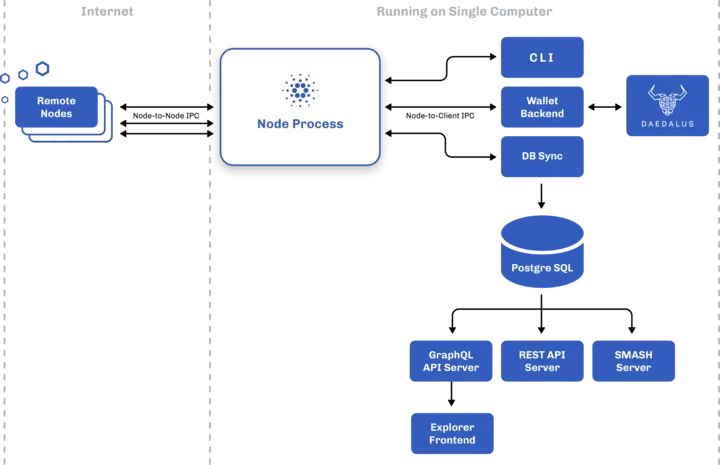
Cardano’s architecture separates the question of how transactions are agreed upon from how they are executed. Although by no means unique as far as blockchains go, it still affects staking, governance, smart contracts, DeFi, and even how users experience transaction finality.
Ouroboros Consensus Protocol
Ouroboros is the proof-of-stake consensus mechanism that determines how new blocks are created and agreed upon across the Cardano blockchain. Time on Cardano is divided into epochs, and each epoch is divided into slots. For every slot, the protocol selects a slot leader, a participant temporarily granted the right to produce the block for that slot.
This selection follows a protocol-defined schedule established in advance for the epoch. At the boundary between epochs, the protocol recalculates the leader schedule for the next epoch based on the current state of the network.
In plain terms, Ouroboros rests on an honest-majority assumption: participants controlling a majority of the stake are assumed to act honestly. This is similar in spirit to how proof-of-work assumes honest majority hashpower.
In Cardano, transaction and state finality is not instantaneous. A transaction becomes more secure as additional blocks are built on top of it. Each subsequent block makes reversal less practical, which is why wallets, exchanges, and applications often wait for several confirmations before treating a transaction as effectively final.
Settlement and Computation Layers
Cardano conceptually distinguishes value transfer and ledger state from smart contract execution.
- Settlement tracks who owns what and updates balances or outputs.
- Computation evaluates the smart contract logic that determines whether a transaction is valid.
This is not a strict physical partition of machines or network hardware. It is a design approach that helps developers reason about ledger rules and contract logic with more structure.
A simplified transaction lifecycle looks like this:
- A wallet constructs and submits a transaction.
- The transaction propagates peer-to-peer across nodes.
- A slot leader includes the validated transaction in a block.
- The ledger state updates once the block is accepted.
- If a smart contract is involved, the script is executed during validation, and the result determines whether the ledger update proceeds.
This separation improves reasoning and upgradeability, but it does not automatically create unlimited throughput. Scaling still depends on parameter tuning, block size, off-chain computation, and Layer 2 engineering.
Scalability, Interoperability, and Sustainability
Scalability on Cardano is pursued through base-layer improvements and off-chain or Layer 2 approaches. Cardano targets roughly a 20-second block time, which mainly affects latency — how quickly a transaction can be included in a block. Throughput is different. It refers to how many transactions the network can process overall, and it depends on block size, parameter settings, script efficiency, and L2 activity.

Interoperability refers to Cardano’s ability to communicate and exchange value or data with other blockchains and systems. This can happen through cross-chain bridges, shared standards, or sidechains. For one, Cardano uses a virtual machine different from Ethereum and compatible networks, which makes it a non-EVM chain and makes it more challenging for these ecosystems to connect. Moreover, bridges introduce their own trust assumptions and attack surfaces, because they often rely on validation logic outside the base protocol.
Sustainability has two meanings here. Environmentally, proof-of-stake avoids continuous energy-intensive mining. Cardano is an example of so-called green coins, although its environmental impact is lower only relatively. Economically, the network must maintain incentives that keep stake pool operators, delegators, developers, and users aligned over time. This is what tokenomics is about.
In summary, an epoch contains many slots, each slot can produce one block, blocks are ordered through the consensus mechanism called Ouroboros, and Cardano’s settlement and computation layers describe how ledger state and smart contract logic are organized on top of that consensus.
ADA Cryptocurrency
As already mentioned, ADA is the native token of Cardano. It is not merely a ticker on an exchange; it is the asset used inside the network’s fee, staking, value transfer, and governance systems.
ADA Utility
ADA has three primary roles:
- Paying transaction fees — every Cardano transaction requires a small amount of ADA.
- Base asset for on-chain value transfer — ADA is the primary unit for sending and receiving value on the ledger.
- Unit for protocol-level incentives — ADA denominates staking rewards and other protocol-level incentives.
The smallest denomination of ADA is called a Lovelace: 1 ADA = 1,000,000 Lovelaces. This matters because wallets and explorers sometimes display balances or fees in Lovelaces rather than ADA. If a wallet shows 2,500,000 Lovelaces, that equals 2.5 ADA. If it does not sound familiar, the units are named after Ada Lovelace, who is considered to be the first programmer.
Not any ADA balance is automatically usable for transacting. Practical usability depends on denominations and fee budgeting. You should keep a small ADA balance available for transaction fees, separate from whatever amount you intend to send, stake, or hold.
Tokenomics and Supply Mechanics
Cardano’s tokenomics are built around a fixed supply ceiling: ADA has a max supply of 45 billion tokens. A max supply with a hard cap, means no additional ADA will be created beyond that limit through the protocol’s issuance schedule.
This means scarcity is built into ADA’s supply-side design. However, scarcity alone does not determine price. Demand, liquidity, adoption, market cycles, and broader risk appetite all have their impact as well.
Staking and Network Security
Cardano staking is where ordinary ADA holders interact most directly with Ouroboros, even if they do not know it explicitly.
Why Cardano Uses Staking Instead of Mining
Cardano’s security model depends on economic incentives rather than computational competition. Under proof-of-stake, validator nodes are selected to produce blocks in proportion to the ADA committed through staking.

The security rationale here is an attacker would need to control a very large share of staked ADA to undermine the network. That way, an attack becomes economically expensive, and the attacker’s own stake is exposed to reputational and reward consequences.
For everyday users, the difference between mining and staking is practical: Cardano staking requires no dedicated hardware from delegators. ADA holders can delegate to a stake pool instead of operating mining rigs. Mining rewards come from winning a computational race; staking rewards come from protocol-level distribution based on pool stake and performance.
Stake Pools and Delegation
It’s about time to discuss delegation further. Delegation lets ADA holders participate in network security without operating their own validator node, and not by transferring funds anywhere. Delegators retain custody of their ADA at all times; only the right to participate in block production through a pool is assigned.
A typical delegation flow looks like this:
- Choosing a pool.
- Delegating your stake key — issue a delegation certificate pointing your stake key to the pool.
- Retaining custody — your ADA stays in your wallet and remains spendable.
- Waiting through the activation epoch — delegation usually becomes active after the start of the following epoch.
- Rewards distribution — rewards accumulate as the pool produces blocks.
- Monitoring performance — track uptime and rewards consistency over several epochs.
- Re-delegation or un-delegation — switch pools or withdraw delegation without moving your ADA.
Stake pool and pool operators were defined before but there also were a couple of new terms. Stake key is the credential linking your ADA balance to a specific pool for delegation. A delegate is a user whose ADA is counted in a pool, run by an operator, who receives the protocol rewards for the work performed but also distributes them to contributors in proportion to their delegated stakes.
Staking Rewards and Common Misconceptions
Many staking mistakes come from a small number of repeated assumptions.
| Misconception | Reality |
|---|---|
| Staking requires locking your funds | ADA remains spendable at all times; there is no lock-up period |
| Delegating gives the pool custody of your funds | You retain full custody; only the stake key’s delegation right is assigned |
| Higher advertised returns are always better | Higher rates can come with tradeoffs like saturation, inconsistent performance, or higher fees |
| Rewards accrue continuously, day by day | Rewards are distributed on a cadence tied to epochs |
| “Guaranteed APY” is trustworthy | Staking rewards are variable and protocol-determined; “guaranteed” language is a red flag |
Cardano’s rewards cadence is anchored to its epoch structure, with rewards calculated and distributed once per epoch based on pool performance during that period. Wallets and exchanges may display rewards on slightly different timelines because some platforms batch or delay reward reporting.
Staking scams usually imitate these misconceptions. Fake pool websites promise “guaranteed” high APY, impostor operators copy well-known pools, and phishing messages ask for seed phrases to “activate” staking. Legitimate delegation never requires your seed phrase or private keys. Verify pool IDs directly through your wallet and avoid links from unsolicited messages.
Governance and Development
Cardano’s governance model is designed to eventually shift protocol control toward ADA holders. That does not mean every holder automatically votes, and it does not mean any single organization can unilaterally change the chain.
ADA Holder Voting Rights
Cardano’s on-chain governance framework gives ADA holders influence over specific categories of network decisions:
- Protocol parameter changes — adjustments to values like block size, transaction fees, or minimum pool pledge.
- Upgrade activation signals — readiness signals for new protocol versions or feature sets.
- Treasury and spend proposals — votes on whether Cardano treasury funds should support development or ecosystem projects.
- Constitutional and governance rule changes — amendments to the on-chain constitution or governance rules.
- No-confidence motions — votes to remove or replace constitutional committee members.
On-chain governance and off-chain coordination are not the same thing. On-chain governance is binding: once a proposal passes the required thresholds, the outcome is enacted by the network. Off-chain coordination includes forums, Cardano Improvement Proposals (CIPs), and community discussion. This layer shapes proposals, but it is not binding on its own.
Delegating ADA to a stake pool is not the same as voting in governance. Delegation secures the network and can earn staking rewards, and governance participation usually requires a separate governance credential or delegated voting power to a chosen representative, sometimes called a DRep.
Cardano Foundation, IOG (previously IOHK), and Emurgo
| Organization | Primary mission | Typical deliverables | How the community interacts with them |
|---|---|---|---|
| Cardano Foundation | Standards-setting, legal stewardship, and global advocacy for the protocol | Compliance frameworks, industry partnerships, educational resources, ecosystem monitoring | Public reports, regulatory engagement, and community outreach programs |
| IOG (Input Output Global) | Core protocol engineering and research | Peer-reviewed research, Cardano node software, cryptographic upgrades, formal verification | Open-source repositories, developer documentation, and technical CIPs |
| Emurgo | Commercial adoption and ecosystem investment | Developer tooling, startup incubation, exchange integrations, business partnerships | Venture programs, hackathons, and enterprise onboarding initiatives |
The useful distinction is control versus contribution. Who can change the protocol? Ultimately, the ADA holder community through on-chain governance. Who builds the software? Largely IOG’s engineering teams. Who supports adoption and standards? Mainly the Cardano Foundation and Emurgo.
All that said, none of these organizations holds unilateral authority over Cardano’s consensus rules.
Development Eras and 2026 Roadmap
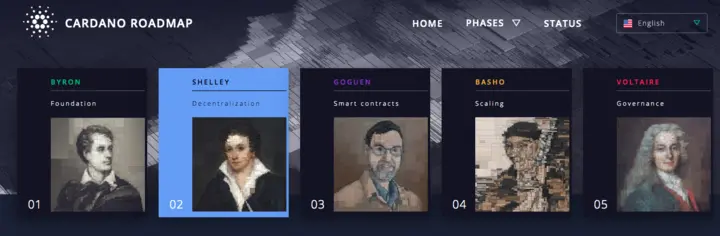
Cardano’s development has historically been organized into named eras (not to be confused with epochs):
- Byron — launched the network with basic transaction functionality on a federated, permissioned basis.
- Shelley — introduced decentralization through delegation and staking.
- Goguen — brought native smart contract support via the Plutus platform.
- Basho — focused on scaling improvements, including sidechains and throughput optimizations.
- Voltaire — delivered on-chain governance and treasury mechanisms.
Looking toward 2026, roadmap items typically include governance tooling refinement, interoperability features, and scaling enhancements. However, a decentralized protocol roadmap should be read as a set of aspirational milestones, not guaranteed delivery dates. Implementation depends on community-approved proposals, treasury funding, and coordinated development work.
Most major protocol changes are delivered through a hard fork, meaning a coordinated network-wide release where node software is upgraded in unison. A historical example of such an event in Cardano is Chang hard fork in 2024. For everyday users, a hard fork is usually seamless. Stake pool operators, however, generally need to update their node software before the scheduled fork to remain in consensus.
Cardano Use Cases and Comparisons
Cardano’s use cases come from the same design choices already discussed: native assets, smart contracts, staking, and the extended UTXO model. The tradeoffs become most visible in DeFi, NFTs, and comparisons with Ethereum and Bitcoin.
Decentralized Finance
Cardano’s DeFi ecosystem is built around the extended UTXO (eUTXO) model. Extended UTXO means each transaction consumes and creates distinct, traceable outputs, which lets developers determine a transaction’s result before it is submitted.
This maps to DeFi activity in specific ways:
- DEX swaps/AMMs → eUTXO lets a decentralized exchange validate trade conditions locally before submission.
Tradeoff: popular liquidity pools can face UTXO contention, where multiple users try to spend the same pool output at the same time. - Lending/borrowing → smart contracts lock collateral in eUTXO outputs with explicit spending conditions.
Tradeoff: composability across multiple lending protocols can be less fluid than in account-based systems. - Stablecoins/payment rails → native and smart-contract-issued stablecoins benefit from generally predictable transaction fees.
Tradeoff: fee predictability does not guarantee low absolute cost during high block-space demand. - Liquid staking derivatives → users can represent staked ADA positions as tradable tokens.
Tradeoff: derivative tokens add smart-contract risk on top of underlying staking exposure.
What to check before using a Cardano DeFi app:
- Smart-contract audit status — has the exact contract version been independently audited?
- Wallet connection/custody model — does the app request transaction-by-transaction signing or broader session permissions?
- Liquidity/slippage exposure — how deep is the pool relative to your trade size?
- Transaction finality expectations — how many confirmations does the app require before crediting an action?
NFTs and Web3 Applications
A key distinction on Cardano is between native tokens and smart-contract tokens. Native tokens are assets recorded directly at the ledger level, without requiring a smart contract to enforce their rules. Smart-contract tokens rely on contract logic for behavior such as royalties or conditional transfers and generally work the same as similar concepts in other blockchain networks (e.g. Ethereum tokens).
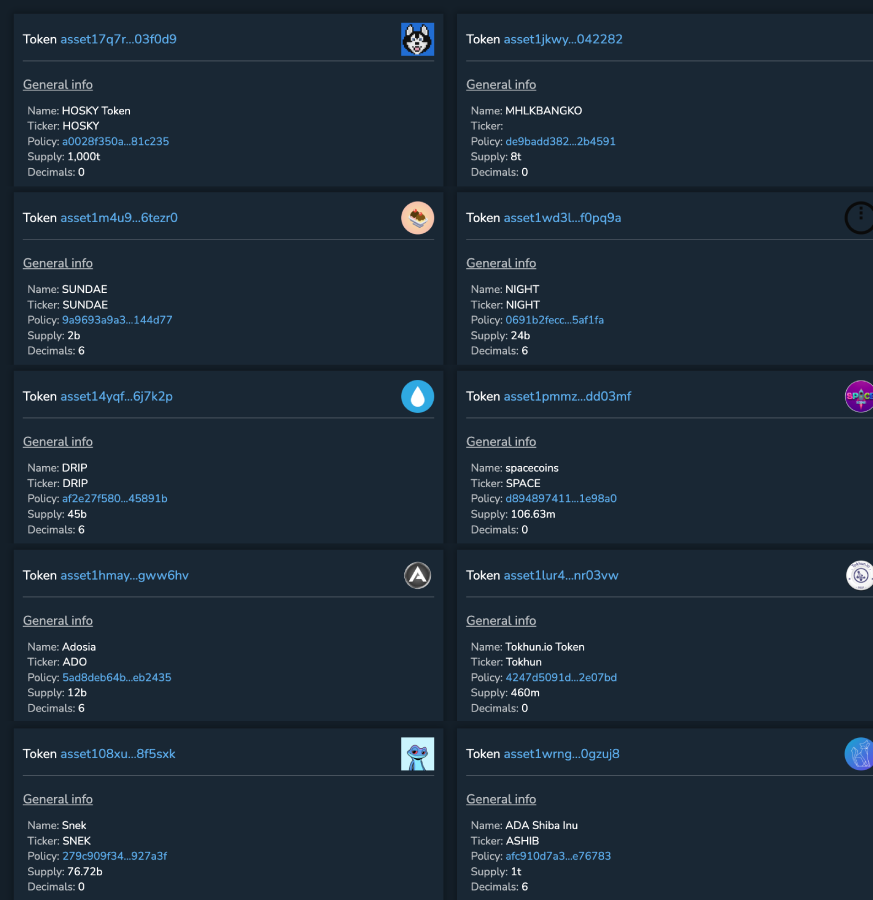
This matters because native token minting and transfers usually involve simpler transaction fee structures, while smart-contract-governed tokens add contract execution costs. Cardano enabled native token creation in 2021, giving the network its multi-asset and NFT foundation.
Common Web3 application types include collectibles (on-chain asset represents ownership and a unique identifier; the image or artwork usually lives off-chain), gaming assets (token represents a verifiable in-game item or right; game logic and rendering stay off-chain), ticketing/credentials (proof of access or achievement; supporting documents are usually stored off-chain), and loyalty tokens — the token represents points or tier status; redemption catalogs and partner terms live in the issuer’s systems.
When people discuss bridging NFTs or tokens across chains, they usually mean creating a wrapped representation on the destination chain rather than moving the original, canonical asset itself. The trust assumption changes: users rely on the bridge operator or protocol to honor the backing.
Cardano vs. Ethereum
| Criterion | Cardano | Ethereum |
|---|---|---|
| Execution model | Extended UTXO (eUTXO) | Account-based |
| Smart contract ecosystem maturity | Smaller, growing tooling (Plutus, Marlowe) | Larger, more mature tooling (Solidity, extensive frameworks) |
| Transaction fee behavior | Generally predictable, size-based calculation | Variable, driven by network demand (gas auctions) |
| Throughput/latency framing | ~20-second block time; not marketed primarily on raw speed | Faster block times, but throughput also depends on layer-2 solutions |
| Staking/validator participation | Delegated proof-of-stake via stake pools | Proof-of-stake with validators, including staking pools/services |
| Token/NFT model | Native assets at ledger level | ERC-20/ERC-721 standards enforced via smart contracts |
| DeFi UX (concurrency) | Some apps may need batchers to handle concurrent UTXO spends on popular pools | Account model generally allows more straightforward concurrent interactions, though congestion still affects cost |
| Governance approach | Emphasis on on-chain governance mechanisms | Primarily off-chain coordination (forums, client teams) with some on-chain elements |
| Ecosystem entities | Cardano, DeFi, NFT | Ethereum, DeFi, NFT |
Choose Cardano if:
- You want more predictable transaction fees for routine DeFi or payment activity.
- You value a growing on-chain governance approach.
- You are comfortable with a smaller but actively developing smart contract tooling ecosystem.
Choose Ethereum if:
- You need the most mature smart contract ecosystem and broadest tooling.
- Your application benefits from account-based concurrency patterns.
- You are building around established ERC token standards with wide wallet and exchange support.
Cardano vs. Bitcoin
| Criterion | Cardano | Bitcoin |
|---|---|---|
| Primary use case | Smart contracts, DeFi, NFTs | Monetary network, value transfer |
| Consensus family | Proof-of-Stake (PoS) | Proof-of-Work (PoW) |
| Programmability | Smart contracts (Plutus, Marlowe) | Limited scripting, no general smart contracts |
| Asset issuance | Native tokens and NFTs supported at ledger level | Primarily BTC; other assets require layered protocols |
| Fees/throughput framing | ~20-second block time, size-based fee calculation | Variable fees tied to block space demand |
| Governance/upgrades | On-chain governance mechanisms emphasized | Off-chain, consensus-driven coordination among developers/miners |
Bitcoin and Cardano were built for different design targets. Bitcoin emphasizes monetary settlement and scarcity. Cardano emphasizes programmability, staking, governance, and application flexibility. That is not a ranking; it is a difference in purpose.
Buying, Storing, and Price Context
Buying ADA is technically simple but custody and risk management are where most mistakes happen.
Exchanges and ADA Purchases
There are two common ways to acquire ADA: buying through a centralized exchange (CEX) or swapping on-chain through a decentralized exchange (DEX).
On a centralized exchange, you would create and verify an account, deposit fiat or an existing crypto balance, place a market or limit order for ADA, and after the purchase, withdraw ADA to a wallet you control.
In an on-chain swap with a DEX, users connect a non-custodial wallet that already holds a supported asset, select the trading pair and review the quoted rate and slippage tolerance, approve and sign the transaction using the wallet software or a hardware device, and finally, confirm the swap on-chain and verify the received balance.
Crypto on-ramps and instant exchanges like ChangeHero present a middle ground between self-custody and convenience to buy Cardano: the funds are not held in the exchange custody and delivered directly to the user’s wallet.
Before you buy, confirm the exchange legally serves your country or state, compare trading fees and withdrawal fees; when withdrawing, explicitly select the Cardano network, and for good measure, send a small amount first, confirm it arrives, then move the rest.
Wallet Options and Custody Mistakes
Once you hold ADA, custody choice determines your real risk exposure. Exchange custody is best for active traders who need liquidity but the primary risk is that the exchange controls your private key, which equals ownership for cryptocurrencies. Mitigation: keep only trading-sized balances on the exchange.
A software non-custodial wallet is the best for everyday users who want control without extra effort or devices. Malware or phishing can compromise the device, though, so they should use an always updated device and verify app authenticity.
A hardware wallet is considered best for long-term holders storing significant value. Nevertheless, custody implications and user responsibility remain the same, so physical loss of a device or damage to it without a backup pose serious risks. The seed phrase should be stored offline in multiple secure physical locations, and this practice works for software free crypto wallets, too.
A note can be made on how custody also affects market interpretation. Large amounts moving into self-custody or hardware wallets can reduce readily sellable exchange balances, while rising exchange balances are sometimes read as near-term sell pressure.
Price Drivers and Market Cycles
Since we are talking about Cardano price now, ADA’s price moves through several overlapping channels:
- Crypto macro: when Bitcoin liquidity expands and risk appetite rises, capital often rotates into altcoins like ADA.
- Protocol fundamentals: usage, fees, and staking participation can support long-term valuation, though usually gradually.
- Ecosystem catalysts: upgrades and governance events can create short-term volatility.
- Market structure: listings can improve liquidity, while delistings can create forced selling.
As a historical context, ADA’s all-time high was $3.10 on Sep 02, 2021 — a useful reminder of how far prices can move across a single market cycle.
In the end of the day, however, development news does not cause immediate price impact, social media buzz has limited impact, and supply narratives are not actual circulating supply mechanics. For a forward-looking analysis that takes all these into consideration, read our Cardano price prediction.
Conclusion
Cardano is best understood as a proof-of-stake smart contract platform with a strong emphasis on formal research, structured upgrades, native assets, staking, and on-chain governance. ADA is the asset that powers that system, but it is not the system itself.
The network’s strengths are clear: delegated staking without custody transfer, predictable fee design, native token support, and a governance model intended to make long-term development less dependent on a single company. The constraints are just as clear: Cardano’s ecosystem is smaller than Ethereum’s, its research-first process can slow feature delivery, and its scalability roadmap still depends on continued engineering and adoption.
At the end of the day, Cardano is not just a faster payment network or a simple ADA investment thesis. It is an attempt to build a sustainable blockchain operating system with security, governance, and upgradeability at its center. Whether that thesis succeeds depends on developer activity, user demand, governance execution, and whether the protocol can turn its design principles into durable network effects.
If you enjoyed this article, you can find more guides, predictions and crypto news coverage in ChangeHero blog. And don’t forget to subscribe to ChangeHero on social media: Twitter, Facebook, and Telegram.
Frequently Asked Questions
How does staking ADA work?
Staking ADA means delegating your tokens to a staking pool through a wallet, rather than running a validator node yourself. The key nuance is that stake delegation is liquid: your ADA is not locked and remains in your control the entire time. Rewards are calculated and distributed in epochs, so you see staking rewards on a regular cadence rather than instantly.
How does Cardano compare with Ethereum?
Cardano and Ethereum both support smart contracts, but they differ in transaction model and ecosystem maturity. Cardano uses Ouroboros and the extended UTXO (EUTXO) model, while Ethereum uses its own proof-of-stake implementation and an account-based model. This distinction affects how smart contracts handle state, concurrency, fees, and developer tooling.
What are the latest Cardano governance updates and ecosystem milestones?
Since Cardano launched in September 2017, the ecosystem has evolved through structured development eras, on-chain governance, treasury-funded proposals, and protocol upgrades. To track current milestones, watch voting activity, treasury actions, Cardano Improvement Proposals (CIPs), and formal upgrade events. The important nuance is that governance changes are versioned and often shipped through hard forks, so timelines can shift without implying underlying instability.