
Main Types of Crypto Exchanges: 2026 Guide

Key Takeaways
- 🔘 The main types of crypto exchanges start with one core split: centralized exchanges (CEX) hold funds for users, while decentralized exchanges (DEX) let users trade from a non-custodial wallet;
- 🔘 Exchange categories also differ by execution model: order book matching, automated market maker (AMM) pools, peer-negotiated escrow, quoted swaps, and derivatives contracts;
- 🔘 The best venue depends on custody preference, liquidity needs, trading product, fee structure, regional access, KYC requirements, and tax reporting obligations;
- 🔘 Low trading fees do not automatically mean low total cost. Spread, slippage, price impact, withdrawal fees, and network fees can change the final result substantially.
Disclaimer
Crypto exchanges vary by jurisdiction, product availability, custody model, and regulatory requirements. Nothing in this guide is investment, legal, or tax advice. Before depositing funds or trading, verify whether a platform is available in your region, whether KYC is required, what reporting obligations may apply, and whether withdrawals are fully supported for the asset and network you intend to use.
As a newcomer to crypto, you usually learn very soon about cryptocurrency exchanges. However, the fact that not every “exchange” works the same way is often left for you to figure out yourself.
At the foundation, platforms split into centralized exchanges (CEX) and decentralized exchanges (DEX), and most other categories are either variations, wrappers, or specialized formats built on top of this divide. So, in this guide, we will unpack the tangible differences between the main types of crypto exchange platforms while equipping you with the knowledge of when is the proper time to utilize each.
Main Types of Crypto Exchanges
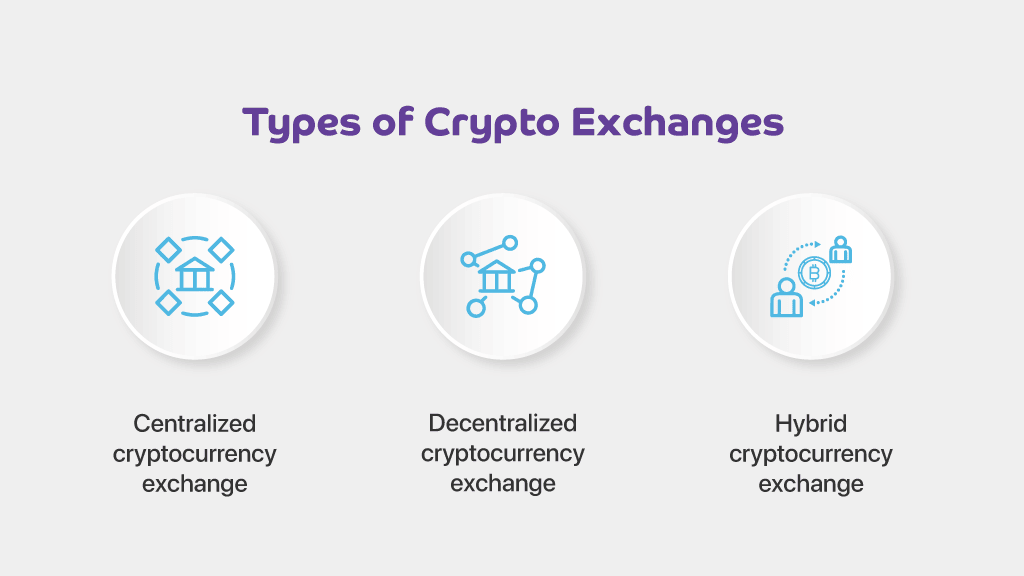
Even the best crypto exchanges for beginners fall into a variety of categories rather than belong to a single type. If you were to define them, three axes determine which exchange type fits your needs: the custody model — who holds your assets during and after a trade; the execution method — how orders are matched or quoted; and the market and product access — whether you can trade spot assets, derivatives, or peer-negotiated deals.
Centralized Exchanges
A centralized exchange (CEX) is the account-based model most crypto users encounter first. You deposit funds, the platform credits your account balance, and behind the scenes, the exchange controls the addresses where those assets sit until you withdraw them.
The defining traits are straightforward:
- Custody: deposited funds move into exchange-controlled wallets, not your own wallet;
- Execution: trades usually run through an order book and matching engine in a separate dedicated page or tab;
- Order types: users can place limit orders, where they set the price and wait, or market orders, where they accept the best available price immediately;
- Market quality: deeper liquidity usually means lower slippage and smaller price impact for larger orders.
CEXs are a natural fit for traders who want fast execution, clearer account history, and access to deeper markets. They are less suitable for anyone who insists on maintaining full control over their assets at all times.
Decentralized Exchanges
In a sharp contrast, hinted at by the name, decentralized exchange (DEX) removes the account-custody layer. Instead of depositing assets into a platform wallet, you connect a non-custodial wallet, sign a transaction, and let a smart contract settle the trade directly on the blockchain.
Not all DEXs work the same way. Many use an automated market maker (AMM) model, where trades execute against a liquidity pool funded by other users rather than against individual buy and sell orders. Others use an order-book DEX model — either on-chain or off-chain — that resembles CEX-style matching while still avoiding central custody.
In practice, most DEX activity sits inside the decentralized finance (DeFi) niche, which adds composability but also adds risk. Wallet interface, network fees, and confirmation times can meaningfully change the effective cost of a trade, especially during blockchain congestion.
Traditional Crypto Brokers
A crypto broker simplifies the trading experience by changing how pricing works. Instead of interacting directly with a public order book, you typically buy or sell at a quoted price or spread set by the broker or routed through the broker’s execution partners.
The benefit is convenience. The drawback is reduced transparency.
Brokers usually offer:
- Simple buying and selling flows;
- Recurring purchase options;
- Cleaner fiat payment experiences;
- Fewer advanced order types;
- A narrower selection of tokens than specialist exchanges.
For a first purchase, that trade-off can be acceptable. For active trading, the hidden cost of spreads and limited execution control becomes more important.
Peer-to-Peer Exchanges
A peer-to-peer (P2P) exchange is more like a marketplace than a traditional exchange. It connects buyers and sellers directly, but the platform itself is not normally the counterparty.
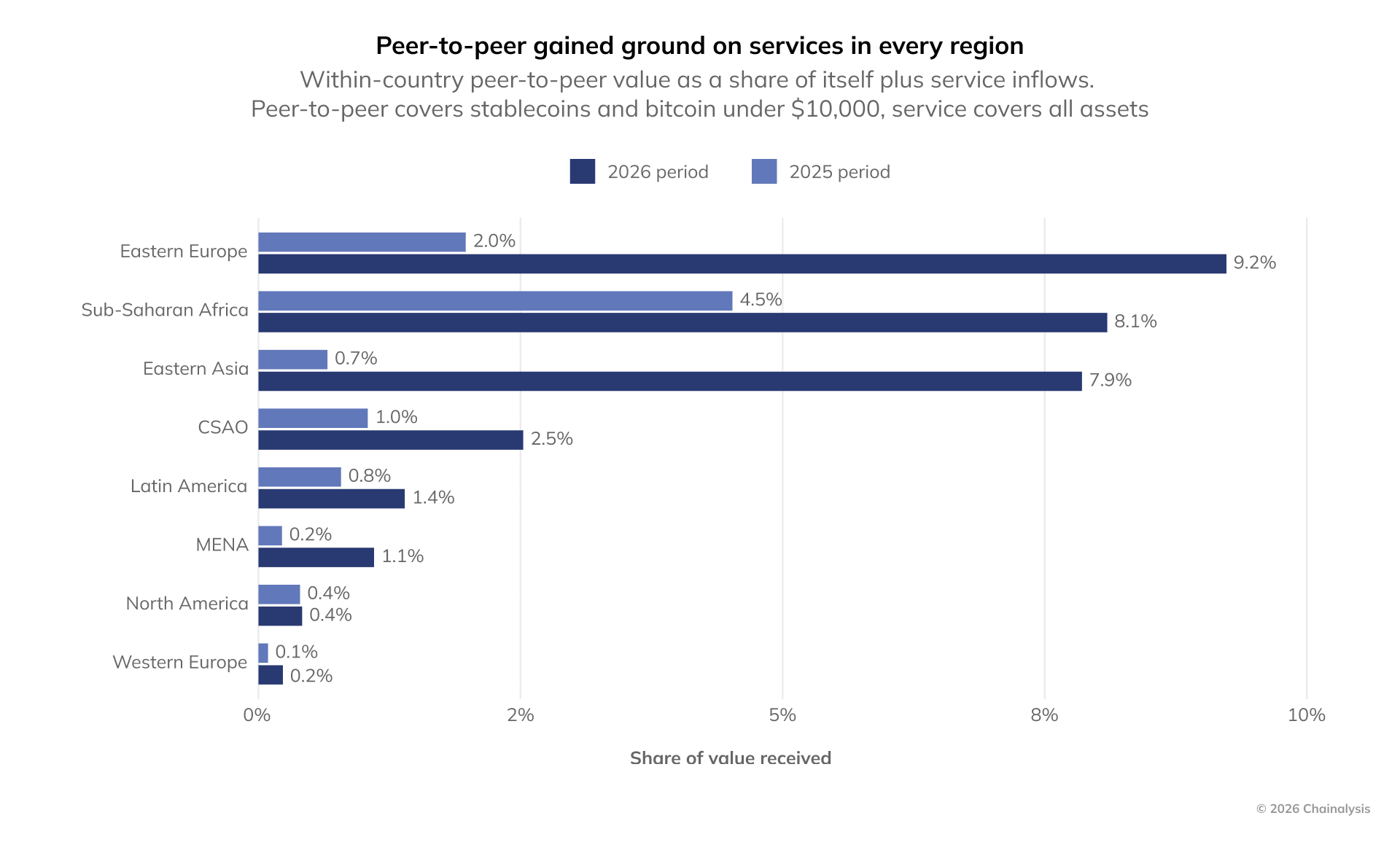
The typical flow relies on crypto escrow. Once buyer and seller agree on terms, funds or crypto are locked until both sides confirm the payment has been completed. Then the escrow releases the assets.
P2P platforms are especially useful where local payment rails are not well-served by mainstream exchanges, or where users need region-specific payment options. However, this model makes counterparty discipline more important: payment method, dispute rules, verification standards, and platform reputation all matter.
Derivatives Exchanges
Derivatives exchanges focus on contracts rather than direct ownership of the underlying asset. Core instruments include futures, perpetual futures, and options.
Margin trading means posting collateral to open a position larger than your balance would otherwise allow. Leverage is the multiplier that determines how much exposure that collateral controls.
The central risk is liquidation. If the market moves against your position and your margin becomes insufficient, the exchange can forcibly close the position. In many cases, that means losing the posted collateral.
Derivatives trading is not simply “advanced spot trading.” It is a different risk system entirely, and regional availability can vary sharply depending on compliance rules.
Instant Exchangers
And last but not least, instant exchangers like ChangeHero are best understood as an execution style rather than a separate market structure. The model is essentially a request for quote but for everyone, not just over-the-counter traders: you enter what you want to swap, the platform displays a rate, and you either accept it or walk away.
From the custody angle, instant exchangers describe themselves as non-custodial. These platforms do not track user accounts and balances the way CEXs do. As a result, you do not deposit more than needed at a time, although there is indeed a trust assumption in the “send us funds and we will send some back” formula.
Another major visible difference is no order book to place orders against. Cost is embedded in the displayed rate as a spread, plus trading fees which are communicated in the interface.
How ‘instant’ are instant exchangers? Most transactions, often called swaps (not to be confused with a financial instrument), conclude in 15 minutes. It’s not simply a marketing copy: we have the data.
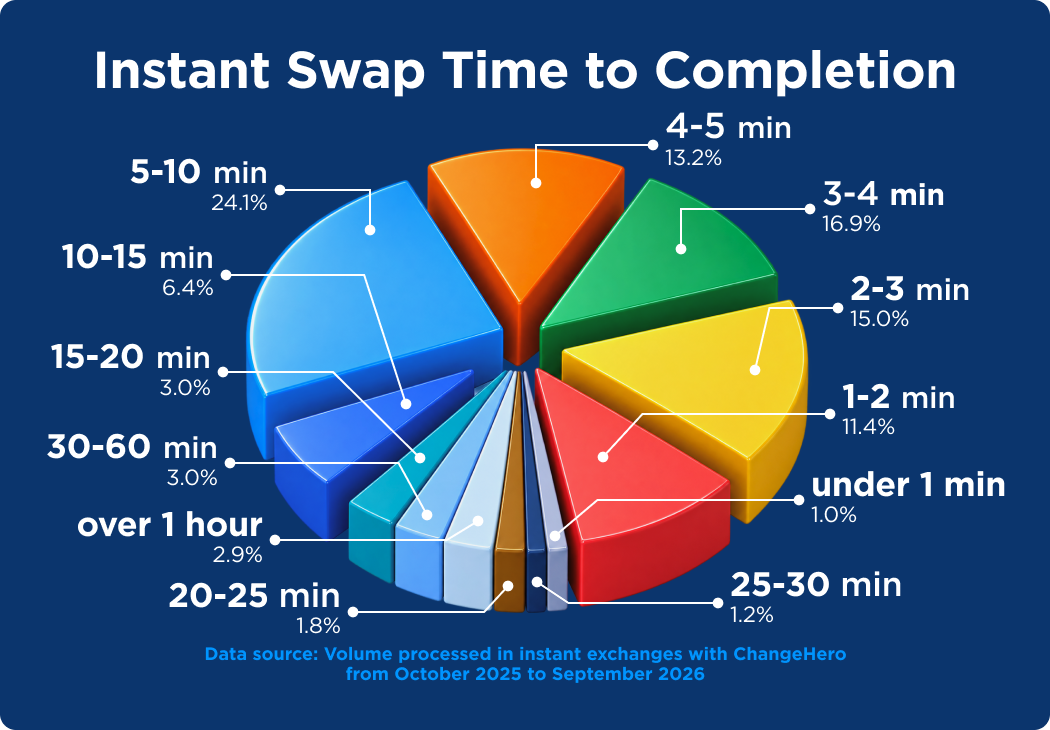
Analyzing all processed volume, which may come from slower and faster blockchains alike, the average swap is likely to conclude in under 5 minutes. Bitcoin blockchain, which is both slow and popular, skews the data toward the 15 minute figure.
Comparing it to a CEX trade cycle, which will see you deposit funds, perform the trade, and withdraw, provided you already have the account set up, the alternative of an instant exchanger is noticeably more time-efficient.
Fees, Security, and Asset Access
Regardless of the type, any crypto exchange should not be judged by the trading fee line alone. The real comparison spans three dimensions: what you pay, how your funds and account are protected, and whether you can enter and exit the assets you actually want to trade.
Maker-Taker Fees
Most centralized exchanges price trades using a maker-taker fee structure. The distinction comes from how your order interacts with the order book.
A market maker places a limit order that rests on the book. The order waits there, adding liquidity for someone else to trade against. A market taker does the opposite: placing a market order, or any order that executes immediately against existing liquidity, removing depth from the book. The former is beneficial and often gets lower fees and even rebates, while the latter is compensated with higher fees.
The common mistake is assuming a limit order is always a maker order. It is not. If your limit price crosses the current spread, meaning it can execute immediately against an existing order, the exchange treats it as a taker order and charges the taker fee.
The fee schedule itself is only one part of the total trading cost. A low headline fee does not help if the pair has a wide spread or shallow book. Slippage and price impact can cost more than the fee itself, particularly on larger orders in thinner markets.
In summary, total cost is:
- Trading fee;
- Spread;
- Slippage;
- Price impact from your exact order size.
Deposit and Withdrawal Costs
Moving funds onto and off a centralized exchange involves two additional cost layers.
The first layer is exchange-imposed fees: flat withdrawal fees, convenience fees, card fees, or deposit-method charges. The second layer is third-party or network cost: blockchain network fees, payment processor charges, or bank-transfer costs the exchange passes through.
Before depositing, review the asset-and-network withdrawal page for the exchange you intend to use. Fees and supported networks vary by asset, and assuming they are uniform across the platform is a common mistake.
The cheapest network is not automatically the right network either. The withdrawal network must match the network supported by the receiving wallet or exchange for that specific asset. Choosing a lower-fee network that the destination does not support can result in funds that never arrive and, in some cases, cannot be recovered.
Security Controls and Custody Risk

The first layer that exchange security has is account security, which you can configure yourself. This includes using a strong two-factor authentication method (instead of SMS), enabling withdrawal address allowlists, monitoring active sessions, and removing devices you do not recognize.
The second layer is custody and venue risk. This is the question of who controls the private keys after you deposit assets, and what happens during a platform freeze, withdrawal halt, trading halt, or insolvency event.
Account controls can protect you from unauthorized access. They cannot protect you from the platform itself restricting withdrawals.
The decision rule is simple: if retaining control of your keys during trading is the priority, a non-custodial wallet paired with DEX-style execution is the better fit. If rapid execution and deep liquidity matter more, custodial exposure may be the trade-off — but it should be managed, not ignored.
Asset Selection and Liquidity
A long list of supported tokens is not the same thing as tradable market quality. “Number of listed assets” tells you what is technically available. It does not tell you whether you can trade a given pair at a fair price and reasonable size.
Without specialized tools, you can still check liquidity directly:
- Spread tightness: a wide gap between best bid and best ask signals thin liquidity;
- Visible order book depth: shallow depth near the mid-price means your order may move the price more than expected;
- Pair-specific volume: volume on the exact pair matters more than general asset volume across the exchange.
This last point is more important than it looks. Liquidity can differ dramatically between pairs for the same asset. Token/USD may be thin while Token/USDT is deep, or the reverse.
Always check the exact pair you will use for both entry and exit. If cashing out to fiat matters, also confirm the exchange has a workable fiat on/off ramp for that asset. Crypto-to-crypto liquidity does not automatically guarantee an easy route back to cash.
Choosing an Exchange by Use Case
A taxonomy is useful only if it leads to a practical decision. The better shortcut is to match the exchange type to your actual goal: custody preference, funding method, and what you plan to do immediately after the purchase.
First Crypto Purchase
For a first purchase, prioritize simple UX, reputable custody controls, and a clear withdrawal path over advanced tools.
The decision flow becomes short:
- Choose a platform with a straightforward buy flow and visible security settings;
- Complete the purchase;
- Test a small withdrawal to a personal wallet if you plan to self-custody;
- Confirm you can sell or cash out later before committing larger amounts.
Some platforms make buying fast but make first withdrawals slower, requiring extra identity verification, temporary holding periods, or limited transfer options. This is not unusual, but it should be known before larger funds are involved.
Fiat On-Ramps
Your funding method changes both cost and speed. The best fiat on-ramp depends on what you are optimizing for.

Bank transfer, including ACH-style methods, is usually cheaper but slower. Wire transfer can move faster and is generally irreversible, but it often involves more manual steps and sometimes higher fees. Debit or credit card funding is fast but usually carries a higher effective cost once processing fees are included. Third-party payment processors add convenience, especially when your preferred method is not supported directly, but they also add their own fees and limits.
Before funding, verify three things:
- Your preferred deposit method is available on your account, not just advertised generally;
- The fiat you deposit can be withdrawn back out if you change your mind;
- Crypto withdrawals are available immediately after funding, or whether a holding period applies first.
Altcoin Trading
Altcoin trading involves two separate questions: can you find the token, and can you enter and exit at a reasonable price?
Finding a listing is actually the easy part. Before trading, check the exact pair you intend to use: Token/USD and Token/USDT on the same exchange can behave very differently. Look at the visible order book, the spread, and the depth near the mid-price. A tight spread and reasonable depth suggest you can trade your intended size without excessive price impact. A wide spread or thin book is a warning sign even if the token appears “available.”
Token availability differs by venue type. A CEX lists a curated set of assets selected for liquidity and compliance reasons. A DEX offers permissionless access to almost anything with a liquidity pool.
When using on-chain liquidity, a DEX aggregator can reduce the time spent comparing pools by routing across venues to find the best effective price after fees and slippage. Early access to a newly launched token generally favors a DEX. Reliable liquidity and a path back to fiat generally favor a CEX.
Self-Custody Trading
Self-custody trading means connecting a non-custodial wallet, signing each transaction yourself, and settling trades directly on-chain. At no point does a platform hold your funds on your behalf.
This is the operational test for whether you are actually retaining your keys.
The trade-off is practical, not only philosophical. Self-custody trading suits users willing to manage network fees and variable confirmation times in exchange for never depositing funds with a third party. It is a weaker fit for traders who need rapid execution across many pairs or advanced order types, because most on-chain venues settle more slowly and offer fewer order mechanics than centralized matching engines.
One workflow pitfall is easy to avoid: keep the chain’s native token on hand to pay network fees. Without gas, swaps can fail or stall before execution.
Crypto Exchange Apps vs Web Platforms
The same platforms across mobile apps and web platforms usually give access to the same account, but they do not create the same trading environment. The difference is not cosmetic; it affects security posture, order-entry precision, recovery options, and execution discipline.
| Reader Outcome | Mobile App | Web Platform |
|---|---|---|
| Device compromise exposure | Tied to phone security: lost/stolen device, malicious keyboards, or overlay malware can expose your session | Tied to browser/computer security: less exposure to SIM-swap or lock-screen notification leaks |
| Session/login control | Harder to see all active sessions at a glance; app-level biometric lock adds a layer | Easier to view and terminate active sessions/devices from account settings |
| Order-entry speed vs precision | Faster for quick market orders on the go, but small screens increase mis-entry risk | Slower to access, but precise limit price and quantity entry reduces fat-finger errors |
| Charting depth | Limited timeframes/indicators, simplified layout | Full charting suite with deeper indicator libraries and multi-timeframe analysis |
| Advanced order types | Often missing conditional orders like stop-limit or OCO | Typically supports stop-limit, stop-market, and OCO configurations |
| Notification reliability | Push alerts can be delayed by OS battery optimization or permission settings | Browser/email alerts less affected by mobile OS restrictions, but require the tab/device to be active |
| Recovery friction when phone is lost | Recovery often stalls — identity re-verification and document uploads are clunky on small screens | Recovery is generally faster — desktop upload and support workflows are easier to complete |
Mobile Security
It helps to separate platform security from device security. Platform security is what the exchange builds into its infrastructure. Device security is how well you protect the phone that can access the account.
A crypto exchange can run strong backend controls and still leave you exposed if your device is compromised.
App-specific risk surfaces include:
- A lost or stolen phone with an unlocked app session;
- SIM-swap exposure if SMS-based two-factor authentication is enabled;
- Malicious keyboards or screen overlays that capture credentials;
- Lock-screen notifications showing balances or withdrawal confirmations.
Run these checks inside the app:
- Review active sessions and force logout on anything unfamiliar;
- Confirm biometric or PIN lock is required every time the app launches;
- Verify withdrawal protection settings, such as address allowlisting or withdrawal delays, are enabled.
Trading Tools
Not every tool difference matters equally. Some are cosmetic, but others can directly affect execution quality.
Four areas deserve comparison:
- Charting depth: web platforms generally offer more timeframes and a deeper indicator library, while mobile apps simplify the layout;
- Order ticket precision: exact limit prices, tick sizes, and small quantity adjustments are easier with a full keyboard and larger screen;
- Order management: open orders, edits, cancellations, and order history are clearer on web because more information fits on screen;
- Advanced order types: stop-limit, stop-market, and OCO setups are more common and easier to configure on web platforms.
The mobile-specific gotcha is fat-finger risk. Small screens make it easier to misread decimals, choose the wrong side, or submit too quickly. A practical mitigation is to default to limit orders rather than market orders when trading on mobile, and to double-check buy/sell direction and size before submitting.
Price Alerts and Notifications
Third, alerts usually travel through three channels, and each can fail differently.
In-app alerts depend on the app being open or running in the background. Push notifications depend on OS-level permissions, background refresh, and battery optimization settings. Email/SMS alerts are more reliable for delivery but still depend on connectivity and whether you check them in time.
This matters during volatility. A delayed alert can mean missing the moment a stop order or watched price level triggers. By the time the notification arrives, the move may already be over.
A simple setup checklist:
- Enable notifications at the OS level;
- Whitelist the app from battery optimization or background suppression;
- Set at least two alert paths for critical levels, such as push notification plus email.
Account Recovery
Mistakes happen. If you need it, account recovery splits into two scenarios.
If you are an app-only user and lose both your phone and phone number, recovery depends entirely on backup access you prepared in advance. If you use both app and web access, losing the phone is less disruptive because you can log in from a browser, review security settings, and revoke the lost device’s session.

Run this drill before you need it:
- Confirm access to the signup email account;
- Confirm a backup two-factor authentication method exists beyond SMS;
- Locate recovery codes or backup codes if the exchange offers them;
- Confirm identity re-verification can be completed through the web platform.
One non-obvious point: recovery is often slower on mobile because document photos, liveness checks, ID uploads, and support correspondence are easier on desktop. If recovery support is needed, starting on web can save time.
Conclusion
You can differentiate crypto trading platforms by defining features like access to certain instruments or pricing. However, the descriptors that matter the most are custody and execution: they narrow down the platforms to main types — CEX, DEX, P2P, and exchangers.
To continue learning about how to start trading crypto and where, read more articles in the ChangeHero blog.
Frequently Asked Questions
What is a cryptocurrency exchange?
A cryptocurrency exchange is a venue or service that lets users trade one asset for another — crypto-to-crypto and, in many cases, fiat-to-crypto as well.
The term covers different custody models. Centralized exchanges (CEX) and brokers hold funds on behalf of users. Decentralized exchanges (DEX) are non-custodial protocols that let users trade directly from their own wallets.
Knowing the model matters before depositing anything. It determines who controls the assets during a trade.
How does a cryptocurrency exchange work?
There are two main paths.
On a custodial, account-based exchange, you deposit funds, place an order or convert one asset to another, and then withdraw. The platform holds your assets in between.
On a wallet-based, on-chain exchange, you connect a non-custodial wallet, sign the transaction yourself, and the trade settles directly on the blockchain. No intermediary takes custody.
The execution method also differs. Custodial platforms usually match trades through an order book, while many on-chain venues use swap or quote-style execution.
How do crypto exchanges make money?
Crypto exchanges generate revenue through several common channels:
- Trading fees, often structured as maker/taker or flat fees;
- Spread or markups built into convert and instant swap flows;
- Deposit and withdrawal-related charges;
- Payment processor pass-through costs;
- Margin, derivatives, custody, or ancillary service fees.
For larger traders, pricing may also be negotiated through an OTC crypto exchange workflow, where execution happens off the public order book. In some cases, an RFQ desk sources liquidity and returns a firm quote for a specified size and settlement window.
The nuance is simple: the lowest advertised trading fee does not always mean the lowest total cost. A wider spread or higher slippage can outweigh a lower fee.
Are crypto exchanges safe?
Exchange safety has two layers: account security and custody/venue risk.
Account security is the layer users can improve directly. An authenticator app instead of SMS, withdrawal allowlists, and active session monitoring all reduce unauthorized-access risk.
Custody/venue risk is different. If a CEX holds your private keys, you depend on the platform’s ability and willingness to process withdrawals. Account controls do not protect you if the platform freezes withdrawals, halts trading, or becomes insolvent.
The practical takeaway is direct: if self-custody fits your needs, withdraw long-term holdings to a non-custodial wallet. If you are actively trading, keep only the balance you need on-platform.