
Litecoin Halving: How It Works and What It Means


Key Takeaways
- Litecoin halving is a scheduled protocol event that cuts the block subsidy miners receive for each new block;
- The next Litecoin halving is projected around July 27, 2027, but the real trigger is block height 3,360,000, not a calendar date;
- The block subsidy will fall from 6.25 LTC to 3.125 LTC, reducing the rate of new LTC issuance;
- Litecoin halvings happen every 840,000 blocks, roughly every four years under the network’s 2.5-minute target block time;
- A halving changes supply issuance with certainty, but it does not guarantee any particular Litecoin price outcome.
Disclaimer
Litecoin halving mechanics can be verified on-chain by checking block height, subsidy values, and block rewards through a blockchain explorer. However, on-chain protocol events do not guarantee price appreciation, miner profitability, or market stability. Nothing on this page constitutes investment advice. Litecoin price behavior depends on demand, liquidity, macro conditions, miner behavior, and broader crypto market cycles, so readers should cross-check data directly and apply their own risk management.
A Litecoin halving is a pre-scheduled protocol event that cuts the block reward miners receive for validating new blocks, permanently slowing the pace at which new coins enter circulation. The goal is reduced issuance that inevitably reshapes miner incentives and indirectly contributes to market volatility. Whether you have a good understanding of the Bitcoin halving mechanism or not, Litecoin halving is still more than “the same but for Litecoin”.
With the next halving standing as the network’s upcoming major milestone, exact timing remains tied to block production speed rather than a fixed calendar date. By the end of this guide, you will be able to interpret the next halving’s timing, understand the emission mechanics behind it, and evaluate the mining and market signals that typically accompany the event as part of Litecoin’s broader tokenomics.
When is the Next Litecoin Halving Date?

Just in case you are here for the date, let’s get this out of the way first. The following sections will dive deeper into the hows and whys of the mechanics, so feel free to keep reading.
Projected Date: July 27, 2027
Litecoin reaches its next halving milestone around July 27, 2027, when the network hits the next scheduled halving block height, cutting the block reward in half. This calendar date is an estimate because Litecoin blocks are not produced at a perfectly fixed pace, so actual timing can shift earlier or later.
Block Height and Countdown
A more precise point for the next Litecoin halving is block height 3,360,000. Block height is simply the number of blocks in the chain, which is normally displayed in block explorers on relevant pages.
If you do not feel like doing the math, a live countdown tool, such as the one at https://www.litecoinhalving.com/, estimates the time remaining based on recent block production speed, giving you a running ETA rather than a fixed date.
Block height is counted sequentially from the genesis block (#0). Occasional reorganizations or stale blocks do not change this scheduled height, but they can make time estimates wobble slightly.
Block Reward Change
At that point, Litecoin’s block reward, or more precisely the block subsidy, will drop from 6.25 LTC to 3.125 LTC per block at the next halving. A miner’s total revenue also includes transaction fees, but only the block subsidy is halved at this event. The combined miner reward ultimately reflects subsidy plus fees, which is why mining economics need to be analyzed separately from the protocol rule itself.
Litecoin Halving Mechanics, Supply, and Emission Timeline
Let’s take a step back and view the bigger picture now: what is even Litecoin halving? Put shortly, it is one of the simplest and most important parts of Litecoin tokenomics: at fixed block intervals, the network reduces how much new LTC miners receive from the protocol.
840,000-Block Cycle
The “cycle” in Litecoin’s halving schedule refers to a deterministic protocol rule. The network cuts the block subsidy at fixed block-height intervals — every 840,000 blocks — rather than on any calendar-based trigger. Because Litecoin targets a 2.5-minute block time, this 840,000-block interval works out to roughly four years per cycle on average. However, actual block production speed means this is an approximation, not a guarantee.
Each entry simply adds another 840,000 to the previous height — a pattern you can carry forward to estimate where future halvings will land. So, the halving at the height 3,360,000 concludes the fourth cycle.
84 Million LTC Supply Cap
Why do halvings exist? To explain why supply emission has to decrease, another tokenomic component needs to be introduced: the limit on maximum amount of litecoins that can exist.

In protocol terms, the supply cap is the maximum number of coins that can ever be minted through block subsidies. For Litecoin, that ceiling is fixed at 84 million LTC. As successive halvings shrink the subsidy toward zero, circulating supply does not hit this ceiling abruptly. Instead, it approaches the maximum supply asymptotically, with each cycle adding a smaller sliver of new coins than the last.
It is worth keeping three related terms distinct, because they are often blurred together:
- Maximum supply, or cap: the hard limit of 84 million LTC that the protocol will ever mint.
- Circulating supply: the amount of LTC currently issued and not provably removed from circulation.
- Newly issued supply: the per-block subsidy added to the emission schedule over time, which shrinks with every halving.
Remaining Coins and Final Emission
The long tail of Litecoin’s emission schedule describes what happens after many halvings have passed. Per-block issuance becomes vanishingly small, so the coins still left to mint trickle out over decades rather than years. This is purely a function of the emission timeline — how slowly the remaining supply gets released — not a statement about price or market value.
When the emission schedule tapers into a long tail, diminishing issuance is spread across decades rather than ending in one abrupt cutoff. For what happens then, since Litecoin’s supply release is almost a carbon copy of Bitcoin’s, you can read our article on what happens when all bitcoins are mined.
Litecoin Halving History
Litecoin’s halving history is short enough to verify directly but long enough to show the protocol’s rhythm.
| Event | Date | Block height | Subsidy before | Subsidy after |
|---|---|---|---|---|
| Launch | October 7, 2011 | 0 | — | 50 LTC |
| First halving | August 25, 2015 | 840,000 | 50 LTC | 25 LTC |
| Second halving | August 5, 2019 | 1,680,000 | 25 LTC | 12.5 LTC |
| Third halving | August 2, 2023 | 2,520,000 | 12.5 LTC | 6.25 LTC |
Litecoin Launch Reward
Litecoin launched on October 7, 2011, with an initial block subsidy of 50 LTC per block. At that point, the block subsidy might as well have been total miner revenue, since it took some time for the network to attract enough activity to start collecting transaction fees in addition to the subsidy. Halvings only affect this subsidy schedule; transaction fees follow market demand and are never halved.
2015 Halving
The first Litecoin halving occurred on August 25, 2015, triggered at block height 840,000. The block subsidy stepped down from 50 LTC to 25 LTC per block.
2019 Halving
The second Litecoin halving occurred on August 5, 2019, triggered at block height 1,680,000. The block subsidy stepped down from 25 LTC to 12.5 LTC per block.
2023 Halving
The third Litecoin halving occurred on August 2, 2023, triggered at block height 2,520,000. The block subsidy stepped down from 12.5 LTC to 6.25 LTC per block. This is the current subsidy rate and it will remain in place until the next halving interval is reached.
To verify any of these values yourself, check a block explorer at the exact block height listed and observe the subsidy paid out on the first block mined after that height.
Price Behavior and Market Cycles

Litecoin price around halving events tends to follow loose, often-observed patterns rather than fixed rules. The halving itself is deterministic; the market reaction is not.
Pre-Halving Price Trends
In the months leading up to a halving, Litecoin price action often reflects two forces that are easy to conflate.
The first is the narrative channel: traders positioning ahead of a well-known, publicly scheduled event, sometimes bidding up price purely on expectation. The second is the mechanical channel: the actual halving of new-coin supply, which does not occur until the block-height trigger is reached.
Because the halving date is known well in advance, markets can front-run the event. In plain terms, any pre-halving move may already reflect anticipated scarcity rather than a reaction to a supply change that has not happened yet.
To avoid treating a single anecdotal “pre-halving pump” as a reliable signal, track a small set of measurable indicators in the weeks and months before the event:
- Spot volume trend: is trading volume rising, flat, or declining relative to prior weeks?
- Derivatives open interest and funding rates: where available, are traders building leveraged long or short positions?
- Realized volatility: is the actual magnitude of price swings increasing ahead of the event?
- Relative performance vs. Bitcoin, or LTC/BTC: is Litecoin outperforming or underperforming Bitcoin over the same window?
That final point is particularly useful because it helps separate Litecoin-specific behavior from broader crypto market movement.
Post-Halving Price Trends
Price behavior after a halving is not uniform across time horizons. Short-term moves are often dominated by profit-taking or a liquidity shock, as traders who positioned ahead of the event unwind those positions once it has passed. Weeks after the event, the price action is more closely tied to miner revenue adjustment, as miners adapt to the lower block subsidy and any resulting changes in selling behavior or network hashrate. In the longer term, broader risk-on or risk-off regime shifts, driven by macro liquidity conditions and overall crypto market sentiment, tend to dominate and can overshadow the halving itself.
Why can post-halving moves be muted or even negative despite issuance dropping? Because the halving is a scheduled, publicly known event. Much of its expected effect may already be priced in before it occurs. Additionally, macro liquidity conditions and Bitcoin’s own trend direction often carry more weight over Litecoin’s price than the mechanical supply change alone, especially because Litecoin tends to trade as a smaller, more liquidity-sensitive asset relative to Bitcoin.
Scarcity, Demand, and Volatility Risks
Scarcity around a halving as reduced flow manifests as the drop in the issuance rate — the inflation rate of new LTC entering circulation. This is a purely mechanical, guaranteed effect of the halving.
Scarcity as demand growth is different. It refers to whether new buyers or increased usage actually show up to absorb that reduced flow. If demand growth merely matches the reduced new supply, price impact can be neutral. Only if demand meets or exceeds the shrinking new-supply rate does reduced issuance translate into meaningful upward pressure. Supply reduction alone does not do the work.

This dynamic creates a distinct set of volatility risks around halving windows:
- Leverage unwinds: built-up derivatives positions can unwind rapidly, amplifying moves in either direction.
- Thin order books: lower liquidity around the event can make price more sensitive to individual large orders.
- Liquidity gaps during off-hours: moves outside peak trading hours can be exaggerated by reduced market depth.
- Headline-driven spikes: news coverage of the halving can trigger short-lived, sentiment-driven price spikes disconnected from fundamentals.
- Correlation shocks with Bitcoin: a sudden shift in Bitcoin’s price or trend can override any Litecoin-specific halving dynamics entirely.
Volatility simply describes the magnitude of price swings — how much and how fast price moves, in either direction. It is not a signal of direction by itself. Rather than trying to predict which way price will move around a halving, it is more productive to size positions and set time horizons according to the level of volatility you expect.
Litecoin and Bitcoin Halving Cycles
It’s about time to address the most direct Litecoin vs Bitcoin comparison relevant to this topic. There’s no pretending that Bitcoin’s and Litecoin’s halvings play the same role in the broader market. The comparison is useful, but it is conceptual rather than a promise that patterns will repeat.
Bitcoin’s halving, given its size and dominance, can influence the broader crypto market regime and overall liquidity narrative. Litecoin’s halving is smaller in market impact and tends to trade more as a satellite narrative — shaped by, rather than shaping, the wider market mood.
Mining Economics After the Halving
When the block subsidy drops, the arithmetic of mining changes immediately, even if the network’s response takes longer to unfold. Revenue, costs, hashrate, hardware efficiency, and mining pool choice all need to be reassessed. Otherwise, “mining is profitable” or “mining is dead” becomes a slogan rather than an analysis.
Profitability and Break-Even Costs
The variables that contribute to mining profitability in plain terms are:
- Revenue: block subsidy, which is halved on schedule, plus transaction fees, which are variable and set by network demand.
- Cost: electricity, hardware amortization, and hosting fees if applicable.
- Operational rates: hashrate owned, meaning your share of total network hashrate, and uptime, meaning the percentage of time your rig is actually mining.
A halving cuts the subsidy term in that equation by half while leaving the fee term untouched. Therefore, total revenue does not necessarily fall by exactly 50%, because fees can offset part of the drop depending on network activity.
Moreover, mining profitability measured in LTC terms and profitability measured in fiat terms can diverge whenever LTC’s price moves. Coin-denominated math — coins earned versus coin-equivalent spent on power — does not automatically track fiat-denominated math — dollars earned versus dollars spent. This is why miners typically track both figures side by side.
Hashrate and Difficulty

The chain of cause and effect after a halving has a specific order:
- The subsidy halves, cutting expected revenue per unit of hashrate.
- Marginal miners, whose costs sit close to their break-even electricity price, may shut off rigs that are no longer profitable.
- If enough miners exit, network hashrate can dip.
- Difficulty adjusts only after the protocol’s retarget interval; it does not change instantly.
- Once difficulty adjusts downward to match the lower hashrate, remaining miners’ share of block rewards can improve because they are competing against less total hashrate.
Operationally, difficulty represents the expected number of hashes required, on average, to find a valid block under Litecoin’s Scrypt proof-of-work algorithm. Combined with Litecoin’s target block time, difficulty determines the expected blocks per day the network should produce. When actual hashrate diverges from what difficulty assumes, blocks arrive faster or slower than the target until the next retarget brings the two back into alignment.
Mining Hardware Efficiency
Post-halving, efficiency differences matter more than before because revenue per hash is lower across the board. A rig that was merely “fine” pre-halving can become unprofitable once the subsidy component shrinks.
A simple decision rule follows: if two rigs offer similar hashrate, the one with lower watts-per-hash retains more resilience at higher electricity rates because its cost side scales more slowly as power prices rise.
Smaller miners rarely solo mine after a halving for a straightforward probability reason. With a smaller subsidy relative to the time between found blocks, variance becomes harder to tolerate. Solo mining becomes less about steady income and more about waiting through long, unpredictable gaps — a variance-management problem rather than a simple recommendation for or against it.
Halving Charts and On-Chain Indicators
Charts and on-chain data will not tell you what price will do next. They can, however, help you sanity-check claims about network health, miner behavior, and demand using measurable inputs rather than narrative alone.
The three most useful indicator groups are hashrate and difficulty, miner reserves and exchange flows, and network activity and transaction fees. Each answers a different question. Reading them together is more reliable than leaning on any single chart.
Hashrate and Difficulty Charts
A usable hashrate and difficulty chart should show, at minimum, a timeframe selector, the hashrate line itself, the difficulty line, and — if available — estimated miner revenue layered alongside them. Align these around the halving using rolling windows such as 30, 90, and 180 days rather than staring at the halving date in isolation. The point is not the date itself, but how the lines behave in the weeks before and after it.
Reading the chart follows a consistent chain:
- Hashrate moves first — miners turn rigs on or off as expected profitability shifts.
- Difficulty responds with a lag — mining difficulty adjusts only at the protocol’s retarget interval.
- Stabilization follows — once difficulty catches up to the new hashrate level, the network settles into a new equilibrium until the next shock.
A hashrate drop right after a halving is often a normal profitability response from marginal miners exiting. By itself, it is not evidence of a network failure or a security issue.
Miner Reserves and Exchange Flows
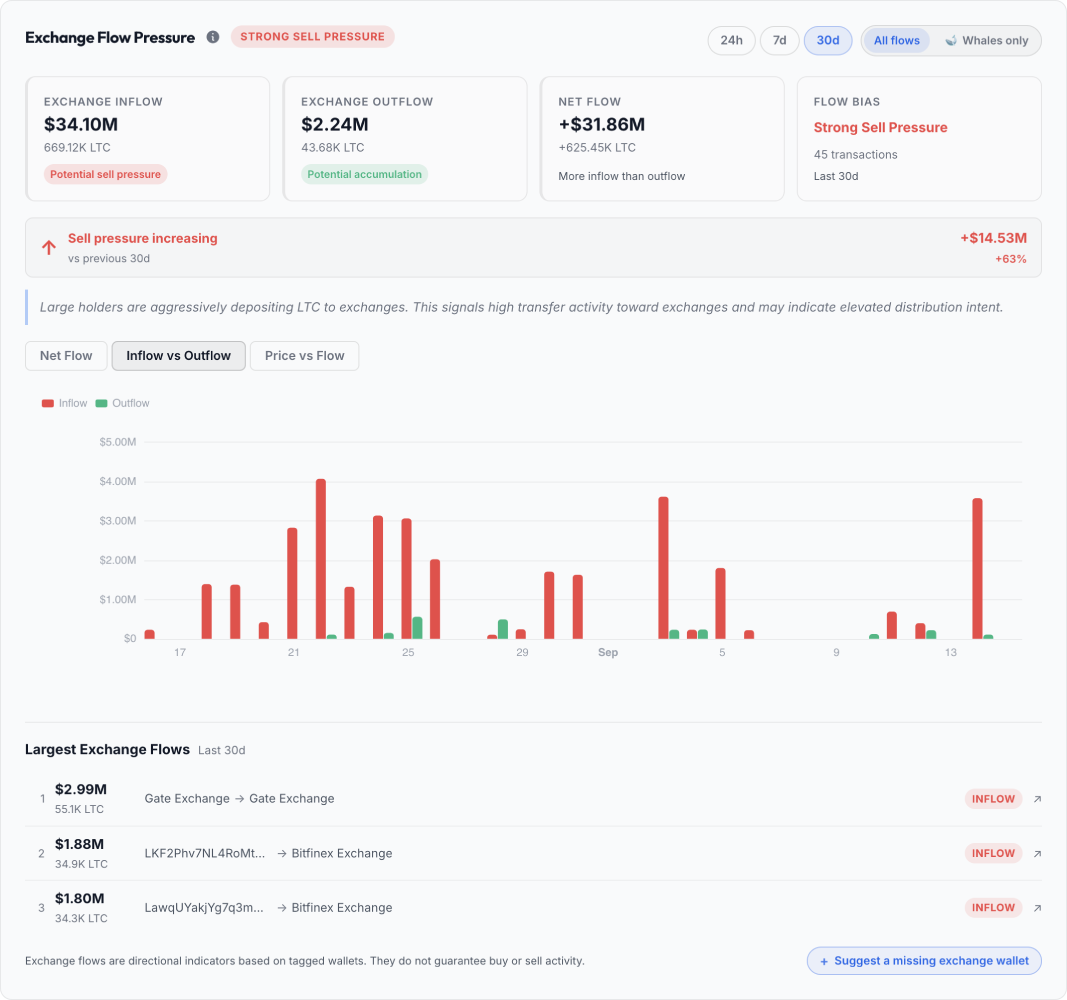
Before interpreting this data, it helps to define two terms. Miner reserves refers to the LTC balance held in wallets clustered as miner-associated addresses. Exchange flows run in two directions: inflows, meaning LTC moving onto exchanges and commonly read as potential sell pressure, and outflows, meaning LTC leaving exchanges and commonly read as accumulation or movement toward long-term holding.
Both readings are probabilistic tendencies, not confirmed intent. Miners and holders move coins for many reasons unrelated to trading.
| Reserves rise | Reserves fall | |
|---|---|---|
| Inflows rise | The most conservative read is mixed. Miners may be accumulating even as some coins move toward exchanges elsewhere. | This is the combination most consistent with potential sell pressure, but “potential” is the operative word. |
| Inflows fall | This leans toward accumulation or holding behavior, though it is still not proof of intent. | Coins are leaving miner wallets without a corresponding exchange buildup, which most conservatively suggests movement to other wallets or services rather than an imminent sale. |
That being said, clustering heuristics used to label miner addresses and exchange wallets can misfire, so a sharp one-day spike in reserves or flows should prompt “investigate further” rather than be treated as proof of a directional move.
Network Activity and Transaction Fees
Two metric categories are relevant here. Usage proxies — transactions per day, active addresses, and mempool pressure — describe how much the network is being used. Fee market outputs — median fee, fee per byte, and total fees per block — describe what that usage costs.
Higher transaction fees can mean genuine rising demand, but they can also reflect congestion or inefficient use of block space. The chart alone will not tell you which interpretation is correct.
There is also a mechanical link worth noting for the post-halving period: once the block subsidy drops, transaction fees make up a larger share of total miner revenue relative to that smaller subsidy. That means sustained fee weakness after a halving can matter more to miner economics than it did before. The chart-reading takeaway is simple: post-halving fee trendlines deserve more attention than pre-halving fee trendlines because the average miner fee per block can become a more material slice of payouts.
Before concluding that activity is meaningfully up or down, run through three context checks:
- Compare to a 30/90-day baseline rather than judging a single day or week in isolation.
- Check whether the activity is exchange-driven batching — large consolidated transactions — versus organic, distributed usage.
- Confirm whether fee changes coincide with mempool backlog, which would point to congestion rather than a genuine demand surge.
How to use indicators together:
- Start with hashrate and difficulty to gauge miner participation and network security.
- Then check miner reserves and exchange flows for signs of potential distribution behavior.
- Validate with network activity and transaction fees to confirm whether real demand and fee support back up the picture.
- Evaluate all of this over weeks, not single-day candles. Short windows are where false signals live.
Conclusion
Litecoin’s next halving is a fixed protocol event, but what happens around the event is less predictable. Price moves, hashrate shifts, miner behavior, and exchange flows all respond to incentives, but they also respond to broader market conditions. If you take one practical habit from this guide, let it be this: whenever you see a claim about what the Litecoin halving means for price, mining profitability, or network security, trace it back to a specific, checkable data point.
The tools and checklists covered here — countdown verification, break-even calculations, chart-reading steps, and on-chain indicator combinations — are meant to let you do that verification yourself on an ongoing basis rather than relying on any single source’s interpretation.
We hope you enjoyed the article! If it left you wanting more, welcome to the ChangeHero blog: updates to the blog and even more daily content can be found on our social media. Follow us on Telegram, X (Twitter), and Facebook!
Frequently Asked Questions
What is Litecoin halving?
Litecoin halving is a scheduled protocol event that cuts the block subsidy paid to miners by half at a predetermined block height. The block reward miners receive is made up of two separate components: the block subsidy, which is newly created LTC, and transaction fees, which are paid by users.
A halving only changes the subsidy schedule. The fee market is untouched. In practical terms, the rate of new LTC creation drops sharply, while fees continue to be set by network demand independently of the halving event.
When is the next Litecoin halving?
The next Litecoin halving is projected to land around July 27, 2027, based on current block production estimates. Because the halving is triggered strictly by reaching a specific block height rather than a calendar date, this projected date can drift earlier or later depending on how quickly blocks are actually mined.
The scheduled block height for the next Litecoin halving is 3,360,000, and the block subsidy will fall from 6.25 LTC to 3.125 LTC.
How often does Litecoin halving happen?
Litecoin halving happens every 840,000 blocks, a fixed interval written into the protocol’s rules. Using Litecoin’s targeted 2.5-minute block time, that interval translates to roughly four years between events.
However, the deterministic trigger is always block height, not elapsed time. This is why the real-world interval only approximates four years rather than matching it exactly.
What happens to Litecoin price after halving?
Litecoin price after a halving does not follow any guaranteed pattern. Reactions can differ significantly depending on the timeframe — days, weeks, or months after the event.
One key reason outcomes vary is that markets often price in a well-known, publicly scheduled event before it occurs. The expected move may already be reflected in price beforehand. After the halving, price can still be driven more by demand, liquidity, Bitcoin’s trend direction, and macro conditions than by the supply change alone.
