What is Bitcoin Halving? A Complete Guide for Beginners


Key Takeaways
- 割 Bitcoin halving = a 50% cut to the block subsidy every 210,000 blocks (roughly ~4 years). It’s protocol-enforced monetary policy—code executes it, not a committee.
- 割 Halving is triggered by block height, not a calendar date. Forecasted dates drift because block times fluctuate around the ~10-minute target and difficulty adjusts every 2,016 blocks.
- 割 It reduces the flow of new BTC, not your existing balance. Your wallet doesn’t change; what changes is the issuance rate (new BTC entering circulation per block/day).
- 割 Market impact is real—but not a promise. Reduced issuance can tighten sell-side flow, yet price outcomes still hinge on demand, liquidity, and positioning (halving narratives get “priced in” and can fail under macro headwinds).
- 割 Long-run trajectory: each halving shifts Bitcoin from subsidy-funded security toward fee-dependent security, with issuance asymptotically approaching the 21 million cap and the subsidy trending toward ~0 around 2140.
Disclaimer:
This content is for educational purposes only and does not constitute financial, investment, or trading advice. Always conduct your own research and consult with qualified professionals before making any financial decisions.
Contents
- 1. What is Bitcoin Halving?
- 2. Bitcoin Halving Schedule and Issuance Rules
- 3. Bitcoin Halving History
- 4. Market Effects of the Bitcoin Halving
- 5. Mining Effects of the Bitcoin Halving
- 6. Network Effects of the Bitcoin Halving
- 7. Bitcoin Halving vs Other Scarcity Models
- 8. Future Outlook for Bitcoin Halvings
- 9. Conclusion
Halving is a term both critically important to the crypto industry and lacking a reference point for anyone unfamiliar with cryptocurrencies. It’s not all Bitcoin getting halved or anything like that—it reduces the block subsidy, or more simply put, new bitcoin issued to miners. Approximately every four years, the network's issuance schedule is fundamentally altered, which triggers ripple effects across mining economics, market dynamics, and long-term adoption trajectories.
By the end of this guide, you will understand the precise mechanism behind halving events, their historical timeline, how they affect miner profitability and network security, and the second-order market impacts that have historically followed each reduction cycle in the broader cryptocurrency market.
What is Bitcoin Halving?
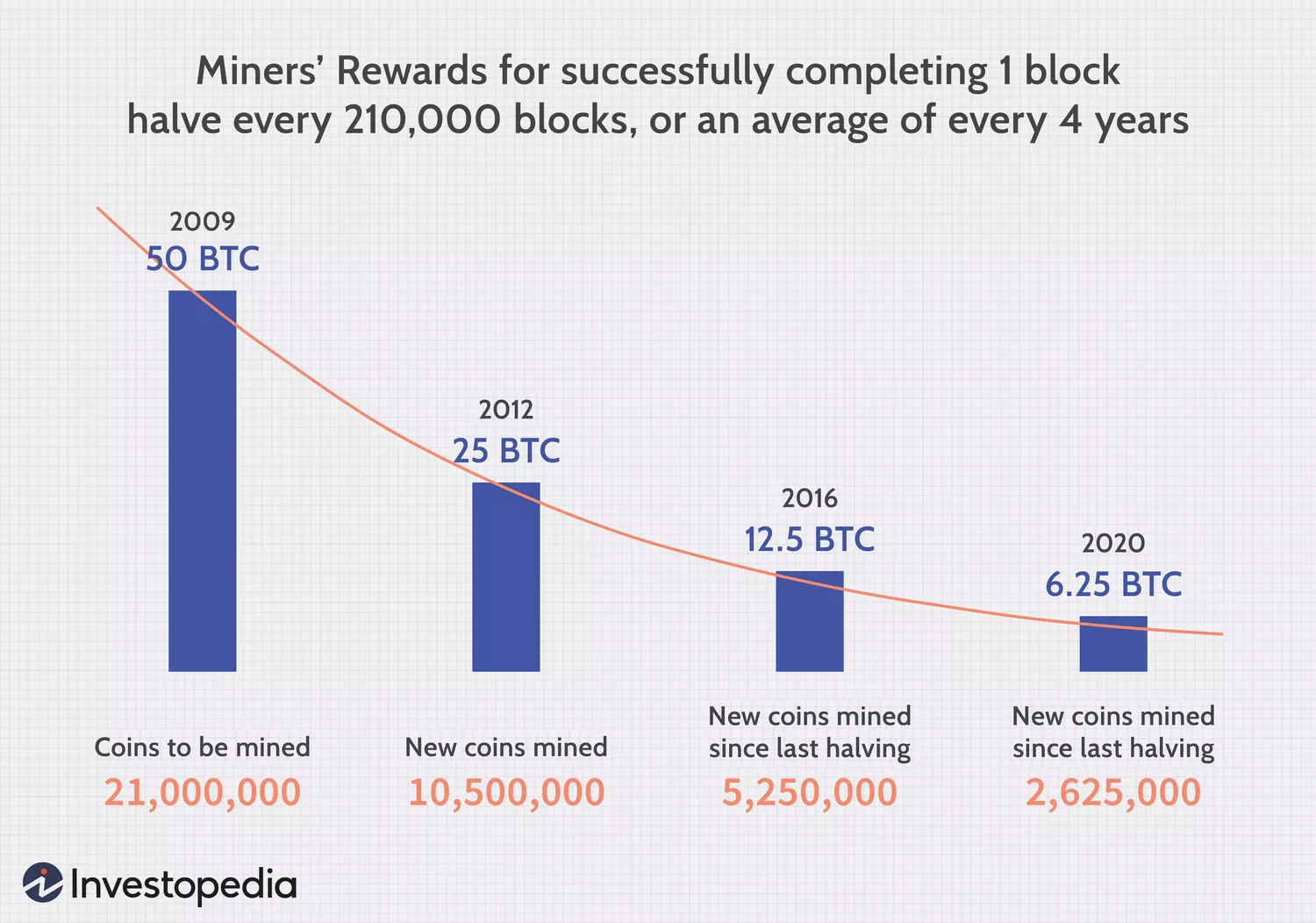
By definition, a Bitcoin halving reduces the block rewards or subsidy paid to miners by exactly 50%, cutting the rate at which new BTC enters circulation and programmatically enforcing Bitcoin's 21 million supply cap. This protocol-level event occurs every 210,000 blocks—roughly every four years—and serves as Bitcoin's monetary policy mechanism, executed by code rather than central authority.
If you’ve ever asked what Bitcoin halving is, the cleanest way to think about it is: the network reaches a specific block height, and the code simply starts paying miners less newly minted BTC per block from that point onward. Your balance does not change, your wallet does not “lose” anything, and no one needs to approve it—Bitcoin just follows its own rules.
To better parse how it works, you need to understand other key terms:
- Block: A bundled set of transactions that miners validate and add to the Bitcoin blockchain; each block extends the permanent ledger by one unit.
- Block subsidy (block reward): The fixed amount of new BTC created and awarded to the miner who successfully adds a new block; this is the portion affected by the halving.
- Miner: A network participant running specialized hardware to solve cryptographic puzzles; miners compete to add the next block and earn the subsidy.
- Issuance: The rate at which new bitcoins are introduced into circulation through the block subsidy mechanism.
- Circulating supply: The total number of BTC currently available and held by users; grows with each block until the 21 million cap is reached.
If you still do not have a solid grasp on how Bitcoin mining works, catch up with our guide.
Meaning of Bitcoin Halving
Why exactly does Bitcoin halving matter? The cause-and-effect chain is built into Bitcoin's design:
- Reduced new issuance rate means slower supply growth: Each halving cuts the number of new bitcoins entering circulation per block, which directly slows the pace at which the total supply expands.
- Disinflation, not inflation, means predictable monetary schedule: Bitcoin's supply continues to grow after each halving, but at a decreasing rate (disinflation), ensuring a transparent, pre-determined issuance curve that no central authority can manipulate.
- Scarcity narrative reinforcement affects market psychology: By systematically reducing new supply over time, the halving emphasizes Bitcoin's finite nature and positions it as a scarce digital asset, which has historically attracted attention from investors seeking inflation-resistant stores of value.
- Long-run supply cap alignment due to the 21 million ceiling: Each halving brings Bitcoin closer to the hard cap; around the year 2140, the subsidy will reach zero, and the total circulating supply will stabilize at 21 million BTC, transitioning mining revenue entirely to transaction fees.
Bitcoin Halving Schedule and Issuance Rules
Bitcoin's issuance schedule operates on a fixed protocol: miners receive block rewards approximately every 10 minutes, these rewards halve every 210,000 blocks, and the total supply converges asymptotically toward a hard cap of 21 million BTC enforced by consensus rules.
Block Interval

Bitcoin's protocol targets a block time of approximately 10 minutes, meaning the network aims to validate and add a new block to the blockchain roughly six times per hour. In practice, actual block times fluctuate above and below this target due to variations in network hash rate and miner activity. The difficulty adjustment mechanism, which recalibrates mining difficulty every 2,016 blocks (approximately every two weeks), gradually pulls these variations back toward the 10-minute average over time.
At the protocol's 10-minute target, the network produces approximately 6 blocks per hour, 144 blocks a day, and about 52,560 blocks each year.
Bitcoin measures time in blocks, not dates, and the 10-minute target is the pacing mechanism that makes issuance predictable while still letting the network self-correct.
Halving Frequency
As a result, the halving trigger is a block-height rule rather than a calendar date. The widely cited "approximately every four years" estimate can drift because it depends on the actual average block time during that period—if blocks consistently come faster or slower than 10 minutes, the halving arrives sooner or later than the four-year mark.
Maximum Supply
Bitcoin approaches its maximum supply of 21 million BTC through a geometric series rather than reaching it abruptly. Each halving cuts the block reward by half—50 BTC became 25, then 12.5, then 6.25, then 3.125—and this pattern continues indefinitely. Mathematically, adding progressively smaller fractions (1⁄2 + 1⁄4 + 1⁄8 + 1/16...) converges toward a limit without ever fully reaching it. The 21 million cap represents the maximum possible supply that Bitcoin's code will ever allow, not a quantity that materializes at a specific moment. The asymptotic design ensures that new Bitcoin continues to reward miners for securing the network over many decades, even as the reward shrinks to negligible amounts and the inflation rate approaches zero while maintaining scarcity.
For clarity on very small future rewards, one BTC unit equals 100 million satoshis (sats). When block rewards eventually drop below 1 BTC in later eras, miners will still receive precise fractional amounts measurable in satoshis, preventing confusion about whether rewards have disappeared entirely.
Bitcoin Halving History
2012 Halving
When it happened: November 28, 2012 (UTC)
Block reward change: 50 BTC → 25 BTC
Bitcoin's inaugural halving occurred at block height 210,000, marking the first time the protocol executed its pre-programmed monetary policy. Before this event, miners earned 50 BTC for every block they successfully mined. Once the halving triggered, that figure dropped to 25 BTC per block, slashing the rate at which new coins entered circulation.
Issuance rate implication: Daily target issuance fell from approximately 7,200 BTC to 3,600 BTC. This reduction introduced the network's first real-world test of programmed scarcity.
Why this halving matters in the issuance schedule: The 2012 halving validated Bitcoin's core thesis that digital scarcity could be enforced algorithmically, proving the protocol could execute its deflationary roadmap without human intervention or central authority override.
2016 Halving

When it happened: July 9, 2016 (UTC)
Block reward change: 25 BTC → 12.5 BTC
The second halving arrived at block height 420,000, further tightening Bitcoin's supply mechanism. Miners who had adapted to earning 25 BTC per block now saw their rewards cut in half once again, reinforcing the network's commitment to long-term scarcity over short-term issuance.
Issuance rate implication: New supply dropped from roughly 3,600 BTC per day to approximately 1,800 BTC per day. By this point, Bitcoin had already distributed over 15.75 million of its eventual 21 million coin cap, meaning more than 75% of the total supply was already in circulation before this second reduction took effect.
Why this halving matters in the issuance schedule: The 2016 event demonstrated that Bitcoin's monetary policy remained resilient through multiple halving cycles, with miners continuing to secure the network despite reduced block subsidies—proof that transaction fees and market price adjustments could sustain the ecosystem even as issuance declined.
2020 Halving
When it happened: May 11, 2020 (UTC)
Block reward change: 12.5 BTC → 6.25 BTC
At block height 630,000, Bitcoin executed its third halving, cutting the block reward to 6.25 BTC. This reduction arrived during a period of heightened global economic uncertainty, drawing attention to Bitcoin's predictable supply curve as a contrast to emergency monetary expansion policies deployed by central banks worldwide.
Issuance rate implication: Daily issuance fell from approximately 1,800 BTC to around 900 BTC. With this halving, Bitcoin's annual inflation rate dropped below 1.8%, making it one of the most disinflationary assets in existence and further cementing its "digital gold" narrative.
Why this halving matters in the issuance schedule: The 2020 halving pushed Bitcoin's supply issuance rate below that of many traditional stores of value, including gold. Moreover, it demonstrated the protocol's unwavering adherence to its schedule even as external economic conditions shifted dramatically, reinforcing confidence in its algorithmic neutrality.
2024 Halving
The fourth halving occurred on April 19, 2024 (UTC), at block height 840,000. At that event, the block reward decreased from 6.25 BTC to 3.125 BTC (Chainalysis).
On-chain observers can confirm any halving by checking two data points: the block height (which should be near a multiple of 210,000) and the coinbase subsidy amount in newly mined blocks. When the subsidy drops to the expected value—such as 3.125 BTC after the 2024 halving—the event has executed as programmed. No central authority announces these transitions; the blockchain itself serves as the source of truth.
Each successive halving brings Bitcoin closer to its terminal supply of 21 million coins. As block rewards shrink, transaction fees become an increasingly critical component of miner revenue, testing whether the network can sustain security through fee markets rather than inflationary subsidies.
Market Effects of the Bitcoin Halving

Bitcoin halving events initiate a multi-stage market transmission mechanism that operates through distinct but interconnected channels. The simplified chain looks like this: reduced issuance → decreased float expansion → altered market expectations → repositioning across market participants → changes in price discovery and volatility patterns.
This mechanism is real, but it is not a promise. The magnitude of any move depends on demand, liquidity, and what the market already “priced in.”
Supply Dynamics
New issuance quantifies the flow of freshly mined Bitcoin entering circulation. Circulating supply refers to the total stock of Bitcoin already mined and available for trading, while float represents the subset of circulating supply that actively moves through exchanges and markets rather than sitting dormant in cold storage.
The halving's practical impact centers on the float mechanism. Miners typically sell a portion of their block rewards to cover operational costs—electricity, hardware maintenance, and debt servicing—creating consistent downward pressure. Cutting the subsidy reduces this predictable source of new sell-side flow, which can tighten order books under stable conditions. However, miner selling represents only a fraction of total daily trading volume, which often exceeds several billion dollars across major exchanges.
The distinction between total supply and available liquidity matters significantly. Bitcoin's 21 million cap receives considerable attention, but the practical market effect stems from how much Bitcoin actively seeks buyers. Long-term holders who accumulated during previous cycles rarely sell into minor price movements, effectively removing their holdings from active float. The Bitcoin halving reduces the rate at which new supply enters this dynamic float, but it doesn't reduce the total stock. For order-book depth, this means the marginal reduction in daily new supply creates a modest tightening effect, measurable primarily during periods when other selling sources (exchange outflows, institutional rebalancing) remain stable.
Demand Dynamics
Market demand for Bitcoin segregates into three distinct behavioral categories, each responding differently to halving narratives and the resulting scarcity dynamics.
Structural demand originates from long-term holders, corporate treasury allocations, and strategic institutional positions that operate on multi-year timeframes. Around Bitcoin halving events, this segment typically maintains steady accumulation patterns, viewing reduced issuance as reinforcement of Bitcoin's scarcity narrative.
Tactical demand comprises momentum traders, macro-focused funds, and risk-on capital that rotates based on broader market conditions. This segment responds to halving events primarily through the lens of liquidity cycles and risk appetite. When global liquidity expands and equities trend upward, tactical capital flows into Bitcoin regardless of halving mechanics.
Reflexive demand operates through price-driven feedback loops—rising prices attract attention, which drives inflows, which push prices higher. Halving narratives can trigger reflexive demand through media coverage and social momentum, particularly when combined with visible price appreciation. This segment creates the most volatile demand surges but proves equally capable of rapid reversals.
Price Behavior

Halving-related price effects can be separated into three phases: the pre-halving run-up (typically 6-12 months prior), the event week (±2 weeks around the actual block), and post-halving months (3-18 months following). Each phase behaves differently, and that is exactly why simple “it always pumps” narratives break down.
Pre-halving run-ups can price in optimistic supply-shock scenarios, leaving the post-halving period to consolidate or correct. Moreover, the event week itself often looks surprisingly calm—anticipated events rarely create surprises. The widest outcome range tends to show up later, when demand conditions reveal themselves over time.
Volatility
Related to the price action, Bitcoin volatility around halving events emerges from both mechanical and narrative sources, creating patterns that resist neat prediction.
Mechanical drivers include reduced liquidity during anticipation phases when participants hesitate to commit capital before the event, leverage buildups in perpetual swaps that create liquidation cascades when prices move against crowded positions, and dealer hedging activity in options markets. When large options positions expire near halving dates, market makers adjust hedges dynamically—buying when prices rise and selling when they fall—which can amplify short-term price swings. Exchange withdrawals to cold storage reduce available float, meaning smaller order flow can generate larger price impacts during specific trading sessions.
Narrative drivers show up through news shocks (regulatory announcements, institutional adoption headlines), sentiment reversals when price action contradicts widely-held expectations, and social-media-driven momentum shifts. Halving periods concentrate attention on Bitcoin, making markets more reactive to tangentially related news.
Historical patterns show volatility often increases during the 30-60 days immediately following halvings before stabilizing, though the direction remains unpredictable.
Speculation
Additionally, speculation captures positioning aimed at price moves rather than long-term holding or utility: spot accumulation with defined exit targets, leveraged perpetual swaps and futures, and options strategies like call buying or put selling. The difference from investment is timeframe and intent.
Halving events pull speculative capital through narrative momentum. Traders often position 6-12 months before the event, leverage rises, and derivatives data becomes the “weather report” you can’t ignore. Funding rates, open interest, and options implied volatility help you spot when positioning is getting crowded—because that’s when forced liquidations can drown out the halving story in the short term.
Mining Effects of the Bitcoin Halving
A halving is not abstract for miners—it is an immediate revenue shock. The block subsidy gets cut in half instantly, while electricity bills do not. That pressure can push inefficient miners offline, temporarily lowering the network's hash rate until Bitcoin's difficulty adjustment algorithm recalibrates downward.
The final equilibrium depends heavily on two external variables: Bitcoin's market price and the level of transaction fees miners collect alongside the subsidy. Both are deliberate, not incidental.
Revenue

Miners earn revenue from two sources combined: the fixed block reward (subsidy) paid in BTC and the variable transaction fees paid by users, both of which convert to fiat income based on Bitcoin's prevailing market price. The formula can be expressed as:
Revenue per block (USD) = (Block subsidy BTC + Transaction fees BTC) × BTC price (USD)
A worked example illustrates the immediate impact: Before the 2024 Bitcoin halving, a miner earning an average block with 6.25 BTC subsidy plus 0.5 BTC in fees at a Bitcoin price of $60,000 would generate $405,000 in revenue. After the halving, the same miner earning 3.125 BTC subsidy plus 0.5 BTC in fees at the same price drops to $217,500—a 46% decline—even though the hash rate contributed and computational work performed remained identical.
Transaction fees introduce crucial sensitivity into this dynamic. If sustained fee demand elevates average transaction fees above pre-halving levels, miners can partially offset the subsidy reduction, though this scenario requires either higher Bitcoin adoption or persistent Layer 2 settlement activity.
Profitability
Mining profitability depends not just on revenue but on the operational cost structure miners must cover regardless of subsidy changes. The halving tightens margins by cutting income while leaving expenses fixed or rising, exposing miners with inefficient operations.
| Cost Driver | Why Halving Makes It More Binding |
|---|---|
| Electricity (kWh × price) | Largest variable cost; halving cuts revenue per kWh consumed, raising the effective cost per BTC mined. |
| Hardware efficiency (J/TH) | Older ASICs consuming 40-50 J/TH become unprofitable faster than 20-25 J/TH models when revenue drops. |
| Hosting & facilities (opex) | Fixed monthly costs (cooling, security, maintenance) now represent a larger percentage of reduced revenue. |
| Debt service & financing | Leverage amplifies pressure: halved revenue makes loan payments harder to meet without liquidating BTC reserves. |
| Hardware depreciation | ASICs lose resale value faster post-halving as marginal units flood secondary markets during capitulation. |
Hashrate
Hash rate behavior following a halving typically unfolds in two phases: immediate volatility as marginal miners react to the revenue shock, followed by medium-term stabilization as the network adjusts and capital reallocates. In the days immediately surrounding the halving event, some miners may preemptively shut down unprofitable hardware, causing temporary hash rate drops of 5-15%. However, this dip rarely persists because Bitcoin's difficulty adjustment mechanism compensates within weeks, and surviving miners benefit from reduced competition for blocks.
Medium-term hash rate trends depend on Bitcoin's price trajectory and the deployment timeline for new, efficient hardware. Conversely, if price stagnates or declines, hash rate may plateau or contract as delayed hardware orders are canceled and marginal capacity exits permanently.
Difficulty Adjustment

Bitcoin's difficulty adjustment mechanism exists to maintain the target block interval of approximately 10 minutes regardless of how much hash rate secures the network. Every 2,016 blocks (roughly two weeks), the protocol recalibrates difficulty based on how quickly the previous 2,016 blocks were mined. If blocks have been arriving faster than 10 minutes on average, difficulty increases; if slower, difficulty decreases.
Post-halving, this mechanism becomes critical because the subsidy cut can trigger hash rate exits, which would otherwise slow block production and destabilize transaction confirmation times. If the halving causes a 10% drop in hash rate because marginal miners shut down, the next difficulty adjustment—occurring up to two weeks later—will reduce difficulty by approximately 10%, increasing each remaining miner's expected share of newly mined blocks.
Consequently, the difficulty does not change instantly at the halving; the adjustment can occur anywhere from a few hours to two weeks later, depending on where the network falls in the current 2,016-block epoch. During this interim period, miners face the full brunt of reduced subsidy with no compensating increase in block discovery probability.
Miner Capitulation
Miner capitulation describes the phase when economically unviable miners are forced to shut down operations, sell equipment, or liquidate Bitcoin reserves to cover debts and operational costs. This process is a natural market-clearing mechanism following the halving's revenue shock.
Miner capitulation directly reduces network hash rate, forcing Bitcoin's difficulty adjustment downward and temporarily increasing the profitability of remaining miners. It also weakens the balance sheets of affected mining companies, potentially triggering equity dilution, asset sales, or consolidation within the industry.
However, miner capitulation does not mechanically determine Bitcoin's price direction. While large miner sell-offs can contribute to short-term downward pressure, Bitcoin's price is ultimately driven by broader demand dynamics—macroeconomic conditions, institutional adoption, regulatory clarity, and speculative sentiment—that are independent of miner profitability.
Network Effects of the Bitcoin Halving
Halvings do more than cut emissions—they slowly change what the network “runs on” economically. Each halving reduces the protocol-issued reward that miners receive per block, shifting the revenue mix from subsidy-dominated to increasingly fee-dependent. In addition, that pressure can lead to hardware upgrades, geographic relocation, and operational exits, which ripple through security, transaction settlement, mining concentration patterns, and energy use.
Security Budget
Bitcoin's security budget represents the total miner revenue available per block to pay for hash rate, calculated as the sum of block reward plus transaction fee amounts. This revenue pool directly funds the computational work that defends the network against reorganization attacks and 51% attacks.
Immediately post-halving, miners operating near break-even thresholds may shut down equipment, causing hash rate drawdowns that temporarily lower the cost of attacking the network. Within weeks, Bitcoin's difficulty adjustment mechanism responds to the hash rate decline by reducing mining difficulty, which stabilizes production costs and restores economic viability for remaining miners. Over the long term, as block subsidies approach zero by the 2140s, transaction fees must constitute the overwhelming majority of miner revenue. This transition requires the fee market to mature sufficiently to sustain a security budget that deters state-level adversaries and well-funded attackers.
It’s crucial to clarify that hash rate is not equal to security budget, even though it responds to it. Hash rate follows incentives; security budget is the incentive pool.
Transaction Fees

Transaction fee pressure can intensify after a Bitcoin halving even when user demand remains constant, because miners facing reduced subsidy income require higher fee revenue to maintain profit margins. Bitcoin's fixed block size limit creates a persistent block space constraint. When the subsidy halves, miners need to extract more value from the same limited block space, which can translate to sustained higher average fee rates if users continue competing for settlement priority.
Persistent high fee rates across multiple blocks signal structural demand exceeding available block space, whereas short spikes typically reflect temporary congestion. Elevated base-layer fees also push users toward second-layer settlement methods, leaving the base layer primarily for higher-value final settlement.
Decentralization
Bitcoin halvings indirectly influence miner set composition by raising the efficiency threshold required for profitable mining. When block subsidy revenue halves, only operations with access to the cheapest electricity, most efficient hardware (measured in joules per terahash), and optimal cooling and operational management remain economically viable. This consolidation risk is a possibility rather than a certainty, but the margin pressure is consistent.
Node decentralization does not equal mining decentralization. Running a full node requires modest hardware, and the halving exerts no direct pressure on node operators. Mining decentralization is where the economic squeeze shows up.
Energy Use
Bitcoin's aggregate energy consumption can move in either direction following a halving. Energy consumption scales with hash rate, and hash rate responds to economics. If miner revenue falls sharply post-halving and Bitcoin's price does not rise proportionally, unprofitable miners shut down equipment, and vice versa.
It’s not that "halving halves Bitcoin's energy consumption." Energy is an emergent outcome of mining economics, not a protocol-determined variable.
Bitcoin Halving vs Other Scarcity Models
| Scarcity mechanism | Who controls it | Predictability | Supply response to price | Verification | Known terminal supply | Primary risk to scarcity thesis |
|---|---|---|---|---|---|---|
| Bitcoin halving (protocol) | Network consensus via node operators | Deterministic and scheduled | None; issuance follows code regardless of price | On-chain verification | 21 million BTC by ~2140 | Social consensus breakdown or protocol fork |
| Fiat monetary policy (central bank discretion) | Central bank committees | Low; subject to macroeconomic interpretation and political pressure | High; supply expands/contracts based on policy goals | Trust-based | No terminal supply | Policy reversal, political interference, currency devaluation |
| Gold (geology + mining) | Market forces constrained by geology and production capacity | Moderate; discovery and extraction timelines known but variable | Moderate; higher prices incentivize exploration and mining investment | Physical assaying and custody | Ongoing discovery and recycling | New deposit discoveries, asteroid mining (future), demand collapse |
Halving and Monetary Policy
Bitcoin halving operates as a protocol-enforced issuance schedule. In contrast, fiat monetary policy relies on committee-set rate and asset-purchase decisions made by central banks like the Federal Reserve or European Central Bank. The Bitcoin protocol doesn't care about unemployment rates, inflation targets, or political pressure; it simply executes the halving when the appropriate block arrives.
Only a narrow set of variables in Bitcoin's scarcity model are contingent rather than hard-coded. The 210,000-block cadence for halvings is fixed in the protocol code and enforced by the network's full nodes; changing it would require overwhelming consensus across miners, developers, and node operators. Similarly, the 21 million supply cap is a constant written into Bitcoin Core. What can shift? Network demand for block space (affecting transaction fees), hash rate distribution among miners, and the economic viability of mining operations.
Future Outlook for Bitcoin Halvings

Bitcoin halvings occur at precise block height intervals rather than fixed calendar dates. The protocol cuts the block reward in half every 210,000 blocks, a rule hardcoded into Bitcoin's consensus mechanism since its inception. Because blocks arrive approximately every 10 minutes on average—but actual intervals fluctuate—the calendar date for any Bitcoin halving remains an estimate until the trigger block is mined.
The next halving, which will reduce block subsidy to 1.5625 BTC and daily issuance to 225 BTC a day, is expected to happen in 2028. To track timing, watch: current block height progress to the next boundary, the rolling average block interval, and the estimated time-to-boundary from explorers (usually shown as a range, not a promise).
Declining issuance reduces constant miner sell pressure as a share of existing supply. Furthermore, it steadily shifts miner revenue away from subsidy and toward transaction fees, making on-chain demand a bigger security variable than it was in the early years.
What to watch: fee share of total miner revenue as a forward-looking indicator of whether Bitcoin is successfully transitioning toward a fee-sustained security budget.
What will happen when all bitcoins are mined? Supply completion around 2140 describes marginal issuance approaching zero, not a shutdown of Bitcoin. The final satoshis will be mined in fractions that become economically negligible, and miners will rely on fees. Some BTC is already effectively unavailable due to lost private keys or provably unspendable coins, which does not change the protocol’s cap but does matter for economically accessible supply.
Post-subsidy outcomes generally split into two broad pathways:
- High-fee market: strong settlement demand supports miner incentives and a robust security budget.
- Lower-fee pressure: consolidation toward the most efficient miners, potentially alongside layer-two fee flow-back mechanisms or acceptance of lower (but viable) security spend.
Neither is predetermined. It’s a long, gradual transition by design.
Conclusion
The Bitcoin halving reduces new BTC issuance by cutting the block reward in half, not the supply or float; it transforms Bitcoin's emission schedule while creating predictable supply pressure without guaranteeing price outcomes. In addition, it reshapes miner economics and steadily shifts the network toward a more fee-dependent security model, one halving at a time.
Stay tuned to the ChangeHero Blog and follow us on our Medium, Twitter, Telegram and Facebook to be aware of the hottest news from the world of crypto.
Frequently Asked Questions
What happens on the Bitcoin halving date?
Bitcoin halvings occur at a specific block height rather than a scheduled wall-clock time, making the actual calendar date approximate. Before the 2024 halving, approximately 900 BTC entered circulation daily; after the halving, this dropped to roughly 450 BTC per day, illustrating the tangible supply-rate reduction. Actual timing can drift by hours or even days because blocks target a ten-minute average rather than adhering to a fixed schedule, meaning network hash rate fluctuations shift the calendar estimate even though the block-height trigger remains constant. Transaction fees paid by users do not halve alongside the block subsidy; miners continue to collect full transaction fee revenue regardless of subsidy changes, meaning their revenue structure shifts rather than being cut in half.
Does the coin halving guarantee a price increase?
No, halvings do not guarantee price increases despite popular narratives linking them to bull markets. Three non-overlapping factors can dominate price movements after a halving: demand shifts driven by investor sentiment or macroeconomic conditions, liquidity and market depth changes that amplify or dampen volatility, and miner selling behavior as operations adjust to reduced subsidy revenue.
How many BTC halvings are left?
The commonly cited terminal era lands around 2140, when the BTC issuance schedule tapers to negligible amounts and miners rely entirely on transaction fees for revenue. Simply dividing the number of years until the date results in a number that suggests there should be about 33 halving events in total. However, "remaining halvings" is inherently approximate because block times vary with network hash rate and difficulty adjustment cycles, meaning calendar estimates shift even though the block-height schedule is embedded in protocol rules.
What happens when all bitcoins are mined?
When the block subsidy effectively reaches zero, miners transition to a fee-only revenue model where transaction fees become their sole incentive for securing the blockchain, directly tying the security budget to user activity and fee-paying demand. This shift does not occur abruptly on a specific day for users; instead, the subsidy tapers over many halvings until it becomes negligible, allowing the network to gradually adjust to a fee-driven incentive structure without sudden disruption.
If you crave a more specific answer to the question "what happens when all bitcoins are mined," we have a deep dive that covers this transition and the post-subsidy reality in more detail.
Can the BTC halving schedule change?
The protocol rules embedded in Bitcoin's codebase define the 210,000-block interval and subsidy reduction formula, so altering them demands broad social consensus and client adoption across the decentralized network.