
Crypto Exchange With Lowest Fees (2026)

Key Takeaways
- 🔘 The crypto exchange with lowest fees is the venue with the lowest all‑in execution cost, not the smallest posted percentage.
- 🔘 The core fee mechanics are simple, but the real cost lives in the edges: spread, slippage, withdrawal/network fees, and fiat conversion.
- 🔘 “Zero-fee” claims are often real in a narrow sense (specific pairs, maker-only, capped volume), but they rarely eliminate costs — they usually reprice them.
Disclaimer
Nothing in this guide constitutes investment, legal, or tax advice. Fee schedules and product availability change frequently and can be region-specific. Always verify current rates on the exchange’s own fee pages before trading.
The crypto exchange with the lowest fees is the one that costs you least in total — not just the one advertising the smallest maker/taker rate. “Lowest fees” in this guide means the sum of trading fees, bid-ask spreads, deposit and withdrawal charges, network fees, and any fiat conversion costs a trader actually pays from entry to exit.
Consider two platforms, both showing a 0.10% trading fee. Platform A adds a 0.50% spread on the BTC/USD pair, charges a $25 wire withdrawal fee, and applies a 1.5% fiat conversion markup. Platform B charges 0.10% with a tight 0.05% spread, free ACH withdrawal, and no conversion fee. The actual round-trip cost on a $10,000 position could differ by $80–$100 or more—entirely from components the headline fee never mentioned.
The exchanges compared throughout this guide are assessed against three explicit criteria:
- Transparent published fee schedule — maker/taker rates, tier thresholds, and any token-discount terms must be publicly documented
- Predictable withdrawal pricing — fixed or clearly disclosed network and fiat withdrawal fees, not rates that shift without notice
- Availability and region constraints — whether the fee structure is actually accessible to traders in the relevant jurisdiction (US, EU, global)
How Crypto Exchange Fees Work
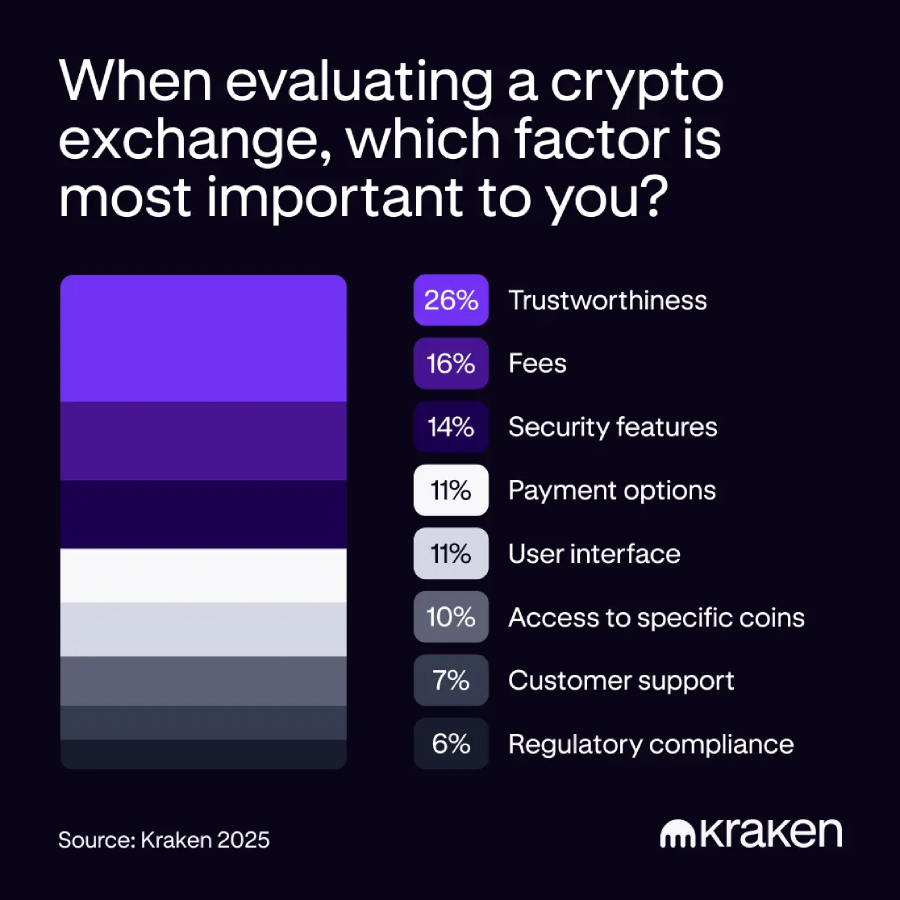
Every trade, deposit, or withdrawal on a centralized exchange (CEX) carries a price tag — sometimes several. The issue with fees is not that they are complex; it is that they are fragmented across screens and product modes. Once you treat “fees” as a system (commission + execution + movement of funds), your comparisons become accurate.
Trading Fees
This is the most visible cost on any crypto exchange, almost always expressed as a percentage of the notional value of the trade. The fee is typically taken from the asset you receive (so if you're buying BTC with USDT, the fee comes out of your BTC), and it is assessed at execution — not when you place the order.
For example, you place a spot buy order for $1,000 worth of ETH on an exchange charging a 0.10% taker fee. At execution, the fee is $1.00, and you receive ETH equivalent to $999.00 in value. A 0.05% fee on the same trade costs $0.50. Small fractions matter when scaled to high volumes.
It’s also worth keeping the tier reality in mind: some 0.0% maker or ultra-low taker tiers advertised by exchanges often require extremely high 30-day trading volumes to unlock — Gemini's published volume-tiered schedule illustrates this clearly, with the lowest rates reserved for traders moving tens of millions of dollars monthly. (per NerdWallet)
On top of that, most major exchanges operate two distinct interfaces: an advanced order book (where the percentage rates above apply) and a simplified "quick buy," "instant buy/sell," or "simple trade" mode aimed at newer users. These simplified flows typically bundle a higher fee into the quoted price rather than displaying it transparently. On Coinbase, for example, the standard (non-Advanced) interface can charge up to 1.49% — versus the Advanced Trade maker rate of 0.40%. The same dynamic applies to recurring buy programs and card purchases, which often carry their own pricing tier entirely. If you're using an app's quick-buy screen, always check which mode you're in before confirming.
Deposit Fees
Deposit costs depend almost entirely on the method and asset involved, and they don't always come from the exchange itself. Crypto deposits are typically free at the exchange level. However, confirmation requirements apply, and delayed crediting is a real operational cost if timing matters.
On the other hand, bank transfer deposits (ACH, SEPA, wire) may or may not carry an exchange fee, but third-party or bank fees can apply on the sending side. Card deposits (debit or credit) almost always carry a percentage-based fee — often ranging from 1.5% to 3.99% depending on the platform and card type.
Before you deposit, verify:
- Is the network/blockchain you're sending on supported by the exchange?
- What is the minimum deposit amount for this asset?
- How long does crediting typically take, and how many confirmations are required?
- Is the fee (if any) charged by the exchange, your bank, or both?
Withdrawal Fees

Crypto withdrawals from a centralized exchange almost always carry a fee, and for now let’s stop on those that the platforms set. Flat withdrawal fees: a fixed fee per asset per network (easy to predict, easy to compare). Dynamic or "network-pass-through" fees: the fee shown reflects current network conditions and can change quickly.
Before you click withdraw, confirm:
- Which network are you withdrawing on? (ERC-20, TRC-20, BEP-20, etc. — selecting the wrong one can result in permanent loss of funds)
- What is the fee at this moment, and has it changed since you last checked?
- Is there a minimum withdrawal amount for this asset on this network?
- Is the fee deducted from the amount you're sending, or added on top?
Network fees — commonly called gas fees — are payments made to the validators or miners who process and confirm transactions on a blockchain. They are not exchange revenue; they are infrastructure costs passed through to the user.
On a centralized exchange, you'll see network fees embedded in the withdrawal fee (one number, low transparency) or explicitly itemized (more transparent, still variable). Moreover, the same token on different networks can carry dramatically different costs. USDT withdrawn via ERC-20 (Ethereum) might cost $2–$10 or more during periods of network congestion, while USDT on TRC-20 (Tron) might cost a fraction of a cent. Same asset, different cost profile — purely a function of the chain.
Spreads
The spread is the gap between the best available bid price and the best available ask price in an order book. On liquid pairs, it is small. On illiquid pairs, it can dominate your total cost even when the fee schedule looks “cheap.”
A simple diagnostic method:
- Find the mid-price (midpoint between best bid and best ask).
- Compare it to your expected execution price for a “buy now” or “sell now.”
- Express the difference as a percentage: (spread ÷ mid-price) × 100.
The mitigation is mechanical: use limit orders rather than market orders when you can, and trade in deeper liquidity pools (BTC/USDT, ETH/USDC) when available.
Premium Plans
Several exchanges offer subscription-based membership tiers that reduce or restructure standard trading fees. Operationally, “fee reduction” can mean:
- Reduced taker rate
- Rebates
- Zero-fee up to a cap (e.g., Coinbase One)
Break-even framework: monthly subscription cost ÷ expected monthly trading volume = required fee savings rate.
Before committing to any trade or withdrawal, calculate the total cost per trade: trading fee + spread cost + withdrawal or network fees if you're moving funds off-platform. Each component is individually small, but they compound — and on frequent trades or large withdrawals, the combined effect is rarely trivial.
Lowest-Fee Exchanges (2026)
All fee comparisons below use spot trading fees at the entry tier unless otherwise noted. Maker and taker fees frequently differ—sometimes substantially—so both are listed where available. Keep in mind that withdrawal fees and spreads can dominate your total cost far more than the posted trading rate; this list focuses on the trading fee layer only.
ChangeHero
While not exactly a spot trading platform, instant crypto exchanges with ChangeHero come with a 0.5% commission per swap. This may look higher than the fee schedules of the platforms to follow but that fee covers more than trading.
Best for: Custody-conscious traders of all levels of expertise looking for non-standard altcoin pairs to swap, or hassle-free swaps of major cryptocurrencies with no exchange onboarding and obligatory KYC.
Base fees: 0.5% for Best Rate, 0.7–0.9% for Fixed Rate.
How fees get cheaper: With all costs, from depositing, on-ramping and withdrawing included in the service commission, this more often than not ends up being the more economical option.
Gotchas that raise the real cost: In Best Rate exchanges, the exchange rate provided by the liquidity sources can change while the assets move to the service’s address; use Fixed Rate to avoid this risk.
Who should avoid: Users looking for a strictly no-KYC platform: according to ChangeHero’s policy, an exchange can be paused for the user to go through an identification procedure.
Binance
Best for: High-volume traders who want the widest altcoin selection with a built-in discount mechanism.
Base spot fees (maker/taker): 0.10% / 0.10% at entry tier.
How fees get cheaper:
- (a) Paying fees with BNB: Binance applies a 25% discount when you elect to pay trading fees using BNB, the platform's native token. Example: a $1,000 trade at the standard 0.10% costs $1.00; with the BNB discount applied, that drops to $0.75.
- (b) Volume tiers: Separate from the BNB discount, Binance operates a tiered fee schedule where both maker and taker rates decrease as your 30-day trading volume and BNB holdings increase. These two mechanisms can stack, but confirm the current stacking rules on Binance's official fee page before assuming maximum savings.
Gotchas that raise real cost:
- The "Simple Buy" flow on the Binance app uses spreads rather than maker/taker fees, which can cost significantly more than the professional trading interface.
- Withdrawal fees vary widely by asset and network; on some tokens they are high enough to erode fee savings from multiple trades.
Who should avoid: Users in jurisdictions where Binance operates a restricted entity (Binance.US has a different, often less competitive, fee schedule) and traders who rely on instant/simple buy flows without checking whether they are accessing the maker/taker market.
MEXC
Best for: Limit-order-focused traders and those hunting early-stage altcoin listings who want to minimize maker-side costs entirely.
Base spot fees (maker/taker): 0% maker / 0.05% taker at entry tier.
How fees get cheaper: MEXC's MX token holding and VIP volume tiers can reduce taker fees further. The 0% maker rate applies automatically to limit orders that rest in the order book (i.e., orders that are not immediately matched). Market orders, or limit orders that execute immediately as taker, are charged the taker rate.
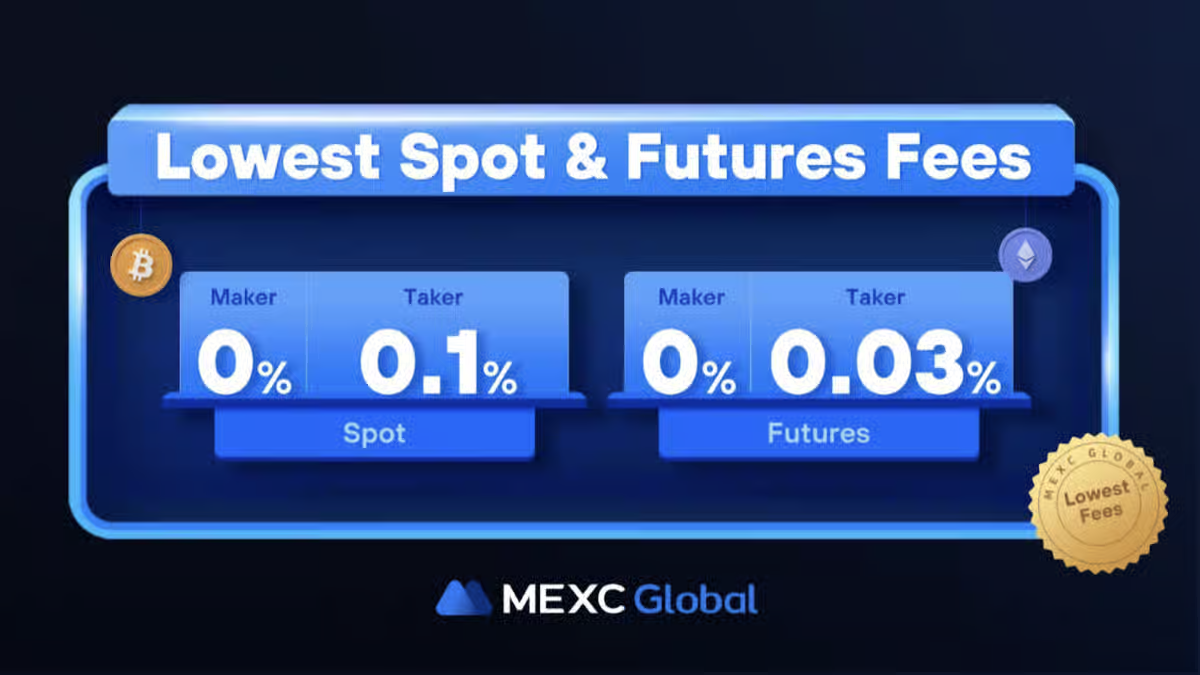
Practical implication of 0% maker: Placing a limit order below the ask (buy) or above the bid (sell) that sits unfilled until matched costs you zero in trading fees. Placing a market order—or a limit order priced to fill immediately—triggers the taker fee. One-line warning: "0% maker" can still be offset by spread and price impact on illiquid pairs, where the bid-ask gap alone may exceed what you would have paid in fees on a more liquid crypto exchange.
Gotchas that raise real cost:
- Illiquid pairs with wide spreads can make the effective cost far higher than the 0% maker headline suggests.
- Taker fees, while low, apply to any order that crosses the book, so active scalpers or market-order users will not benefit as much as patient limit traders.
Who should avoid: Traders who primarily use market orders and expect to capture the 0% headline rate—they will pay taker fees instead.
KuCoin
Best for: Altcoin traders who want access to a large number of smaller-cap tokens with a native-token discount option.
Base spot fees (maker/taker): Confirm current entry-tier maker and taker rates from KuCoin's official fee schedule before publishing, as rates are subject to change.
How fees get cheaper: KuCoin uses KCS (KuCoin Token) as a fee discount mechanism. Before finalizing this entry, the writer must confirm—and explicitly state—whether the discount is triggered by holding a minimum KCS balance, by paying fees with KCS directly, or both, and at what threshold each action applies. Reference KuCoin's published fee rules to verify, because the practical savings differ depending on which action actually triggers the reduction. Volume-based VIP tiers also apply independently.
Gotchas that raise real cost:
- Without actively meeting the KCS holding or payment threshold, users default to standard rates that are not especially differentiated from mid-tier competitors.
- Withdrawal fees on certain assets can be elevated; always check the specific asset's withdrawal fee before routing funds out.
Who should avoid: Traders who prefer not to hold or manage an exchange-native token to unlock discounts, or those who need strong regulatory assurance in the US (KuCoin's US regulatory standing should be verified before use).
Kraken Pro
Best for: US-based traders and security-conscious users who want transparent, regulated fee structures with competitive maker rates.
Base spot fees (maker/taker): Maker from 0.16%, taker 0.26% at entry tier.
Transparency note: These fees apply specifically to Kraken Pro (the advanced trading interface). Kraken's standard "instant buy" or simple buy flow operates on a spread-based model that is substantially more expensive and should not be used to evaluate Kraken as a "low-fee" crypto exchange. Always confirm you are accessing Kraken Pro's order book when comparing costs. The maker-from-0.16% / taker-0.26% rate represents the Pro entry tier; rates decrease with 30-day volume.
How fees get cheaper: Volume-based tiering on Kraken Pro; higher 30-day USD volume unlocks progressively lower maker and taker rates. No native-token discount mechanism.
Gotchas that raise real cost:
- Users who access Kraken via the default interface rather than Kraken Pro may unknowingly pay spread-based costs that far exceed the Pro fee schedule.
- No native token buy-and-hold discount means savings require genuine volume growth through the tiers.
Who should avoid: Casual or infrequent traders who are unlikely to reach higher volume tiers and who may default to the instant-buy flow; for them, actual costs will significantly exceed the Pro headline rates.
Bybit
Best for: Derivatives-heavy traders who also trade spot and want a unified fee environment across product types.
Base spot fees (maker/taker): Fetch current entry-tier spot maker and taker rates from Bybit's official fee schedule page before publishing; rates are subject to periodic revision.
How fees get cheaper: Bybit operates VIP tiers based on 30-day trading volume and asset holdings. The platform also supports fee discounts tied to its native ecosystem; confirm whether any token-based discount currently applies to spot trading specifically.
Gotchas that raise real cost:
- Bybit's liquidity depth on some spot pairs—particularly smaller altcoins—means spread can exceed the posted fee; the differentiator that materially affects total cost here is spot order book depth relative to trade size.
- Regional restrictions apply; verify availability in your jurisdiction before onboarding.
Who should avoid: Users in restricted regions or those whose primary activity is spot trading of illiquid assets where spread dominates over fee rate.
OKX
Best for: Active spot and derivatives traders who want competitive base fees and a well-developed VIP program with OKB token integration.
Base spot fees (maker/taker): 0.08% maker / 0.10% taker at entry tier.
How fees get cheaper: OKX uses volume-based VIP tiers and OKB (OKX's native token) holdings to reduce fees. Holding or trading OKB can unlock lower rate brackets; confirm the exact OKB holding threshold and corresponding discount from OKX's current official fee page before publishing.
Gotchas that raise real cost:
- The VIP program tiers are relatively complex; users who do not actively manage their tier standing may miss savings they would have qualified for.
- Withdrawal fees vary by asset and network and can be significant on certain tokens.
Who should avoid: Occasional traders who will not reach meaningful volume tiers and do not wish to hold OKB to benefit from token-based discounts; for them, effective fees are closer to the base rate with no structural reduction.
Gate
Best for: Traders seeking broad altcoin coverage, including early-stage and lower-cap tokens not listed on larger crypto exchanges.
Base spot fees (maker/taker): Fetch current entry-tier spot maker and taker rates from Gate.io's official fee schedule before publishing; confirm whether GT (Gate.io's native token) holding applies a discount and at what threshold.
How fees get cheaper: Gate.io's GT token and volume-based tiers interact to determine effective fees. The differentiator that materially affects total cost is altcoin coverage—access to tokens unavailable elsewhere may justify paying the posted rate even without a tier discount.
Gotchas that raise real cost:
- Liquidity on some of the more obscure listings is thin, meaning spread and price impact can dwarf the posted maker/taker fee.
- The interface and fee structure complexity may make it harder for newer users to confirm which rate they are actually paying.
Who should avoid: Users who prioritize simplicity or who are based in jurisdictions where Gate.io's regulatory status is uncertain; verify regional availability before depositing funds.
HTX
Best for: Traders who want access to a broad token catalog with an established exchange that has a long operating history and an HT token-based discount structure.
Base spot fees (maker/taker): Fetch current entry-tier spot maker and taker rates from HTX's official fee schedule before publishing; confirm current HT (HTX native token) discount applicability on spot trades.
How fees get cheaper: HT holding and/or volume tiers reduce trading fees. The differentiator that materially affects total cost is whether HT discounts currently apply to spot (vs. futures), as the fee benefit has historically varied by product; confirm before finalizing.
Gotchas that raise real cost:
- HTX's regulatory situation has evolved; users in certain regions may face onboarding restrictions or reduced product access.
- Withdrawal fees on some tokens have historically been above industry average; always verify the specific asset withdrawal cost.
Who should avoid: US-based users (HTX does not serve US customers) or traders who need strong regulatory clarity in their home jurisdiction.
Bitfinex
Best for: Professional and high-volume traders, particularly those trading Bitcoin and major pairs, who benefit from Bitfinex's deep liquidity and UNUS SED LEO token discount integration.
Base spot fees (maker/taker): Fetch current entry-tier spot maker and taker rates from Bitfinex's official fee schedule before publishing; confirm the UNUS SED LEO holding discount tier and its current percentage reduction.
How fees get cheaper: Holding UNUS SED LEO (LEO), Bitfinex's native token, reduces trading fees progressively based on the amount held. Volume-based tiers also apply. The UNUS SED LEO mechanism is a meaningful differentiator for large holders because the discount can be substantial at higher holding levels.
Gotchas that raise real cost:
- Bitfinex's regulatory history (particularly in the US) means it is not available to US persons; this is a hard disqualifier for a significant portion of the market.
- Funding fees for margin positions and complex fee schedules across product types can obscure actual costs for users trading across multiple Bitfinex products.
Who should avoid: US-based users (Bitfinex restricts US persons) and casual traders who will not hold enough UNUS SED LEO to access meaningful discounts.
Fee Structures and Pricing Models
Most spot exchanges use a maker/taker model layered with volume tiers, optional token discounts, and — at the high end — maker rebates. Each layer compounds, so knowing how they interact lets you calculate your effective rate rather than just reading a headline number.
Maker Fees
A maker fee applies when your order adds liquidity to the order book — typically a limit order placed away from the current market price that sits and waits for a counterparty. Because you're improving the book, exchanges reward this behavior with lower fees than taker activity.
That being said, a limit order can become a liquidity taker. If your limit price crosses the spread, when it's priced at or through the best available opposite order, the exchange fills it immediately, and you're charged the taker rate, not the maker rate. This catches many traders off guard.
Using Binance's baseline rate of 0.10% maker: $1,000 × 0.0010 = $1.00 in maker fees. MEXC, by contrast, charges 0% maker, meaning that the same $1,000 trade costs nothing on the maker side — an illustration of just how wide maker/taker dispersion can run across venues.
Taker Fees
A taker fee applies when your order removes liquidity from the order book. Market orders are always taker orders. Aggressively priced limit orders that fill immediately (the edge case described above) are also charged as taker. Because takers consume the liquidity makers provide, exchanges charge them more.
At the 0.10%/0.10% baseline, maker and taker cost the same: $1.00 each. But at Kraken Pro — a common reference for US-based traders — the spread widens: the maker rate is 0.16% ($1.60) and the taker rate is 0.26% ($2.60) on $1,000 notional. That difference between a resting limit and a market order, per $1,000 traded, scales fast in active trading. This is why order type — not just venue — directly affects your trading cost.
Volume Tiers
Most exchanges calculate your fee tier using a trailing 30-day volume window. The base metric is almost always quote-currency notional, not the number of trades.
Tier mechanics in practice:
- Your tier is determined by where your 30-day notional sits in the bracket table.
- When the window rolls and your volume drops, your tier drops with it.
- Maker and taker rates often tier asymmetrically: maker fees may fall faster, while taker fees decline more gradually.
Zero maker fees are often gated behind institutional-scale requirements for monthly volume; retail traders rarely qualify. OKX offers a more accessible illustration at its base tier: 0.08% maker / 0.10% taker — lower than several major competitors from the starting point.
Token Discounts
Some exchanges allow you to pay trading fees in a platform's native token in exchange for a reduced rate. The operational condition is the one most people miss: the discount typically applies only when fees are actually settled in the native token.
Token discounts may or may not stack with volume-tier discounts; the interaction varies by exchange. Additionally, confirm whether the token discount applies to both maker and taker fees or only one side.
Binance offers a 25% discount on trading fees when fees are paid in BNB. At the 0.10%/0.10% base rate, this brings effective fees to 0.075% on both sides — but only for trades where BNB is used to settle the fee.
Maker Rebates
At certain venues and for certain trading pairs, maker fees go negative — meaning the exchange pays you a small credit for posting liquidity rather than charging you. This is a maker rebate, and it appears as a negative fee rate (e.g., −0.01%).
Naturally, negative maker fees push you toward market-making behavior. However, rebates are typically pair-specific and tier-gated; standard retail tiers usually do not access meaningful rebate pricing.
Estimating Total Trading Cost (Beyond Posted Fees)
Posted maker/taker fees are only one line item in your actual execution cost. To compare exchanges on equal footing, you need a single, reproducible calculation that captures every cost component.
All‑in Cost Formula: trading fee (maker/taker) + spread (bps) + price impact (bps) + conversion/FX cost (bps) + withdrawal/on-chain cost amortized per trade (bps, optional)

To convert each component to basis points (bps), divide the cost expressed as a decimal by the trade value and multiply by 10,000. For example, a $3 fee on a $1,000 trade = 30 bps. Note that spread and price impact are observable only at order time — record them live, not from a static fee schedule.
Order Types
The order type you choose determines which cost drivers dominate your all‑in cost.
| Order Type | Primary Cost Drivers |
| Market order | Spread + immediate price impact |
| Limit (post-only) | Maker fee + adverse selection risk |
| Stop / Stop-limit | Frequently executes as taker during volatility; treat as taker cost |
Before placing any order:
- Confirm whether your order qualifies as maker or taker at this venue
- Check whether post-only mode is available (and enabled) for limit orders
- Understand how partial fills are handled — do unfilled portions rest, cancel, or re-queue?
- Verify whether stop orders route to a market order on trigger — most do, which means taker fees and full spread exposure at the moment of highest volatility
A limit order that rests and fills as a maker is almost always cheaper on fee alone, but it introduces adverse selection risk: you fill because the market moved to your price, which often means it moved against you.
Liquidity
Shallow order books raise expected slippage even when posted fees are low. A crypto exchange quoting 0% maker fees is not cheap if your order moves the market by 0.40% on the way through a thin book.
Four interface-level checks can help with assessing the liquidity depth:
- Top-of-book size
- 1% depth on both sides
- Spread across sessions
- Venue concentration
When posted fees are low but liquidity is shallow, the implicit costs — spread and price impact — frequently exceed the fee savings.
Slippage
Slippage is the difference between the price you expected and the price you received. In fast or thin markets it can dwarf the posted fee.
For a $10,000 BTC/USDT market order (BTC priced at $50,000; you are buying 0.2 BTC):
| Scenario | Spread | Price Impact | Trading Fee (taker) | Total All‑in Cost |
|---|---|---|---|---|
| Calm market (deep book, low volatility) | 0.05% (5 bps) | 0.03% (3 bps) | 0.10% (10 bps) | 0.18% (18 bps) |
| Volatile market (wide spread, fast move) | 0.15% (15 bps) | 0.30% (30 bps) | 0.10% (10 bps) | 0.55% (55 bps) |
Switching to an exchange with a 0.08% taker fee saves only a few bps, which is noise compared to an execution-quality difference dominated by spread and impact.
Stablecoin Pairs
Routing through a stablecoin can reduce cost — or add an invisible layer of it.
Do you already hold fiat assets on the exchange account balance? If not yet, you are already working from stablecoin. Choose USDT or USDC based on which has tighter spread and deeper book for your target pair. Check both — liquidity between USDT and USDC pairs differs materially by asset and by venue.
If yes, ask the next question: does the exchange offer a direct fiat/target-asset pair with tight spread? If yes, use it: one spread, one fee. If the spread is not tight enough, convert fiat to USDT or USDC first, and then trade.
Even if it’s rarely applicable, account for the depegging risk, USDT vs. USDC liquidity gap, and hidden costs of multi-hop routing.
Fiat Conversion
Speaking of fiat, on-ramp costs are often the most opaque part of the all‑in calculation. It would depend on the payment method (card vs. ACH/wire), mode ('buy' widget vs. advanced order book), who processes the payment (third-party payment processors add markup) and the bank FX spread, where applicable.
A two-step path can easily add ~100 bps before you place a single trade. When a direct fiat pair exists for your currency, use it.
"No-Fee" Crypto Exchanges: What "Zero Fees" Really Means
“Zero-fee trading” is usually a scope statement, not a universal condition. Before accepting the claim, examine its conditions: is it spot only vs. derivatives? Maker-only vs. maker + taker? Limited pairs or order types? Is it affecting rebates and negative fees? Zero-fee promotions almost always carry constraints: time-limited windows, first-X trades or first-$Y volume, select pairs only, maker-only, geographic exclusions, etc.
Suppose a crypto exchange advertises 0% maker fees. You place a limit buy on a thinly traded altcoin. Your order fills, incurring no explicit fee—but the best ask was 0.8% above the mid-price. You paid 0.8% in spread cost without paying a single dollar in stated commission.
Don’t take the promo’s word for granted: navigate to the platform's fee schedule page directly (not the marketing landing page). Identify the specific market's fee class, and check the VIP/tier table just in case. Confirm whether the fee waiver requires paying in a native token.
A "0% fees" banner with no accompanying pair list warrants extra caution; so does a fee schedule that shows 0% but only at unreachable volume tiers. Zero-fee access can be gated behind a paid subscription, or API trading is explicitly excluded from the zero-fee rate.
Risks, Legality, and Key Considerations
By now it’s clear that the lowest advertised fee is rarely the only cost on the table. Before depositing funds or executing your first trade, evaluate the venue across five risk dimensions: solvency and custody, security and insurance, compliance and jurisdiction, hidden execution costs, and tax recordkeeping.
Exchange Solvency and Custody Risk
Custody risk is the single largest unpriced cost in retail crypto trading. Even before you deposit any finds, examine the exchange for the following: Proof-of-Reserves (PoR) availability, insurance fund disclosures, client asset segregation language in the TOS, withdrawal status page history, jurisdiction of incorporation and regulatory licensing. Assess the concentration risk by checking public resources such as block explorers. If you can find it, check the stablecoin and fiat redemption dependencies, and earn and lend program counterparty risk.
What do you do in the worst case scenario when the exchange pauses withdrawals? Document your balances and transaction history, monitor official communications directly, and definitely do not continue trading to "average down" or recover losses. More often than not, this is not insolvency just yet.
Security, Insurance, and Account Protections

Exchange-Level Security Controls are platform-run (cold storage, MPC, audits) and frankly, not something you always have control over but User-Account Protections are entirely on you:
- Hardware security keys or passkeys
- Anti-phishing code
- Withdrawal address allowlisting
- API key restrictions
- Device and session reviews
A note on "insurance" claims: verify trigger, exclusions, caps, and claim process. If no disclosure exists beyond marketing language, treat it as unverified.
KYC/AML, Sanctions, and Regional Compliance
Compliance determines access to the cheapest rails. If your fiat rails or products are restricted, you can be pushed into higher-cost paths (third-party processors, P2P spreads, multiple withdrawal cycles).
Travel and relocation can trigger re-verification, product access changes, or forced position closure. Export records before any residency change.
Hidden Fees, Spread Manipulation, and Price Impact
A replicable method to estimate your all-in cost before you size up:
- Record mid-price
- Check order book depth at your size
- Compare spread to fee
- Test with a small marketable limit order
- Measure at different times of day
- Calculate fiat conversion costs separately
- Sum all components
Let’s recap the fee illusions that frequently misprice “low-fee” venues: wide spreads on low-liquidity pairs, unreachable volume tiers, token discount opportunity cost, withdrawal minimums and per-withdrawal fees, unfavorable stablecoin conversion on deposits, maker fee applying only to post-only orders…and more.
Conclusion
Low-fee crypto exchanges cut trading costs only when traders account for both posted fees and hidden costs like spreads, withdrawals, and fiat conversion. Spread-based pricing and withdrawal fees are two of the most overlooked cost vectors — a platform advertising 0% maker fees can still be expensive if its spreads are wide or its withdrawal fees are flat and high. Fiat conversion charges add another layer that rarely appears in headline comparisons. Before committing real size to any exchange, simulate one complete trade end-to-end: buy with fiat, execute a trade, and withdraw to a wallet — then total every cost that appeared.
Frequently Asked Questions
Which crypto exchange has the lowest fees for spot trading?
The answer depends on your trading profile, but MEXC, Binance, and OKX consistently offer the lowest base spot fees for most users. MEXC charges 0% maker and 0.05% taker at entry level; Binance charges 0.10% maker/taker with a BNB discount available; OKX's maker/taker numbers are competitive base/starting rates that vary by tier.
Which crypto exchange has the lowest fees in the USA?
Coinbase Advanced, Kraken Pro, and Binance.US offer the lowest fees for US-based spot traders, but eligibility depends on several constraints. Coinbase Advanced starts at 0.40% maker / 0.60% taker, while Coinbase standard mode charges up to 1.49%—a difference that catches many users off guard.
What is the difference between maker and taker fees?
Maker fees apply when your order adds liquidity to the order book; taker fees apply when your order removes liquidity. Most exchanges charge makers less than takers because market makers improve depth. On a $1,000 trade, the difference can be small in dollar terms but compounds significantly at volume.
Are "zero-fee" exchanges actually cheaper?
Zero-fee exchanges can still cost more than fee-charging exchanges once hidden offsets are accounted for. The posted fee is only one component of total trading cost, and "zero-fee" labels often mask several other expense sources that erode execution value.
Do DEXs have lower fees than CEXs?
DEXs can post lower protocol fees than centralized exchanges, but total transaction cost on a DEX is often higher once all cost layers are included. DEX "fees" can be low in quiet markets but total cost spikes sharply during network congestion.
What are the cheapest ways to withdraw crypto?
Withdrawal costs are determined by both the exchange's fee schedule and the underlying network's transaction costs—these are two separate charges that users often conflate. Optimizing withdrawals requires choosing the right network, timing, and asset.
Which exchanges have the lowest futures fees?
Binance, OKX, and MEXC offer some of the lowest futures trading commissions, but commission rates are often not the dominant cost for futures traders. For positions held overnight or longer, funding rates can exceed cumulative commissions by a wide margin.
Do crypto trading fees reduce taxable gains?
Trading fees generally affect cost basis or proceeds calculations in most jurisdictions, but the exact treatment depends on local tax law and the accounting method applied. This is not tax advice—consult a qualified tax professional for guidance specific to your situation.