
Best No KYC Crypto Exchanges: Review and Guide


Key Takeaways
- 🔘No-KYC is a label that does not always mean complete privacy, and frankly, should not be viewed as such. What you should expect from “No-KYC” platforms is conditional loosening of the identification requirements of the platform or the fully blockchain-based functionality that still requires you to on-ramp somewhere else.
- 🔘Based on the research performed by our team, we have compiled a shortlist of the most reliable "no-KYC" platforms that provide the optimal conditions without major drawbacks to security or user experience:
- 🔘Centralized exchange (CEX) platforms that got into our list are: MEXC, Bybit and ChangeHero for instant swapping.
- 🔘Decentralized exchange (DEX) we recommend: Uniswap, PancakeSwap, dYdX.
- 🔘Platforms for peer-to-peer (P2P) trading: Bisq, Hodl Hodl, RoboSats.
⚠️ Compliance Disclaimer
Before continuing, please read the following:
- Not legal or tax advice — Nothing in this guide constitutes legal, financial, or tax advice. Consult a qualified professional for guidance specific to your situation.
- Laws vary by jurisdiction — Regulations governing cryptocurrency trading, privacy tools, and identity verification differ significantly across countries and may change without notice.
- Platform policies change — Exchanges can and do update their KYC requirements, sometimes without warning. Always verify current terms directly with the platform.
- You remain responsible for tax reporting — Using a no-KYC exchange does not exempt you from tax obligations. Transactions may still be traceable and reportable under local law.
- Privacy tools reduce exposure but do not guarantee anonymity — Decentralized exchanges, P2P platforms, and non-custodial wallets lower your identity footprint but are not foolproof.
Some platforms geofence entire regions, meaning users in certain countries will encounter restricted access or disabled features without any workaround available through the platform itself. Feature access for unverified users also varies significantly — withdrawal limits, trading pair availability, and deposit methods may all differ compared to verified accounts.
Contents
Before you ask, in this guide, "no-KYC" means no identity verification is required at the point of signup or to begin trading — you can connect a wallet or create an account without submitting a passport, selfie, or proof of address. "May require KYC on triggers" refers to platforms that operate without verification by default but impose identity checks when certain thresholds are crossed — such as fiat withdrawals, high-volume activity, or risk-flag events. This definition leaves decentralized exchanges (DEX), peer-to-peer (P2P) marketplaces, and centralized exchanges (CEX) with reduced-verification tiers in this rating.
If you are a self-custody user with some holdings in crypto looking for swaps without mandatory verification or a privacy-conscious trader who understands the trade-offs between convenience and identity exposure, this article should be of use to you. Don’t go into this guide expecting to find platforms with guaranteed 100% anonymity or frictionless on-ramp to crypto; and what you should definitely not look for here is tips on evading legal requirements or sanctions.
What Is a No-KYC Crypto Exchange?
A no-KYC crypto exchange in this conversation means users can trade crypto without completing identity verification. Instead of submitting government-issued documents or personal data, traders interact using only a wallet address or minimal credentials.
However, "no-KYC" is a spectrum, not a single implementation. At one end are fully non-custodial DEXs. At the other are centralized platforms that delay verification until you cross a threshold or trigger a review. If you do not pin down which model a platform uses, you will misjudge both your cost structure and your ability to exit later.
What KYC Means
KYC — “Know Your Customer” — is a regulatory compliance process that platforms use to confirm who their users are. In crypto, it typically means collecting one or more of the following identifiers before a user can trade, withdraw, or access full features:
- Government-issued photo ID (passport, driver's license, national ID)
- Selfie or liveness check (sometimes matched against the ID photo)
- Proof of address (utility bill, bank statement, dated correspondence)
Even without formal KYC, platforms commonly log signals that can link activity back to a specific user:
- Email address or phone number provided at signup (anonymous signup is rarer than it appears)
- IP address recorded at login, deposit, or withdrawal
- Device fingerprinting (browser, OS, screen resolution, cookies)
- On-chain clustering (transaction patterns, change address reuse, interaction with labeled wallets)
KYC is not the same as AML monitoring. Anti-money laundering screening operates independently of identity collection — a platform can skip ID verification entirely and still screen wallet addresses and transaction flows against sanctions lists or risk-scoring tools. The absence of a KYC form does not mean the absence of compliance infrastructure.
What "No-KYC" Means in Practice
"No-KYC" describes three distinct operational models with their own limits and failure modes.
Tier 1 — No-account, wallet-connect trading (typical DEX pattern)
- What the user provides: A wallet signature (e.g., connecting MetaMask or a Ledger hardware wallet to a decentralized exchange front-end). No email, no account, no login.
- Concrete limitation: Fiat rails are unavailable. Users must already hold crypto — Bitcoin, Ethereum, Tether, USD Coin, or another on-chain asset — to fund trades. There is often no support channel tied to an identity if something goes wrong.
Tier 2 — Account optional / minimal signup
- What the user provides: An email address, or nothing at all for guest-mode instant swaps. Self-custody of funds is often maintained throughout.
- Concrete limitation: Withdrawal caps are common. Some instant-swap and broker-style services operating in this tier commonly report unverified withdrawal limits in the range of approximately $1,000–$10,000 per day or per transaction, though figures vary by platform and should be verified directly. Recovery options without an account are minimal to nonexistent.
Tier 3 — KYC optional until thresholds
- What the user provides: Basic account credentials at signup; identity documents only if the user wants to unlock higher limits or specific features (fiat withdrawals, higher trading volume, certain payment methods).
- Concrete limitation: The "no-KYC" experience is feature-gated. Peer-to-peer trading, larger fiat withdrawals, or access to regulated payment rails typically require verification. Users who never verify remain subject to the lower-tier caps permanently.
Fees also vary by model. Instant-swap and broker-style flows (most common in Tiers 2 and 3) commonly carry service fees in the range of approximately 0.5%–3% per swap, which is distinct from AMM swap fees on a decentralized exchange, where the cost structure is different.
Where KYC still appears — even on "no-KYC" platforms:
- Fiat on-ramps (bank transfer, card payment, or third-party payment processor integrations)
- Certain payment methods that inherently carry identity data (SEPA, ACH, some e-wallets)
- High withdrawal volume that crosses internal risk thresholds
- Suspicious activity review triggered by transaction patterns or sanctioned-address interactions
- Regional access restrictions that route users through compliant intermediaries
These triggers are platform- and jurisdiction-dependent. A platform operating without KYC for most users in one country may be required to collect documents for users in another.
Types of No-KYC Crypto Exchanges
Before drilling into individual platforms, it helps to identify what kind of venue you are actually using. "No-KYC" is a policy stance that shows up across three structurally different platform types, each with different custody models, identity footprints, and failure modes.
| Type | DEX | P2P | CEX (no-KYC tier) |
|---|---|---|---|
| Custody model | Non-custodial (self-custody; you hold your keys) | Typically non-custodial during trade (escrow/multisig holds funds in transit) | Custodial; exchange holds your funds |
| Identity/account footprint | No account; wallet address is public on-chain | Pseudonymous account on platform-mediated venues; full anonymity only on decentralized P2P clients | Account required (email or equivalent); identity not formally verified at entry, but monitoring is ongoing |
| Typical funding rails | Crypto-only; no native fiat on-ramp | Crypto and fiat (bank transfer, cash, vouchers — varies by seller) | Crypto-to-crypto primarily; some support fiat deposits with third-party processors |
| Liquidity & execution | Varies by pool depth; AMM slippage on thin pairs; MEV exposure on larger trades | Fragmented; depends on counterparty availability and negotiated price | Generally deepest liquidity; fastest execution |
| Common limits/triggers | No platform-imposed caps, but gas costs and bridging complexity act as soft limits | Limits set per listing or seller; fiat rails can trigger identity trails | Unverified withdrawal caps (typically in the range of 0.06–2 BTC or equivalent per day, an industry-wide pattern rather than any single platform's guarantee); verification triggered by large withdrawals, risk flags, or geo/IP checks |
| Primary risks | On-chain traceability, smart contract bugs, MEV extraction, L2 bridge failures | Counterparty fraud, payment reversal, dispute resolution delays, payment-method identity leakage | Account freeze, forced KYC on withdrawal, custodial loss |
| Best-fit user profiles | Privacy-focused users transacting in crypto who already hold digital assets and can manage wallets | Users who need fiat-to-crypto without ID verification and can tolerate variable liquidity | Users who prioritize execution speed and liquidity and can tolerate custodial and account-freeze risk |
Decentralized Exchanges (DEXs)
A decentralized exchange connects to your wallet — typically via a browser extension like MetaMask — without creating an account or holding your funds at any point. You retain self-custody throughout: the smart contract executes the swap directly from your wallet, and settlement is final on-chain.
Most DEXs today use an automated market maker (AMM) model, where prices are determined algorithmically by pool ratios rather than a traditional order book. As a result, AMMs are vulnerable to slippage on illiquid pairs and to MEV (maximal extractable value). Order-book DEXs reduce some of this exposure but are less common.
The "no-KYC" label here is accurate but narrow: there is no account, no identity check, and no transaction fee paid to a compliance function — but every swap is recorded on a public ledger. A blockchain address with a consistent transaction history is a deanonymization surface, not a private identity.
Peer-to-Peer (P2P) Exchanges
The mechanics of a P2P trade differ depending on whether you're using a platform-mediated marketplace or a fully decentralized P2P client. The payment method you choose in a P2P trade determines how much identity information the trade generates:
- Bank transfer — high traceability.
- PayPal-like rails — reversible, logged, and chargeback-prone.
- Cash in person — minimal digital trail; higher physical risk.
- Cash deposit (ATM or bank branch) — partial trail; varies by jurisdiction.
- Vouchers and prepaid instruments — depends on how they were purchased.
Centralized Exchanges (CEXs)
No-KYC is usually conditional. A CEX that advertises "no KYC" is almost always describing an entry-level account tier, not an unconditional policy:
- Withdrawal caps for unverified accounts — commonly roughly 0.06 BTC to 2 BTC equivalent per day across the industry, but platform-specific and change over time
- Verification triggers — manual review can require identity verification even below the stated cap.
- Geo/IP restrictions — blocked regions can lose access regardless of KYC status.
Benefits of No-KYC Exchanges
Skipping identity verification changes more than just a signup form. The three benefits below are real and measurable, though each comes with practical limits worth understanding before you commit to a platform.
Privacy and Data Minimization
The clearest win of no-KYC flows is a smaller data surface area: fewer pieces of sensitive information created, stored, and potentially exposed. In particular, government-issued ID document upload, selfie or liveness/biometric check, proof of address (utility bill, bank statement), SSN or national ID number, and source-of-funds questionnaire are typically avoided in no-KYC flows.
Wallet addresses and on-chain transaction history, IP address and device fingerprints (logged by web interfaces), and trade metadata on centralized no-KYC platforms are the identifying details that persist. Privacy here means identity-data minimization, not invisibility.
Faster Onboarding
Getting started on a no-KYC platform is significantly faster for that very reason. By skipping the document upload and various identification procedures, users can jump right into trading, saving precious time.
One practical caveat: onboarding can still slow down. If your wallet is not funded, the fiat on-ramp typically reintroduces identity checks. Some platforms also trigger verification requests as you approach withdrawal thresholds.
Fewer Geographic/Account Restrictions
KYC requirements are often how exchanges enforce jurisdictional compliance. Remove KYC and those gates sometimes disappear. However, geo/IP-based blocks are independent of KYC and can still apply — including on DEX front-ends.
Peer-to-peer platforms like Bisq take a different approach to geographic access, routing trades between individuals without a central intermediary that can apply blanket geo-blocks, though self-custody and counterparty coordination introduce their own trade-offs.
Top No-KYC Crypto Exchanges for 2026

The preceding sections have built up to this part of the article to create the right expectations. To know which platform is worthy of your trust, you have to know what to trust it with and what not to expect.
Exchanges featured in this guide were assessed across a consistent set of criteria designed to reflect real-world usability for users who prioritize privacy and self-custody. This is not an exhaustive audit, but a structured comparison based on factors that matter most to non-verified users.
The core evaluation criteria include:
- Custody model — whether the platform is non-custodial, semi-custodial, or custodial, and what that means for key control
- Fees and spreads — trading fees, hidden spreads, and withdrawal costs for unverified users
- Liquidity and slippage — available depth for common pairs like Bitcoin and Ethereum, and realistic slippage at typical trade sizes
- Withdrawal caps and wallet compatibility — limits applied to unverified accounts and which wallets (including MetaMask and hardware wallets) are supported
Security signals and support limitations are also factored in, though these are covered in full in the evaluation section.
KYC is not required to begin trading on these platforms—but not to be taken that it can never be triggered. Withdrawal caps, flagged transactions, or higher-volume activity may prompt verification requests later. Always confirm current requirements directly in-app before committing funds.
ChangeHero
- Best for: Traders who want a broad altcoin selection with multiple liquidity sources and economical rates with a low barrier to entry.
- Type: instant swap platform; non-custodial. ChangeHero does not hold your funds when deposited.
- KYC reality check: ChangeHero typically allows crypto-to-crypto trading without identity verification. Exceeding the limits of typical activity (volume or number of swaps) or triggering risk flags will often prompt KYC.
- Geography/Access: Available in many regions; U.S. users face restrictions.
- Costs to watch: 0.5% service fee off each swap; spread included in the rate.
- Liquidity & execution: Solid liquidity on major pairs; thinner on long-tail altcoins, where routing through multiple liquidity sources might not be possible. Execution experience can be modified by switching between Best and Fixed rate.
- Operational steps: (1) Provide a destination address for the asset you want to receive. (2) Send the assets you want to be exchanged to a one-time address generated by the service.
- Primary risks: Delivery risk—instant swap exchanges are the opposites of trustless; according to the KYC/AML policy, the only point at which the swap can be paused is after the funds arrive at the service’s address, making the user experience uncertain.
- Constraint: ChangeHero itself is crypto-to-crypto only; KYC or identity verification procedures imposed on transactions with fiat currencies are subject to policies of its partner providers.
Uniswap
- Best for: Swapping ERC-20 and multi-chain tokens directly from a self-custody wallet with no account creation.
- Type: Decentralized exchange (DEX); non-custodial. You retain control of your funds throughout every swap.
- KYC reality check: No account, no KYC—Uniswap requires only a connected wallet to trade. There is no registration process that could later trigger verification at the protocol level, though front-end interfaces may apply restrictions by region.
- Geography/Access: The official app.uniswap.org front-end has geo-restricted certain tokens for users in specific jurisdictions; the underlying protocol remains permissionless.
- Costs to watch: Network gas fees on Ethereum are the dominant cost and can make small trades uneconomical during congestion. The default swap fee tiers (0.05%, 0.30%, 1%) are set per liquidity pool.
- Liquidity & execution: Uniswap's AMM model exposes traders to MEV/front-running and slippage on thin pairs. Its breadth of token support—spanning thousands of ERC-20 tokens and multiple chains—means liquidity depth varies significantly by pair; high-cap pairs are generally deep, long-tail tokens are not. This breadth is what makes Uniswap a comprehensive option for token access, not just a convenience.
- Operational steps: (1) Connect MetaMask or another compatible wallet. (2) Select the token pair, review the price impact and gas estimate, and confirm the transaction in your wallet.
- Primary risks: Smart-contract risk (audited but not immune); MEV bots can sandwich transactions on Ethereum if slippage tolerance is set too loosely.
- Constraint: Works only with a self-custody wallet—there is no custodial account option and no fiat on-ramp at the protocol level.
dYdX
- Best for: Traders who want decentralized perpetuals and leverage without handing over identity documents.
- Type: Decentralized exchange (DEX, perpetuals-focused); non-custodial. Funds are held in smart contracts, not by dYdX the company.
- KYC reality check: No account in the traditional sense—access is wallet-based. No KYC is required to connect and trade, but the front-end may restrict certain geographies. "No account" and "no KYC" both apply here at the protocol level.
- Geography/Access: The United States and several other jurisdictions are blocked at the front-end level.
- Costs to watch: Maker/taker fees apply to perpetual trades; funding rates on open positions are the hidden ongoing cost most traders underestimate.
- Liquidity & execution: Order-book model (not AMM) on its own chain provides tighter spreads than most DEXs for major pairs, but liquidity on smaller perpetual markets can be thin.
- Operational steps: (1) Connect a compatible wallet (MetaMask or similar) and bridge or deposit collateral (USDC) onto the dYdX chain. (2) Open a position and set your leverage and liquidation price before confirming.
- Primary risks: Liquidation risk is the defining derivative-specific danger—a position can be automatically closed at a loss if collateral falls below the maintenance margin, with no manual override. Smart-contract risk also applies.
- Constraint: Requires on-chain collateral in USDC before any trade is possible; fiat on-ramps typically add KYC through third-party providers.
PancakeSwap
- Best for: Swapping BEP-20 tokens on Binance Smart Chain where lower gas fees matter more than Ethereum's ecosystem depth.
- Type: Decentralized exchange (DEX); non-custodial. Funds never leave your wallet until a swap is executed.
- KYC reality check: No account, no KYC—wallet connection is the only requirement. The same front-end geo-restriction caveats that apply to other DEXs apply here.
- Geography/Access: Front-end restrictions exist in some regions.
- Costs to watch: Transaction fees on Binance Smart Chain are a fraction of Ethereum gas costs, making PancakeSwap more accessible for smaller trade sizes. The default swap fee is 0.25% per trade.
- Liquidity & execution: AMM model means slippage risk on low-volume pairs; MEV/front-running exposure exists but is generally lower-cost to execute on BSC. Unlike Uniswap's Ethereum-native depth, PancakeSwap's liquidity is concentrated in the Binance Smart Chain ecosystem, so cross-chain Ethereum token access requires bridging.
- Operational steps: (1) Connect MetaMask (configured for BSC) or Trust Wallet. (2) Select the BEP-20 token pair, check price impact, and confirm the swap.
- Primary risks: Smart-contract risk; lower network security assumptions on Binance Smart Chain compared to Ethereum are a documented tradeoff.
- Constraint: Liquidity varies by chain—native Ethereum tokens are not directly available without a bridge, which introduces additional smart-contract and timing risk.
Bisq
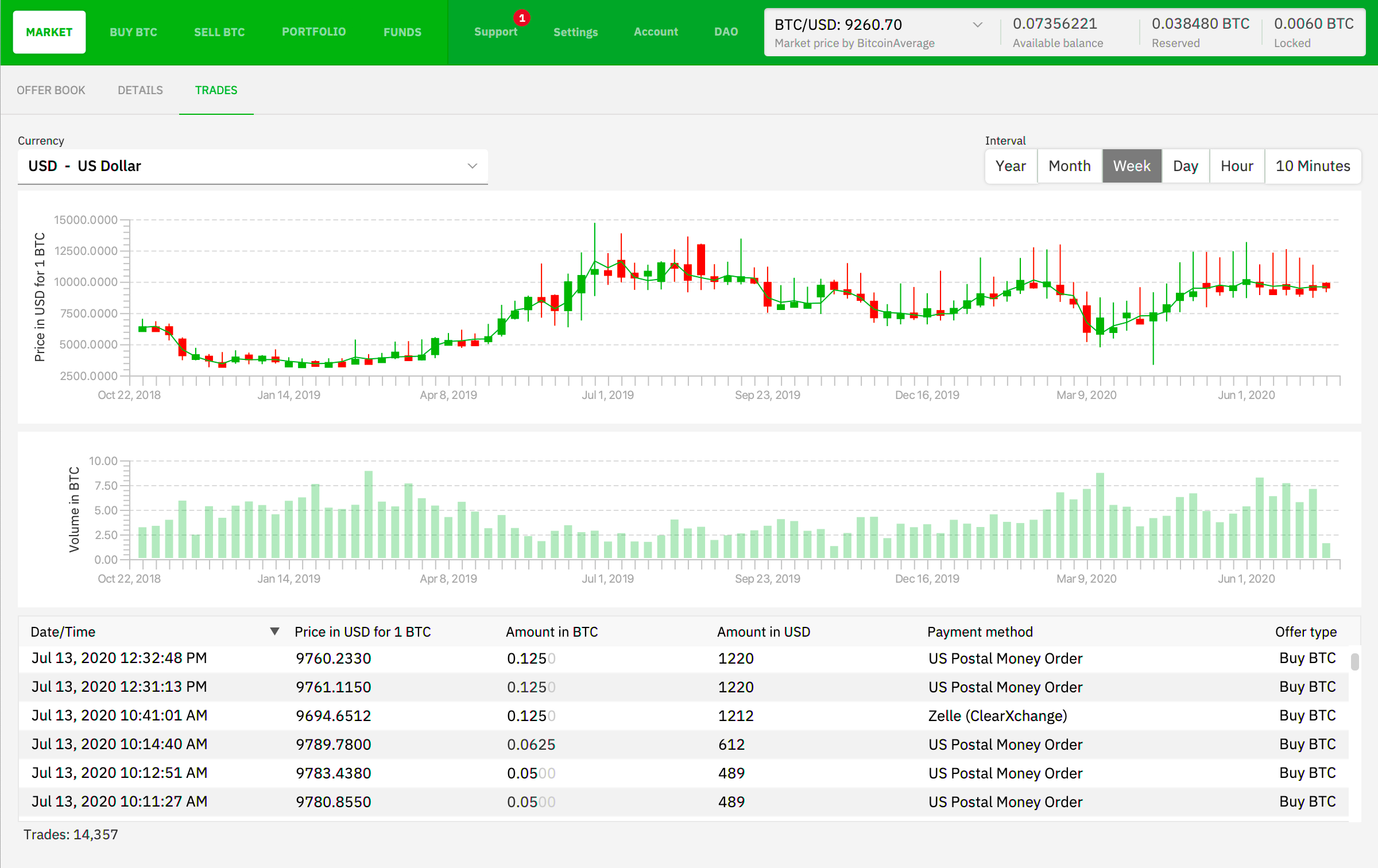
- Best for: Privacy-focused Bitcoin buyers and sellers who want a fully decentralized, censorship-resistant P2P exchange.
- Type: Peer-to-peer (P2P) exchange; non-custodial. No central server holds your funds or data.
- KYC reality check: No account, no KYC—Bisq has no central operator to collect identity documents. Privacy is structural, not a policy that can change.
- Geography/Access: Accessible globally in principle; payment method availability determines practical reach. Varies; check current access for specific fiat rails in your region.
- Costs to watch: Trading fees plus Bitcoin network fees for the on-chain security deposit transactions; spread above spot is common in P2P markets.
- Liquidity & execution: Order-book depth is thinner than centralized exchanges; expect to wait for a matching offer or post your own. Trade volume is lower than CEX alternatives.
- Operational steps: (1) Download and run the Bisq desktop application (no browser version; desktop app required). (2) Fund a security deposit in Bitcoin, find or post an offer, and complete the trade through the built-in escrow process.
- Dispute/escrow workflow: Bisq uses a 2-of-2 multisig escrow for Bitcoin trades. If a dispute arises, a Bisq arbitrator (a bonded community member) mediates; in unresolved cases, a higher-level "mediator" can issue a signed transaction. The process is on-chain and does not rely on Bisq Inc.
- Trade friction: Trades can take hours to days depending on the payment method and counterparty responsiveness. Security deposits lock up Bitcoin for the duration of the trade.
- Primary risks: Counterparty risk (mitigated by escrow but not eliminated); the dispute process requires both parties to be online and responsive.
- Constraint: Desktop app required—there is no mobile or web version; this limits accessibility for users without a dedicated machine.
HODL HODL
- Best for: Bitcoin-native traders who want P2P escrow without running local software.
- Type: Peer-to-peer (P2P) exchange; non-custodial escrow model.
- KYC reality check: No KYC required to create an account and trade. Contrary to the idea the name might give you, HODL HODL does not hold funds—escrow is multisig. The "no KYC" designation reflects both no account verification and no fund custody.
- Geography/Access: Web-based and broadly accessible; specific fiat payment methods may be regionally limited.
- Costs to watch: Escrow fee charged per trade (typically a percentage of trade value); spread above spot Bitcoin price is set by individual traders.
- Liquidity & execution: Peer-to-peer order book; liquidity is thinner than CEX markets and depends on active counterparties in your region and currency.
- Operational steps: (1) Create an account (email only, no ID required). (2) Find or post a Bitcoin offer, agree on terms, and fund the multisig escrow contract to initiate the trade.
- Dispute/escrow workflow: Escrow is 2-of-3 multisig—buyer, seller, and HODL HODL each hold one key. In a dispute, HODL HODL acts as the third-party arbitrator and can release funds based on provided evidence (chat logs, payment receipts). This is faster than Bisq's fully decentralized model but introduces one trusted party.
- Trade friction: Trade completion depends on counterparty payment speed; fiat bank transfers can add 1–3 business days. Premiums above spot Bitcoin are common.
- Primary risks: Counterparty risk during the fiat leg (before escrow release); reliance on HODL HODL as arbitrator introduces a single point of trust.
- Constraint: Bitcoin only—HODL HODL does not support altcoin trading.
RoboSats
- Best for: Users who want maximum anonymity for Bitcoin/Lightning P2P trades, including Tor-native access.
- Type: Peer-to-peer (P2P) exchange; non-custodial (Lightning Network escrow).
- KYC reality check: No account, no KYC—RoboSats uses randomly generated robot avatars tied to a token; no email, no username registration. Truly account-free.
- Geography/Access: Designed to operate over Tor for maximum privacy; accessible via clearnet as well.
- Costs to watch: Coordinator fee (small percentage per trade) plus Lightning Network routing fees; on-chain swap fees if converting from Lightning to on-chain Bitcoin.
- Liquidity & execution: Liquidity is limited relative to larger P2P platforms; Lightning Network pairs are the core offering. Thin order books mean wait times for matching.
- Operational steps: (1) Access RoboSats via Tor Browser or the clearnet URL and generate a robot identity. (2) Post or take a Lightning Network Bitcoin offer and complete settlement via Lightning invoice.
- Dispute/escrow workflow: RoboSats uses Lightning hold invoices as escrow—funds are locked on the Lightning Network, not held by a custodian. Disputes are handled by a coordinator (a federated RoboSats node operator) who reviews the trade chat and can release the hold invoice. The federated model means different coordinators have different trust assumptions.
- Trade friction: Trade completion requires both parties to be online near-simultaneously for Lightning settlement; this can create delays. Premiums above spot Bitcoin are normal given the privacy premium.
- Primary risks: Lightning Network routing failures can delay settlement; coordinator trust assumptions vary by federated node.
- Constraint: Bitcoin and Lightning Network only—no altcoin support and no fiat on-ramp beyond the P2P fiat payment methods offered by counterparties.
MEXC
- Best for: Active traders who want access to a large number of altcoins and futures with minimal upfront verification — including liquid major altcoins like XRP and Cardano alongside long-tail listings.
- Type: Centralized exchange (CEX); custodial.
- KYC reality check: MEXC typically permits spot trading and withdrawals below a daily threshold without KYC. Higher withdrawal limits, futures access beyond basic tiers, and certain fiat services often require verification. Confirm current thresholds in-app.
- Geography/Access: U.S. users are restricted.
- Costs to watch: Maker/taker fees; futures funding rates; withdrawal fees by network.
- Liquidity & execution: Among the deeper liquidity pools on this list for altcoin spot and futures pairs; large token listing count means some pairs are thin.
- Operational steps: (1) Register with an email address. (2) Deposit crypto or use a supported on-ramp (note: fiat on-ramps typically add KYC) and trade within unverified limits.
- Primary risks: Custodial risk; regulatory uncertainty in certain jurisdictions has historically affected user access.
- Constraint: Unverified accounts can typically access spot and limited futures trading, but higher-limit withdrawals and some product tiers commonly require verification—confirm current account states in-app.
Bybit
- Best for: Derivatives and spot traders who want a liquid, feature-rich CEX with an accessible entry point before full verification.
- Type: Centralized exchange (CEX); custodial.
- KYC reality check: Bybit has tightened verification requirements over time. Unverified accounts may access limited spot and derivatives trading, but withdrawal limits are typically capped and some product access (higher leverage tiers, P2P fiat) often requires KYC. The unverified access tier should be confirmed in-app as policies evolve.
- Geography/Access: U.S. users are restricted.
- Costs to watch: Maker/taker fees on spot and derivatives; funding rates on perpetual contracts; withdrawal fees.
- Liquidity & execution: Bybit is one of the most liquid derivatives venues in this list; deep order books on major perpetual pairs reduce slippage significantly.
- Operational steps: (1) Register with an email address. (2) Deposit crypto (fiat on-ramps typically add KYC) and trade within unverified account limits.
- Primary risks: Custodial risk; derivatives-specific liquidation risk on leveraged positions; policies on unverified access have shifted and may continue to do so.
- Constraint: Unverified withdrawals are capped—Bybit, like other custodial CEXs in this list, applies BTC-denominated daily limits to unverified accounts. Confirm current limits in-app.
How to Evaluate No-KYC Exchanges
Choosing a no-KYC venue is not just about skipping identity checks—it's about the full tradeoff stack: who holds your funds, what the real cost of a trade is, and whether the platform will still be accessible when you need it. Use the framework below to vet any no-KYC venue, highlighted in our rating or not, whether it's a decentralized exchange (DEX), a peer-to-peer (P2P) marketplace, an instant-swap platform, or a custodial exchange with tiered access.
Custody Model (Non-Custodial vs Custodial)
Before anything else, establish who controls the funds at every stage of the trade. Three models exist, each with a distinct risk profile:
1. Self-Custody Wallet-Connect Swaps (DEX/AMM)
- Your wallet (e.g., MetaMask) connects directly; you sign transactions from your own address.
- Settlement happens on-chain via smart contracts—every fill is a verifiable blockchain event.
- Evaluation questions: Is there an on-chain transaction per trade, or are fills recorded on an internal ledger? Can the protocol's smart contracts be paused or upgraded by an admin key? Who controls that key?
2. Peer-to-Peer (P2P) Escrow Models
- Funds are locked in an escrow smart contract or multisig until both counterparties confirm.
- Platforms like Bisq use this model; settlement is on-chain but the matching layer is off-chain.
- Evaluation questions: Where does final settlement occur—on-chain or in a platform database? What is the dispute resolution path if the counterparty ghosts? Who can release or freeze escrow funds, and under what conditions?
3. Custodial Account-Balance Trading (Offshore CEX)
- The exchange holds your funds; trades are internal ledger fills with no on-chain transaction per trade.
- Evaluation questions: Who can freeze or deny withdrawals—the exchange, a regulator, or a payment processor? Is your balance actually backed 1:1, or is there fractional exposure? Under what legal jurisdiction can assets be seized?
Quick self-custody check: If you cannot sign a message from your own wallet address without the platform's involvement, you are in a custodial model regardless of marketing language.
Fees, Spreads, and Hidden Costs
No-KYC venues frequently bury costs across multiple layers. Break every trade into four verifiable cost categories:
| Cost | What It Is | How to Verify |
|---|---|---|
| Explicit Trading Fee | The stated maker/taker or flat percentage fee | Check the fee schedule page; confirm it appears in the trade confirmation |
| Spread / Price Impact | The gap between mid-market price and your execution price | Compare the quoted rate against a reference market (CoinGecko, Binance spot) at the same timestamp |
| Network / Withdrawal Fee | Gas fees (Ethereum, Solana, TRON) or miner fees (Bitcoin) paid to move funds on-chain | Displayed in the withdrawal screen; cross-check against a live gas tracker |
| Embedded Service Fee / Quote Padding | A margin built into the quoted rate by instant-swap brokers—invisible unless you compare against reference price | No-KYC instant-swap services typically embed a service fee in the range of 0.5%–2.5% on top of spread; sources like GhostSwap confirm this range. Always separate this from the network fee in your cost comparison. |
Effective price method: Before confirming any trade, pull the mid-market price of the pair on a reference exchange at that exact moment. Divide your quoted output by your input and compare. The full gap between your effective rate and the reference rate is your all-in cost—not just the labeled fee.
Thin liquidity is one of the most common and least-disclosed risks on no-KYC venues. Test before you size: send a small test trade—5–10% of your intended size—and record the execution price. Compare that price to the reference market rate at the same timestamp. If the slippage on the test trade exceeds your tolerance, do not scale up.
Asset and Network Coverage
Not every no-KYC venue supports every asset, chain, or withdrawal network.
| Dimension | What to Check | Practical Risk If Ignored |
|---|---|---|
| Asset Support | Spot vs. perpetuals; which tokens are listed (e.g., Bitcoin, Ethereum, Tether, USD Coin, Monero, XRP, Cardano) | You may find a trading pair exists but withdrawal of the specific token is unavailable |
| Chain / Network Support | Which L1s and L2s are supported (e.g., Ethereum, Solana, TRON, BSC) | Depositing on one chain and discovering your target chain isn't supported forces bridging |
| Withdrawal Network Availability | Can you withdraw on the specific chain you actually need? | Being forced onto an unintended network adds bridge risk, extra fees, and potential delays of hours or days |
Withdrawal limits on no-KYC venues are not uniform. Daily caps for unverified accounts — A common baseline range is roughly $1,000–$5,000 USD equivalent per day for unverified users, though this varies significantly by platform. In addition to those, watch out for per-transaction caps, rolling windows, and conditional limits triggered by behavior.
Wallet Compatibility
Compatibility issues can likewise strand funds or force you into a less secure signing method. Run this checklist before connecting or withdrawing:
DEX / Wallet-Connect Platforms
Hardware Wallet Support
Bitcoin-Native and P2P Wallets
Any platform that requires you to use only its own proprietary wallet for self-custody is not truly non-custodial.
Trust and Security Signals
No-KYC support operates under fundamentally different constraints than KYC platforms. The lack of concrete identity significantly reduces what they should be capable of in each case. They should be able to confirm transaction status using a TXID or order ID, escalate P2P escrow disputes if evidence is provided, issue bug reports, and provide general guidance. However, reversing a completed on-chain transaction, recovering funds sent to the wrong wallet address, or lifting withdrawal limits without identity verification are usually not possible for one reason or another.
| Signal | What a Genuine One Looks Like | Red Flag |
|---|---|---|
| Domain / App Verification | Consistent domain history; app distributed via official repo or major app store; no typosquatting variants in search results | Multiple similar domains; recently registered certificate; app requires sideloading from unknown source |
| Proof of Reserves / Transparency | Third-party attestation with verifiable Merkle tree; on-chain treasury addresses disclosed for DEX protocols | Self-reported "we hold 1:1 reserves" with no verifiable proof; no on-chain transparency for a custodial platform |
| Open-Source Code / Audits | Public GitHub with active commit history; audit reports from named firms with findable credentials; DEX smart contracts verified on-chain | "Audited" badge with no linked report; closed-source smart contracts; unverifiable team identities combined with opaque custody arrangements |
| Incident History | Past incidents disclosed with post-mortems; user funds made whole or process explained | No incident history despite years of operation (suspicious absence); incidents discovered only via third-party reporting |
| Operational Controls | 2FA enforced for custodial accounts; YubiKey or hardware key support for high-value account tiers | No 2FA option; SMS-only 2FA as the ceiling; aggressive bonus/yield claims used to distract from weak security disclosures |
For one, an unverifiable team + opaque custody model + aggressive yield or referral bonus claims appearing together is a high-risk signal regardless of any individual positive indicator.
Likewise, pay attention to what the community is saying. A single review source can be gamed. Triangulate across at least three independent signals:
- Developer repository activity (for open-source projects)
- Long-running community threads
- Incident reports and third-party journalism
How to Buy Crypto Without KYC (Fiat Options)

Platform-level, payment-rail, and counterparty disclosure are all forms of KYC that can emerge at different points in a transaction. Using a bank transfer or credit card to fund any crypto purchase—even on a "no-KYC" platform—introduces identity linkage at the payment-rail level. The crypto venue's KYC policy becomes largely irrelevant when your bank statement shows the transfer destination. Choose your fiat method with this in mind.
Cash-Based Options
Cash is the highest-privacy fiat path because it has no inherent digital trail—but every practical cash-to-crypto method introduces its own specific identity exposure points.
1. Cash-in-Person P2P (e.g., via Bisq or local classifieds)
- Identity exposure points: Your physical presence and potentially your face.
- Availability: Highly variable by region. Bisq and RoboSats both support in-person cash trades with non-custodial escrow mechanisms.
- Spread/fees: Typically 2–8% above spot. Privacy comes at a cost—no-KYC exchange service fees typically range from 0.25% to 1.5% per transaction, and in-person cash premiums are generally even higher than digital no-KYC routes.
- Settlement speed: Immediate once cash is counted and escrow released—usually minutes.
- Highest-probability scam: "Fake escrow" social engineering.
2. Cash Deposit to a Seller's Bank Account
- Identity exposure points: Deposit slips can require the depositor's name.
- Availability: Common in Latin America, Southeast Asia, and parts of Europe.
- Spread/fees: Typically 1–5% premium over spot.
- Settlement speed: Often 1–4 hours once the deposit is confirmed.
- Highest-probability scam: Receipt manipulation.
3. Bitcoin ATMs and Crypto Vouchers
- Identity exposure points: Many Bitcoin ATMs require a phone number at minimum; above certain thresholds they require government-issued ID and/or facial recognition.
- Availability: Strong in North America and Europe; vouchers depend on retailer participation.
- Spread/fees: ATMs typically charge 8–20% above spot.
- Settlement speed: Near-instant for vouchers; ATM confirmations vary.
- Highest-probability scam: Government/utility impersonation scams.
Bank Transfer Options
Bank transfers offer higher limits and often better pricing than cash or vouchers, but they carry the most significant payment-rail identity exposure.
Domestic Bank Transfer (ACH/SEPA/local equivalents)
- Your full legal name appears as the sender.
- When to use: Higher limits, better pricing, established P2P liquidity.
- When to avoid: High-privacy requirements.
Wire Transfer (SWIFT/domestic wire)
- Greater identity disclosure.
- When to use: Large transaction amounts where no other method is liquid.
Open Banking / Instant Bank Pay—Identity linkage is still present.
Card Options
Gift cards represent a middle path: no bank account is linked to the trade itself, but the purchase of the gift card can still link back to you.
Credit card purchases are the least "without KYC" of all fiat methods—treat this category as rare or partial-KYC at best.
Visa and Mastercard (including Visa Crypto Card and Mastercard Crypto Card programs) mandate 3D Secure (3DS) authentication, Address Verification Service (AVS) checks, and in many jurisdictions, explicit cardholder identity verification before a transaction is approved.
In the credit card context, "no-KYC" typically means the crypto platform does not require you to submit a passport or proof of address to create an account or initiate small trades. Nonetheless, your identity remains linked at the issuer and network layer, which is why products marketed as a crypto credit card or crypto debit card are not a path to anonymity; they are simply a different UX wrapper around bank-grade identity linkage.
Other typical tradeoffs include 3–8% fees plus potential cash-advance fees, $100–$500 limits, and high decline rates.
Risks, Legality, and Key Considerations
Using no-KYC venues shifts responsibility—and exposure—directly onto the user. There is no compliance layer to catch mistakes, no fraud department to reverse a bad trade, and often no customer service queue at all.
If you ask one question about custody—make it “who can move your funds without your (digital) signature?” If the answer is anyone other than you, the arrangement is custodial and from the point of view of the blockchain, whoever holds the keys owns the coins.
No-KYC venues are notoriously disproportionately targeted by fraud because pseudonymity cuts both ways.
To add insult to injury, the price you see quoted is not always the price you pay. Check the previous sections to see how hidden costs like spreads and premiums sneak in the total.
"No-KYC" also frequently implies no recourse. What support can realistically do depends entirely on the platform model.
Many no-KYC platforms also cap unverified withdrawals—a commonly cited range is 0.1–2 BTC per day—which can force staged withdrawals over multiple days or trigger a verification requirement at precisely the moment you need liquidity most.
To no one’s surprise, the legal landscape around no-KYC crypto activity is complex, and it varies by jurisdiction.
One practical detail that repeatedly trips users up is the boundary between using privacy tools and treating them as a compliance bypass. For example, trading on a DEX, or holding a privacy-focused asset like Monero, is not the same thing as attempting to evade legally required identification or sanctions controls. The latter category is where enforcement risk concentrates.
Whether or not the venue where you traded collected your identity documents has no bearing on your tax obligations.
Because no-KYC venues do not generate account statements or year-end tax documents, the documentation burden falls entirely on you. Maintain the following for every transaction:
- The wallet addresses you controlled and used (MetaMask, hardware wallets, and any other self-custody address)
- Transaction IDs (TXIDs) for every on-chain movement
- Timestamps for all transactions, recorded in UTC
- Any fiat on-ramps or off-ramps used (P2P payment rails, bank transfers,
Safety Practices
Using no-KYC exchanges often ends up in risk management shifting entirely onto you. Before diving into controls, map your threats by exchange type: DEX risks include approval drainers, fake tokens, MEV/sandwich attacks, and malicious RPC endpoints — primary control is wallet permission hygiene and verified RPC sources. P2P risks center on counterparty fraud, chargeback reversals, escrow disputes, and in rare cases physical safety — primary control is reputation vetting and never releasing escrow early. CEX/instant-swap risks involve account freezes, withdrawal triggers from pattern detection, and limited support recourse — primary control is transaction sizing and keeping withdrawal addresses pre-registered.
A clean financial identity starts with strict separation between your crypto activity and everything else you do online: use a dedicated email/alias strategy, practice browser profile isolation and transaction privacy hygiene in general, and do not neglect the small test transaction rule.

Phishing targeting crypto users has evolved well beyond obvious scam emails. Address poisoning is a targeted attack where a malicious actor sends a zero-value or dust transaction from a wallet address engineered to visually resemble one you have previously interacted with.
Your device is the perimeter for device and network security, and self-custody means your storage decisions directly determine your risk profile. Learn more about the crypto wallet best practices from our guide.
Conclusion
"No-KYC" describes the onboarding process, not the absence of all oversight—fiat on-ramps, withdrawal triggers, IP and device metadata, and tax obligations are all points where exposure remains real regardless of whether you submitted an ID.
FAQs
Which no-KYC exchanges work in the USA?
US residents can generally access non-custodial DEXs and open-source P2P software, but most offshore CEXs and many instant-swap platforms actively restrict American users.
For context, this is also why many US traders follow a two-step workflow: they buy on a fully regulated venue like Coinbase or Crypto.com (accepting KYC at the acquisition step), then move to self-custody for swaps and trading. That does not make the flow "anonymous," but it can reduce the amount of identity data replicated across multiple venues.
On the P2P side, Bisq is the baseline reference point in this guide, but US users also evaluate newer P2P implementations such as Haveno and Particl depending on their custody preferences and the trade types they need.
What are the best ways to buy crypto with fiat without KYC?
Fiat-to-crypto without KYC is possible but always involves tradeoffs between privacy, cost, speed, and scam exposure. Transaction fees on no-KYC services commonly range from 3% to 8%+, and spreads can exceed the headline fee on convenience-oriented instant-swap platforms — meaning the real cost is often higher than advertised.
If your priority is minimizing identity collection at the platform layer, P2P is usually where the discussion starts. If your priority is minimizing identity linkage at the payment-rail layer, cash-based P2P is the practical ceiling.
One additional clarification that matters in real workflows: paying with a crypto debit card or crypto credit card is still identity-linked at the issuer level by design, so these products do not function as "no-KYC on-ramps" even when the point-of-sale experience feels crypto-native.
Can I Trade Anonymously Without KYC?
Trading without KYC removes identity verification, but full anonymity usually requires additional steps. No-KYC exchanges won’t tie activity to your legal name through documents, but blockchain transactions remain traceable unless you actively protect your privacy.
Some users use VPNs and privacy-focused cryptocurrencies like Monero or Zcash, or route funds through multiple wallets. The important detail is that “no-KYC” and “anonymous” are related, but not identical.
Do No-KYC Exchanges Have Withdrawal Limits?
Many do. Limits can be daily, monthly, per-transaction, or tier-based. DEXs often have no centralized withdrawal limits because you’re trading from your own wallet.
If you anticipate larger withdrawals, check the platform’s current withdrawal policy before depositing. Policies can change, and surprises here are rarely pleasant.
Are No-KYC Exchanges Safe?
They can be, but safety varies. Some platforms use strong security practices—cold storage, 2FA, audits, and transparent operations. Others don’t.
The real difference is recourse. With less regulation and weaker identity links, account recovery and dispute resolution can be harder. That’s why platform selection and personal security habits matter more than usual.
What Happens If an Exchange Later Requires KYC?
Usually you’ll get a transition period. Your options are to complete KYC or withdraw funds before enforcement begins.
The best defense is simple: don’t store significant funds on exchanges long-term. Withdraw regularly to your own wallet so policy changes don’t trap your assets. Some traders also diversify across multiple no-KYC platforms to reduce the impact of forced-KYC shifts, and on P2P desks (including models associated with HodlHodl) they also diversify counterparties and payment rails to reduce single-point failure.