Best Anonymous Bitcoin Wallets in 2026

Key Takeaways
- 🥸 The best anonymous Bitcoin wallet is not a single product but a workflow: self-custody, fresh addresses, coin control, Tor, and strict separation between KYC and no-KYC funds.
- 🥸 Bitcoin is pseudonymous, not anonymous. Every transaction is permanently recorded, so privacy comes from reducing linkability rather than erasing the trail altogether.
- 🥸 Wasabi Wallet, Sparrow Wallet, Electrum, and Ledger Nano X can all support private Bitcoin use, but each solves a different part of the privacy stack.
- 🥸 CoinJoin improves on-chain ambiguity, Tor improves network privacy, and coin control prevents accidental UTXO clustering. None of them can undo an identity record already created by a KYC exchange.
- 🥸 The most common privacy failure is operational, not technical: address reuse, careless consolidation, and mixing KYC-bound UTXOs with no-KYC coins.
Disclaimer
This guide is for educational purposes only and does not constitute legal, financial, tax, or investment advice. Privacy laws, exchange policies, and virtual-asset compliance rules vary by jurisdiction and may change over time. Readers should check local regulations before using privacy-preserving tools, no-KYC funding methods, or peer-to-peer cash-out routes.
It is still possible to maintain privacy while using the famously pseudonymous, not anonymous, Bitcoin blockchain. In this guide, “anonymous” means minimizing identity linkage across on-chain data and network metadata, not eliminating traceability outright — while keeping full self-custody of your funds. Bitcoin privacy in 2026 is as much an operational discipline as it is a wallet feature. The wallet matters, but so does how you receive, label, spend, consolidate, and cash out coins.
Bitcoin Anonymity Limits

Before the lists and ratings, let’s define the scope of this article. Bitcoin transactions are publicly recorded and permanent, and that single fact is the root reason “anonymous Bitcoin” has hard limits from the start. Every payment becomes part of a ledger that anyone can inspect, forever, which means true anonymity has to be understood as a matter of degree rather than an on/off switch.
Public Ledger Traceability
A Bitcoin transaction spends one or more UTXOs — unspent transaction outputs — as inputs and creates new outputs, usually a payment to the recipient and a change output back to the sender. Once broadcast and confirmed, that transaction becomes part of the permanent record. Anyone doing blockchain analysis later can trace exactly which UTXO funded it and where the resulting outputs went next.
Because inputs and outputs are linked at the moment of broadcast, this record does not fade with time. It remains to be read by anyone with the patience and tooling to follow it.
The risk compounds when multiple inputs are combined in one spend. Doing so tells an outside observer that all those inputs likely belong to the same wallet. This deepens the transaction graph relationships that connect your activity across addresses.
Even if none of the coins involved were ever tied to KYC, combining coins from different sources in a single spend can quietly link two previously separate identities or contexts. That is not a wallet-brand problem. It is a UTXO management problem.
Using so-called mixers to address this is a double-edged sword. First of all, their centralized variations often turn out to be simple honeypot scams. If you are lucky enough to avoid a scam, a mixer would accept your UTXOs and replace them with equivalent ones from another source for an outgoing transaction. The massive trust assumption cannot be overlooked, and more often than not, regulated crypto services would treat funds with a history tracing back to such a mixer as high-risk, if not reject them outright.
Pseudonymity vs True Anonymity
Bitcoin addresses are human-unreadable pseudonyms, not your name, but they are not nothing either. This is the core of pseudonymity, and it breaks into three privacy layers:
- On-chain privacy — how linkable your own UTXOs and addresses are to one another through blockchain analysis.
- Network privacy — whether your IP address or other transport-layer metadata can be tied to the transactions you broadcast.
- Identity and financial perimeter — the KYC records, exchange relationships, invoices, counterparties, and payment rails that already know your real-world identity.
A good wallet can meaningfully improve the first two layers through better address hygiene, Tor routing, and smarter transaction construction. It cannot erase the third. Once an exchange or counterparty has recorded who you are, no amount of wallet-level privacy engineering undoes that fact. It can only limit how far the linkage spreads from that point forward.
Identity Leaks Through KYC and Address Reuse
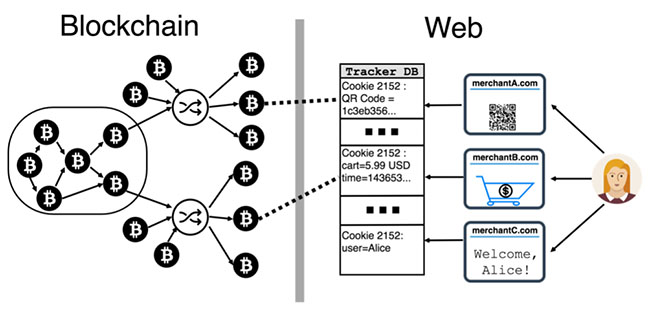
Speaking of, KYC is not just a one-time hurdle at sign-up. It creates lasting leak points that follow your BTC long after the paperwork is done.
The clearest pathway is the withdrawal record. When you move Bitcoin off an exchange, that platform retains a direct link between your verified identity and the withdrawal transaction ID, with this link permanently visible on-chain. Re-depositing funds, or “round-tripping” coins back through an exchange or custodial service, re-establishes it even if you took privacy steps in between.
On top of it, address reuse compounds the problem further. Posting an address publicly, reusing it across multiple payments, or letting a counterparty see it more than once gives any observer doing blockchain analysis a simple way to map a real name to an address — and from there, follow every transaction connected to it.
This is why bitcoin.org’s best-practice guidance is to use a new address for every incoming payment. A useful operational rule to carry forward is simple: treat each receive as a new address. It does not fix network-level exposure or undo an existing KYC record, but it closes one of the easiest doors into your transaction history.
Top Anonymous Bitcoin Wallets in 2026
Each wallet below is evaluated through the same lens: on-chain linkability, network metadata exposure, and operational partitioning. Brand reputation matters less than whether the wallet helps you avoid the privacy failures Bitcoin users actually make.
Wasabi Wallet
Best for: Users who want a non-custodial wallet built around coin control and batch-transaction privacy workflows for Bitcoin.
Privacy strengths:
- Built-in coin control UI that makes it easier to see and select specific UTXOs before spending, rather than letting the wallet auto-select inputs for you.
- Routes wallet traffic over Tor by default, reducing the chance that your IP address gets tied to the transactions you broadcast.
- Labels and clusters UTXOs visually, helping you avoid accidentally mixing coins from different sources or contexts.
Privacy limits:
- CoinJoin availability is not guaranteed in every version or setup — zkSNACKs discontinued Wasabi’s built-in CoinJoin coordinator on June 1, 2024, so CoinJoin at best is a feature you must verify is currently functional.
- Even where CoinJoin works, it improves on-chain unlinkability. It does nothing for network privacy on its own without Tor active.
- Separate Wasabi’s general privacy aids from its CoinJoin coordinator. Coin control and Tor routing work independently of coordinator status; CoinJoin depends entirely on an active, functioning coordinator you have confirmed yourself.
Required companion setup:
- Keep Tor enabled rather than disabling it for convenience.
- Confirm current CoinJoin/coordinator status before each use if your workflow depends on it.
- Apply coin control discipline when selecting inputs for any spend.
When to avoid:
- If you need guaranteed CoinJoin access on a fixed schedule without manually checking coordinator availability first.
Sparrow Wallet
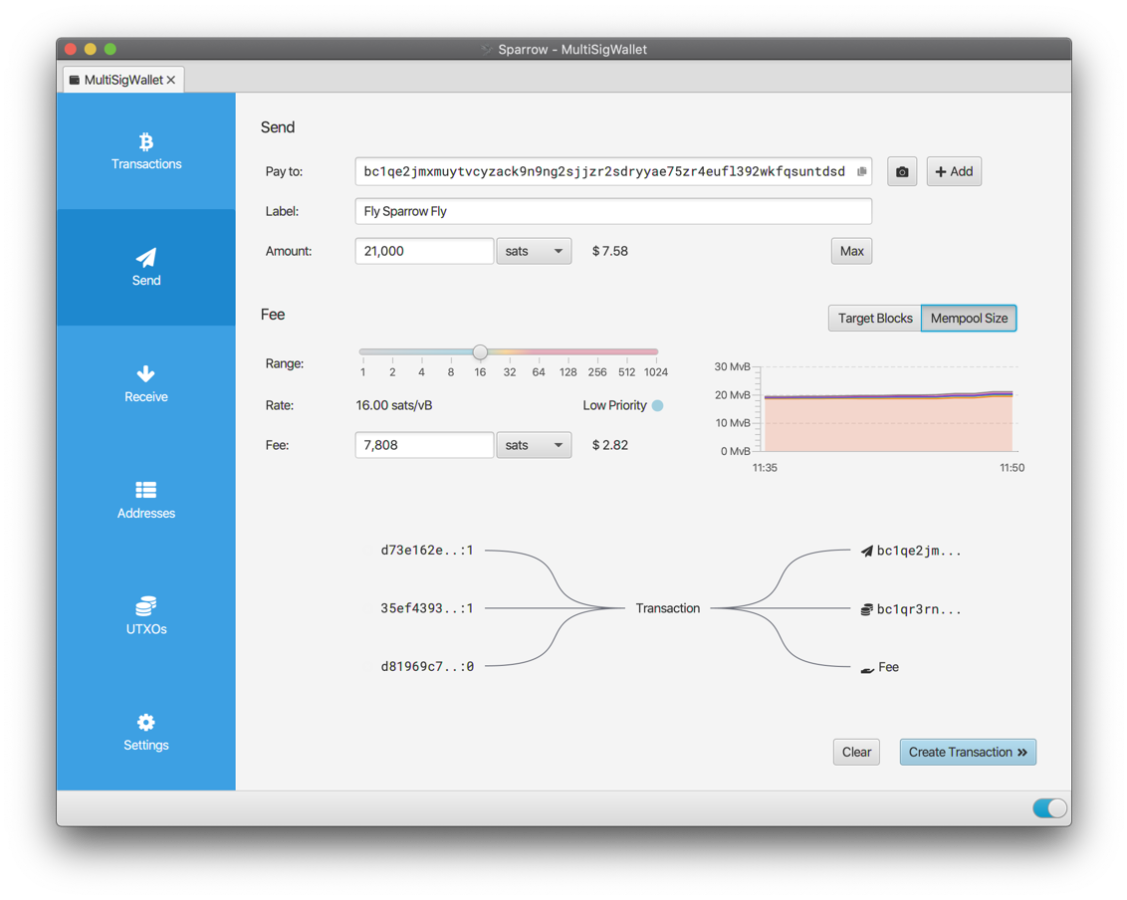
Best for: Power users who want a coordinator for disciplined, UTXO-level spending rather than an automatic anonymity layer.
Privacy strengths:
- Granular coin control that lets you see every UTXO individually, label it, and choose exactly which ones go into a transaction.
- Connects to a user-run full node, removing reliance on third-party infrastructure for balance and transaction data.
- Integrates with external CoinJoin tools and hardware wallets, acting as a coordination hub for a broader privacy workflow.
Privacy limits:
- Sparrow itself does not anonymize anything. The privacy benefit comes from the coin-control-centric spending discipline it enables.
- Without active UTXO management, it is still possible to combine unrelated coins in one transaction — the exact failure mode Sparrow’s interface is designed to help you catch and prevent.
- It requires more manual attention than a “set and forget” wallet, which can lead to mistakes under time pressure.
Required companion setup:
- A self-run full node, such as Bitcoin Core or similar, for maximum network privacy.
- Tor connection to your node.
- Ongoing coin control discipline before every spend.
When to avoid:
- If you are not willing to actively manage UTXOs and would rather have privacy handled automatically.
Electrum
Best for: Users who want a lightweight, non-custodial wallet with fast setup, provided they manage its server-connection privacy tradeoffs.
Privacy strengths:
- Supports coin control for manual UTXO selection.
- Can connect to your own Electrum server, removing a layer of third-party visibility into your wallet activity.
- Lightweight client structure means minimal on-disk footprint and fast synchronization.
Privacy limits:
- Network privacy and server trust are the main weaknesses. By default, Electrum connects to third-party servers that can observe which addresses and balances belong to your wallet, even without seeing your private keys.
- Repeated connections to the same third-party server over time can build a profile of your spending habits, separate from anything visible on the Bitcoin blockchain itself.
- The mitigation is direct: run and connect to your own Electrum server via ElectrumX or similar to minimize third-party visibility into your wallet’s query patterns.
Required companion setup:
- Self-hosted Electrum server connection where possible.
- Tor routing for server communication.
- Coin control discipline for UTXO selection.
When to avoid:
- If you are unwilling to set up or connect to your own server infrastructure and would otherwise default to unknown third-party servers.
Ledger Nano X
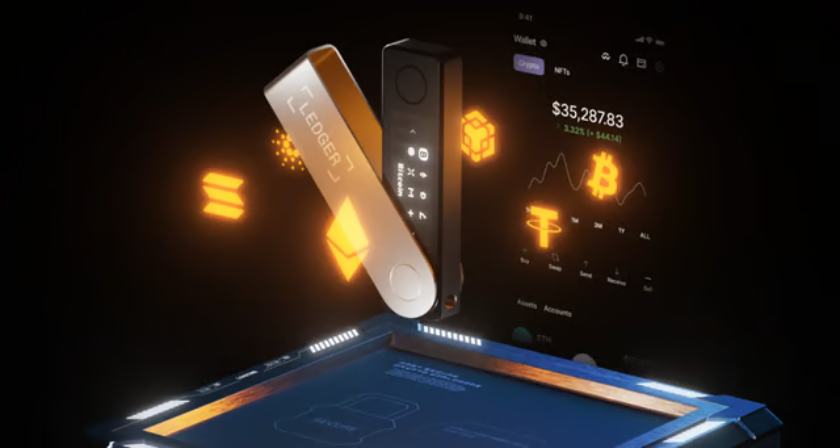
Best for: Users prioritizing key isolation and theft resistance for BTC storage, who understand this is a different problem than on-chain anonymity.
Privacy strengths:
- Hardware-level key isolation keeps private keys off internet-connected devices, protecting against remote key theft.
- Pairs with privacy-aware companion software like Sparrow for coin control during spends.
- Ledger Wallet’s architecture separates signing from broadcasting, which can be combined with privacy-conscious network routing.
Privacy limits:
- Hardware isolation protects your keys, but it does not automatically provide on-chain anonymity. These are separate problems with separate solutions.
- A user can keep keys perfectly secure on a Ledger Nano X and still lose privacy by merging multiple UTXOs in a single spend or by broadcasting transactions through an identifiable network path.
- The device itself has no coin control logic of its own. Privacy outcomes depend entirely on the companion software and network setup you pair it with, including whether you broadcast through a privacy-aware stack rather than defaulting to Ledger Live.
Required companion setup:
- Privacy-aware wallet software, such as Sparrow, connected to the device for coin control.
- Tor routing for transaction broadcast.
- Disciplined coin selection before every spend to avoid merging unrelated UTXOs.
When to avoid:
- If you are relying on hardware isolation alone and skipping companion software or network-level privacy steps.
In summary, the wallet shortlist only matters if it maps to a full privacy workflow. Wasabi, Sparrow, Electrum, and Ledger Nano X can all support private Bitcoin use, but none of them replaces the core practices: Tor, coin control, fresh addresses, and strict separation between wallet contexts.
Privacy Features and Forensic Resistance
Wallet selection is only the first layer. The actual resistance to chain analysis comes from how specific features interact with on-chain linkability, network metadata, and device-level exposure.
CoinJoin Support
Already mentioned extensively, what does CoinJoin do? It changes one specific thing: it creates ambiguity about which input paid which output within a single, larger transaction. That makes it harder for a blockchain observer to definitively cluster UTXOs by ownership. And as opposed to centralized mixers, it is an auxiliary protocol for Bitcoin transactions: you can think of it as a transaction constructed in a more complex way.
CoinJoin does nothing for network-layer anonymity, only breaking the chain-layer links. If your wallet broadcasts the CoinJoin transaction without Tor, your IP address can still be exposed to whatever server or peer relays it, completely independent of how well the coins themselves were mixed.
The benefit can also be undone after the fact through poor wallet hygiene. Spending a freshly mixed UTXO alongside an unrelated, identifiable one in the same transaction re-links what the CoinJoin just worked to separate. Spending discipline after mixing matters as much as the mixing itself.

Academic measurement identified 5,948,184 CoinJoin transactions on the Bitcoin network between June 2016 (block 400,000) and June 2025 (block 900,000) — representing roughly 0% to 0.8% of all Bitcoin transactions over that period. That is a small slice of overall BTC activity. CoinJoin usage itself can become a distinguishing signal, and it increases uncertainty about linkage rather than makes your transaction history disappear.
Tor and Network Privacy
Even a perfectly constructed, CoinJoin-mixed transaction can leak your identity through the network layer. For example:
- Your wallet needs to broadcast transactions and check balances.
- It connects to a peer, a third-party server, or an infrastructure provider.
- That connection point sees your IP address, the timing of your requests, and which transaction you are broadcasting.
- From there, correlating your IP with a specific transaction ID can tie real-world identity directly to on-chain activity.
This is precisely why Tor is offered as a remedy. Routing wallet traffic prevents your IP address from being associated with the Bitcoin transactions you broadcast, addressing the network-privacy layer specifically. Tor changes who can observe the transport-level metadata around your broadcast.
A related but distinct exposure comes from relying on external servers for wallet data. Running your own full node is recommended for privacy reasons because it prevents third-party providers from automatically learning your wallet’s balance and transaction patterns. When you query a remote server for that information instead, you hand an outside party a direct view into your holdings and habits, even without Tor in the picture.
A practical rule follows: if your wallet uses external servers or providers by default, treat Tor plus your own node as the privacy baseline. Otherwise, you are outsourcing your metadata to whoever operates that infrastructure.
Address Control and Coin Control
Coin control means manually selecting which UTXOs go into a transaction rather than letting the wallet auto-select them for you. Its purpose is simple: to prevent you from combining coins from different sources unnecessarily, which is a direct driver of forensic clustering risk.
Consider the failure mode. You have one UTXO from a privacy-conscious source and another from an exchange withdrawal tied to your KYC identity. If your wallet auto-selects both to fund a single payment because neither alone covers the amount, that transaction now links both UTXOs as belonging to the same owner. Whatever separation you had built between them collapses in one spend.
No matter which wallet or node software you choose to use, if possible:
- Label UTXOs by source and context: exchange withdrawal, mixed output, direct payment, mining payout, or P2P trade.
- Avoid merging UTXOs from unrelated contexts into a single spend unless there is no other option.
- Keep change outputs separate and treat them as distinct, trackable UTXOs.
- Avoid “send max” or auto-sweep functions when they force a merge of UTXOs you would otherwise keep apart.
- Maintain separate “clean” and “dirty” coin pools, and resist spending from whichever pool happens to have sufficient balance.
CoinJoin can add ambiguity, Tor can hide transport metadata, but coin control prevents you from undoing both with one careless transaction.
Taproot, Stealth Addresses, and HD Wallets
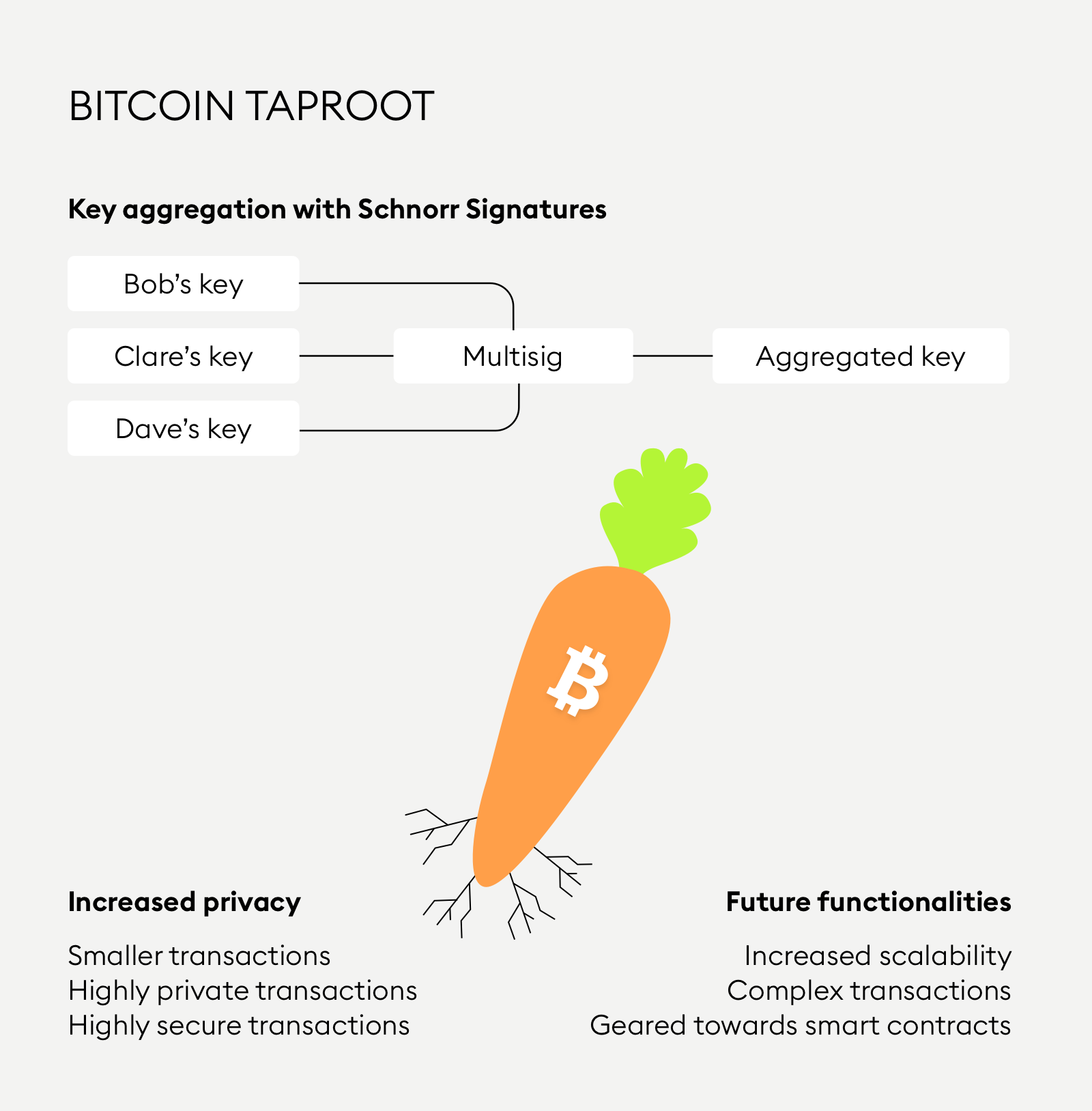
Taproot used to be often misunderstood as a privacy feature that hides transaction details outright. It does not.
What Taproot actually does is make certain complex spending conditions, such as multisig or script-based spends, look identical to simple key-path spends on-chain. That narrows what an observer can infer about the type of spend that occurred. It is a meaningful improvement to script-level privacy, but Taproot does not hide transaction amounts, does not hide recipient addresses, and is not a stealth-address system by itself.
Those stealth addresses, usually meaning one-time unlinkable addresses automatically for every payment, are not a native Bitcoin base-layer feature. Any “stealth-like” privacy outcome in Bitcoin comes from wallet-level protocols or conventions built on top of Bitcoin’s existing address structure, not from a default behavior of the protocol itself.
HD, or hierarchical deterministic, wallets solve a related but separate problem. They can generate a new address for every incoming transaction from a single seed, which supports the “new address per payment” habit discussed earlier. However, this convenience can come with a cost. Sharing your extended public key, or xpub, with a third-party wallet or service can let that party derive and view your entire address set, including addresses you have not used yet. That happens even if you never reuse a single address. Treat the xpub as sensitive account information, not as harmless “read-only” convenience.
Mobile Metadata Exposure
Mobile wallets introduce a privacy risk that has little to do with Bitcoin’s blockchain and a lot to do with how phones work as surveillance-dense devices.
A quick metadata surface map:
- OS-level identifiers such as device ID and advertising ID can tie wallet app usage to a broader profile maintained by Apple, Google, or app developers.
- App analytics and telemetry can transmit usage patterns, timestamps, and sometimes balance-adjacent events to third-party analytics providers.
- Push notification services typically route through centralized infrastructure such as APNs and FCM, meaning a third party learns that your device received a wallet-related notification and roughly when.
- Cellular and Wi-Fi location traces can place your device at a specific location at the moment a transaction was broadcast.
- Contact and address-book leakage can arise when wallet apps request contact permissions, potentially exposing who you transact with to app developers or compromised third parties.
Each exposure connects back to the same harm: identity linkage that happens off-chain through device and app-layer metadata. A perfectly executed coin-control and CoinJoin strategy can still be undermined by what your phone quietly reports in the background.
A practical mitigation path is to minimize analytics and telemetry permissions for wallet apps, avoid cloud backup of wallet app data where possible, and consider keeping a watch-only wallet on mobile while signing happens on a separate, more controlled device.
Desktop vs Mobile Anonymity

The desktop-versus-mobile choice can be less about convenience and more about anonymity posture.
Desktop environments more readily support running a full node, routing through Tor, and maintaining compartmentalized workflows: separate wallets, separate coin pools, and separate network configurations. Mobile devices offer portability and everyday usability, but they also carry ambient exposure from location services, push infrastructure, and OS telemetry.
As a rule of thumb, mobile is acceptable for a small daily-spend wallet where the privacy stakes of any single transaction are low. High-privacy or high-value activity is better handled through desktop or hardware-assisted workflows where you can enforce Tor, run your own node, and apply coin control without mobile metadata leakage working against you.
No-KYC Setup, Funding, and Cash-Out
Anonymity on Bitcoin is rarely lost at the moment of transacting. It is usually lost at the edges, where fiat meets BTC and where one wallet context bleeds into another. Funding, spending, and cash-out should be treated as one operational chain: the on/off-ramp layer.
If any link in that chain re-links a no-KYC transaction to an identified one, every privacy step taken earlier can become retroactively weakened.
Non-Custodial Wallet Setup
Self-custody is the natural starting point here, but self-custody alone does not create anonymity. How you partition that self-custody matters.
The 2026 guidance on this point is specific: separate receiving funds, long-term holdings, everyday spending, and application use into different wallets or wallet contexts. Below is a repeatable setup routine independent of which non-custodial wallet software you choose.
- Create a dedicated receiving context. Use a wallet or account structure whose sole job is accepting incoming payments, generating a fresh address per transaction.
Rationale: prevents an observer from clustering your inbound activity with your spending or holding patterns. - Create a separate long-term hold context. Move funds out of the receiving context into a wallet that is rarely, if ever, used for spending.
Rationale: isolates your largest balances from the transaction graph your day-to-day activity generates. - Create a distinct day-to-day spend context. Fund this wallet in small batches from the hold context, and use it exclusively for routine P2P or merchant payments.
Rationale: prevents a single leaked spend from exposing your full balance or linking back to your long-term coin pool. - Create an isolated experimental/app-use context. Any wallet connected to new services, Lightning apps, or unaudited software should hold only disposable amounts.
Rationale: contains the damage if an app has weak privacy practices, a data leak, or malicious code. - Avoid cross-funding contexts directly. Do not top up your spend wallet straight from receiving, and do not fund experimental wallets from spend.
Rationale: every direct transfer between contexts is itself a linkage event. - Re-evaluate context boundaries periodically. If a context has accumulated coins from mixed sources, treat it as compromised for anonymity purposes and start a fresh one.
Rationale: contexts degrade over time as linkage accumulates.
Labeling discipline is what makes this structure usable months later. For every UTXO or wallet context, record:
- Source: which funding method or counterparty it came from.
- Counterparty context: who or what you transacted with.
- Intended use: hold, spend, or experimental.
- Status: clean, tainted, or unknown.
These labels can live natively in wallets that support in-wallet UTXO labeling, or in an offline note. The point is not bookkeeping for its own sake. The point is preventing the most common no-KYC privacy failure: accidentally merging a “clean” UTXO with a “tainted/unknown” one during a later spend because you no longer remember which was which.
No-KYC Bitcoin Funding Methods
Even the best no-KYC crypto exchanges or other no-KYC funding methods are not equally private. Each has its own linkage vectors, fees, and liquidity tradeoffs.
| Funding Method | KYC Exposure | Typical Linkage Vectors | Fee/Liquidity Tradeoff |
|---|---|---|---|
| In-person cash trades | None, if arranged privately | Physical-world exposure, meeting location, being seen, device/phone correlation | Low fees, but liquidity depends on finding a willing counterparty locally |
| P2P online markets, e.g., Bisq, RoboSats | Low to none, depending on platform and payment rail used | Chat logs, payment-method metadata, IP address if Tor is not used | Moderate fees; liquidity varies by platform and region |
| Vouchers/gift cards redeemed for BTC | Low, but purchase of the voucher itself may carry a trail | Bank rails or in-store purchase records tied to the original voucher purchase | Often higher fees/premiums; liquidity limited by voucher denominations |
| Mining/earning income in BTC | None at the point of earning | Payout address reuse, pool account metadata, counterparty records for freelance/service work | No direct fee, but liquidity depends on earning volume and payout frequency |
| Merchant refunds in BTC | Low, tied to the original purchase context | Order records, shipping/address data, email tied to the merchant account | Fee-neutral but irregular as a funding source |
Unsurprisingly, the re-linkage trap is where many no-KYC workflows fail. No-KYC funding only stays no-KYC if the coins do not cross back into a KYC-regulated service. Depositing funds acquired through any of the methods above into an exchange, custodial platform, or service that later performs identity verification can retroactively connect your real identity to that coin’s history.
The safest operational assumption is that no-KYC coins should be treated as permanently outside the KYC perimeter: spent, held, or exchanged peer-to-peer, but never deposited into a platform that will ask for ID.
Cash-Out Without Identity Verification
If you think getting BTC without disclosing your identity is hard, try selling it! But seriously, a cash-out strategy depends on what you need at the end of the process.
- Goal: need fiat
- Branch: in-person cash trade — Main failure mode: physical-world exposure at the meeting point. Mitigation: vary meeting locations and counterparties rather than relying on a single recurring trade partner.
- Branch: P2P online trade via Bisq or RoboSats settled to bank transfer — Main failure mode: the bank transfer creates an identity trail linking your name to the trade. Mitigation: use payment methods within the P2P platform that minimize information shared with the counterparty, and treat the receiving bank account as a disclosed identity point going forward.
- Goal: need to pay a bill or merchant
- Branch: direct BTC payment to a merchant that accepts it — Main failure mode: merchant records such as invoice, email, or shipping address tie the payment to a real-world identity. Mitigation: pay from your dedicated spend context only, never from a hold or receiving wallet.
- Branch: BTC-to-bill-pay service — Main failure mode: the service may log account and payment metadata even without formal KYC. Mitigation: treat the service as a disclosed counterparty context and label any coins that pass through it accordingly.
- Goal: need stablecoins
- Branch: P2P BTC-to-stablecoin swap — Main failure mode: online trade platforms generate account and chat logs that can later be subpoenaed or leaked. Mitigation: keep the swap conversation and account minimal, and avoid reusing the same P2P account across multiple trades tied to different wallet contexts.
Goes without saying that it is possible and even easy to carelessly or accidentally undo the fund partitioning that led to these funds being moved or acquired. The operational fix is equally concrete: never consolidate before cash-out. Sell or spend from a single labeled pool per context and keep each funding source separate through the entire process.
KYC Exchange Linkage

Some users will still need to use a regulated exchange at some point — for liquidity, for a specific fiat rail, or because no-KYC options are not available in their region. The current guidance here is clear: when you do buy through a legal platform, withdraw the coins to a separate private wallet rather than leaving them on the exchange or mixing them into existing wallet contexts.
When KYC is unavoidable, limit the exposure:
- Do create a dedicated “KYC-bound” wallet that exists only to receive withdrawals from identified accounts.
- Do document every UTXO that originates from a KYC withdrawal as permanently linked to your identity.
- Do not reuse deposit or withdrawal addresses associated with your no-KYC pools for any KYC-platform activity.
- Do not merge KYC-sourced coins with no-KYC-sourced coins in the same transaction, ever.
- Do not assume time or multiple hops erase the original link.
This procedure is falsifiable by design. If you can point to a UTXO and say with certainty whether it is KYC-bound or not, the system is working. If you cannot, the damage has already spread.
It is worth being precise about what withdrawing to a private wallet accomplishes. Buying BTC on a KYC platform and withdrawing it to a non-custodial wallet only moves custody into your hands. What it does not do is make the coins anonymous. The exchange retains a permanent record: the withdrawal transaction ID, the timestamp, and the account identity tied to that withdrawal.
There is also a regulatory layer that limits how much anonymity is even plausible between regulated entities. The FATF Travel Rule requires that originator and beneficiary information accompany applicable virtual-asset transfers. In practice, transfers between KYC exchanges, or between a KYC exchange and another regulated custodial service, are expected to carry identifying information by design, not by accident.
Wallet Selection Criteria and Tradeoffs
Granted that we established that privacy is less about using one of the four options from our rating and all about discipline, you are not limited to our highlights. Basically every wallet trades off the same five variables differently: operational discipline, custody, private-use costs, legal exposure, and ease of misuse. The right choice is not the most feature-rich wallet on paper. It is the workflow you can reliably execute without cutting corners.
Technical Skill Level
Match your actual day-to-day discipline, not your aspirational discipline, to one of these three tiers.
Beginner
- Tolerance for operational complexity: low.
- Minimum privacy behaviors: generate a new address per incoming payment and avoid “send max” when it would merge every UTXO you own.
- Wallet form factor: a mobile hot wallet with simplified, mostly automated address handling.
If you cannot consistently generate a fresh address per receive and resist consolidating your whole balance into a single spend, choose a simpler wallet but use it correctly instead of a feature-heavy desktop client you will misconfigure.
Intermediate
- Tolerance for operational complexity: moderate.
- Minimum privacy behaviors: UTXO labeling, review of inputs before every spend, and keeping Tor enabled.
- Wallet form factor: a non-custodial desktop wallet built around coin control.
If you cannot commit to reviewing your UTXO set before every spend, the privacy benefit of a coin-control wallet will mostly remain theoretical.

Advanced
- Tolerance for operational complexity: high.
- Minimum privacy behaviors: full node operation, Tor routing, manual coin selection on every transaction, and verification that any coordinator-dependent feature like CoinJoin is functional before relying on it.
- Wallet form factor: a desktop wallet connected to a self-run node, often paired with a hardware wallet for signing.
The failure mode is worth internalizing: privacy tools can backfire when skill and tooling mismatch. A powerful desktop wallet with granular coin control, in the hands of someone who does not review inputs before spending, can produce worse outcomes than a simple wallet used correctly.
Custody Model
Custody determines who can see what by default, independent of wallet branding.
Custodial wallet
By default, the custodian can and does learn your identity, full balance history, deposit and withdrawal graph, and timing. You gain convenience and lose coin control, self-custody, and any meaningful wallet-layer privacy.
Non-custodial hot wallet
You hold the keys, but if the wallet connects to third-party servers without Tor, the server operator can observe address and balance patterns through metadata. You gain signing autonomy and coin control. Network privacy is not automatic.
Non-custodial cold/hardware wallet
A hardware wallet isolates private keys from internet-connected devices. However, the hardware itself has no coin-control logic. Privacy outcomes depend on companion software and network setup. Expect to budget roughly $50 to $250 for a hardware wallet, and treat seed backup security as part of the same model.
Watch-only wallet
A watch-only wallet holds public keys or addresses with no signing capability. Any service hosting it can see the full balance and transaction graph tied to those addresses, even though it cannot move funds. Watch-only status protects keys, not your transaction graph.
These solutions rarely work in isolation from each other. Connecting a non-custodial desktop wallet to your own full node is meaningful only when paired with Tor. Running your own Electrum-style server matters only if you actually query it instead of falling back to public servers. Pairing a hardware wallet with privacy-aware coin-control software is substantive; pairing it with an app that auto-selects UTXOs through default third-party servers is mostly cosmetic.
Fees and Liquidity
There is a considerable economic element to this workflow, too. Privacy draws costs from:
- Bitcoin network fees. These are mempool-dependent. Paying more gets faster confirmation, not more anonymity.
- Privacy-protocol or service fees. Mixing or coordination layers can add fees beyond miner fees in exchange for improved on-chain ambiguity.
- Spread/liquidity costs. No-KYC channels often mean wider spreads, premiums, and fewer counterparties than liquid KYC exchanges.
The execution gotcha is simple: trying to reduce future fees can quietly increase linkability. Consolidating many small UTXOs into one “to save on fees later” proves common ownership of every input in a permanently recorded transaction. The fee savings may be real, but the linkage created is large and irreversible.
Legal Considerations Before You Pick a Wallet

All in all, if you need to use Bitcoin “anonymously”, rather than choose a wallet software, you are going to apply three operational layers:
- Wallet software choice itself. A non-custodial wallet is a tool for holding and signing transactions. Its privacy posture depends on how it handles addresses, network traffic, server queries, and coin selection.
- Acquisition and disposal of BTC. Buying, selling, swapping, or cashing out may trigger compliance requirements depending on platform type, payment rail, jurisdiction, and counterparty.
- Counterparty exposure. Even if your wallet is private, the person, merchant, exchange, or service you transact with may keep records that identify you.
This is why the legal question cannot be answered by wallet name alone. A self-custodial wallet may be lawful to use, while a specific transaction path, counterparty, or cash-out method may create compliance obligations. Privacy tooling reduces unnecessary exposure; it does not exempt the user from local rules.
Frequently Asked Questions
What is the most anonymous Bitcoin wallet?
There is no single “most anonymous” Bitcoin wallet, because anonymity is an outcome rather than a product feature. Prioritize a non-custodial wallet that gives you granular coin control and lets you route traffic over Tor or connect to infrastructure you run yourself. That combination addresses both on-chain linkability and network-metadata exposure.
The constraint is important: no wallet can erase an existing KYC record or an identity link already established with a counterparty.
Can I buy Bitcoin anonymously directly in a wallet?
Wallet software and integrated purchase features are different things. The wallet handles storage and signing, while a built-in “buy” button usually connects to a third-party on-ramp provider. In-wallet buys typically inherit whatever identity requirements the on-ramp enforces, which for most regulated providers means KYC.
Genuine no-KYC funding usually happens through external workflows such as P2P trades or in-person cash exchanges, not through a wallet’s built-in buy button.
Are privacy wallets more expensive to use?
They can be. Costs split into Bitcoin network fees and additional privacy-workflow costs such as coordination time, wider spreads on no-KYC channels, or protocol/service fees for mixing.
One nuance matters more than the headline cost: attempts to save money by consolidating UTXOs can backfire badly. Combining inputs in one spend proves common ownership and increases linkability.
Can I use an anonymous wallet for other cryptos?
Not automatically. Bitcoin-focused privacy workflows like coin control and CoinJoin do not transfer cleanly to other chains because privacy properties and address models differ from network to network.
Multi-asset wallets can also increase metadata and correlation risk, since a single app identity, shared device, or shared network footprint can tie activity across chains together.
Is using an anonymous Bitcoin wallet illegal?
Using a non-custodial, privacy-preserving wallet is often legal on its own, but legality and compliance depend heavily on who you transact with, not just which wallet you use. Some jurisdictions’ 2025 guidance specifically cautioned against dealing with anonymous counterparties, which matters because regulated exchanges and other counterparties can impose identification or compliance requirements on a transaction regardless of how private your own wallet setup is.
If you plan to interact with regulated venues at any point, check your local rules first rather than assuming wallet-level privacy settles the question for you.