
Is Crypto a Good Investment? A Complete Guide to Cryptocurrency Investing in 2026


Disclaimer
This article does not intend to substitute professional financial or investment advice and is intended to serve as educational material on crypto and digital assets. When dealing with cryptocurrencies, remember that they are extremely volatile and thus, a high-risk investment. Always make sure to stay informed and be aware of those risks. Consider investing in cryptocurrencies only after careful consideration and analysis of your own research and at your own risk.
Content Currency & Expert Validation
This guide reflects cryptocurrency market conditions, regulatory developments, and institutional trends as of December 2025. The crypto landscape evolves rapidly—what's accurate today may shift within months as regulations clarify, technologies mature, and market dynamics change.
Contents
- 1. Key Takeaways
- 2. Introduction to Cryptocurrency Investments
- 3. Is Cryptocurrency a Good Investment Right Now?
- 4. Why People Invest in Cryptocurrency
- 5. Understanding the Risks of Cryptocurrency Investment
- 6. Cryptocurrency Market Analysis and Current Trends
- 7. How to Invest in Cryptocurrency
- 8. Building a Cryptocurrency Investment Portfolio
- 9. Top Cryptocurrencies to Consider
- 10. Crypto as Digital Money and Economic Hedge
- 11. Advanced Investment Considerations
- 12. Regulatory Landscape and Compliance
- 13. Tax and Legal Considerations
- 14. Future of Cryptocurrency Investments
Key Takeaways
- Just like any investment vehicle, cryptocurrencies are not a universally beneficial choice and will fit investors with certain timeline expectations, risk appetites and financial situations.
- As of 2025, Bitcoin and crypto as investments are more commonplace due to increasing institutional involvement and confidence and improving regulations. Nevertheless, they occupy a niche of high-risk investments in large portfolios for a reason.
- Should you find cryptocurrencies acceptable for your own portfolio and financial situation, they would work the best as long-term commitment with a reasonable degree of regular management (diversification, rebalancing, etc.).
Introduction to Cryptocurrency Investments
What is Cryptocurrency?
First things first: when investors choose crypto, what exactly do they put the capital in? Before understanding these basics, asking the titular question is simply premature.
Simply put, cryptocurrency is digital money that works with the help of blockchain technology—a decentralized ledger that records all transactions across a network of computers. Unlike traditional currencies issued by governments, cryptocurrencies operate independently of central banks and use cryptography to secure transactions and control the issuance of new units.
Bitcoin, launched in 2009, was the first cryptocurrency and remains the most recognized. Since then, thousands of digital assets have emerged, each with unique features and use cases. What is the core appeal of this technology? For example, cryptocurrencies enable peer-to-peer transactions without intermediaries like banks, potentially offering faster, cheaper transfers and greater financial control.
Here's what makes crypto fundamentally different: instead of a bank maintaining your account balance, the blockchain records every transaction permanently and publicly (though your identity stays pseudonymous). You control access through a private key—a unique cryptographic code that functions like an uncrackable password.
Decentralization means no single entity controls the network, so transactions get validated by network participants (called miners or validators, depending on the system), who maintain the blockchain's integrity for financial rewards.
For a more in-depth overview of what are cryptocurrencies, the key concepts and types, we highly encourage you to read our guide. What follows will assume a degree of familiarity with the cryptocurrency market and a basic knowledge concerning these digital assets.
Overview of the Cryptocurrency Market
The days when crypto used to be a niche experiment are long gone, and it is now a significant financial sector. As of 2025, global cryptocurrency ownership reached 6.8%, representing over 560 million users worldwide, according to Triple-A’s cryptocurrency ownership data.
The market's total capitalization surpassed its November 2021 all-time highs in 2025, with Bitcoin's individual market value approaching $2 trillion. Institutional adoption has also accelerated dramatically post-2024: 86% of surveyed institutional investors report having exposure to digital assets or planning allocations for 2025, based on EY research.
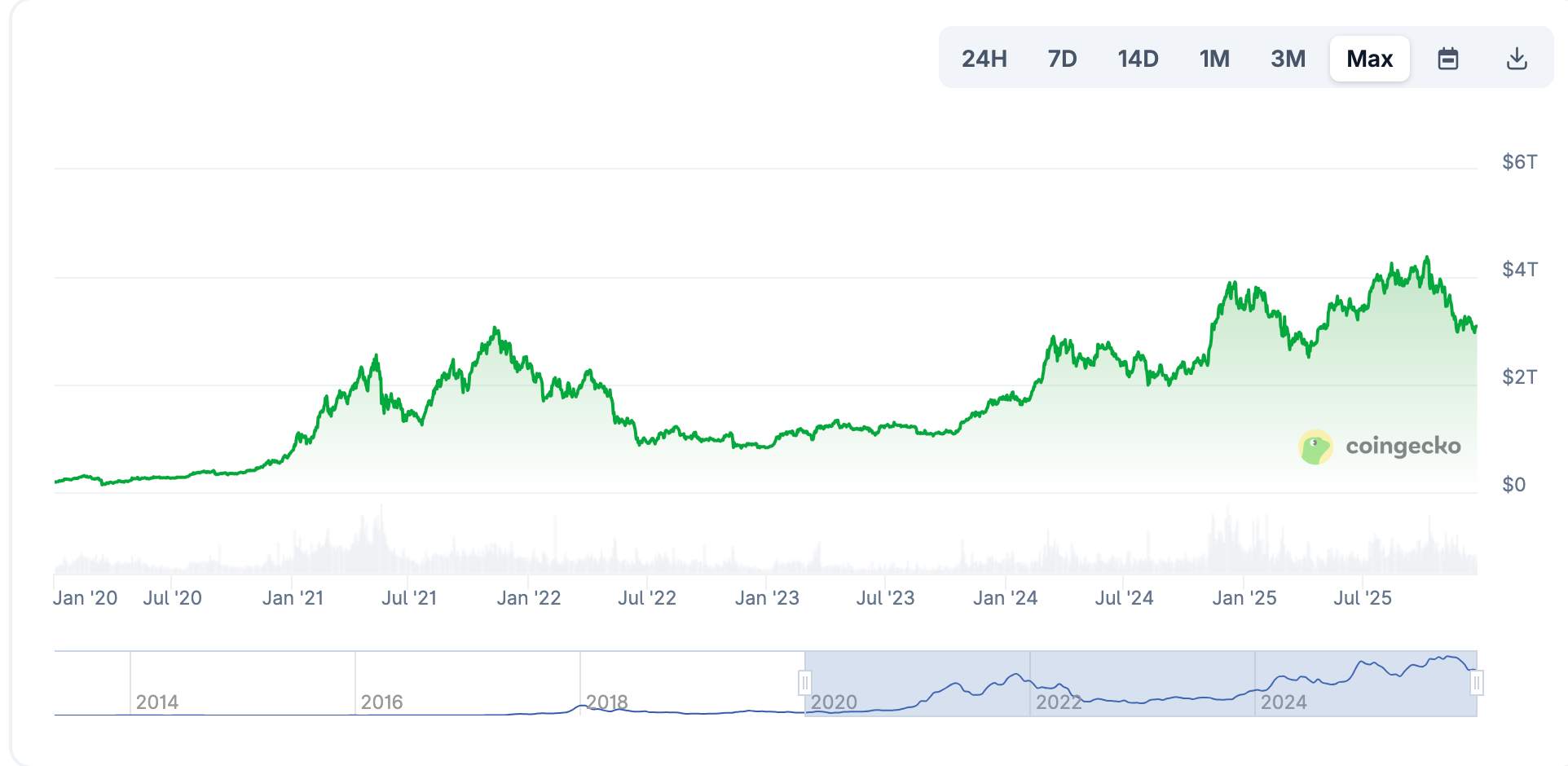
Total Cryptocurrency Market Capitalization chart 2020–2025. Source: Coingecko
Bitcoin ETFs alone attracted cumulative inflows of $29.4 billion through August 2025, according to CFRA Research, demonstrating mainstream financial integration. Professional investors currently hold approximately $27.4 billion in U.S. spot Bitcoin ETFs, per XBTO data.
The market features different asset categories—from Bitcoin and Ethereum to stablecoins (which hit $290 billion in total capitalization in Q4 2025, per Nasdaq) and specialized tokens for decentralized finance applications. The key point here is the diversity that creates varied investment opportunities with different risk profiles.
Is Cryptocurrency a Good Investment Right Now?
Evaluating Cryptocurrency as an Investment
Market conditions are only one of the factors that should be considered when answering the titular question. When considering any investment, crypto or not, keep in mind your financial situation, risk tolerance, and timeline.
As for cryptocurrency investments, they come with unique characteristics that separate them from traditional assets. Since its inception, Bitcoin has demonstrated an average annual return of approximately 200%, significantly outperforming traditional asset classes. In 2024 alone, Bitcoin returned approximately 135%, while Ethereum gained 55.15%.
But here's the important detail: these returns come with extreme volatility and significant crypto- and Bitcoin-specific risks: more on that later. For now, let’s see how timeline alone factors into making the decision to invest in cryptocurrency (or not).
Long-Term vs Short-Term Investment Potential
Given the price history, for long-term Bitcoin investment strategies, the picture looks more favorable. The success of spot Bitcoin ETFs and institutional involvement imply long-term strategies, and based on the previously mentioned data, these players are in this space to stay at least for a while.
Long-term strategies work for Bitcoin and other cryptocurrencies because they smooth out volatility and align with adoption trends. By the way, approximately 59% of crypto investors use dollar-cost averaging as their primary investment strategy. That's the majority choosing patience over timing.
On the other hand, short-term crypto investment carries substantially higher risk.
In 2024, the correlation between Bitcoin and the S&P 500 hit a historical high of 0.87, influenced by institutional participation and macroeconomic factors. This means short-term price movements often reflect broader market sentiment rather than crypto-specific fundamentals.
“Should I invest in Bitcoin for quick gains?” Only if you can stomach significant losses and have no immediate need for that capital. Short-term trading requires active management, technical analysis skills, and emotional discipline most beginners lack.
Decision Framework to Help You Decide: Should You Invest in Crypto?
Is investing in Bitcoin a good idea for you? Ask yourself these questions:
- Can you afford to lose your entire investment without affecting your lifestyle?
- Do you have 3–6 months of emergency savings already set aside?
- Are you investing for at least 3–5 years?
- Do you understand basic blockchain mechanics and wallet security?
- Can you ignore daily price swings without panic selling?
If you answered “no” to any of these, you should either wait or start with education before putting in real money. Simple as that.
Is Cryptocurrency Right for Your Portfolio?

Coming from this angle, especially if you already are experienced in investing, the answer lies in appropriate allocation, not binary yes-or-no decisions.
Morgan Stanley recommends limiting crypto allocations to 2% for balanced growth, 3% for market growth, and 4% for opportunistic growth portfolios. For 2025, 59% of institutional investors plan to allocate more than 5% of their assets under management to cryptocurrencies, according to EY.
Crypto can be part of a diversified portfolio, even a moderately conservative one, but letting it dominate it is usually a recipe for disaster. Think “satellite” position, not core holding.
Here is what ChangeHero’s in-house financial analyst Alexander has to say to the questions posed:
“According to financial planning standards, cryptocurrency should represent only a small portion of a diversified portfolio. Certified financial planners typically recommend 2–5% allocation depending on risk profile, with higher percentages reserved for investors with substantial liquidity and high risk tolerance. The key principle: never invest more than you can afford to lose completely, and ensure crypto allocation doesn't compromise core retirement or emergency fund goals.
Is it worth investing in Bitcoin right now? If you approach it as a long-term, small-percentage allocation within a diversified portfolio, the benefits of cryptocurrency exposure may outweigh the risks. Treat it as you would any emerging asset class—with respect for its volatility and realistic expectations about returns.”
Why People Invest in Cryptocurrency
Observing others make decisions and grapple with consequences can be one of the most valuable lessons in the school of life, and investing is not a stranger to that. Put your FOMO aside for just a moment and learn about the main reasons people invest in cryptocurrency: a mix of financial opportunity, portfolio strategy, and belief in a new financial paradigm.
Potential for High Returns
The most compelling and popular reason? Returns. Since its inception, Bitcoin has demonstrated an average annual return of approximately 200%, significantly outperforming traditional asset classes like stocks or bonds. Even in recent years in more challenging conditions, the numbers remain impressive.
That being said, that's the upside. The question “is investing in Bitcoin a good idea” often comes down to whether you can stomach the volatility that comes with those gains. In other words, just like it rallies up, it can lose 80% of its value or more. High returns don't come without high risk.
And in altcoin territory? Beyond Ethereum (ETH), the price swings get even more pronounced. It also should be noted that whether the price of an asset swings up or down is not an equal probability: there are only a few noteworthy examples of successful coins but hundreds of thousands of failed cryptocurrencies whose value stagnates near zero.
Portfolio Diversification Benefits
Cryptocurrency investments offer a unique diversification angle. Historically, crypto has moved somewhat independently from traditional markets (meaning when stocks drop, crypto might not follow), which can reduce overall portfolio risk.
That relationship is evolving, though. In 2024, the correlation between Bitcoin and the S&P 500 hit a historical high due to institutional participation and macroeconomic factors, and with increased presence of these players in the crypto market further drives the correlation up. Bitcoin and certain other cryptocurrencies are more of a “risk-on” choice than a fringe bet on novel technology.
Inflation Protection Potential

Not everyone will agree here but still, many investors view Bitcoin as “digital gold”—a hedge against inflation and currency devaluation. The logic is straightforward: Bitcoin's fixed supply of 21 million coins contrasts with fiat currencies (like dollars or euros) that can be printed indefinitely.
While this argument has theoretical merit, real-world performance as an inflation hedge remains debated and context-dependent. Sometimes Bitcoin behaves like a risk asset, not a safe haven. We’ll unpack this more in the “Crypto as Digital Money and Economic Hedge” section.
Institutional Adoption and Mainstream Acceptance
By now, early adopters in crypto are a minority. Institutional interest signals legitimacy and long-term viability. When major financial players commit capital, it reduces uncertainty for individual investors and changes how seriously regulators, banks, and corporations treat the space.
Innovation and Financial System Evolution
Those who see merit in crypto beyond returns invest because they believe in what cryptocurrency represents: a reimagined financial system built on blockchain technology. Investing in crypto today means participating in innovations like decentralized finance (financial services without traditional banks), smart contracts (self-executing agreements), and tokenized real-world assets—which reached approximately $33 billion by October 2025. For some investors, that future potential matters as much as today's price, if not more.
Understanding the Risks of Cryptocurrency Investment
The earlier this is addressed, the better. Before you invest in crypto, let’s be honest about what can go wrong. While the potential returns get most of the attention, understanding Bitcoin investment risks is what separates informed investors from reckless gamblers.
Price Volatility and Market Fluctuations
Cryptocurrency prices swing far more wildly than anything you can find on a stock market. We’re talking 20% drop in a single day or surge 30% in a week. The 135% BTC returned in 2024 came with stomach-churning dips along the way.
Why does this happen? Even a decade in, crypto markets are still relatively small compared to traditional finance, meaning large trades create bigger price movements. Add in 24/7 trading, global participation, and sentiment-driven buying, and you get extreme volatility. One regulatory announcement or institutional move can trigger massive price swings.
This volatility makes crypto a risky short-term play. If you need your money within months, you could be forced to sell during a crash. Long-term Bitcoin investment strategies help smooth out these fluctuations, but you still need the mental fortitude to watch your portfolio value swing dramatically.
Regulatory Uncertainties and Legal Risks
Although it is different from region to region in detail, crypto operates in a legal gray zone that's constantly shifting as a whole. Governments worldwide are still figuring out how to regulate digital assets, creating uncertainty that directly impacts whether investing in Bitcoin is a good idea right now.
The big question US regulators and investors keep asking: are cryptocurrencies financial securities? The answer matters because securities face strict disclosure and trading requirements. Bitcoin is generally considered a commodity by the CFTC, but many altcoins occupy murky legal territory. The SEC has taken enforcement actions against projects it deems unregistered securities, which can tank a token's value overnight.

Here's another catch: crypto investors often celebrate the lack of traditional regulation, but that same freedom creates space for scams and fraud. Without regulatory oversight, dishonest projects can launch tokens, hype them up, and disappear with investor money. The FBI reports having received 149,686 cryptocurrency fraud complaints in 2024 alone, with losses totaling $9.3 billion.
Unregulated and fake exchanges, which accounted for the most damage, can freeze withdrawals, manipulate prices, or simply shut down. There's no FDIC insurance protecting your crypto holdings. You're largely on your own if something goes wrong.
Technical and Security Risks
Knowing the basics is also important since cryptocurrency investments come with unique technical vulnerabilities. An estimated $2.2 billion was stolen via hacking incidents in 2024, and in the first half of 2025 alone, nearly $1.93 billion in crypto was stolen through various attacks.
The most common attack vector? Private key compromise, which accounted for 43.8% of all funds stolen in hacks during 2024. Lose your private key or seed phrase, and your crypto is gone forever—no customer service can retrieve it. Even worse, get phished or hacked, and thieves can drain your wallet in minutes.
Other threats persist: Smart contracts (the code running DeFi platforms) can contain bugs that hackers exploit. Exchange hacks remain common. Even hardware wallets aren't foolproof if you don't follow proper security practices. Is Bitcoin a safe investment from a technical standpoint? Only if you treat security as seriously as the asset itself.
Common Crypto Scams and How to Avoid Them
With billions in fraud losses reported, scams are a major reason why cryptocurrency can be a bad investment for the unprepared. Here are schemes you’re likely to encounter:
- Fake exchanges and wallets that promise great features but steal your login credentials or private keys. Always verify you're using the official website or app—one wrong letter in the URL can cost you everything.
- Pump-and-dump schemes that artificially inflate a coin's price through coordinated buying and hype, then early investors sell at the peak while newcomers lose money. If someone’s aggressively promoting a little-known token with “guaranteed returns,” run.
- Phishing attacks that impersonate legitimate platforms through emails, texts, or fake websites. They’ll ask for your seed phrase (which legitimate services never request) or direct you to malicious sites that look identical to real exchanges.
- Investment scams that promise unrealistic returns—“double your Bitcoin in 90 days!”—and are simply Ponzi schemes. In crypto, if it sounds too good to be true, it definitely is.
- Romance scams where fraudsters build online relationships, then convince victims to invest in fake crypto opportunities. These accounted for significant losses in the FBI’s fraud reports.
How do you avoid them? There is no single strategy but plenty of steps that can make you safer. Once again, never share your seed phrase. Use hardware wallets for large amounts. Enable two-factor authentication wherever you can. Verify URLs carefully. Be skeptical of unsolicited investment advice. Research projects thoroughly before investing. If someone's pressuring you to invest quickly, that's a red flag.
Why Cryptocurrency Can Be a Bad Investment

Photo by Marcos Paulo Prado on Unsplash
Let’s tie this together. Should you invest in Bitcoin or other cryptocurrencies? Not if you:
- Can't afford to lose the money
- Need funds within the next year or sooner
- Don't understand the technology and risks
- Can't handle extreme price swings
- Haven't implemented proper security measures
- Are investing based on hype rather than research
Crypto's potential for high returns comes packaged with significant downsides. The volatility that creates wealth also destroys it. The innovation that excites investors also attracts criminals. The lack of regulation that promises freedom also eliminates protections.
Bitcoin investment risks are real and substantial. Understanding them doesn't necessitate avoiding crypto entirely; it means approaching it with clear eyes and appropriate caution.
Cryptocurrency Market Analysis and Current Trends
The cryptocurrency market has reached significant maturity. Since surpassing its November 2021 all-time highs, its cumulative estimated value has consistently floated above $3 trillion.
The stablecoin market alone more than doubled since 2024 to over $310B at the time of writing, signaling increased utility for everyday transactions and institutional treasury management. These are less speculative bubbles and more like infrastructure markers showing crypto's growing role in global finance.
By now, it is hard to argue that institutional money is driving market stability and price discovery. Institutional participation fundamentally changed market dynamics as well. What does this mean for your Bitcoin investment strategy? You now need to understand traditional market forces, not just crypto-native catalysts.
By the way, Bitcoin’s returns don't follow straight lines but rather, four-year cycles of explosive growth followed by corrections. Understanding this pattern helps answer “is it worth investing in Bitcoin” with realistic expectations, not hype.
Market Timing: Is Now a Good Time to Invest?
Is investing in Bitcoin a good idea right now? Even with the cycles in the picture, market timing in crypto remains notoriously difficult due to relative lack of correlation to traditional markets and volatility.
The smarter approach is to eliminate this concern with DCA as a primary investment strategy. This method removes timing pressure and builds positions gradually. Whether you're asking “should I invest in Bitcoin” or considering broader cryptocurrency investments, focusing on consistent accumulation beats trying to time market peaks and valleys.
How to Invest in Cryptocurrency
Step-by-Step Guide to Getting Started
Investing in crypto begins with five essential steps:
- Choose a reputable platform. Exchanges like Coinbase, Kraken, or Binance offer beginner-friendly interfaces and robust security features.
- Complete KYC verification. If you opt to use those, you will have to submit a government-issued ID and proof of address. This ensures compliance with anti-money laundering regulations and protects your account.
- Fund your account. Use bank transfer, debit card, or wire transfer. Bank transfers typically offer lower fees but take longer to process.
- Select your cryptocurrency. Decide which asset aligns with your strategy. Bitcoin remains the most established option, while Ethereum offers exposure to DeFi and other unique opportunities.
- Execute your purchase and secure your funds. After buying, transfer assets to a secure wallet you control (we’ll cover security in detail below).
Should you choose this path, don't rush through account setup. Taking time to enable two-factor authentication and verify withdrawal addresses prevents costly mistakes later. You can also go for a non-custodial option such as ChangeHero and safely skip some of the steps above but the security of your self-custody wallet remains non-negotiable.
How Much Should You Invest in Crypto?

The key question: is crypto a safe investment for your specific financial situation?
Financial advisors typically recommend limiting cryptocurrency to 2–4% of your total portfolio, depending on your risk tolerance. Do not determine allocations at random: it’s 2% for balanced growth, 3% for market growth, and 4% for opportunistic growth portfolios.
Start with an amount you can afford to lose completely. If $500 represents money you need for rent or emergencies, don't invest it in crypto. The cryptocurrency market's volatility means your investment could drop 30–50% in weeks, though it could also surge significantly. In short, never invest borrowed money or funds earmarked for essential expenses.
Consider your timeline too. Investing in crypto for retirement naturally requires different allocation strategies than speculative short-term positions.
Trading vs Long-Term Investing Approaches
Should you invest in Bitcoin as a trader or holder? It is also a major difference, and your approach depends on your goals, time commitment, and risk tolerance.
- Trading involves actively buying and selling based on short-term price movements. This strategy demands constant market monitoring, technical analysis skills, and emotional discipline. Most traders lose money because they overtrade, chase momentum, or panic sell during dips. It's high-effort and high-risk.
- Long-term investing (often called “HODLing” in this space) means buying quality assets and holding through market cycles. This Bitcoin investment strategy works best if you believe in cryptocurrency's fundamental value proposition and can withstand volatility.
The data supports patience. Employing DCA removes the pressure of finding the “perfect” entry point, and the further you zoom out in the money-in-money-out scale, the more holders in the black you will find.
Buying and Storing Cryptocurrency Safely
Once you’ve made up your mind that investing in Bitcoin or other crypto is a good idea for your situation, security should be right next in the list.
After purchasing crypto, consider transferring it to a private wallet you control. Exchange accounts get hacked—in the first half of 2025, cryptocurrency-related crimes resulted in nearly $1.93 billion in stolen funds.
Non-custodial wallets give you complete control via a private key (a string of characters that proves ownership) and seed phrase (12–24 words that recover your wallet). Think of your private key as the password to your vault—except there's no “forgot password” option. Hardware wallets like Ledger or Trezor offer maximum security by keeping private keys offline. Software wallets (mobile or desktop apps) provide convenience for smaller amounts.
A key security rule in the crypto space goes: Never share your seed phrase with anyone. Private key compromise was the most successful crypto attack vector in 2024, accounting for 43.8% of all funds stolen in hacks. Write it on paper, store it in a fireproof safe, and create a backup in a separate secure location. No screenshots, no cloud storage, no exceptions.
Although self-custody is optimal, for beginners holding modest amounts, reputable exchange wallets with insurance and two-factor authentication offer reasonable security. As your holdings grow beyond roughly $1,000–5,000, complete transition to self-custody and cold storage makes more sense. Remember the important detail: whoever controls the private keys controls the cryptocurrency.
Building a Cryptocurrency Investment Portfolio

Photo by Troy Mortier on Unsplash
Asset Allocation Strategies for Crypto
The most fundamental question when building a crypto portfolio: how much should you actually allocate?
The aforementioned Morgan Stanley recommendations (2–4%) are conservative percentages that reflect crypto's volatility and the Bitcoin investment risks that come with an emerging asset class. However, 59% of institutional investors plan to allocate more than 5% of their assets under management to cryptocurrencies in 2025, according to EY. That's a significant shift. But institutions typically have different risk profiles and resources than individual investors.
Your allocation depends on three core factors: your risk tolerance, investment timeline, and existing portfolio composition. If you're wondering “is crypto a good investment” for your specific situation, start by assessing what percentage loss you could handle without losing sleep. Because volatility is real—and knowing your limits matters more than copying institutional strategies.
Dollar-Cost Averaging vs. Lump Sum Investment
Should you invest in Bitcoin all at once or spread it out over time? This is one of the most practical questions when investing in crypto.
DCA means investing fixed amounts at regular intervals—say, $100 every week. If Bitcoin drops after you buy, your next purchase captures that lower price. If it rises, you've already secured earlier positions. Simple, systematic, sustainable.
On the other hand, lump sum investing means putting your full allocation in immediately. Historically, lump sum tends to outperform DCA in rising markets simply because you're invested longer. But crypto's volatility makes this psychologically difficult. Buying $10,000 of Bitcoin only to watch it drop 30% the next week tests even experienced investors.
It’s not one or the other, though. There can be a practical middle ground: DCA for your initial entry, then hold long-term. This balances statistical advantage with emotional sustainability—and in crypto, staying in the game matters more than perfect timing.
Diversifying Your Cryptocurrency Portfolio
Holding only Bitcoin is a Bitcoin investment strategy, but it's not diversification. Professional investors currently hold approximately $27.4 billion in U.S. spot Bitcoin ETFs, yet needless to say, most also maintain exposure to other assets, including crypto.
A diversified crypto portfolio typically includes:
- Bitcoin (40–60%) — the foundational asset with the longest track record
- Ethereum (20–30%) — exposure to smart contract platforms and DeFi
- Stablecoins (10–20%) — for liquidity and yield opportunities
- Altcoins (0–20%) — higher risk, higher potential return assets
Different crypto assets move differently, which can reduce overall portfolio volatility while maintaining upside potential.
Keep in mind: diversification within crypto doesn't eliminate crypto-specific risks. Due to rising correlation to traditional finance, macro factors affect the entire space.
Rebalancing Your Crypto Portfolio
Rebalancing means bringing your portfolio back to target allocations after market movements shift them. Say Bitcoin surges and suddenly represents 75% of your crypto holdings instead of your target 50%. Rebalancing means selling some Bitcoin (or buying other assets) to restore your intended balance.
Why bother? Because the advantages of cryptocurrency include explosive growth potential—but that same volatility can concentrate risk in whichever asset happens to pump. Rebalancing forces you to sell high and buy low systematically, removing emotion from the equation. It's disciplined profit-taking disguised as portfolio maintenance.
Photo by Kanchanara on Unsplash
Put it into practice by setting a rebalancing schedule (quarterly or semi-annually works for most investors) or using threshold-based triggers (rebalance when any asset drifts, say, 10% from target). In any case, for better results, you should find a system that removes guesswork from the decision.
Top Cryptocurrencies to Consider
When deciding where to invest in crypto, understanding the core options helps you build a strategy that matches your goals and risk tolerance. For more extensive coverage, you can read the linked guide, and what will follow is a quicker summary.
Bitcoin (BTC) Investment Analysis
Bitcoin remains the largest cryptocurrency by market value without fail, with its market capitalization approaching $2 trillion in 2025. The numbers speak for themselves: since its inception, Bitcoin has demonstrated an average annual return of approximately 200%, significantly outperforming traditional asset classes.
Is the conclusion here that Bitcoin is a good investment? It’s true that Bitcoin's track record shows substantial long-term growth potential, but that comes with significant short-term volatility.
Is it too late to buy Bitcoin? The question isn't really about timing the perfect entry—it's about understanding your investment strategy.
Bitcoin ETFs cumulative inflows indicate sustained institutional demand. This approach means investing fixed amounts regularly rather than trying to time the market perfectly. It's not as exciting as hitting the exact bottom, but it works.
Ethereum (ETH) Investment Potential
Ethereum offers different advantages compared to Bitcoin—it’s a smart contract platform that powers thousands of decentralized applications, DeFi protocols, and NFTs. In 2025, Ethereum demonstrated strong performance, though lower than Bitcoin's returns.
When you invest in Ethereum, you're betting on the growth of blockchain applications beyond simple transactions. Many cryptocurrency investments include Ethereum because it serves as infrastructure for the broader crypto ecosystem—kind of like investing in the internet rather than just email.
Major Alternative Coins (Altcoins)
Beyond Bitcoin and Ethereum, altcoins offer exposure to specific blockchain use cases—from payment systems to gaming platforms. The catch? These carry higher investment risks due to lower liquidity and less established track records.
When considering if investing in Bitcoin is a good idea versus altcoins, remember that smaller cryptocurrencies often move more dramatically in both directions (and the chances are not 50/50). Higher potential returns are often outweighed by higher potential losses. If you're just starting out, it's wise to keep altcoin exposure small until you understand the market deeply.
Stablecoins and Yield Opportunities
Stablecoins represent a different category entirely: crypto tokens designed to maintain stable value (usually $1). These aren't growth investments but rather tools for earning yield through lending or liquidity provision while minimizing price volatility.
They answer the question “is crypto a safe investment” differently than Bitcoin does, offering stability rather than appreciation potential. For many users, they are the savings account of the crypto world.
Crypto as Digital Money and Economic Hedge
Originally, neither Bitcoin nor crypto as a whole were not intended to be investment vehicles. We have previously made a guide that covered the relationship between cryptocurrencies and fiat money, so if that sparked your interest, we recommend reading it.

Photo by Rostislav Uzunov on Unsplash
Bitcoin and Crypto as Inflation Hedge
Can Bitcoin and other cryptocurrencies protect your wealth against inflation? It's one of the most debated questions in crypto investing. The theory sounds straightforward: traditional currencies lose purchasing power when governments print more money, while Bitcoin has a fixed supply of 21 million coins. Scarcity plus demand should equal inflation protection, right?
In practice, it's more complicated. Bitcoin's track record as an inflation hedge is mixed at best. While it has delivered impressive returns over the long term, its performance during specific inflationary periods hasn't always aligned with expectations. During past high-inflation environments, Bitcoin sometimes dropped significantly alongside stocks. In other words, it didn't consistently behave like traditional hedges such as gold.
Just like with short vs. long-term investing, Bitcoin's potential as an inflation hedge depends on your time horizon. Short-term volatility can overshadow any inflation-protection benefits. For long-term investors, however, the fixed supply does create structural scarcity that could preserve value if demand continues growing.
Macroeconomic Factors Affecting Crypto Prices
Understanding crypto investment risks means understanding how broader economic forces influence prices. With the correlation between BTC and traditional markets as tight as ever, Bitcoin’s independent performance is more and more rare.
Thankfully, these macroeconomic factors that directly impact cryptocurrency investments are not too difficult to pinpoint:
- Interest rates, particularly in the U.S., significantly affect crypto valuations. When central banks raise rates, investors often shift from riskier assets like crypto to safer, yield-generating options like bonds. When rates fall, capital tends to flow back toward higher-risk opportunities.
- Institutional adoption changes market dynamics, adds stability but also connects crypto more closely to traditional finance.
- Regulatory developments create immediate price reactions. Positive clarity tends to boost confidence, while regulatory crackdowns trigger sell-offs. This makes investing in crypto particularly sensitive to policy announcements—sometimes dramatically so.
Could Crypto Become Global Digital Currency?
It might not be a major investment thesis anymore but believe it or not, it is still one that deserves at least some attention for the purposes of this guide. Could cryptocurrency function as everyday money? The question remains largely theoretical. While Bitcoin pioneered digital scarcity, several practical barriers prevent widespread adoption as global currency today.
Transaction speed and cost present immediate challenges. Bitcoin processes roughly 7 transactions per second compared to Visa's thousands. Network congestion can make small purchases impractically expensive due to fees. (Imagine paying $15 in fees to buy a $5 coffee.)
Price volatility creates another fundamental issue. Currency needs relative stability for daily commerce—imagine your coffee costing different amounts minute by minute. Stablecoins address this by pegging value to traditional currencies, hence their booming popularity. This suggests stablecoins, rather than volatile cryptocurrencies like Bitcoin, might better serve the digital currency role.
Government digital currencies (CBDCs) represent the more likely path to mainstream digital money. These combine blockchain efficiency with regulatory oversight and stable value. Cryptocurrencies may continue as investment assets and alternative stores of value rather than replacing traditional currency for everyday transactions.
Is crypto a good investment as a currency replacement? Not yet. But as part of the evolving financial system? That's where the real potential lies.
Advanced Investment Considerations

Photo by Bram Naus on Unsplash
Crypto Derivatives and ETFs
Crypto derivatives and exchange-traded funds (ETFs) give you exposure to cryptocurrency investments without having to directly hold the assets themselves. In simple terms, derivatives are financial contracts whose value depends on an underlying crypto asset, while ETFs are investment funds that track crypto prices and trade on traditional stock exchanges.
The advantages? ETFs trade during regular market hours, fit neatly into existing brokerage accounts, and eliminate worries about wallet security or private keys. The tradeoff is that you're investing in a fund that tracks Bitcoin rather than holding Bitcoin itself—which means you can't use it for transactions or move it to your own wallet.
DeFi Yield Opportunities and Risks
Decentralized finance (DeFi) offers ways to earn yield on crypto holdings through lending, staking, and liquidity provision. More often than not, it’s finance on steroids, benefits and risks amplified. These opportunities can generate returns significantly higher than traditional savings accounts. Sounds tempting, right?
Beyond security concerns, DeFi protocols face smart contract vulnerabilities, impermanent loss (when providing liquidity to trading pairs), and the risk that protocols may fail or be exploited. It cannot be emphasized enough that these aren't beginner-friendly investment options due to technical understanding and constant monitoring.
Environmental and ESG Considerations
Environmental, social, and governance (ESG) factors increasingly influence crypto investment decisions, particularly around Bitcoin's energy consumption. The good news? The industry has made meaningful progress on sustainability.
Approximately 52% of the electricity for Bitcoin mining now comes from clean energy sources like hydro, wind, solar, and nuclear power. Granted, this shift reflects mining operations moving to regions with abundant renewable energy more than growing awareness of environmental impact within the crypto community, but the result is beneficial nonetheless.
For investors concerned about ESG factors, this matters. It means investing in Bitcoin doesn't conflict with environmental values the way it might have several years ago. That said, energy consumption remains a legitimate consideration when evaluating whether crypto fits your personal investment criteria and values.
Regulatory Landscape and Compliance
Speaking of governments, the regulatory environment for cryptocurrency investments as a whole has evolved significantly, and understanding these developments is crucial when deciding whether investing in crypto is a safe option for your portfolio.
In 2025, regulatory authorities worldwide stepped up enforcement, seizing over $22 billion in illicit cryptocurrency funds. This included $15 billion in the Chen Zhi case, the largest asset forfeiture in U.S. history. Governments today are actively monitoring the space, which brings both benefits and risks to crypto investors.
Different countries are taking varied approaches. Some nations embrace crypto through clear frameworks, while others maintain restrictive policies or outright bans. The United States operates through multiple regulatory bodies—the SEC (Securities and Exchange Commission) handles securities-related matters, while the CFTC (Commodity Futures Trading Commission) oversees commodity aspects of crypto assets. A fragmented approach creates complexity for investors trying to determine if Bitcoin is a safe investment or if crypto belongs in their long-term investment strategy.
Impact of Regulation on Investment Decisions

Regulatory developments directly influence whether crypto is a good investment right now. They affect both price action and investor confidence in measurable ways.
Positive regulatory clarity often drives institutional adoption. However, regulatory uncertainty remains a legitimate concern when evaluating “is investing in Bitcoin a good idea.” New rules can impact market access, tax treatment, and the legal classification of specific cryptocurrencies. For example, if regulators classify a token as a security rather than a commodity, it faces stricter requirements and potential trading restrictions.
Compliance Requirements for Crypto Investors
Most regulated exchanges now require Know Your Customer (KYC) verification, which means proof of identity before you can trade. This process, while sometimes frustrating, actually protects investors from fraud.
Record-keeping matters too. You'll need transaction histories for tax reporting, and proper documentation protects you during audits. If you're exploring the benefits of cryptocurrency beyond simple trading—such as staking, DeFi protocols, or yield farming—compliance requirements become even more complex. (By the way, we'll cover tax specifics in more detail in the next section.)
The key takeaway? Regulation is maturing the crypto space. While it adds complexity, it also reduces some risks and makes investing in crypto more accessible to traditional investors who previously stayed away due to uncertainty. Think of it as the growing pains that come with any emerging asset class becoming mainstream.
Tax and Legal Considerations
How Cryptocurrency is Taxed
The IRS in the U.S. treats cryptocurrency as property, not currency, as many other government agencies worldwide do. That means every time you sell, trade, or use crypto, you're potentially triggering a taxable event. If you bought Bitcoin as an investment and later sold it for a profit, you'll owe capital gains tax on the difference between your purchase price and sale price.
Here's where timing matters. Short-term gains (assets held less than a year) get taxed at your ordinary income rate. Long-term gains (held over a year) benefit from lower rates: in the U.S., for instance, 0%, 15%, or 20%, depending on your income bracket. This is one reason why long-term Bitcoin investment strategies often make more sense from a tax perspective than frequent trading.
By the way, even swapping one crypto for another counts as a taxable event. Trading Ethereum for Bitcoin? You'll need to report the fair market value of that transaction. No exceptions.
Tax Treatment for Bitcoin ETFs
In case you did not know, Bitcoin ETFs simplify the tax picture slightly. When you invest in a spot Bitcoin ETF through a brokerage account, you're buying shares that track Bitcoin's price. You only pay capital gains tax when you sell those shares, just like traditional stock investments.
The tax advantage here is clear: no need to track individual crypto transactions, manage private keys, or worry about which specific Bitcoin units you're selling. Your brokerage handles the cost basis calculations automatically.
Using Crypto Losses for Tax Benefits

Photo by Kelly Sikkema on Unsplash
Here's where crypto investment risks can actually work in your favor. If your crypto investments lose value, you can use those losses to offset gains from other investments—a strategy called tax-loss harvesting.
You can deduct up to a set amount of net capital losses against ordinary income each year (currently $3,000 in the U.S.), with additional losses carrying forward to future tax years. Given Bitcoin's volatility, strategic loss harvesting during market dips can reduce your overall tax burden while maintaining your long-term investment position. You're turning a downside into an opportunity.
Record Keeping Requirements
If you need to report your income for tax purposes, you should keep detailed records of every transaction: purchase dates, amounts, values in USD at the time, sale dates, and proceeds. This includes transfers between wallets, trades between different cryptocurrencies, and any purchases made with crypto.
Most exchanges provide transaction histories, but don't rely solely on them. Download and save records regularly—exchanges can close or lose data. Specialized crypto tax software can help automate tracking across multiple platforms, which becomes essential as your crypto portfolio grows. The more active your trading, the more critical this documentation becomes.
Future of Cryptocurrency Investments
So, is it too late to buy Bitcoin? Not according to recent market forecasts. Analysis from ChatGPT, reported by CryptoDnes, predicts Bitcoin's price may reach the mid-$90,000 range by early 2026, though predictions always carry uncertainty.
The advantages of cryptocurrency keep expanding beyond simple digital money. One game-changing development: tokenized real-world assets (RWAs). By October 2025, the total value of tokenized RWAs reached approximately $33 billion, representing everything from real estate to bonds on blockchain networks. This bridges traditional finance with crypto investment opportunities.
Building on that, stablecoins are reshaping how people think about cryptocurrency investments. These aren't only trading tools anymore but also essential for both exchange transactions and yield generation.
Conclusion
Is crypto a good investment, looking forward? The answer depends on your Bitcoin investment strategy and overall financial plan. Long-term crypto investment requires understanding these technological shifts, not just price predictions. The market is maturing with better infrastructure, clearer regulations, and broader adoption—all factors that could reduce some Bitcoin risks while maintaining the benefits of Bitcoin as a high-growth, high-risk asset class.
How do you invest in cryptocurrency? You can find the answer to how to start investing in crypto in the ChangeHero blog as well! Follow ChangeHero on X, Facebook, and Telegram for daily updates, cryptocurrency investment tips, and more content.
Frequently Asked Questions
Is Bitcoin a Good Long-Term Investment?
Bitcoin can be a strong long-term investment for those willing to accept high volatility.
Since its inception, Bitcoin has demonstrated an average annual return of approximately 200%, significantly outperforming traditional asset classes like stocks and bonds. In 2024 alone, Bitcoin's annual returns reached approximately 135%. Bitcoin’s market value is approaching $2 trillion as of 2025, showing growing institutional acceptance. Professional investors currently hold approximately $27.4 billion in U.S. spot Bitcoin ETFs, which signals serious long-term positioning.
That said, Bitcoin investment risks include regulatory changes, market manipulation, and technological vulnerabilities. So is it worth investing in Bitcoin? Yes, if you view it as a multi-year commitment and size your position appropriately.
Is Crypto a Hedge Against Inflation?
Crypto's effectiveness as an inflation hedge remains debated and inconsistent.
Bitcoin was designed with a fixed supply cap of 21 million coins, which theoretically protects against currency devaluation. The logic is simple: limited supply means Bitcoin can't be inflated away like fiat currencies.
In practice, however, Bitcoin's correlation with traditional markets has increased—in 2024, the correlation between Bitcoin and the S&P 500 hit a historical high of 0.87. This means Bitcoin often moves with risk assets rather than acting as a pure inflation hedge like gold traditionally does.
During periods of economic uncertainty, crypto has shown both protective and risk-asset characteristics depending on market conditions. The inflation protection potential exists in theory, but real-world performance depends heavily on macroeconomic factors, institutional behavior, and overall market sentiment. If you're considering crypto investment as an inflation hedge, view it as part of a broader diversification strategy rather than a guaranteed protection mechanism.
Are Cryptocurrencies Financial Securities?
The classification of cryptocurrencies as financial securities remains legally uncertain and varies by jurisdiction.
In the United States, regulatory bodies like the SEC and CFTC have taken different positions depending on the specific cryptocurrency and how it's marketed. Generally speaking, Bitcoin and similar decentralized cryptocurrencies are typically not classified as securities because they lack a central issuer and don't represent ownership in a company.
Sounds straightforward, right? But many altcoins—especially those launched through initial coin offerings (ICOs) or that promise returns based on the efforts of a development team—may be classified as securities under the Howey Test (a legal framework used to determine whether an asset qualifies as an investment contract).
This regulatory ambiguity creates legal risks for investors. Enforcement actions in 2025 seized over $22 billion in illicit cryptocurrency funds, highlighting increased regulatory scrutiny.
Before investing in any cryptocurrency, research how regulators view that specific asset. Established cryptocurrencies like Bitcoin face less classification risk than newer tokens with unclear utility or centralized control structures.
Is Cryptocurrency Safe to Invest In?
Cryptocurrency investing carries significant safety risks that go beyond normal investment volatility.
An estimated $2.2 billion in cryptocurrency was stolen via hacking incidents in 2024, and in the first half of 2025 alone, cryptocurrency-related crimes resulted in nearly $1.93 billion in stolen funds. The most common attack method: private key compromise, which accounted for 43.8% of all funds stolen in hacks in 2024. In 2024, the FBI received 149,686 complaints of cryptocurrency fraud, with reported losses totaling $9.3 billion.
Is Bitcoin a safe investment? Only if you take proper security measures. Use hardware wallets for significant holdings, enable two-factor authentication, never share your seed phrase, and research platforms thoroughly before trusting them with your funds. The advantages of cryptocurrency—decentralization and self-custody—come with personal responsibility for security that traditional banking doesn't require.
How Much of My Portfolio Should Be in Crypto?
Most financial advisors recommend keeping cryptocurrency investments to a small percentage of your overall portfolio due to high volatility and risk.
Morgan Stanley recommends limiting crypto allocations to 2% for balanced growth portfolios, 3% for market growth portfolios, and 4% for opportunistic growth portfolios. The right allocation depends on several personal factors: your risk tolerance, investment timeline, financial goals, and whether you can afford to lose the invested amount entirely.
By the way, for 2025, 59% of institutional investors plan to allocate more than 5% of their assets under management to cryptocurrencies—but these are sophisticated investors with different risk parameters than individual investors.
Start conservatively—perhaps 1–2% of your portfolio—and only increase your crypto investment if you understand the technology, risks, and can emotionally handle significant price drops. Another tip is to use DCA (dollar-cost averaging) strategy to remove the need to time the market and some anxiety associated with it.
What's the Best Cryptocurrency for Beginners?
Bitcoin remains the best cryptocurrency for beginners due to its established market position, relative stability compared to altcoins, and widespread acceptance. As the first and largest cryptocurrency, Bitcoin has the most mature infrastructure, regulatory clarity, and institutional support.
Bitcoin ETFs are accessible through traditional brokerage accounts.
Ethereum is a reasonable second choice for beginners interested in smart contract platforms and DeFi applications. Stablecoins like USDC can be useful for understanding crypto mechanics without price volatility.
Avoid investing in low-cap altcoins, meme coins, or newly launched tokens until you understand the crypto market deeply. Focus on learning the fundamentals with established cryptocurrencies before exploring more speculative investments.


