
Best OTC Crypto Exchange: 2026 Rating & Guide


Key Takeaways
- 🔘 An OTC crypto exchange is best understood as an OTC desk / RFQ desk for block trades: large spot (and sometimes derivatives) transactions executed off-book for price certainty and reduced visible market impact.
- 🔘 Your true cost is the all-in quote plus rail-dependent fees: spread/commission, bank wire costs, on-chain network fees, and the opportunity cost of slow settlement.
- 🔘 Settlement is not a footnote. Fiat settlement is banking-hours-dependent; crypto settlement is confirmation-dependent; internal venue transfers are fastest but increase reliance on venue custody.
- 🔘 Eligibility is a hard gate. KYC/KYB, sanctions screening, Travel Rule requirements, and regional restrictions can block execution even if pricing looks competitive.
Disclaimer
Over-the-counter execution involves pricing opacity that does not exist on a public order book, and it introduces counterparty and settlement risk that varies by desk and settlement rail. Nothing on this page constitutes investment advice. Desk terms change. Trade minimums, limits, spreads, and eligibility can shift without notice — verify all terms directly with the venue before initiating a ticket.
Over-the-counter trading is distinct from both on-screen order-book trading (where your order interacts with the public market at variable prices) and P2P marketplaces (where you negotiate directly with individual counterparties, often without institutional settlement guarantees).
If you are looking for the lowest retail fees on a $500 trade, a standard centralized exchange with an order book will serve you better. If you need fully permissionless swaps with no identity verification, OTC desks — which are compliance-bound and counterparty-dependent — are likewise not the right tool. These platforms typically prove the most valuable for corporate clients or high-net-worth individuals.
Overview of OTC Crypto Exchanges
Definition

An OTC crypto exchange — or more precisely, an over-the-counter trading desk — executes large cryptocurrency transactions directly between two parties, outside of a public order book. Three structural features separate it from both exchange order-book trading and peer-to-peer platforms:
- Price formation: On a public exchange, price is discovered through continuous matching of buy and sell orders. In OTC, price is quoted — a dealer or counterparty provides a firm rate in response to a specific request, rather than emerging from aggregate market activity.
- Liquidity sourcing: Exchange order books aggregate public limit orders. OTC desks, by contrast, source liquidity from a proprietary dealer network or counterparty relationships — internalizing flow, tapping institutional liquidity pools, or warehousing risk on their own books.
- Visibility and market impact: Exchange trades print publicly to the tape, signaling intent to every other participant. OTC transactions are executed off-book as block trades — large single transactions settled bilaterally — meaning the trade does not appear in the public order flow and does not move the visible market price during execution.
The dominant mechanism for initiating an OTC trade is the RFQ (request-for-quote): the client specifies the asset, size, and direction, and the desk responds with a firm two-sided or one-sided price. A block trade in the crypto context refers to any large-volume transaction executed as a single fill outside the exchange order book, typically to avoid the slippage and market impact that breaking the order into smaller pieces would generate.
By definition, OTC execution is not a DEX swap (which routes through on-chain automated market makers with public liquidity pools and full on-chain visibility). It is not copy trading, which replicates another trader's positions rather than executing a distinct bilateral transaction. And OTC is not inherently a leveraged or derivatives product — by default, OTC crypto desks execute spot block trades, though some desks also support structured or forward products separately. OTC is an execution and settlement mechanism, not a product category.
Trade Process
OTC crypto trades follow a structured workflow from client onboarding through post-trade confirmation:
Stage 1 — Onboarding
Before any trade can be even quoted, the client completes KYC/KYB verification and signs an ISDA-style master trading agreement or equivalent bilateral agreement with the desk. Entity documentation, beneficial ownership details, and approved wallet addresses or bank account details come into play here. Incomplete onboarding is the most common cause of delayed first execution.
Stage 2 — Quote request (RFQ)
The client submits a request specifying: asset pair (e.g., BTC/USD), direction (buy or sell), notional size (in base asset or fiat equivalent), and desired settlement method. The desk uses these inputs to price the trade against its internal liquidity and hedging cost.
Stage 3 — Quote acceptance
The desk returns a firm, time-limited quote — typically valid for a matter of seconds to a few minutes depending on market volatility and the execution channel. Acceptance constitutes a binding trade commitment. Rejecting or allowing the quote to lapse returns the client to the RFQ stage.

Stage 4 — Execution and hedging
On acceptance, the desk executes the trade, simultaneously hedging its resulting exposure through its own liquidity network. The client's trade is filled as a single block — no partial fills, no queue position risk.
Stage 5 — Settlement
Counterparties exchange assets according to the agreed settlement method and timeline (detailed below under the settlement split). The client provides settlement instructions — wallet address for crypto delivery or banking details for fiat transfer — in advance during onboarding or at trade confirmation.
Stage 6 — Post-trade reporting
The desk issues a trade confirmation specifying price, size, fees, settlement date, and reference ID. Clients using the desk for treasury or compliance purposes should archive these confirmations; they serve as the authoritative record of execution.
Execution paths: voice/manual OTC vs. electronic OTC
OTC desks operate on two distinct execution models: in a voice/manual OTC setup with a human trader, the client communicates with a dedicated trader by phone, messaging platform, or email. This path allows for negotiation on price, deal structure, and settlement terms. It is better suited to non-standard pairs, very large tickets where relationship and discretion matter, or complex requirements. Consequently, availability is tied to trading desk hours, the audit trail depends on the desk's logging practices, and response speed is slower than electronic channels.
Another option is electronic OTC / portal (eRFQ/AutoRFQ): the client submits RFQs and accepts quotes through a web portal or API. Speed is significantly higher — quotes can be returned and accepted in seconds. The audit trail is automatic and timestamped. Some electronic portals support a high number of asset pairs (Kraken OTC, for example, supports over 200 pairs via its electronic portal). The trade-off is limited negotiation on price; complex or illiquid trades may still route to voice. In practice, some venues brand an electronic OTC interface as an eOTC tool, meaning a self-serve portal layer sitting above an RFQ workflow rather than a traditional dealer chat.
Pricing Anatomy: Understanding An All-In Quote
When an OTC desk returns a quote, the price shown is typically an all-in quote — a single number that incorporates the desk's spread over a reference index (such as a mid-market spot price aggregated from major venues), any implicit commission, and an adjustment for the desk's hedging cost given the trade size and current liquidity. Some desks also apply an explicit commission on top of the spread; clients should confirm whether the quoted price is truly all-in or whether additional fees apply post-trade.
OTC spreads are not fixed and vary materially by asset, trade size, and market conditions. As a realistic benchmark, spreads at major OTC desks can range from approximately 0.1% to 1.5% depending on the asset's liquidity profile and the size of the order — tighter for large-cap liquid assets like BTC or ETH in standard sizes, wider for thin-liquidity pairs or very large blocks where hedging cost is higher. The spread is not slippage in the order-book sense, but it serves the same economic function: it is the cost of sourcing liquidity without market impact.
Settlement Split: Fiat Settlement Vs. Crypto Settlement

Settlement method materially affects timeline and operational requirements: a fiat leg of the settlement, where applicable, clears through traditional banking infrastructure. Timeline is subject to banking hours, correspondent bank cutoffs, and jurisdiction-specific settlement windows. Wire transfers in USD, EUR, or GBP typically settle T+0 to T+1 for same-currency transfers within banking hours, but cross-currency or cross-border fiat legs can extend to T+2. Settlement finality on the fiat rail is confirmed when funds are credited to the receiving bank account with good value — not when the wire is initiated.
The crypto leg settles on-chain. Timeline depends on network congestion and the number of blockchain confirmations required by the receiving party. For Bitcoin, desks commonly require 3–6 confirmations; for Ethereum, confirmation requirements vary. Practical realistic range is 20 minutes to several hours under normal conditions. Settlement finality for crypto is reached when the required confirmation threshold is met on-chain. Some desks offer pre-settlement or pre-funding arrangements that shorten effective settlement time.
Clients should confirm which settlement option is supported before initiating a trade, as not all desks support both rails for all asset pairs, and mismatched settlement preferences can delay closing. Settlement can typically complete within 24 hours depending on the rails and the timing of trade execution relative to banking cutoffs.
Use Cases
OTC execution is the right tool in specific circumstances. Below are seven distinct scenarios where OTC outperforms on-exchange execution — and where its limits apply.
1. Large-ticket execution (trade size trigger)
Goal: Execute a single large order — typically $50,000 or above for access to deep institutional liquidity — without fragmenting into smaller market orders.
Why OTC helps: A large market order placed on a public exchange consumes successive price levels in the order book, generating slippage. OTC absorbs the full size in a single block execution at a pre-agreed price, eliminating order-book market impact.
Caveat: OTC minimum sizes vary by desk; some desks set minimums at $10,000–$25,000, others at $100,000+. Maximum order caps also vary — some desks handle nine-figure single trades, while others have internal limits. Confirm both thresholds before engaging.
2. Thin liquidity pairs
Goal: Trade meaningful size in a less-liquid asset where the public order book is shallow.
Why OTC helps: The desk sources liquidity through its counterparty network rather than relying on the public book, potentially achieving better execution than a series of partial fills.
Caveat: OTC spreads on thin-liquidity pairs are meaningfully wider. The all-in quote may reflect a significant premium over spot. Assess whether the spread cost is lower than the slippage cost of on-exchange execution.
3. Time-sensitive execution with price certainty
Goal: Lock in a price immediately without uncertainty about fill levels.
Why OTC helps: The RFQ process delivers a firm, guaranteed fill price. On a volatile exchange order book, a large market order may fill across a range of prices; OTC eliminates that uncertainty.
Caveat: Quotes are time-limited. If the client cannot accept quickly, the desk re-quotes — potentially at a different price.

4. Market impact sensitivity
Goal: Execute without signaling position size or direction to the broader market.
Why OTC helps: Off-book block execution means the trade does not appear in public order flow. Sophisticated market participants cannot detect or trade against the order during execution.
Caveat: The desk itself is aware of the order and may hedge in a way that has some secondary market impact, though this is typically smaller and less direct than the client executing on-exchange.
5. Fiat on/off-ramping at scale
Goal: Convert large fiat amounts into crypto (or vice versa) without using retail exchange deposit/withdrawal infrastructure.
Why OTC helps: OTC desks maintain banking relationships and fiat rails suited to large institutional transfers. The desk handles the fiat settlement leg, often with tighter compliance documentation and larger wire capacity than retail exchange infrastructure supports.
Caveat: Fiat on/off-ramp availability is jurisdiction-dependent. Not all desks support all currencies, and banking cutoffs constrain same-day fiat settlement.
6. Treasury rebalancing
Goal: Rebalance a crypto or mixed treasury portfolio — e.g., converting BTC to stablecoins or rotating between assets — without disrupting market prices.
Why OTC helps: Treasury operations often involve predictable, recurring, large-size transactions. OTC desks can be engaged in advance, pricing can be negotiated, and settlement can be coordinated with treasury management workflows.
Caveat: Recurring OTC relationships require ongoing KYC/KYB maintenance. Pricing is reset at each RFQ; there is no guaranteed ongoing rate.
7. Structured or cross-currency transactions
Goal: Execute a transaction that crosses fiat and crypto legs simultaneously, or requires coordination across multiple assets.
Why OTC helps: A desk can structure a multi-leg transaction and quote it as a single all-in price, reducing execution timing risk between legs.
Caveat: Multi-leg complexity may require voice execution and longer negotiation time, reducing speed advantage.
Who OTC is For and Not For
|
|
How to Choose the Best OTC Crypto Exchange
A strong desk is not defined by marketing language; it is defined by execution mechanics you can test.
Liquidity

Liquidity in an OTC context is not a binary condition — it is a set of testable, execution-impacting properties. When evaluating any RFQ desk, apply these five concrete checks:
- Quote size at stated spread: Ask the desk to confirm the maximum notional size available at their quoted spread — a tight spread that only holds for $100,000 but not $2,000,000 is not deep liquidity for block execution.
- Number of liquidity sources and counterparties: Ask how many independent counterparties or liquidity venues contribute to the desk's pricing — a single internalized pool carries different slippage risk than a multi-source aggregation model.
- Spot vs. derivatives block support: Confirm explicitly whether the desk can execute both spot block trades and derivatives blocks (e.g., large options or futures positions), as not every OTC crypto exchange supports both.
- Re-quote and slippage behavior during fast markets: Request a written policy or historical examples of how the desk handles re-quotes during periods of high volatility — this is where liquidity quality is most directly revealed.
- Post-trade execution quality evidence: Ask whether the desk can provide timestamped RFQ logs, fill confirmations, or execution reports that allow you to verify that the executed price matched the quoted price.
Some desks explicitly position their OTC offering for large spot and derivatives blocks — Kraken, for example, targets institutional-size trades of $50,000 and above. Use that type of threshold as a signal of how a desk defines "institutional" execution, not as a market-wide standard — minimums and positioning vary materially across venues.
Pricing and spreads
Pricing transparency at an OTC desk requires more than a quoted spread. Before comparing venues, separate what is included in the quote from what arrives after confirmation.
What an all-in quote must include:
- Spread or commission: The explicit cost embedded in the price or charged separately as a desk commission.
- Fees: Any additional execution fees, settlement fees, or wire/ACH fees not captured in the spread.
- Settlement method: Whether the quote assumes internal transfer, on-chain settlement, or fiat bank transfer — each carries different costs and timelines.
- Cutoff times: The time window within which the quote is firm, and when the desk's settlement cutoff applies.
- FX component (if fiat): If the trade involves a fiat currency other than USD, whether the FX conversion is embedded in the spread or charged separately.
Four questions to ask any OTC desk to verify pricing transparency:
- How are your quotes sourced — do you internalize flow, aggregate external liquidity, or route to a third-party RFQ platform?
- How long is a quoted price firm, and under what conditions can the desk re-quote before I confirm?
- Is your quoted spread the all-in execution cost, or are there additional fees applied post-execution?
- Do spreads vary by trade size, asset, settlement method, or client tier?
Fees

Total cost of an OTC trade is not limited to what appears on a fee schedule. Separating explicit fees from implicit costs is a prerequisite for accurate venue comparison.
Explicit fees (directly invoiced or deducted): desk commission (flat or basis-point fee on notional), wire transfer fees (incoming and outgoing, which vary by rail and correspondent bank), ACH or SEPA-equivalent fees where applicable, and on-chain network/gas fees if settling to an external wallet.
Implicit costs (not itemized but real): spread embedded in the executed price (the gap between mid-market and the filled price), opportunity cost from slow settlement, i.e. capital tied up during a multi-day fiat settlement window cannot be redeployed; slippage beyond the quoted spread if the desk re-quotes or partially fills at a different level, and FX conversion cost if fiat is involved and the rate is not separately disclosed.
Key differentiation rules the cost analysis must reflect:
- Costs that vary by settlement rail: On-chain fees apply only to external wallet settlement; wire fees vary by currency and correspondent bank; internal transfers typically carry no transfer fee but may still carry a spread.
- Costs that vary by client tier: Desk commission and spread are frequently tiered by monthly or trailing volume. Higher-volume clients on named tiers may access tighter spreads and reduced wire fees. Confirm the tier structure in writing before assuming published rates apply to your trade size.
Minimums and Limits
Not all limit structures are the same, and understanding the four distinct layers of limits matters before you place your first trade:
- (a) Minimum ticket size: The smallest single trade the desk will quote. Crypto.com OTC, for example, sets a minimum of $50,000 per trade — this is a venue-specific threshold, not an industry standard, and it varies widely.
- (b) Maximum single order: The largest block the desk will execute in a single RFQ. Crypto.com OTC sets a maximum of $5,000,000 per transaction. Above that threshold, the desk may require the order to be split or negotiated separately.
- (c) Daily and monthly limits: Aggregate caps on volume within a rolling period, which can affect systematic or high-frequency OTC users even when individual tickets are within limits.
- (d) Limits by verification level or KYB status: Some venues apply lower limits until full institutional KYB (Know Your Business) verification is complete — entity verification, beneficial ownership documentation, and source-of-funds review can each gate access to higher limits.
If your required block exceeds the venue's maximum single order, you face a choice between splitting the order across multiple tickets — which introduces timing risk and may widen your average execution cost — or negotiating a bespoke block with the desk. Spreads that range approximately 0.25% to 1.0% (as seen at venues like Crypto.com OTC) can compound materially when a split execution extends over multiple quotes in a moving market. Always confirm the full limit structure, not just the minimum, before selecting a venue for large transactions.
Settlement Speed and Finality

Settlement speed is a function of which rail you use, and "finality" means something operationally different on each one. Evaluate three modes:
Exchange internal transfer: Funds move between accounts held at the same venue. Finality is near-instant in most cases — once the desk confirms execution, the balance reflects in the counterparty account without a blockchain transaction or banking intermediary. Credit risk window is minimal. Delays are rare but can occur during compliance holds or system maintenance. This is the fastest settlement option for users with accounts at the same venue.
On-chain settlement to an external wallet: Funds settle to a client-controlled wallet via a blockchain transaction. Finality depends on the network — Bitcoin confirmation thresholds, Ethereum block times, and congestion all affect when the receiving party considers the transaction irreversible. Chain congestion can delay confirmation times unpredictably; some desks also apply withdrawal allowlist verification as a control step, which adds a manual review window. This settlement rail carries no counterparty credit risk post-confirmation but introduces network-layer timing uncertainty.
Fiat bank transfer (wire, ACH, SEPA-equivalent): Finality is defined by when the receiving bank credits the funds as cleared and irrevocable. Wire transfers within the same banking day are typically same-day in many jurisdictions if sent before cut-off, but correspondent banking relationships, currency, and receiving bank processing times all introduce variability. ACH and SEPA-equivalent rails are slower by design and rarely same-day. Weekend and public holiday banking hours can suspend settlement entirely — a trade confirmed Friday afternoon may not settle in fiat until Monday or Tuesday depending on jurisdiction and rail.
Settlement timeframe variability is a real operational risk, not a theoretical one. When time-sensitive capital deployment is a priority, confirm the expected settlement timeline for your specific rail before execution, not after.
Asset Coverage
Asset breadth claims from OTC desks require active verification, not passive acceptance. When evaluating coverage, go beyond the headline pair count and apply two additional angles: the first is whether the desk can source meaningful size in less-liquid pairs without moving the market. A desk that can execute $5,000,000 in BTC/USD efficiently may not be able to do the same in a mid-cap altcoin or an emerging-market fiat pair without material slippage. Request indicative quotes on your specific pairs at your expected trade size — the answer reveals true liquidity quality more reliably than a list of supported assets.
Secondly, for treasury operations, the distinction between USDT, USDC, and local fiat settlement is operationally significant. USDT/USDC availability enables fast on-chain settlement without fiat rail delays; local fiat pairs determine whether you can avoid FX conversion costs and hold in your operating currency. Confirm which stablecoins the desk supports and whether they can settle directly to your treasury wallet.
If your use case involves portfolio rebalancing — converting multiple positions simultaneously — ask explicitly whether the desk supports basket orders or multi-leg conversions as a single transaction. Executing a rebalance as separate sequential RFQs introduces timing risk between legs.
Fiat Rails And Banking Support
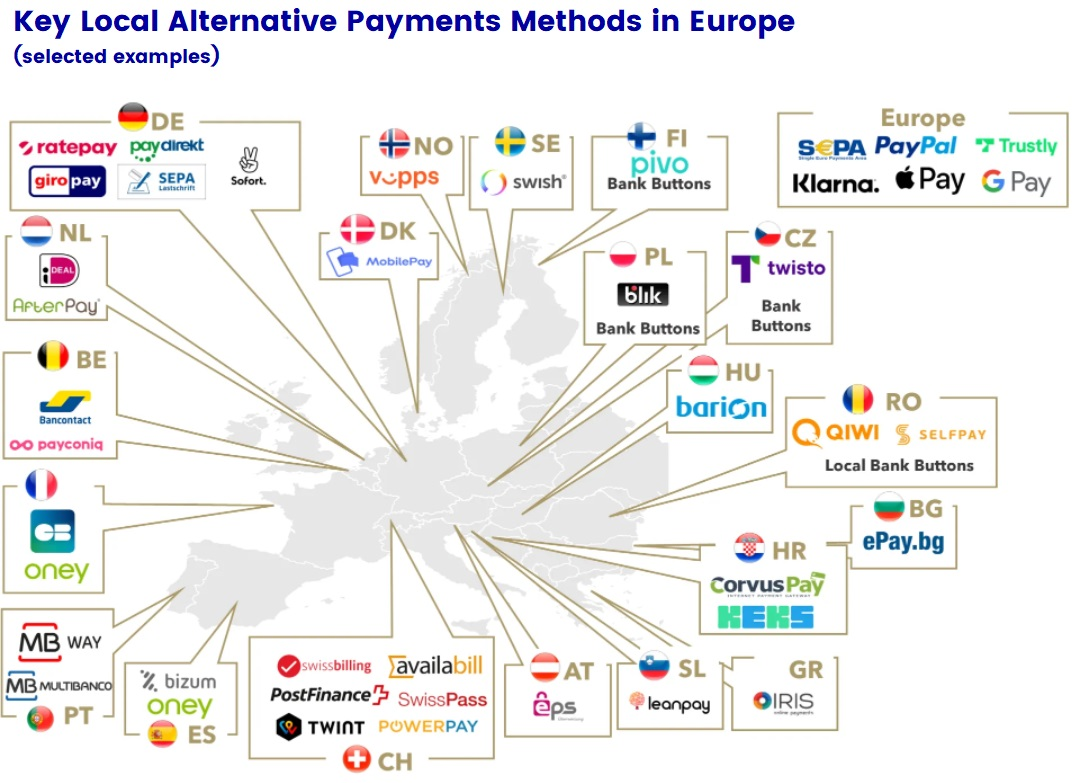
The fiat rail you use determines settlement speed, cost, and operational risk. Evaluate each venue against this checklist before assuming fiat settlement will work smoothly for your use case:
- Supported currencies: Confirm which fiat currencies the desk can send and receive — USD, EUR, GBP, and major regional currencies each require different banking relationships, and not every desk supports all of them.
- Rail types available: Identify whether the venue supports domestic wire, ACH (US), SEPA (Europe), SWIFT international wire, or local equivalents — each has different speed, cost, and finality characteristics.
- Cut-off times: Every rail has a daily cut-off time after which instructions submitted will not process until the next banking day. Confirm the specific cut-off for each rail you intend to use.
- Same-day availability: Ask whether same-day wire settlement is available for your currency and amount, and whether it requires advance notice or a specific account tier.
- Named or segregated accounts: Some venues provide named or segregated client accounts that reduce counterparty commingling risk and can simplify reconciliation. Verify whether this is available and what documentation it requires.
Plan settlement timing around known banking hours, confirm your desk's cut-off times in writing, and when capital deployment is time-sensitive, prefer on-chain or internal settlement options that are not subject to banking hour constraints.
Custody Options
1. Exchange custody: Assets are held in an account at the OTC venue. This is operationally the simplest model — settlement is internal, fast, and requires no on-chain transaction. Controls to verify include: withdrawal allowlists (so funds can only move to pre-approved addresses), multi-approval withdrawal policies for institutional accounts, and whether the venue holds custody insurance or publishes proof-of-reserves attestations. The primary risk is counterparty exposure to the venue itself — the client bears the risk of the exchange's solvency and security posture.
2. Third-party custodian integration: Assets are held by a regulated custodian (e.g., a qualified custodian or institutional-grade custody provider) that has a direct settlement relationship with the OTC desk. This model separates trading counterparty risk from custody risk. Controls to verify include: whether the custodian is independently regulated, what the settlement flow looks like (does the custodian release funds pre- or post-execution?), and what the turnaround time is for custodian-authorized transactions. The client bears less direct exchange custody risk but introduces a dependency on the custodian's operational speed.
3. Client self-custody via external wallet settlement: The OTC desk settles directly to a client-controlled external wallet after execution. This eliminates exchange custody risk post-settlement. Controls to verify include: whether the desk requires a pre-registered withdrawal allowlist, whether withdrawals require multi-signature or multi-approval authorization on the client side, and what the desk's wallet screening policy is for inbound funds. The client bears full self-custody responsibility — key management, wallet security, and on-chain fee management are entirely client-side.
For each custody pattern, confirm in writing what insurance coverage, if any, applies and at what point risk transfers from the desk to the client.
Compliance and KYC/AML
OTC desks apply more rigorous onboarding standards than retail exchanges, and documentation readiness directly affects how quickly you can execute.

For institutional onboarding (KYB — Know Your Business), expect to provide:
- Certificate of incorporation or equivalent formation documents
- Beneficial ownership disclosure (typically anyone holding 25% or more, though thresholds vary by jurisdiction)
- Source-of-funds and source-of-wealth documentation for the entity
- Corporate structure chart if operating through a holding structure
- Authorized signatory documentation and government-issued ID for each signatory
- Proof of address for the entity and, in some cases, for key principals
For individual/high-net-worth onboarding (KYC), expect:
- Government-issued photo ID (passport preferred for international clients)
- Proof of residential address
- Source-of-funds and source-of-wealth declarations
- In some cases, professional references or statements of net worth
If the desk flags your account for enhanced due diligence (EDD) — due to jurisdiction, transaction profile, or entity complexity — expect the onboarding process to extend from days to weeks. EDD review can also apply to individual transactions post-onboarding, placing a compliance hold on settlement until review is complete.
Sanctions screening and the Travel Rule both affect onboarding and settlement speed without necessarily requiring action from the client. Sanctions screening occurs at onboarding and may recur on transactions — any match, even a false positive, can pause settlement while the desk resolves it. The Travel Rule (requiring originator and beneficiary information to accompany transfers above threshold) adds data requirements to on-chain and fiat settlements.
10 Best OTC Crypto Exchanges (2026)
Before we go into detail on the top choices, a note on data freshness: OTC desk availability, minimums, and supported jurisdictions can change; verify directly with the desk before onboarding.
ChangeHero
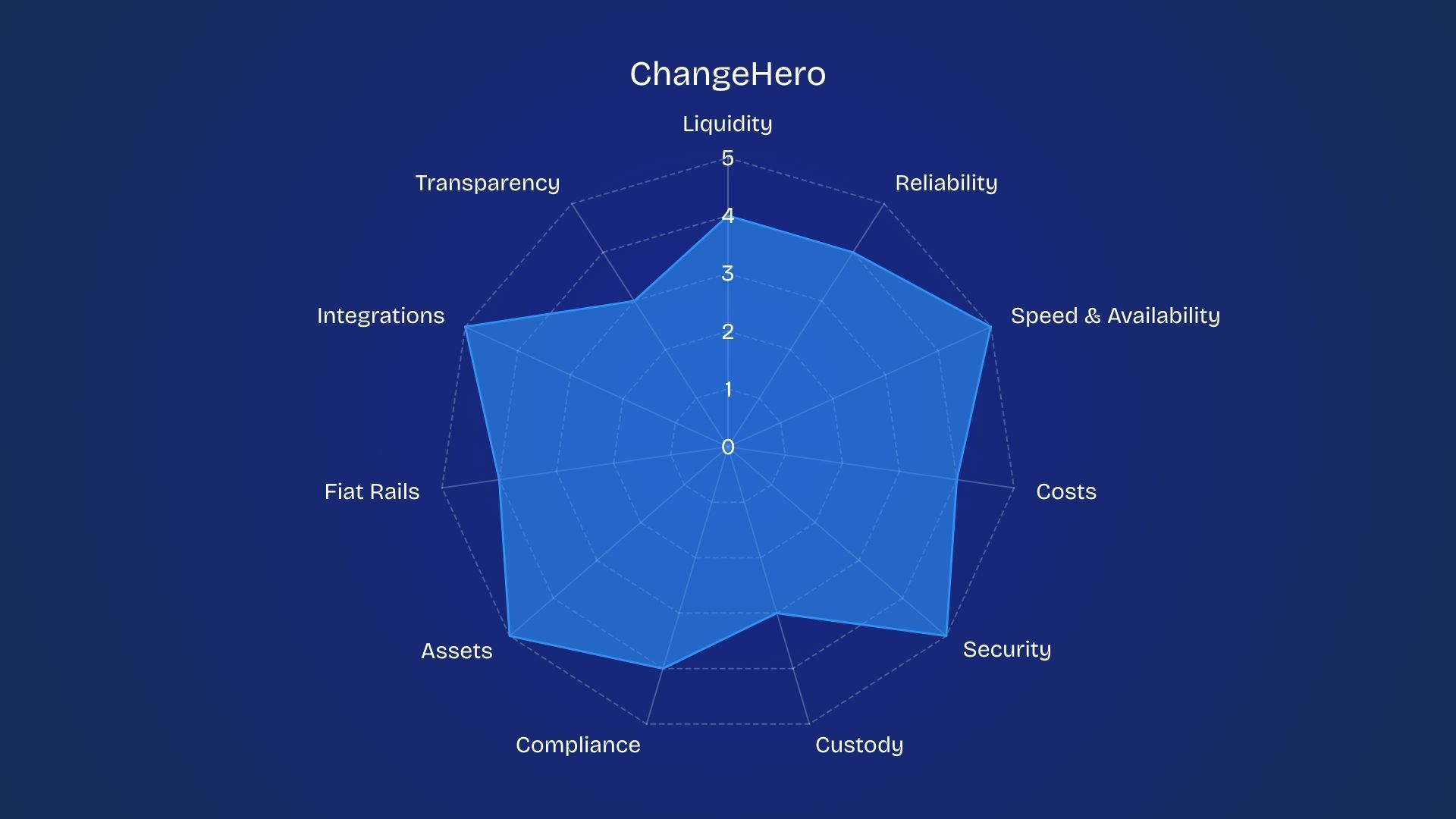
Best for: Global access to high-volume trading with competitive rates sourced from the top crypto exchanges.
Typical client: High-net-worth individuals, crypto companies.
Minimums & limits: contact our business team for more information.
Execution methods: RFQ via 10+ integrated CEX and DEX platforms, providing 400+ cryptocurrencies across the board.
Settlement & rails: Crypto-to-crypto trades settle within time frames and SLAs within the industry standard.
Asset coverage: Spot trading across 400+ cryptocurrencies.
Compliance & region notes: ChangeHero operates globally but maintains a list of Prohibited Jurisdictions—verify access in the Terms of Use for your specific situation.
Pricing model transparency: All-in spread quoted at time of RFQ; pricing is built into the workflow, with service fee and liquidity provider spread totaled into the result.
Primary risk/limitation: ChangeHero is a better fit for individuals or teams rather than institutional clients at a whole different level of accountability than the service can cover.
OTC desk note: Rather than operating a true OTC desk, ChangeHero handles high-volume transactions in a dedicated pipeline with involvement from the business and compliance teams.
Kraken OTC
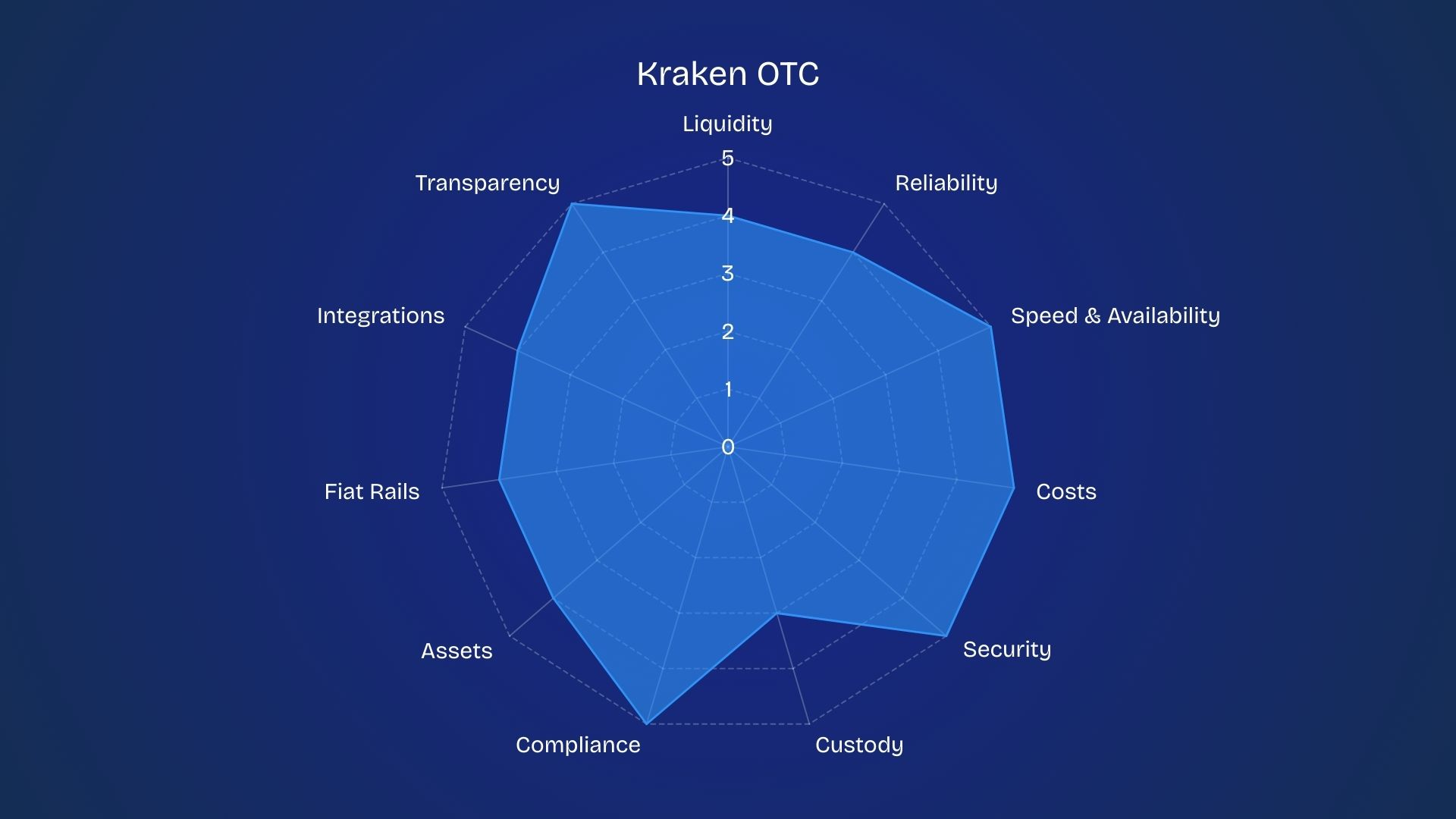
Best for: Institutions and high-volume traders needing fast spot and derivatives block execution with flexible settlement.
Typical client: Hedge funds, family offices, corporate treasuries, and professional traders executing large single transactions.
Minimums & limits: $50,000 minimum per trade.
Execution methods: RFQ via Kraken's OTC portal, enabling trades across 150+ pairs to be executed in seconds; voice and relationship-manager support also available for larger or more complex block trades.
Settlement & rails: Trades can be settled within 24 hours using a Kraken account, a bank transfer (fiat rail), and/or an external wallet—giving clients a choice of settlement option depending on custody preference.
Asset coverage: Spot and derivatives; 150+ trading pairs, one of the broader coverage sets among institutional OTC desks.
Compliance & region notes: Kraken serves clients in numerous jurisdictions including the US; eligibility depends on entity type and domicile—confirm with the desk for your specific situation.
Pricing model transparency: All-in spread quoted at time of RFQ; pricing transparency is built into the portal flow, with no separate commission line disclosed publicly.
Primary risk/limitation: Kraken's OTC desk is tightly integrated with its own exchange infrastructure, so clients who prefer fully segregated, third-party custody arrangements will need to confirm external wallet settlement workflows before onboarding.
OTC desk note: Kraken OTC operates separately from the standard Kraken retail exchange (maker-taker order book). The portal, minimums, and settlement terms described here apply to the OTC desk only.
Coinbase Prime
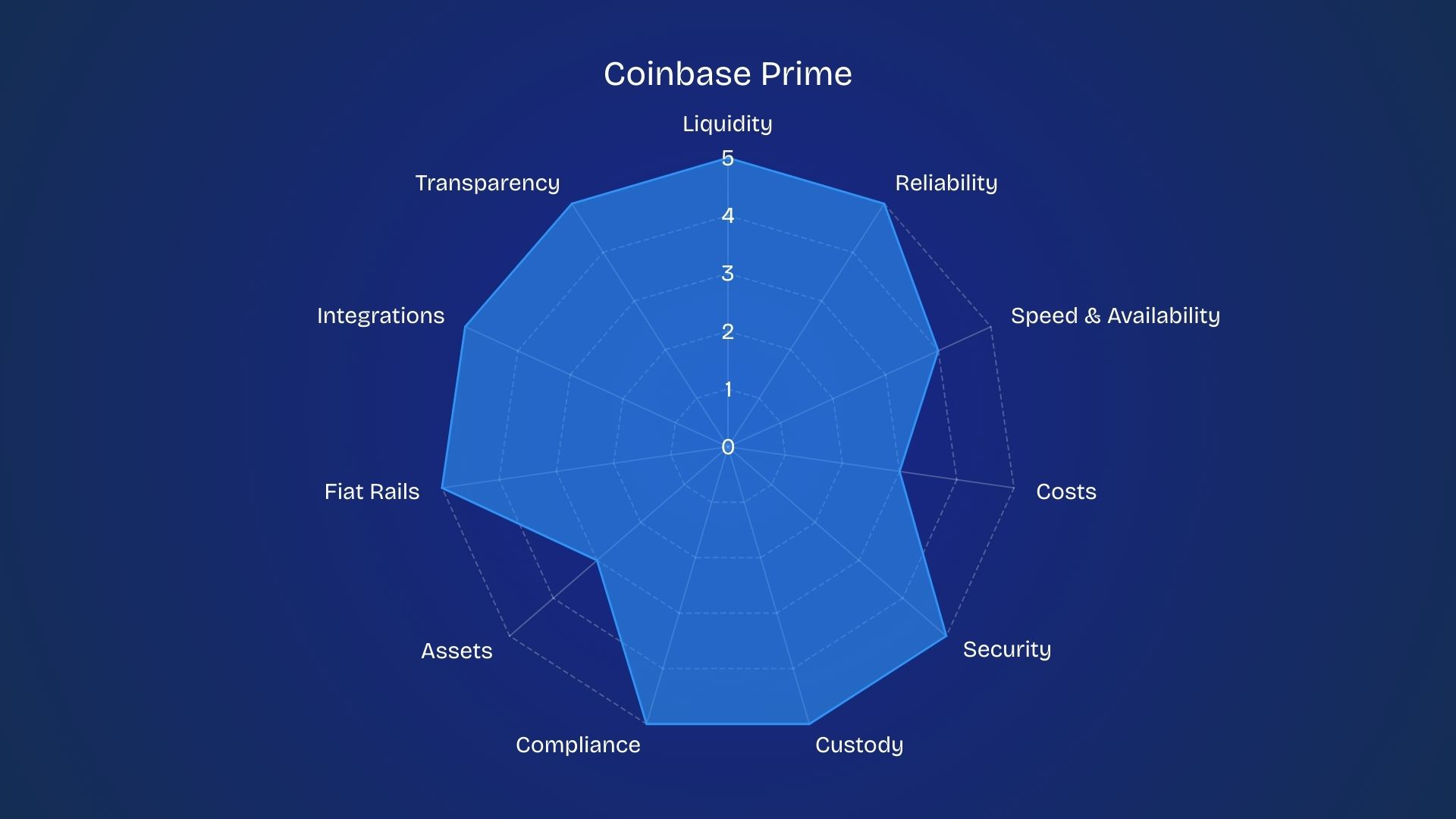
Best for: US-regulated institutions that require a fully integrated prime brokerage experience alongside OTC block execution.
Typical client: Registered investment advisers, hedge funds, publicly traded companies, and other entities with strict compliance and custody requirements.
Minimums & limits: Higher minimums typical; specific thresholds are not publicly listed and are determined at the account level.
Execution methods: RFQ via the Coinbase Prime portal; dedicated coverage team and voice execution available for institutional block trades.
Settlement & rails: On-platform settlement into Coinbase Prime custody is the primary model; fiat rails supported through regulated banking partners; external wallet settlement available but subject to onboarding approval.
Asset coverage: Spot; broad major-pair coverage with access to Coinbase's listed asset universe; derivatives block execution is not a publicly stated feature of the OTC desk.
Compliance & region notes: One of the strongest US eligibility footprints in the institutional OTC space; operates under US federal and state money transmission licenses; non-US institutions should confirm availability.
Pricing model transparency: All-in quoted spread at time of RFQ; spread/commission structure not published publicly—clients receive pricing at quote time.
Primary risk/limitation: Deep integration with Coinbase's own custody solution is a differentiator for many clients but a constraint for institutions that have a mandatory third-party custodian requirement.
OTC desk note: Coinbase Prime OTC is distinct from Coinbase Advanced Trade (the retail/professional order book). Maker-taker fees and standard exchange features do not apply to OTC block trade execution.
Binance OTC
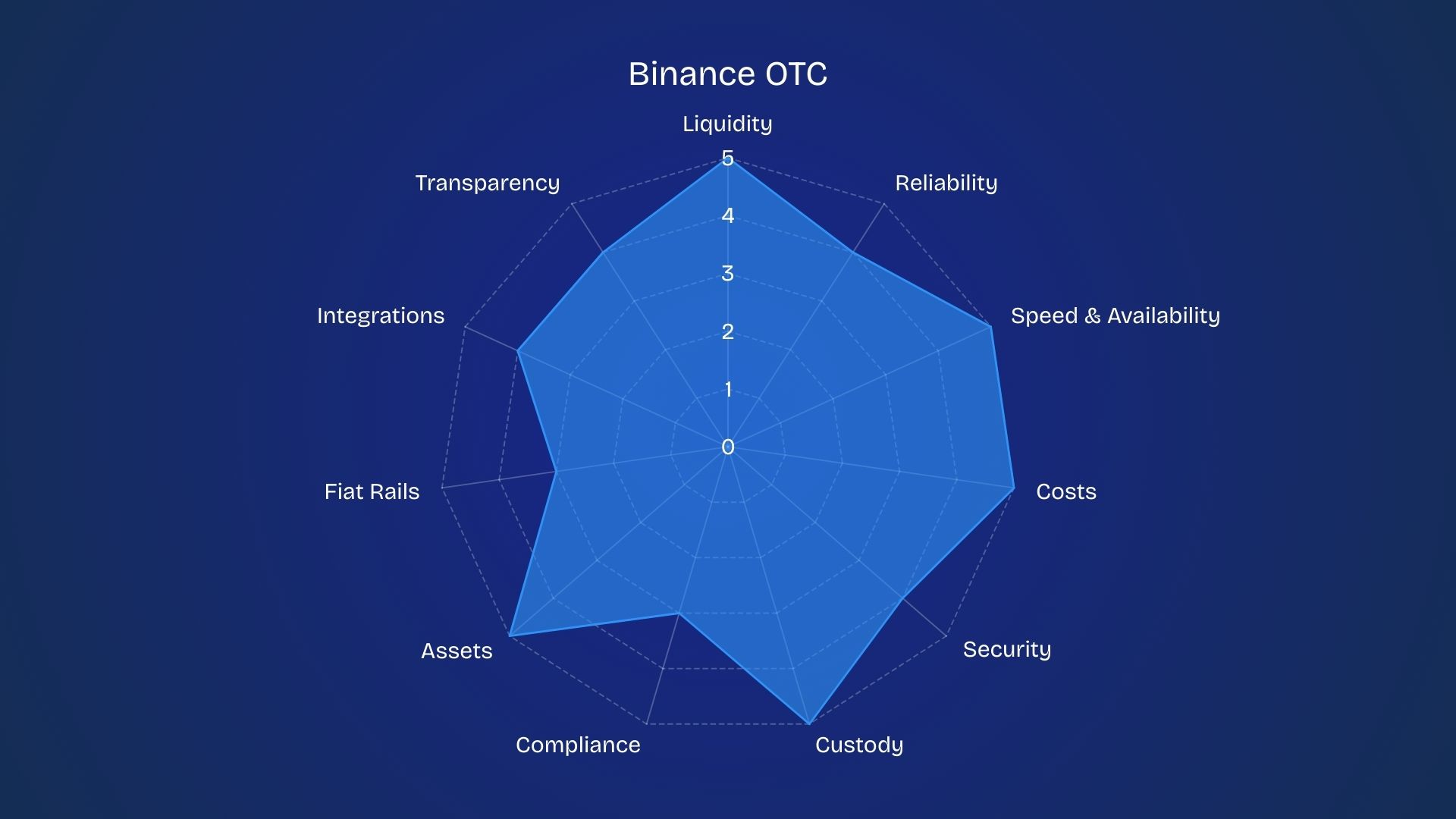
Best for: Global institutions and large traders seeking broad asset coverage and multiple execution channels for block trades.
Typical client: Crypto-native funds, market makers, and corporate clients operating outside the US.
Minimums & limits: Higher minimums typical; exact thresholds vary by asset and region and are not uniformly published.
Execution methods: RFQ portal (AutoRFQ for qualifying clients), voice execution, and API-based execution for systematic traders; one of the more complete execution model menus among major OTC desks.
Settlement & rails: Settlement primarily on-exchange within the Binance ecosystem; fiat rail availability varies significantly by jurisdiction; external wallet settlement available for crypto legs.
Asset coverage: Spot; extensive breadth across hundreds of tokens, which is a meaningful differentiator for clients trading in less liquid altcoins alongside major pairs.
Compliance & region notes: Binance OTC is not available to US persons; clients in certain other jurisdictions may also face restrictions—eligibility screening is essential before initiating onboarding.
Pricing model transparency: All-in spread quoted per RFQ; slippage and market impact are managed through block price negotiation rather than an order book; specific spread ranges are not published.
Primary risk/limitation: Regulatory history and the ongoing evolution of Binance's compliance posture in multiple jurisdictions represent a governance consideration that some institutional mandates may require review of before onboarding.
OTC desk note: Binance OTC is a separate service from Binance Spot and Futures exchange trading. Order book maker-taker fees do not apply to OTC desk transactions.
OKX OTC
Best for: Institutions and large traders looking for RFQ-based block execution with a platform that has recently re-entered the US market.
Typical client: Crypto-native institutions, proprietary trading firms, and high-net-worth entities in eligible jurisdictions.
Minimums & limits: Higher minimums typical; specific thresholds not publicly listed—confirm with the desk.
Execution methods: RFQ portal and voice/chat execution; API connectivity available for institutional clients.
Settlement & rails: On-platform settlement standard; fiat rail availability depends on jurisdiction; crypto settlement to external wallets supported.
Asset coverage: Spot; broad coverage across major pairs and a wide range of altcoins consistent with OKX's listed asset universe.
Compliance & region notes: OKX reported a relaunch of US operations in April 2025; this should be understood as a reported relaunch with that date context—it does not imply nationwide availability across all US states or entity types, and eligibility should be confirmed directly with the desk. Non-US clients in supported regions should similarly verify current availability.
Pricing model transparency: All-in spread quoted at RFQ; pricing transparency at the quote level; no publicly stated spread range.
Primary risk/limitation: Given OKX's relatively recent reported US relaunch, institutional clients with US regulatory sensitivities should conduct additional due diligence on the current jurisdictional and licensing status before onboarding.
OTC desk note: OKX OTC is separate from OKX's standard spot and derivatives exchange. Retail exchange fees and order book execution do not apply to OTC desk block trades.
Bitstamp OTC
Best for: Institutions seeking a regulated European-origin OTC venue with established fiat rail infrastructure.
Typical client: Banks, asset managers, and corporate clients, particularly those with European operational ties.
Minimums & limits: Suited for mid-to-large blocks; specific minimums not publicly listed.
Execution methods: Voice and relationship-managed execution; RFQ availability not publicly specified.
Settlement & rails: Strong fiat rail history given Bitstamp's long-standing banking relationships in Europe; crypto settlement available; settlement timing not publicly detailed.
Asset coverage: Spot; major pairs; breadth is more focused compared to broader multi-asset platforms.
Compliance & region notes: Bitstamp holds licenses in Luxembourg (EU) and the UK, and operates in the US; note that Bitstamp was acquired by Robinhood in June 2025—institutions evaluating Bitstamp OTC should factor in that change in ownership when considering governance, potential platform integration trajectories, and counterparty continuity, without speculating on specific future outcomes.
Pricing model transparency: Spread-based all-in pricing at time of execution; specific spread/commission rates are not publicly disclosed.
Primary risk/limitation: The Robinhood acquisition introduces a period of organizational transition that institutions with long-term counterparty stability requirements may wish to monitor.
OTC desk note: Bitstamp OTC is separate from Bitstamp's retail exchange order book. Standard exchange maker-taker fees do not apply to OTC desk execution.
Bitget OTC
Best for: Traders and institutions in Asia-Pacific and other non-US markets seeking a crypto-native OTC block execution venue.
Typical client: Crypto-native funds, high-volume traders, and regional institutions in supported jurisdictions.
Minimums & limits: Higher minimums typical; not publicly specified—confirm with the desk.
Execution methods: RFQ and chat-based execution; specific API availability for OTC not publicly specified.
Settlement & rails: On-platform settlement primary; fiat rail availability varies by region; external wallet crypto settlement available.
Asset coverage: Spot; broad altcoin coverage aligned with Bitget's exchange listings, which can be a differentiator for clients trading less common pairs.
Compliance & region notes: Bitget OTC is generally not available to US persons; eligibility varies by jurisdiction—confirm before onboarding.
Pricing model transparency: All-in spread at time of quote; pricing transparency at the individual trade level; no published spread range.
Primary risk/limitation: Bitget's regulatory licensing footprint is less extensive than some larger incumbents, which may be a consideration for institutions with counterparty compliance requirements.
OTC desk note: Bitget OTC operates separately from Bitget's standard spot and futures exchange. Exchange trading fees and order book mechanics do not apply.
Crypto.com Exchange OTC
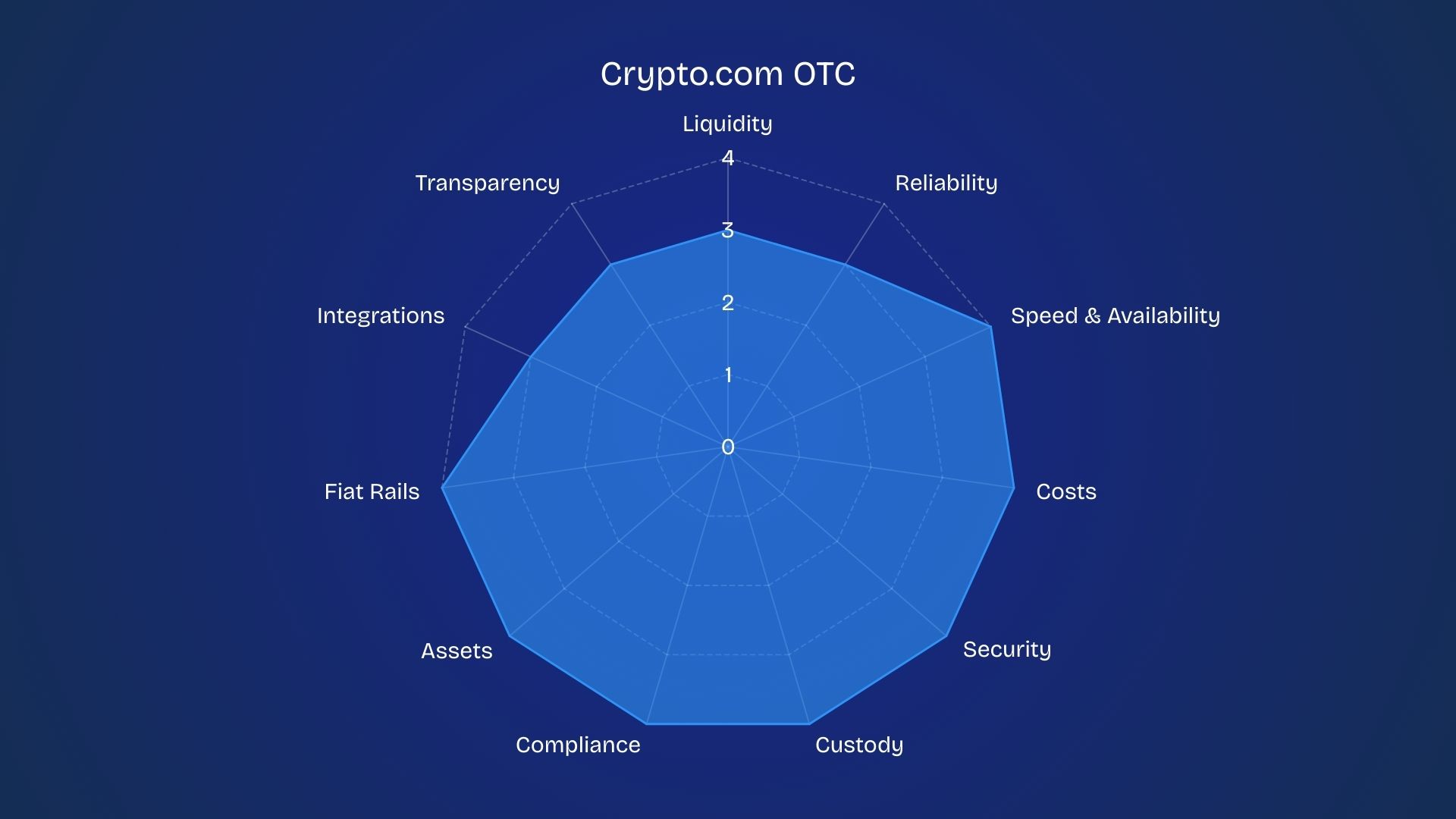
Best for: Mid-to-large institutional clients wanting a defined trade-size band with transparent spread guidance.
Typical client: Institutions, funds, and high-net-worth entities transacting in the $50,000–$5,000,000 range per order.
Minimums & limits: $50,000 minimum trade size; maximum OTC order amount of $5,000,000 per trade.
Execution methods: RFQ via the Crypto.com OTC portal; relationship manager support available for qualifying clients.
Settlement & rails: On-platform settlement into Crypto.com Exchange accounts; fiat rail options available; external wallet settlement availability should be confirmed with the desk.
Asset coverage: Spot; major pairs with coverage across Crypto.com's listed assets.
Compliance & region notes: Availability varies by jurisdiction; US eligibility should be confirmed directly with the desk given evolving regulatory context.
Pricing model transparency: The platform has cited an OTC spread range of approximately 0.25% to around 1%—treat this as an observed indicative range rather than a guaranteed rate, as actual spreads will vary by asset, size, and market conditions. This is one of the few cases where any spread guidance is publicly associated with a major OTC desk.
Primary risk/limitation: The $5,000,000 per-order cap means very large block trades will need to be broken into multiple transactions, which introduces execution model considerations around timing and aggregate market impact for clients trading at the upper end of institutional size.
OTC desk note: Crypto.com Exchange OTC is distinct from Crypto.com's retail exchange and App products. Standard retail maker-taker fee tiers and order book execution do not apply to OTC desk trades.
Gemini OTC
Best for: US-based institutions prioritizing a regulated, trust-chartered counterparty with integrated custody.
Typical client: Registered investment advisers, family offices, and institutional buyers requiring a US-regulated custodian alongside OTC execution.
Minimums & limits: Higher minimums typical; specific thresholds not publicly listed.
Execution methods: Voice and relationship-managed execution; RFQ portal availability not publicly specified.
Settlement & rails: Direct integration with Gemini Custody (a New York trust company) is a core differentiator—settlement option includes on-platform custody without needing a separate custodian relationship; fiat rails via ACH and wire.
Asset coverage: Spot; major pairs; asset breadth is more selective, consistent with Gemini's conservative listing approach.
Compliance & region notes: Strong US eligibility footprint; Gemini operates under New York Department of Financial Services oversight; one of the cleaner compliance profiles for US institutional clients.
Pricing model transparency: Spread-based all-in pricing at execution; no publicly stated spread or commission schedule for the OTC desk.
Primary risk/limitation: Gemini's more conservative asset listing approach means clients trading a wide range of altcoins may find coverage more limited than on broader platforms.
OTC desk note: Gemini OTC is separate from Gemini's ActiveTrader and retail exchange products. Order book maker-taker fees and retail platform features do not apply to OTC desk transactions.
FalconX
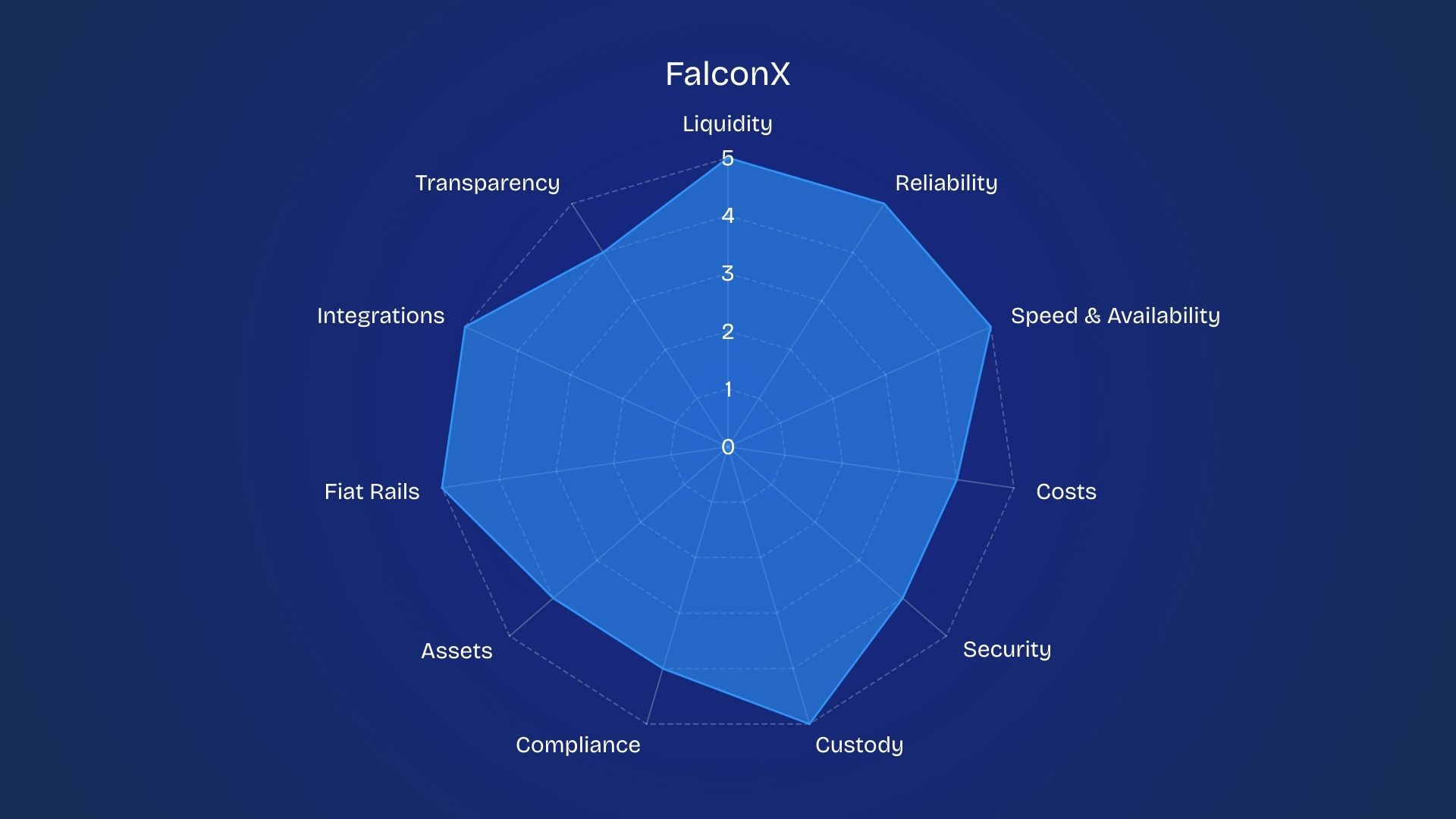
Best for: Sophisticated institutional clients—particularly funds and prime brokerage relationships—that require the deepest block trade execution infrastructure with multi-venue liquidity aggregation.
Typical client: Hedge funds, venture funds, market makers, and large crypto-native institutions executing at scale.
Minimums & limits: Higher minimums typical; FalconX is positioned for larger institutional block sizes—not suited for smaller transactions.
Execution methods: RFQ and API-native execution model; FalconX's platform is built around programmatic and relationship-managed block trade execution, making it one of the more API-forward OTC venues for institutional clients.
Settlement & rails: Multi-venue settlement capability; fiat rails through institutional banking relationships; crypto settlement to external wallets; custody integration options with major institutional custodians—settlement option flexibility is a core part of the value proposition.
Asset coverage: Spot and derivatives block execution; coverage across major pairs and a meaningful altcoin selection; derivatives block trade support is an explicit differentiator.
Compliance & region notes: FalconX is a US-regulated entity (registered with FinCEN; holds money transmitter licenses in applicable states); serves institutional clients in the US and internationally—one of the stronger US eligibility profiles among pure-play institutional OTC and prime desks.
Pricing model transparency: All-in spread quoted at execution via RFQ; pricing transparency at the trade level; slippage and market impact managed through aggregated liquidity across multiple venues rather than a single order book.
Primary risk/limitation: FalconX is purpose-built for institutional scale—clients without the operational infrastructure to support API integration, credit arrangements, and institutional onboarding processes may find the platform's complexity a barrier relative
OTC Trading Features That Matter
Evaluating an OTC crypto exchange goes beyond checking the headline spread. The execution model, settlement rail, and coverage structure each carry measurable consequences for price, risk, and operational friction.
Execution Methods
| Execution Path | When It's Optimal | Key Trade-off |
|---|---|---|
| Voice/manual RFQ via dealer | Relationship-driven, bespoke structures, large clips where nuance matters | Slowest; dealer has information advantage once size is revealed |
| Electronic RFQ/portal | Speed and auditability matter; mid-size tickets | Quote window is short (often 5–30 seconds); partial-fill policy varies by desk |
| Algorithmic/agency execution (TWAP/VWAP-style) | Large conversions where minimizing slippage outweighs speed | Higher operational overhead; execution spans minutes to hours, introducing timing risk |
| Principal vs agency model | Principal: price certainty now. Agency: potentially better average price, desk earns commission | Principal fills expose dealer inventory; agency shifts market impact risk back to you |
| Single-dealer vs multi-dealer quoting | Multi-dealer tightens spreads on competitive tickets; single-dealer preserves confidentiality | Multi-dealer increases information leakage risk on sensitive positions |
What to ask the desk before trading:
- Is your quote sourced from internal inventory, external liquidity providers (LPs), or both—and what's the split?
- What is the quote validity window, and does it shorten during volatile market regimes?
- What is your partial-fill policy—do unfilled clips expire, roll, or require a new RFQ?
- Is the price all-in (spread and commission included in one number), or will fees appear as a separate line item?
- Can you show me a recent sample confirmation so I can verify how pricing is itemized?
Market Impact Management

Three distinct risks are often conflated in OTC discussions, and conflating them leads to the wrong mitigation: market impact means your own order moves the price against you as it executes—most relevant on large block execution relative to available liquidity. Information leakage refers to counterparties or intermediaries inferring your direction before execution completes and trade ahead, widening your effective cost. If the desk hedges your fill on a spot venue while you hold a derivatives position, temporary price divergence between instruments creates residual exposure called basis risk.
Mechanisms desks use to reduce impact:
- Order slicing: Breaking a large order into smaller clips distributed over time reduces the visible footprint on any single venue.
- Time-distributed execution: Spreading fills across a defined window (analogous to a TWAP algorithm) flattens your average price against short-term volatility spikes.
- Internalization: Matching your order against the desk's existing client flow without touching external venues eliminates external market impact entirely.
- Crossing networks: Pairing opposing institutional flows anonymously, often at or near mid-price, benefits both sides without signaling direction to external markets.
- Hedging procedures: Desks running a principal model will hedge residual inventory; understanding their hedge venue and timing is essential to assessing your effective basis risk.
On a major pair like BTC/USD, time-distributed execution is effective because liquidity replenishes quickly but on a thin pair (a low-cap altcoin or an exotic fiat corridor), spreading execution over time can increase impact because the liquidity pool doesn't recover between clips. For thin pairs, a single internalized fill or a crossing with an opposing client order is structurally superior to any algorithmic slice-and-dice approach.
Order Types
OTC order types extend well beyond the limit/market binary that you may be familiar with from exchange trading. Core OTC-relevant constructs are:
- Firm quote vs indicative quote: A firm quote is a binding commitment to trade at the stated price within the validity window. An indicative quote is directional only—the desk will re-price when you go to execute. Always confirm which type you are receiving before making a decision.
- Time-in-force for RFQs: Most electronic RFQ portals operate on hard expiry windows (5–30 seconds). Voice RFQs via a relationship manager may carry soft windows, but the dealer can pull the quote if the market moves materially.
- Partial execution and clip sizes: Some desks set minimum clip sizes (the smallest fillable unit of a larger order). Confirm whether unfilled clips expire or remain live, and whether each clip generates a separate confirmation for reconciliation.
- Trigger/conditional orders: Certain desks offer structured contingency execution—if BTC/USD reaches a specified level, the order activates. These are typically arranged via relationship manager, not portal.
- Portfolio/basket execution: A single RFQ covering multiple assets simultaneously (e.g., sell BTC + ETH + SOL in one ticket) reduces leg risk on multi-asset conversions. This is almost exclusively a relationship-manager function; portals rarely support it natively.
Settlement Options
Settlement is where execution-side efficiency gets preserved or eroded. Each settlement rail carries distinct cutoff times, finality characteristics, fee structures, and reconciliation burdens.
| Rail | Speed | Finality | Fees | Reconciliation Burden |
|---|---|---|---|---|
| On-exchange / internal account transfer | Near-instant (same platform) | Immediate; platform-reversible only by agreement | Minimal or zero | Low—single platform ledger |
| On-chain to external wallet | Minutes to ~1 hour (network-dependent) | Irreversible after sufficient confirmations | Network/gas fees; vary by chain congestion | Medium—requires address whitelisting, txid matching |
| Fiat wire / ACH / SEPA equivalent | 1–3 business days (wire); longer for ACH/SEPA | Reversible within bank window; subject to compliance holds | Bank fees both sides; correspondent charges on cross-border | High—requires banking details, reference matching, cut-off adherence |
| Stablecoin settlement | Minutes to ~1 hour | Irreversible on-chain; smart-contract risk present | Network fees lower than fiat wire; stablecoin redemption fees may apply | Medium—requires wallet whitelist; issuer redemption confirmation if converting out |
Delivery-versus-payment (DvP) expectations and settlement risk reduction:
Pure DvP—simultaneous exchange of assets and payment with zero gap—is structurally difficult in crypto OTC given the asynchronous nature of blockchain finality and fiat banking hours. Desks manage this through several practical mechanisms:
- Prefunding: Requiring the client to pre-position funds (fiat or crypto) before execution begins. This eliminates counterparty credit risk but adds cash drag.
- Staged release: Crypto leg settles first (faster finality), fiat leg follows within a defined window. Common for institutional clients with established credit.
- Third-party custody: Assets held in a neutral custody account until both legs confirm, approximating true DvP but adding custody fees and coordination overhead.
- Confirmation chains: Multi-step sign-off (internal compliance → operations → custody) that slow settlement but reduce error and fraud exposure.
Relationship Coverage and White-Glove Service
"Coverage" is a term OTC desks use loosely. In practice, it describes a bundle of service components that determine how much operational risk you absorb versus how much the desk absorbs on your behalf:
- 24/7 availability: Markets don't close; your coverage team shouldn't either—especially for crypto where weekend dislocations are common.
- Named coverage team: A specific individual (or small team) who knows your mandate, entity structure, and operational constraints. Generic support queues are not coverage.
- Escalation path during volatility: A documented process for reaching a senior dealer or risk officer when markets are moving fast and standard procedures won't hold.
- Post-trade reporting: Structured trade confirmations, daily/monthly statements, and audit-trail documentation compatible with your accounting and compliance requirements.
- Coordinated large conversion planning: For treasury-scale moves or fund rebalances, proactive market timing guidance, execution scheduling, and internal coordination across the desk's liquidity and operations teams.
Regional Eligibility and Availability
Whether you can access a U.S.-available OTC desk depends on more than just geography. Onboarding rules, licensing structures, and state-level availability all interact—and because platforms update these regularly, checking current eligibility before you request a quote or initiate KYC is essential. OKX's U.S. relaunch in April 2025, for example, demonstrates how quickly regional availability can shift; assumptions based on a platform's status even six months prior may no longer hold. Always verify directly before proceeding.
United States Eligibility
As much as this would have been preferable, "U.S. availability" for OTC crypto exchange services isn't a single binary condition. In practice, some platforms grant partial access while blocking others:
- Onboarding availability — whether the platform accepts U.S.-based individuals or entities into its KYC/KYB process at all.
- Trading availability — whether you can submit and receive RFQ responses and execute trades once onboarded.
- Settlement availability — whether you can fund via USD fiat rails and withdraw to a U.S. bank account. This is often the most constrained layer, even for platforms that accept U.S. clients for onboarding and trading.
Treat these as separate access requirements. A platform may onboard you, allow you to trade, and still be unable to process a USD wire withdrawal depending on its banking relationships.

You can usually access a U.S.-available OTC desk if you are a U.S.-based individual (retail) or entity (business) in a supported state, you can complete identity verification (KYC for individuals; KYB for businesses, including documentation of beneficial ownership, incorporation, and source of funds), and your funding method is compatible — typically a domestic USD wire from a U.S. bank account; ACH and other fiat rails vary by platform. For institutional or business access: your entity type is recognized (LLC, corporation, trust, etc.) and your jurisdiction is not restricted at the entity level.
Licensing and Oversight
OTC desks at major platforms — including Coinbase, Kraken, Gemini, OKX, and Binance — frequently operate through a separate legal entity from the retail exchange front-end. This is not a technicality; it has direct compliance and contractual implications:
- Which entity you are contracting with? The legal counterparty on your OTC trades may differ from the brand name you associate with the platform. Confirm the contracting entity name in the platform's terms of service or master trading agreement, then verify it matches the entity named on invoices, wire instructions, and settlement confirmations. Mismatches are a red flag.
- Which compliance program governs the trade? Prime services and OTC desks often operate under a different licensing and AML/KYC framework than the retail exchange. The regulatory posture — including which state money transmission licenses apply, whether the entity is registered as a broker-dealer, and how settlement is handled — may differ materially from what you'd encounter opening a standard exchange account.
During due diligence, locate the platform's legal entity disclosures: check the footer of the legal/terms page, the privacy policy header, and any dedicated "regulatory information" or "licenses" page. Confirm the entity name on the platform's legal pages matches the name on wire instructions and any invoices or trade confirmations you receive. Before sending any funds, request from the OTC desk: (a) counterparty and settlement instructions in writing, (b) onboarding documentation confirming your account is fully approved, and (c) confirmation of which licensed entity is the counterparty to the trade. Cross-reference any stated licenses (e.g., state money transmitter licenses, FinCEN MSB registration) against the relevant state or federal registry independently.
Supported States
Platforms publish supported and unsupported state lists because U.S. state-level money transmission licensing, BitLicense requirements (New York), and other local regulations determine where a platform is legally permitted to operate. These lists are not static — licensing approvals are granted and revoked, regulatory requirements change, and platforms expand or contract their U.S. footprint over time.
To verify your state's current status, navigate to the platform's legal, compliance, or terms of service section and locate the "supported states," "restricted jurisdictions," or "availability" page. This is typically linked from the footer or the sign-up flow. If you cannot find a definitive list, contact the platform's OTC support directly and ask in writing whether your state of residence (for individuals) or state of incorporation (for entities) is currently supported for onboarding, trading, and USD settlement.

Confirm this before initiating KYC or KYB. Completing onboarding in a state that is subsequently found to be unsupported can delay or block your access to settlement. Moreover, recheck periodically — especially before a large trade or if significant time has passed since you last verified.
Key Considerations and Risks
Every OTC trade carries operational risk that goes beyond price. A quote can look competitive and still cost you through settlement failure, hidden spread, or a counterparty you cannot properly vet.
Counterparty Risk
Not every OTC desk operates the same way, and the type of counterparty you face determines the category of risk you are taking:
- Exchange-run OTC desk – The platform itself is the counterparty or facilitates the trade on its own books. Risk: the desk may have informational advantages, and your recourse in a dispute depends entirely on that platform's terms.
- Agency broker – The broker routes your order to external liquidity providers and earns a commission. Risk: execution quality depends on the broker's network, and the true execution venue may not be disclosed to you.
- Principal liquidity provider – An independent market maker takes the other side of your trade from its own inventory. Risk: the provider is trading against you as principal, with full discretion over the quote and spread offered.
The risk signals include but are not limited to refusal to disclose settlement flow or name the legal entity that holds your funds during the transaction, inconsistent banking beneficiary details across communications (a common indicator of fraud or internal control failure), an unclear or missing legal entity on the term sheet or trade confirmation, quote or confirmation documents that arrive through informal channels (personal email, messaging apps) rather than official, documented systems. The brightest of these red flags must be the pressure to move quickly without time to verify counterparty identity or confirm settlement instructions through a second channel.
Before executing any OTC trade, obtain written confirmation of the following: the full legal name and jurisdiction of the entity you are contracting with; the platform's dispute resolution process and, if fiat rails are involved, its chargeback or reversal posture; the format in which trade confirmations are delivered (email, portal, API) and how they are archived; specific settlement instructions, including beneficiary name, account number, and wallet address where applicable; and the desk's process for handling trade discrepancies or unmatched settlements.
Settlement Risk
Speaking of which, settlement risk is distinct from execution risk. A trade can be agreed at a good price and still fail, be delayed, or incur friction depending on the settlement rail used.
| Rail | Failure Mode 1 | Failure Mode 2 | Mitigation |
|---|---|---|---|
| On-exchange internal transfer | Platform-side compliance hold that freezes credited funds post-trade | Incorrect account mapping causing credit to wrong sub-account | Confirm internal settlement mechanics in writing with the desk before trading |
| On-chain to external wallet | Chain congestion delaying confirmation beyond expected window | Missing or incorrect memo/destination tag causing funds to be unrecoverable at the receiving address | Pre-register and verify destination addresses; always include required tags |
| Fiat bank wire / ACH / SEPA | Beneficiary mismatch triggering a compliance rejection or return | Cutoff times causing a wire to settle the next business day, creating overnight exposure | Send a test wire for new beneficiaries; submit wires before published cutoff times |
Bear in mind the distinction between trade time vs settlement time vs finality: trade time is when price and quantity are agreed. It locks your execution cost but does not move assets.
Settlement time is when assets actually transfer. This varies by rail: on-chain transfers depend on network confirmation times; fiat wires can take one to three business days depending on bank and cut-off; internal exchange transfers may be near-instant.
Finally, finality is when the transfer becomes irreversible. For fiat, bank finality is the point at which a returned or recalled wire is no longer possible—this is not the same as receiving credit. For blockchain transactions, finality depends on the number of confirmations the receiving party requires, which varies by chain.
Settlement friction compounds when you combine rails—for example, a trade quoted in crypto but settled partially in fiat introduces both on-chain and wire cutoff risk in the same transaction.
Pricing Opacity
OTC quotes are constructed differently from exchange order books, and the difference matters for your actual execution cost. An OTC desk may quote on an all-in basis—meaning the spread, any commission, and the desk's margin are bundled into a single price—or it may separate a spread plus commission structure where fees are stated explicitly. These are not equivalent in transparency.
Reference pricing is also variable. Some desks derive their quote from an aggregated index of public exchange prices; others use internal pricing models that are not disclosed. The practical implication is that you cannot always verify whether the quote you received was competitive without independently checking the mid-market price at the same moment.
Furthermore, quote validity also varies: a quote may be valid for a fixed window (10–30 seconds is common on RFQ desks) or until market conditions change. Understanding the time-in-force of a quote prevents disputes when a market moves between verbal agreement and signed confirmation.
Before accepting an OTC quote, ask:
- What reference price was used to construct this quote, and can you show the mid-market rate at the time of quoting?
- Are there size-banded spreads—does the pricing change at different notional tiers?
- What fees are embedded in the all-in price, and is there any separate commission?
- If the trade is only partially filled, what are the slippage and partial-fill rules?
- If the market moves before settlement, how is repricing handled, and who bears that risk?
Volume Reporting Limitations
Public exchange volume data does not include OTC. This matters because desks routinely cite liquidity depth as a reason to trade with them, but that claim may not be independently verifiable from public sources.
Volume reported on exchanges reflects on-book trading activity. OTC trades—executed bilaterally through an RFQ desk or direct negotiation—are typically not reported to public data aggregators. When a desk tells you it executes "$X billion per month," that figure exists outside any publicly audited record. Trusting liquidity claims without a verification path is a meaningful risk, particularly for large or infrequent traders who cannot build their own dataset through repeated experience.

When evaluating an OTC crypto exchange or RFQ desk, request:
- Historical RFQ logs showing quoted vs executed rates for trades of similar size to yours.
- Fill-rate statistics: what percentage of RFQs at your target size were fully filled vs partially filled vs declined.
- Anonymized execution samples demonstrating performance in both high- and low-liquidity conditions.
A desk that cannot or will not provide any of this should be treated with skepticism about its liquidity claims.
Security Controls
Security risk in OTC trading is both a platform problem and a process problem. On the platform security level, users must acknowledge:
- Cold storage policy: Request written confirmation of the percentage of client assets held in cold storage and the conditions under which assets are moved to hot wallets.
- Withdrawal allowlisting: Confirm whether the platform supports pre-approved wallet address allowlists for institutional accounts, preventing unauthorized withdrawals to new addresses.
- 2FA / U2F: Verify that the platform supports hardware security key authentication (U2F/FIDO2) for account access, not only SMS or TOTP.
- Role-based access: For institutional accounts with multiple team members, confirm that granular role-based access controls are available—differentiating, for example, between users who can view balances, execute trades, and initiate withdrawals.
However, expecting even the most reputable provider to handle all security measures is futile if you do not commit to the process level:
- Out-of-band verification: Any new settlement instruction or change to existing instructions should be verified through a second communication channel (phone call to a known number, not a callback to a number provided in the same email chain).
- Dual approval for settlement: Require that outbound settlement instructions above a defined threshold require approval from two named individuals, whether on the desk's side or your own.
- Phishing-resistant communications: Establish a named, verified contact and a consistent communication method before trading. Be skeptical of any mid-trade instruction change that arrives through an unfamiliar channel or email address.
- Secure wallet address handling: Never copy-paste wallet addresses from emails without independently verifying the address through a second source. Clipboard-hijacking malware targets exactly this step.
The less time assets spend in intermediary accounts, the lower your exposure to platform risk, operational error, and fraud. Register destination wallet addresses with the desk before trading so that settlement can proceed to a known, verified address without requiring new instruction approval at settlement time. Before settling a full-size transaction to any new external wallet or bank account, send a small test amount and confirm receipt before authorizing the remainder. Once settlement instructions are agreed and confirmed, treat any mid-trade request to change beneficiary details as a high-priority fraud signal. Establish a policy—documented in advance—that instruction changes require re-verification through a named contact via a pre-agreed channel.
These practices reduce both the window of exposure and the operational surface area for fraud, error, or settlement failure.
Conclusion
Choosing the best OTC crypto exchange isn't a single answer—it depends on your trade size, region, settlement needs, and compliance requirements. "Best" in this guide means optimizing for execution quality, settlement reliability, and compliance fit, not simply the tightest spread on a single trade. The desk that's ideal for a US-based institution clearing $5M in USDC may be entirely wrong for a Europe-based fund settling in EUR via wire.
As a general pricing expectation: OTC desk spreads typically range from 0.25% to ~1%, and widen on thin pairs, during high volatility, or outside standard banking hours—so always confirm your all-in quote before committing to a trade size.
Frequently Asked Questions
What is the minimum trade size for OTC crypto?
Minimum trade sizes vary widely across providers. Kraken OTC requires a minimum of $100,000 per trade, positioning it squarely for institutional and high-net-worth clients. On the higher end, some prime desks set floors at $250,000 or more. Crypto.com OTC accepts trades starting at $30,000 with no stated maximum, illustrating how mid-tier venues are lowering the barrier. Always confirm the current threshold directly, as minimums shift with market conditions and client tier.
What is the difference between an OTC exchange, OTC desk, broker, and prime brokerage?
These terms are often used interchangeably but carry distinct practical implications. An OTC exchange is a platform that facilitates peer-to-peer or desk-matched trades outside a public order book. An OTC desk (sometimes called an RFQ desk) is a trading team — either within an exchange or standalone — that provides quotes on request and acts as counterparty or agent. A broker arranges trades between two parties without holding custody. A prime brokerage offers bundled services: credit, custody, execution, and reporting. Who holds custody, who is your legal counterparty, and the depth of KYC/KYB onboarding all differ significantly across these structures — confirm each before signing an agreement.
When should I prefer OTC over an order book exchange?
The core decision check is market impact: if your trade size exceeds roughly 1–2% of visible liquidity on the order book for that pair, routing through an order book will move the market against you. For thin pairs — assets with low daily volume — even smaller trades can cause significant slippage. Time-sensitive block execution favors OTC when you need a single, locked price rather than a filled average. Ask the desk directly: "Where are you sourcing your quote — your own inventory, aggregated liquidity, or a specific LP?" The answer tells you how competitive the all-in quote is likely to be.
How are OTC prices set and what fees do I pay?
OTC desks price trades using either a spread (built into the buy/sell rate, no separate line item) or an explicit commission on top of mid-market. Many desks use a hybrid. Crypto.com OTC, for example, operates within an observed spread range that varies by asset and trade size, with no minimum stated commission. Before confirming any trade, verify the following in your all-in quote:
- Spread or commission: How is the desk's margin applied?
- Settlement fees: Any per-transfer or network fees?
- Banking/wire fees: Who absorbs intermediary bank costs on fiat legs?
- Time-to-settle: When does finality occur, and does that affect your cost of capital?
Never accept a quote without confirming all four components.
How long does OTC settlement take?
Settlement timing depends on the rail used. Exchange account transfers (both counterparties on the same platform) are typically T+0 — sometimes minutes. Kraken OTC, for instance, supports deep liquidity across a broad range of pairs with settlement into exchange accounts executed rapidly. Bank wire / fiat settlement is subject to banking hours, cutoff times, and correspondent bank chains — expect same-day to T+2 depending on currency corridor and jurisdiction. On-chain / external wallet settlement varies with network congestion and block confirmation requirements, and compliance review of wallet addresses can add time. Any compliance flag, large transaction report trigger, or missed settlement cutoff can push settlement to the next business day or longer.
Is OTC trading only for institutions?
No — though it originated in institutional markets, OTC crypto exchange access has broadened. The eligibility signals to watch are: KYC (standard identity verification for individuals) versus KYB (business verification with UBO disclosure and incorporation docs), stated trade minimums, and whether the venue assigns a dedicated relationship manager. As noted in the minimum-size FAQ, some desks now accept trades from $5,000–$30,000. VIP tier programs at larger exchanges like Binance and Coinbase can also unlock OTC access for high-volume retail traders who don't meet institutional definitions. Check the onboarding path — some venues list institutional-only in their marketing but accept verified high-net-worth individuals.
Do OTC desks support derivatives?
Most OTC crypto desks focus on spot execution — buying or selling actual crypto assets at a negotiated price. Derivatives (options, forwards, perpetual swaps) are less commonly available at pure OTC desks and are more typical of prime brokerage or dedicated derivatives desks. OKX and Binance offer derivatives alongside OTC spot services, but these are often separate products with different onboarding and margin requirements. If you're seeking to hedge a large spot conversion using options or forwards, confirm explicitly whether the desk offers derivatives or can introduce you to a counterparty that does — don't assume spot OTC access extends to structured products.
What documents do I need for OTC onboarding?
Documentation requirements vary by venue and jurisdiction, but expect the following:
Individuals: government-issued photo ID, proof of residential address (utility bill, bank statement), source of funds declaration, and a completed KYC form.
Businesses: certificate of incorporation and constitutional documents, Ultimate Beneficial Owner (UBO) identification and verification, corporate structure chart, source of funds and anticipated trading activity, and authorized signatory documentation and trading authorization letter.
Some desks also request a prior trading history or reference from an existing counterparty for large initial trades. Prepare these before outreach to avoid onboarding delays.
How do I reduce counterparty and settlement risk in OTC trades?
Follow this five-point checklist before and during each trade:
- Use a regulated venue where possible — check licensing status in the relevant jurisdiction.
- Confirm the settlement method upfront — know whether funds move via exchange account, bank wire, or on-chain transfer before agreeing to price.
- Test with a smaller transaction first — especially with a new desk or counterparty, run a reduced-size trade to verify operational flow.
- Confirm wallet whitelisting — ensure your receiving wallet address is pre-approved in the desk's compliance system to prevent settlement holds.
- Obtain written trade confirmations — get a timestamped confirmation of price, quantity, and settlement terms before releasing funds.
This matters most when evaluating settlement speed and finality across different rail types.
How do I do fiat-to-crypto OTC?
Fiat-to-crypto OTC trades work by converting a fiat currency (USD, EUR, GBP, etc.) into crypto at a negotiated rate, with the fiat leg settled via bank wire or supported fiat rail. Most major desks — including those at Kraken and Coinbase — support common fiat currencies, but coverage varies. Key friction points: banking cutoff times can delay fiat receipt by one business day; intermediary bank fees on international wires reduce your effective rate; and some desks require fiat to be pre-deposited before quoting. When evaluating a platform, the "Fiat rails and banking support" criteria — including which currencies are supported, which banks are used, and whether same-day settlement is available — should be confirmed directly with the desk before initiating a trade.
Is OTC crypto available in the US?
Regional availability is not static. Regulatory developments, licensing requirements, and business decisions cause desks to enter or exit markets. OKX is a recent example: after withdrawing from the US market, it relaunched US access in 2025, illustrating how quickly availability can shift. Kraken, Coinbase, and Crypto.com maintain US-facing OTC services, but supported assets, minimum sizes, and eligible client types may differ from their global offerings. Always verify current availability directly with the desk, and treat any third-party listing of supported regions as a starting point rather than a guarantee.