
How to Store Cryptocurrency Safely: Complete Crypto Security Guide for 2026


Contents
- 1. Cryptocurrency’s Security Fundamentals
- 2. Types of Cryptocurrency Wallets and Storage Methods
- 3. How Cryptocurrency Wallets Work
- 4. Comprehensive Guide to Hardware Wallets
- 5. Securing Your Crypto Wallet: Essential Steps
- 6. Advanced Security Strategies
- 7. Security Strategies for Different Types of Crypto Users
- 8. Best Practices for Long-Term Cryptocurrency Storage
- 9. Protecting Yourself from Crypto Scams and Threats
- 10. Crypto Storage Insurance and Legal Considerations
- 11. Conclusion
Cryptocurrency security starts with one fundamental truth: you are your own bank. Unlike traditional finance where institutions protect your money, crypto puts full responsibility in your hands.
This complete guide walks you through everything you need to know about crypto protection from understanding how wallets work to implementing enterprise-level security practices. Whether you're holding $100 or $100,000 in Bitcoin, Ethereum, or other cryptocurrencies, you'll learn the safest way to store crypto long-term and how to secure your crypto wallet against modern threats.
We'll cover practical, actionable crypto security tips for beginners and advanced users alike. You'll discover how to store crypto offline, when hardware wallets become necessary, and how to keep crypto safe without becoming a security expert. By the end, you'll have a clear roadmap for protecting your digital assets in 2025 and beyond.
Cryptocurrency’s Security Fundamentals
What Makes Cryptocurrency Vulnerable
At this point, you can safely assume major blockchain networks to be secure against hacking and exploits at the network level. But the ways we interact with it? That's where risk lives.
Long story short: your private key—the cryptographic password that controls your crypto—represents complete ownership. It’s not tied to any identity, just to the fact of access. Therefore, worst case scenario: anyone else who gets this key owns your funds. Think of it like having the combination to a safe: incredibly secure until someone else knows the numbers.
Most vulnerabilities don't come from breaking blockchain encryption, contrary to what you might expect. They come from how we store keys, where we keep seed phrases—the backup words that recover your wallet—and which platforms we trust. In other words, it’s exchange (and platform) hacks, phishing attacks, and simple human error that account for the vast majority of crypto losses.
Common Cryptocurrency Security Threats

Photo by SCARECROW artworks on Unsplash
The majority of threats you face when learning how to secure cryptocurrency fall into a few main buckets.
Phishing attacks trick you into revealing your credentials, in the case with crypto, seed phrase or private key. Scammers create fake wallet websites, send emails impersonating exchanges, or even pose as customer support. These attacks work because they exploit trust: you think you're accessing your legitimate wallet, but you're actually handing over your keys to someone else.
Social engineering takes this further. Attackers might impersonate friends, create urgency with messages such as "Your account will be locked!", or offer fake investment opportunities. These attacks account for the most losses than hacking or exploits.
Malware and keyloggers silently record your keystrokes or screenshots, capturing passwords and seed phrases as you type them. This software often hides in fake wallet apps, browser extensions, or infected downloads. By the way, your antivirus might not catch crypto-specific malware since these threats evolve quickly.
Exchange vulnerabilities introduce another layer of risk. When your crypto stays on an exchange, it isn’t actually in your control—it’s sitting in the exchange’s wallets. When exchanges get hacked (and they do), you can lose access even if your personal security was perfect.
Common Attack Vectors and How to Avoid Them
So, now that you have a brief idea of what you might be up against, let’s take another angle to review these risks and some more.
Exchange hacks most commonly target the platform's hot wallets (internet-connected storage used for daily operations). Unfortunately, there is little you can do to prevent these directly, but you can still minimize exposure by moving funds to your own wallet after trading. The safest way to store crypto long-term is always off exchanges—not because exchanges are universally careless, but because they're high-value targets.
Wallet vulnerabilities, another attack vector that is usually out of your hands, often stem from poor randomness in key generation or software bugs. The “fix” is simple but important: stick with established, open-source wallets that security researchers have audited. As opposed to that, avoid new, untested wallet software regardless of promised features or slick interfaces.
User errors are the most insidious silent killer. Writing your seed phrase in a phone note? Screenshotting your private key? Storing backups in email? All of these create permanent vulnerabilities. These mistakes can’t be fixed—there's no customer service that can reverse a compromised key. Once someone has your seed phrase, they basically own your funds forever.
The True Cost of Poor Security Practices
Behind every statistic is a real person who lost real money. Financial losses from crypto investment fraud now reportedly cause greater monetary damage than direct hacks. Contrary to stereotypes, attackers target people, not just platforms.
Poor security can lead to losing trust in crypto entirely and missing opportunities because you're too scared to participate, or making worse decisions out of paranoia. Aiming for perfect security is lofty but futile—that's just impossible. The goal is informed security: understanding risks and implementing protections that match your holdings and technical comfort.
Photo by Rohan on Unsplash
Every security measure in this guide builds on a few fundamentals: your private key is everything, most attacks target human behavior, and prevention is your first and often only protection. Remember: the cost of mistakes is that much higher.
Types of Cryptocurrency Wallets and Storage Methods
It makes sense that securing your holdings starts with where you do the holding. Cryptocurrency wallets are digital tools that store your private keys—the passwords that prove you own your crypto. The wallet you choose directly affects how secure your crypto is and how vulnerable you are to hacks.
For a standalone guide on the topic with a deeper look into the variety, read this guide.
Hot Wallets vs Cold Wallets
Hailing from data security, the terms “hot” and “cold” refer to whether the data storage can connect to the internet. Hot wallets, therefore, are ones that have this connectivity, while cold wallets keep the most sensitive info offline.
Hot wallets include software wallets on various platforms such as desktop, mobile, web, and exchange accounts. They're convenient for frequent transactions but constantly exposed to online threats. Cold wallets, of which hardware wallets and paper wallets are the most common types, stay offline, making them far harder for hackers to access remotely.
A simple rule of thumb: hot wallets for spending money, cold wallets for savings. Use hot wallets for small amounts you need regular access to. The bulk of your holdings, though, belongs in cold storage, especially long-term investments.
Software Wallets
First of all, desktop wallets install the software directly on your computer and give you full control of your private keys. They are stored locally on your device but are also exposed to online threats. Popular examples include Electrum for Bitcoin and Exodus for multi-currency holdings.
Pros:
- You control your keys (most often non-custodial).
- Better security than most web wallets.
- No direct third-party access to your funds.
Cons:
- Vulnerable if your computer gets malware or hacked.
- Security depends entirely on your device hygiene.
- Funds can be lost if your hard drive fails and you have no backup.
Some security considerations:
- Only download from official sources.
- Use strong passwords and enable encryption features.
- Keep your OS and wallet software updated.
- Never store large amounts here long-term.
Secondly, mobile wallets like Trust Wallet or Edge put crypto access in your pocket. They're the most convenient option for everyday use.
Best practices:
- Once again, only install from official app stores.
- Enable all security features (biometrics, PIN, app lock).
- Use separate devices for large holdings if possible.
- Keep your phone’s OS and the wallet app updated.
- Be extremely careful on public Wi-Fi—it’s a common attack vector.
Smartphone wallets work well for daily transactions and small amounts. They're not ideal for storing your entire portfolio since your phone is too easy to lose or compromise.
Thirdly, Web wallets run in your browser and include exchange wallets and browser extensions like MetaMask. Normally, they also keep private keys and backups locally stored but it is best checked in each case. They're the most accessible option but also among the riskiest.

Photo by Shutter Speed on Unsplash
When to use them:
- For small amounts needed for immediate trading or DeFi interactions.
- When convenience temporarily outweighs security concerns.
- As a short-term holding spot before moving to cold storage.
Main risks:
- Phishing attacks targeting login credentials.
- Browser vulnerabilities and malicious extensions.
- Exchange hacks and custodial risk.
- In many cases, you don’t control the private keys at all.
If you must use web wallets, treat them like your physical wallet—carry only what you're willing to lose.
Hardware Wallets: The Gold Standard for Security
Hardware wallets are widely considered the safest way to store crypto for most people. These physical devices (like Ledger or Trezor) keep your private keys completely offline on a secure chip.
Why they're considered most secure:
- Private keys are isolated and never leave the device.
- By default, they're immune to standard computer viruses and remote hacks.
- Every transaction requires physical confirmation on the device.
- Your crypto stays protected even if your computer is compromised.
They're built specifically for crypto security—nothing else. Hardware wallets cost roughly $50–$200, but they're worth every penny if you're storing significant amounts. They’re often the best way to store crypto long-term because they combine cold storage security with manageable day-to-day use.
Paper Wallets
Although no longer a common practice, paper wallets are exactly what they sound like: your private key and public address printed on paper or written down. They're completely offline and free to create, representing a type of cold wallet that is not costly at all.
To create a paper wallet to be as safe and secure as possible, you would go through these steps:
- Use an offline computer or air-gapped device.
- Generate keys using trusted open-source tools.
- Print or write clearly on durable paper.
- Consider lamination to protect from moisture or wear.
- Store in fireproof and waterproof containers.
Critical warning: Paper wallets are unforgiving. Lose the paper, lose your crypto forever. Damage it? Same result. They’re best for inheritance planning or ultra-long-term storage you won’t touch for years—not for regular access or active trading.
Custodial vs Non-Custodial Wallets
There is also another categorization of cryptocurrency wallets based on who actually controls your cryptocurrency.
Custodial wallets:
- A third party (like an exchange) holds the private keys that control a public address.
- You access crypto through your account, not the address itself.
- Examples: exchange accounts on Coinbase, Binance, Kraken.
Implications:
- Convenient and user-friendly.
- The service can freeze your account or restrict withdrawals.
- Exchanges are prime hacking targets, and you rely entirely on their security.
- If the exchange fails, your funds could disappear.
Non-custodial wallets:
- You hold the private keys directly.
- Nobody can access your crypto without your permission.
- Most hardware wallets, desktop wallets, and many mobile wallets are non-custodial.
Implications:
- Full control and full responsibility.
- You and your devices are the only point of failure.
- Better long-term security, but requires understanding seed phrase backups.
It’s unlikely your first time hearing the golden rule: "Not your keys, not your crypto." For serious crypto security, non-custodial wallets are essential. Custodial options work for small amounts and active trading, but never store your main holdings where someone else controls the keys.
How Cryptocurrency Wallets Work
Photo by Mariia Shalabaieva on Unsplash
Without having a clear picture of how a crypto wallet actually works, you are not likely to stumble onto a path to security. Opposite to that, once you have this knowledge, it becomes intuitively understandable what you need to do to prevent the worst.
A cryptocurrency wallet is not quite a specialized email account for your digital assets but you can view it as one. Just as email relies on addresses and passwords to send messages securely, crypto wallets use a system of keys and addresses to manage your funds.
Understanding Public and Private Keys
At the core of every crypto wallet is a cryptographic key pair: a public key and a private key. These work together like a mailbox and its key.
Your public key generates your wallet address—think of it as your mailbox number that anyone can see and use to send you crypto. It's completely safe to share by design.
Your private key, on the other hand, is like the physical key to that mailbox. It's a long string of letters and numbers that lets you authorize actions with that address, meaning you own the wallet. Instead of it being “I can use it because I own it”, crypto wallets operate on the logic: “I own it because I can use it”.
As a result, not just you but anyone with access to your private key has complete control over your crypto. There's no "forgot password" button, no customer service to call. Keeping one piece of information secure should not be too difficult, though, right?
Wallet Addresses and Transactions
Your wallet address is derived through a mathematical process called hashing. It becomes a shorter, slightly more user-friendly string (usually starting with specific characters depending on the blockchain, such as “0x”) that you share when receiving funds.
When you send cryptocurrency, you're essentially signing a transaction with your private key and broadcasting it to the blockchain network. Validators verify the signature matches your public key without having to know the private key. The transaction becomes permanent once confirmed.
This is why verifying addresses before sending is crucial—crypto transactions are irreversible. A single wrong character means your funds go to a different address permanently, often without a chance of recovery.
Seed Phrases and Recovery Methods
Cryptographic key pairs are unique, so what do you do if you want to avoid reusing addresses or manage different cryptocurrencies in one app? Most modern wallets generate what's called a seed phrase (or recovery phrase)—typically 12 to 24 random words in a specific order.
This phrase is the master key that can regenerate all your private keys. Let that sink in: on top of having to worry about private keys, you now have a piece of information that is simultaneously a backup for all addresses you use but also losing it means losing them all.
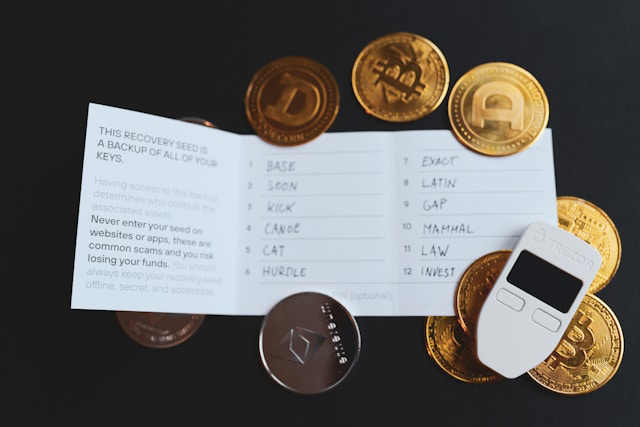
Photo by rc.xyz NFT gallery on Unsplash
Why does this matter for crypto security? If your hardware wallet breaks, your phone gets stolen, or your computer crashes, your seed phrase lets you restore complete access to your funds on a new device. Without it, your crypto is permanently lost.
The seed phrase is generated once during wallet setup and should be written down immediately on paper (never digitally, at no point). This is the safest way to store crypto backup information—offline, in multiple secure physical locations. Anyone who finds your seed phrase can recreate your entire wallet and drain your funds.
Comprehensive Guide to Hardware Wallets
Hardware wallets are where many users make the leap from “I hope this is safe” to “I know how to secure my crypto wallet properly.” But buying one is not where it ends— a proper setup is in order.
Setting Up Your First Hardware Wallet
Setting up a hardware wallet takes about 15–20 minutes, and the process is more straightforward than most people expect.
Step 1: Unbox and verify authenticity.
Check that packaging seals are intact and the device hasn't been tampered with. Buying hardware wallets from third-party sellers on marketplaces is not safe! Always purchase directly from the manufacturer's official website.
Step 2: Initialize the device.
Connect your hardware wallet to your computer or phone in the intended way: using the included cable or wirelessly. Download the official companion app (like Ledger Live or Trezor Suite) only from the manufacturer's verified website—not from app store search results or email links.
Step 3: Generate your seed phrase.
The device will create a unique 12- or 24-word recovery phrase. Write this down on the physical card provided (or your own durable paper). Again, never store it digitally, screenshot it, or type it into any app. This seed phrase is the master key to all your crypto you will store there!
Step 4: Verify your seed phrase.
The device will ask you to confirm several words from your seed phrase to ensure you wrote them down correctly. This step is critical. Test your backup now, not when you need it.
Step 5: Set a PIN code.
Choose a strong 6–8 digit PIN that isn't obvious—no birthdays or repeated numbers. This PIN protects physical access to your device.
Your hardware wallet is now ready. Before transferring significant funds, send a small test transaction to confirm everything works as expected. Start with a small amount, verify it arrives, then move the rest.
Hardware Wallet Comparison and Reviews
Not all hardware wallets offer the same features or security models. Here’s how a few major brands compare:
| Feature | Ledger Nano X | Trezor Model T | SafePal S1 |
|---|---|---|---|
| Price Range | ~$150–$200 | ~$220–$280 | ~$50–$60 |
| Supported Coins and Tokens | 5,500+ | 1,800+ | 30,000+ |
| Screen Type | Small OLED | Color touchscreen | Color display |
| Bluetooth | Yes | No | No (air-gapped) |
| Open Source | Partially | Fully | Partially |
| Best For | Portability + variety | Transparency-focused users | Budget-conscious users |
Ledger devices:
- Use a secure element chip (similar to those in passports and credit cards).
- Offer extensive coin support and solid mobile app integration.
- Use partially closed-source firmware, which some users accept in exchange for features.
Trezor wallets:
- Are fully open-source, meaning security researchers can audit every line of code.
- The Model T offers a touchscreen interface that prevents keylogger attacks during PIN entry (you tap on the device itself, not your computer keyboard).
SafePal devices:
- Are budget-friendly and designed to be completely air-gapped.
- Never connect directly to the internet, interacting via QR codes instead.
- Offer strong resistance to remote attacks but are slightly less convenient for very frequent transactions.
All three manufacturers have established security track records. Your choice comes down to budget, the coins you hold, and whether you prioritize open-source transparency, maximum coin coverage, or complete air-gapping.
If you are interested in a more in-depth review of even more products and options, find it in this review by the ChangeHero team!
Hardware Wallet Best Practices
Owning a hardware wallet doesn't automatically make your crypto safe. How you use it matters.
- Keep firmware updated.
Manufacturers release security patches regularly. Update through official apps only. Never click firmware update links in emails—that's a common phishing tactic. - Store your seed phrase securely offline.
Yes, you still need to take care of that even with a hardware wallet. Consider metal backup plates that protect against fire and water damage. Never store your seed phrase in password managers, cloud storage, or anywhere connected to the internet. Keep it in a fireproof safe or safety deposit box. Some people split it between two secure locations, but only do this with a clear system so you can reconstruct it without confusion. - Use your hardware wallet for storage, not daily spending.
Hardware wallets are best for long-term holdings. If you trade frequently, keep only small amounts in hot wallets and move profits to cold storage regularly. - Verify addresses on the device screen.
Before confirming any transaction, check that the wallet address displayed on your hardware wallet screen matches the address you're sending to. Malware can change addresses on your computer screen, but it can't modify what's shown on the hardware device itself. This single habit blocks most clipboard hijacking attacks. - Test your recovery process.
At least once, wipe your device and restore it from your seed phrase to confirm your backup works. Do this with a small amount first to avoid panic during a real recovery situation.
Never photograph your hardware wallet screen showing balances or addresses and post it online; even small details can help attackers target you through social engineering. Hardware wallets protect crypto from hackers at the device level, but physical security and proper habits close the remaining gaps.
Securing Your Crypto Wallet: Essential Steps
Whether you go for a software or hardware wallet, once you've chosen your configuration, the real work begins. Security isn't a one-time checkbox—it's a layered system that protects your crypto from hackers, scammers, and even your own mistakes.
Photo by Zulfugar Karimov on Unsplash
Setting Up a Secure Wallet Environment
Start with a clean foundation. Before installing any wallet software, run a full antivirus scan to ensure your device is free from malware. Download wallet apps only from official websites or verified app stores—never from third-party sites or email links. Fake wallet apps are one of the most common phishing tactics hackers use.
For desktop wallets:
- Consider using a dedicated computer if possible, especially for large holdings.
- Avoid using the same device for everyday browsing, email, or downloading random files.
For mobile wallets:
- Keep your phone's operating system updated.
- Rooting or jailbreaking the device is not advised—doing so removes built-in security protections.
Never access any of your wallets on public Wi-Fi. If you must check your crypto while traveling, use a trusted VPN to encrypt your connection. For large transactions that are not realistically urgent, it’s best to wait until you’re on a secure network you control.
Strong Passwords and Authentication
Weak passwords are one of the easiest ways hackers gain access to wallets. After all, it’s easier to crack a short string than a longer, cryptographically secure one. Your wallet password should be at least 16 characters long, combining uppercase letters, lowercase letters, numbers, and symbols. Avoid obvious patterns or reused passwords from other accounts. Sounds tedious, right? It is—but that's exactly what makes it effective.
Password managers like Bitwarden, 1Password, or KeePass help generate and store complex passwords securely. Password managers encrypt your credentials and eliminate the need to remember or write down passwords (which can be stolen or lost). To not undermine the safety layer these applications create, never store wallet passwords in plain text files, notes apps, or generic cloud storage.
Passwords and authentication matter especially for exchange accounts or custodial wallets:
- Change your password periodically—at least every six months.
- If you receive any notification about login attempts you didn't make, change your password immediately and review recent activity.
Two-Factor Authentication (2FA)
As the name implies, 2FA adds a second verification layer beyond your password. Even if someone steals your password, they can't access your wallet without the second factor. Think of it as needing both a key and a fingerprint to open a door.
The second step to log in can be an authenticator app like Google Authenticator, Authy, or Microsoft Authenticator or SMS-based 2FA, which is not safe and should be avoided whenever possible. Text message codes can be intercepted through SIM-swapping attacks, where hackers convince your mobile carrier to transfer your phone number to a new SIM card they control. Authenticator apps generate time-based codes directly on your device, making them far more secure in comparison.
When enabling 2FA, save your backup codes in a password manager or write them down and store them in a secure physical location. Without these backup codes, you could lose access if you lose your phone.
Hardware wallets don’t typically need 2FA because the device itself acts as physical authentication. But for exchanges, web wallets, and any service tied to your email, it’s best to always enable it.
Secure Backup and Recovery Plans
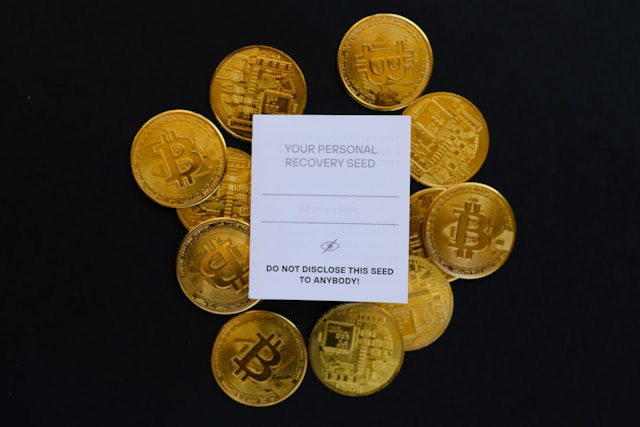
Photo by rc.xyz NFT gallery on Unsplash
A backup plan ensures you can recover your crypto if your device is lost, stolen, or damaged. For non-custodial wallets, your seed phrase is your backup. Without it, your crypto is gone forever.
Build a reliable backup process:
- Test your backup by performing a trial recovery.
Set up a second wallet using your seed phrase to verify it works correctly. This test confirms you've recorded the phrase accurately and understand the recovery process. - For hardware wallets, store the device and seed phrase separately.
If both are stolen together, your security is compromised. - Consider using a passphrase (also called a "25th word") as an additional layer.
This creates a hidden wallet that requires both the seed phrase and the passphrase to access. Take extra care not to lose it either: if enabled, even with a full 24-word phrase you won’t be able to restore the wallets.
Document your wallet setup in a secure location:
- Include wallet types, public addresses (not private keys), and instructions for recovery.
- This helps your family or trusted contacts recover your crypto if something happens to you.
- Keep this documentation separate from your seed phrase for security.
Review and update your backup plan annually; technology changes, wallets get updated, and your security needs to evolve. Regular reviews keep your backup strategy effective at all times.
Advanced Security Strategies
Once you've mastered the fundamentals of how to secure cryptocurrency, you can explore advanced techniques that provide enterprise-level protection. These strategies aren't necessary for everyone, but they become essential as your portfolio grows or if you're managing crypto on anyone else’s behalf.
Multi-Signature Wallets for Enhanced Security
Guides like this one frequently suggest multisig wallets as an advanced option. Multi-signature (multisig is a shortened name) wallets require multiple private keys to authorize a transaction—like several signatures on a check instead of just one.
- You set up a wallet that requires, for example, 2 out of 3 possible signatures to approve any transaction.
- You might keep one key on your hardware wallet, store another with a trusted family member, and place the third in a safety deposit box.
- An attacker would need to compromise multiple keys simultaneously to steal your funds.
Multisig is particularly valuable for:
- Holdings above roughly $10,000 where extra security justifies the complexity.
- Shared accounts like business partnerships, DAOs, or treasuries.
- Estate planning scenarios where heirs need coordinated access.
- Situations where you want protection against both theft and personal key loss.
The obvious trade-off is increased complexity: each transaction requires gathering multiple signatures, which takes more time and technical understanding.
Cold Storage Best Practices
Advanced cold storage goes beyond basic hardware wallets. Air-gapped systems—devices that have never connected to the internet—represent one of the safest ways to store crypto long-term. On the other hand, if you happen to have a suitable device, you can have a cold wallet for virtually no extra cost.

Photo by Philipp Katzenberger on Unsplash
The process:
- Generate private keys on a completely offline device (often a dedicated computer).
- Keep that device permanently disconnected from any network.
- Sign transactions on this air-gapped machine.
- Transfer the signed transaction via USB or QR code to an online device for broadcasting. The keys never leave the offline device, only the signature, which cannot be used to reverse-engineer the private key.
This method ensures your private keys never exist on an internet-connected system.
Some serious holders go further:
- Storing multiple hardware wallets in geographically distributed locations (like safety deposit boxes in different cities).
- Using tamper-evident bags.
- Implementing strict access protocols and logs.
For most users, a well-managed hardware wallet setup is enough. But if you’re holding very large amounts, these cold storage practices can significantly raise your security ceiling.
Regular Security Audits and Updates
As mentioned before, efficiently securing crypto from hackers and other threats isn't a one-time setup but an ongoing process. Regular security reviews, preferably every 3–6 months, should see you:
- Update all wallet software and firmware from official sources.
- Test your backup recovery process by restoring from your seed phrase.
- Review and rotate passwords where appropriate.
- Confirm that your 2FA apps and backup codes still work.
- Check that your security practices still match your current holdings and usage.
Given that private key compromise has been reported as the largest single attack vector other than the users themselves, maintaining vigilant, up-to-date security practices over time becomes your strongest defense against evolving threats on par with staying informed.
Security Strategies for Different Types of Crypto Users
The general framework described so far is not a one-size-fits-all approach. From there, you can match your holdings and how you use crypto with an approach to security. Over-securing tiny amounts costs more than it protects, while under-securing large holdings invites disaster. Let’s now match common holding levels with appropriate protection.
Security for Small Holdings (Under $1,000)
Starting small? Focus on learning fundamentals without overspending on hardware.
A reputable mobile wallet like Trust Wallet, Exodus, or MetaMask usually strikes the right balance:
- Non-custodial control (you hold the keys).
- Reasonable security with built-in protections.
- No extra hardware cost.
Your essential security checklist:
At this level, a $50–$100 hardware wallet isn't strictly necessary yet. Your bigger risk isn’t sophisticated hackers; it’s phishing scams and clicking malicious links. Focus on building good habits: double-check URLs, verify wallet addresses character by character, and never rush transactions.
Many beginners lose funds to simple mistakes like sending crypto to the wrong network. Take your time, and always send a small test transaction first when trying something new.
Medium Holdings Security ($1,000 – $10,000)
Once your holdings reach four figures, it's time to upgrade your security approach. This is where hardware wallets become worth the investment. The cost is small compared to the risk of losing everything to private key compromise.
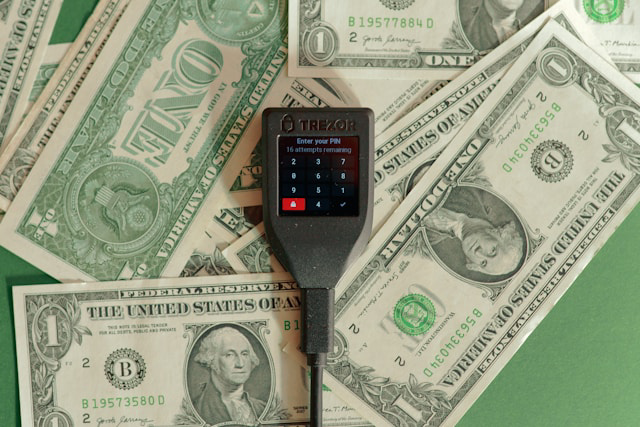
Photo by rc.xyz NFT gallery on Unsplash
Your security setup should include:
A balanced approach is to keep 80–90% of your holdings in cold storage on your hardware wallet and 10–20% in hot wallets for trading or DeFi activities. Think of it like keeping most cash in a vault while carrying spending money in your pocket.
Enterprise-Level Security for Large Holdings
Managing five figures or more? At this point, your security needs move into professional-grade territory. At the level like this, the cost of advanced security measures becomes negligible compared to potential losses.
Typical requirements:
Consider splitting large holdings across multiple storage solutions and locations. Never put all your crypto eggs in one basket, no matter how secure that basket seems.
DeFi and Trading Security Considerations
Active traders and DeFi users face unique challenges because they can’t lock everything in cold storage. If you’re one, you need assets available in hot wallets to interact with protocols and execute trades, which increases your attack surface significantly.
DeFi-specific security practices:
Yes, this setup adds extra transactions and some fees, but those costs are tiny compared to losing everything in a DeFi exploit or phishing attack.
If you're providing liquidity or staking:
- Weigh potential returns against security risk.
- Prefer protocols with longer track records or additional protections where possible.
- Never stake your entire portfolio in a single platform.
Diversification protects against smart contract vulnerabilities and platform-specific failures.
Best Practices for Long-Term Cryptocurrency Storage
Long-term storage is where the concept of “how to store cryptocurrency safely” really comes into focus. Your long-term bag needs to survive hacks, resist compromising and even persist in life events.
Safest Way to Store Crypto Long-Term
The safest way to store crypto long-term is cold storage using a hardware wallet or an air-gapped system. In simple terms, this means keeping your private keys completely offline, disconnected from any internet-connected device. If your keys never touch the internet, remote hackers can't reach them.
Photo by engin akyurt on Unsplash
For long-term holdings (anything you won't touch for months or years):
- Use a reputable hardware wallet.
- Set it up once, transfer your assets, back it all up and then store the device in a secure physical location.
- Keep your seed phrase in a separate, equally secure spot—like a fireproof safe or bank deposit box.
Substantial amounts call for extra measures:
- Consider splitting your holdings across multiple hardware wallets in different physical locations.
- For ultra-long-term storage, some users create paper wallets or engrave seed phrases on metal plates designed to withstand fire and water damage.
The key principle: maximize physical security, minimize digital exposure.
Minimizing Assets on Exchanges and DeFi Platforms
Once you're done actively trading or using your crypto, it’s time to move it to your own non-custodial wallet. It’s a rather straightforward rule that will go a long way. Why the urgency? When funds sit on an exchange, you’re trusting the platform’s security, not your own.
- Use exchanges for buying, selling, or swapping.
- Withdraw to your hardware wallet or cold storage shortly after.
- For DeFi, deposit only what you need for active positions and withdraw when you're done.
For traders who need quick access:
- Keep a small "working balance" in a secure hot wallet.
- Move profits and excess holdings to cold storage regularly.
Never leave more than you can afford to lose on any single platform, no matter how reputable it seems.
Estate Planning and Inheritance Considerations
Your crypto dies with you unless you plan ahead. Unlike traditional assets, there's no customer service line to help your heirs recover your holdings—if they can't access your private keys or seed phrases, your crypto is permanently lost.
Thinking that far ahead, some steps to consider:
- Document your holdings and wallet locations in a secure estate plan.
- Store this information with your will or in a safety deposit box, separate from your actual seed phrases.
- Consider splitting access: one trusted person knows where the wallet is, another knows where the seed phrase backup is, and your will explains how to combine them.
Some families use multi-signature wallets so multiple people must approve transactions. That way no single person has complete control, and the family collectively can access funds if needed.
And as morbid as it sounds, test your recovery process while you're alive. After all, it will be too late if you neglect this! As a whole, make sure your designated person can actually follow your instructions and access a test wallet. Update your documentation whenever you:
- Change wallets.
- Rotate seed phrases.
- Move funds to new storage methods.
Estate planning for crypto isn’t morbid per se—it’s just responsible security that extends beyond your lifetime.
Protecting Yourself from Crypto Scams and Threats
Bad actors are well aware that crypto transactions are irreversible and users hold direct control of their funds, which they abuse to their advantage. Understanding common threats and spotting them early is your first line of defense.
Recognizing and Avoiding Common Scams

Photo by Immo Wegmann on Unsplash
Phishing attacks remain the most common entry point for hackers. These scams arrive via malicious links in fake emails or impostor websites mimicking legitimate exchanges or wallet providers. Their goal is simple: trick you into entering your seed phrase, private key, or login credentials.
Red flags:
- Unsolicited emails asking you for things like "verify your account."
- Social media messages from “support” accounts that reached out to you first.
- Websites with URLs that look almost right (like "binnance.com" instead of "binance.com").
Remember, no legitimate service will ever ask for your seed phrase or private keys—ever.
Social engineering goes a step further at the very minimum. These scams are more sophisticated, where perpetrators may:
- Pose as tech support, romantic interests, or investment advisors.
- Build trust over time, then escalate into urgent requests.
- Promise guaranteed returns, exclusive token launches, or “urgent” security fixes.
Reportedly, cryptocurrency-related investment scam complaints to the FBI's Internet Crime Complaint Center in the US became 29% more frequent and losses increased by 47% to $5.8 billion in 2024. The pattern is consistent: urgency, secrecy, and offers that sound too good to be true. If someone pressures you to act quickly or threatens account closure, it's almost certainly a scam.
Protecting Your Devices and Network
Your crypto security is only as strong as the devices you use. Keeping operating system and wallet software updated, using reputable antivirus or endpoint protection, and avoiding downloading apps or files from unofficial sources are all baseline protection.
Public Wi-Fi is a major vulnerability since these networks can expose your data. For any crypto-related actions on the go, use a reputable VPN to encrypt your traffic (ideally, one that you set up). For high-value transactions, wait until you're on a secure home or office network.
For higher security, use a dedicated device for crypto management (an old laptop or tablet works). Don’t use this device for casual browsing, email, or downloads. And again: never store seed phrases or passwords in cloud services, email drafts, or general note-taking apps. These are common breach targets.
Safe Trading and Transaction Practices
Every crypto transaction is permanent, so double-checking matters to the extent that it might be what separates you from a catastrophic failure.
Before sending funds:
- Always double-check wallet addresses character by character.
- Be aware that malware can swap addresses in your clipboard.
- For significant transfers, send a small test transaction first to confirm everything is correct.
On exchanges:
- Enable withdrawal whitelists if available, restricting withdrawals to pre-approved addresses.
- Enable all security settings: 2FA, email alerts, login notifications.
- Prefer platforms with transparent security practices and proof-of-reserves audits where available.
For trading via DEXs:
- Stick to well-established platforms when possible.
- Understand that newer DEXs may carry higher smart contract risk.
- Avoid connecting your primary hardware wallet directly to every new DApp—use a separate hot wallet with limited funds.
The bottom line: protecting your crypto requires vigilance at every step. These habits become second nature over time—verify everything, trust slowly, and remember that scammers exploit urgency and emotion. Taking a moment to think things through is one of your strongest security tools.
Crypto Storage Insurance and Legal Considerations

Photo by Vlad Deep on Unsplash
If being your own bank gave you the impression that your crypto holdings and their security lie in a plane separate from regulations, think again! With increasing regulatory clarity and involvement in the space, it is further from the truth but it also means you can have extra protections that were not previously feasible—such as insurance.
Insurance Options for Cryptocurrency Holdings
Traditional homeowners or renters insurance generally won't cover cryptocurrency losses. If someone steals your seed phrase or hacks your wallet, standard policies typically don’t apply. That’s where specialized crypto insurance comes in.
Most crypto insurance falls into two categories:
Custodial coverage:
- Protects assets held by exchanges or third-party custodians.
- Major platforms sometimes offer FDIC insurance for USD balances and separate crime insurance for a portion of their crypto held in hot or cold wallets.
- Important caveat: this usually doesn’t cover individual account hacks due to compromised passwords or phishing.
Non-custodial coverage:
- A smaller but growing niche.
- Some providers offer personal crypto policies covering theft, hacking, or certain types of loss.
- Policies often cost a percentage of your holdings annually and may require proof of strong security measures (hardware wallets, multi-sig, etc.).
Insurance generally won’t cover your own operational mistakes (like sending to the wrong address) and normal price volatility. Always read policy terms carefully to understand what’s actually protected.
Legal and Tax Implications of Storage Methods
You may also not realize that how you store cryptocurrency can affect how you track and report it. In many jurisdictions, crypto is treated as property, not currency. That means every sale or trade can be a taxable event if it results in a gain. Moreover, moving crypto between your own wallets can create complex tracking needs, even if it’s not always a taxable event by itself (rules vary by jurisdiction—check locally).
Using non-custodial wallets in comparison to keeping funds on exchanges gives you more privacy and control. Nonetheless, you’re still legally responsible for tracking all transactions, including purchase prices (cost basis), transfer dates, fair market values when selling or swapping. Exchanges can make it less of a hassle but remember everything else about it.
Cold storage methods don’t eliminate tax obligations. You still need records, even if the wallet itself is offline.
Many users maintain spreadsheets or use crypto tax software to aggregate data from multiple wallets. When it gets complicated or extensive, tax professionals familiar with crypto can be of major help.
Most importantly, estate planning needs to account for legal implications. If something happens to you, your heirs will need both technical access and a clear paper trail. Some jurisdictions now recognize digital asset provisions in wills or trusts, allowing you to formally outline how crypto should be handled.
The safest way to store crypto long-term combines physical security, good documentation, and legal compliance. Protecting yourself technically is only half the picture—protecting yourself legally keeps that security meaningful.
Conclusion
To summarize, learning how to store cryptocurrency safely isn’t about being perfect—it’s about stacking practical layers of protection that match your holdings and comfort level. Start with the basics, add hardware as your portfolio grows, keep your private keys offline whenever possible, and make testing your backups a regular habit.
Do that consistently, and you’ll be far ahead of most crypto users when it comes to keeping your digital assets safe in 2026 and beyond.
Frequently Asked Questions
Do I Need a Hardware Wallet?
It depends on what you're holding and how you use crypto.
- If you're keeping more than a few hundred dollars worth of cryptocurrency for longer than a few weeks, a hardware wallet becomes a smart investment.
- Hardware wallets store your private keys offline, isolating them from common internet threats.
- Because private key compromise has been reported as the leading driver of stolen funds, reducing key exposure is one of the most effective security moves you can make.
For very active traders who need quick access, a mobile or desktop wallet might be more convenient for day-to-day use—but for long-term holders, hardware wallets are often the safest way to store crypto long-term.
When Should I Move Coins Off an Exchange?
As soon as you're not actively trading them.
Exchanges are convenient, but inherently risky:
- They control your private keys.
- They’re high-value targets for hackers.
- Platform failures, withdrawals halts, or account freezes can happen with little warning.
If you're holding crypto as an investment rather than day-trading:
- Move it to a non-custodial wallet within 24–48 hours of purchase.
- Keeping small amounts on exchanges for occasional trading is fine—just don’t treat exchanges as storage vaults.
You truly own your coins only when they’re in a wallet where you control the private keys.
How Much Crypto Justifies Extra Security Measures?
Here’s a practical way to think about it:
- Under ~$500:
- Focus on learning and basic security (strong passwords, 2FA, reputable mobile wallet).
- ~$1,000–$5,000:
- Invest in a hardware wallet.
- Start separating “spend” funds from “savings.”
- Above ~$10,000:
- Consider multiple hardware wallets, multi-signature setups, or advanced cold storage.
The more value at stake, the more layers of protection make sense. Financial losses from crypto investment fraud and hacks have become substantial, so security investments are not optional luxuries at higher levels—they’re part of responsible ownership.
- Under ~$500:
What Happens If I Lose My Hardware Wallet?
If you’ve backed up your seed phrase correctly, you’re fine.
- The hardware wallet is just a device that stores your keys.
- Your actual cryptocurrency lives on the blockchain.
- With your 12–24 word seed phrase, you can restore full access on any compatible wallet.
This is exactly why secure seed phrase backup is non-negotiable when learning how to protect your crypto. Store it physically (metal backups are ideal), never digitally, and never take photos of it.
If your device is lost or stolen but your seed phrase is safe:
- Treat it like a compromised key.
- Move your funds to a new wallet generated from a new seed phrase as soon as possible.
How Often To Update Security Practices?
A good maintenance rhythm:
- Review your crypto security setup every 3–6 months.
- Check for and install wallet software and firmware updates promptly.
- Update your device operating systems regularly (monthly is a good baseline).
- Change passwords at least annually or immediately if you suspect any breach.
- Verify your backup recovery process at least once a year.
On the other hand, don’t constantly rotate your seed phrase without reason—it complicates estate planning and increases the risk of you making mistakes. Stability matters, as long as your seed phrase remains secret and secure.
Can I Store Different Cryptocurrencies Together?
Yes. Most hardware wallets and many software wallets support multiple cryptocurrencies.
- Popular hardware wallets can handle Bitcoin, Ethereum, and hundreds of other tokens simultaneously (within their supported networks).
- Each cryptocurrency uses its own address format and sometimes separate apps or account types within the wallet.
- You manage them through one interface or device, which simplifies how to secure your crypto wallet without juggling a pile of hardware.
Just verify that your chosen wallet supports the specific coins you hold before moving funds. Compatibility lists are usually available on the manufacturer’s official site.


