
How Does Polymarket Work? Beginner's Guide

Key Takeaways
- 🏆 Polymarket markets are binary event contracts: you buy YES or NO shares that pay $1.00 if correct and $0.00 if wrong;
- 🏆 Prices between $0.01 and $1.00 function as live implied probabilities, but they are shaped by liquidity, spreads, and trader behavior rather than guaranteed forecasts;
- 🏆 Trades happen peer-to-peer through an order book, so execution quality depends on bids, asks, depth, slippage, and whether you act as a maker or taker;
- 🏆 Positions are collateralized with USDC on Polygon, while outcome tokens and settlement logic are enforced through smart contracts;
- 🏆 Market resolution depends on the UMA Optimistic Oracle, meaning payouts only become available after the outcome is proposed, left open to dispute, and finalized;
- 🏆 Polymarket is not risk-free: liquidity risk, regional access restrictions, market disputes, fees, and regulatory uncertainty can all affect the result of an otherwise correct prediction.
Disclaimer
This article is for informational purposes only and does not constitute investment, legal, tax, or financial advice. Prediction markets involve real financial risk, including the possibility of losing the full amount committed to a position. Rules, fee schedules, regional access, oracle timelines, and market availability can change, so readers should verify all time-sensitive details directly through Polymarket’s own documentation and interface before trading.
What is Polymarket that has taken the world by storm? There, in short, you buy and sell shares tied to the outcome of a real-world yes-or-no question. The price of that share behaves like a live, constantly updating probability of the event happening. Unlike a bookmaker setting fixed odds, Polymarket runs on peer-to-peer trading, meaning you buy from and sell to other users, making it crypto-adjacent in this regard.
At a high level, Polymarket combines four systems: binary YES/NO shares, an order-book trading model, USDC collateral on the Polygon blockchain, and an oracle-based settlement process. This guide will focus on the interesting part: not any one of these pieces in isolation but how they interact.
Yes-or-No Shares

Let’s start with a short explanation: every Polymarket market is a binary event contract with two possible outcomes: YES or NO. Shares in each outcome trade on a $0 to $1 scale. When the market resolves, the winning side pays out $1.00 per share while the losing side pays $0.00.
Market Questions and Outcomes
So, before trading, the first thing to audit is the market question itself. The wording determines how — and whether — a market resolves cleanly.
Well-constructed Polymarket questions usually have the following traits:
- Binary by design: the outcome must reduce to a strict YES or NO, with no third result.
- Objective and verifiable: the resolution should be checkable against real-world facts, not subjective opinion.
- Time-bounded: the question specifies an explicit end date and resolution date.
- Tied to a named source of truth: the question references a specific, identifiable reference point, such as an official report, named index, or stated event.
- Free of vague language: terms like “significant” or “soon” invite dispute. Ambiguous wording increases resolution risk, and traders often price that uncertainty directly into the shares.
This is the first practical rule of Polymarket: you are not only trading the event. You are trading the exact wording of the event contract.
Share Prices as Implied Probabilities
You may have seen predictions with percentages that cite Polymarket as a source. How exactly does that work?
Share prices on Polymarket function as market-generated implied probabilities. The most common way to measure chances is percentage, so you can think of $0.01 or 1 cent as 1% in Polymarket’s share pricing.
Prices run between $0.01 and $1.00, and a YES share priced at $0.42 corresponds to a 42% implied probability that the outcome will occur, according to Polymarket’s own documentation. Since YES and NO prices in the same market always add up to $1.00, a YES price of $0.40 implies a NO price of $0.60 — and at resolution, one side pays $1.00 while the other pays $0.00.
Where do the prices and by proxy, implied probabilities, come from? The good old market forces: supply and demand. Let’s say the initial split is 50/50 but more people believe YES to be the outcome than there are NO holders. They would like to buy these shares, driving up the demand and the price. At the same time, NO holders try to sell and drive the price of their shares lower and lower. The entire premise of Polymarket is to make participants carefully consider their bets by putting money on the line, and so, increasing the likelihood of their predictions to be closer to the truth.
In other words, implied probability is not the same thing as true probability. The price reflects current trading conditions, available liquidity, order-book depth, and participant expectations. In a deep market, that price may be an efficient signal. In a thin market, it may be noisy.
Winning and Losing Share Values

Betting on probability is one thing but how does a prediction market like ones on Polymarket resolve, then?
Say you buy 100 YES shares at $0.42 each, spending $42 total. If the market resolves YES, each share is redeemable for $1.00, so your 100 shares are worth $100. That is a gross profit of $58. If the market resolves NO, those same YES shares become worthless, dropping to $0.00 each, and the $42 is lost.
The losing side of a binary market always goes to zero at resolution. The winning side is redeemable for its fixed $1.00 payout.
Thus, 70¢ YES share is not “70 cents of profit already banked.” It is the current price of a contract that pays $1.00 only if YES resolves correctly. Your actual return depends on the true probability of that outcome and, in many cases, your ability to exit before resolution.
Polymarket’s Trading Mechanics
Polymarket’s trading layer is where the platform starts looking less like a simple wager and more like a financial market. The outcome is binary, but the path to entering, managing, and exiting a position depends on order-book mechanics.
You will find a lot of high-level similarities between trading on an exchange and using Polymarket. As such, you may find our guide to how to start trading crypto useful for the topic and in general.
Peer-to-Peer Order Book
Every trade on Polymarket happens through an order book. Buyers and sellers post prices they are willing to transact at, and a trade executes only when one side agrees to meet the other’s price.
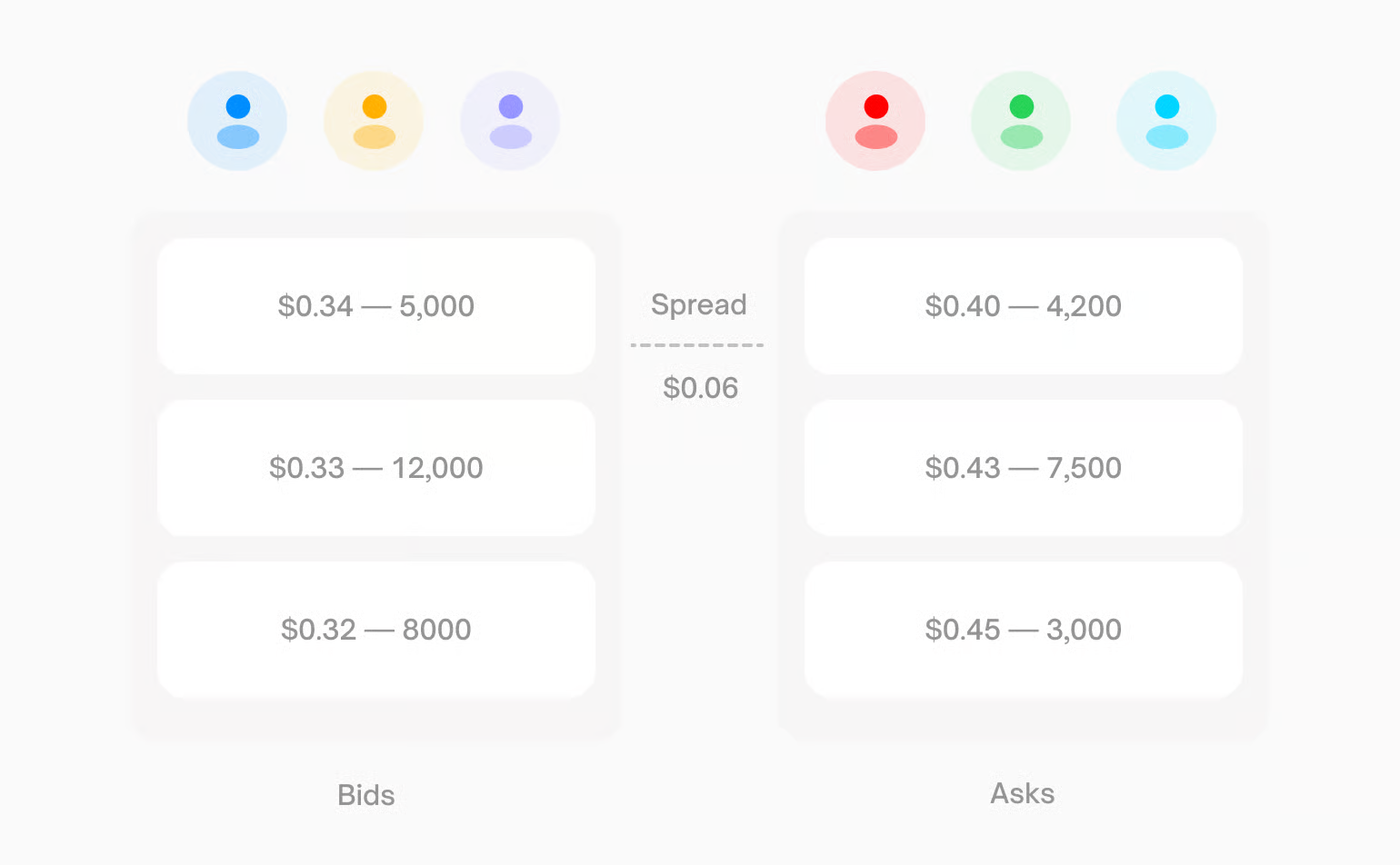
On the buy side, you see bids — the prices traders are offering to pay for shares. On the sell side, you see asks — the prices traders are willing to accept. The highest bid and lowest ask are the best bid and best ask, and the gap between them is the bid-ask spread.
For example, if the best bid for YES shares is $0.47 and the best ask is $0.49, that $0.02 gap is the spread. If you want to buy immediately, you pay $0.49, crossing the spread, rather than waiting at $0.47 where another buyer is already bidding. That two-cent difference is the cost of demanding immediate execution.
A less obvious point is that liquidity is outcome-specific, too. YES and NO shares each have their own order book, their own bids and asks, and their own depth. They are not perfect mirror images simply because their prices sum to $1.00.
Market depth refers to the total volume of resting orders available at or near the best bid and ask. When depth is thin, there may not be enough size at your desired price to fill your entire order. In that case, you may receive a partial fill: part of your order executes, while the remainder either fills at progressively worse prices or sits unfilled until a matching order arrives.
Market Orders and Limit Orders
Polymarket supports two basic order types, already familiar to traders but less obvious to anyone with no trading experience: a market order executes immediately against whatever liquidity is currently available on the order book. It gives you execution, but not price certainty. In a market with low depth, a market order can cause slippage — your average execution price drifts away from the best quoted price as your order eats through multiple price levels. Larger orders create more price impact because they consume more liquidity.
A limit order lets you set the exact price you are willing to trade at. The trade-off is execution uncertainty. If the market never reaches your limit price, your order remains unfilled.
This dichotomy maps directly to the maker/taker distinction. A maker places a limit order that does not immediately match anything, adding resting liquidity to the book and making the market. A taker places an order that immediately matches an existing order, removing or taking liquidity from the book. Makers wait; takers get filled immediately. The trade-off is time versus certainty.
Selling Before Resolution
Upon resolution, the winners take it all and the losing side is in the red, but one of Polymarket’s defining mechanics is that you do not have to hold until the market resolves. You can sell your shares to another trader while the market is active, closing your position and realizing a gain or loss immediately.
For example, say you buy 100 YES shares at $0.40 each, spending $40. A week later, in light of new information, traders push the implied probability higher, and YES trades at $0.55. If you sell your 100 shares at that price, you receive $55, for a per-share profit of $0.15 and a total gain of $15. You realized the gain without waiting for the event to resolve.
The reverse works the same way. If the price drops to $0.30, selling locks in a $0.10 per-share loss, or $10 total, and lets you exit before a possible total loss at resolution.
However, selling is not guaranteed at a favorable price. You need a counterparty. If you are selling, the price you actually get is constrained by the current best bid. If you are buying, it is constrained by the best ask. Wider bid-ask spreads make both entry and exit more expensive because crossing the spread costs you more relative to the market’s implied probability at that moment.
Collateral, Wallets, and Blockchain Infrastructure
Polymarket is not the first decentralized prediction market to use the blockchain technology but it is an example of the most successful one to date. So far we have established how shares and trading work. The next layer is collateral: what backs each position, where those funds live, and how the blockchain infrastructure enforces the rules.
USDC and Polygon
Every position on Polymarket is backed by collateral, and that collateral is USDC — a stablecoin pegged to the US dollar — held on the Polygon blockchain. Mechanically, the flow is straightforward: you hold USDC on Polygon, authorize the platform’s contracts to spend a specified amount, and that authorized balance becomes the collateral backing the positions you open.
That “right network” part is important. USDC on Ethereum and USDC on Polygon are not interchangeable at the wallet level. They may represent the same stablecoin conceptually, but they exist on different chains, and Polymarket’s contracts recognize the Polygon version. Sending USDC while it is still on Ethereum, or failing to bridge it over first, is one of the most common funding failure modes.
The practical takeaway is simple: confirm your USDC is on Polygon before attempting any on-chain action tied to Polymarket.
Smart Wallets and Self-Custody
Polymarket operates on a self-custody model. That means you — not the platform — control the private key or seed phrase that grants access to your funds. For a more comprehensive version, read our guide on how to set up a crypto wallet but below is a shorter rundown.
A private key/seed phrase is the credential that proves ownership of a wallet and authorizes actions from it. If you lose it, there is no customer support process that can restore access. Your wallet address is the public identifier that receives USDC and holds your outcome tokens. A signature is the cryptographic approval you generate, usually through a non-custodial wallet like MetaMask, when authorizing a trade, withdrawal, or contract interaction.
Some Polymarket setups use a smart wallet abstraction rather than a traditional externally-owned account. A standard non-custodial wallet requires you to sign individual transactions. A smart wallet is contract-based and can bundle or streamline permissions. For example, you may approve a contract to spend up to a set amount of USDC for trading instead of signing every order separately.
The custody principle does not change: you hold the keys, and assets move only after your authorization.
Outcome Tokens and Smart Contracts
When you buy YES or NO on a market, you are not only creating a platform-side record. You receive an on-chain outcome token representing that position, and it lives in your wallet like any other blockchain asset.
These outcome tokens are governed by smart contracts — self-executing code deployed on Polygon. Once a market settles, the smart contracts enforce redemption by converting the winning token into its payout and rendering the losing token worthless.
Polymarket’s outcome shares are issued as ERC-1155 tokens, a multi-token standard that lets a single contract manage many distinct outcome tokens. That is a practical fit for a platform running thousands of markets at the same time. By contrast, the platform’s collateral-side stablecoin infrastructure includes pUSD, an ERC-20 token on Polygon, following the standard single-asset token model.
The broader point is not that smart contracts remove risk. They do not. It is that the rules governing outcome tokens are enforced on-chain rather than only through an internal company ledger. That makes the logic publicly verifiable in principle, although transparency of code is not the same as a guarantee against every market, oracle, liquidity, or regulatory risk.
Settlement, Payouts, and Cashing Out
The trading phase ends when the market closes, but closure and settlement are not the same thing. A market has to pass through resolution before winning tokens can be redeemed.
UMA Oracle Resolution
Once a market closes, it does not resolve instantly. Polymarket relies on the UMA Optimistic Oracle to handle resolution. “Optimistic” means the proposed outcome is assumed correct by default unless someone actively challenges it within a set window. In the typical case, users are not waiting on a vote or manual review.
The resolution lifecycle works as follows:
- The market reaches its end time, closing trading.
- An outcome is proposed to the oracle, with the proposer posting a bond.
- A dispute window opens, during which anyone can challenge the proposed outcome if they believe it is incorrect.
- If undisputed, the outcome becomes final — Polymarket’s own documentation notes this typically takes around 2 hours after proposal.
- A settlement state is applied, marking the market as resolved and making winning outcome tokens eligible for redemption.
What can delay settlement? Naturally, if a dispute is raised against the proposed outcome. The proposal step can be delayed, meaning no one has submitted an outcome for the oracle to evaluate. Finally, finalization processing can take longer than the typical window in edge cases tied to the oracle’s internal resolution timeline.
This is why clean wording matters. A well-defined question usually passes through resolution smoothly. A vague question can become contestable precisely when traders want certainty.
Winning Share Redemption
Before resolution, your shares are worth whatever another trader is willing to pay for them. After final resolution, that changes. Only winning-side outcome tokens can be redeemed; losing-side tokens are not redeemable and hold no value going forward.
The action itself is a claim. Redeeming winning shares is not always passive. Depending on the underlying settlement structure, you may need to submit an explicit claim transaction rather than assuming funds appear automatically.
To confirm redemption worked, look for two things: a completed on-chain transaction tied to the redemption, and an updated balance reflecting the payout. That is the signal that the claim went through rather than remaining pending.
Withdrawals to Wallets
Getting funds out is also a separate step from redemption. A withdrawal means moving your balance out of the platform’s trading environment. A transfer is the on-chain movement of that asset from one address to another. On Polymarket, a withdrawal is executed as a transfer (and that’s one fewer distinction to worry about.)
The path from redeemed balance to spendable funds in your wallet looks like this:
- Post-redemption balance: after claiming, your payout sits as an available balance tied to your account.
- Initiate the withdrawal: specify the destination wallet address.
- On-chain transfer executes: the asset moves from Polymarket’s contracts to your specified address.
- Funds arrive as a token balance on Polygon: visible in your wallet like any other on-chain asset.
A common withdrawal error has nothing to do with market mechanics. It is choosing the wrong network or mistyping the destination address. Double-checking both before confirmation is the simplest safeguard.
Fees and Revenue Model

This is the part when we answer how Polymarket profits and what you pay regardless. Fees are only one part of trading costs. On Polymarket, the all-in cost of a position also includes spread, slippage, price impact, and network fees. Separating these components is necessary if you want to understand whether a trade is actually attractive.
Trading Fees
Before estimating what a trade costs, separate three primitives: maker versus taker, fees versus rebates, and before-rebate price versus after-rebate price.
On Polymarket, maker orders pay 0 fees. A taker is the side that incurs a fee. Depending on the market category, that fee can be partially offset by a rebate.
Polymarket US documentation lists a taker fee of 0.06 and a maker rebate of -0.0125 as illustrative values. These are documentation-specific figures, not a generalization across every category. Using a placeholder notional of $1,000:
- As a taker, $1,000 × 0.06 = $60 in fees paid before any rebate;
- As a maker on the resting side of a matched trade, $1,000 × 0.0125 = $12.50 earned as a rebate.
Stack those across a market’s category-specific range and you get the after-rebate cost — the number that actually matters to net execution.
One easy mistake is assuming fees apply per order. They apply per executed trade — per fill. If one order is broken into several smaller fills, each fill is assessed separately. The total fees paid can therefore differ from what a single fully-filled trade at one price would have cost.
Spread and Liquidity Costs
Platform fees are only part of the picture. Three separate costs sit beside them:
- Bid–ask spread cost: the price paid for crossing the spread as a taker instead of waiting at the best bid or ask.
- Slippage/price impact: the additional cost of moving through order-book depth when your order size exceeds what is resting at the best price.
- Network/transaction costs: the gas fee paid to execute the on-chain transaction.
A quick round-trip example makes spread cost visible. Suppose the best bid is $0.47 and the best ask is $0.49. You enter as a taker, buying at $0.49. Nothing changes about the underlying probability, but you exit immediately as a taker, selling at $0.47. You have paid the spread on entry and exit, creating a $0.04 round-trip cost per share even though the market did not move.
Before placing a trade, check the following:
- Current spread width: how far apart the best bid and best ask are.
- Displayed depth at your intended size: whether there is enough resting liquidity to fill your order.
- Maker or taker status: whether you are resting an order or crossing the spread.
Gas fits into this picture as a smaller line item. Per-trade gas typically runs $0.003 to $0.005, which is minor relative to spread costs or trading fees on most trades but becomes more noticeable if you place frequent, small trades. They do not go to Polymarket but to the node operators who run the underlying decentralized infrastructure.
Polymarket Revenue Sources
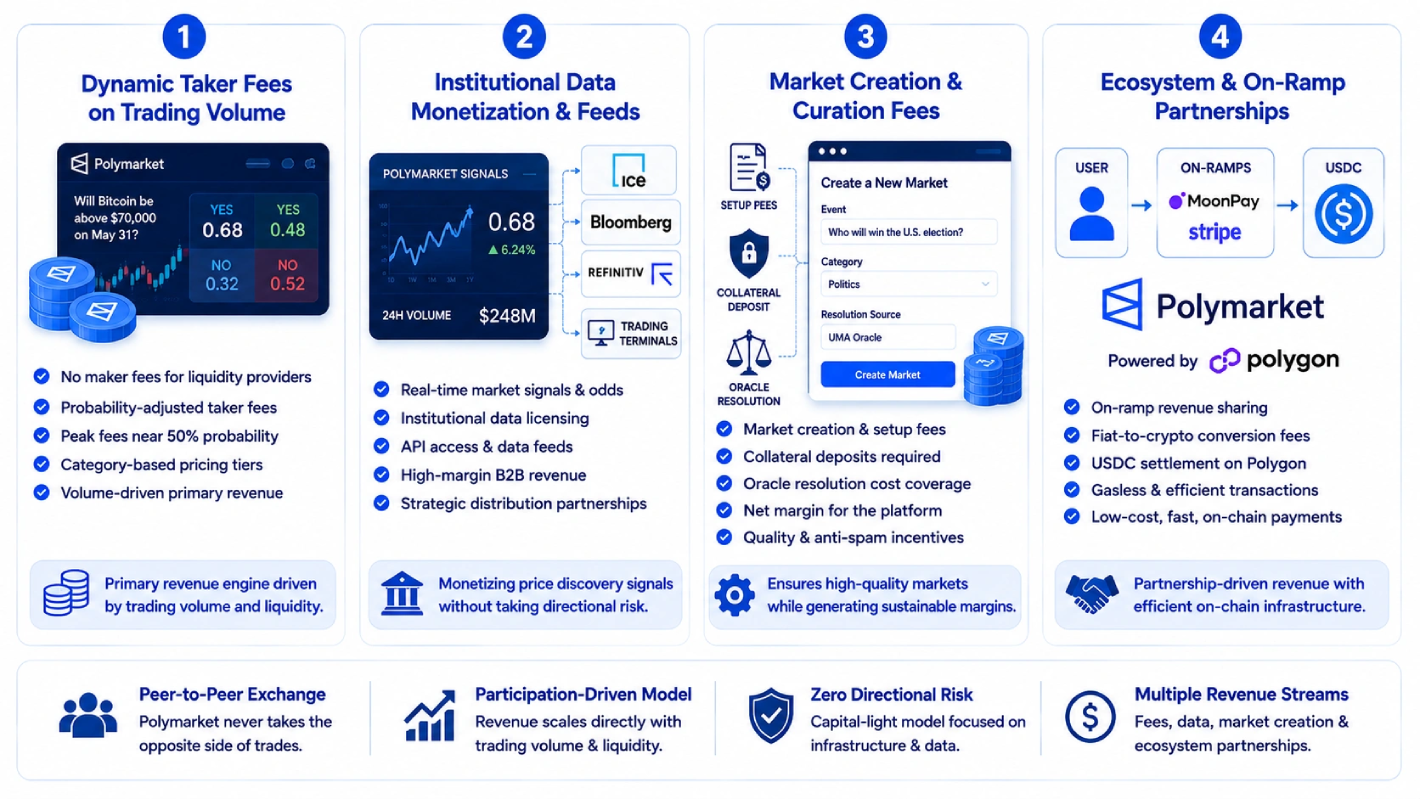
Based on what the published fee schedule supports, Polymarket’s platform-level revenue reduces to two non-overlapping sources.
First, there are net trading fees collected: taker fees taken in minus maker rebates paid out. Second, category-based fee differences operate as a pricing lever. Since after-rebate ranges vary by category — 0% to 0.75%, 0% to 0.94%, and 0% to 1.40% — Polymarket can price risk or incentivize activity differently across market types without changing the underlying maker/taker structure.
Beyond these mechanisms, the public fee schedule does not support claims about additional revenue streams. Anything beyond trading fees and category-based pricing should be treated as speculation rather than documented fact.
Market Types and Sports Trading
Polymarket hosts prediction markets across politics, finance, crypto, culture, and sports. Structurally, they use the same binary share model. Practically, they do not behave the same way. The key question is what type of information moves the market.
Politics, Finance, Crypto, and Culture Markets
These categories all trade between $0 and $1, but they diverge in information cadence, liquidity profile, and catalyst risk.
Information cadence is the first distinction. Finance markets are often tied to scheduled data releases, such as a CPI print, central bank decision, or earnings date. You can anticipate when volatility is likely to spike. Crypto markets sit somewhere in between: some are tied to scheduled events, such as an ETF approval decision or network upgrade date, while others react to continuous news. Politics and culture markets are more vulnerable to unscheduled repricing because an election call, policy announcement, or award result can arrive without a fixed release window. Catalysts for gap moves arrive correspondingly.
Liquidity profile is the second distinction. Headline markets — a major election or widely watched interest-rate decision — tend to attract deeper order books and tighter spreads. Niche markets, such as a smaller cultural award or secondary economic indicator, often have thinner depth. In those markets, even modest orders can move prices.
The time horizon also changes the behavior of a market. Nearer-dated markets, especially those closing within days, tend to converge quickly toward either $0.01 or $0.99 as uncertainty collapses. Long-dated markets can stay range-bound for weeks or months, drifting as sentiment changes without a decisive catalyst. Because uncertainty persists longer, these markets tend to be more spread-sensitive. Sizing a long-dated position means accepting that capital may remain exposed to range-bound movement for longer than expected.
Sports Event Markets
Nevertheless, chances are, you most likely know Polymarket for its sports-related markets. They split into two archetypes by the nature of trading.
The first is the single-game or match winner market. These markets are highly time-bounded, resolve within hours, and are sensitive to pre-game news. A late injury report, lineup change, or weather update can reprice a market quickly. Traders in this category need to watch news up to game time rather than assuming the price reflects stable information.
The second is the season-long, award, or futures market. These markets span weeks or months, and information gets absorbed more slowly. Liquidity often concentrates near key milestones — playoff rounds, mid-season trades, or awards announcement dates — rather than remaining deep every day. Entering between milestones can mean thinner depth than expected.
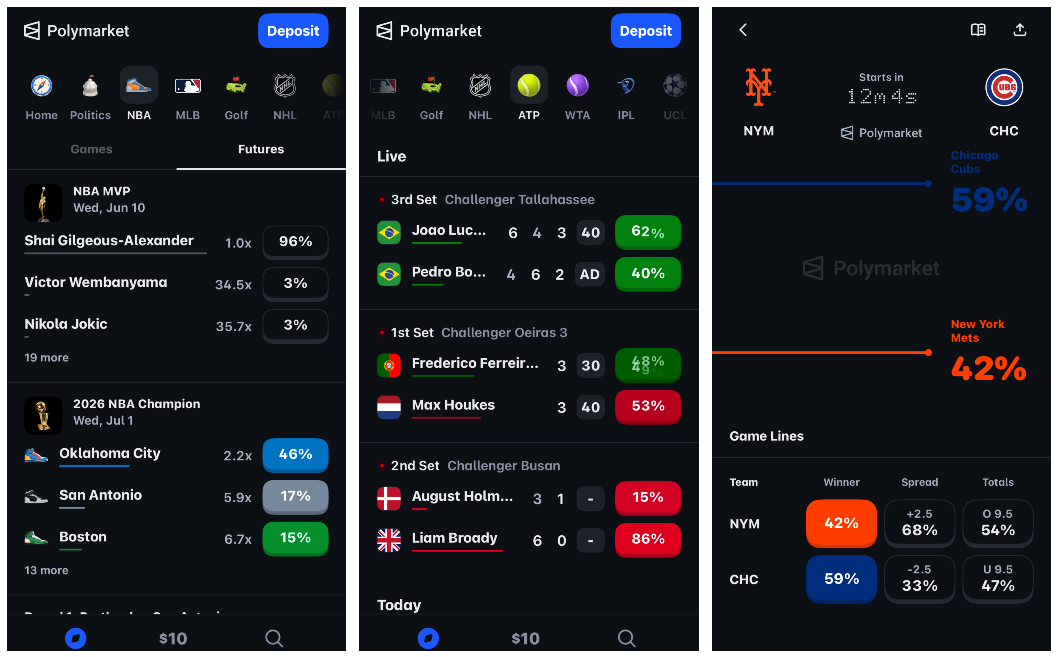
It is also worth understanding in-play versus pre-event trading. In-play, in a prediction market context, means probability updates rapidly as a live game unfolds. A score change or momentum shift can immediately affect share price. The execution risk is that order books may not refill between fast moves, widening spreads and increasing slippage. Rapidly updating, in-play-style conditions therefore carry higher execution risk than stable pre-event markets.
Market Rules and Resolution Criteria
As you would expect, every market — sports, politics, finance, or culture — comes with rules that define exactly how and when it resolves. Reading them before trading is not optional.
Before committing capital, verify the following:
- Exact question wording: confirm the question resolves to a strict binary outcome.
- End time and resolve time: these can differ, so know both.
- Definition of “official”: identify the source or body treated as authoritative.
- Acceptable data sources: check whether the rules name one source or allow several.
- Treatment of postponements, cancellations, or format changes: understand the fallback before the event changes.
Rules text often includes clauses that determine the result in edge cases. “Official result as reported by [named source]” means the market depends on that reference point, even if other reports arrive earlier. “Must occur by [date/time]” sets a hard cutoff. “If the event is postponed beyond [date], the market resolves as [specified outcome]” tells you the fallback in advance.
This is not busywork. It is the difference between trading the outcome you think you are trading and getting caught by wording you skipped past.
Legal Classification and User Risk
Isn’t it all gambling, though? Polymarket does sit in a regulatory gray zone, and one which neither traditional gambling law nor securities and derivatives law was written to handle cleanly. That ambiguity affects access, platform structure, and user risk.
Prediction Markets vs Gambling
Whether a prediction market counts as gambling really depends on the lens applied. A decision-focused test helps clarify the distinction:
- Is pricing peer-to-peer or house-set? Polymarket prices emerge from traders transacting against each other on an order book, not from a bookmaker setting fixed odds.
- Can you exit or hedge before the outcome is known? A Polymarket position can be sold before resolution, changing the risk profile compared with a typical locked wager.
- Does the price function as a probability signal? A share price behaves like a continuously updating implied probability rather than a static payout multiplier.
- Is there price discovery? Order-book-driven price discovery resembles financial markets more than sportsbook pricing.
However, the gambling comparison does not disappear: real money is still staked on an uncertain binary outcome, retail participation dominates, and retail users are often the population consumer-protection frameworks are designed to protect; the event remains outcome-dependent from the trader’s perspective, even if pricing is market-driven.
Both sides of the comparison matter. The structure is not identical to fixed-odds betting, but that does not mean regulators will treat it as ordinary trading.
Prediction Markets vs Trading

Even in this guide a little earlier, Polymarket positions are often compared to trading, but the comparison only goes so far. A share on Polymarket is an event-contingent claim. It pays out based on whether a defined resolution criterion is met. It is not ownership of an underlying asset.
There is no dividend, no cashflow, and no claim on a company or commodity behind it. The entire value proposition is the resolution outcome.
The practical implication is that risk is discontinuous at resolution. Prices can drift smoothly for weeks, but once the market resolves, the price jumps to either $0 or $1. There is no smooth transition at that final step.
Regional Access Restrictions
Due to gambling regulations, access to Polymarket can be geo-restricted, and those restrictions can change as regulatory posture shifts. This is not only an abstract legal issue. It can become an operational risk.
If access rules change while you hold an open position, practical consequences may include being unable to place new trades, a forced wind-down of existing positions on a timeline you do not control, or constraints on withdrawing funds or managing positions normally.
Regulatory attention from bodies like the US CFTC has historically shaped how platforms in this space structure access. That is why restriction changes can arrive with little warning and limited flexibility for users already holding positions.
Liquidity, Manipulation, and Dispute Risk
Like everywhere else, thin liquidity creates a predictable risk chain. When depth is shallow, spreads widen. Wider spreads make it easier to move prices with modest order size because there is not enough resting volume to absorb pressure. That increases the chance that you get filled at a worse price than expected. Not to mention, reputable sources then proceed to cite these market figures as reliable predictions of real-world events.
It is worth separating two risks that are often lumped together.
Price manipulation during trading happens while a market is active. For example, a trader may place a large order in a thin market to move the displayed price and trigger other participants into reacting to a signal that does not reflect genuine sentiment.
Dispute or resolution risk happens at the end of a market’s life. For example, an outcome may be proposed to the resolution process that a reasonable participant could contest because source reporting is ambiguous. That can trigger a dispute window instead of immediate settlement.
One is a trading-phase risk tied to market depth. The other is a resolution-phase risk tied to wording and evidence.
It has to be mentioned that Polymarket and other prediction markets often get criticized for not just allowing insider trading but enabling it as an intentional feature. There have been multiple cases of officials and government employees using their knowledge of confidential information to place bets on these platforms. Although the user-side risk is limited to losing a bet that looked promising, this is more of an ethical issue.
Before trading, use this checklist:
- Check depth at your intended size rather than relying only on the best bid or ask.
- Avoid low-participation windows when thin books make price pushing easier.
- Use limit orders to control execution price.
- Read resolution criteria carefully before entering.
- Size positions assuming you may not be able to exit quickly, especially in markets where depth could dry up before resolution.
Conclusion
Polymarket functions like a blockchain-based DApp where wallets, signatures, on-chain transactions, and redemption claims are part of the user workflow rather than back-office details. In this regard, it is a real success story of a blockchain-based app.
The most important point is that Polymarket behaves less like a fixed-odds bookmaker and more like a continuously repricing market. Being correct about the outcome is only one part of the trade. Prediction markets can be powerful information tools, but they are still markets. They reward precise reading, disciplined execution, and risk management more than simple confidence in a headline outcome.
Frequently Asked Questions
Can I lose all my money on Polymarket?
Yes. The amount you spend to acquire shares is your downside on that position, and it can drop to near zero if your chosen outcome loses at resolution.
There is one nuance: even if you plan to sell before resolution, thin liquidity may prevent you from exiting at a favorable price, or at all. Losses are sized to the position you take, not automatically to your entire wallet balance, but the full amount committed to a losing position can be lost.
How accurate are Polymarket predictions?
Polymarket prices reflect tradable, crowd-implied probability rather than guaranteed forecasts. Accuracy is not constant across all markets.
Deep, liquid markets with tight spreads may produce cleaner signals. Thin markets with wide spreads can be noisier and less representative of genuine sentiment. The price is useful, but it is still a market price — not a certainty.
What happens if a market is disputed?
A disputed market takes longer to finalize. Redemption or withdrawal of winnings tied to that market may be delayed until the dispute resolves.
Disputes usually come from ambiguity in resolution criteria or conflicting source reporting. This is why reading market rules before trading is essential.
Is Polymarket legal?
Whether Polymarket is legal to use depends on where you are located, and that answer can change over time as regulatory treatment develops. Bodies like the CFTC have influenced how platforms in this space structure access and restrictions.
The practical issue is not only the legal label. Regional restrictions can affect your ability to place new trades, manage existing positions, or withdraw funds. Polymarket also uses on-chain assets like USDC and outcome tokens, so it sits adjacent to cryptocurrency regulation even when the market question itself concerns non-crypto events.


