
What is SUI Crypto? A Beginner's Guide


Key Takeaways
- 💧 Sui is a Layer 1 blockchain designed to support high-performance decentralized applications, smart contract execution, and digital asset ownership at scale. Built to serve developers and end users alike, Sui (the network) processes transactions with a fundamentally different approach than most existing blockchains — one engineered for speed and low latency without sacrificing security.
- 💧 The Sui network and the SUI token are distinct concepts: Sui defines the rules and rails of the system, while SUI is the asset used to pay for computation, participate in governance, and secure the network through staking.
- 💧 In 2026, Sui ranks 13th by total value locked (TVL) among DeFi platforms, and the SUI coin is estimated to be the 28th most valuable cryptocurrency in the market right now with a $3.7B market cap.
For anyone evaluating next-generation blockchain infrastructure, Sui represents one of the more technically ambitious L1 networks to emerge in recent years, with a roadmap that increasingly targets business-ready deployments rather than purely experimental apps.
Whether you are here to understand the technology of the Sui blockchain at a conceptual level or to make a concrete decision about building on or investing in this platform, this guide covers the ground you need.
Sui’s Team and History
Mysten Labs
Sui is a Layer 1 blockchain built by Mysten Labs, a company founded by engineers who previously worked on Meta's Novi wallet and the Diem blockchain project. If it does not tell you anything already, that team spent years inside one of the most resource-intensive blockchain research efforts in history, working on problems of global-scale transaction throughput, developer tooling, and financial system security. When Diem was ultimately shelved, the core engineers did not abandon those priorities but carried them directly into building a new, independent protocol.

Existing Layer 1 networks in the crypto industry imposed architectural trade-offs that made high-throughput, low-latency applications difficult to build reliably. Mysten Labs was founded with a clear mandate: create a base-layer platform that could support real-world applications without forcing developers to choose between performance and safety.
The distributed ledger underpinning Sui reflects that ambition, designed from the ground up rather than adapted from existing blockchain technology. The team brought Move — a smart contract language originally developed for Diem — into Sui's design, prioritizing resource safety at the language level.
Currently, Mysten Labs operates as a private company that develops and maintains the Sui protocol, but stands separate from the decentralized network itself.
Launch
Sui's mainnet launched on May 3, 2023, marking the point at which the protocol became a live, publicly accessible blockchain network. On that date, the peer-to-peer network went live, SUI tokens became available on the network, and validators began producing blocks under real economic conditions.
SUI Token
The SUI token powers network fees, staking, and governance on Sui, serving as the fundamental unit of value that connects every onchain action to the protocol's economic engine.
Utility
SUI's utility breaks down into three distinct, non-overlapping functions, each with a direct outcome for the user:
- Gas fees: Every transaction submitted to the Sui network requires SUI to cover computation and storage costs. Users also pay gas fees at the moment of a smart contract execution, whether they are transferring assets, interacting with a smart contract, or minting an NFT. Gas costs are not fixed; they fluctuate based on network demand, which means the same operation may cost slightly more during peak activity.
- Staking: Token holders can stake SUI by delegating it to a validator of their choice. This delegation secures the network by increasing a validator's weight of the vote in the proof-of-stake consensus. In return, stakers earn a share of the epoch rewards distributed by the protocol. The user-facing reason to stake is straightforward: your idle SUI can generate yield while actively contributing to network security.
- Protocol-level use: SUI is also used to pay for onchain storage, which on Sui is a first-class resource. When data is stored on the network, a storage fee denominated in SUI is locked as a deposit and returned if the data is later deleted. This makes the token a direct participant in how the network manages state growth and scalable data management.
Governance
Governance on a proof-of-stake L1 like Sui refers to the process by which token holders and validators collectively influence protocol parameters and upgrades. In practice, this covers decisions such as changes to gas fee structures, validator requirements, epoch length, and the adoption of protocol upgrades proposed through Sui's governance framework.
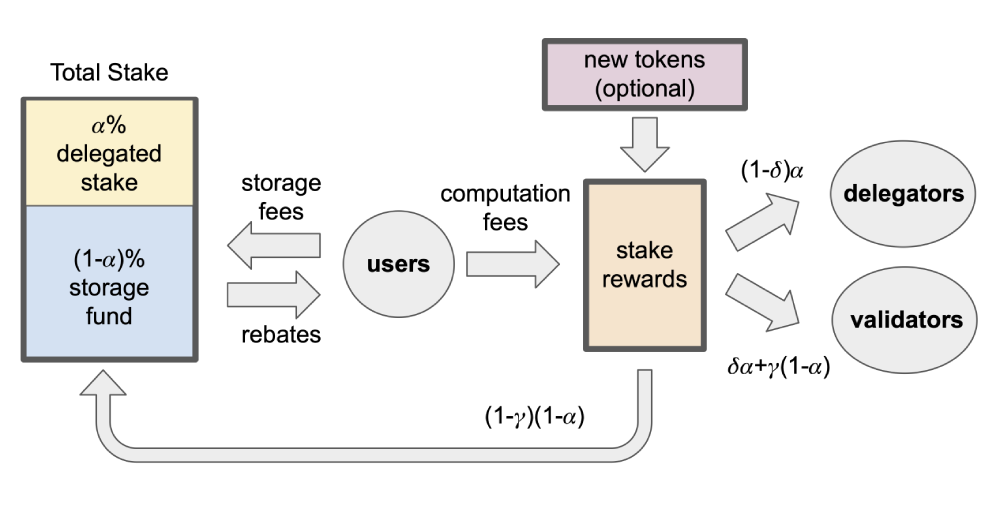
As a SUI token holder, you can participate directly by voting on onchain proposals or indirectly through delegation, by assigning your voting weight to a validator or representative whose position aligns with yours. There is an important distinction: delegating your stake to a validator for staking rewards is not the same as delegating governance votes. The two processes are operationally separate, and assuming they are linked is one of the more common misunderstandings in SUI's tokenomics.
Validators play a central role not just in consensus but also in governance because their accumulated stake determines their influence over proposal outcomes. Regardless, it’s the token holder who ultimately decides who receives that weight.
Supply
SUI's total token supply is capped at 10 billion tokens. This makes SUI a fixed-supply asset, which is a meaningful distinction from inflationary protocols with uncapped issuance.
The portion of total supply that is actively available on the open market (i.e. not locked, vesting, or held in reserve) is smaller than that: only a little under 40% of those 10B SUI are in circulating supply. The rest are to be distributed in small-scale monthly unlock events that release about 0.1% of the total supply into circulation at a time, until 2030. At the end of the decade, the remaining 52.17% of the supply is to be released in a single cliff unlock.
Allocation
The total 10 billion token supply of SUI is distributed across different stakeholder groups at the protocol level. Each category represents a potential source of future selling pressure on Sui price — or long-term ecosystem support, depending on how tokens are governed.
The Sui Foundation made a decision to hold no airdrops of the native token. On launch, the SUI token was distributed to community members, investors, and reserved by the Sui Foundation for further use. The basic breakdown is straightforward: 50% to the public, 50% in the reserve. These halves are further divided as on the chart below:

- 20% to early contributors: developers, testers, community managers, etc.;
- 14% to investors;
- 10% to Mysten Labs treasury;
- 6% to the Community Access Program (the recognition sale and retrospective awards);
- 50% will be distributed from the Reserve managed by Sui Foundation toward decentralization efforts, grants, and research.
Sui Network Design
Now that we know the basics of the SUI coin, let’s take a closer look at the architecture it powers.
Sui's architecture treats performance not as a tuning problem but as a structural one. Its object-centric state model is what makes parallel execution possible, parallel execution is what makes throughput scale, and throughput at scale is what compresses finality to sub-second ranges under real conditions. Each of the four design choices below feeds directly into the next, forming a causal chain, not simply a list of independent features.
Object Model
Sui organizes onchain state as discrete objects rather than account balances; the model is distinct from UTXOs, too. Every asset — an NFT, an in-game item, a token — exists as a uniquely identified object with a clear ownership record tracked in the Move programming language, making assets directly ownable at the protocol level rather than merely “represented” by database entries. Owned objects belong to a single address and can be modified without coordination with any other transaction, while shared objects are accessible by multiple parties simultaneously but require sequencing; the implication here is objects can move concurrently (pun may be intended).
Parallel Execution
Sui's scheduler applies a straightforward rule to enable concurrent processing: transactions that touch disjoint sets of objects can do it but transactions that share a write dependency on the same object must serialize. Mechanically, every transaction declares its inputs: the objects it reads and the objects it writes; the runtime constructs an implicit dependency graph from these declarations. Two transactions with no overlapping write targets have no conflict edge between them and are dispatched to separate execution threads simultaneously. In contrast, two transactions that both write to the same shared object do have a conflict edge and must run in sequence (i.e. one after another).
This means a batch of 10,000 NFT transfers, each touching a distinct owned object, can theoretically execute as 10,000 independent threads. On the contrary, if a smart contract produces shared objects that many users have to interact with or an app over-centralizes its state inside a shared object, serialization is forced. These scenarios can be avoided at the design stage by correctly applying Move’s object model to an application architecture.
Horizontal Scaling
"Scaling" covers at least three separate dimensions: execution throughput (how many transactions can be processed per unit of time), consensus throughput (how quickly the network agrees on transaction ordering), and storage/ingestion capacity (how much state history the network can absorb). Sui's design separates these concerns deliberately.
Execution scaling is primarily driven by parallelism. Adding validators does contribute here because each validator node can bring more compute resources. Network/validator scaling, however, addresses consensus throughput and fault tolerance, not execution bottlenecks caused by shared-object contention.
Transaction Finality
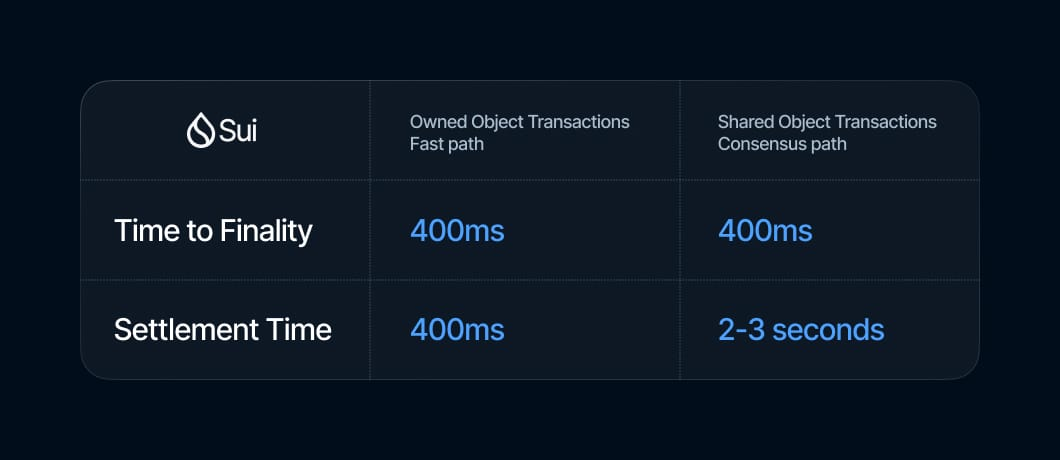
Finality in Sui refers to the point at which a transaction outcome is irreversible and committed to the ledger, after which no reorganization or rollback is possible. Research benchmarks place this at approximately 39 ms at high throughput under normal conditions. A consensus protocol upgrade Mysticeti introduced in 2024 reduced consensus latency by roughly 80% compared to its predecessor, making this possible.
However, sub-second finality is still not the same as instant finality. Under adversarial conditions or network congestion, the fast path delivers the headline latency figures but the worst-case path, which kicks in for shared-object transactions or under abnormal validator behavior, takes meaningfully longer, though still within seconds rather than minutes. Apps that require as little latency as possible, such as financial or gaming, can feel this difference.
Sui Ecosystem
Wallets
From a purely technical point of view, a wallet on Sui does something slightly different from what you might expect on older blockchains. Rather than simply authorizing a balance transfer, it signs transactions that mutate (change the state of) objects. It’s important when you're choosing where to store SUI tokens, NFTs, or any other onchain asset, particularly for applications that combine identity management with asset ownership.
Before picking a wallet, consider:
- Custodial vs. self-custody: Custodial wallets (typically exchange accounts) hold your keys for you. Self-custody wallets give you full control — and full responsibility. For anything beyond very casual use, self-custody is the standard recommendation.
- Software vs. hardware: Software wallets are convenient and often Sui-native by design, but they're connected to the internet. Hardware wallets add an offline signing layer, which matters if you're holding meaningful value.
- Sui-native support requirements: Not every wallet handles Move-based assets correctly. Look explicitly for support of object-centric assets and Sui NFT standards — a generic EVM wallet won't cut it here.
- Transaction simulation and phishing checks: A trustworthy Sui wallet will preview what a transaction will actually do before you sign it — similar to how SignGuard works in the OneKey ecosystem. Domain-level phishing detection is a meaningful bonus.
Popular options include Surf Wallet (supports popular Web2 credentials), OKX Wallet (multi-chain), Slush (by Mysten Labs), Suiet browser extension, Phantom (for Solana features), and Backpack (with a built-in exchange).
Decentralized Exchanges
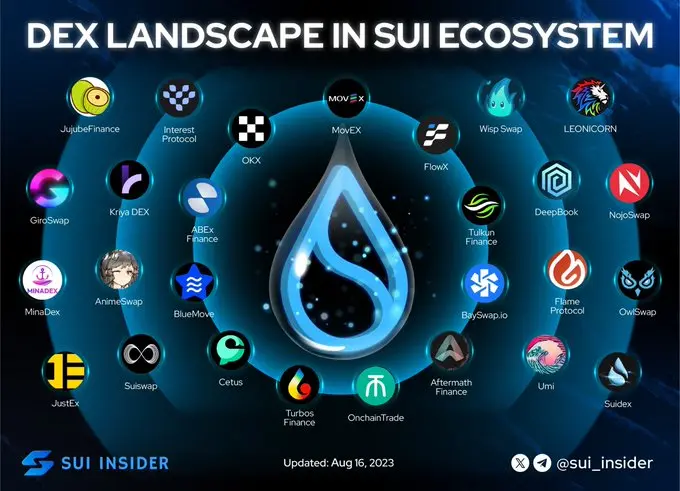
Speaking of which, decentralized exchanges (DEX) on Sui give users the ability to swap tokens, provide liquidity management, and access price discovery entirely on chain, i.e. without routing through a centralized intermediary. But "can I swap here?" is only the first question worth asking.
When evaluating a DEX on Sui, consider these criteria:
- Liquidity depth: A pool might exist for any token pair, but shallow liquidity means your trade will move the price against you. Check depth, not just availability.
- Slippage behavior: Understand the default slippage tolerance settings. High slippage settings on illiquid pairs are a frequent source of unexpected losses.
- Token discovery risk: New or unverified tokens can appear on DEXs instantly. That's by design — but it also means scam tokens and honeypots appear just as easily. Verify contract addresses through official project channels before trading unfamiliar assets.
- Routing and aggregators: Single-venue swaps are simple but may miss better pricing available across multiple pools. Aggregators route through several liquidity sources simultaneously, which often improves execution on larger trades.
- Stablecoin pairs as a baseline: A DEX's health is partially readable through its stablecoin liquidity. Deep, stable pairs (think USDC/SUI or USDC/USDT) indicate real user activity and a reliable price anchor for the broader market.
For a quick health check on any DEX, look at three metrics: rolling 30-day volume trends (is it growing or declining?), TVL relative to volume (low TVL with high volume signals instability), and stablecoin liquidity as a share of total TVL.
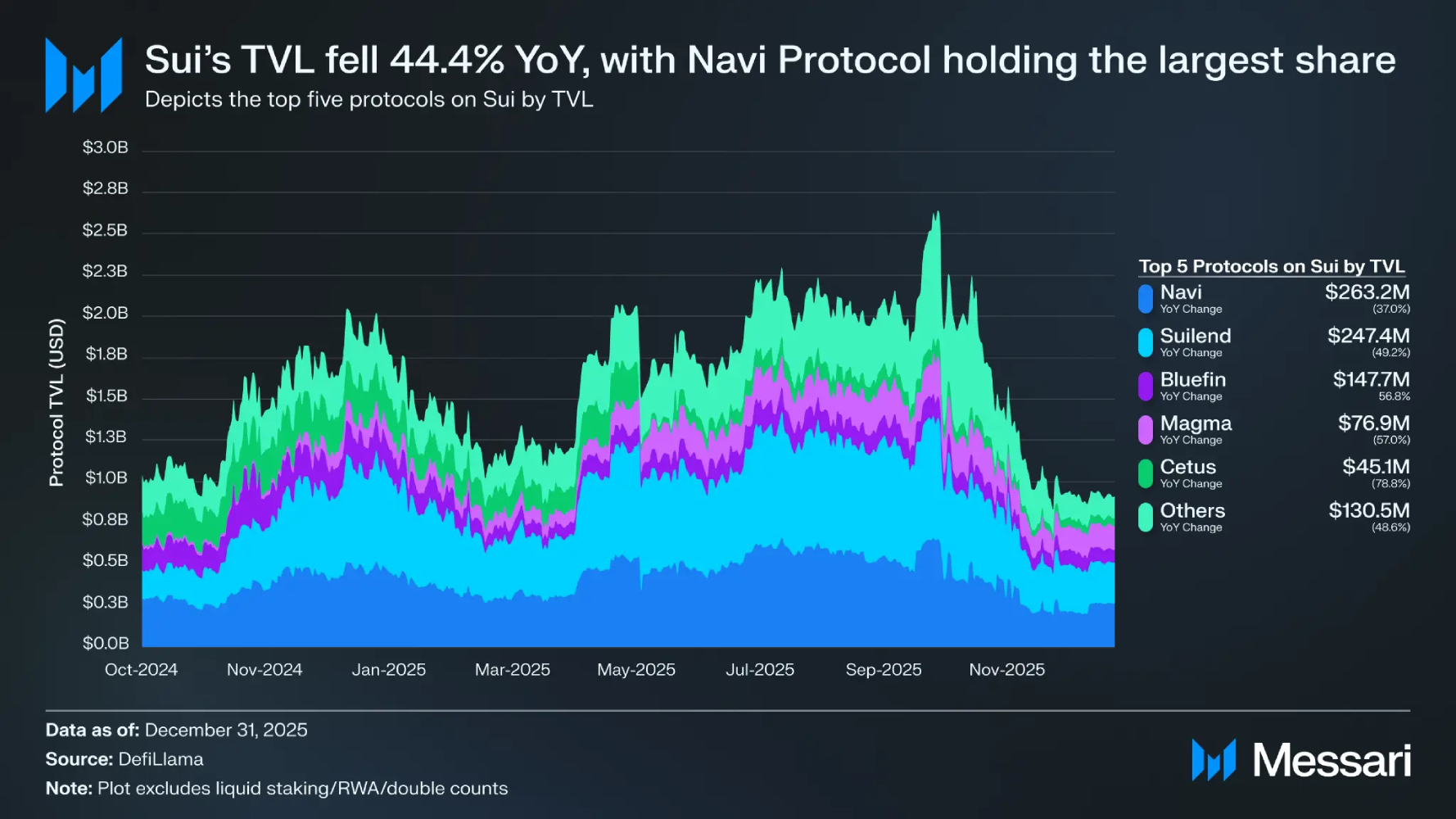
The Sui DeFi ecosystem has produced numbers that make these checks increasingly relevant. At the time of writing, the average daily trading volume on Sui-based DEXs approaches $45 million and on a monthly scale, climbs up to $1.5B. Admittedly, not yet close to the biggest players such as Ethereum but still considerable capital, placing Sui 13th by total value locked (TVL) according to DefiLlama.
Decentralized Applications
Sui's dApp layer covers significantly more ground than swapping and storing tokens.
- Lending and borrowing: You deposit collateral and borrow against it, or supply assets to earn yield. The primary risk is smart contract vulnerability — a bug in the lending protocol's code can drain pools regardless of how healthy your position is, and Move is not immune to such mistakes. Top example: NAVI Lend.
- Liquid staking: You stake SUI and receive a liquid token representing your staked position, which you can then use elsewhere in DeFi. Oracle risk is a concern: the liquid token's value depends on accurate price feeds, and a manipulated oracle can trigger cascading liquidations. Top example: SpringSui.
- Payments and onchain commerce: You send or receive SUI or stablecoins as payment for goods and services directly. Liquidity risk applies here mainly through stablecoin stability — if the payment token loses its dollar peg, the transaction's real value shifts. Top examples: USDC and Sui Dollar.
- Infrastructure tooling: You use block explorers, indexers, analytics dashboards, and developer tooling that makes the rest of the ecosystem legible. These carry indirect risks — if a tool displays inaccurate data, user decisions based on it can go wrong. Top examples: Sui Vision and SuiScan.
Sui's composable dApp ecosystem has been gaining real traction. Monthly active users reportedly rose from around 10 million to over 40 million earlier in 2025.
What is SUI Crypto Used For?
Sui powers a growing range of real-world applications, from decentralized finance to interactive gaming and AI-driven workflows, each category benefiting from the network's design in distinct, measurable ways.
DeFi
Sui's architecture supports high-throughput trading, programmable liquidity, and composable financial products that can be combined into seamless multi-step workflows without manual bridging between protocols.
Users can:
- Swap tokens on a DEX at near-instant settlement
- Provide liquidity to a pool and receive LP tokens representing the position
- Deposit collateral into a lending protocol, borrow against it, and deploy the borrowed asset directly into a liquidity pool — all within a single composable session
- Mint or redeem stablecoins against on-chain collateral
- Bridge assets from another chain and immediately deploy them into yield-generating positions
Gaming
Most commonly, Sui treats in-game assets as first-class on-chain objects, giving players verifiable real ownership over items, characters, and currency that persist beyond any single game session or platform. Because those assets conform to shared object standards, an item earned in one experience can appear and function inside a compatible application — making cross-platform interoperability a practical user benefit, not just a protocol claim.
Sui empowers game developers and players to:
- Mint a new in-game item as an on-chain object at the moment it drops
- Trade or sell an asset on a player-to-player marketplace without a centralized intermediary
- Upgrade an item through a Move contract that verifies eligibility on-chain
- Transfer an asset to another wallet or grant access to a friend
- Use an asset earned in one game experience inside a compatible application, enabled by shared object standards
Wallet UX remains a friction point for players who have never held crypto. Gas fee volatility, even if low on average, can create unpredictable costs during high-demand events like item drops. Interoperability between games depends on agreed object standards that are still maturing across the ecosystem, not to mention developers actually bothering with it.
AI
For this emerging field, Sui functions as a trusted data layer where AI agent actions, model outputs, and dataset provenance can be logged, verified, and audited on-chain, even when the compute itself happens off-chain.
Building a decentralized AI solution with Sui as groundwork opens up possibilities such as:
- An AI model runs inference offchain, submits a cryptographic hash of its output to a Move contract for onchain verification, and an end-user application reads that attestation before displaying results to the consumer
- Store a cryptographic proof of the model output on-chain for downstream consumption
- Query the attestation log to verify that a piece of AI-generated content was produced by a specific model version
- Grant or revoke an agent's permissions through a Move transaction rather than a centralized admin panel
How Does Sui Compare to Its Competitors?
Sui competes in a crowded field of high-throughput Layer 1 blockchains, so understanding where it fits architecturally matters more than raw benchmark comparisons.
Sui vs Solana
Choice for: Teams building high-throughput consumer applications where ecosystem liquidity and developer toolfall matter as much as raw speed: payments, decentralized trading, and on-chain gaming.
Where Sui tends to win:
- Sui's object-centric parallel execution means independent objects are processed concurrently without requiring a global scheduling layer, producing approximately 39 ms finality and up to ~297,000 TPS under favorable conditions.
- The Mysticeti consensus upgrade (2024) delivered roughly an 80% reduction in latency, making Sui's sub-second finality more consistent under load.
- Sui's object ownership model reduces certain classes of contention bugs at the protocol level rather than relying on developer discipline alone.
Where Solana tends to win:
- Solana's ecosystem liquidity, DeFi depth, and NFT market infrastructure are significantly more mature.
- Tooling, indexing infrastructure, and third-party integrations (wallets, oracles, analytics) are broader and battle-tested.
- The developer community and available hiring pool are considerably larger today.
Sui vs Aptos
Both are teams with existing Move expertise or backgrounds in the Diem/Libra ecosystem. Both chains use Move as their smart contract programming language, but the implementations diverge meaningfully. Aptos uses a resource-based account model inherited from Diem, while Sui's Move variant (sometimes called Sui Move) centers on objects rather than accounts.
Where Sui tends to win:
- Sui's object model provides a more expressive ownership primitive — objects can be owned, shared, or frozen — which gives developers finer-grained control over access patterns without extra boilerplate.
- Sui's object-based data model maps naturally to NFTs, gaming assets, and DeFi positions as first-class entities, making it highly scalable for asset-heavy use cases.
Where Aptos tends to win:
- Aptos's Block-STM parallel execution engine is well-documented and has attracted significant institutional and enterprise attention.
- Aptos has a growing ecosystem of Move tooling that teams coming from the Diem background may find more immediately familiar.
- Aptos's validator set and governance structure have attracted certain enterprise partnerships that carry weight for institutional integrations.
For more on what APT cryptocurrency is, read our guide on that project.
Sui vs Avalanche
Choice for: Teams that need app-specific validation environments, custom gas tokens, or permissioned execution contexts — use cases where the subnet model's flexibility justifies its operational overhead.
Where Sui tends to win:
- Sui provides generalized high-performing parallel execution on a single network with consistent sub-second finality, without requiring teams to bootstrap and maintain their own subnet validator set.
- For applications that benefit from shared composability — where your protocol needs to interact with existing DeFi liquidity or NFT ecosystems on the same network — Sui's single-network object model avoids the fragmentation that comes with subnets.
- Developer onboarding is more straightforward when there is no infrastructure layer to configure before writing the first smart contract.
Where Avalanche tends to win:
- Avalanche's subnet architecture gives teams genuine control over validator membership, execution rules, and gas token configuration — features that are simply not available on Sui's single-network model.
- The C-Chain's EVM compatibility means teams with existing Solidity contracts can deploy with minimal changes, accessing a mature toolchain (Hardhat, Foundry, Ethers.js) from day one.
- Avalanche's ecosystem maturity and institutional adoption in areas like asset tokenization and financial applications is ahead of Sui's.
Sui vs Near Protocol

Choice for: Teams prioritizing developer accessibility, human-readable account names, and a familiar JavaScript/TypeScript-adjacent development experience for consumer-facing Web3 applications.
Where Sui tends to win:
- Sui achieves parallelism within a single execution environment rather than partitioning state across shards, which simplifies cross-contract composability.
- Sui's consistent sub-second finality is a meaningful advantage for latency-sensitive applications like real-time gaming or high-frequency DeFi interactions.
- The Move programming language's linear type system and object ownership model offer stronger compile-time safety guarantees than Near's Rust or JavaScript SDKs for applications where asset integrity is paramount.
Where Near tends to win:
- Near's account model uses human-readable names (e.g., alice.near) and supports function-call access keys, which produces genuinely friendlier onboarding UX for non-crypto-native users.
- JavaScript and TypeScript SDK support lowers the barrier for web developers entering blockchain development — a demographic that Move's learning curve does not serve as naturally.
- Near's Nightshade sharding has been in production longer and has a track record that newer teams may find reassuring.
Outlook in 2026
Will Sui’s architectural benefits translate into sustained user retention? Builders and developers are by default in the minority, so it still remains to be seen whether the majority of crypto users would appreciate what Sui has to offer. Luckily, we know where exactly to look and confirm.
- Network latency / sub-second finality: Will the sub-second finality be consistent during high-throughput periods? Will Sui see latency creep as the user base scales?
- Will fee revenue that goes to validators rise without user drop-off? Or will active addresses decline, signaling pricing-out rather than demand for blockspace?
- Active users trend (MAU): Will month-over-month MAU growth be sustained for at least two consecutive quarters? Will user activity be event-driven rather than sticky usage, evident from sharp fluctuation in MAU numbers?
- Can TVL grow in tandem with protocol revenue? Will TVL be inflated by mercenary liquidity that exits on incentive reduction?
- Will DEX volume be diversified across multiple protocols? Or concentrate in one venue, signaling fragility?
- Will stablecoin supply grow organically tied to lending and trading demand? Will stablecoin growth stall while competing chains gain share?
- Will Nakamoto coefficient, a metric that measures network decentralization, increase quarter-over-quarter? Will stake concentration increase as large operators capture delegations?
- Will new contract deployments accelerate month-over-month via GitHub commits, new Move contract deployments, and SDK adoption? Will developer activity plateau after the grant program spends?
In these pairs of questions, the first is a positive signal that you can look up at any given time and the second one is a negative outcome. Ideally, you should be looking at most if not all of these criteria to confirm healthy network growth or stagnation.
For insights on the future price and SUI price prediction, proceed to our dedicated page!
Conclusion
Since its mainnet launch in May 2023, Sui has operated with a hard-capped SUI supply and sub-second finality, and that combination of proven throughput and controlled tokenomics is what gives the network its credibility as a serious infrastructure layer — not just another chain chasing hype. With sustained on-chain activity, Sui is an active, growing network worth tracking closely, especially as teams adopt more modular tools and shared standards to build open experiences across apps.
If you enjoyed our guide, check out the ChangeHero blog for more! Follow us on Twitter, Facebook, and Telegram for daily updates and even more content.
Frequently Asked Questions
What specific bottleneck does Sui's parallel execution solve?
Sequential blockchains process transactions one at a time through a shared global state, meaning every transaction waits in line regardless of whether it touches the same data. Sui's object model lets transactions involving independent objects execute simultaneously, eliminating unnecessary queuing.
When does Sui not parallelize well?
When multiple transactions compete for the same shared object—like a popular liquidity pool or a global counter—they create contention and must be sequenced, narrowing the parallelism advantage.
Is Sui designed for payments, DeFi, or gaming?
Sui's object model and sub-second finality make it a natural fit across all three, but it particularly shines where individual ownership and low-latency confirmation matter most—think real-time game asset transfers or instant payment settlement.
Does Sui's design reduce smart-contract risk?
Move's resource-oriented safety orientation helps prevent entire classes of vulnerabilities—like double-spend bugs or unauthorized asset duplication—by design, not just by convention.
Does high TPS automatically mean cheap fees and good UX?
Not necessarily. Throughput capacity sets a ceiling, but fees are driven by actual demand on the network, and UX depends on wallet design, onboarding flows, and app quality—none of which TPS numbers measure.
What kinds of apps get built on Sui?
Applications where individual ownership is the norm benefit the most. Three concrete examples: in-game items where each asset has unique attributes and belongs to a single player; NFTs that update dynamically based on user actions; and orderbook positions where each order is an independent object owned by its creator.
What's not a good use case for Sui?
Apps built around heavily shared global state—like a single global registry that every user writes to, or a protocol where every action modifies one central pool—run into Sui's shared-object contention limits. A global leaderboard that updates on every transaction is another example.
How should users evaluate DeFi safety on Sui?
The criteria are not Sui-specific: Has the protocol been independently audited, and are reports public? Are admin keys time-locked or governed by multisig? Is TVL stable or suspiciously concentrated in one wallet? What permissions does the contract hold, and can they be upgraded unilaterally? What are the liquidation and risk parameters?
What metrics actually indicate ecosystem traction on Sui?
Beyond price, watch active wallet growth, transaction volume trends, developer activity, and network fee revenue—Sui has been reported as on track for approximately $15 million in annualized network fee revenue. Fee revenue in particular reflects real economic activity, not just speculation.
Is Sui faster than Solana or Aptos?
The honest answer is: it depends. The outcome changes based on workload composition, the ratio of shared-object to owned-object transactions, network load at the time of measurement, and the specific app's architecture. Absolute rankings shift under different conditions, and a chain that leads in one benchmark may lag in another.
Where can I buy SUI?
SUI is available on major centralized exchanges (CEXs) that list it as a tradable asset, as well as on decentralized exchanges (DEXs) native to the Sui network. You can also buy SUI on ChangeHero through our fiat-to-crypto partners.
What's the difference between buying SUI on a CEX versus swapping on a DEX?
On a CEX, the exchange holds your SUI until you withdraw it—introducing counterparty risk but typically offering tighter spreads and easier fiat on-ramps. On a Sui-native DEX, you swap directly from your wallet, maintaining custody throughout, but you'll encounter slippage on larger orders, pay network gas fees, and may need to consider bridge costs if you're moving assets from another chain.
What network to select when withdrawing SUI from an exchange?
Always select the native Sui network when withdrawing SUI tokens. Sending to the wrong network—for example, selecting an EVM-compatible chain—can result in permanently inaccessible funds, as the receiving address format may appear valid but point to an incompatible chain.
Do I need SUI for gas even if I hold other tokens on the Sui network?
Yes—SUI is the native gas token for all transactions on the Sui network, so you need a small amount of SUI in your wallet to pay fees regardless of which other assets you're transacting with.
How do I verify I'm using the real SUI token on the correct chain?
Three quick checks: (1) Confirm your wallet explicitly shows "Sui" as the active network, not an EVM chain or testnet. (2) Cross-reference the token name and network indicator in your wallet against official Sui documentation or the project's verified website. (3) If you're interacting with a DEX or app, verify the URL matches the project's official domain before connecting your wallet—phishing sites frequently mimic legitimate interfaces.