

 Support









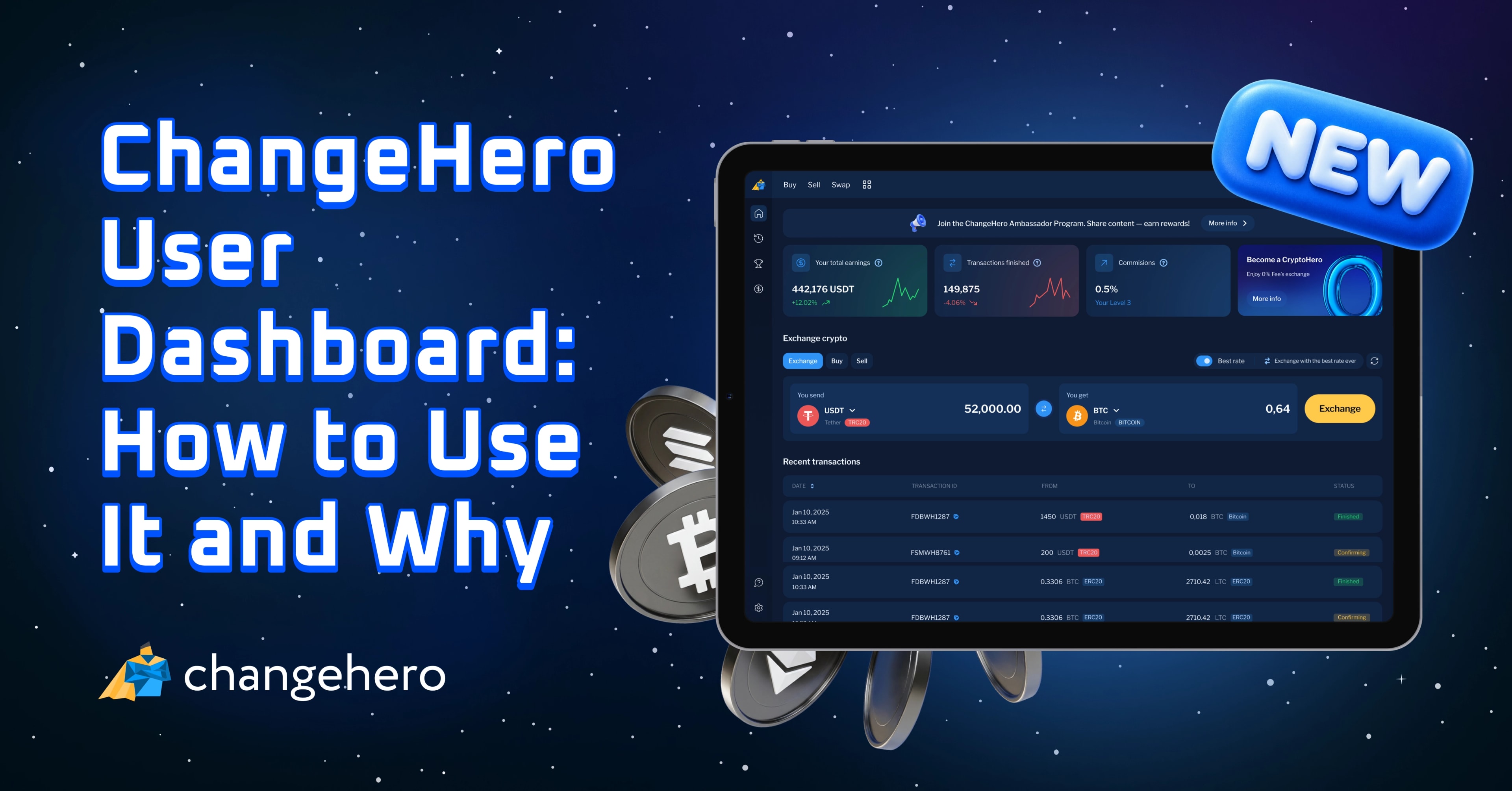
ChangeHero User Dashboard: How to Use It and Why
ChangeHero is rolling out optional user accounts. Learn why even if you do not have to, you should consider registering.
Author: Catherine
Buy Bitcoin with VISA, MasterCard, Apple Pay, Google Pay or PayPal directly to wallet | No KYC up to 700€



 Rated by thousands of customers
Hit start and watch a ChangeHero card purchase finish while a typical exchange is still asking for passport.

 Legacy verification queues and human errors
 Legacy verification queues & human errors

Currently, the BTC price is $81,789.93. According to the Bitcoin price chart, the 24-hour change is -1.85%. The total market capitalization of Bitcoin is $1,644,025,522,664 with 20,100,587 BTC in circulation. In the previous 24 hours, the Bitcoin price hit highs of $84,305.48 and lows of $82,156.25, offering a prime opportunity for secure and competitive transactions on ChangeHero.

Select the fiat currency of purchase and Bitcoin(BTC) from the drop-down menus. Adjust the amounts in the calculator widget until you are good to go.

After clicking ‘Buy’, review the transaction and fee details and compare offers. You can still adjust the transaction to your liking.

To continue with the purchase, choose the payment method, the provider, enter the recipient BTC crypto wallet address and confirm you have read the relevant agreements.

Provide your bank card details and complete the purchase in a secure 3-D environment. Complete a verification procedure if prompted.

Once the payment goes through successfully, wait for a few minutes for the bank and provider to send BTC to your Wallet.

Standing for the Single Euro Payments Area, SEPA simplifies bank transfers in euros across 36 countries in the European Union.

A Central-Bank-of-Brazil-developed instant payment solution to settle Brazilian real transfers in a few seconds.

Mexico's SPEI facilitates fast and secure electronic transfers between bank accounts within the country.
Keep things quick and personal data safe with no KYC crypto purchases up to 700€. Note that conditions apply depending on the provider.
ChangeHero is the best place to purchase crypto with the most competitive exchange rates. No hidden fees or markup.
Buy coins and tokens from a wide selection of supported assets. Skip the roundabout multiple conversions with mounting fees.
Get cryptocurrency of choice without worrying if your country is supported. We cover many locations with local currencies and payment options.
Should anything go off script during your fiat to crypto exchange, our Support Heroes have got your back!
Buy BTC on ChangeHero, with our providers green-lighting over 70% of transactions!
Best practices to protect your data and funds: PCI DSS for the cardholder data, 3D Secure for transaction protection, 2FA for the optional provider-side user accounts.


Talk is cheap, especially if we're the ones doing all the talking. See for yourself some of the reviews that make up our Excellent TrustScore on Trustpilot.
I was hesitant to use ChangeHero initially, but I’m glad I did! The platform is incredibly intuitive, and the process was so quick. I didn’t even need to register, which saved me time and effort. The exchange rates were competitive, and my transaction went through smoothly in under 10 minutes. I’ll definitely be using ChangeHero for all my crypto swaps moving forward
Milton George
Read on
I would suggest it to everyone because it is quick, anonymous, offers a wide range of currencies, and has comprehensive assistance.
Mae Burch
Read on
One my favourite & trusted currency exchange service provider this company. I am use their service 16 time. behaviour & service ar amazing. thank you so much for best service.
Julio Fink
Read on
The best currency rates in Singapore , hence I keep coming back. But not only that, the service is excellent & very efficient, even for last minute travel cash. I have used changehero a number of times & there has never been a slip up. Highly recommended.
Heather Ochoa
Read on
This was my first experience of ordering currency on line. give a very good exchange rate so I ordered from them. The whole process was easy and quick. I got relevant up-dates as the order was processed and sent out. From order to receiving the currency it was a week but could have been quicker if I had requested a different delivery date. I would definitely use them again.
Van Keith
Read on
Had an excellent experience ordering foreign currency for 2 different countries. Had not done this before, but wanted to be prepared with some cash beforehand. The delivery was extra speedy & exchange rates seemed reasonable when comparing with other sites.
Traci McKinney
Read on
I am use their currency exchange service 7 time. Really trusted service provide always. thanks this company owners. thanks for great service. I am definitely use your service next time if my need.
Verna Giles
Read on
ChangeHero has completely transformed the way I exchange currencies. The platform is incredibly easy to use, with clear instructions at every step of the process. Transactions are completed within minutes, which is perfect for someone like me who values efficiency.
Natalia Marquez
Read on
Quick service and currency nomination distribution. easy ordering and delivery. Thank you for giving me a head start on my trip. thank you so much.
Teo Rui En
Read on
ChangeHero works exclusively with reputable licensed virtual service providers that do not keep users’ funds in custody and release the purchased cryptocurrency to the user's address instantly.
Yes, to receive the purchased BTC you need to own an appropriate cryptocurrency wallet address. By the way, ChangeHero seamlessly integrates with the crypto wallets you already trust, including industry leaders like Exodus, Trezor, and Tangem Wallet.
The fiat-to-crypto fees depend on the selected currencies, payment methods, and current miner fees. You can always see the current fees before purchasing in transaction details.
ChangeHero’s swap service is available in most countries, except for Prohibited Jurisdictions listed in our Terms of Use. The fiat purchase/sale availability depends on the service provider: see the complete lists at https://help.mercuryo.io/ for Mercuryo or https://finchpay.io/faq for FinchPay.
You can feel free to purchase crypto with fiat using Credit or Debit card, Apple Pay, Google Pay, Revolut Pay, local payment options sush as SEPA, PIX in Brazil or SPEI and many others.
Our payment providers accept most major credit and debit cards, including VISA and MasterCard in more than 100 countries.
We attest our providers do their best to process transactions as quickly as possible — ideally in an instant. However, multiple factors outside of their influence affect the transaction processing speed, such as network load or card payment processing by the bank. In our experience, transactions are usually completed within 5 to 30 minutes.
We would love to remedy that as soon as possible! Direct your request to support@changehero.io or the providers’ teams and we will consider the possibility of adding the requested currency.
The minimum and maximum amounts vary depending on the currencies and the provider. For reference, the minimum amount is around €25 equivalent and the maximum amount is approximately €10,000 equivalent per transaction.
Please note that the KYC threshold varies by provider. You can expect to be able to purchase up to €700 equivalent anonymously without an identity verification. The provider reserves the opportunity to selectively request an identity verification even for smaller amounts.
ChangeHero does not store the personal information of clients beyond verification procedures. Our partner payment providers use reputable and regularly audited identity verification services that encrypt all sensitive data.
Our partners and ChangeHero always work to expand the list of supported payment methods and purchase limits. If you are interested in purchasing BTC in amounts over €10,000 equivalent, feel free to get in touch with support@changehero.io.
Once your Bitcoin (BTC) is securely in your wallet, the possibilities are endless. You're free to use your BTC however you want. You can HODL your coins for the long term, send them to friends, sell your Bitcoin for fiat currency, or explore the ever-expanding world of Bitcoin use cases.
Should any issue arise during your exchange, our support team is available to help you. You can contact us 24/7, and we will resolve the matter as quickly as possible.
Yes. Once your payment is successfully processed, the BTC will be sent to your wallet in just a few minutes. As soon as the funds arrive in your wallet, they are available for you to use immediately.
In the throes of the 2008 financial crisis, as trust in legacy financial systems faltered, a pseudonymous figure or group known as Satoshi Nakamoto published a groundbreaking document on October 31. This whitepaper, titled "Bitcoin: A Peer-to-Peer Electronic Cash System," introduced a radical solution for online payments without relying on a central authority. While previous attempts at digital cash existed, this moment marked the true genesis of the blockchain and cryptocurrency era.
Bitcoin (BTC) is a decentralized digital currency powered by a distributed ledger technology known as the blockchain. Its core innovation is an immutable and transparent public ledger that records all transactions. This ledger is maintained by a global network of computers, ensuring that once a transaction is confirmed, it cannot be altered or removed. This structure provides unparalleled transparency and security, allowing anyone to verify transactions while preventing fraud and censorship.
The success of Bitcoin ignited a global movement, proving that financial sovereignty was possible outside of traditional frameworks. While its own characteristics, such as volatility and scalability challenges, have led to the creation of thousands of alternative cryptocurrencies, Bitcoin remains the industry's foundational asset. It stands as a powerful symbol of decentralization and the catalyst for a new wave of financial innovation.
ChangeHero is rolling out optional user accounts. Learn why even if you do not have to, you should consider registering.
Which Solana wallet reigns supreme in 2026? ChangeHero's crypto experts break down security, features, and compatibility across leaders in the market. Read to choose the right wallet!

Explore expert Ethereum price forecasts for 2026, 2027, 2028, 2029, 2030, 2035 and 2040, diving into ETH potential in the evolving cryptocurrency market. Make informed investment decisions with ChangeHero!

Explore expert Avalanche price forecasts for 2026, 2027, 2028, 2029, 2030, 2035 and 2040, diving into AVAX potential in the evolving cryptocurrency market. Make informed investment decisions with ChangeHero!

Explore expert Dogecoin price forecasts for 2026, 2027, 2028, 2029, 2030, 2035 and 2040, diving into DOGE potential in the evolving cryptocurrency market. Make informed investment decisions with ChangeHero!

Explore expert Metis price forecasts for 2026, 2027, 2028, 2029, 2030, 2035 and 2040, diving into METIS potential in the evolving cryptocurrency market. Make informed investment decisions with ChangeHero!