
What is Solana (SOL)? A Beginner’s Guide


Solana is a high-throughput blockchain platform built to support decentralized applications and crypto-currencies without sacrificing speed or scalability. If you’re here because you keep seeing people ask “what is solana” and you want an answer that goes beyond marketing claims, you’re in the right place.
Who This Guide Is For
This article is tailored for the audience of:
- Traders and end-users considering Solana-based assets or applications can use this guide to understand transaction fees, confirmation and finality behavior, liquidity dynamics, and what “fast” actually means when conditions get stressful.
- Stakeholders assessing decentralization, network reliability, and long-term viability will see transparent analysis of validator distribution, historical downtime events, and governance realities that shape Solana’s resilience.
Origins of Solana Crypto
Solana didn’t start as “another chain with faster blocks” but as an argument: transaction ordering could be made dramatically cheaper if the network had a verifiable clock, and that consensus should spend less time debating when things happened and more time validating what happened.

Founders
Solana emerged supposedly from the vision of Anatoly Yakovenko, who founded the project in 2017 after identifying a fundamental problem: existing blockchains couldn’t scale without sacrificing decentralization or security. Yakovenko brought deep technical expertise from his background as a software engineer at Qualcomm, where he worked on distributed systems and compression algorithms. His specific contribution to early Solana was the conceptualization of Proof of History (PoH).
Joining Yakovenko were several co-founders who shaped Solana’s early architecture. Greg Fitzgerald, formerly a colleague at Qualcomm, became the principal engineer responsible for translating Yakovenko’s whitepaper concepts into working code. Stephen Akridge contributed expertise in optimizing transaction processing through GPU parallelization, drawing from his experience in systems architecture. Raj Gokal rounded out the founding team by handling business development and ecosystem growth, bringing operational experience from previous ventures in the startup world.
The Solana project officially began in 2017 when Yakovenko published his initial whitepaper describing Proof of History as a solution to blockchain timestamping. The founding team set out to solve a specific problem statement: delivering high throughput and low transaction fees at global scale without compromising the decentralization that makes blockchains valuable.
Solana Labs
Not to be confused with Solana itself, Solana Labs functions as the core engineering organization responsible for building and maintaining the protocol. The Labs team handles protocol development, client implementation, software releases, and developer tooling that makes building on Solana practical; not grantmaking, governance decisions, or ecosystem narrative.
Concrete outputs from Solana Labs include the primary validator client software that nodes run to participate in consensus, the Solana Command Line Interface (CLI) tools that developers use to deploy programs, and reference implementations of key protocol features like the Tower BFT consensus mechanism. When the network undergoes upgrades or patches security vulnerabilities, those engineering efforts originate from Labs’ development teams. The organization also maintains extensive documentation and software development kits (SDKs) in multiple programming languages, making the protocol accessible to builders with different technical backgrounds.
Solana Foundation
Thirdly, the Solana Foundation serves as the ecosystem stewardship organization, distinct from Labs’ engineering focus. The Foundation’s mission centers on community growth, education initiatives, grant distribution to promising projects, and potentially validator decentralization programs that broaden network participation. This separation between a builder organization (Labs) and an ecosystem organization (Foundation) mirrors a pattern you’ll see across crypto: a neutral steward can fund and coordinate without being the only “voice” that matters.
In practice, the Foundation manages activities like hackathons that introduce developers to Solana, educational content that helps newcomers understand the protocol, and grant programs that fund projects building applications, infrastructure, or research.
Launch
Solana’s initial testnets and developer networks (devnet) became available for experimentation in 2018-2019, allowing developers to deploy test applications and validators to practice node operation without real economic stakes. The network transitioned to mainnet beta in March 2020, marking the first time real SOL tokens moved on a live blockchain with economic consequences.
Solana’s Network Architecture
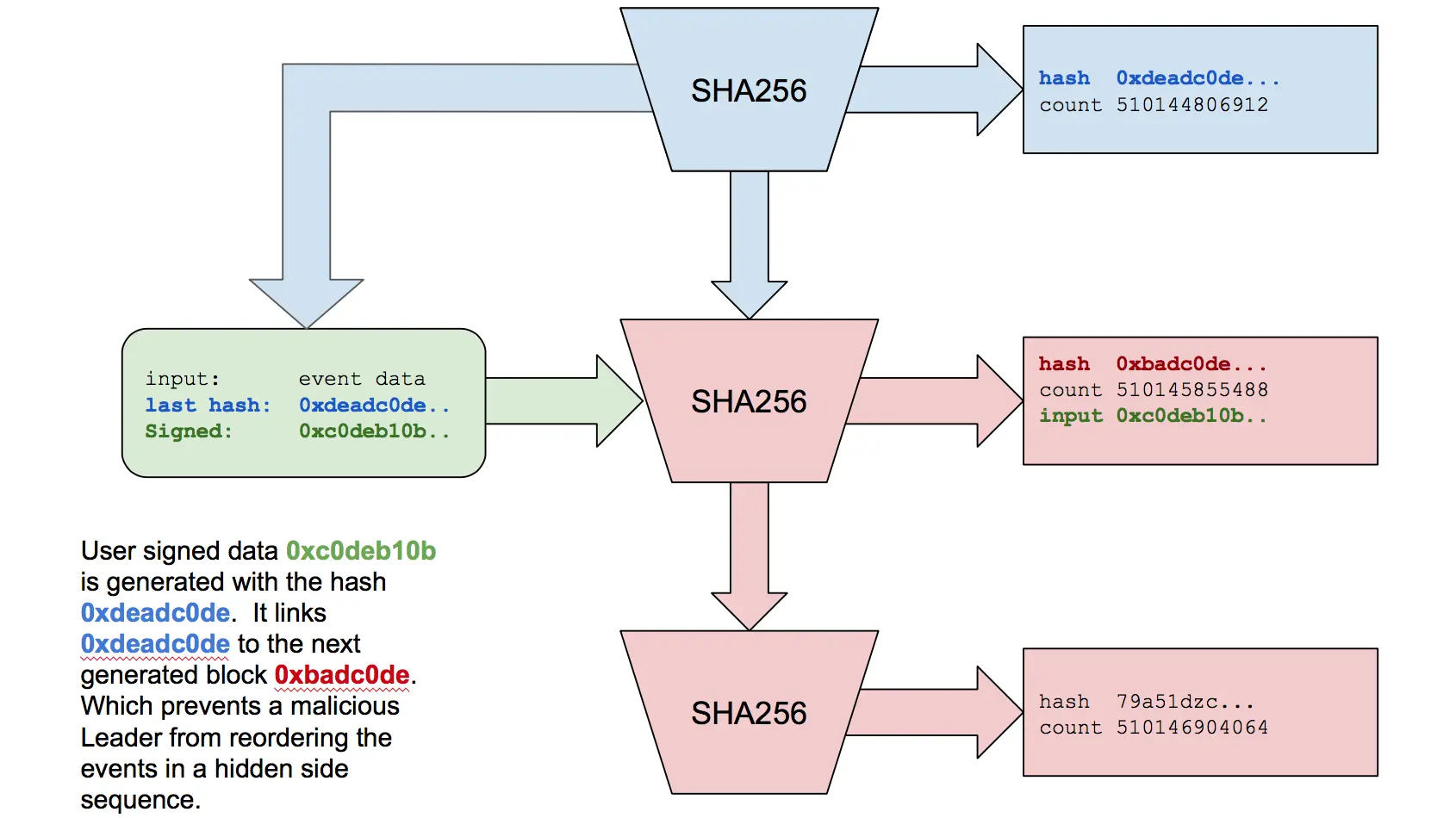
Solana’s architecture is built on four layers that work together to keep things fast: Proof of History establishes ordering, Proof of Stake provides consensus and finality through validator voting, the Validator Set defines who can produce and verify blocks, and Transaction Processing describes the execution pipeline from submission to confirmation.
Proof of History
Proof of History produces a verifiable sequence of events encoded as a cryptographic hash chain, where each hash includes the previous output and a timestamp, creating an append-only record of ordering. Despite its name having a form that is similar to popular consensus algorithms, PoH is not one: it is purely a time-ordering signal that lets validators agree on sequencing without constant communication.
In the pipeline, PoH sits at the instruction ordering stage. The leader uses it to schedule execution and structure blocks. Validators verify the hash chain to confirm the leader followed the correct sequence, checking that each hash derives from the previous one without gaps or manipulation. That’s the key: validators can independently verify ordering without coordinating timestamps across the network.
PoH has two direct performance implications:
- Reduced coordination overhead for ordering: Validators don’t need to exchange messages to agree on when events happened, since the hash chain provides cryptographic proof of sequence.
- Faster verification of ordering: Checking a hash chain is cheaper than running consensus rounds for every ordering decision, and validators can process the sequence in parallel.
This efficiency comes with a tradeoff: PoH relies on continuous hashing and hardware-level clock synchronization. If a leader’s clock drifts or hashing hardware fails, sequence integrity degrades. Validators must maintain sub-millisecond precision, which increases hardware and operational demands.
Proof of Stake
Validators lock SOL tokens to participate in consensus and block production, and stake weight influences how often they’re selected to produce blocks and how much influence their votes carry.
Finality in Solana is a confidence threshold that a block won’t be reversed. As validators vote, accumulated stake weight raises confidence. Once a supermajority of stake (typically over 66%) has voted to confirm a block, it reaches practical finality, meaning reversal probability drops to near-zero.
What are the responsibilities of a Solana validator?
- Voting on proposed blocks: Validators evaluate blocks and cast stake-weighted votes to accept or reject state changes
- Producing blocks when scheduled: Leaders organize transactions using PoH ordering and broadcast blocks
- Validating and relay transactions: Validators verify signatures and propagate valid transactions to keep the network healthy
- Earning rewards and fees: Validators receive inflationary staking rewards plus a portion of transaction fees, tied to stake and uptime
When there are responsibilities and compensation, there are risks, too. For one, downtime reduces rewards and delegations. There are systemic risks of Solana’s particular implementation of staking as well: large validators or stake pools can centralize influence and weaken censorship resistance; moreover, validators face incentives to reorder transactions for profit, which can harm fairness and UX
Validator Set
Not every “node” is a validator: validators stake SOL and have voting power, while non-validator nodes may track state or relay data.
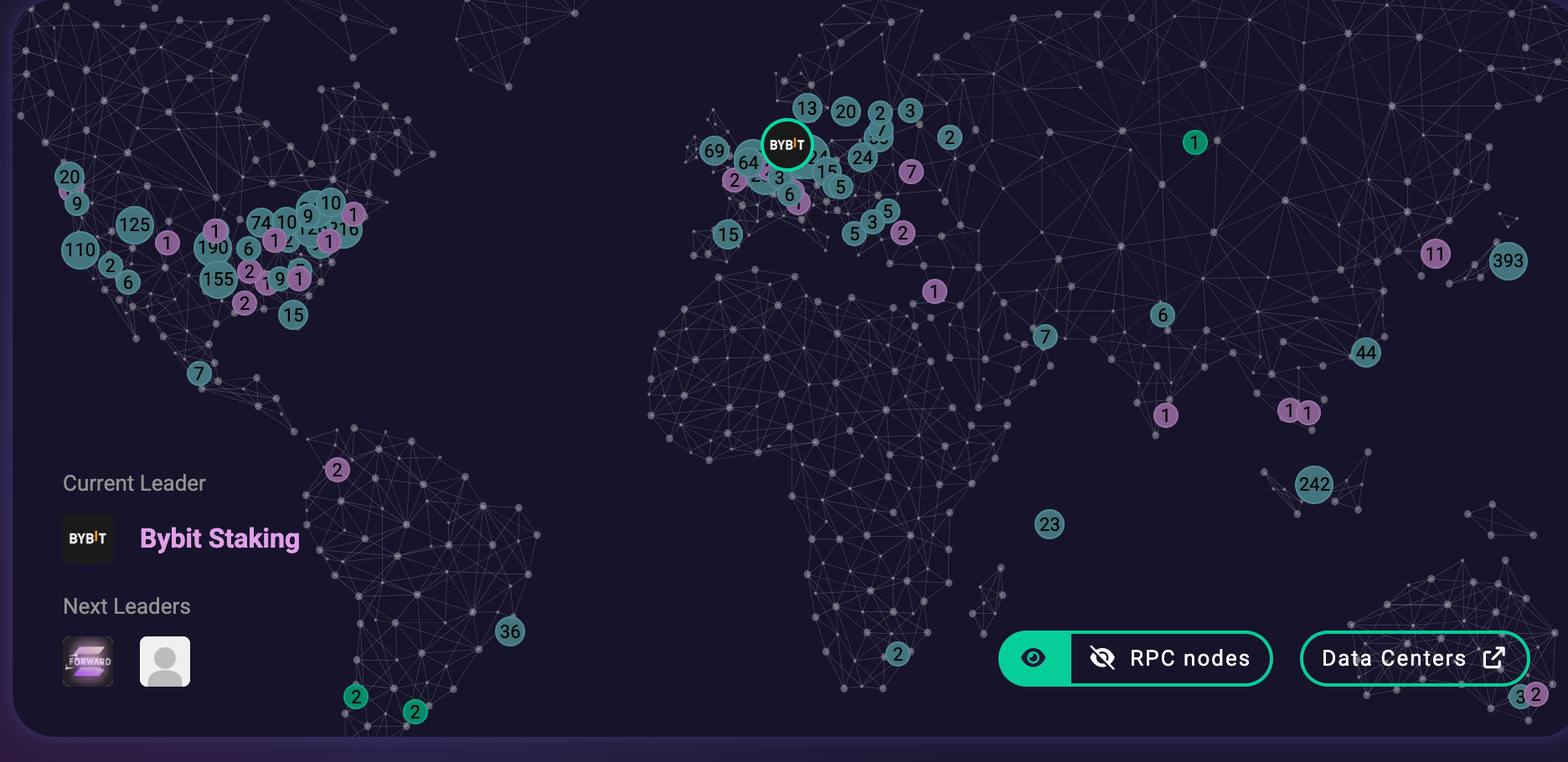
The validator lifecycle is straightforward but demanding: operators acquire stake (self-funded or delegated), run hardware meeting requirements, join the cluster, vote and produce blocks when scheduled, and earn rewards based on stake and uptime.
Stake delegation economics shape both behavior and decentralization. Delegators choose validators based on performance, commission, and reputation, increasing validator stake weight without transferring ownership. This market dynamic tends to push stake toward reliable, low-commission validators—but it can also centralize influence if a small set of operators becomes the default.
Transaction Processing
- Transaction creation and signing: A user builds a transaction listing accounts to read/write, instructions to execute, and a recent blockhash for replay protection. They sign with a private key to authorize it.
- Submission to the network: The signed transaction is broadcast to nodes, relayed toward the current leader, and enters a memory pool.
- Leader ordering via PoH: The leader timestamps and sequences transactions using Proof of History and packages them into blocks.
- Execution and state update: The runtime executes instructions in order. A transaction is an atomic unit of instructions that either fully succeeds or fully reverts—partial execution isn’t possible. Signatures are verified and account states checked before writes occur.
- Confirmation by validator votes: Validators vote stake-weighted confirmations. Confirmation represents the threshold where enough stake has voted to make reversal impractical, typically once a supermajority stake supports the block.
Fees are charged at the execution stage before instructions run, deducted from the fee payer. They compensate validators for computation and prevent spam by attaching a cost to flooding the network. If the fee payer can’t cover fees, the transaction fails before execution.
SOL Coin
In Solana, the native asset SOL has three jobs: paying transaction fees, securing the chain through staking, and enabling limited governance participation.
Solana uses an inflationary model with emissions that decrease over time. New SOL is issued to reward validators and stakers. There is currently no hard limit on the amount of existing SOL, which prevents disinflation even as the inflation rate contracts on the protocol level.
As for paying transaction fees, the path is simple: payer debits SOL → validators process → a portion burns and the remainder compensates the validator that included the transaction. Burning counteracts inflation pressure; validator compensation funds participation.
The burned part is the base fee but there are other components: priority fees let users pay more during congestion for faster processing. Rent-exempt minimum balances lock SOL in newly created accounts (not a fee, but a balance requirement).
Typical fees are fractions of a cent, but priority fee markets can increase total cost when demand spikes.
SOL Staking
How does Solana staking work in practice? The threshold to participation is even lower than running a validator node thanks to delegating:
- Choose a staking method: Native delegation, liquid staking protocols, or exchange staking
- Pick a validator: Compare uptime, commission, operational history
- Delegate SOL: Use your wallet to delegate to a validator stake account
- Earn rewards: Rewards distribute each epoch (about two days)
- Wait for activation: New stake activates next epoch
- Understand cooldown: Unstaking deactivates over one epoch
- Monitor and adjust: Re-delegate if performance or commissions shift
Returns for participation depend on commission rate, uptime, and validator performance. A 10% commission validator keeps 10% of earned rewards before distributing the rest to delegators. Regardless of commissions, missed votes or downtime reduce rewards.
Solana Ecosystem
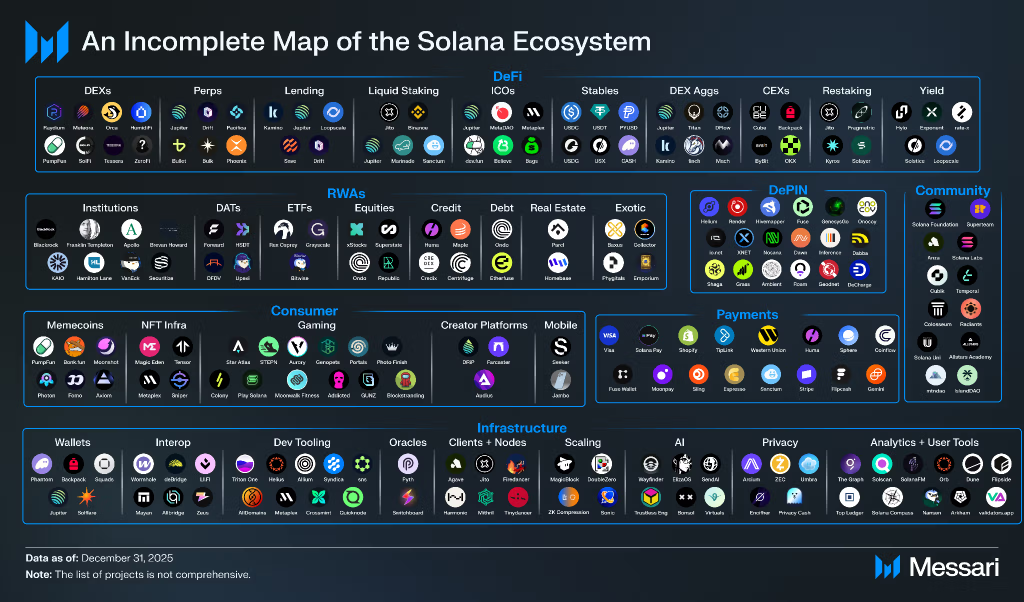
Solana’s ecosystem is easiest to understand as four connected layers: the application layer (dApps), the financial layer (DeFi primitives), the asset layer (NFTs and SPL tokens), and the builder layer (developer tooling).
Decentralized Applications
Also abbreviated as dApps, blockchain applications on Solana interact with on-chain programs through a programs-and-accounts model: executable code lives in programs, while state lives in accounts owned by those programs.
Common categories include decentralized exchanges (DEXs), games, social apps, payment processors, and NFT marketplaces. Solana’s composability shows up via CPI (cross-program invocation), allowing atomic “do A, then B, then C” transactions—swap collateral, read an oracle, repay a loan, all in one go.
DeFi
Decentralized finance (DeFi) on Solana includes automated market makers (AMMs), order books, lending, liquid staking derivatives, and perps. Low fees and fast confirmations make tight-loop strategies possible (arbitrage, frequent rebalancing, fast liquidations), but risks remain: smart contract risk, oracle risk, liquidity fragmentation, MEV, stablecoin depeg risk, and cross-program dependency.
NFTs and SPL Tokens
SPL is Solana’s fungible token standard. Tokens are defined by a mint, while balances live in associated token accounts. Common patterns include stablecoins (such as USDC and USDT), governance tokens (Pump.fun’s PUMP or Jupiter’s JUP), LP tokens, and reward points.
Solana NFTs combine an SPL token (supply 1), on-chain metadata (often via Metaplex), and off-chain media (Arweave/IPFS). Use cases include tokenizing digital or physical art, gaming assets, tickets/memberships, and identities. NFTs increasingly intersect with DeFi as collateral or via fractionalization, though this is still maturing.
The lifecycle of any token on Solana typically looks like: create mint → create associated token account → mint → transfer → burn/freeze (if enabled). SOL remains the fee currency for all of it.
Developer Tooling
Solana tooling spans SDKs, frameworks like Anchor, local testing environments, and RPC/indexing infrastructure. Developers must plan for account sizing, compute unit limits (1.4M per transaction as of 2026), transaction composition decisions, RPC provider reliability, and key management (deploy/upgrade/mint authorities).
Production readiness signals include audits, bug bounties, RPC/indexer uptime under stress, and documentation quality.
Security of Solana
Continuing the layer theme, Solana security is easier to reason about when you separate three layers: cryptography (signatures and integrity), network/economic attack surface (liveness and censorship), and program-level risk (smart contract logic and admin keys). Mixing these layers is how people end up blaming “the chain” for a phishing link.
Solana uses Ed25519 for identity and signing; this algorithm was invented in 2011, after Bitcoin was already live, and created specifically for faster signing without sacrificing security. Signatures provide authenticity, integrity, and non-repudiation. What they don’t provide is availability: liveness failures can halt block production without “breaking cryptography.”
That being said, user security is often a wallet security problem, not the fault of the protocol. Hot wallets are convenient but exposed to online attacks; hardware wallets which isolate keys and require physical confirmation are considered to be more secure but are less user-friendly.
To reduce wallet-level risk:
- Verify recipient addresses carefully.
- Verify program IDs via trusted explorers and official docs before signing.
- Use a hardware wallet for high-value transactions.
Solana’s attack surface includes consensus/economic attacks, network-layer attacks, propagation/MEV concerns, and DoS/resource exhaustion. The many incidents on Solana, which are becoming a thing of the past by 2026, are liveness failures, not safety failures. Congestion and halts prevent transactions from finalizing, but they don’t automatically imply stolen funds or ledger corruption.
Last but not least, most ecosystem losses come from program bugs, account validation failures, CPI dependency risk, or upgrade authority compromise. Users should check program IDs, use trusted front-ends, start with small test transactions, and pay attention to whether upgrade authority is burned or active.
Is Solana Reliable?
It would be disingenuous to pretend Solana has no baggage: for many long-time crypto users, it is known for a history of outages, among other things. Just a few of them:
- September 2021 – Block production halted for approximately 17 hours due to resource exhaustion triggered by a transaction flood on the Grape Protocol IDO; validators struggled with memory consumption under spam conditions. Trigger: Traffic surge / validator resource exhaustion.
- January 2022 – Network experienced degraded performance lasting several hours; duplicate transactions overwhelmed validators, creating consensus delays. Trigger: Spam/traffic surge.
- May 2022 – Seven-hour outage caused by NFT minting bot activity that flooded the network with invalid transactions; validators faced difficulties processing the transaction volume. Trigger: Spam/traffic surge.
- February 2024 – Network downtime lasting approximately five hours impacted transaction confirmations and forced exchanges to pause deposits and withdrawals; the incident demonstrated continued vulnerability to specific load patterns despite previous optimizations. Trigger: Consensus bug / traffic surge.
- February 2025 – Brief degradation in confirmation times occurred during a coordinated validator upgrade; most services remained operational but with elevated latency. Trigger: Upgrade-related regression.
These five incidents are not an exhaustive list but they are not damning evidence of complete unreliability either. By now, Solana has a solid track record in remedying these problems, which occur more and more rarely in recent years.
Solana vs Ethereum and Bitcoin
| Dimension | Solana | Ethereum | Bitcoin |
|---|---|---|---|
| Primary use case | High-throughput smart contract execution and DeFi applications | Programmable decentralized applications with established liquidity | Digital store of value and settlement layer |
| Execution model | Smart contracts via Rust/C programs | Smart contracts via Solidity EVM | Limited scripting; primarily UTXO payments |
| Consensus and ordering | Proof-of-History (PoH) timestamping combined with Proof-of-Stake (PoS) | Proof-of-Stake (PoS) finality gadget | Proof-of-Work (PoW) probabilistic consensus |
| Typical transaction fees | ~$0.00025 per transaction under normal conditions | Variable; ranges from $1–$50+ depending on network congestion | $1–$10+ for standard transfers during peak demand |
| Speed and finality | Transactions confirm in under 1 second with practical finality in ~13 seconds | Block time ~12 seconds; finality ~15 minutes under normal conditions | Block time ~10 minutes; probabilistic finality over 6 blocks (~1 hour) |
| Decentralization indicators | Over 1,000 validators worldwide; debates around client diversity and validator concentration | Thousands of validators; multiple client implementations reduce single points of failure | Thousands of mining nodes; highly distributed hash power across geographies |
| Reliability track record | Notable outages; improving resilience with network upgrades | Multi-year uptime with rare consensus issues; proven reliability under high load | Continuous uptime since 2009 with no network-level downtime |
| Developer ecosystem | Growing Rust/C tooling; composable DeFi primitives emerging but less mature than Ethereum | Largest smart contract developer base; extensive tooling, libraries, and battle-tested protocols | Limited scripting environment; composability constrained by design |
| Attack surface | Validator staking plus PoH clock mechanism; potential risks from network complexity and novel architecture | Long-established security model; extensive auditing history reduces unknowns | Simplest attack surface; decades of battle-testing against adversarial conditions |
Key Considerations and Risks

Solana’s performance-first design delivers speed and low costs, but it also introduces tradeoffs that you should evaluate differently depending on whether you’re investing in SOL, building applications, or using Solana dApps. The cleanest way to think about risk here is three layers: live Solana price risk, protocol/network risk, and ecosystem/application risk.
Volatility
SOL volatility reflects both broad market moves and ecosystem-specific demand shocks (NFT waves, memecoin cycles, DeFi launches). Emissions and unlock schedules add supply pressure, while outages can trigger confidence shocks that cascade into liquidations. At the end of the day, all cryptocurrencies are prone to volatility, and Solana is not an exception.
Position sizing that survives multi-day congestion or outages helps for SOL specifically; exercise time horizon alignment when planning to buy Solana.
Regulatory Risk
In the legal dimension, SOL-as-asset risks and application-layer risks exist separately. For SOL specifically, legal classification (i.e. commodity vs security vs digital asset), exchange delisting pressure, disclosure requirements serve as examples of external risk factors that can move the needle in ways you don’t expect. Enforcement action against DeFi/NFT apps and stablecoin access constraints may not concern SOL directly but it can still suffer as a proxy for the entire platform and ecosystem.
What is Solana Used For?
Solana works best when low fees and fast confirmations are a priority, with the operational reality of occasional congestion or downtime as an acceptable drawback.
Firstly, digital payments by processing transactions at sub-second speeds with minimal fees. Low fees make micropayments viable, and fast confirmations reduce checkout friction.
Secondly, high-frequency trading by delivering fast state updates and low-latency transaction inclusion. Fast inclusion supports active strategies, but RPC latency and MEV dynamics still matter. Priority fees can be the difference between a clean fill and a missed trade during volatility.
Thirdly, digital asset management by providing programmable token accounts with flexible authority structures. SPL standards simplify custody and reporting, and authority models support both personal and enterprise setups.
Fourthly, Web3 applications by supporting high-frequency user interactions with low-cost composability. High-interaction apps can work on Solana without drowning in fees, but UX must handle RPC lag, signature fatigue, and smart contract risk.
Solana’s 2026 Outlook
Whether or not Solana keeps its admittedly solid share on the crypto market is up to reliability and adoption than to price narratives. But in case you are interested in those, see our Solana (SOL) price prediction page!
Actionable indicators include validator profitability, outage frequency, client diversity progress (including Firedancer), and stablecoin stability.
A factor worthy of a separate mention is network centralization. Solana’s sub-second UX depends on validator hardware and bandwidth that raise participation costs. Watch stake concentration, hosting concentration, and client monoculture risk until alternative clients are production-proven.
Outages affect users (settlement delays), developers (protocol downtime cascades), and markets (confidence shocks). Solana’s February 2024 5-hour downtime is a practical reminder: plan for liveness failure even if safety holds.
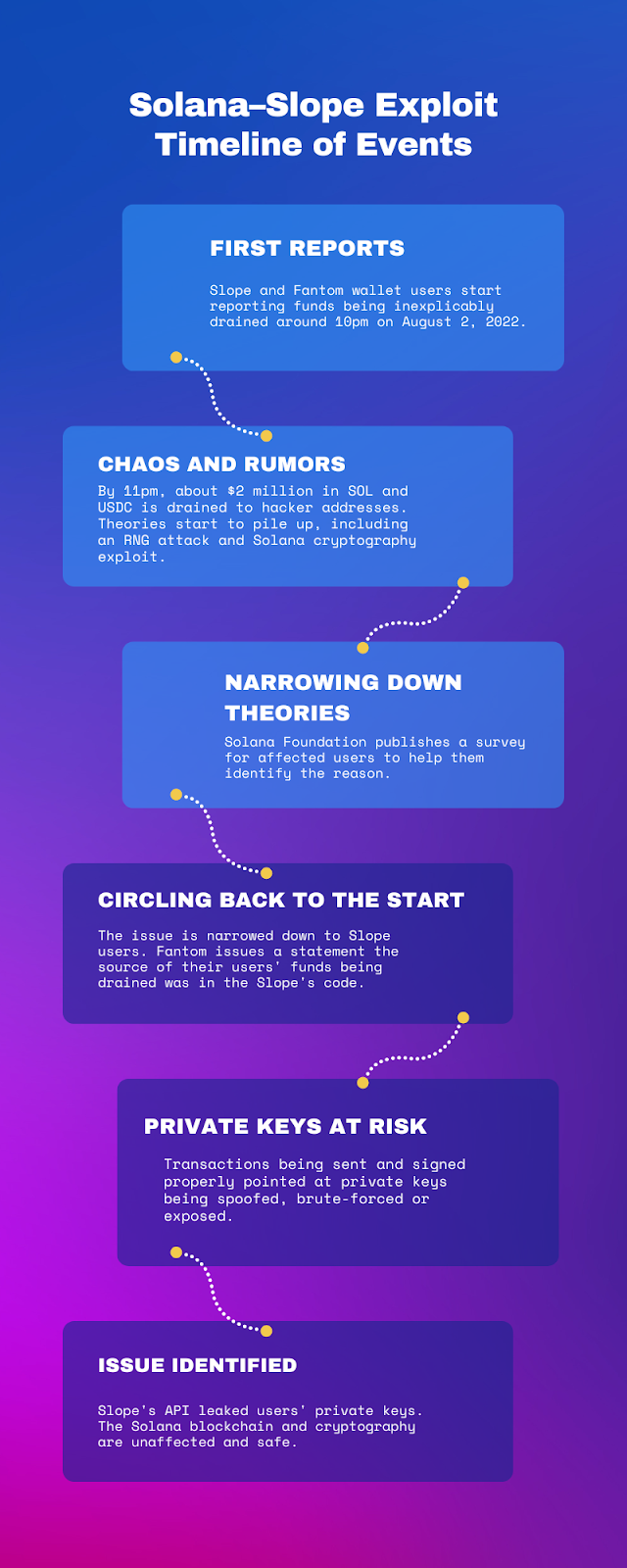
Even if the base layer is healthy, apps can fail, as Slope has demonstrated in 2022. Builders should focus on due diligence on audits, admin keys, upgradeability, oracle design, and liquidity concentration; include this in your checklist as a developer or a due diligence list as a user.
Conclusion
Solana delivers impressive throughput and sub-cent transaction fees by optimizing execution speed around a tightly coordinated validator set. That design is exactly why Solana can feel so smooth in day-to-day use—fast confirmations, cheap interactions, and composable single-chain execution—but it’s also why reliability events and decentralization debates remain part of the package.
If you enjoyed the Solana guide, do check out more guides and digests in ChangeHero blog! The updates are regularly posted to X, Facebook, and Telegram, so don’t forget to subscribe
Frequently Asked Questions
Is Solana secure?
Solana employs a dual-consensus architecture combining Proof of Stake (PoS) and Proof of History (PoH) to secure transaction ordering and prevent double-spending, with over 1,000 validators worldwide maintaining network integrity through cryptographic verification and stake-based incentives.
The security model operates on two parallel tracks: protocol-level security and user-level security. At the protocol level, Solana’s validator network verifies every transaction through consensus mechanisms that make it computationally impractical for malicious actors to alter confirmed blocks. The network processes transactions in under 1 second with cryptographic hashing that creates an immutable record of transaction order, with typical fees around $0.00025 per transaction.
However, protocol security doesn’t protect users from operational mistakes. The most common security failures happen outside the blockchain itself: phishing attacks, malicious smart contract interactions, and compromised devices.
How many confirmations does Solana need?
Solana transactions become irreversible after confirmation, achieving practical finality within 400-600 milliseconds as the network reaches consensus and writes the transaction to the distributed ledger.
How does SOL staking work?
Staking on Solana locks your SOL tokens by delegating them to a validator who uses your stake as collateral to participate in consensus, earning you a share of network rewards (typically 5-8% annually) while your tokens remain in your control through a stake account. Staking moves SOL into a stake account you control; it does not hand ownership to the validator. Activation takes an epoch, and unstaking requires a cooldown epoch.
Educational Disclaimer
The information presented in this guide is strictly educational and should not be construed as financial, investment, or legal advice. On-chain metrics—including transaction throughput, validator counts, staking yields, and fee structures—are subject to change as network conditions evolve and protocol upgrades are deployed. Performance claims and benchmark figures reflect conditions at the time of writing and may not represent future network behavior. Readers are strongly encouraged to verify current network statistics, consult official Solana documentation, and conduct independent due diligence before deploying capital, migrating production systems, or making investment decisions based on the content herein.
Methodology & Credibility Note
Last Reviewed: May 2026
Primary Sources: Official Solana documentation, Solana Foundation announcements, on-chain analytics from block explorers (Solscan, Solana Beach), third-party audits, and peer-reviewed research papers on Proof-of-History and Tower BFT consensus.
Independent References: Cross-verified against reports from blockchain research firms, validator node operators, and ecosystem audits published by security organizations.
Update Protocol: This article is reviewed periodically to reflect protocol upgrades, network performance shifts, and emerging risks. Material changes to validator economics, consensus mechanisms, or security incidents motivate irregular revisions.