
Best Solana APIs: 2026 Overview and Rating


Key Takeaways
- 🌩️ Solana APIs are not a single product category. They split into RPC infrastructure for raw on-chain access, market and DEX data aggregators, multi-chain platforms with first-class Solana support, and protocol-specific endpoints. Picking well starts with knowing which of those layers you actually need.
- 🌩️ The five providers covered in this overview (CoinStats, Mobula, GetBlock, Raydium, Birdeye) sit in different parts of the stack. Some specialize, some unify, and most production stacks combine two or more.
- 🌩️ Free tiers and credit-based pricing are the norm in this category, which lowers the barrier to testing before committing to a paid plan. Evaluating latency, data freshness, and documentation quality against a real workload is usually more useful than comparing feature checklists on paper.
Introduction to Solana APIs
Solana's role in the broader crypto landscape has shifted considerably over the past two years. What was once positioned mostly as a high-throughput Ethereum alternative now carries a meaningful share of stablecoin settlement, DEX volume, and consumer-facing apps. With that growth came a wave of developer demand for reliable programmatic access. Trading bots, portfolio dashboards, AI agents, NFT marketplaces, and DeFi front-ends all rely on APIs to read or interact with the chain.
Direct interaction with a Solana RPC node is technically possible, but most production teams choose not to manage validators or maintain RPC infrastructure themselves. That decision, multiplied across thousands of projects, is what built the API layer the ecosystem now runs on. Some providers stay close to the raw RPC interface and optimize for throughput and latency. Others sit several layers above, returning structured token metadata, normalized DEX trades, or portfolio-ready balances out of the box.
For most users, interacting with Solana means buying or swapping SOL on a service like ChangeHero, where Solana swaps run instantly without an account. For developers, the interaction is one layer deeper: their applications need to read on-chain state, fetch token prices, track wallet activity, or submit transactions programmatically. That is the layer Solana APIs occupy.
The 2026 picture is also shaped by a newer constraint: AI agents. LLM-driven applications increasingly need to query crypto data inside an agent loop, which has pushed several providers to ship MCP (Model Context Protocol) servers alongside traditional REST endpoints. That distinction matters for teams building agent infrastructure, since it determines whether AI tools can call the API natively or require custom wrappers.
The five providers covered below were selected because they each represent a distinct category of Solana API. They are not direct substitutes for each other, and the choice between them comes down to what part of the stack a given project needs to solve.
Solana API Categories
Solana APIs are not interchangeable. Knowing which category a provider sits in saves time during evaluation and prevents the common mistake of paying for one product and then realizing it solves a different problem.
RPC Infrastructure
RPC providers expose the raw JSON-RPC interface that Solana validators run. Endpoints cover account state, transaction submission, block data, mempool monitoring, and program-level interactions. RPC is the foundation layer: dApps, custody systems, and on-chain bots all depend on it, but the responses are unprocessed and require parsing logic on the consumer side.
Latency, geographic distribution, and uptime under load are the main differentiators in this category. Pricing tends to follow either compute-unit or per-request models, with free tiers usually capped on daily or monthly quotas.
Market and DEX Data
Market data providers aggregate token prices, OHLCV candles, trade history, and liquidity figures from Solana DEXes (Raydium, Orca, Meteora, Pump, and others) and sometimes cross-reference centralized exchange feeds. Output is structured and schema-stable, which is what most analytics tools, screeners, and trading bots want.
Coverage depth varies. Some providers track every pool on every DEX in real time; others focus on the highest-liquidity pairs and update less frequently. For long-tail token tracking (memecoins, low-liquidity pools), refresh cadence and indexing speed often matter more than the headline number of tokens listed.
Wallet, Portfolio, and DeFi Data
Wallet APIs return token balances, transaction histories, NFT holdings, and DeFi positions for any Solana address. These responses are usually pre-enriched with USD pricing, 24-hour changes, and protocol metadata, which removes a significant amount of work for portfolio dashboards or tax tools.
A subset of providers in this category extends beyond Solana into Ethereum, EVM chains, and Bitcoin, returning a unified schema across all of them. That matters for products serving users who hold assets on multiple chains rather than only on Solana.
Protocol-Specific Endpoints
Some Solana protocols (including Raydium and Birdeye) publish their own APIs that expose protocol-internal state at higher fidelity than aggregators can. Pool data, fee structures, swap routing, position management, and protocol-specific events sit here. These endpoints are usually free or low-cost but narrower in scope than aggregators.
Key Features to Evaluate
Solana APIs can look similar on a feature checklist and still behave very differently in production. A few areas tend to surface real differences during evaluation.
Coverage and Data Freshness
Coverage is the count of tokens, pools, wallets, and protocols represented in the API. Freshness is how quickly that data updates. The two are independent. A provider can claim broad coverage but lag during volatile periods, and a narrower provider can sometimes deliver tighter latency on the assets it does support.
For Solana specifically, where new tokens launch constantly and pool migrations are frequent, the more relevant question is often "how quickly does a new launch appear in the API" rather than "how many tokens are tracked overall."
Latency and Geographic Routing
For RPC providers and trading-oriented data feeds, latency is the headline metric. Round-trip times of 50 milliseconds versus 200 milliseconds compound across thousands of calls per minute and can change strategy outcomes. Geo-distributed clusters in Frankfurt, New York, Singapore, and similar hubs reduce that gap for users connecting from those regions.
MCP and AI Agent Support
In 2026, MCP server support is no longer a niche feature. It determines whether an LLM-based agent can call the API as a structured tool without custom wrappers. Teams building autonomous agents, AI-powered analytics, or chat interfaces that touch crypto data should treat MCP availability as a meaningful differentiator.
Documentation and SDK Quality
This is the feature most often underestimated during evaluation and most felt during integration. Clear endpoint references, working examples in multiple languages, schema-accurate responses, and an active changelog all reduce time to first integration. Sandbox environments and curl examples are a reasonable proxy for documentation maturity.
Authentication, Rate Limits, and Pricing Model
Rate limits and pricing models vary significantly. Per-request pricing is simpler to forecast. Compute-unit and credit-based models offer flexibility but require modeling actual usage patterns to estimate costs. Free tiers are common but ceilings differ by an order of magnitude across providers.
Top Solana API Providers (2026)
The five providers below cover the most-used categories in Solana API development as of 2026. They are not direct substitutes for each other, and most production stacks combine two or more.
CoinStats Solana API
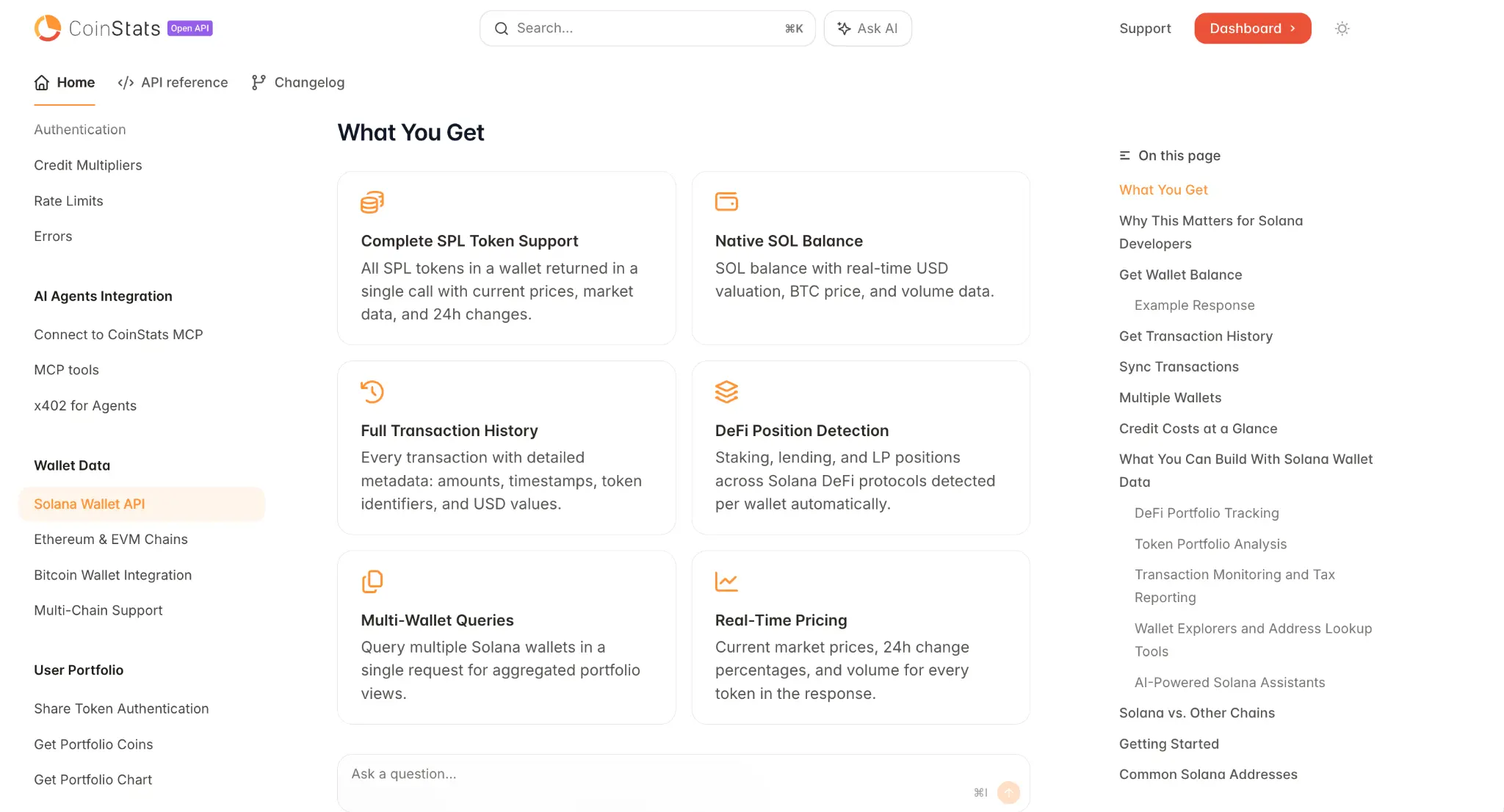
CoinStats Solana Wallet API is part of a multi-chain data platform that treats Solana as a first-class supported network rather than a side feature. The same REST API covers wallet balances, transaction histories, DeFi positions, market data, and portfolio analytics across 120+ blockchains, with Solana, Ethereum and EVM chains, and Bitcoin all returning data through a unified schema.
For Solana specifically, the Wallet endpoint returns full SPL token inventory for any address with USD prices, 24-hour changes, and ranking metadata pre-enriched. DeFi positions across 10,000+ protocols are detected automatically, so teams building dashboards or tax tools do not need to integrate each protocol separately. Market data covers 100,000+ coins across 200+ exchanges including Hyperliquid, Binance, and Coinbase, with historical pricing stretching back roughly a decade.
The MCP Server is a notable differentiator in 2026. It exposes the same data layer as callable tools for LLM environments like Claude Code, Cursor, and VS Code, using the same API key as the REST endpoints. AI agents can query Solana balances, prices, DeFi positions, and news without custom middleware, which is uncommon among Solana data providers.
Pricing follows a credit-based model with a free tier that includes 50,000 credits per month. Paid plans start at $49/month and scale based on usage. Documentation is hosted at coinstats.app/api-docs and covers authentication, parameter syntax, and credit costs per endpoint.
Best for: Portfolio trackers, multi-chain wallet apps, AI agents that need structured Solana data alongside other chains, DeFi dashboards, tax tools, and consumer-facing products that combine pricing with portfolio analytics.
Limitations: Not an RPC provider. Teams that need to submit transactions to Solana or stream raw block data typically pair CoinStats with a dedicated RPC layer.
Mobula
Mobula is real-time onchain trading and wallet infrastructure covering 90+ EVM chains plus Solana, with Solana as a first-class network. Pricing, liquidity, and wallet data are sourced directly from on-chain pools through the Octopus engine, which combines volume aggregation and liquidity weighting to price both blue-chip and long-tail assets, refreshing in real time with no caching even on free tiers.
On Solana specifically, the API returns SPL balances, full transaction history, PnL and win-rate, DeFi positions (including Solana native staking, Meteora, and Drift perps), token security checks, holder and first-buyer breakdowns, OHLCV, and trade-level data across Raydium, Jupiter, Meteora, PumpFun and Raydium Launchlab, with new tokens and pools typically indexed within seconds of creation.
Beyond read data, Mobula ships an execution layer: swap routing and execution across Solana and 90+ EVM chains through MobulaRouter (Uniswap v2/v3/v4, PancakeSwap, Curve, Raydium, Jupiter), with MEV protection, aggregator routing, and cross-chain bridging, plus a perpetual execution engine. Real-time delivery runs over 10+ WebSocket streams (pool states, trades, PnL changes) and webhooks, exposed through REST, a GraphQL API, and an official TypeScript SDK.
Mobula is also agent-native: through its agent-payment interface (x402 / MPP), AI agents can autonomously subscribe, pay, query Solana data, and execute swaps and perps, going beyond read-only data access. An llms.txt-indexed doc set rounds out the agent tooling.
Pricing follows a credit-based model with metered billing, a free tier suitable for prototyping, and paid plans (Startup, Growth, Enterprise) that scale with throughput and add SLA guarantees.
Best for: Onchain dashboards, Solana DEX screeners, Telegram trading bots, multi-chain portfolio analytics with PnL, AI trading agents that need to query and execute in one place, and projects that need accurate pricing on long-tail Solana tokens.
Limitations: Not a raw RPC provider. Teams needing validator-level access or raw block streaming typically pair Mobula with a dedicated RPC layer.
GetBlock
GetBlock is a Singapore-based RPC infrastructure provider that supports 130+ blockchains including Solana through JSON-RPC, REST, GraphQL, WebSocket, and (on select networks) gRPC. It sits at the foundation layer of the stack, giving teams direct access to full nodes and archive endpoints without running validator infrastructure themselves.
For Solana specifically, GetBlock operates geo-distributed clusters in Frankfurt, New York, and Singapore. Independent benchmarks rank its Solana RPC node as the fastest in Europe at 6 ms latency, with competitive Asia response times as well as of early 2026. Every API call deducts one request from the balance regardless of method complexity, which keeps cost forecasting more predictable than compute-unit accounting.
The free tier allows up to 40,000 blockchain requests per day, with paid plans layering higher throughput, dedicated nodes, and SLA guarantees. Recent additions to the platform include a Token Risks API for smart contract audits, gRPC support for networks like Sui (which is deprecating its JSON-RPC interface in mid-2026), a Web3 marketplace, testnet faucets, and ecosystem explorers.
GetBlock has an easy-to-use dedicated MCP server. Teams integrating raw Solana RPC into AI agent workflows may wrap the JSON-RPC interface in custom function definitions.
Best for: Teams that need low-latency raw RPC access to Solana with control over geographic routing. Multi-chain teams also benefit from the 130+ chain coverage under a single provider relationship.
Limitations: Enriched Solana data falls outside its scope and requires a separate provider. Teams building consumer-facing products or analytics dashboards will almost always need to pair it with a dedicated data or indexing layer.
Raydium API
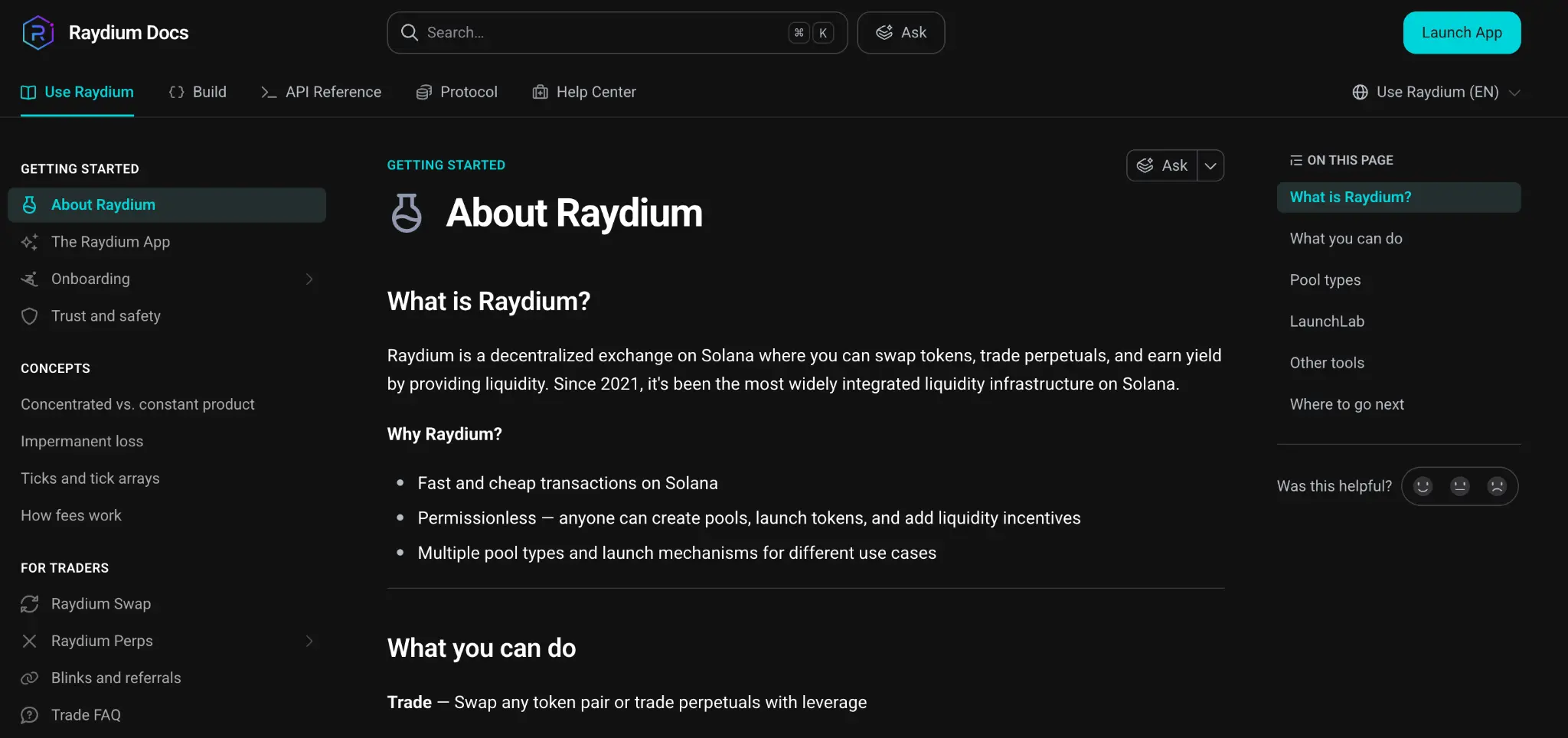
Raydium API is the protocol-native interface for Raydium, the most widely integrated DEX on Solana since 2021. The API is open and free to use, exposing pool data, swap routing, liquidity figures, and trade history directly from the protocol rather than through a third-party indexer.
Coverage spans Raydium's three pool types: CLMM (concentrated liquidity), CPMM (the constant product format used by default for new pools and LaunchLab migrations), and AMM v4 (the legacy constant product implementation that remains widely distributed across Solana). Endpoints include pool details with token reserves and fees, programmatic trade execution, liquidity provision flows, and routing across all Raydium pools. The companion TypeScript SDK abstracts the API into typed methods for teams building front-end integrations.
Because the API is protocol-native, it returns the most accurate state for Raydium pools without aggregator latency. That makes it useful for arbitrage bots, custom routing logic, and apps building directly on Raydium's liquidity. The trade-off is scope: the API only knows about Raydium. Cross-DEX aggregation, broader Solana market data, or non-Raydium pools require a separate provider.
There is no formal pricing tier or rate-limit table for the public API endpoints, which is typical of protocol-level APIs in DeFi. Teams running high-throughput workloads usually combine the API with a dedicated RPC provider to avoid hitting public limits during peak load.
Best for: DeFi applications building directly on Raydium, arbitrage bots that need fresh on-chain pool state, projects launching tokens through LaunchLab, and integrations that require authoritative Raydium data.
Limitations: Single-protocol scope. Multi-DEX coverage, cross-chain context, and wallet portfolio data need to come from a separate source.
Birdeye API
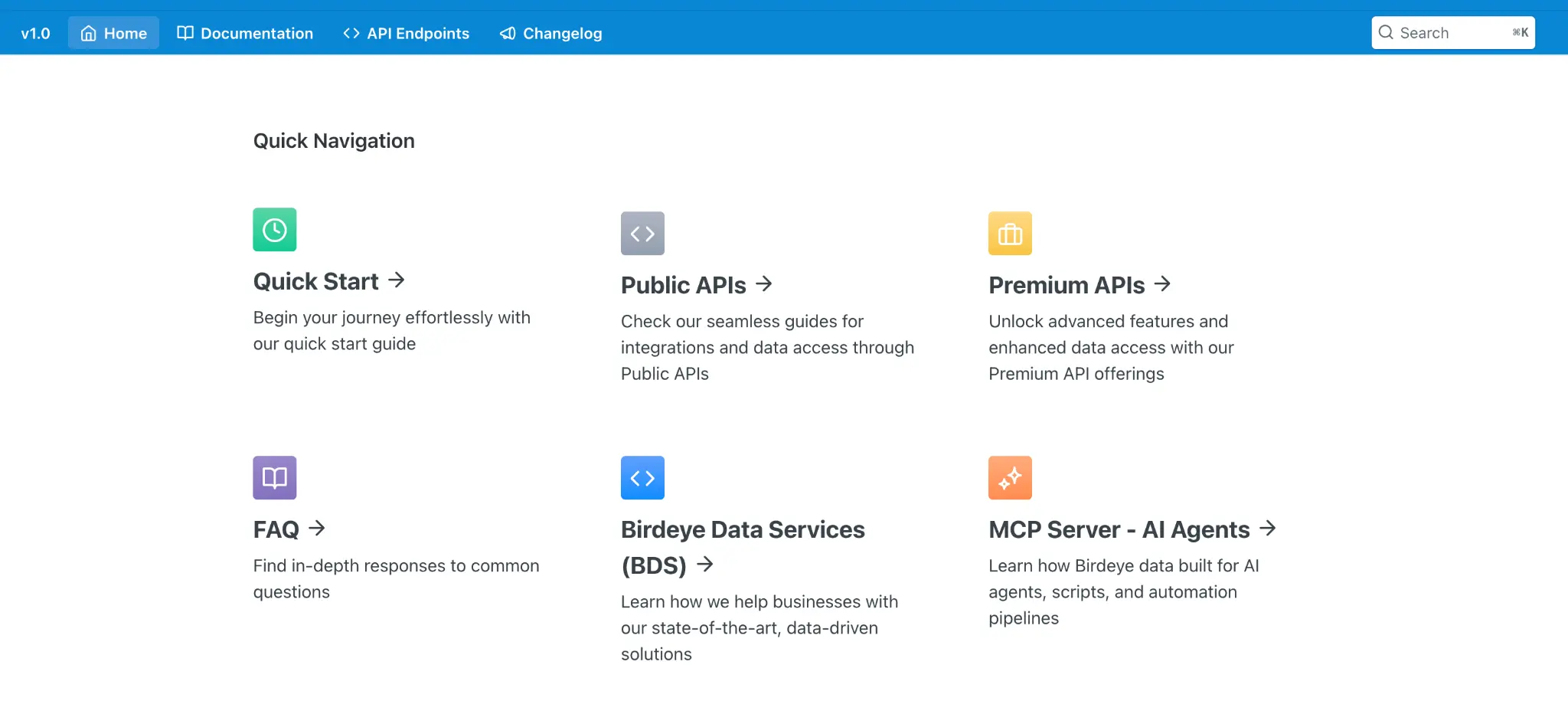
Birdeye API started as a Solana-native data provider in 2022 and has since expanded across other chains, but Solana remains the deepest part of its coverage. The platform aggregates onchain trading data across 200+ DEXes and AMMs, processes over $1 billion in daily trading volume, and serves both retail traders through its consumer interface and developers through its API tier.
For Solana specifically, the API exposes token security flags, holder distribution, OHLCV candles, real-time price updates, per-token trade history, wallet portfolio queries, and DEX trade streams. WebSocket access on higher tiers supports streaming for active trading and screener applications. The granularity is what sets Birdeye apart in the Solana DEX analytics space: rather than returning aggregated price snapshots, the API can deliver trade-level data suitable for signal generation and risk analysis.
Pricing follows a compute-unit model with tiered plans. The Standard tier includes 30,000 compute units, with cost per 1M additional CUs scaling on top of the base fee. Some endpoints are restricted to Standard or Premium tiers, including parts of the WebSocket layer. The free tier exists but is tight for production trading workloads, so most teams move to a paid plan once a bot or screener goes live.
Birdeye does not currently publish an MCP server. AI agent integration involves wrapping REST endpoints in custom tool definitions, similar to GetBlock and Raydium.
Best for: Solana DEX screeners, trading bot signal feeds, token security analysis, holder distribution research, and analytics dashboards that need granular trade-level Solana data.
Limitations: No native MCP support yet, and pricing tiers can become a meaningful cost line for high-throughput consumers. CEX market data is not the primary scope.
Free vs Paid Solana APIs
Free tiers are the norm in this category, which makes early evaluation straightforward. They are not, however, identical in what they offer. A few patterns are worth knowing before committing to a paid plan.
Rate Limits and Throughput
Free tiers sit anywhere from 10,000 monthly credits to 40,000 daily requests, depending on the provider and pricing model. That difference matters: a Solana screener pulling thousands of tokens at short intervals exhausts a small free tier within hours, while the same workload fits comfortably under a generous daily quota. Paid plans usually multiply throughput by an order of magnitude or more, and some add burst allowances for short spikes.
Data Quality and Granularity
Some providers throttle data freshness or detail on free plans. Tick-level trade data, full OHLCV history, and WebSocket access are commonly gated to paid tiers. For prototyping and basic dashboards, free-tier data is often sufficient. For production trading systems or analytics products, the gap shows up quickly.
Commercial Usage Terms
Free APIs in this space frequently restrict commercial use, require attribution, or prohibit redistribution. Paid licenses typically allow commercial usage and broader product integration. Reviewing the terms before launching a revenue-generating product on a free tier prevents friction later.
Support and SLA
Free tiers rarely promise uptime or response times. Paid plans add SLA guarantees, often in the 99.9 percent range, plus priority support. For workloads where downtime translates directly to lost revenue, that reliability is a structural cost rather than an optional upgrade.
Common Solana API Use Cases
Solana APIs cover a wide range of applications. The most common use cases each tend to favor different providers in the lineup.
Portfolio Tracking and Wallet Dashboards
Apps that read wallet balances, calculate portfolio value, and display PnL across multiple chains lean heavily on enriched data providers. CoinStats Solana API and Mobula are common picks here, since both return USD-priced balances, multi-chain context, and DeFi positions in a single call. Tax tools and accounting platforms fall in the same category for similar reasons.
Trading Bots and DEX Screeners
Bots that monitor Solana DEX activity, surface signals, and execute trades typically pair RPC infrastructure with specialized data feeds. Birdeye is a frequent choice for DEX-level signals, with GetBlock providing the underlying RPC layer. Raydium API can supplement either when authoritative pool state is required for routing or arbitrage logic.
AI Agents and LLM-Powered Applications
LLM-based products that need to answer crypto questions or take action on user portfolios benefit from MCP-compatible APIs. As of 2026, CoinStats Solana API is the only provider in this lineup with a published MCP server, which makes it the more direct fit for agent infrastructure. Other providers can still be used through custom tool definitions, but the integration overhead is higher.
Analytics and Research Dashboards
Research-oriented tools that pull historical data, holder distribution, or trade microstructure tend to use Birdeye for Solana-specific depth and Mobula or CoinStats for cross-chain aggregation. The combination depends on whether the dashboard is Solana-only or multi-chain in scope.
Custom DeFi Integrations
Apps that build directly on Raydium pools, route swaps through LaunchLab tokens, or interact with specific Solana programs are the natural fit for Raydium API and a paired RPC provider. The rest of the stack is optional in this scenario, since the protocol-native endpoint already returns authoritative state.
How to Choose a Provider
The shortest version of the choice is: match the provider category to the problem, then evaluate within that category on latency, freshness, and documentation. A few practical steps help shorten the process.
Define the Workload First
A trading bot, an AI agent, a portfolio tracker, and a DEX screener look superficially similar but use Solana data in different ways. Writing down what the system actually needs (read-only balances, transaction submission, signal generation, multi-chain context, sub-second updates) before comparing providers narrows the lineup faster than any feature checklist.
Test the Free Tier on Real Data
Documentation reads well in isolation. The actual behavior of an API under realistic load is more informative. Running a representative query pattern through the free tier for a few days surfaces issues that pricing pages and marketing copy do not, including off-hours latency, reliability under bursty traffic, and how the provider handles new token launches.
Read the Status Page and Changelog
Status pages reveal how providers behave during stress and how transparent they are about incidents. A changelog with regular entries and clear deprecation notices is a reasonable signal of operational maturity. Both are more predictive of long-term experience than uptime claims on the homepage.
Plan for Combinations
Most production stacks end up combining two or three providers because no single API covers every category. CoinStats for unified wallet and market data, GetBlock for raw RPC, Birdeye for DEX-level Solana signals, and Raydium API for protocol-specific work is one common pattern. The exact combination varies by use case.
Risks and Operational Considerations
Even the most reliable Solana API operates within an ecosystem that can move quickly and unpredictably. A few risks are worth keeping in mind during evaluation.
API Key Security
Solana data APIs typically use bearer tokens or API keys for authentication. Treat them like any other secret: environment variables or vaults rather than checked-in code, IP whitelisting where supported, and rotation on a schedule. Key compromise on a read-only data API is less damaging than on a trading API, but quota exhaustion and unexpected billing are still real consequences.
Rate Limits and Provider Outages
Provider outages and rate-limit bans can affect dependent applications even when the underlying chain is healthy. Failover logic, exponential backoff on retries, and a secondary provider for critical paths are common defenses. Status-page monitoring helps catch issues before users notice. Holding a small buffer below the documented rate limit (around 80 percent is a typical target) leaves headroom for unexpected spikes.
Data Integrity and Freshness Gaps
Aggregated data can lag, miss new tokens, or occasionally return outliers, particularly during high-volume launches and volatile periods. Cross-validating against a secondary source for high-stakes decisions, and timestamping all responses for downstream auditability, both help limit the impact.
Terms of Service and Commercial Use
Each provider has its own terms around redistribution, commercial usage, and acceptable workloads. Reading the relevant sections before integrating is the path of least resistance. Reviewing the terms again before launching a revenue-generating product is also worth the time, since the same API can be free for prototyping and licensed for commercial deployment.
Network-Level Considerations
Solana itself has had periods of degraded performance. APIs that read from the chain inherit some of that exposure: missed slots, transient state inconsistencies, and slower confirmations during congestion all surface in API responses. Building applications that tolerate brief degradation is more sustainable than assuming uninterrupted access.
Conclusion
The Solana API landscape in 2026 is diverse enough that the right answer depends on what is being built. CoinStats Solana API consolidates wallet, market, DeFi, and portfolio data across 120+ chains with first-class Solana support and the only published MCP server in this lineup, which makes it a strong default for portfolio products and AI agents. Mobula focuses on onchain-native pricing and wallet analytics with broad multi-chain coverage and tight refresh cadence. GetBlock provides RPC infrastructure with low-latency Solana endpoints across geo-distributed clusters in Europe, North America, and Asia. Raydium API exposes protocol-native data for the most-integrated DEX on Solana. Birdeye delivers the deepest Solana-specific DEX analytics and trade-level granularity in the lineup.
Most teams in production end up combining two or more of these. The starting point is the workload: read it carefully, match it to a category, and evaluate on the free tier before committing. Documentation quality, latency under real load, and how each provider handles new token launches are usually more predictive of long-term fit than the marketing pages suggest.
Frequently Asked Questions
Which Solana API is best for AI agents in 2026?
CoinStats Solana API is the most direct fit because it ships an MCP Server compatible with environments like Claude Code, Cursor, and VS Code. Other providers in this lineup can still be used inside agent workflows, but they require custom tool wrappers around their REST endpoints. For teams building autonomous agents or LLM-powered crypto assistants, MCP support meaningfully reduces integration overhead.
Are free tiers enough to launch a production app?
For prototyping and low-volume apps, often yes. For production trading systems, screeners, or portfolio products with active users, free tiers usually run out of headroom within days. Paid plans add throughput, granularity, and SLA guarantees that production workloads need. Running the planned query pattern through the free tier for a few days is the simplest way to estimate whether the upgrade is needed.
What is the difference between an RPC provider and a data API?
RPC providers expose the raw JSON-RPC interface that Solana validators run, returning unprocessed account state and transaction data. Data APIs sit several layers above, returning structured token metadata, normalized DEX trades, and pre-enriched balances. Most production stacks use both: an RPC provider for execution and raw chain state, and a data API for portfolio, market, or analytics layers.
Can I use the same API for Solana and other chains?
Yes. CoinStats and Mobula both support Solana alongside Ethereum, EVM chains, and Bitcoin through a unified schema, which simplifies development for multi-chain products. GetBlock supports Solana RPC alongside 130+ other networks. Raydium API is Solana-specific, and Birdeye covers Solana plus a few other chains, with the deepest data on Solana itself.
How do I estimate API costs before committing?
Run a representative workload against the free tier, measure actual request volume, and project that against the provider's pricing model. Per-request pricing is easier to forecast accurately. Compute-unit and credit-based models require modeling endpoint complexity by usage pattern, since different endpoints can consume very different amounts under the hood. WebSocket streams and webhooks usually carry their own billing line.
How fast does new token data appear in Solana APIs?
Cadence varies by provider. Onchain-native aggregators like Mobula and Birdeye typically pick up new Solana tokens within seconds of pool creation. Multi-chain platforms like CoinStats add new tokens through both onchain detection and exchange feeds. Protocol-native APIs like Raydium reflect new pools as soon as they are created on the protocol. RPC providers like GetBlock surface raw on-chain state immediately, but parsing and enriching it is the consumer's job.
Do Solana APIs support transaction submission?
Only RPC providers do directly. GetBlock supports transaction submission through its Solana RPC endpoints. The data-focused APIs in this lineup (CoinStats, Mobula, Birdeye) are read-only by design and do not broadcast transactions. Raydium API supports trade execution flows specific to Raydium pools, but the underlying transaction is still submitted through an RPC provider.


