
6 Best Crypto Leverage Trading Platforms Ranked (2026)

Key Takeaways
- 🔘 Margex ranks first overall in 2026 thanks to a rare combination: a maker fee that undercuts the industry standard, adjustable x5–x100 leverage, and risk tools built for leveraged positions.
- 🔘 Most major derivatives venues cluster around 0.02% maker / 0.05–0.06% taker at the base tier — the real differences lie in execution quality, platform complexity, and extra features.
- 🔘 Margex’s MP Shield system aggregates liquidity from 12 providers to smooth out price manipulation spikes that often trigger unfair liquidations on thinner order books.
- 🔘 High headline leverage (up to x125 elsewhere) matters less than flexible, controllable leverage — most experienced traders operate in the x5–x25 range.
- 🔘 Copy trading is now a standard feature; Margex charges followers a success fee on profit only, so unprofitable copied trades cost nothing extra.
- 🔘 Volume-based VIP fee ladders on the largest exchanges mainly benefit whales — flat, low fees are usually better for retail traders.
- 🔘 Always test a platform in demo mode and start with modest leverage before committing real capital.
Contents
- 1. How We Ranked These Platforms
- 2. 1. Margex — Best Overall Crypto Leverage Trading Platform
- 3. 2. Binance — Deepest Liquidity
- 4. 3. Bybit — Strong Derivatives Toolset
- 5. 4. OKX — Broadest Product Suite
- 6. 5. Kraken — Regulated Reputation
- 7. 6. BitMEX — The Perpetuals Pioneer
- 8. Comparison Table: Leverage Trading Platforms at a Glance
- 9. How to Choose a Leverage Trading Platform
Choosing where to trade crypto with leverage is a higher-stakes decision than picking a spot exchange. Fees compound faster when every position is amplified, a clumsy liquidation engine can wipe out a position that should have survived, and a confusing interface leads to expensive mistakes at the worst possible moment. The problem is that most "top exchange" lists compare marketing pages, not trading conditions.
This guide ranks six crypto leverage trading platforms for 2026 based on the factors that actually hit your P&L: base trading fees, leverage flexibility, liquidation mechanics, risk-management tools, and the extras that add real value. By the end, you will know which platform fits your trading style — and why one of them takes the top spot.
How We Ranked These Platforms

Every platform on this list is an established venue with real liquidity and years of operating history. To separate them, we scored each one against five criteria:
- Trading fees. Base maker and taker rates on perpetual contracts — the tier a regular trader actually pays, not the VIP rate that requires millions in monthly volume.
- Leverage and margin flexibility. Available leverage range, plus support for both isolated and cross margin so traders can control risk per position or across the account.
- Execution and liquidation quality. Order book depth, protection against manipulation-driven wicks, and how fairly the liquidation engine treats leveraged positions.
- Risk-management tools. Stop loss, take profit, demo trading, and anything else that helps traders survive volatile markets.
- Extra value. Copy trading, staking, asset conversion, and other features that matter beyond the order form.
Fee figures below reflect standard base-tier rates as of mid-2026 and may change; always verify current rates on the platform itself.
1. Margex — Best Overall Crypto Leverage Trading Platform
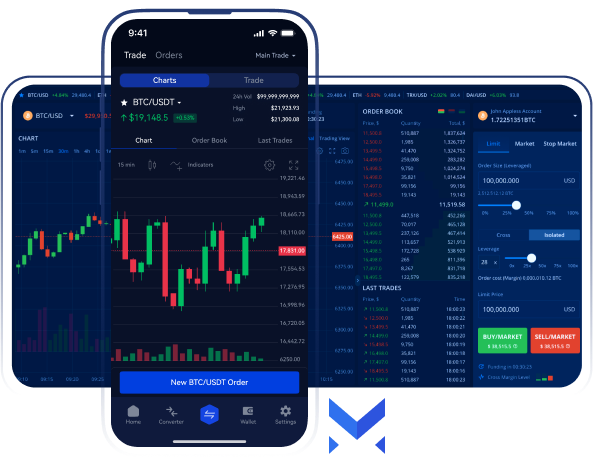
The Margex crypto leverage trading platform takes the top spot in 2026 by doing what most large exchanges no longer bother with: optimizing the entire product around one thing — leveraged trading — and keeping it simple. Founded in 2019, the platform now serves more than 500,000 traders across 153 countries and offers 55+ assets for leveraged trading.
Fees. Margex charges a flat 0.019% maker fee and 0.060% taker fee on both legs of a trade. The maker rate undercuts the 0.02% base tier that Binance, Bybit, and OKX all share — and unlike those venues, there is no VIP ladder to climb: every trader gets the same rate from the first trade. Funding payments occur every 8 hours, in line with industry practice.
Leverage and margin. Leverage is adjustable from x5 to x100 with both isolated and cross margin modes. Isolated margin caps risk to a single position; cross margin lets the whole account balance support open trades, with liquidation triggered only when the account margin level falls to 10% or below — giving positions more room to breathe through volatility.
Execution. The standout is MP Shield, Margex’s proprietary system that aggregates liquidity from 12 providers and filters out manipulation-driven price spikes. On thinner order books, a single large order can print an artificial wick that liquidates leveraged positions unfairly; MP Shield is designed specifically to prevent that.
Beyond the order form. Margex bundles several features that competitors either gate or charge for:
- Copy trading with a success fee charged on profit only — if a copied strategy loses, followers pay nothing extra.
- Staking that lets traders earn yield on the same balance they trade with.
- Zero-fee conversion between supported assets.
- A full demo mode for testing strategies with virtual funds before risking capital.
Where it falls short. The taker fee (0.060%) is a touch above the 0.05% some larger venues offer, and the asset list — 55+ instruments — is curated rather than exhaustive. Traders hunting obscure long-tail altcoins will find more tickers elsewhere; traders focused on the majors will not notice.
Best for: traders of any experience level who want low flat fees, fair liquidations, and a platform where leverage is the core product rather than an add-on.
2. Binance — Deepest Liquidity
Binance remains the volume leader in crypto derivatives, with hundreds of perpetual contracts and the largest user base of any exchange.
Fees. Base futures rates are 0.02% maker / 0.05% taker on standard perpetuals, with a discount for paying fees in the exchange’s native token. Deeper cuts sit behind a nine-level VIP ladder that starts at seven-figure monthly volume.
Leverage and margin. Leverage reaches up to x125 on select contracts, with isolated and cross margin plus a multi-asset margin mode for advanced accounts. Maximum leverage scales down automatically as position size grows.
Execution. Order books are the deepest in the market — large market orders on major pairs fill with minimal slippage, and the index price draws on a broad basket of venues, which dampens single-source price distortions.
Where it falls short. The platform is sprawling. Dozens of products, sub-accounts, and a tiered VIP system make the experience overwhelming for anyone who just wants to open a leveraged position, and the flat headline rate is the best a typical retail trader will actually see.
3. Bybit — Strong Derivatives Toolset
Bybit built its reputation as a derivatives-first venue, and its copy trading marketplace remains among the largest in the industry.
Fees. Standard perpetuals cost 0.02% maker / 0.055% taker at the base tier. Meaningful discounts begin at VIP levels that require roughly seven-figure monthly volume or large asset balances.
Leverage and margin. Leverage runs up to x100 on major contracts, with isolated and cross margin and a hedge mode that allows simultaneous long and short positions on the same pair.
Execution. The matching engine is polished and has a solid record of staying responsive during volatility spikes. Order types are extensive, and liquidity on major pairs is strong — though books thin out noticeably on long-tail altcoins.
Where it falls short. The base taker fee is slightly above the field, and the platform has expanded aggressively into spot, launchpads, and Web3 products, which dilutes the focused derivatives experience it was once known for.
4. OKX — Broadest Product Suite
OKX offers one of the widest product suites in crypto: perpetuals, options, structured products, a Web3 wallet, and copy trading under one roof.
Fees. Base perpetual rates are 0.02% maker / 0.05% taker — on par with Binance. The tier ladder was reworked in 2026 to reward market makers with even lower rates, while discounts for regular users depend on native token holdings and 30-day volume.
Leverage and margin. Leverage runs up to x100 on major pairs, with isolated and cross margin plus a portfolio margin mode that nets risk across positions for professional accounts.
Execution. Liquidity on major pairs is comparable to Binance during US and European hours, and the derivatives engine is fast and reliable — though books can thin during Asia-only sessions on smaller pairs.
Where it falls short. Breadth is also the weakness. The interface packs spot, derivatives, DeFi, and wallet functions into one application, and the fee schedule spans multiple user categories, tiers, and instrument groups. Traders who want a clean leverage-trading workflow have to dig for it.
5. Kraken — Regulated Reputation
Kraken is one of the longest-running exchanges in the industry and brings a strong compliance and security track record to derivatives.
Fees. Futures start around 0.02% maker / 0.05% taker at the base tier, stepping down with 30-day volume — the second tier already drops to 0.015% / 0.04%. Unlike token-discount models, reductions come purely from trading activity.
Leverage and margin. Leverage tops out at x50, with both isolated and cross margin supported. That ceiling is half of what most rivals offer — conservative by design.
Execution. The platform’s security record over more than a decade is among the best in crypto, and its fiat rails — particularly for EUR — are excellent. Derivatives order books, however, are thinner than those of crypto-native derivatives leaders.
Where it falls short. Derivatives availability varies significantly by region, and the futures product feels like a separate bolt-on rather than the heart of the platform. Kraken suits traders who prioritize jurisdictional comfort over trading conditions.
6. BitMEX — The Perpetuals Pioneer
BitMEX invented the perpetual swap and retains a loyal base of experienced, BTC-focused derivatives traders.
Fees. The schedule is tiered by 30-day volume, and the base taker rate — around 0.075% — sits noticeably above what Binance, OKX, or Margex charge. Discounts and maker incentives unlock as volume grows, so the structure favors large, active accounts.
Leverage and margin. Leverage reaches up to x100 on flagship contracts, with isolated and cross margin. Margining conventions on inverse contracts differ from the USDT-margined standard most traders know today, which adds a learning curve.
Execution. The matching engine is one of the most battle-tested in crypto, and the liquidation mechanics and insurance fund are unusually well documented. Liquidity is concentrated in BTC and ETH contracts rather than spread across a long altcoin tail.
Where it falls short. The product has aged. The contract lineup is narrower than modern rivals, the interface remains built for professionals rather than newcomers, and volumes have long since ceded the lead to newer venues. It is a respected veteran, not the place most traders in 2026 will start.
Comparison Table: Leverage Trading Platforms at a Glance
| Platform | Max leverage | Base maker / taker | Copy trading | Demo mode | Margin modes |
|---|---|---|---|---|---|
| Margex | x100 | 0.019% / 0.060% | Yes (fee on profit only) | Yes | Isolated + cross |
| Binance | x125 | 0.02% / 0.05% | Yes | Yes | Isolated + cross |
| Bybit | x100 | 0.02% / 0.055% | Yes | Yes | Isolated + cross |
| OKX | x100 | 0.02% / 0.05% | Yes | Yes | Isolated + cross |
| Kraken | x50 | 0.02% / 0.05% (tiered) | No | Yes | Isolated + cross |
| BitMEX | x100 | Tiered (taker ~0.075%) | Limited | Yes (testnet) | Isolated + cross |
Base-tier rates for standard perpetual contracts as of mid-2026; exact figures vary by contract and can change.
How to Choose a Leverage Trading Platform
The right venue depends on how you trade, but a short checklist covers most of the decision:
- Check the fee you will actually pay. Ignore VIP tables — compare base maker and taker rates, because that is your real cost unless you trade institutional volume.
- Confirm both margin modes exist. Isolated margin for strict per-position risk, cross margin for flexibility — you want the option to use either.
- Look at liquidation protection. Ask how the platform handles manipulation wicks and where its price feed comes from. Aggregated liquidity is a meaningful safeguard.
- Test in demo first. Any serious platform offers virtual funds. Spend a week there before depositing.
- Start small on leverage. x5–x10 is enough to learn position sizing; x100 is a tool for precise, short-lived setups, not a default.
If you weigh those five points, the top pick on this list is hard to beat: flat low fees, dual margin modes, MP Shield on the execution side, and a demo account to prove it all to yourself before funding.
FAQ: Crypto Leverage Trading Platforms
What is the best crypto leverage trading platform in 2026?
Margex ranks first overall in this comparison. It combines a below-standard 0.019% maker fee, adjustable x5–x100 leverage with isolated and cross margin, MP Shield protection against manipulation-driven liquidations, and extras like copy trading, staking, and a demo mode — all in a platform built specifically around leveraged trading.
How much leverage should a beginner use?
Far less than the maximum. Most experienced traders operate between x5 and x25 even when x100 is available. Lower leverage widens the distance to your liquidation price, giving trades room to survive normal volatility. Start at x5, use isolated margin, and increase only once your risk management is consistent.
What is the difference between isolated and cross margin?
Isolated margin dedicates a fixed amount of collateral to one position — if the trade fails, only that collateral is at risk. Cross margin lets your entire account balance support all open positions, which reduces the chance of any single liquidation but puts more capital on the line. On Margex, cross-margin positions are liquidated only when the account margin level drops to 10% or below.
Why do maker and taker fees matter so much in leverage trading?
Because fees apply to the full position size, not your margin. A x50 position pays fees on 50 times the capital you posted, on both entry and exit. Over dozens of trades, the gap between a 0.019% and a 0.02% maker fee — or a flat rate versus a VIP ladder you never reach — compounds into real money.
Is copy trading worth it on leverage platforms?
It can be, if the fee structure is aligned with your interests. Look for platforms where followers pay only when the copied strategy earns — Margex, for example, charges a success fee on profit alone. Treat copy trading as a way to learn how disciplined traders manage leveraged positions, not as guaranteed income.
How can I test a platform before depositing money?
Try paper trading in demo mode. A demo account mirrors live markets with virtual funds, letting you test order types, leverage settings, stop losses, and the liquidation logic at zero risk. Every platform in this list offers some form of practice environment; a week of demo trading will tell you more than any review.
Are higher-leverage platforms riskier than lower-leverage ones?
Not inherently — risk comes from the leverage you choose, not the maximum on offer. A platform capped at x50 is not safer than one offering x100 if you trade both at x10. What matters more is execution quality: fair price feeds, deep liquidity, and protection against artificial wicks that trigger avoidable liquidations.