
Best Crypto Wallet API: 2026 Review


Key Takeaways
- ⚙️ What developers look for in a “crypto wallet API” can be described as a normalization layer: one integration to pull balances, transaction history, NFTs, and DeFi positions across chains—without running your own indexers.
- ⚙️ Wallet Data APIs (read) are not JSON-RPC nodes (raw state), exchange/custody APIs (keys + trading), payment processors (checkout), or MPC/key management (signing).
- ⚙️ Quick picks by job-to-be-done: CoinStats (asset and DeFi data layer), ASCN.AI (risk scoring/AML), CryptoCompare (pricing only), ChangeHero (crypto swapping), Blockbook (self-host control).
If you’re building a wallet application, portfolio tracker, or fintech product that needs to surface crypto balances, transaction history, NFT holdings, or DeFi positions across multiple blockchains, you are looking for at least one crypto wallet API to integrate. In practice, a wallet API is a developer-focused infrastructure layer that retrieves, normalizes, and delivers on-chain data without requiring you to operate your own indexing pipeline for every chain you support.
Definitions and API Types
A crypto wallet API is a developer interface that retrieves blockchain portfolio data, monitors wallet addresses and transactions, tracks token balances across chains, and enables event-driven workflows through webhooks or programmatic calls. These APIs solve the indexing problem: rather than querying dozens of raw RPC nodes and decoding transactions manually, developers call a single endpoint that aggregates balance histories, NFT metadata, transaction logs, and token transfers in a normalized format. The result is faster product iteration, lower infrastructure overhead, and more consistent data quality across multi-chain applications.
Wallet API
A Wallet API provides the action layer for blockchain interactions—enabling applications to construct, sign, and broadcast transactions on behalf of users or wallets. Unlike data-retrieval endpoints, these APIs execute state-changing operations that modify on-chain balances or contract states.
Choose a Wallet API when your application needs to initiate on-chain actions programmatically: sending tokens, interacting with smart contracts, executing swaps, or managing multi-signature wallet approvals. This API type is essential for custodial wallets where the service controls key material, and equally critical for non-custodial designs where the API constructs transactions but the user retains signing authority through a browser extension or hardware wallet.
In a custodial model, the Wallet API manages private keys server-side and can execute the full lifecycle—construction, signing, broadcast—without client involvement. In a non-custodial model, the API generates unsigned transaction payloads returned to the client, where the user signs locally using MetaMask, WalletConnect, or hardware.
Wallet Data API
A Wallet Data API delivers indexed, normalized views of on-chain activity—balances, transaction histories, NFT holdings, and DeFi positions—without executing any state-changing operations. These APIs aggregate raw blockchain data into portfolio-ready formats that applications consume for display, analytics, or decision logic.
Choose a Wallet Data API when your application displays portfolio information, tracks asset movements, or aggregates cross-chain holdings without initiating transactions. Moralis Wallet API, for instance, supports 30+ chains and provides 20+ transaction categories, enabling decoded histories instead of raw logs.
Wallet Infrastructure API
A Wallet Infrastructure API provides the connectivity and operational layer that underpins both transaction execution and data retrieval—managed RPC endpoints, dedicated nodes, archival access, and blockchain event indexing services.
Choose this layer when your product needs direct blockchain access without abstraction, custom event filtering, tracing modules, archival state queries, or high-throughput reads. It also functions as a resilience layer: when a Wallet Data API lags or fails, infrastructure access lets you query the chain directly.
Managed RPC is cost-efficient but subject to shared limits; dedicated nodes offer predictable throughput; archival nodes enable historical state from genesis; indexing services transform raw block data into queryable databases optimized for wallet-centric access patterns. Multi-provider fallbacks mitigate provider outages.
If you’re also evaluating end-user storage options alongside your data layer, compare the best crypto wallets to understand how custody and wallet UX choices impact your overall architecture.
Top Crypto Wallet APIs for Developers in 2026
Crypto Wallet APIs enable developers to query on-chain balances, transaction histories, token holdings, and decoded transaction metadata without operating full nodes or writing custom indexers.
The wallet APIs assessed in this guide are evaluated against criteria that map cleanly to production realities:
- Chain coverage: Number of blockchains supported (EVM and non-EVM), inclusion of testnets, and historical depth available per chain.
- Data model normalization: Whether the API returns raw blockchain data or provides a unified schema with token metadata, wallet labels, and enriched transaction semantics across chains.
- Latency and reliability: Response time for balance queries, webhook delivery lag, and uptime track record (SLA commitments where published).
- Webhook depth: Granularity of event subscriptions (address activity, token transfers, NFT mints, smart contract events), filtering capabilities, and retry/failure handling.
- SDK maturity: Availability of official client libraries (JavaScript, Python, Go, Rust), quality of type definitions, and active maintenance cadence.
- Compliance features: Support for transaction labeling, AML screening integrations, OFAC sanctions list checks, and audit log exports; where relevant, teams may also evaluate third-party providers such as Scorechain for a dedicated Risk Assessment API layer.
- Documentation clarity: Completeness of API reference docs, availability of code examples and Postman collections, and responsiveness of developer support channels.

For a clean comparison lens, each provider below is evaluated against:
- The primary developer job-to-be-done
- Coverage focus (chains + NFTs/DeFi)
- Integration surface (REST, JSON-RPC, webhooks, SDKs)
- Operational fit (consumer apps vs enterprise infrastructure)
| Provider | Primary Use Case | Integration Surface | Best When You Need… |
|---|---|---|---|
| ChangeHero | Instant crypto swaps | REST, WebSocket | Registration-free floating/fixed rate swaps + exchange rate lookup |
| CoinStats API | Multi-layer API system | REST, Webhooks, JSON-RPC (add-on) | Event-driven architecture with cross-chain REST abstractions |
| ASCN.AI | Compliance and risk monitoring | REST | Address screening + transaction risk scoring |
| CryptoCompare | Market data and token pricing | REST, WebSocket | Low-latency granular market data |
| Blockbook | Self-hosted blockchain indexing | REST, WebSocket | Full infrastructure control + UTXO/EVM indexing |
ChangeHero
Best for: Integrated in-app swap option for crypto wallet applications.
What you actually integrate:
- Dedicated floating and fixed rate transaction creation endpoints
- Deposit address generation
- Affiliate profile status lookup
- WebSockets for live exchange rate and transaction status updates
Key constraints:
- Not arbitrary address indexing
- KYC handled through regular support channels
Implementation note:
Use scoped keys, store in a secrets manager, implement nonce management for request signing. Teams comparing exchange-account endpoints can also benchmark broader crypto APIs when assessing trading and custody integration patterns.
CoinStats Wallet API
Best for:
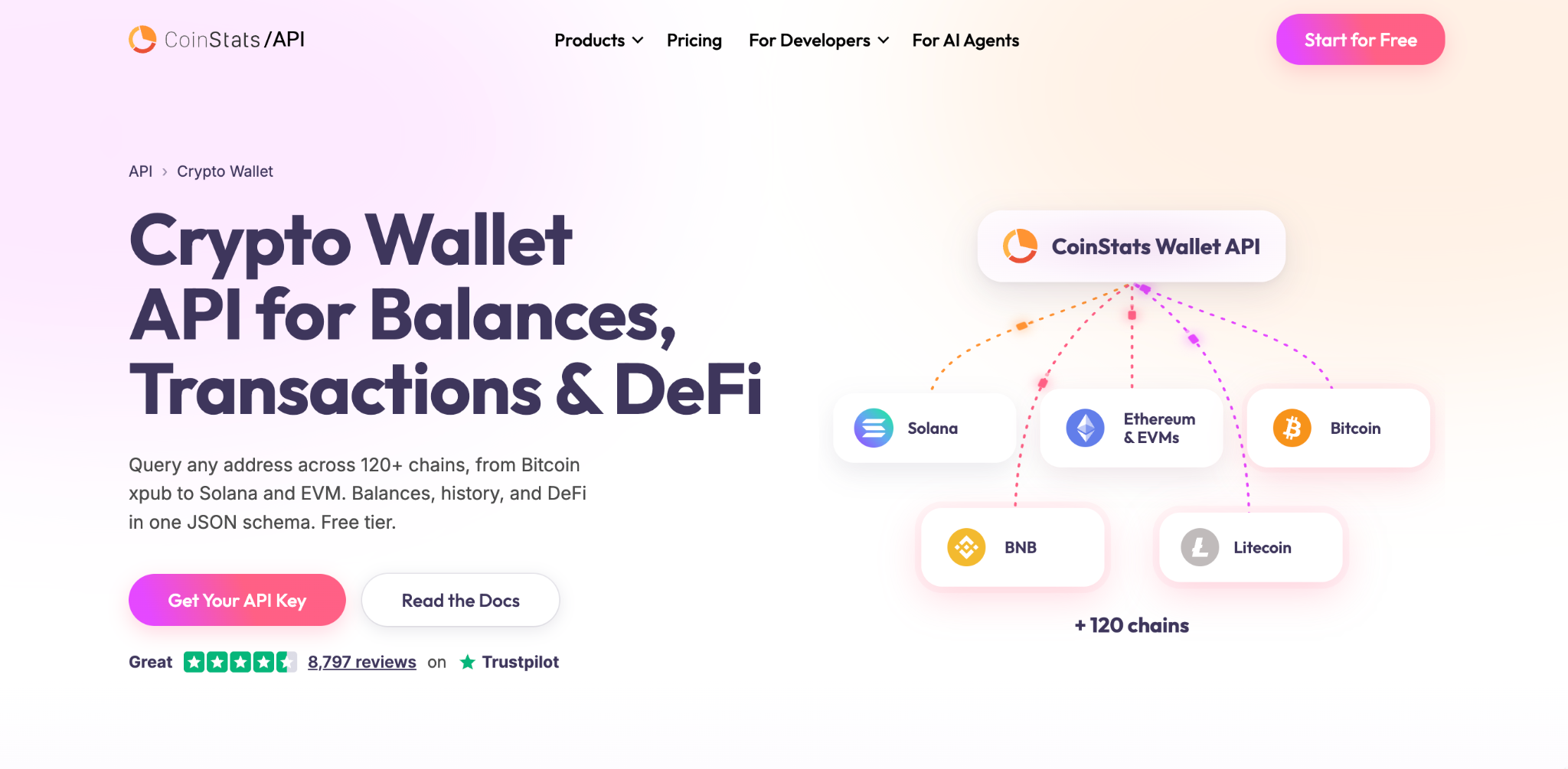
Teams, developers, and AI agents that need an all-in-one, read-only data layer for multi-chain asset tracking, transaction history, DeFi analytics, and token security across Bitcoin, Ethereum, Solana, and 120+ chains.
What you actually integrate:
- Unified Wallet REST API: One JSON schema returns balances, full transaction history, NFTs, and DeFi positions for any address across 120+ chains, plus prices for 100,000+ coins from 200+ exchanges.
- Bitcoin Extended Public Keys: Native xpub, ypub, and zpub support resolves every derived address in an HD wallet from a single call.
- Transaction History & P&L: Per-wallet history with realized and unrealized PnL, cost basis, and USD value at time of transfer, the data tax and accounting tools need.
- Auto-Detected DeFi Positions: Built-in protocol resolution indexes staking, lending, LP, and yield positions across 10,000+ protocols, with no protocol-by-protocol setup.
- Token Security API: Smart-contract risk scoring (honeypots, malicious mints, blacklists, hidden fees, upgradeable proxies) powered by the Hexens Glider engine across major EVM chains.
- MCP Server for AI Agents: One OAuth-protected URL exposes 20+ wallet, DeFi, and portfolio tools to LLMs and agents, using the same key as REST.
Key constraints:
- Read-Only Data Layer: CoinStats is purely an aggregation and data API; it does not offer low-level JSON-RPC nodes, transaction broadcasting endpoints, or write-privilege wallet creation.
- Credit-Based Rate Limits: A credit-multiplier system where complex calls (multi-chain DeFi resolution) cost more than simple market tickers. The free tier is 20,000 credits/month at 2 requests/second.
Implementation note:
Use the REST endpoints or the hosted MCP server to power portfolio dashboards, tax and accounting tools, and AI assistants. Authenticate server-side with the X-API-KEY header; for AI clients, connect over MCP through the browser OAuth consent flow using the same key. Transaction endpoints support a sync (PATCH) call to refresh history before reading.
ASCN.AI
Best for: Compliance-heavy or institutional-grade wallet applications that need risk scoring, transaction monitoring, and compliance workflows.
What you actually integrate:
- Address risk scoring (sanctions, mixers, high-risk exposure)
- Transaction monitoring and suspicious pattern alerts
- Compliance automation (audit trails, chain-of-custody reports)
- Address screening against OFAC/EU lists
- Behavioral analytics classifications
- Hooks for KYC/AML systems linking identities to on-chain activity
Key constraints:
- Compliance and risk category, not general-purpose wallet data
- Assumes custodial/semi-custodial obligations; non-custodial may not benefit
- Higher latency (200–500ms) due to graph analysis and list lookups
- Ethereum + Bitcoin focus; L2/alt-L1 depends on enabled modules
Implementation note: Typically integrated at deposit/withdrawal approval points; store risk scores alongside transactions for auditability; consume async compliance alerts via webhook listeners if available.
CryptoCompare
Best for: Institutional-grade market data, granular order book metrics, and low-latency streaming pricing for high-frequency wallet trading features.
What you actually integrate:
- Real-time streaming price feeds via WebSockets and REST
- Historical aggregate data (minute, hour, day intervals) with VWAP metrics
- Order book snapshots and multi-exchange liquidity analytics
- Multi-currency fiat conversion and cross-rates
- Supplementary on-chain signals (active addresses, transaction counts)
- Integrated crypto news feeds and sentiment tracking
Key constraints:
- Primarily a market data aggregator; cannot replace an on-chain transaction indexer or NFT inventory API
- Commercial licenses for real-time WebSocket streams and institutional data are highly premium-priced
- Complex nested JSON data schemas require robust client-side parsing
- API keys strictly enforce credit consumption, requiring careful credit monitoring to prevent downtime
Implementation note: Utilize WebSocket connections for active portfolio trading views to minimize REST polling overhead. Cache historical OHLCV data long-term for static chart rendering, and set up fallback endpoints for rare fiat cross-rate gaps.
Blockbook
Best for: Self-hosted, open-source blockchain indexing (Bitcoin + EVM) with full control and no dependency on hosted API uptime.
What you actually integrate:
- REST endpoints for balances, tx history, UTXOs
- WebSockets for address monitoring/new blocks
- UTXO queries for coin selection logic
- EVM decoding for internal tx and token transfers
- Mempool monitoring
- Search by hash/height/address with pagination
Key constraints:
- You operate the infrastructure
- Significant disk/sync/maintenance overhead
- Public instances are best-effort; not production-grade by default
- Separate chain deployments per network
Implementation note:
Run on dedicated servers due to continuous indexing and I/O. Apply reverse-proxy rate limits. Cache heavily (Redis/CDN) for addresses with large histories.
Key Features to Compare
Wallet API selection turns on technical dimensions that decide whether your application surfaces complete data, handles edge cases, or fails silently under load.

Assign weights to each dimension based on your application type: analytics platforms prioritize historical completeness and profitability models, consumer wallets prioritize balances and swap execution reliability, and compliance tools prioritize risk signals and decoded transaction coverage.
Balances
Balance endpoints form the foundation of wallet state representation, yet vendors diverge on finality assumptions, refresh cadence, and fiat valuation.
What to verify: Separate native vs token balances; confirmed vs pending; include block height/timestamp.
Must-have fields: Integer base units + decimals; token arrays with contract, symbol, decimals, quantity; valuation timestamps; finality indicators.
Edge cases: Reorg behavior; token-heavy addresses (500+ tokens); contract vs EOA semantics.
How to test quickly: Query a recently active address; cross-check against a block explorer at the same block height; test pending behavior on testnet.
Common failure modes: Stale fiat conversion; missing block height; unstable ordering; treating all states as confirmed.
Transfers
Transfer history must disambiguate external transactions, internal calls, token movements, and contract-mediated flows.
What to verify: Documentation defines “transfer” scope; directionality is explicit; status is returned.
Must-have fields: Hash, block/time, from/to, base units + token contract, direction flag, status, gas, type labels.
Edge cases: Failed tx visibility; pagination integrity; zero-value transfers.
How to test quickly: Query a high-activity address and cross-check transactions vs event logs.
Common failure modes: Missing internal transfers; poor idempotency guidance; confirmation depth ignored; directionality errors in multi-party calls.
Token Holdings
Token holdings endpoints reveal metadata quality, spam filtering, and historical state support.
What to verify: Spam filtering controls; metadata completeness; multi-standard support; historical holdings.
Must-have fields: Contract, symbol/name, decimals, balance base units, valuation timestamp, verified status, logo URI, standard ID, spam score.
Edge cases: Airdropped scam tokens; filtering toggles; historical ownership; ERC-1155 semantics.
How to test quickly: Query an address with 20+ tokens including spam; validate top tokens vs explorer; request historical holdings.
Common failure modes: No spam flags; null metadata on long-tail tokens; “ERC-20 only” despite claims; historical block params ignored.
NFT Holdings
NFT endpoints must reconcile ownership, metadata caching, media URLs, and quantity semantics.
What to verify: Collection + item endpoints; refresh strategy; media URLs separate from pointers; ERC-1155 quantities correct.
Must-have fields: Contract, token ID, owner, quantity, metadata URI, cached metadata snapshot, media URLs, collection identifiers, last refresh timestamp.
Edge cases: Broken IPFS gateways; ERC-1155 multi-quantity; onchain vs offchain metadata.
How to test quickly: Query a wallet holding multiple NFTs; cross-check metadata vs marketplace displays; test recently updated metadata.
Common failure modes: Token ID normalization conflicts; stale metadata TTLs; raw IPFS hashes without gateway resolution; missing verification flags; ignored ERC-1155 quantity semantics.
DeFi Positions
DeFi position aggregation quality varies by decomposition logic and update frequency.
What to verify: Positions split by lending/borrowing, LP, staking, vaults; protocol coverage disclosed; price sources declared; refresh frequency documented.
Must-have fields: Position type, protocol identifiers, underlying breakdown, USD value + price timestamp, rewards, entry timestamps, health metrics (LTV).
Edge cases: Unbonding states; impermanent loss representation; deprecated vaults flagged.
How to test quickly: Query an address with lending + LP; cross-check values vs protocol UI; test a closed/liquidated position.
Common failure modes: Inflated protocol counts; stale pricing; missing underlying breakdown; slow refresh; time-lock states flattened.
Decoded Transactions

Decoding separates production-grade portfolio systems from raw indexers.
What to verify: Coverage breadth; decoded summaries + raw calldata; ABI references included.
Must-have fields: Hash, action label, method name/signature, parameters, events arrays, contract verification, raw calldata hex.
Edge cases: Proxy contracts; multi-hop aggregators; unverified ABIs.
How to test quickly: Decode a Uniswap/Aave/Curve tx; cross-check against explorer decoding.
Common failure modes: Top-protocol-only coverage; proxy interactions labeled generically; missing raw calldata; multi-step actions collapsed.
Risk Signals
Risk signals are essential for compliance workflows but require taxonomy clarity and evidence standards.
What to verify: Sanctions exposure, phishing/drainers, mixers, high-risk contracts, rug indicators, anomaly detection.
Must-have fields: Risk score + labels, evidence links, timestamp, severity, remediation guidance.
Edge cases: Passive receipt vs active engagement; temporal logic (pre/post sanction); false positives.
How to test quickly: Query a known sanctioned address and a clean address; validate evidence.
Common failure modes: Binary-only checks; high false positive rates; missing evidence; no temporal context; hard-coded anomaly thresholds.
Cross-Chain Support
“30+ chains” or “120+ chains” is not a quality signal by itself.
What to verify: Unified schema across chains; address format handling; bridged-asset interpretation.
Must-have fields: Chain ID, last indexed block height, schema versions, address specs, bridge registries.
Edge cases: EVM + Solana portfolios; canonical vs wrapped assets; schema drift.
How to test quickly: Query the same address across multiple EVM chains; validate block height freshness against explorers.
Common failure modes: Inflated chain counts with testnets; normalization breaks on non-EVM; missing bridge provenance; chain-specific indexing lag undisclosed.
Swap Support
Swap support spans quote, build, execute, and track.
What to verify: Quote vs execution separation; routing coverage; post-trade tracking; slippage/deadline enforcement. OpenOcean V4 Swap API is available on 40+ chains; validate route depth and chain availability in practice.
Must-have fields: Quote IO tokens, output amounts, price impact, route breakdown, expiry. Execution tx object, gas estimate, deadline, slippage, permit support. Tracking status, settled amounts, effective price, revert reasons.
Edge cases: Low-liquidity pairs; strict slippage under volatility; reverted swaps with revert reason surfaced.
How to test quickly: Compare quotes against other aggregators; simulate unsigned tx; execute on testnet; confirm status transitions.
Common failure modes: Stale quotes; single-DEX routing; slippage ignored; missing EIP-2612 permit support; no revert context.
MEV Protection
MEV protection terminology is slippery. You need mechanism-level clarity.
What to verify: Private tx submission vs relay vs bundle support; scope (swaps only vs any tx); fallback behavior.
Must-have fields: Mechanism type, relay provider, latency overhead, revert policy, inclusion proof, fallback behavior.
Edge cases: Congestion fallback to public mempool; slippage revert offchain vs onchain; inclusion receipt availability.
How to test quickly: Submit a protected transaction and check public mempool visibility before inclusion.
Common failure modes: Conflating hiding with anti-sandwich guarantees; undisclosed latency; no auditability; undefined fallback behavior.
Security, Compliance, and Key Considerations
Crypto wallet API integrations create a security surface that combines Web2 vulnerabilities with blockchain-specific attack vectors. The correct mental model is layered defense: key custody, authentication, transaction validation, and compliance controls all matter at the same time.
Key Management
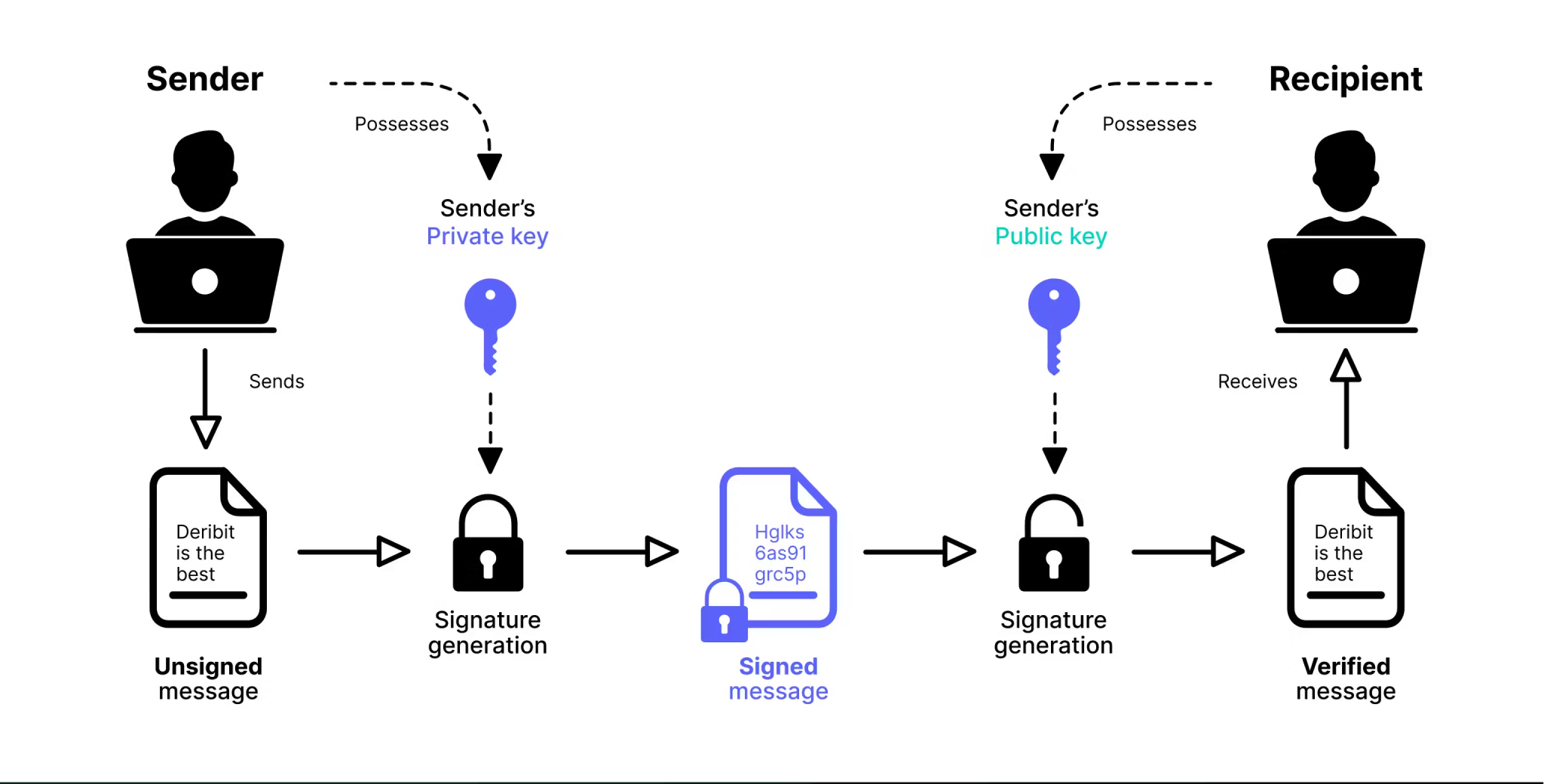
API Keys and Tokens:
- Do store production API keys in a secrets management system (AWS KMS, HashiCorp Vault, GCP Secret Manager).
- Verify keys are scoped to minimum permissions.
- Do rotate on compromise, personnel changes, and vendor incidents.
- Avoid sharing keys across environments.
- Verify revoked keys fail within 60 seconds.
Webhook Signing Secrets:
- Do store in KMS/HSM; rotate; never log in plaintext.
- Verify signature validation before parsing payloads.
- Do maintain a replay harness to confirm rejection logic survives refactors.
Wallet-Related Keys (Custodial Scenarios):
- Do use HSMs for private key material.
- Verify operations stay inside the HSM boundary.
- Do implement multi-person approval for rotation/recovery.
Minimal Key Lifecycle Checklist:
- Create → Generate within KMS/HSM; document scope and expiration.
- Store → Encrypt at rest/in transit; enable access logs.
- Use → Automated secrets injection; no copy/paste.
- Rotate → On compromise/personnel/vendor incident; at least every 90 days.
- Revoke → Delete from secrets manager; confirm provider invalidation.
- Audit → Monthly access log export and correlation.
Authentication
- API keys belong server-side; never in browser JS or mobile binaries.
- OAuth 2.0 / JWT fits delegated user access; enforce issuer/audience/exp/signature checks.
- mTLS is appropriate for high-value flows when supported, but does not replace app-layer auth.
- Least privilege: separate read-only, write, and admin keys.
- Environment separation: isolate sandbox vs production; enforce IP restrictions if supported.
Rate Limiting
Rate limiting is a three-layer system: vendor quotas, client throttling, and burst handling.
- Do obtain the provider’s exact policy (rps/rpm, burst, per-key vs per-IP).
- Do throttle at 80% of vendor limits across all replicas.
- Do queue bursts with caps on depth and wait time.
- Do exponential backoff (1s doubling, cap 32s) + jitter (±25%).
- Do retry only on 429, 503, and timeouts.
- Avoid retrying on 400/401/403.
- Idempotency: stable UUID per operation, stored before calling write endpoints; expire at 24 hours.
Data Validation
Data validation defends against malformed primitives, chain context mismatches, and untrusted metadata.
- Address validation must be chain-specific (EIP-55 checksums, bech32 variants, Solana base58).
- Chain context must be explicit (chainId/network), never inferred from address format.
- Token contract validation should include allowlists and contract metadata confirmation.
- Numeric precision requires BigInt / arbitrary precision; operate in smallest units.
- Decoded transaction metadata is interpretive; raw calldata is authoritative.
- NFT metadata URIs are untrusted input; sanitize and enforce CSP; apply size and timeout limits.
Incident Response
Examples of detection signals to watch: suspicious request spikes (>3× in 5 minutes), webhook signature failure surges (>5% in 10 minutes), rate-limit saturation (throttle queue depth >50% for >2 minutes), balance inconsistencies between providers (>1% drift), etc.
Should anything tip off the alarm, revoke credentials within 60 seconds, block anomalous IPs, enable read-only mode, and freeze affected accounts if needed.
Recovery:
- Rotate all related credentials.
- Restore incrementally and reconcile on-chain vs internal records.
- Implement controls identified as gaps.
AML Monitoring & Sanctions Screening

AML flows differ in custodial vs non-custodial models:
- Custodial: pre-transaction screening, thresholds, manual review triggers.
- Non-custodial/watch-only: post-transaction monitoring and alerts; avoid “blocking” user assets you do not control.
Sanctions screening requirements:
- Screen addresses and entities; update lists daily.
- Cache screening results for 24 hours maximum.
- Separate “potential match” manual review from “confirmed match” immediate block workflows.
Conclusion
The “best crypto wallet API” is not a single brand name; it is not even the same type of API most of the time. It is the provider whose data model, latency profile, webhook behavior, and operational controls match your product’s constraints, not to mention the match between the use case and your needs.
Frequently Asked Questions
What is the difference between a wallet API and an RPC endpoint?
A wallet API provides indexed, aggregated data for wallet-centric operations, whereas an RPC endpoint returns raw blockchain state through direct node queries. Use a wallet API when you need portfolio summaries, categorized transaction history, or multi-asset aggregation; prefer RPC when you need real-time state queries, mempool visibility, or custom smart contract interactions not yet indexed.
Which wallet API is best for multi-chain portfolio data?
Select a wallet API for multi-chain portfolio data by validating chain coverage, normalized schema completeness (tokens, NFT, DeFi), and query latency under pagination. Test real multi-chain wallets, verify bridged assets (USDC vs USDC.e), and confirm schema consistency across chains.
Which wallet API supports xPub, yPub, and zPub monitoring?
An API that supports xPub, yPub, and zPub monitoring must support extended public key derivation scanning with configurable gap limits and return scan-depth metadata. Treat xPubs as sensitive: they expose the wallet’s full activity graph and must be transmitted over TLS and stored encrypted.
Which wallet API is best for NFT data?
Choose an NFT-focused wallet API based on ownership verification, metadata resolution strategy, transfer history completeness, and market context (floor prices, collection stats). Verify that responses include both metadata URIs and resolved metadata snapshots, plus a metadata_last_updated-style timestamp to detect staleness.
Which wallet API is best for swaps?
Evaluate swap APIs by separating quote discovery, transaction building/signing, and execution tracking. Validate route breakdown visibility, slippage and deadline enforcement, and any MEV protection mechanism claims (private submission, relay, bundle support) with explicit documentation.
When should an application use webhooks?
Use webhooks when you need near-real-time UX without constant polling and when request volume scaling would otherwise crush your rate limit budget. Use polling when latency tolerance is high or you are prototyping. In both cases, design for duplicates, out-of-order delivery, and reorg corrections.
What rate limits are typical for wallet APIs?
Typical ranges depend on tier: free plans often 10–100 rpm, paid plans 100–1,000 rpm, enterprise negotiable. Compute unit systems complicate this: expensive calls (wide logs, full histories) can consume far more credits than simple balance lookups. Cache, batch, and backoff with jitter.
How should API keys be secured?
Store keys in a secrets manager, rotate regularly, scope permissions, separate environments, restrict by IP if supported, and never embed keys in client apps. Proxy sensitive calls through your backend so you can enforce authentication, rate limits, and input validation behind server boundaries.


