
What is Shiba Inu Coin (SHIB)? A Beginner's Guide


Key Takeaways
- Shiba Inu is a blockchain ecosystem based on Ethereum that includes a proprietary DEX ShibaSwap and an NFT incubator. Even more applications are in the pipeline;
- What is Shiba Inu coin’s distinction from Dogecoin? It is not only a meme coin but also a system of tokens that are a product of DeFi boom;
- What is Shiba Inu coin’s future? Developers included a funding mechanism into the protocol to ensure features that are developed in secret can be delivered on. However, some argue that SHIB has no long-term future.
Contents
- 1. Origin of Shiba Inu Coin
- 2. How SHIB Works on Ethereum
- 3. SHIB Ecosystem: ShibaSwap, Shibarium, and Governance
- 4. SHIB Tokenomics
- 5. How to Buy, Trade, and Store SHIB
- 6. Staking SHIB
- 7. Use Cases and Real-World Utility
- 8. Comparison: SHIB vs Dogecoin
- 9. Security, Risks, and Key Considerations
- 10. Conclusion
Shiba Inu (SHIB) is an ERC-20 memecoin launched on the Ethereum blockchain that has since expanded into a broader decentralized ecosystem — and the most useful way to understand it is to separate the token (SHIB) from the infrastructure and community layers built around it.
Origin of Shiba Inu Coin
Quick facts: Shiba Inu (SHIB) is a meme token built on the Ethereum blockchain, launched in August 2020 by a pseudonymous creator known as Ryoshi.
Launch
SHIB’s origin story is unusually easy to verify on-chain, even though the person behind it remains anonymous. Here are the foundational details that still shape how SHIB trades and how its supply narrative is understood:
- Initial supply: One quadrillion tokens (1,000,000,000,000,000 SHIB), an intentionally enormous issuance designed to keep the per-token price fractional
- Token standard: ERC-20, which made SHIB immediately compatible with Ethereum-based wallets and decentralized applications from day one
- No presale or private round: Tokens were not pre-sold to early investors in a traditional fundraise
At launch, the total supply of one quadrillion SHIB was split in two equal halves. Fifty percent of all tokens were used to seed a liquidity pool on Uniswap, giving the cryptocurrency an immediately tradable market. The remaining 50% were sent directly to the wallet of Ethereum co-founder Vitalik Buterin — a move the creator made without Buterin’s prior involvement. As a result, his decision to donate crypto received in this “airdrop” to charity also came as a surprise to the emerging community and changed the way SHIB’s value works.
Creator
Ryoshi is credited as the pseudonymous creator of Shiba Inu, but no publicly verified real-world identity has ever been confirmed. What we “know” comes primarily from early blog posts and community communications published under the Ryoshi name, which have since been deleted.

From a due diligence standpoint, deliberate anonymity changes the accountability profile: a project with an unknown founder is not automatically illegitimate, but it does require a different kind of scrutiny and a more conservative security posture.
Ryoshi positioned SHIB as the “Dogecoin killer” from the start, which influenced how the broader cryptocurrency community framed it: less as a technical innovation and more as a narrative-driven asset that would live and die by attention, liquidity, and community coordination.
How SHIB Works on Ethereum
Despite commonly being labeled as a memecoin, SHIB is not a “coin” you download into a wallet. It is a specific token balance tracked by an Ethereum smart contract, and your cryptocurrency wallet is the tool that lets you sign transactions that update that contract’s internal ledger.
Ethereum
Every SHIB balance is recorded as an entry in an Ethereum smart contract's internal mapping rather than a coin sitting in a wallet file. Ethereum acts as the settlement layer — the final authority on who owns what. Your wallet is a cryptographic keypair that signs transactions, and the Ethereum network updates the SHIB smart contract's state accordingly when that signature is validated.
Shiba Inu follows the ERC-20 token standard, and understanding four core functions makes the mechanics clear: balances (a mapping of addresses to amounts), transfer (moves tokens directly from your address), approve (grants a third-party contract permission to spend up to a defined allowance), and transferFrom (lets that approved contract execute the actual move). Every SHIB transaction you initiate on-chain is ultimately calling one of these functions, which in turn requires gas in ETH.
Transaction Flow
Scenario 1 — Wallet-to-wallet SHIB transfer:
- You compose a transaction in your wallet app (usually through steps like choosing a sending and receiving addresses) and sign it with your private key (this happens under the hood).
- The signed transaction is broadcast to the Ethereum mempool.
- An Ethereum validator picks up the transaction and includes it in a block.
- The SHIB smart contract executes the transfer function, emitting a Transfer event on-chain.
- The recipient's balance in the contract mapping updates immediately.
On a block explorer such as Etherscan, you can confirm this by checking: transaction status (Success), gas used, the Logs tab for the Transfer event, and the Token Transfers tab showing your address as sender and the recipient's address.
Scenario 2 — Swapping SHIB on a DEX:
- If the DEX router does not yet have an allowance, you first submit an approve transaction (a separate gas cost).
- You then submit the swap transaction, which calls the router contract.
- The router uses transferFrom to pull your SHIB, executes the swap logic through the liquidity pool, and sends the output token to your address.
On a block explorer, you will see two transactions if an approval was needed, the swap transaction's internal calls under the "Internal Txns" tab, and multiple token transfer events in the logs — one for SHIB leaving your wallet and one for the received token arriving.
Fees
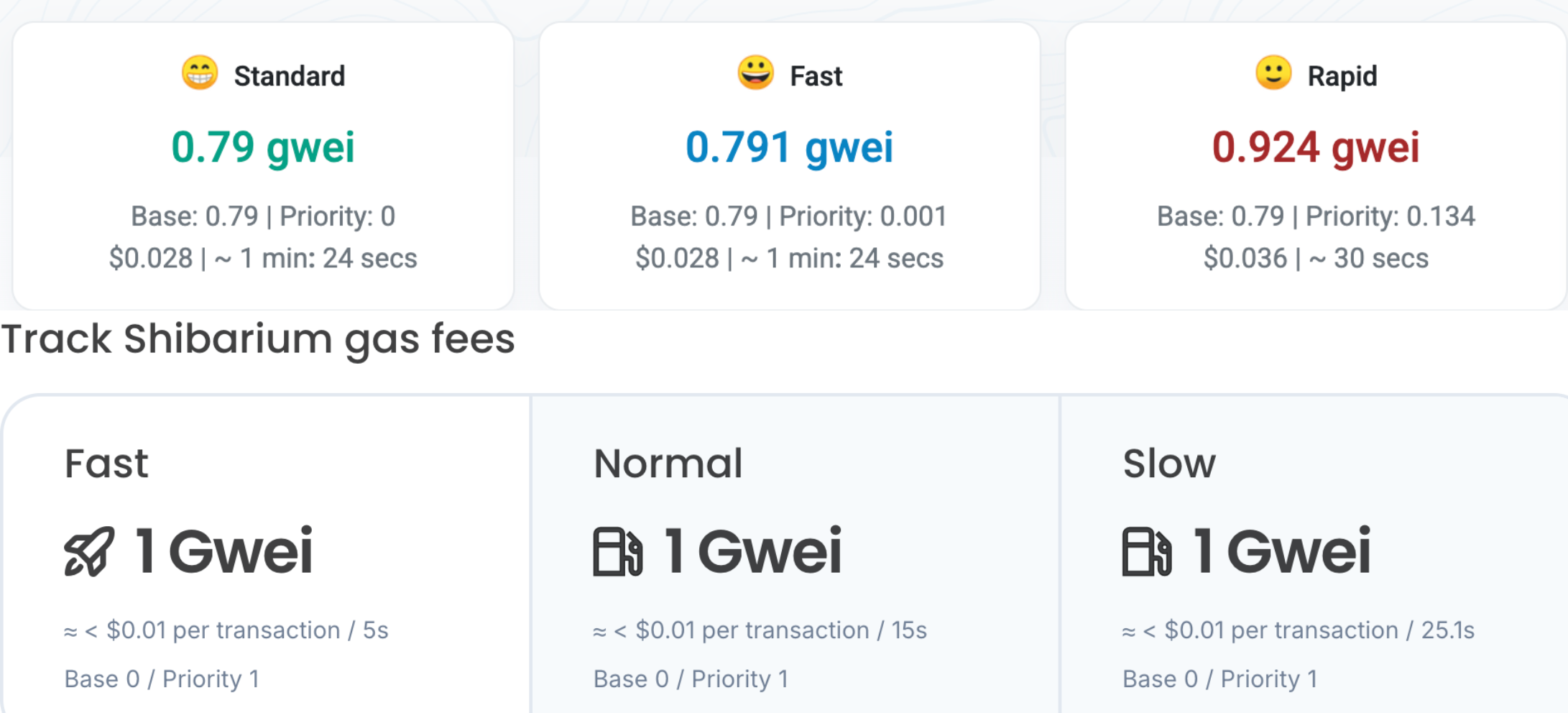
Every SHIB transaction costs gas, and that gas is paid in ETH, not SHIB. This is a fixed constraint of the Ethereum network. Even if you are transferring billions of SHIB tokens, you need ETH in your wallet to pay the transaction fee. The SHIB amount and the transaction fee are entirely separate: one is what you send, the other is what Ethereum charges for smart contract’s computation. A plain ETH transfer uses a flat 21,000 gas units; an ERC-20 transfer commonly runs 45,000–65,000 gas units or higher depending on contract complexity.
What is more, fee variability is driven by two factors: the base fee (set by the network and influenced by congestion) and the priority fee (a tip to validators for faster inclusion). During peak network congestion, gas prices can spike significantly, making the same SHIB transfer cost several times more in ETH than during quiet periods. Most wallet apps offer speed tiers (slow, standard, fast) that adjust these parameters. Choosing "slow" during low-congestion periods can reduce costs without meaningfully delaying the transaction.
SHIB Ecosystem: ShibaSwap, Shibarium, and Governance
Although the community-driven nature of Shiba Inu created many related applications, the most prominent ones are made by the “core” team. ShibaSwap is where most on-chain DeFi activity happens, Shibarium is the lower-fee environment the ecosystem is pushing users toward, and BONE is the token that links governance and L2 fees into one operational loop.
ShibaSwap
This is the native decentralized exchange (DEX) of the Shiba Inu ecosystem. It gives SHIB holders a way to put their assets to work directly on-chain, without handing custody to a centralized platform, like it would happen with a centralized exchange (CEX). Users can:
- Swap (e.g., SHIB → BONE): Input asset is any supported ERC-20 token; the on-chain action is a token swap routed through a liquidity pool smart contract.
- Provide liquidity (e.g., SHIB/ETH pool): Input assets are two paired tokens deposited into a smart contract pool; the on-chain action is liquidity provision in exchange for LP tokens.
- Stake (e.g., SHIB staking via "Bury"): Input asset is SHIB, BONE, or LEASH; the on-chain action locks tokens into a staking smart contract in exchange for yield.
Shibarium
What is Shibarium? It is a layer-2 scaling network built on top of Ethereum, launched in 2023, that processes transactions independently before periodically settling data back to Ethereum mainnet.
Here is what happens differently when Shibarium is involved: a transaction is initiated in your cryptocurrency wallet or a connected dApp (such as ShibaSwap on Shibarium). It is then executed on Shibarium's own network rather than directly on Ethereum mainnet. Periodically, Shibarium bundles and posts transaction data back to Ethereum for final settlement, which is how it inherits Ethereum's security model at the settlement layer while processing individual transactions independently. What you experience differently as a user is lower transaction fees and faster confirmation times compared to executing the same action directly on Ethereum mainnet.

This matters practically: if you are swapping tokens on a Shibarium-based application, the transaction fee you pay is a Shibarium network fee (denominated in BONE), not a full Ethereum gas fee. Speed is also noticeably different: Shibarium block confirmations are faster, which makes the network more suitable for frequent, lower-value interactions.
To use it, you will have to use the bridge. Bridging is the process of moving an asset — say, SHIB — from Ethereum mainnet into Shibarium (or back out). In practice, your tokens are locked in a smart contract on the origin chain, and a corresponding representation of that asset is minted or released on the destination chain. It is important to understand the custody assumption here: your assets are held by the bridge smart contract during transit, meaning that smart-contract risk applies for the duration of the bridge operation.
SHIB Ecosystem Tokens
The Shiba Inu ecosystem runs on three distinct tokens, each with a defined functional role.
| Token | Primary role in ecosystem | Where it is used | What a holder can do | Key dependency |
|---|---|---|---|---|
| SHIB | Base currency and community asset | ShibaSwap, Shibarium, governance (limited) | Swap, stake (bury), transfer, use as gas-adjacent asset on Shibarium dApps | ERC-20 smart contract; bridge for Shibarium use |
| BONE | Governance and gas token | Shibarium (gas fees), ShibaSwap, governance | Vote, pay transaction fees on Shibarium, stake, swap | Shibarium network contract; DAO voting contract |
| LEASH | Scarce ecosystem asset with staking utility | ShibaSwap | Stake (bury), swap, hold for ecosystem access perks | ERC-20 smart contract; ShibaSwap liquidity pools |
BONE is the token you need to hold to actually use Shibarium (it covers transaction fees), while SHIB is what most users hold as their primary Shiba Inu position. LEASH is the most supply-constrained of the three and functions primarily within ShibaSwap's liquidity and staking mechanics.
It should be mentioned that this setup is described as it should work according to the design; in reality, in September 2025, Shibarium has suffered a $4-million bridge exploit. While most of the related ecosystem is restored or in the process of recovery, LEASH is effectively worth zero at the time of writing.
Governance
Governance in the Shiba Inu ecosystem is tied primarily to BONE, the designated governance token. Holders of BONE are the participants eligible to propose and vote on protocol-level decisions — the more BONE held, the greater the voting weight in most standard decentralized governance models.
The categories of decisions typically governed include: (1) fee parameters, such as transaction fee percentages on ShibaSwap liquidity pools or Shibarium network settings; (2) incentives and rewards programs, such as which pools receive liquidity mining rewards or how staking yields are structured; and (3) protocol upgrades and listings, including new token listings on ShibaSwap or smart-contract upgrades to existing infrastructure.
SHIB Tokenomics
Shiba Inu's tokenomics define its total supply, initial allocation, and burn-driven supply reduction. Burns permanently remove tokens from circulation, shrinking effective supply — but price impact still depends on demand and market conditions.

Supply
SHIB launched with a fixed initial supply of 1,000,000,000,000,000 tokens. There is no mining mechanism and no protocol-level cap on additional issuance, which means the "max supply" framing familiar from Bitcoin does not apply here in the same way.
Thus, its total supply, or the amount of all SHIB tokens that can exist, no matter if burned or in circulation, is not limited. The circulating supply can increase with protocol emissions, for example, from staking, or decrease with token burns. By the way, burning does not destroy tokens but sends them to an address that cannot be used to sign an outgoing transaction.
Distribution
SHIB's initial one quadrillion tokens were split into two equal allocations, each with a distinct strategic purpose:
- 50% — Uniswap liquidity pool: Half of the total supply was paired with ETH and deposited into Uniswap to bootstrap the trading market. This liquidity seeding gave SHIB its first price discovery mechanism and allowed anyone to trade it immediately after launch without relying on centralized exchange listings.
- 50% — Vitalik Buterin's wallet: This was a publicity and community-building maneuver — a high-stakes bet that Buterin's association, even involuntary, would generate attention.
Seeding a Uniswap pool at launch meant SHIB had immediate liquidity from day one. Without it, early buyers would have faced enormous slippage or no market at all.
A token where a handful of addresses control a large percentage of circulating supply carries meaningful volatility risk — a single large sell order from a concentrated holder can trigger outsized price moves. SHIB's holder distribution has broadened considerably since launch, but concentration in top wallets remains a metric worth revisiting periodically.
Burning
Generally in crypto, a burn means sending tokens to an irrecoverable address — commonly called a dead wallet or null address — for which no one holds the private key. Those tokens remain visible on-chain and therefore, accounted for in the total supply figure, but can never be spent, traded, or retrieved, so not included in circulating supply figures.
Burn events can be categorized into two types. One-time burn events are large, discrete transfers to a burn address — the most significant example in Shiba Inu's history being Vitalik Buterin burning 410 trillion SHIB (approximately 40% of the total initial supply) from the wallet that received the gifted allocation. Ongoing burn mechanisms involve smaller, recurring burns tied to transaction fees, ecosystem activity, or dedicated community burn portals; these operate continuously.
Burning reduces supply, but it does not guarantee price appreciation. Price is determined by the intersection of supply and demand. Here is a simple illustration: if circulating supply drops by 10% and total market cap stays exactly the same, then price per token rises by roughly 10%. But market cap is not static — it reflects what buyers are willing to pay at any moment. If demand falls simultaneously with a burn event, the price effect can be neutral or even negative.
How to Buy, Trade, and Store SHIB

Buying SHIB is simple in theory, but doing it safely comes down to a handful of decisions: are you using a centralized exchange (CEX) or a decentralized exchange (DEX), are you staying custodial or moving to self-custody, and are you verifying every transaction on-chain.
Here is a clean operational flow:
- Choose your entry point: a CEX or crypto onramp for fiat-to-SHIB, or a DEX if you already hold Ethereum or another compatible token.
- Complete any required verification and buy SHIB using your preferred method.
- Decide on custody: keep SHIB on the exchange for short-term activity, or move it to a self-custody wallet for greater control.
- Execute any swaps or trades you need, confirming contract addresses and slippage settings before signing.
- Store your holdings according to your time horizon: exchange wallet for active trading, hardware wallet for long-term security.
- Verify every transaction on a block explorer and record transaction hashes, wallet addresses, and fees for your own records.
Exchanges
Where should you buy your first SHIB tokens? The right answer depends on your starting point, technical comfort level, and how much control you want over your keys.
Centralized Exchange (CEX) Checklist
- Identity and verification: Most CEXs require KYC (Know Your Customer) documentation before you can deposit fiat or withdraw above certain limits. Factor in processing time.
- Fiat on-ramp availability: Confirm the platform supports your local currency and preferred payment method (bank transfer, card, etc.) before registering.
- Fees breakdown: Distinguish between the trading fee (charged per order, typically a percentage of the trade value) and the withdrawal fee (a flat or variable amount deducted when you move SHIB off-platform). These are separate transaction fee costs.
- Liquidity and trading volume: Higher 24-hour trading volume generally means tighter spreads and faster order execution. Thin liquidity on a pair can cause unexpected price slippage even on a CEX.
- Order types: Check whether the platform offers both market orders (instant execution at current price) and limit orders (execution at your specified price). Limit orders help you manage entry cost on volatile assets, such as memecoins.
- Custody implications: When SHIB sits on a CEX, the exchange holds the private keys — not you. This is convenient but means you are exposed to platform risk.
Decentralized Exchange (DEX) Checklist
- Self-custody wallet required: A decentralized exchange connects directly to your cryptocurrency wallet — you cannot use a CEX login.
- Gas fees: Transactions on Ethereum-based DEXs cost ETH in gas. Fees fluctuate with network congestion, so check current gas prices before executing.
- Slippage: On a decentralized exchange, price can shift between when you submit a transaction and when it confirms. Set a slippage tolerance that reflects current market conditions — too tight and the transaction fails; too loose and you accept a worse rate.
- Liquidity depth: Check the liquidity pool depth for your SHIB pair. Low liquidity amplifies price impact, meaning large orders move the price significantly against you.
- Token contract verification: SHIB is an ERC-20 token deployed on Ethereum. Always verify the official contract address before trading — counterfeit tokens with similar names exist on DEX interfaces.
- MEV and sandwich-risk awareness: On public blockchains, bots can detect your pending transaction and insert trades around it to extract value. Using a private RPC or MEV-protection feature where available reduces this exposure.
Wallets
A cryptocurrency wallet for SHIB is not a single app or even a category — it is a spectrum of custody models with different tradeoffs between convenience and security. What are the options? To add to the exchange balance vs. self-custody wallet described before, there are also:
- Non-custodial software wallet: A desktop or mobile application where you hold the private keys locally. This gives you full control, but responsibility for security sits entirely with you. The seed phrase (typically 12 or 24 words generated when you first set up the wallet) is the master key to your funds. The seed phrase is not the same as your wallet address: your address is public and shareable, while your seed phrase must never leave your hands. Store it offline (written on paper or engraved on metal), never in a photo, cloud document, or password manager.
- Hardware wallet: A dedicated physical device that keeps private keys in a secure element, isolated from internet-connected systems. This is the preferred model for any meaningful long-term holding.
SHIB is an ERC-20 token, which means it requires an Ethereum-compatible wallet. Before receiving SHIB, always confirm that the receiving wallet supports the ERC-20 standard and that you are sending on the Ethereum network — not a different chain that might use the same address format.
Staking SHIB
Staking Shiba Inu (SHIB) allows token holders to put their assets to work directly through decentralized exchange protocols, without handing custody to a centralized party. The primary venue for staking SHIB is ShibaSwap, the official DEX built by the Shiba Inu ecosystem. Understanding exactly how the mechanics work — and what they cost — is essential before committing any tokens.
ShibaSwap
ShibaSwap is an Ethereum-based DEX where SHIB holders can stake, swap, and participate in liquidity pools through direct smart contract interactions. Because everything runs on-chain, there is no intermediary holding your funds — but there is also no support desk if something goes wrong.
What you need before staking:
- A compatible Ethereum wallet (such as MetaMask or any ERC-20 compatible cryptocurrency wallet) connected to the mainnet
- Sufficient ETH in your wallet to cover gas fees. You will need ETH for multiple separate on-chain transactions, not just one
- Confirmation that you are accessing the correct ShibaSwap domain to avoid phishing sites; always verify the URL independently before connecting your wallet
- A clear sense of how much SHIB you intend to stake, since gas overhead can make small amounts economically unviable
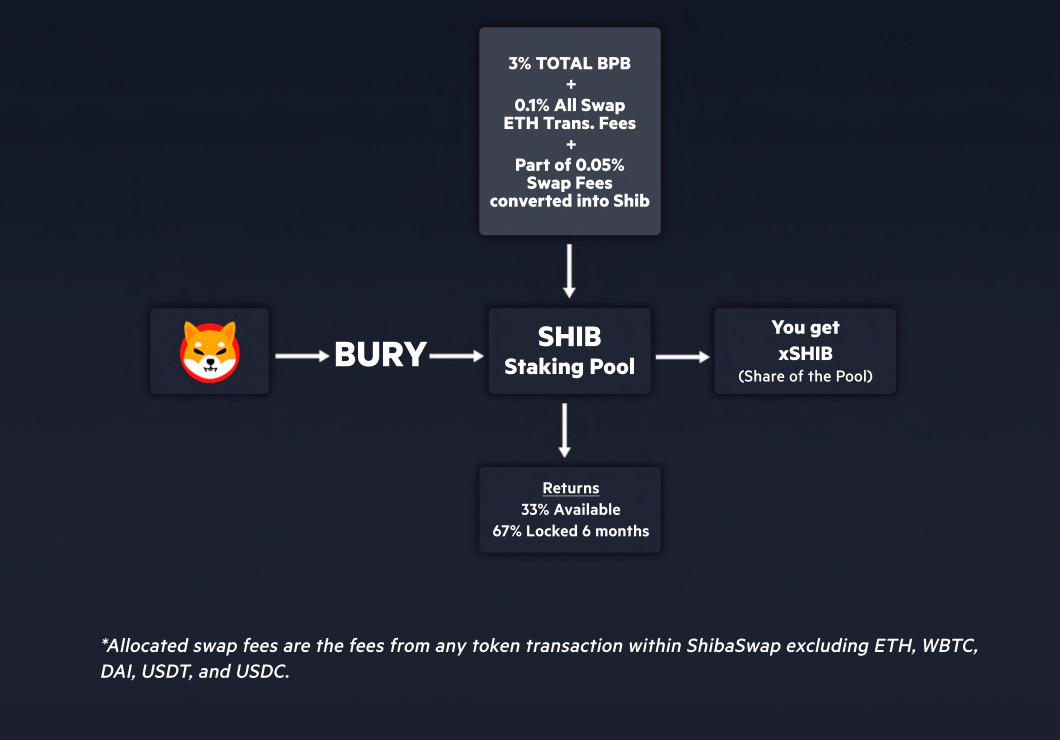
Step-by-step staking process:
- Connect your wallet — Navigate to ShibaSwap and connect your Ethereum wallet. You should see your SHIB balance reflected in the interface before proceeding.
- Select the SHIB staking option — Locate the staking or "Bury" section on ShibaSwap (SHIB staking on ShibaSwap is referred to as "burying"). Confirm the pool you are entering is the correct one for SHIB.
- Approve token spend — Before staking, you must sign a token approval transaction. This is a separate on-chain transaction that authorizes the smart contract to interact with your SHIB. You will pay a gas fee at this step, and nothing is staked yet.
- Stake/deposit SHIB — Enter the amount of SHIB you want to stake and confirm the deposit transaction. This is the second on-chain transaction.
- Confirm in your wallet — Your wallet will prompt you to review and sign the transaction. Check the gas fee estimate and confirm only when you are satisfied.
- Verify on a block explorer — Copy your transaction hash from the wallet confirmation screen and paste it into a block explorer such as Etherscan. Confirm the transaction status shows "Success" and that the contract interaction reflects a deposit to the correct ShibaSwap contract address.
- Track your position — Return to the ShibaSwap dashboard. Your staked SHIB balance and any accruing rewards should be visible from within the interface.
- Claim rewards — Rewards are not auto-compounded. You must manually claim them, which is another on-chain transaction with an associated gas cost.
- Unstake/withdraw — When you are ready to exit, initiate the withdrawal. This is yet another transaction requiring ETH for gas. Confirm on the block explorer that your SHIB has returned to your wallet address.
Rewards
Rewards from staking SHIB on ShibaSwap come in the form of ecosystem tokens rather than more SHIB directly. Historically, stakers have received allocations in tokens such as BONE and LEASH, which are other assets within the Shiba Inu ecosystem. However, reward structures in DeFi are not static — incentive programs change, token emissions shift, and APY figures displayed on the interface reflect a point-in-time estimate, not a guarantee.
As mentioned, rewards are not automatically compounded. They accumulate within the protocol and must be claimed manually by the user, which requires initiating a separate on-chain transaction. This means that to realize any yield, you must actively return to ShibaSwap, claim your rewards, and pay the associated gas fee for that claim transaction.
Rewards begin accruing after your staking transaction is confirmed on the Ethereum blockchain. Whether ShibaSwap imposes a lock-up period, cooldown, or withdrawal delay can vary by pool configuration and may change with protocol updates.
Use Cases and Real-World Utility
Realistically, SHIB is mostly a speculative investment, as many other memecoins, with some ecosystem usage on the side. There are quite a few things that it can theoretically be used for, though. Some use cases are smooth, others are still friction-heavy, and almost all of them require good wallet hygiene.
Payments

Sending SHIB directly to another wallet address (P2P) or completing a checkout through a merchant that accepts the token, either via direct wallet payment or a third-party payment processor.
How it would work:
- Open your cryptocurrency wallet and select SHIB as the asset to send
- Choose the network — Ethereum mainnet for maximum compatibility, or confirm whether the merchant or recipient supports an L2 route
- Enter the recipient's wallet address and double-check it character by character
- Set your gas fee and submit the transaction
- Share the transaction hash as proof of payment if needed
Although it is not widely accepted as a payment method and definitely not a household name, Cryptwerk tracks 1,136 merchants and 38 payment gateways that can make it happen.
Friction & constraints:
- Gas fees on Ethereum mainnet fluctuate with network demand and can exceed the value of small transfers
- SHIB's price volatility means the dollar value of a payment can shift between initiation and confirmation
- Merchant acceptance remains limited; most require a payment processor to convert SHIB at point of sale
- L2 routing through Shibarium or other Ethereum L2s adds compatibility requirements that not all recipients currently support
- No dispute resolution exists for on-chain errors
DeFi
Interacting with decentralized exchange protocols to swap SHIB, provide liquidity to SHIB trading pairs, or staking assets in yield-generating smart contracts are activities that occur more frequently compared to payments. These three distinct actions that each carry their own mechanics and risks.
Swapping:
- Connect your cryptocurrency wallet to a decentralized exchange (DEX) that lists SHIB
- Verify the SHIB ERC-20 token contract address within the DEX interface
- Select your input token and SHIB as the output (or vice versa)
- Set slippage tolerance — the maximum price movement you will accept before the swap reverts
- Approve the transaction and confirm the swap on-chain
Providing Liquidity:
- Navigate to the liquidity section of a DEX
- Select the SHIB pair you want to support (e.g., SHIB/ETH)
- Deposit an equal value of both tokens into the pool's smart contract
- Receive LP (liquidity provider) tokens representing your share
Staking/Yield:
- Locate a staking contract within the Shiba Inu ecosystem or a compatible protocol
- Approve the smart contract to spend your SHIB (see the Approvals callout below)
- Deposit your tokens and track accrued rewards on-chain
Low liquidity in a SHIB trading pair means that even a moderately sized trade can move the price noticeably, increasing your effective execution cost. Slippage tolerance is a user-controlled parameter; finding the right balance depends on current pool depth and trading volume.
When you provide liquidity, you are exposed to impermanent loss — a reduction in value relative to simply holding the two assets separately. This occurs when the price ratio between your two pooled tokens shifts. The effect is worse during large relative price moves, which are common with a volatile asset like SHIB. Impermanent loss is only "realized" when you withdraw, but it can meaningfully erode gains from fee income.

Friction & constraints:
- Every DeFi action requires at least one on-chain transaction, each costing gas
- Approval transactions add an extra step and an extra fee before the main action
- Smart-contract risk is inherent — even audited contracts can contain vulnerabilities
- Low liquidity pools amplify slippage and can make larger trades prohibitively expensive
- Yield rates in staking contracts can change without notice and are not guaranteed
Gaming
At one point, the entire Shib Army was looking forward to this use case. Users acquire, trade, or use SHIB-ecosystem NFTs as in-game assets, collectibles, or identity markers within compatible gaming environments built on or integrated with the Shiba Inu ecosystem.
How blockchain gaming would work:
- Set up a cryptocurrency wallet that supports Ethereum-based NFTs (ERC-721 or ERC-1155 tokens)
- Browse a compatible NFT marketplace and locate SHIB-ecosystem assets
- Purchase or mint an NFT, paying with ETH for both the asset cost and gas fee
- Confirm the NFT appears in your self-custody wallet (not just on the platform's dashboard)
- Connect your wallet to the compatible game or platform to use the asset
In gaming contexts, SHIB can function as an in-game currency for purchases or entry fees, but NFTs carry the utility: unlocking gameplay, representing status, or serving as collectibles. SHIB itself would be the payment token; the NFTs are the functional assets.
A concrete example from within the Shiba Inu ecosystem: Shiboshis are a collection of 10,000 Shiba Inu-generated NFTs on Ethereum. They represent one of the earliest expressions of NFT-linked identity and collectible utility within this ecosystem — each token is unique, stored on the Ethereum blockchain, and can function as a collectible or avatar tied to a holder's decentralized identity.
Friction & constraints:
- NFT minting and trading on Ethereum carries gas fees that can exceed the asset's market value for lower-priced collectibles
- Game platforms can modify or deprecate in-game asset functionality unilaterally
- Secondary market liquidity for ecosystem-specific NFTs is often thin
- Price volatility of both SHIB and the underlying NFT market adds financial risk
- Smart-contract risk applies to NFT contracts just as it does to DeFi protocols
Metaverse
Similarly to gaming, the idea of a metaverse on Shibarium used to be floating around at the peak of the trend. Users would hold or display SHIB-ecosystem tokens or NFTs to gain token-gated access to virtual spaces, establishing a digital identity, interacting with virtual land or items, or participating in community-driven virtual environments.
How it would work:
- Confirm your cryptocurrency wallet holds the required token or NFT for the specific platform
- Connect your wallet to the metaverse platform using a wallet connection prompt (completely different from a seed phrase)
- Verify that the platform reads your on-chain holdings correctly before engaging
- Interact with token-gated content, virtual land, or community spaces as permitted by your holdings
- Withdraw or transfer assets back to your wallet after any in-platform transaction
Friction & constraints:
- Metaverse projects vary enormously in decentralization; many remain effectively centralized despite using blockchain tokens
- Platform development risk is high — projects can shut down, pivot, or change access rules
- Interoperability between virtual worlds is limited and rarely guaranteed
- Gas fees for transferring virtual land or items on Ethereum mainnet can be substantial
- Volatility of underlying tokens affects the real-world cost of virtual interactions
Comparison: SHIB vs Dogecoin

Shiba Inu and Dogecoin live in the same cultural neighborhood — meme coins with passionate communities and sentiment-driven moves — but they behave very differently once you look under the hood.
Dogecoin is a true and blue coin, not a token riding on another network. It runs on its own proof of work blockchain, merge-mined with Litecoin, which means its security is sustained by computational mining rather than delegated to another chain's validator set. Block times average roughly one minute, and transaction fees have historically remained very low — a design feature that has made DOGE a recurring candidate for everyday payments and tipping. The primary usage narratives for Dogecoin center on peer-to-peer transfers, merchant payments, and community tipping — simple, direct value movement with minimal smart contract interaction.
| Criterion | Shiba Inu (SHIB) | Dogecoin (DOGE) |
|---|---|---|
| Underlying blockchain | ERC-20 token on Ethereum; no native L1 chain | Native L1 coin on its own proof-of-work blockchain |
| Security model | Secured by Ethereum's proof-of-stake validator set; L2 activity on Shibarium adds rollup security | Proof-of-work, merge-mined with Litecoin; network security depends on miner participation |
| Supply model | Initial supply of 1 quadrillion tokens; Vitalik Buterin burned ~41% of total supply in 2021, reducing circulating supply in a single event; ongoing community burn programs continue at smaller scale | Uncapped; ~5 billion new DOGE issued annually with no deflationary mechanism; circulating supply grows continuously |
| Ecosystem & utility | DeFi via ShibaSwap DEX, NFT collections, Shibarium L2 for lower-cost transactions, governance through BONE token | Primarily peer-to-peer payments and tipping; limited smart contract or DeFi ecosystem |
| Fee exposure | Ethereum gas fees (transaction fee) for on-chain ERC-20 actions; Shibarium L2 reduces costs for supported transactions | L1 Dogecoin network fees, historically low; no Ethereum gas exposure |
| Primary risk drivers | Social hype dependence, Ethereum gas volatility, smart contract exposure, liquidity swings | Social hype dependence, unlimited inflation suppressing scarcity, high price volatility, low DeFi utility |
| Typical on-chain actions | Swapping on DEX, bridging to Shibarium, staking, NFT minting, ERC-20 transfers | Sending coins wallet-to-wallet, merchant payments, tipping |
| Best fit | Best for users who want DeFi access, L2 experimentation, and participation in a multi-token ecosystem | Best for users who want straightforward, low-fee peer-to-peer crypto transfers with minimal technical complexity |
Security, Risks, and Key Considerations
SHIB can be easy to buy and easy to hold, but most losses happen in the “in-between” moments: the first approval, the first bridge, the rushed swap, the wrong network selection, the phishing page that looks identical to the real one. If you want peace of mind, you need a clear map of the failure modes and a routine to prevent them.
Smart Contract Risk
Risk level: High
Smart contract risk means that a bug, exploit, or malicious design in code can drain your funds without warning, and no one can reverse it on a decentralized network. A lot can go wrong:
- A vulnerability in the ShibaSwap contracts or any Shibarium-based protocol could be exploited to siphon liquidity or locked tokens (and even has already happened before).
- Interacting with a cloned or counterfeit contract address (not the official SHIB ERC-20 contract) can result in total loss.
- An oracle failure — where a protocol's price feed is manipulated — can cause cascading liquidations or unfair swaps even in audited smart contracts.
- Admin key compromise: if a protocol uses upgradeable contracts controlled by a multisig or single key, a compromised key grants an attacker full control.
- Integration risk: protocols that connect ShibaSwap or Shibarium to external bridges or yield aggregators inherit those platforms' vulnerabilities.

On ERC-20 approval/allowance risk specifically: every time you interact with a DEX, you typically grant a token allowance. Unlimited approvals, where you authorize a contract to spend any amount of your SHIB, are the default for many interfaces. If that contract is later exploited or upgraded maliciously, the attacker can sweep your entire approved balance. To stay safe, always set approvals to the exact amount needed for a single transaction, and periodically revoke old approvals using tools like Etherscan's token approval checker.
A security audit reviews code at a specific point in time. It does not guarantee the protocol is safe after upgrades, new integrations, or changes to external dependencies. Oracle manipulation and admin key misuse are two well-documented failure classes that have caused losses in audited protocols.
Custody Risk
Risk level: High
Custody risk means that how and where you store SHIB directly determines whether you — or someone else — controls your digital asset.
A reputable CEX normally holds your SHIB in a custodial account, meaning the exchange controls the private keys. This reduces operational burden (no seed phrase to manage, simpler recovery) but exposes you to exchange insolvency, hacks, or access restrictions. This may be acceptable for small amounts actively used for trading.
Self-custody via a non-custodial cryptocurrency wallet means you hold the private key and bear full responsibility. This is preferable for larger holdings, long-term storage, or any amount you cannot afford to lose to a third-party failure.
Scam Risk
Risk level: High
Scam risk is the threat of deliberate deception designed to steal your SHIB or your access credentials. For SHIB specifically:
- Fake ShibaSwap and Shibarium portals: Fraudulent websites mimic the official interfaces with near-identical URLs. Connecting your wallet grants attackers permission to drain funds.
- Fake airdrops: Announcements promising free SHIB for connecting your wallet or sending a "gas fee" first are almost universally theft attempts. Legitimate airdrops do not require upfront payments.
- Counterfeit token contracts: On a decentralized exchange, anyone can create a token named "SHIB" with a different contract address. Buying the wrong token means your funds go to the scammer.
- Community moderator impersonation: Scammers pose as official Shiba Inu or ShibaSwap support staff on Telegram and Discord, offering to "help" with wallet issues — then requesting seed phrases or remote access.
A few tips that would go a long way are: always verify the SHIB contract address directly on Ethereum's block explorer before swapping on any decentralized exchange. Check the domain spelling letter by letter — scam sites often substitute characters (e.g., "shlbaswap" vs. "shibaswap"). Never connect your cryptocurrency wallet to any dApp you did not navigate to independently from a bookmarked or officially published link. And not for SHIB alone, never share your seed phrase with anyone, under any circumstances.
Volatility
Risk level: High
SHIB's price can move dramatically in a short window, and understanding why helps you avoid the most costly mistakes.

Most of the time, SHIB moves with the broader cryptocurrency market. When Bitcoin or Ethereum sells off in a risk-off environment, most altcoins fall harder and faster; SHIB is not insulated from macro crypto sentiment. Occasionally, burn announcements, Shibarium ecosystem releases, or new exchange listings can trigger sharp short-term price spikes. These events are real, but their price impact is often front-run and short-lived.
Liquidity
Risk level: Medium–High
Liquidity risk is not simply whether you can sell SHIB — it is whether you can sell at the price you expect.
Every trade you execute has a price impact. On a DEX, your order draws from a liquidity pool, and a large swap relative to the pool's depth will move the price against you — this is called slippage. A plain example: if you attempt to swap a large amount of SHIB on a thinly populated pool during a volatile moment, the price you receive for the final portion of your trade could be meaningfully worse than the price shown at the start. Slippage of 2–5% or more is not unusual in shallow pools, and a market order placed during peak volatility can fill across multiple price levels in ways that are difficult to anticipate. Slippage, price impact, and pool depth are the three execution variables worth checking before any significant swap.
Regulation
Risk level: Medium, jurisdiction-dependent
Regulatory risk affects how you access, hold, and exit SHIB, and the rules can change without much notice.
Exchanges are subject to local licensing requirements. A regulatory decision in your jurisdiction could result in SHIB being delisted from a platform you rely on, or the exchange itself restricting access to users in your region. Tangentially related, KYC (Know Your Customer) requirements are expanding across exchanges globally. Platforms that previously allowed pseudonymous trading may introduce mandatory identity verification, affecting how you buy and sell.
A token that is freely tradeable today may face new restrictions — or conversely, gain clearer legal status — within months. This has direct implications for custody choices: if a centralized exchange is forced to delist SHIB or freeze withdrawals in response to regulatory action, users holding funds on that platform may face limited options. This is one of the strongest arguments for maintaining at least a portion of significant SHIB holdings in self-custody.
Conclusion
Shiba Inu has traveled a long way from its origins as a meme-inspired token to its current standing as a multi-layered ecosystem asset. Its identity today is shaped by three interlocking elements: its ERC-20 architecture on Ethereum, which gives it the security and composability of one of the most battle-tested blockchains in crypto; its ecosystem components — ShibaSwap for decentralized trading, Shibarium as its own Layer-2 scaling solution, and a governance structure across multiple tokens; and a tokenomics model defined by a supply in the quadrillions and an ongoing burn mechanism that continuously removes tokens from circulation.
If you enjoyed this Shiba Inu beginners guide, check out ChangeHero blog for more. Follow ChangHero on Twitter, Facebook, and Telegram for daily updates and more content.
FAQs
Who Created Shiba Inu Coin?
Shiba Inu Coin was created in August 2020 by an anonymous individual or group using the pseudonym Ryoshi, whose real-world identity has never been publicly verified or confirmed by any authoritative source.
Is Shiba Inu Coin a Memecoin?
Shiba Inu Coin is a memecoin by the most widely accepted cultural and functional criteria applied to that category of cryptocurrency assets. SHIB takes its name and imagery directly from the Shiba Inu dog meme, the same cultural source as Dogecoin. SHIB launched without a unique technical protocol; demand was driven primarily by community narrative and social momentum. "Memecoin" is a cultural and market-behavior category, not a technical classification. SHIB is technically an ERC-20 token on Ethereum — that is its technical identity.
Is Shiba Inu Coin a Good Investment?
Whether Shiba Inu Coin is a suitable investment depends entirely on your personal financial parameters, and evaluating it requires a structured rubric rather than a simple yes or no.
Can Shiba Inu Coin Reach $1?
Reaching $1 per token would require Shiba Inu Coin to achieve a market capitalization that exceeds anything the global financial system has ever produced, based on straightforward math.
The calculation is simple: Market cap = price × circulating supply. SHIB launched with an initial supply of one quadrillion tokens (1,000,000,000,000,000), and while burn events have reduced that figure, circulating supply still sits in the hundreds of trillions. Applying the formula: $1 × even 500 trillion tokens = $500 trillion market cap. For context, global GDP is roughly $100 trillion.
How Does Shiba Inu Coin Burning Work?
Shiba Inu coin burning works by sending tokens to an irrecoverable wallet address — commonly called a burn address — from which they can never be moved or redeemed, permanently reducing the circulating supply. Fewer tokens in circulation, all else being equal, means each remaining token represents a larger share of the total supply — a basic supply-side dynamic that proponents argue supports price over time.
What Is ShibaSwap?
ShibaSwap is the Shiba Inu ecosystem's native decentralized exchange, built on Ethereum, where users can swap tokens, provide liquidity, and stake assets directly from a non-custodial cryptocurrency wallet.
What Is Shibarium?
Shibarium is a Layer-2 blockchain network built on top of Ethereum, launched in January 2023, designed to reduce transaction fees and increase processing speed for Shiba Inu ecosystem activity.
What Are SHIB, BONE, and LEASH?
The Shiba Inu ecosystem operates with three distinct ERC-20 tokens — SHIB, BONE, and LEASH — each with a different primary function and separate token economics. SHIB is the base currency and community token for trading, burning, and general transactions. BONE is the governance token for voting on ShibaSwap proposals and gas fee on Shibarium. LEASH was designed to serve as a store-of-value token, although has not recovered since the September 2025 Shibarium bridge hack.
Where Can Shiba Inu Coin Be Bought?
Shiba Inu Coin can be purchased on major centralized exchanges or swapped directly on decentralized exchanges like ShibaSwap, with each route involving different requirements, tradeoffs, and risks. CEX platforms are represented by Coinbase, Binance, Upbit, and OKX. The largest DEXs for Shiba Inu are Uniswap, PancakeSwap, and ShibaSwap. And don't forget about alternatives such as onramps and swap platforms such as ChangeHero!