
Complete Guide to Ondo Crypto & Real-World Asset Tokenization


Important Regulatory Disclaimer
Cryptocurrency and tokenized securities carry significant risks. This guide provides educational information only and does not constitute financial, legal, or investment advice. Ondo Finance products involve regulatory requirements including Know Your Customer (KYC) and Anti-Money Laundering (AML) compliance. Some products are restricted to qualified purchasers or non-U.S. persons under securities regulations. Always conduct your own research and consult licensed financial advisors before investing.
Ondo Finance is a decentralized protocol that makes institutional-grade financial products accessible to everyday crypto users. Founded by a Goldman Sachs' digital assets team alumni, Ondo bridges traditional finance and DeFi by tokenizing stable, yield-generating assets that were once the privilege of institutional investors.
Introduction to Ondo Finance
Source: Ondo Blog
What is Ondo?
Elaborating on the introduction a bit, Ondo Finance is a blockchain-based platform that brings institutional-grade financial products to public blockchains. In simple terms, Ondo takes traditional financial instruments like the U.S. Treasury securities and bank deposits and converts them into blockchain tokens that anyone can access, hold, and trade through cryptocurrency wallets. The platform specifically focuses on a financial aspect called real-world asset (RWA) tokenization.
Imagine it as a metaphorical bridge connecting Wall Street to DeFi. Instead of needing a traditional brokerage account or meeting high investment minimums, users can now access Treasury-backed yields and other institutional products directly through blockchain networks like Ethereum and Solana. As of late 2025, Ondo's tokenized assets surpassed $1.8 billion in total value locked (TVL), making it one of the largest players in the RWA tokenization space.
History and Background of Ondo
Ondo Finance was founded by Nathan Allman, who previously worked on Goldman Sachs' digital assets team. This institutional pedigree shaped Ondo's approach from the start: it combines deep traditional finance expertise with blockchain innovation to create compliant, professionally managed products.
The platform gained significant momentum throughout 2024 and 2025, particularly after BlackRock's USD Institutional Digital Liquidity Fund (BUIDL) confirmed the institutional appetite for tokenized products. That fund attracted over $500 million within months of its 2024 launch. Another Ondo product, OUSG now holds the majority of its assets in this same BlackRock fund.
A major milestone in the recent history of the project came in late November 2025 when the U.S. Securities and Exchange Commission (SEC) formally closed its two-year investigation into Ondo Finance without recommending any charges. After months of litigation, newfound regulatory clearance allowed Ondo to announce acceleration in the U.S. operations and integrate its acquisition of Oasis Pro Markets, an SEC-registered broker-dealer.
Goals and Mission of Ondo
Ondo's core mission is an interesting example of where crypto has moved from its cypherpunk grassroots: it aims to bring institutional-grade financial products to public blockchains, bridging traditional finance and decentralized systems. Among other things, the platform aims to democratize access to stable, yield-generating assets that were previously available only to qualified institutional investors or high-net-worth individuals.
Rather than competing with traditional finance, Ondo positions itself as a "liquidity conduit." It operates across Ethereum, Solana and other public chains to offer its products where blockchain liquidity already exists. This strategy allows everyday crypto users to access Treasury yields and other institutional-grade returns without leaving the blockchain ecosystem. No banks, no paper forms, just your wallet and KYC verification.
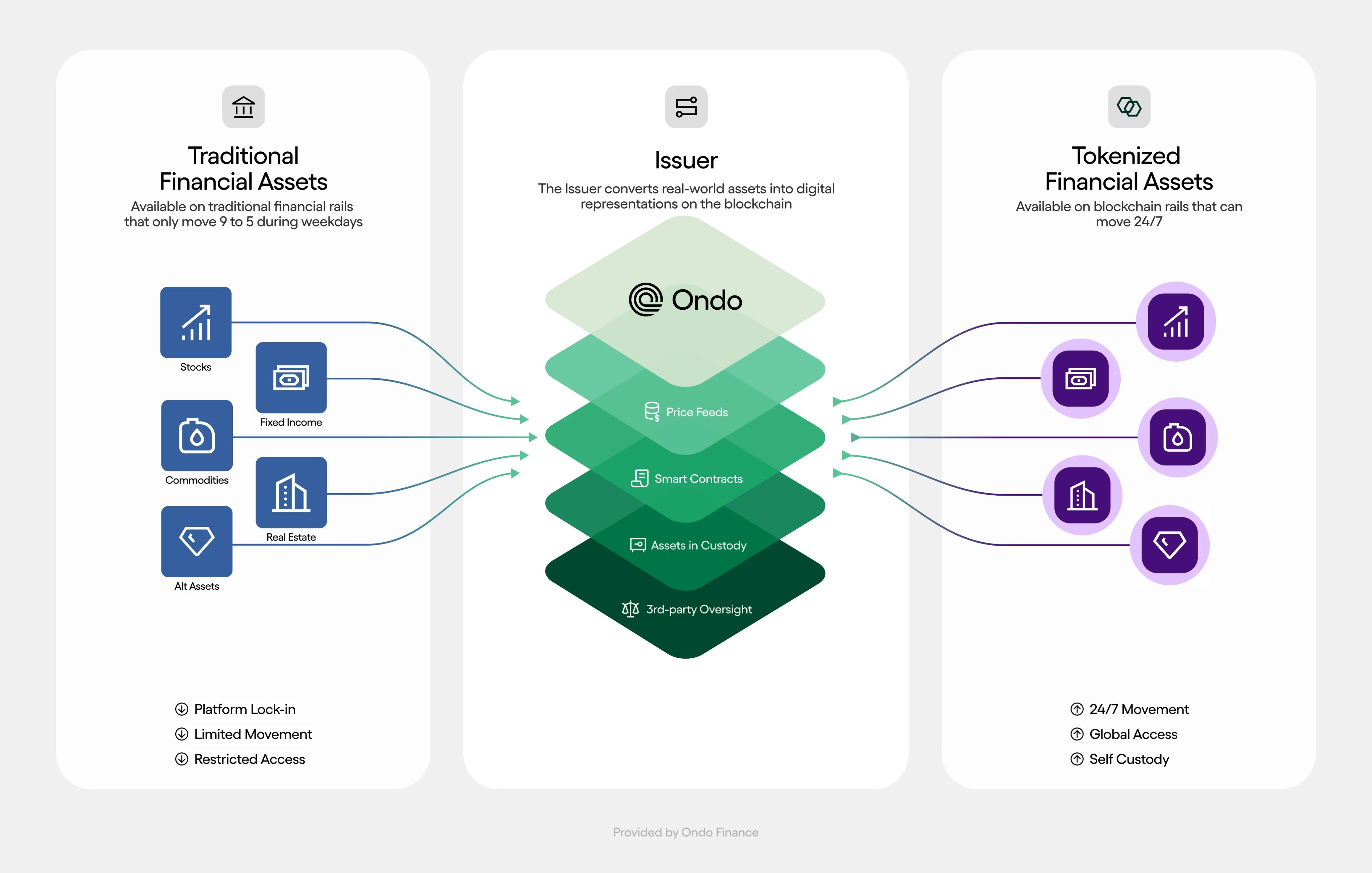
Ondo uses a multi-layered technology stack that combines blockchain infrastructure with traditional financial custody. When you invest in real-world assets through Ondo, your funds purchase actual securities held by regulated custodians, while blockchain tokens represent your ownership. This hybrid approach gives you the security of traditional finance with the efficiency of DeFi.
Technology Behind Ondo
Source: STRENGTHENING AMERICAN LEADERSHIP IN DIGITAL FINANCIAL TECHNOLOGY, Executive Order 14178 of January 23, 2025
Ondo's technology centers on tokenization: the process of representing real assets as blockchain tokens, like creating a digital certificate for a physical asset. In simple terms, the “liquidity conduit” model means Ondo deploys its products where crypto users already are, rather than forcing everyone onto a single proprietary chain.
The technical architecture relies on audited smart contracts that handle token minting (i.e. creation), redemption, and compliance checks. These contracts interact with traditional financial rails through regulated intermediaries, ensuring that every token maintains backing by actual assets held in custody accounts. Given the multilayered on- and off-chain composition of the product as a whole, the architecture required extensive legal and technical coordination to satisfy both blockchain standards and securities regulations.
Smart Contract Architecture
Ondo's smart contracts utilize their innate self-execution properties to enforce compliance rules automatically. When you attempt to purchase OUSG or USDY, the contracts verify your eligibility based on KYC (Know Your Customer) requirements and jurisdiction restrictions before allowing the transaction.
The contracts also manage yield distribution. For OUSG, which generated approximately 3.75% annual yield as of late 2025, smart contracts calculate and distribute earnings based on your token holdings. As mentioned before, the majority of OUSG assets invest in BlackRock's USD Institutional Digital Liquidity Fund (BUIDL), creating an additional trust layer through institutional partnerships.
Integration with Traditional Financial Systems
Ondo's integration approach differs fundamentally from typical DeFi protocols. Rather than trying to replace banks and brokers with a blockchain-native solution, Ondo partners with them. Following the SEC's closure of its investigation in November 2025, Ondo accelerated plans to integrate Oasis Pro Markets, strengthening its connection to regulated financial infrastructure.
The platform maintains custodial relationships with traditional financial institutions that hold the underlying securities. When you buy tokenized treasuries through Ondo, actual T-bills sit in custody accounts managed by regulated entities. Your blockchain token represents a legal claim on those assets, enforced through both smart contract code and traditional securities law.
How Ondo Compares to Traditional Finance
Source: Kaleido
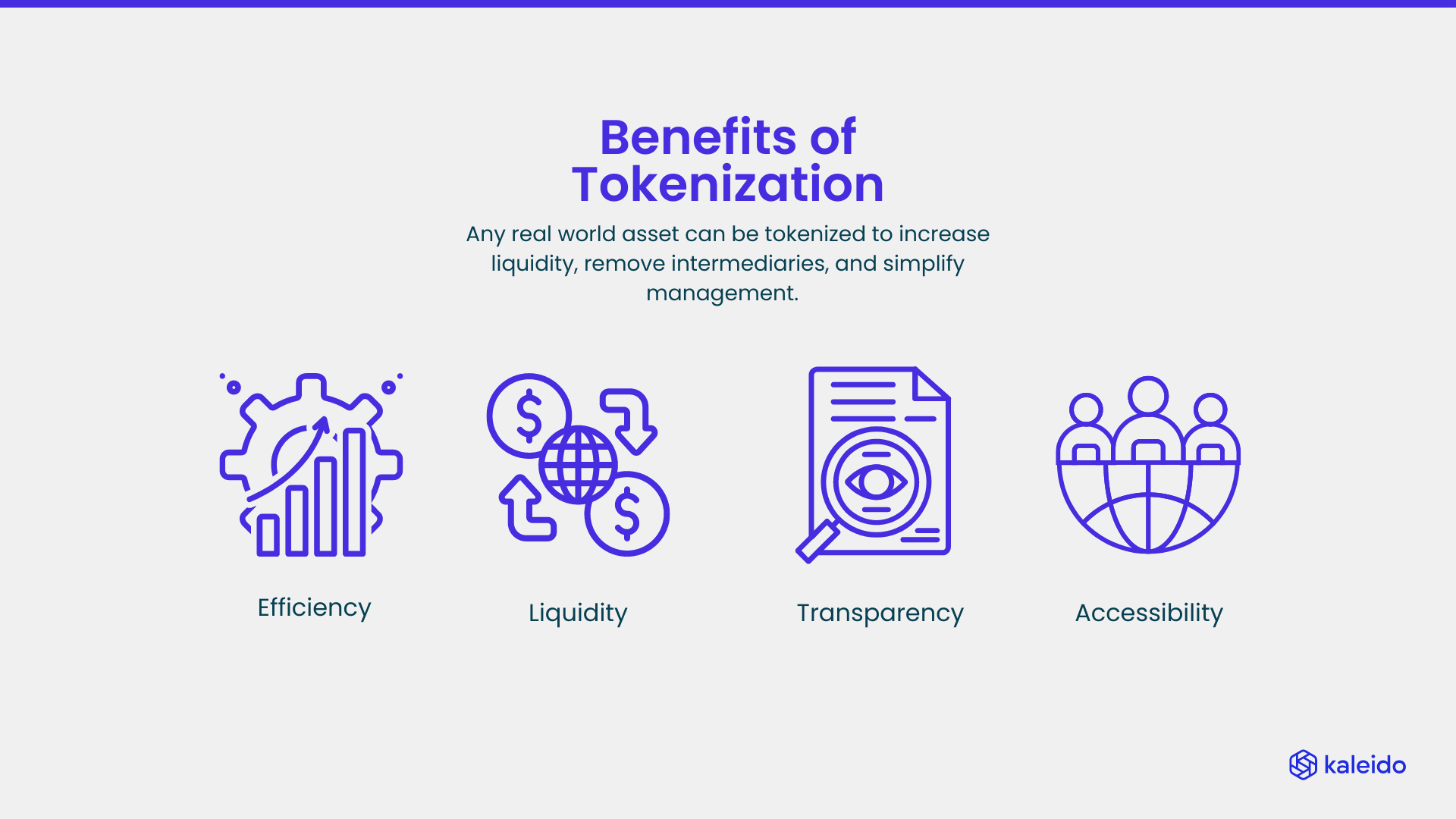
In case you didn’t know, traditional access to institutional-grade Treasury products typically requires minimum investments of $100,000 or more, plus relationships with specialized brokers. It is unsurprising Ondo sought to remove these barriers: its users can invest smaller amounts and access the same underlying securities that large institutions use.
The operational differences matter too. Traditional treasury purchases involve multiple intermediaries, occasional settlement delays, and limited trading hours. As opposed to that, Ondo's tokenized versions trade 24/7 on blockchain networks with near-instant settlement. Plus, you maintain custody through your wallet rather than relying on a brokerage account.
On the other hand, Ondo keeps the traditional finance's regulatory framework. Unlike purely decentralized protocols, Ondo requires KYC verification and restricts access based on jurisdiction. This compliance-first approach sacrifices plenty of blockchain ideals at the cost of legal clarity and institutional trust that purely decentralized alternatives lack. Whether the trader accepts this compromise or not is entirely up to them still.
So, that was a brief 101 on the Ondo Finance platform. With that foundation in place, how does Ondo turn these principles into actual products you can use?
Ondo Ecosystem Overview
Ondo primarily focuses on stable, institutional-grade assets that appeal to risk-conscious investors. These include short-term U.S. Treasury securities, bank deposits, and tokenized securities like equities.
The platform's strategic roadmap includes expanding into more complex structured products over time. For now, current offerings maintain a conservative profile suited for capital preservation and steady yields—exactly what beginners often need when first exploring tokenized assets.
USDY (U.S. Dollar Yield Token)
Firstly, USDY provides non-U.S. investors with access to yield-bearing dollar exposure, currently offering approximately 3.69% annual returns. The token is backed by short-term U.S. Treasuries and bank deposits, combining stability with passive income.
Source: GitHub
USDY operates under Regulation S of the Securities Act of 1933, which restricts its sale to qualified non-U.S. persons only. So, this product appeals to international users seeking dollar-denominated yields without traditional banking infrastructure—a practical solution for accessing U.S. financial instruments from anywhere in the world.
OUSG (Short-term U.S. Treasuries Product)
Secondly, OUSG offers qualified U.S. purchasers liquid exposure to short-term Treasury securities with yields around 3.75% annually. The majority of OUSG's assets are invested in BlackRock's USD Institutional Digital Liquidity Fund (BUIDL), which itself attracted over $500 million shortly after its 2024 launch. The difference is clear, with OUSG targeting U.S. investors.
As of late 2025, OUSG accumulated over $1.1 billion in total value locked. The product provides T-bill exposure without the complexity of traditional Treasury purchasing—no need to navigate government bond platforms or minimum purchase requirements.
Ondo Global Markets
And now for something else, this product launched in September 2025. Ondo Global Markets became the world's largest tokenized securities platform within 48 hours, accumulating $240 million in TVL. By October 2025, the platform maintained leadership with approximately $320 million as the broader tokenized securities market reached nearly $700 million.
Ondo Global Markets enables users to access tokenized versions of traditional securities, including equities, with proper KYC (Know Your Customer) and compliance requirements in place. This means you can invest in tokenized stocks while the platform handles regulatory obligations in the background.
Ondo Chain and The Ondo Bridge
Although we wrote Ondo Finance is multi-chain, it does have a proprietary Layer-1. Ondo developed Ondo Chain specifically for institutional-grade financial markets. The chain features a permissioned validator model to prevent front-running—a critical protection for financial transactions. (Front-running, as a note, is when someone uses advance knowledge of pending transactions to profit at your expense.)
Source: Ondo Blog
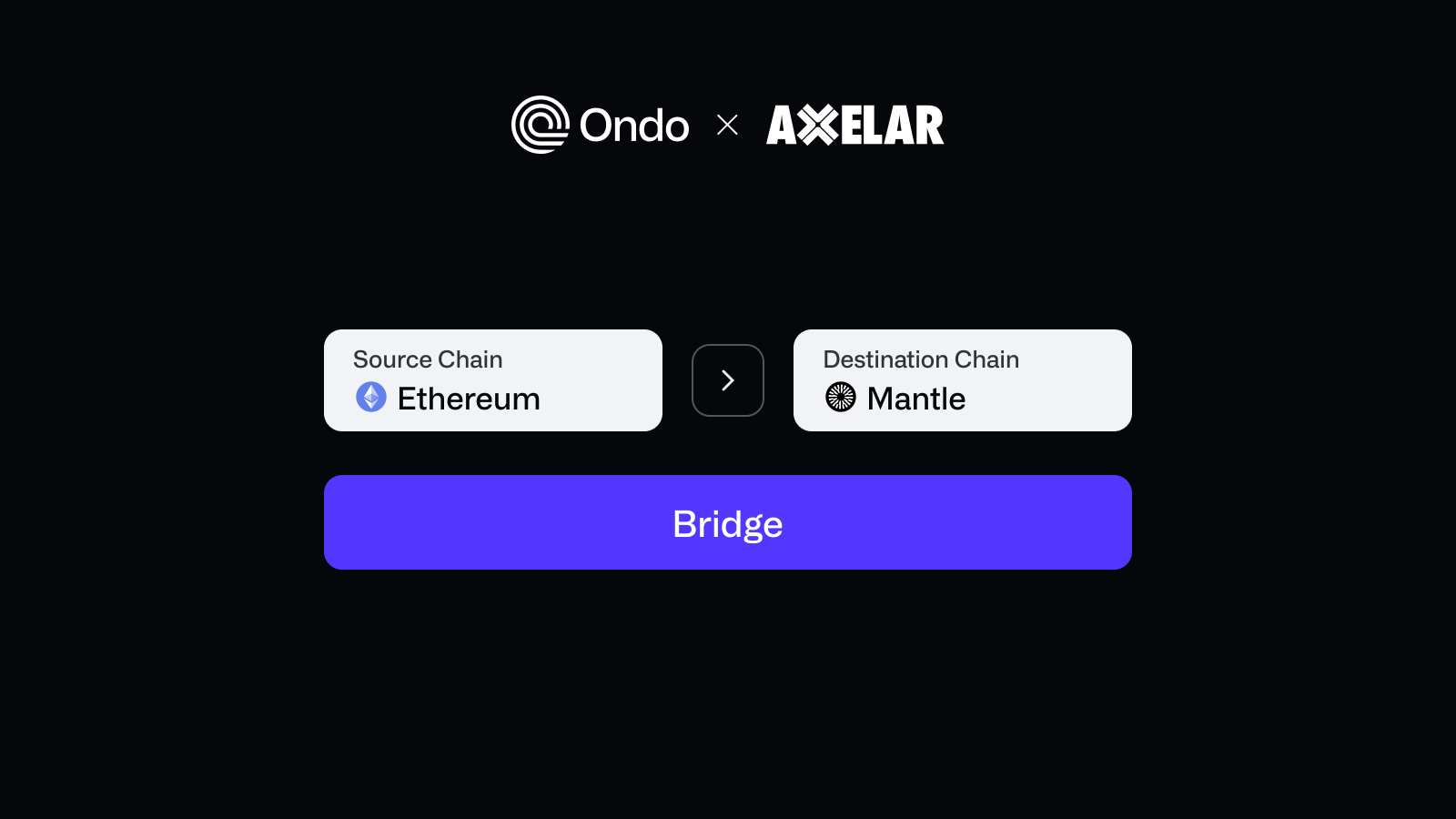
To enable interoperability with this L1, Ondo deployed the Ondo Bridge using LayerZero's protocol. This allows native cross-chain transfers of USDY, OUSG, and other tokens across multiple supported blockchains. The practical benefit? You can move your tokenized assets between ecosystems without complicated wrapping processes or losing token functionality.
Flux Finance
Last but not least, Flux Finance operates as Ondo's lending protocol, allowing users to use tokenized assets as collateral for borrowing. This creates additional utility for OUSG and USDY holders, enabling capital efficiency without liquidating positions.
The protocol integrates directly with Ondo's product suite, providing a complete DeFi experience backed by real-world assets rather than volatile crypto collateral. Instead of worrying about liquidation risks from sudden price crashes, you're collateralizing loans with stable, yield-bearing Treasury products.
The ecosystem overview brings us to the native cryptocurrency of the ecosystem, the ONDO token. The time could not be better to introduce how ONDO is the puzzle piece that ties the whole ecosystem together.
ONDO Tokenomics and Economics
Purpose and Role of the ONDO Token
The core topic of the guide, ONDO token serves as the governance token for the Ondo DAO. In other words, it gives token holders voting power over protocol decisions and future developments. Unlike many DeFi tokens that carry inflationary mechanics, ONDO launched with an initial total supply of 10 billion tokens and no planned inflation: the supply stays fixed, which is supposed to preserve long-term value stability.
It is worth mentioning ONDO doesn't function as a revenue-sharing token or yield-bearing asset. Think of it as owning a say in the company's direction rather than receiving dividends. This design positions ONDO as a decision-making tool rather than a direct income source, which sets it apart from many other crypto governance tokens.
Token Supply and Distribution
Source: tokenomist.ai
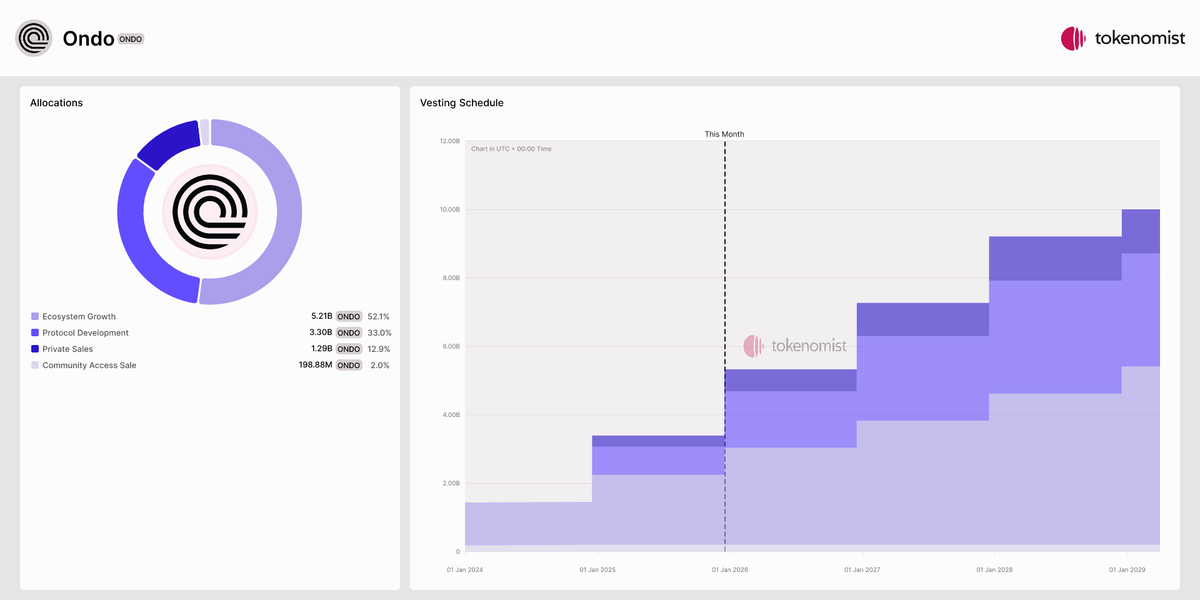
ONDO's 10 billion token supply was distributed across several allocation categories to balance community participation, team incentives, and ecosystem growth. The fixed supply model creates scarcity, which can influence price dynamics as adoption grows.
Fee Structure and Revenue Model
How does Ondo Finance make money? Primarily through management fees on its tokenized products like USDY and OUSG. These fees typically range around 0.15% annually on assets under management, which funds ongoing operations, security audits, and product development. The fee structure mirrors traditional finance models: transparent, predictable, and designed to scale with total value locked (TVL).
As of late 2025, Ondo's $1.8 billion in TVL translates to meaningful revenue streams that support protocol sustainability. The revenue model doesn't directly redistribute earnings to ONDO token holders. Instead, it funds the DAO treasury and operational expenses, reinforcing long-term protocol health rather than short-term payouts.
Governance Token Voting
The Ondo DAO governance covers areas like fee adjustments, new product launches, partnership approvals, and treasury fund allocation. The voting mechanism follows standard DAO practices—one token equals one vote, with proposals requiring minimum quorum thresholds to pass.
This governance model gives the community real influence over Ondo's strategic direction, balancing decentralization with the need for efficient decision-making. For users new to DAO governance, this means your ONDO holdings translate into actual voting power on platform evolution. It's direct participation, not just passive ownership.
Getting Started with Ondo
Getting started with Ondo means choosing between two paths: accessing tokenized real-world assets like USDY and OUSG, or purchasing the ONDO governance token. Each path has different requirements based on where you live and what you're trying to achieve.
Account Setup and KYC Process
If you want Ondo's tokenized products (USDY or OUSG), you'll need to verify your identity with them through Know Your Customer (KYC) and Anti-Money Laundering (AML) procedures. This isn't optional since securities regulations require it.
Source: Ondo Blog
You'll verify your identity by submitting a government-issued ID, proof of address, and sometimes documentation proving your accredited investor or qualified purchaser status. The process typically takes 1–3 business days. Once you're approved, you can access Ondo's platform to mint or redeem tokenized products.
First Investment Walkthrough
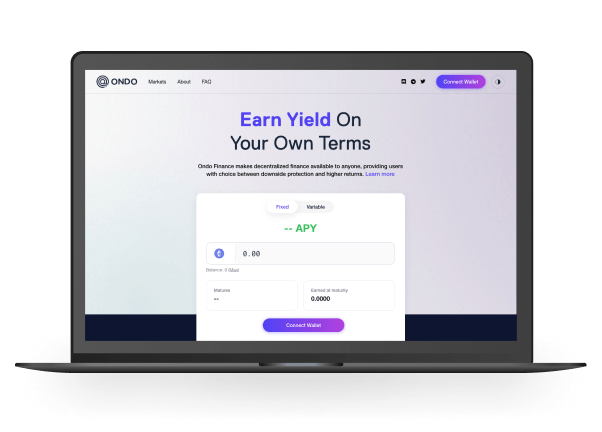
After completing KYC, connect a non-custodial wallet (like MetaMask) to the Ondo Finance platform. You'll need stablecoins (typically USDC) in your wallet to purchase USDY or OUSG tokens.
Here's how the mechanics work: deposit USDC through the platform, which mints the equivalent tokenized asset directly to your wallet address. For USDY, you receive tokens backed by short-term U.S. Treasuries and bank deposits, yielding approximately 3.69% annually. OUSG offers around 3.75% yield through exposure to short-term government securities.
How to Buy ONDO
Buying the ONDO governance token is simpler and doesn't require KYC on the platform. The token trades on centralized exchanges (CEXs) like Coinbase and Binance, plus decentralized exchanges (DEXs) on Ethereum, Solana, and other blockchains where Ondo operates.
Additionally, you can buy ONDO with USD and EUR on ChangeHero with a credit or debit card. Purchases below 700 EUR equivalent (threshold varies by provider) are eligible for the no-KYC fast track processing, making the transaction fast and smooth.
Swap and Stake Ondo
If you need to move ONDO across supported chains, use the Ondo Bridge. This lets you move tokens between Ethereum, Solana or elsewhere—useful if you want to access liquidity pools or DeFi protocols on specific blockchains.
Staking ONDO tokens directly through the platform isn't currently a primary feature. The token's main utility is governance participation. You can provide liquidity on partner platforms or participate in governance votes through the Ondo DAO. Always verify official channels before moving tokens to avoid scams—this can't be emphasized enough in the crypto space.
Source: 4IRE
Is the attention to ONDO warranted? Let’s review its market performance to verify demand and utility of the token and project as a whole.
ONDO Performance Analytics
Ondo Price History and Charts
The ONDO governance token has seen significant growth since its launch, tracking broader institutional interest in real-world asset tokenization. The token's performance has moved in step with Ondo's ecosystem expansion but also the market at large.
Ondo Finance’s TVL is a clear signal of strong market adoption and investor confidence in the platform's institutional-grade approach. This growth reflects more than just market momentum. It demonstrates sustained trust in Ondo's bridging of traditional finance and blockchain technology.
Ecosystem Performance Data
Ondo's product suite delivers measurable performance across its offerings.
OUSG (Ondo Short-Term U.S. Government Treasuries) accumulated over $1.1 billion in TVL as of late 2025. This product offers qualified purchasers liquid exposure to short-term U.S. Treasury securities with yields of approximately 3.75% annually. USDY (U.S. Dollar Yield) provides approximately 3.69% yields to non-U.S. investors, backed by short-term U.S. Treasuries and bank deposits.
The platform's Ondo Global Markets launch in September 2025 marked a watershed moment. It surpassed $240 million in TVL within just 48 hours, establishing it as the world's largest tokenized securities platform. By October 2025, this figure grew to approximately $320 million as the broader tokenized securities market expanded to nearly $700 million total.
Risk-Adjusted Returns Analysis
Ondo's products aim to deliver predictable, institutional-grade returns rather than speculative gains.
OUSG and USDY provide yields comparable to traditional Treasury instruments while maintaining blockchain-based accessibility and liquidity. The majority of OUSG's assets are invested in BlackRock's USD Institutional Digital Liquidity Fund (BUIDL), which attracted over $500 million within months of its 2024 launch. That validates institutional appetite for tokenized financial products.
Source: Ondo Blog
These structured returns differ fundamentally from volatile cryptocurrency speculation. Ondo positions its offerings as stability-focused alternatives within the digital asset space, which is a unique value proposition given the context.
Market Comparison with Other Cryptocurrencies
Unlike speculative cryptocurrencies, Ondo operates in the real-world asset tokenization sector, which reached approximately $33 billion in total value by October 2025. This positions ONDO tokens differently from pure crypto plays.
The platform's institutional backing distinguishes Ondo from typical crypto projects. Partnerships with State Street and Galaxy Asset Management for a $200 million seed capital investment in the SWEEP tokenized fund (launching in 2026) demonstrate serious institutional commitment. Combined with the November 2025 closure of the SEC's two-year investigation without charges, Ondo demonstrates regulatory clarity that few competitors can match.
Performance is only one lens, though. To decide whether Ondo fits your strategy, you also need to weigh its advantages against its risks and competitors.
ONDO Crypto’s Benefits, Risks, and Competition
Key Features and Advantages
Ondo Finance stands out by making institutional-grade financial products accessible on public blockchains. The core benefit is getting exposure to the U.S. Treasuries and other real-world assets without leaving the crypto ecosystem.
The platform's OUSG and USDY products offer yields of approximately 3.75% and 3.69% respectively. These are competitive rates backed by actual U.S. government securities and bank deposits instead of speculative crypto mechanisms. The SEC's decision to close its two-year investigation into Ondo in November 2025 without recommending charges adds meaningful regulatory clarity, which is a major factor for risk-conscious investors.
Ondo’s "liquidity conduit" model means users can access these products wherever liquidity already exists. The Ondo Bridge enables seamless cross-chain transfers, reducing friction for users moving between ecosystems.
Challenges and Potential Risks
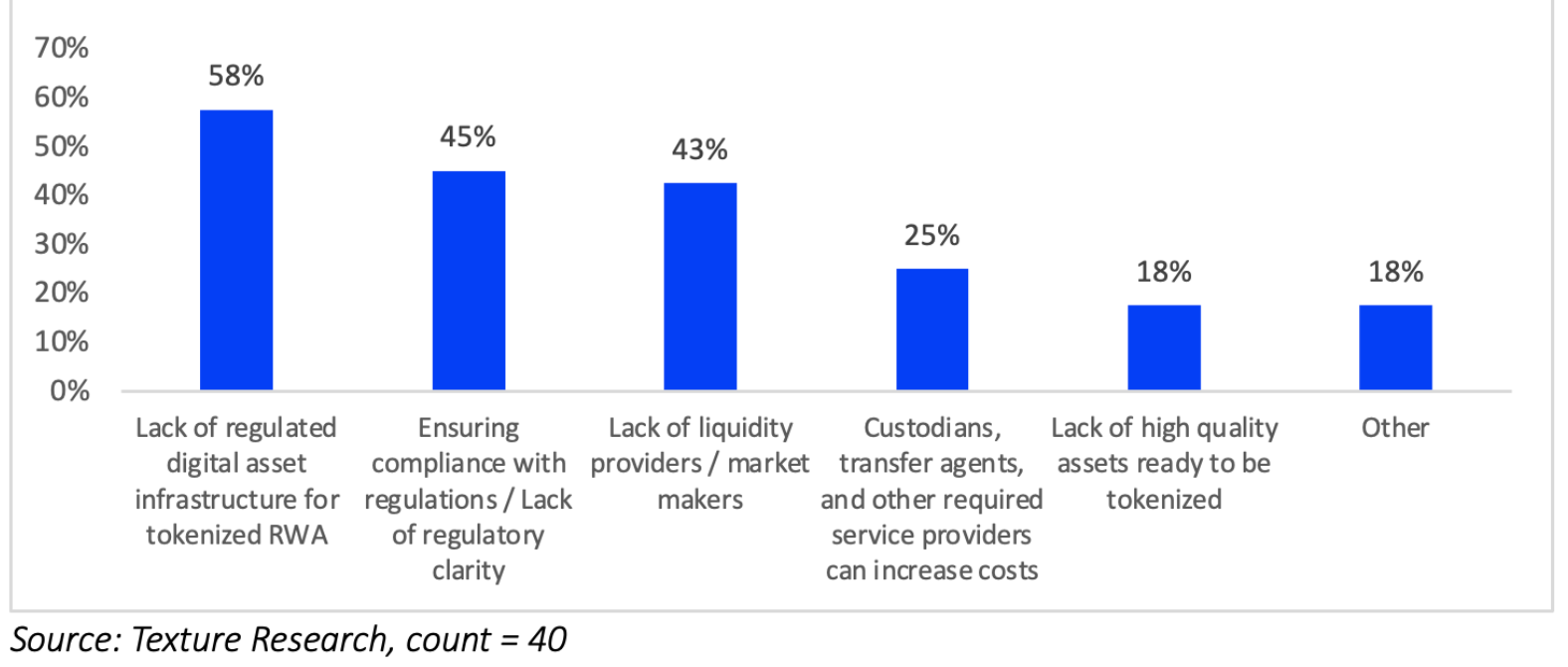
Tokenized real-world assets come with their own set of risks. Security researchers tracked $14.6 million in losses from RWA exploits in the first half of 2025 alone. That's a reminder that smart contract vulnerabilities remain a threat even when underlying assets are stable.
Source: Texture Capital
KYC requirements also limit accessibility. OUSG is only available to qualified purchasers (accredited investors with significant capital), and USDY excludes U.S. persons entirely due to Regulation S restrictions. Whether you're a U.S. retail investor or not, your options are limited.
Furthermore, regulatory uncertainty persists despite the SEC investigation closure. Rules around tokenized securities are still evolving, and future regulatory changes could impact how Ondo operates or which investors can access its products.
Ondo Competitors and Alternatives
Ondo isn't alone in the RWA space: its competitors include crypto-natives and institutions delving into the space. The broader tokenized asset market reached approximately $33 billion by October 2025, with platforms like Ondo Global Markets leading the tokenized securities category at $320 million TVL.
The competitive landscape includes various platforms offering tokenized versions of traditional assets, from real estate to commodities: Securitize, Paxos and Tether with their gold stablecoins, and many others. What sets players apart comes down to regulatory compliance, institutional partnerships, and user accessibility.
Comparative Analysis with Other RWA Platforms
Ondo's main competitive advantage lies in its institutional partnerships and its multi-chain strategy. While other platforms may offer tokenized assets, Ondo's Goldman Sachs pedigree and regulatory-first approach position it as a safer institutional option.
The upcoming SWEEP fund, backed by $200 million from State Street and Galaxy Asset Management, signals continued confidence from traditional finance players. This kind of institutional backing suggests major financial institutions see Ondo as a credible bridge between TradFi and DeFi, not just another crypto experiment.
What is Ondo Used For?
Real-World Applications of Ondo
Ondo Finance addresses practical needs for several different user types by bringing traditional finance yields directly onto public blockchains.
Source:Chainlink Blog
Non-U.S. investors use USDY tokens to earn approximately 3.69% annual yield backed by U.S. Treasury bills and bank demand deposits. This offers a stable alternative to volatile crypto holdings while maintaining on-chain liquidity (meaning you can move or trade your tokens whenever you need to). Qualified institutional purchasers access OUSG tokens, which provide exposure to short-term U.S. government securities yielding around 3.75% annually.
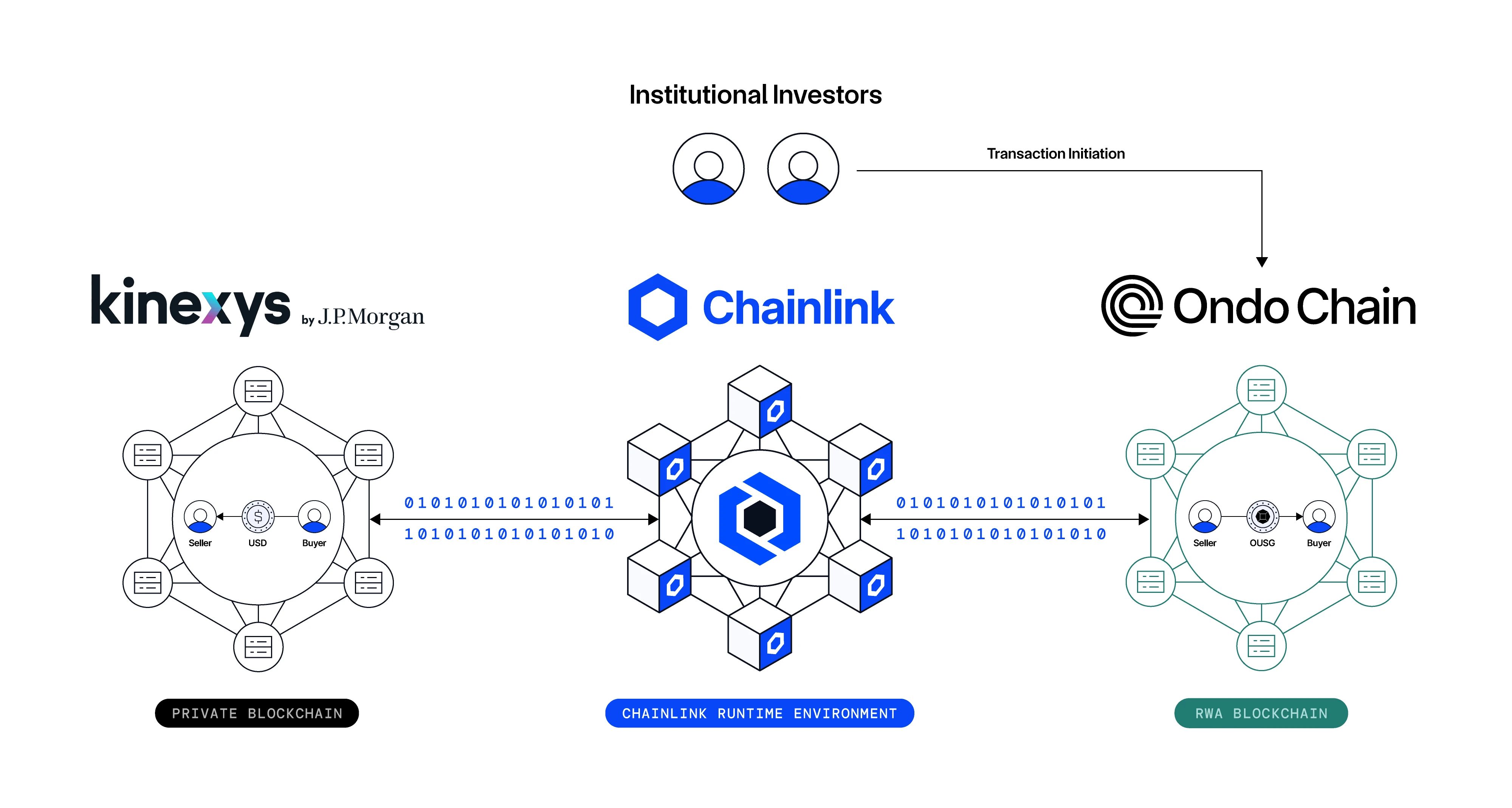
DeFi protocols integrate Ondo's tokenized products as collateral within lending markets. Flux Finance, Ondo's lending protocol, allows users to borrow against tokenized real-world assets. This creates capital efficiency that traditional finance rarely permits with government securities—you can earn yield on Treasuries while simultaneously using them as collateral for other investments.
Industry Adoption
The numbers show strong market validation. Ondo Global Markets reached approximately $320 million in TVL by October 2025, establishing itself as the world's largest tokenized securities platform. Within 48 hours of its September 2025 launch, the platform surpassed $240 million in TVL, demonstrating immediate market demand for on-chain access to traditional securities.
The broader real-world asset tokenization market reached approximately $33 billion in total value by October 2025, with Ondo Finance contributing over $1.8 billion across its products. OUSG alone accumulated over $1.1 billion in TVL by late 2025.
Major financial institutions validated the tokenized asset model through concrete partnerships. Ondo partnered with State Street and Galaxy Asset Management to invest $200 million in seed capital for a new tokenized fund called SWEEP, set to launch in 2026. Following the SEC's formal closure of its investigation in November 2025 without recommending charges, Ondo accelerated its U.S. operations and integration of Oasis Pro Markets, an SEC-registered broker-dealer. That regulatory clarity removed a major uncertainty for institutional participants.
Community Participation
Source: tally.xyz
The Ondo Bridge, built using LayerZero's cross-chain protocol, enables native transfers of USDY and OUSG tokens between Ethereum, Solana, Injective and others. This expands accessibility for diverse crypto communities—if you prefer Solana's speed or Ethereum's liquidity, you can use Ondo products on either.
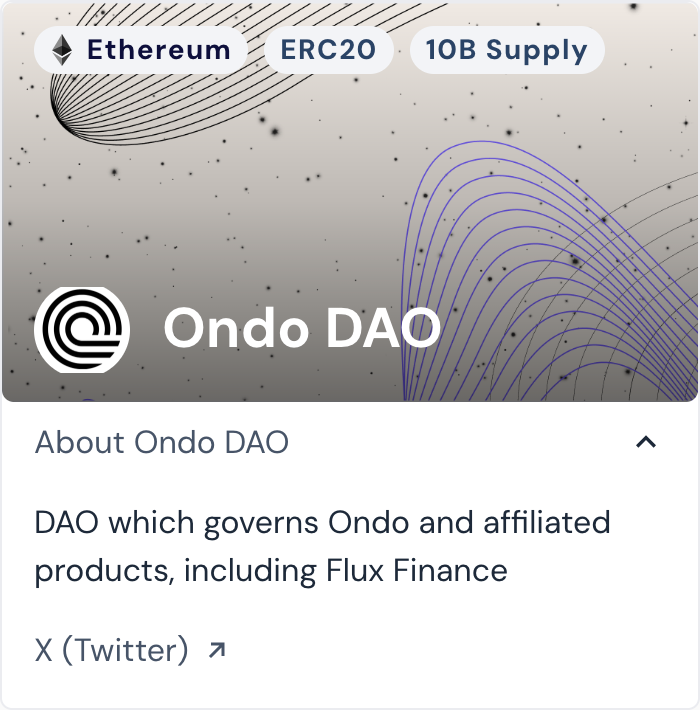
The ONDO governance token gives the community a voice in how the protocol evolves, from which assets to tokenize next to how fees are structured. Most importantly, it gives the holders a voice in the future of the protocol.
Future Outlook for Ondo
Why Ondo is Gaining Traction
Ondo Finance is gaining momentum because it solves a real problem: giving everyday crypto users access to institutional-grade financial products that were previously out of reach.
Traditional finance has long offered stable yields through U.S. Treasuries and similar assets, but accessing them required a sizeable minimum threshold of investments, complex brokerage accounts, and lengthy settlement times. Ondo brings these products on-chain, making them accessible with a few clicks.
The platform's success stems from its focus on real-world assets (RWAs)—assets backed by tangible securities rather than speculative tokens. When the broader RWA tokenization market reached approximately $33 billion by October 2025, Ondo positioned itself as a key infrastructure player in this growing sector.
Recent Developments and Upcoming Features
Previously mentioned, in September 2025, the platform launched Ondo Global Markets. By October, it maintained leadership with approximately $320 million in TVL as the broader tokenized securities market doubled to nearly $700 million.
Looking ahead to 2026, Ondo and its partners have to deliver on the tokenized fund called SWEEP. This collaboration signals institutional confidence and positions Ondo to expand its product offerings beyond short-term Treasuries into more diverse asset classes.
The strategic roadmap includes expanding tokenized cash equivalents, scaling tokenized securities, and eventually developing complex structured products. This phased approach prioritizes building trust and liquidity before adding complexity—a sensible move in a space where users need to feel secure before experimenting with new products.
Source: Ondo Blog
Market Predictions for 2026
Given Ondo's strong foundation and recent regulatory wins, market observers expect renewed growth throughout 2026, within the space that the market would allow. The platform benefits from tailwinds in both crypto adoption and institutional interest in blockchain-based financial products. As traditional finance giants like BlackRock validate the tokenization model, platforms like Ondo stand to capture increasing market share.
At the same time, the RWA space is no longer burgeoning and remains competitive, and security concerns persist. Researchers tracked $14.6 million in losses from RWA exploits in the first half of 2025, highlighting that technical and operational risks still exist. Ondo's focus on compliance, third-party audits, and transparent asset backing positions it well, but users should remain vigilant about platform security as the ecosystem matures.
In simple terms: Ondo is positioned for growth, but like any evolving technology, it carries risks. The key difference is Ondo's emphasis on regulatory compliance and institutional partnerships, which puts it ahead of many competitors when it comes to building long-term trust.
Frequently Asked Questions
What is Ondo and How Does It Work?
Ondo Finance is a real-world asset (RWA) tokenization platform that brings institutional-grade financial products like U.S. Treasury securities onto public blockchains. In simple terms, Ondo converts traditional financial assets into blockchain tokens that anyone (meeting eligibility requirements) can buy, trade, or hold in a digital wallet.
Ondo purchases real-world assets such as short-term U.S. Treasuries or bank deposits and represents them as tokens on-chain. These tokens—like OUSG and USDY—give holders exposure to the underlying asset's yield without needing a traditional brokerage account.
Smart contracts manage the technical side, while regulated custodians hold the actual assets off-chain. The result: you get the security and returns of traditional finance with the speed and accessibility of blockchain.
What is the Purpose of the Ondo Token?
The ONDO token serves as the governance token for the Ondo DAO (decentralized autonomous organization). With an initial total supply of 10 billion tokens and no planned inflation, ONDO gives holders voting rights on key protocol decisions—such as product launches, fee structures, and ecosystem partnerships.
Think of it as your stake in shaping the platform's future. The more ONDO you hold, the more influence you have over how the protocol evolves.
This governance model helps ensure the community has a direct voice in strategic choices, balancing institutional expertise with decentralized oversight.
What are the Benefits of Using Ondo?
Ondo offers several practical advantages.
First, accessibility—you can invest in tokenized U.S. Treasuries with lower minimums than traditional institutional products. Second, liquidity—blockchain-based tokens trade 24/7, unlike traditional securities limited to market hours. Third, transparency—all holdings and transactions are visible on-chain, reducing information asymmetry.
On top of that, products like OUSG provide yields around 3.75% annually, backed by investments in funds like BlackRock's BUIDL. USDY offers approximately 3.69% to non-U.S. investors. As of late 2025, Ondo's tokenized assets surpassed $1.8 billion in total value locked, demonstrating real institutional adoption.
Is Ondo Available on Multiple Blockchains?
Yes. Ondo operates across multiple blockchain networks, including Ethereum, Solana, Injective, and others.
The platform uses a "liquidity conduit" model—deploying products where existing blockchain activity and liquidity are strongest. To enable seamless asset movement, Ondo deployed the Ondo Bridge, which uses LayerZero's protocol for native cross-chain transfers of tokens like USDY.
This multi-chain approach maximizes reach while keeping user experience simple.
How Do I Start Investing in Ondo?
Getting started natively requires completing a KYC (know-your-customer) process to verify your identity and eligibility—particularly important since products like OUSG are restricted to qualified purchasers, while USDY is only available to non-U.S. persons under Regulation S.
Once verified, you connect a compatible wallet, purchase the relevant token (OUSG or USDY) through supported exchanges or Ondo's platform, and hold it to earn yield.
Remember: regulatory requirements vary by jurisdiction, so understanding compliance is essential before investing.


