
What is XRP? Beginner’s Guide to Ripple and XRP Ledger


Key Takeaways
- 🔘 XRP is a decentralized digital asset native to the XRP Ledger, designed specifically for payments and value transfer—not general-purpose smart contracts. The XRPL settles transactions in 3–5 seconds at a fraction of a cent per transaction fee, using a consensus mechanism that requires no energy-intensive mining.
- 🔘 Ripple the company builds on the XRP Ledger, but XRP operates independently—Ripple does not control the ledger or mint new supply. Financial institutions use RippleNet and XRP's liquidity pools to move money across borders without pre-funding correspondent accounts.
- 🔘 The U.S. Securities and Exchange Commission's ongoing regulatory scrutiny creates uncertainty around XRP's classification, custody options, and availability depending on jurisdiction.
← click!T · egg 2 of 6
Informational disclaimer:
This article is intended for educational purposes only and does not constitute financial, legal, or investment advice. Regulatory treatment of XRP and related assets varies by jurisdiction and is subject to change. Before taking any action based on information in this article, readers are strongly encouraged to verify the current legal status of XRP in their region and consult qualified professional advisors where appropriate.
XRP is a digital asset primarily used in payment and settlement contexts, designed to move value across borders quickly and at low cost. It runs on the XRP Ledger (XRPL), an open-source, decentralized network that operates independently of any single company. If you came to this guide asking what XRP is with a practical goal in mind — investing, sending money, or evaluating payment rails — you will keep running into the same three questions: how XRPL works, when XRP is actually needed, and what risks (especially legal and custody) can change the equation.
XRP Ledger Basics

XRP Ledger (XRPL) is an open, decentralized ledger that records and transfers XRP and other issued assets (tokens) across a global network of validators without relying on a central authority. Built by Ripple and released as open-source software, XRPL combines a permissionless architecture with a novel consensus model, delivering settlement speeds and cost structures that differ fundamentally from proof-of-work blockchains.
The easiest way to think about XRPL is as the “rail,” while XRP is the native asset that moves on that rail.
Network Architecture
XRPL operates as a distributed network of nodes, each maintaining a full copy of the ledger's history. A validator is a node that actively participates in the consensus process: it proposes and votes on which transactions should be included in the next ledger version. A full node, by contrast, tracks and relays the ledger's state but does not vote on transaction ordering. Because the codebase is open-source and permissionless, anyone can run either type of infrastructure; there are no staking minimums, token deposits, or gatekeepers controlling who joins.
A ledger version is a snapshot of the entire XRPL state at a given point — account balances, open offers, trust lines, and settings — sealed once validators reach agreement and closed permanently. The lifecycle of a transaction follows a clear path: a client submits it to any connected node, the node broadcasts it to peers, validators exchange and compare proposed transaction sets, and once consensus is reached, a new ledger version closes and becomes the permanent record. Under ideal conditions, XRPL has an often-cited capacity of up to approximately 1,500 transactions per second, though actual real throughput depends on network usage, conditions, and validator performance.
Consensus Mechanism
XRPL uses the XRPL Consensus Protocol, also known as the Ripple Protocol Consensus Algorithm (RPCA). Rather than competing to solve a cryptographic puzzle, validators in the network communicate directly, exchanging proposed transaction sets and iteratively converging toward agreement. The key trust structure here is the Unique Node List (UNL) — a list of validators that a given participant trusts to be honest. Each node operator selects or adopts a UNL; validators not on your UNL can still participate in the network but do not influence your node's view of consensus. Agreement is reached when a supermajority, typically 80% of UNL validators, approve the same transaction set.
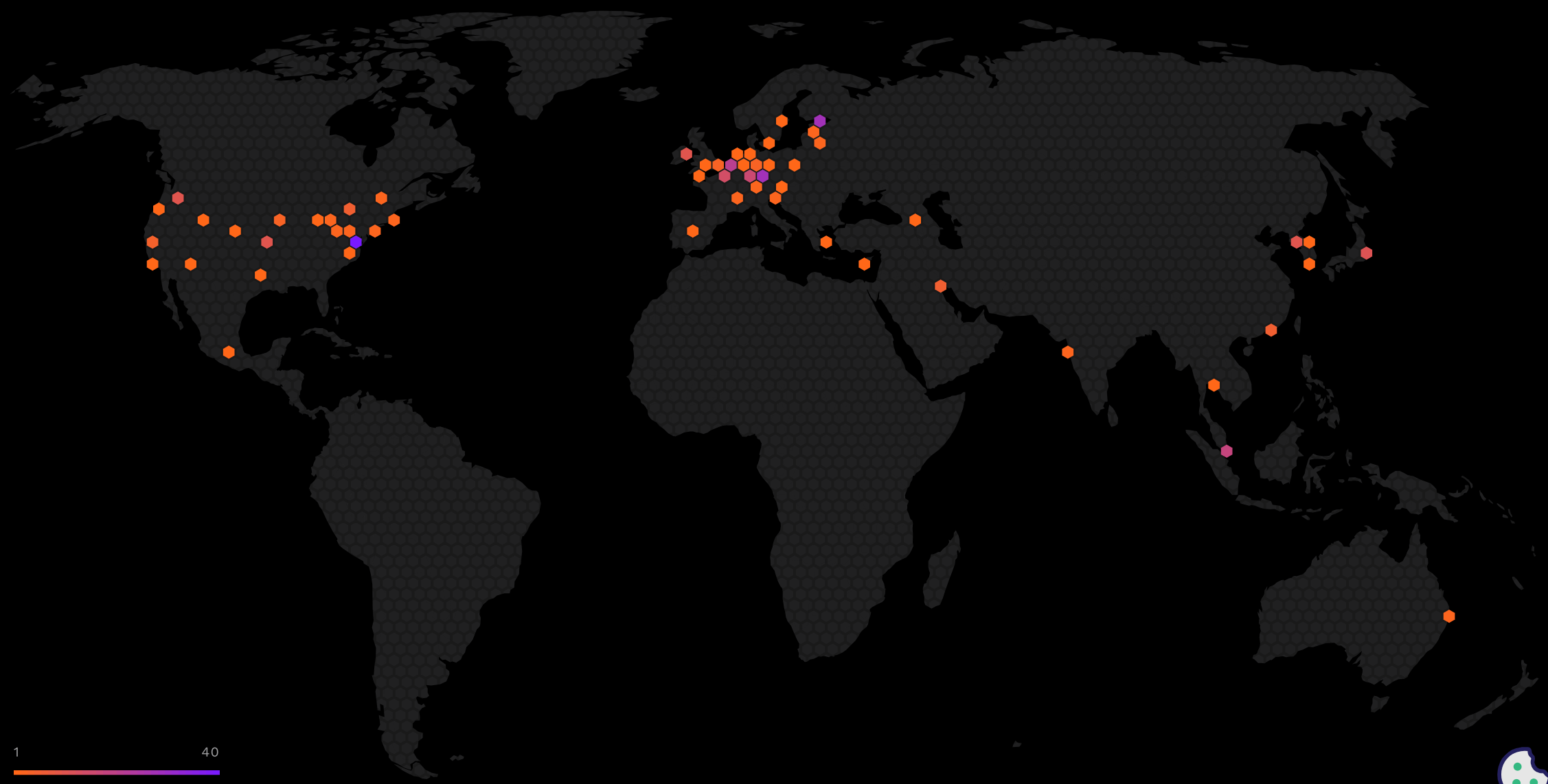
The XRPL network has no single controlling entity; any operator can run a validator, and many independent organizations already do. Where practical centralization can arise is in the validator list curation: if most participants default to a UNL recommended by a single organization, the effective decision-making circle narrows. This is a known governance consideration, not a protocol flaw, and the community actively works to broaden UNL diversity.
Transaction Finality
On XRPL, finality means a transaction is irreversible once it is included in a validated ledger version. There is no probabilistic finality here — no waiting for additional blocks to "bury" a transaction and reduce reversal risk, as you would on proof-of-work networks. Once a ledger closes with your transaction inside it, the outcome is permanent.
From a user's perspective, the confirmation experience is fast. XRPL transactions settle in approximately 3–5 seconds, covering the full cycle from submission to validated ledger close. Most applications and exchanges treat a single validated ledger close as sufficient confirmation, given the protocol's design. One ledger close is generally accepted as final in common practice.
That being said, finality can be delayed in specific edge cases. If validators experience connectivity issues or the network temporarily disagrees on a proposed transaction set, the ledger close is postponed rather than an incorrect result is forced. During these events, transactions typically remain in a pending state and are resubmitted in the next consensus round — the network prioritizes correctness over speed when conflict arises.
Transaction Fees
Every XRPL transaction requires a small fee, and its primary purpose is anti-spam and congestion control rather than compensating any miner or validator. The fee unit is the drop — one drop equals 0.000001 XRP (one millionth of one XRP). A standard transaction costs a minimum of 10 drops, or 0.00001 XRP. For example, at an XRP price of $2.00, that amounts to roughly $0.00002 per transaction.

Fees are not fixed permanently. Under high network load, the minimum required fee scales upward automatically, discouraging spam while allowing legitimate transactions to compete for inclusion. When network activity is normal, fees return to the baseline. Crucially, the fee is burned and removed from circulation. This means no party profits from transaction volume at the protocol level, and the total XRP supply decreases, even if marginally, with each transaction.
Energy Use
XRPL's low energy footprint follows directly from its architecture: there is no proof-of-work mining, so no computational hash competition exists. Validators do not race to solve puzzles; they exchange and compare messages. The energy inputs that remain are server operation and network bandwidth — the same overhead any internet-connected infrastructure requires.
Ripple and XRP
Second, if not first, thing to sort out when discussing XRP, is its other, misplaced, label Ripple. Short version: Ripple Labs Inc. is a private software company, RippleNet is its commercial payments network, XRP is an independent digital asset, and the XRP Ledger is an open-source protocol that no single company owns or controls. If you remember only one thing from this section, make it this: using Ripple’s products does not always mean using XRP, and XRPL is not “Ripple’s blockchain” in the ownership sense.
Ripple Labs
Ripple Labs Inc. builds and sells payments software and network services designed for financial institutions. That is the core business: enterprise-grade tools that help banks and payment providers move money across borders faster and at lower cost. What Ripple Labs does not inherently own or operate is the XRP Ledger itself — XRPL is an open-source protocol maintained by a global community of developers, validators, and node operators, not a proprietary Ripple asset.
Co-founders Chris Larsen and Jed McCaleb were instrumental in establishing both the company and the early architecture of the ledger, alongside early XRPL architects David Schwartz and Arthur Britto, but the protocol was designed from the outset to function independently of any corporate parent. Treating Ripple Labs as synonymous with XRP or XRPL misrepresents how the ecosystem is actually structured.
RippleNet
RippleNet is a network and software stack used by financial institutions to process cross-border transactions — and it is where Ripple Labs earns its commercial traction.
RippleNet ≠ XRP. A bank can connect to RippleNet and use Ripple's messaging and settlement tools without ever holding or touching XRP. For example, a financial institution could use RippleNet's payment messaging layer to coordinate a cross-border transfer while settling in fiat through pre-funded nostro accounts — no XRP required. XRP becomes relevant only when a specific product path, like On-Demand Liquidity (ODL), is chosen to provide real-time liquidity without pre-funded accounts.
How XRP Actually Ties Into This

XRP functions as a utility asset and optional liquidity tool within Ripple's ecosystem — not as something Ripple owns or issues in an ongoing controlled sense. In the On-Demand Liquidity model, XRP acts as a bridge asset: a payment provider sells one fiat currency for XRP, transmits that XRP across the ledger in seconds, and the recipient converts it to the destination currency, completing the settlement without locking capital in pre-funded accounts.
This is what makes XRP genuinely useful for cross-border transaction liquidity. Equally important: XRP trades on exchanges globally and is used in applications entirely outside Ripple's product suite, from DeFi protocols to peer-to-peer transfers.
Relationship to XRP Ledger
The XRP Ledger is a decentralized, open-source blockchain that operates independently of Ripple Labs and would continue to function even if Ripple Labs ceased to exist tomorrow. Consensus on XRPL is maintained by a distributed network of validators and nodes run by independent parties around the world — no single validator or company holds veto power over the network.
In practice, Ripple Labs does engage with the XRPL ecosystem in meaningful ways: contributing to developer tooling, running infrastructure, participating in the broader community, and funding ecosystem grants. But contributing to a network is categorically different from controlling it. Ripple's relationship to XRPL is better understood as that of an active participant and stakeholder, not an operator or owner.
Real-World Uses of XRP & XRPL in Finance
Not every RippleNet payment uses XRP, and that’s exactly why the “who uses what” question matters when you evaluate real-world utility.
Cross-Border Payments
Cross-border payments represent the most operationally visible application of XRPL and RippleNet in global banking integration. To understand why, it helps to map a typical corridor transfer step by step:
- The originating institution initiates a payment instruction — for example, a U.S. payment provider sends a USD-denominated transfer to a recipient in Mexico.
- FX conversion (Step 1): USD is converted to XRP at a partnered exchange or market maker on the source side. This is where fiat currency exchange pricing and spread are locked.
- Settlement on XRPL: XRP moves across the ledger. The XRP Ledger achieves finality in 3–5 seconds, which is what "near-instant settlement" refers to — ledger-level confirmation, not necessarily the moment the beneficiary sees funds credited in their local account.
- FX conversion (Step 2): XRP is converted to MXN by a market maker or local exchange on the destination side.
- The receiving institution credits the beneficiary's account in local fiat. This final crediting step depends on the local on/off-ramp's cut-off times and settlement windows.
- Reconciliation and confirmation are exchanged between parties.
When this model helps most: Thin liquidity corridors where correspondent banking chains are long and slow benefit significantly. Off-hours settlement is another advantage, since XRPL operates continuously without banking-hours constraints. It also reduces intermediary chain complexity by replacing multi-hop correspondent relationships with a single bridge asset path.

Traditional SWIFT-based transfers separate messaging from settlement. SWIFT sends the payment instruction; actual funds move through correspondent banking networks, a process that typically takes 1–5 business days and involves fees that can range from $15 to $50 or more per cross-border transaction depending on corridor and institution (source). XRPL-based settlement, by contrast, is atomic — the asset moves and settles on ledger in a single operation, without a separate messaging layer waiting on correspondent chains.
Liquidity Management
Liquidity management is where XRP's role as a bridge asset becomes most mechanically specific — and where you can clearly see why ODL-style flows are so often discussed.
In an ODL arrangement, an institution does not need to pre-fund a destination account in local currency. Instead, it sources liquidity just-in-time using XRP as an intermediate asset. When a payment is needed, the institution (or its liquidity provider) buys XRP on the source side, transmits it across XRPL, and immediately sells it into the destination currency on arrival. The liquidity is sourced in the moment the payment is executed, rather than drawn from a standing balance held in a foreign account.
The practical implication is that capital that would otherwise sit idle in a pre-funded nostro account can instead remain working in the institution's core treasury operations — deployed until the moment a specific cross-border transaction requires it.
Institutions can participate in RippleNet-style payment coordination without holding or touching XRP at all. RippleNet provides messaging, tracking, and settlement coordination infrastructure that some institutions use purely for operational efficiency — faster confirmation, end-to-end payment visibility, reduced exceptions — without routing value through a crypto bridge asset. This distinction prevents conflating "using Ripple's network" with "using XRP."
XRP Supply and Tokenomics
A crucial point for evaluating any cryptocurrency is its tokenomics, which covers supply dynamics, distribution, and more. XRP's tokenomics operate on a fixed-supply model: all 100 billion XRP were created at the genesis of the XRP Ledger, no mining or block rewards exist to introduce new coins, and the total supply decreases marginally over time because transaction fees are permanently destroyed rather than recycled.
Token Issuance
When people use the term "pre-mined" to describe XRP, what they really mean is "created at inception," which is a fundamentally different model from proof-of-work cryptocurrencies where miners continuously generate new supply as a reward for validating blocks.
Nothing in the XRPL protocol can mint new XRP after that genesis event. This is worth holding onto clearly: when escrowed XRP is released on a schedule, it does not create new coins but simply makes previously locked supply available on the market. The total pool does not grow; only its accessibility changes. There is a mechanism that does the opposite, though: network fees permanently reduce supply — a small amount of XRP destroyed with every operation on the ledger, making the digital asset ever so slightly deflationary over time.
Total Supply and Distribution

XRP has a hard cap of 100 billion tokens. Circulating supply — the portion actively available on exchanges and in wallets — is considerably lower and at the time of writing is 61.4B (61.4%) according to CoinMarketCap. The gap exists because a large share remains time-locked in escrow, some sits in inactive accounts, and a portion has effectively been removed from circulation through lost private keys.
Transaction fee burning means the total supply decreases incrementally with every operation. On a single-transaction timescale, the impact is negligible; on a multi-decade horizon, cumulative burns could meaningfully reduce total supply — a deflationary pressure worth tracking, even if it moves slowly.
XRP's distribution history is well-documented: Ripple, as the issuing entity, retained a substantial allocation at launch and has been the primary distributor of XRP into the market over time. What matters for evaluating XRP today is not the historical narrative but the present-day implications — concentration of holdings, release schedules, and potential market impact.
For XRP specifically, time-locked escrow was introduced to provide market participants with greater visibility into how much supply could enter circulation over a given period.
In 2017, Ripple placed 55 billion XRP into a series of escrow accounts on the XRP Ledger — a significant structural decision designed to cap the amount that could be released into circulation at any one time. The conceptual mechanism works like this: a set amount unlocks monthly; any portion of that monthly unlock that is not used or sold can be placed back into new escrow contracts at the back of the queue, extending the release timeline rather than dumping unused supply onto the market.
XRP vs Other Cryptocurrencies
XRP sits in a crowded field, but not every cryptocurrency is built for the same job. If you are comparing assets for real-world settlement, you want to look past price charts and focus on finality, fee behavior, validation design, and what the network is actually optimized to do.
Bitcoin
Bitcoin and XRP share the "cryptocurrency" label, but they were engineered for fundamentally different purposes.
| Attribute | XRP and XRP Ledger | Bitcoin |
|---|---|---|
| Primary design goal | Cross-border payments and liquidity bridging | Store of value / censorship-resistant peer-to-peer currency |
| Transaction validation | Federated consensus protocol (no mining; validators reach agreement) | Proof-of-Work mining; nodes compete to add blocks |
| Settlement / finality | ~3–5 seconds to finality on the open-source XRPL | Typically 10–60 minutes for practical finality (6 confirmations) |
| Fees / cost variability | Fractions of a cent per transaction; low variance | Variable; can spike sharply during network congestion |
| Energy profile | Minimal; consensus protocol requires no computational race | High energy consumption tied to mining hardware globally |
| Supply issuance model | Pre-created fixed supply of 100 billion XRP; no mining rewards | New BTC minted as block rewards; capped at 21 million over time |
| Cross-border payment fit | Core use case; designed to bridge currencies and provide liquidity | Indirect; primarily a settlement asset, not a real-time rails solution |
For context, traditional cross-border wires via SWIFT can take 3–5 days and carry fees of $15–$30 per transfer — a benchmark that illustrates why XRPL's settlement speed and cost profile represent a structural shift for international payments.
Stellar

Stellar is the most relevant peer comparison for XRP precisely because of shared lineage — Stellar's protocol grew out of early Ripple work — and a closely overlapping payments focus. Both networks target cross-border transactions, at least, originally, which makes the differences between them more instructive than the surface-level similarities.
| Attribute | XRP (XRP Ledger / Ripple) | Stellar (XLM) |
|---|---|---|
| Target users | Banks, financial institutions, market makers seeking institutional settlement rails | Fintech developers, NGOs, remittance apps, and consumer-facing payment services |
| Network participation model | Validator and node model on the open-source XRPL; Ripple runs key validators but the network is permissionless | Federated Byzantine Agreement; open validator participation with a similar consensus approach |
| Asset issuance / tokenization | Possible but secondary; focus is on XRP as a liquidity bridge asset | Asset issuance is a first-class feature; Stellar is frequently used for tokenized fiat and issued assets |
| Typical integration pattern | Bank-to-bank corridors, On-Demand Liquidity (ODL) via Ripple, treasury and FX operations | Remittance apps, mobile wallets, micro-payment platforms, anchor-issued stablecoins |
| Cross-border settlement workflow | XRP acts as a bridge currency between fiat pairs, with settlement finalized on the XRPL | Anchors issue tokens representing fiat; Stellar path payments convert across issued assets |
XRP in a Nutshell: Pros, Cons, Things to Know
XRP looks very different depending on how you approach it: as payment infrastructure, or as a speculative investment. Depending on that, the risk profiles and usage vary considerably.
Advantages
- Settlement speed reduces exposure windows. XRP transactions settle on the XRP Ledger in 3–5 seconds on average, which directly compresses the window during which price risk accumulates between initiation and confirmation — a material concern for treasury teams and payment processors handling high-volume flows.
- Fee predictability vs. fee volatility. Transaction fees on the XRPL are denominated in drops of XRP and are algorithmically adjusted, not auction-based. This means costs stay stable under normal load — unlike fee markets on congested proof-of-work chains where a single spike can make small-value transactions economically irrational.
- Low energy and operational footprint. The XRPL uses a federated consensus mechanism rather than mining, so its energy draw is a fraction of proof-of-work networks. For institutional procurement teams applying ESG criteria to vendor selection, this is an operational differentiator, not just a marketing claim.
- Bridge-asset utility with clear limits. XRP functions as a neutral bridge currency in RippleNet's On-Demand Liquidity corridors, useful precisely because it has no issuing-country association. That said, this utility is corridor-dependent: in markets with thin XRP order books or limited exchange infrastructure, the bridge-asset model can introduce more slippage than it eliminates.
- Network independence from Ripple. The XRP Ledger operates independently of Ripple the company; validators are run by a distributed set of entities, and Ripple's influence is structural rather than administrative. The caveat: perception of centralization persists in parts of the market, and that perception itself carries risk (see Disadvantages below).
- Compared to traditional international wires, which can take 1–5 business days and carry correspondent banking fees ranging from $15 to $50 or more per transaction, XRP-based cross-border transactions via RippleNet present a structurally different cost and time profile.
Disadvantages
- Price volatility compresses the settlement advantage. XRP's exchange rate can move significantly within a single session. Even a 3–5 second settlement window carries non-zero slippage risk when volumes are large or markets are thin. The speed benefit is real, but it does not eliminate FX-equivalent exposure for remittance and settlement operations exposed to Ripple price swings between initiation and confirmation.
- Governance perception risk. The market frequently conflates "Ripple holds a large XRP supply" with "Ripple controls the network." These are separate facts: the network's validator set is independent, but the perception of centralization affects institutional appetite, exchange listing decisions, and regulatory framing regardless of the technical reality.
- Adoption dependency. XRP's utility as a liquidity and bridge asset is contingent on exchange support, active payment corridors, and market-maker participation. Corridors that lose liquidity provider support can degrade quickly, making the asset less useful in exactly the environments where reliable settlement matters most.
- Reputational and legal headline risk. Ripple's legal history has created association risk for XRP — exchange delistings, custody hesitations, and institutional avoidance have occurred as downstream effects.
- Interoperability constraints. The XRPL is not a general-purpose smart contract platform in the way Ethereum or Solana are. For developers or institutions whose use case requires composable DeFi protocols, programmable escrow logic beyond XRPL's native features, or EVM compatibility, XRP's ecosystem is a poor fit — not a temporary gap, but an architectural design choice.
Storing XRP Securely

After you buy XRP, custody risk, or in other words, access and authority over assets, operates differently across the three main holding modes, and each carries a distinct failure profile.
Self-Custody in Hot Wallet
- Primary failure mode: Malware, phishing, or browser-based credential theft targeting the software wallet or connected browser extension.
- Typical attacker vector: Fake wallet apps, malicious browser extensions, and clipboard-hijacking scripts that replace copied wallet addresses.
- Prevention: Use a dedicated device for wallet interactions; verify receiving addresses character-by-character before confirming, and keep software updated from official sources only.
Self-Custody in Cold Wallet
- Primary failure mode: Physical loss or destruction of the device combined with failure to maintain an accessible, correctly stored seed phrase backup.
- Typical attacker vector: Supply chain compromise of a device purchased from unofficial resellers, or social engineering attacks that trick the user into entering their seed phrase online.
- Prevention: Purchase hardware wallets directly from the manufacturer; store seed phrase backups in at least two physically separate, offline locations using durable media.
Third-Party Custodian or Exchange
- Primary failure mode: Exchange insolvency, platform hack, regulatory freeze, or withdrawal restrictions that prevent access to funds the user believes they own.
- Typical attacker vector: Exchange-level security breaches, insider threats, or platform-level account takeovers via compromised email or 2FA.
- Prevention: Use exchanges only for active trading; move XRP intended for longer-term holding to self-custody, and verify custodian insurance terms and reserve audit practices before depositing.
The risks do not disappear if the XRP is being moved instead of stored. If you send XRP to an incorrect address or an exchange deposit address without the required destination tag, the transaction is confirmed on the XRP Ledger within seconds and cannot be recalled, reversed, or intercepted. Recovery depends entirely on the goodwill of whoever controls the receiving address: exchanges may recover mis-tagged deposits on a case-by-case basis with a fee, but transfers to externally controlled wallets are, operationally, permanent losses.
Regulation and Legal Status
XRP occupies one of the most legally complex positions of any major cryptocurrency, largely because of an enforcement action that has reshaped how exchanges, institutions, and retail users approach the token.
SEC v. Ripple
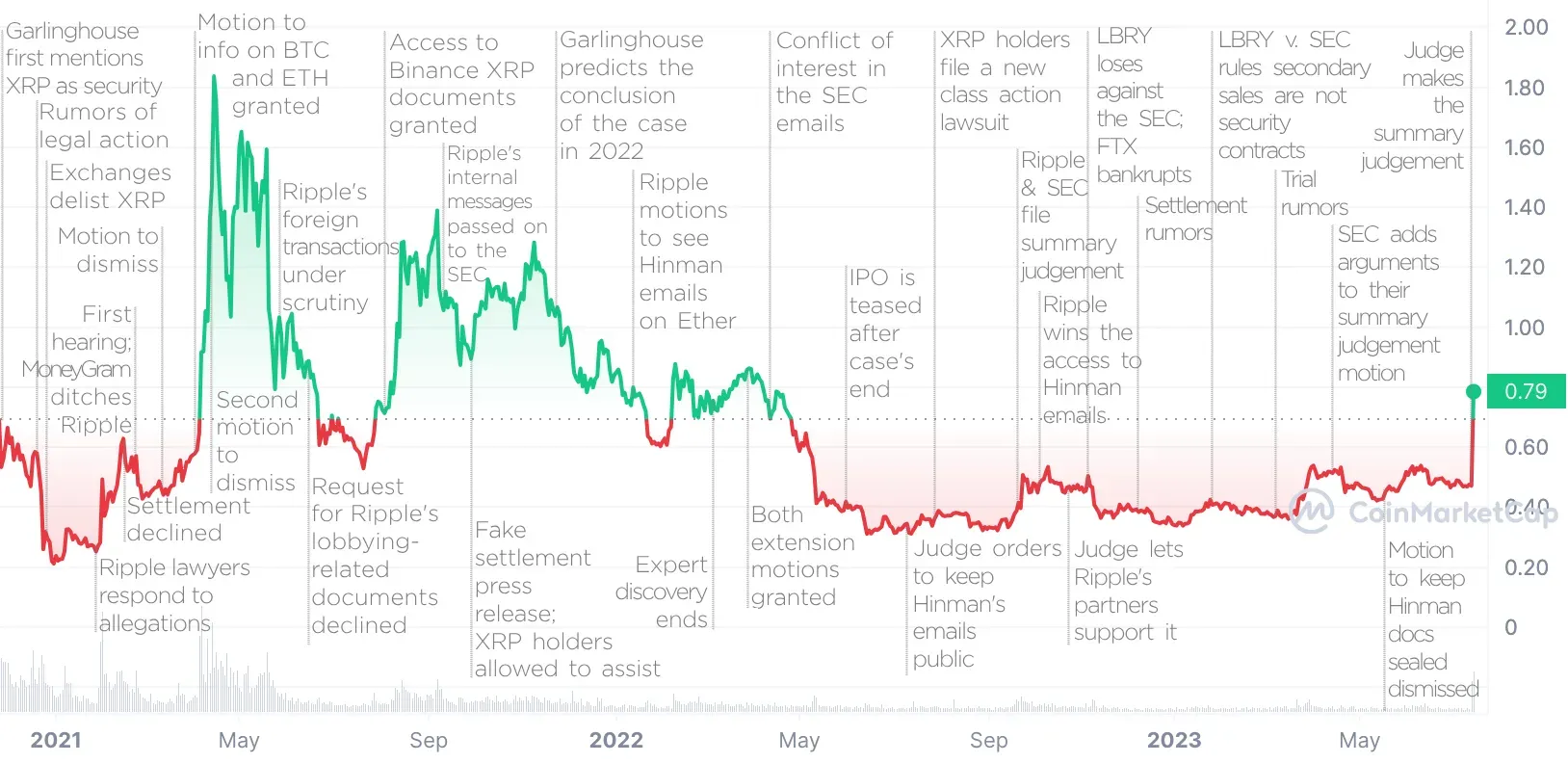
The U.S. Securities and Exchange Commission filed its lawsuit against Ripple Labs Inc. in December 2020, alleging that the company had conducted an unregistered securities offering by selling XRP. What followed was a multi-year legal process that produced one of the most closely watched rulings in crypto enforcement history.
Case Timeline
- December 2020: The SEC files suit against Ripple Labs Inc. and two executives, alleging XRP sales constituted unregistered securities offerings.
- 2021–2022: Discovery phase; multiple exchanges delist or suspend XRP trading in the U.S. as a precautionary measure.
- February 2023: Cross-motions for summary judgment submitted; parties argue their positions without a full trial.
- July 2023: Judge Analisa Torres issues a partial summary judgment ruling. The court finds that programmatic sales of XRP on public exchanges to retail buyers did not constitute securities transactions, while institutional sales directly by Ripple did meet the definition of an investment contract under securities law.
- Post-July 2023: Remaining claims (including SEC appeals and questions around individual executive liability) continue, keeping the case legally unresolved in full.
- Currently: The lawsuit was settled in 2025, with Ripple paying a $125 million penalty, a fraction of SEC's $2B claim. As of 2026, under the current administration, the U.S. SEC has issued a clarification on federal security laws applying to digital assets, stipulating that XRP does not fit the definition of security.
Common Misconceptions
- "The July 2023 ruling means XRP is not a security." It means programmatic retail exchange sales were found not to constitute securities transactions in that specific context but it did not declare XRP categorically exempt from securities law in all circumstances.
- "The SEC case settles XRP's legal status globally." The ruling applies exclusively to U.S. federal securities law. It carries no binding authority over regulators in the EU, UK, Japan, or any other jurisdiction.
- "The case no longer matters." Appeals and remaining claims mean the legal situation still remains fluid. A higher court ruling could alter the current framework.
Regulatory Status by Jurisdiction
As mentioned, the case does not affect XRP’s standing globally, although its status in the US, where Ripple is based from, is vital. XRP's classification varies meaningfully across borders, and the framework that applies to an exchange, custodian, or user depends heavily on which regulator has authority over the activity in question. Genuine regulatory clarity on XRP means tracking both the U.S. securities regulation landscape and the distinct crypto regulation regimes developing across other major markets.
| Jurisdiction / Region | Primary Regulator(s) | Classification Framing | What This Means for Exchanges / Custodians | Practical Implication for Users |
|---|---|---|---|---|
| United States | SEC, CFTC, FinCEN | Contested; partial ruling distinguishes institutional vs. retail context; commodity classification also discussed | Exchanges must assess compliance posture on a transaction-type basis; some re-listed post-July 2023 ruling | XRP generally available on major U.S. platforms following relisting, but institutional use remains sensitive |
| European Union | National competent authorities under MiCA; ESMA oversight | Likely classified as a "crypto-asset" under MiCA framework; not a MiCA-exempt asset-referenced or e-money token by default | Exchanges operating under MiCA licensing must apply CASP (Crypto-Asset Service Provider) rules | Standard KYC/AML requirements; availability generally broad across EU member states |
| United Kingdom | Financial Conduct Authority (FCA) | Unregulated token for most purposes; FCA focuses on marketing and AML compliance rather than securities classification | Exchanges must be FCA-registered for AML; crypto promotions subject to financial promotion rules | KYC required; availability on FCA-registered platforms; marketing restrictions apply |
| Japan | Financial Services Agency (FSA) | Listed as a recognized "crypto-asset" (virtual currency) under the Payment Services Act | Exchanges must hold FSA registration; XRP listed on major licensed platforms | Available on licensed exchanges; standard KYC; consumer protection rules apply |
| Singapore | Monetary Authority of Singapore (MAS) | Digital payment token (DPT) under the Payment Services Act | Exchanges require MAS licensing; DPT services subject to AML/CFT requirements | Available on licensed platforms; KYC required; advertising restrictions in public spaces |
| Australia | ASIC, AUSTRAC | Not classified as a financial product by default; AML/CTF registration required for exchanges | Exchanges must register with AUSTRAC; ASIC monitors for financial product conduct | Generally available; KYC mandatory; regulatory review of crypto framework ongoing |
| Canada | CSA, FINTRAC | Crypto trading platforms treated as money services businesses; provincial securities rules may apply | Platforms must register with FINTRAC and comply with provincial securities regulators | KYC required; some platforms restrict services by province |
| UAE | VARA (Dubai), FSRA (ADGM), SCA | Virtual asset under VARA framework in Dubai; activity-based licensing | Exchanges operating in UAE free zones or mainland must hold relevant virtual asset licenses | Available on licensed platforms; KYC required; jurisdiction within UAE affects applicable rules |
Future Outlook of XRP
What Ripple Labs Inc. builds on its roadmap does not automatically translate into XRPL protocol changes, and vice versa. Forward-looking statements in this section are documented directions and publicly observable trends; actual outcomes depend on regulatory clarity, institutional adoption curves, and evolving market structure — none of which are guaranteed.
For XRP price prediction, refer to the linked article. Here, we’ll focus on the prospects of XRP as an asset, XRPL and Ripple’s solutions in general.
Ripple Roadmap 2026
Ripple's product direction through 2026 centers on expanding institutional utility for XRP and RippleNet. Here are the key items worth tracking:
- Stablecoin and RLUSD expansion — Ripple's USD-denominated stablecoin, RLUSD, is positioned to deepen on-demand liquidity pools. Watch for new exchange listings, institutional custody integrations, and published reserve attestations as verification signals.
- On-Demand Liquidity (ODL) corridor growth — ODL uses XRP as a bridge currency for cross-border settlement. New corridor announcements, partner bank disclosures, and RippleNet corridor count updates would be news to anticipate.
- Central Bank Digital Currency (CBDC) platform deployments — Ripple Labs Inc. has positioned XRPL as a CBDC infrastructure layer. If any pilot-to-production transitions and central bank partnership announcements are made in public government procurement records, this development bears fruit.
- RippleNet institutional onboarding — RippleNet currently serves more than 300 financial institutions. Quarterly growth would be a baseline adoption metric and a leading indicator of XRP demand through ODL.
- Compliance and regulatory tooling — As jurisdictions finalize digital asset frameworks, Ripple's investment in Travel Rule compliance tools and KYC/AML integrations will signal readiness for regulated markets.
- Developer grants and ecosystem funding — Ripple's XRPL Grants program funds third-party builders.
Ecosystem Development
XRP Ledger's architecture makes it particularly well-suited for payments, asset tokenisation, and cross-chain interoperability — not general-purpose smart contract computation. The most plausible application categories on XRPL through 2026 are tokenised real-world assets (RWAs), payment automation via Hooks (XRPL's lightweight logic layer), and decentralized exchange functionality built into the protocol's native DEX.
Interoperability for XRP can mean several distinct things in practice: bridging between XRPL and other blockchain networks, integrating with cross-chain messaging protocols, or expanding exchange integration to access deeper liquidity pools. What would count as meaningful progress in 2026 and onwards? Production-grade integrations with measurable volume routed, reduced settlement friction on multi-chain pathways, and third-party validation of cross-network transaction finality. Interoperability promises are common across the industry — the signal to watch is whether integrations reach live, measurable transaction volume rather than testnet demonstrations.
Conclusion
XRP serves as a digital asset purpose-built for fast, low-cost cross-border settlement and on-demand liquidity, bridging the gap between traditional financial rails and the speed that modern payments demand. Understanding what XRP is — and what it isn't — matters because the distinction between XRP as an asset and Ripple as a company shapes everything from legal exposure to practical utility.
Bookmark the ChangeHero Blog for frequent access to helpful content on crypto and blockchain. Follow us on Twitter, Facebook, Telegram and be the first to get notified.
Frequently Asked Questions
What gives XRP value beyond speculation?
Is XRP backed by gold or any other commodity? The answer is no. XRP derives value primarily from its utility in cross-border payments and settlement. When financial institutions or payment providers use RippleNet to move money internationally, XRP can serve as a bridge currency — converting one fiat currency to another in seconds. This creates real demand: liquidity providers and market makers need XRP on hand to fill those conversion gaps, and that operational demand underpins a portion of the asset's market value beyond pure speculation.
How do adoption and network usage affect XRP price?
Usage demand and investment demand are two distinct forces. When more transactions route through the XRP Ledger, more XRP is needed to facilitate liquidity, which can compress spreads and increase circulation. Investment demand, by contrast, is driven by sentiment and macroeconomic conditions. It is worth noting as a practical constraint: rising transaction volume does not automatically translate into price appreciation — the relationship between utility and market value is real but not linear.
Does Ripple control XRP's value?
Ripple (the company) does not control XRP's value, but it does influence the broader ecosystem. Ripple develops products like RippleNet and contributes to XRPL adoption — that ecosystem development can affect demand indirectly. However, the XRP Ledger itself operates as an independent, open-source protocol. No single entity controls the network's rules or can unilaterally change XRP's supply schedule. The practical distinction matters: Ripple shapes adoption strategy, not protocol fundamentals.
How are XRPL fees calculated and why do they vary?
XRPL transaction fees are determined by a base fee set at the protocol level, which can escalate during periods of high network congestion through a fee-escalation mechanism that discourages spam under load. Under normal conditions, fees remain extremely low.
Why does XRP have a fee at all?
XRP Ledger charges a small transaction fee primarily as an anti-spam and DoS (denial-of-service) defense. Without any cost barrier, bad actors could flood the network with thousands of meaningless transactions and degrade performance for everyone. Even a fraction-of-a-cent fee makes large-scale spam economically impractical, keeping the ledger healthy and performant for legitimate users.
What does a "fraction of a cent" mean for XRP fees in practice?
To make this concrete: a single XRP payment typically costs a fraction of a cent at standard network conditions. If you were sending 1,000 individual payments, your total network fees would still amount to only a few cents at most. Compare that to batching those payments through a traditional correspondent banking chain, where per-transaction fees stack up meaningfully. The cost advantage compounds quickly at volume, which is exactly why institutional payment providers find XRPL operationally attractive.
How fast is final settlement on the XRP Ledger (XRPL)?
Settlement finality on the XRPL typically occurs within 3 to 5 seconds. "Finality" here means the transaction is irreversibly confirmed and cannot be reversed or reorganized — unlike networks that require multiple block confirmations before a payment is truly settled. On XRPL, once the consensus protocol closes a ledger round and validates your transaction, it is done.
What factors can slow down an XRP transfer?
On-ledger finality is fast, but the total time a user experiences can be longer depending on off-ledger factors:
- Exchange processing: Centralized exchanges may batch withdrawals or apply internal processing queues.
- Liquidity routing: If the payment routes through multiple liquidity hops (especially via DEX paths), resolution takes fractionally longer.
- Compliance checks: Regulated custodians and payment providers perform AML/KYC screening that operates outside the ledger itself.
- Deposit confirmation policies: The receiving exchange may require multiple ledger closes before crediting your account.
The ledger itself is not the bottleneck — the surrounding infrastructure usually is.
How does XRPL compare to traditional rails for cross-border transfers?
The contrast is significant in practical terms. A SWIFT-based cross-border transaction typically takes 1 to 5 business days to settle, can involve multiple correspondent banks as intermediaries, and incurs fees ranging from $15 to $50 or more per transaction. XRPL settles the same transfer in 3 to 5 seconds, with near-zero network fees, and without routing through intermediary institutions. Beyond raw speed, the predictability matters: XRPL settlement is deterministic, whereas SWIFT timelines can slip depending on correspondent bank processing and time zones.
Is XRP mined?
XRP is not mined. Rather than relying on proof-of-work competition between miners, the XRP Ledger reaches agreement through a consensus protocol, where a network of validators collectively validates and closes each ledger round without any computational "race" or block reward system.
How was XRP created and how does supply enter circulation?
XRP's entire supply of 100 billion tokens was created at the time of launch; none is generated through ongoing issuance or mining rewards. Distribution happens over time through structured mechanisms, including Ripple's use of escrow accounts to release portions of its XRP holdings on a scheduled basis. The key distinction: creation and distribution are two separate events. All XRP that will ever exist was minted at genesis; how much circulates today reflects years of controlled release rather than new production.
Who validates XRPL transactions?
Validators — independent nodes running XRPL software — are responsible for confirming transactions. Each validator proposes a candidate ledger, and through iterative rounds of the consensus protocol, the network converges on a single agreed state. No validator earns a block reward; participation is incentive-neutral by design. Decentralization debates around XRPL often focus on the composition of the Unique Node List (UNL), which defines which validators a node trusts by default.
