
Beginner’s Guide to Stellar (XLM)


Key Takeaways
- ⭐️ Stellar ≠ XLM: Stellar is the network/protocol; XLM (Lumens) is the native token that makes the network usable—fees, reserves, and liquidity routing. XLM pays transaction fees (spam resistance), enforces minimum account balances (ledger/resource control), and acts as a bridge asset when direct markets between two currencies/assets are thin or nonexistent.
- ⭐️ Supply is fixed at 50B XLM: Created at launch, then a 2019 burn reduced supply to 50 billion XLM, and inflation was removed—no mining, no ongoing issuance.
- ⭐️ Stellar’s real-world flow depends on anchors: Anchors handle fiat in/out (and KYC/AML) by issuing tokenized assets on Stellar; the network can be fine while an anchor/issuer/wallet is the failure point, so issuer/anchor due diligence matters.
Contents
- 1. Overview of XLM and Stellar
- 2. How the Stellar Network Works
- 3. Stellar History and Governance
- 4. Stellar Consensus Protocol (SCP) Explained
- 5. XLM Tokenomics: Supply, Fees, and Distribution
- 6. Transactions, Payments, and Asset Exchange on Stellar
- 7. Ecosystem, Partnerships, and Roadmap (2026)
- 8. XLM vs Other Cryptocurrencies
- 9. How to Buy and Store XLM
- 10. Risks and Key Considerations
- 11. Conclusion
If you are here, you likely want a clear answer to what XLM is, what it actually does on the Stellar network, and whether you need to hold it to use Stellar in the first place.
In short, XLM is the native cryptocurrency token used on the Stellar blockchain network designed for fast, low-cost cross-border payments and asset exchange. Unlike many cryptocurrencies that try to be “money for everything,” XLM has very specific jobs inside Stellar’s payment plumbing: paying transaction fees, maintaining minimum account balances, and acting as a bridge currency when converting between different assets. However, it’s worth getting into the details and diving deeper for a better understanding of this noteworthy crypto project.
Overview of XLM and Stellar

Stellar operates as an open-source, decentralized payment protocol, while its native token lumen (XLM) functions as the digital asset that powers transactions on the Stellar network. The two terms are frequently confused: Stellar refers to the entire blockchain infrastructure designed for cross-border payments and asset issuance, whereas XLM serves as the utility token that enables those operations.
XLM (Lumens)
What is XLM? XLM is the native cryptocurrency of the Stellar ledger, created alongside the network's launch in 2014. It exists as a digital asset recorded on Stellar's public ledger, functioning independently of mining or staking mechanisms. The initial supply was set at 100 billion Lumens at launch, but a significant burn in November 2019 removed 50 billion tokens, establishing the current fixed supply at 50 billion XLM.
What does XLM do? Lumens serve three critical network utility roles. First, they are used as anti-spam protection which requires small transaction fees to prevent malicious actors from overwhelming the network with unnecessary operations. Second, XLM establishes minimum account balances that ensure network participants maintain a stake in the system's health. Third, lumens function as a bridge currency, facilitating liquidity between different fiat currencies and digital assets when direct trading pairs don't exist or lack sufficient depth.
What XLM is not: XLM is not a mineable cryptocurrency—no proof-of-work validation exists within Stellar's architecture. Calling XLM Stellar is common but inaccurate; rather, it's one component of a broader payment infrastructure. Additionally, XLM is not a smart-contract platform token like Ethereum's ETH; while Stellar supports programmable transactions, its design philosophy prioritizes payment efficiency over computational complexity.
Why does it exist? XLM was created to solve the liquidity challenge inherent in multi-currency transfers. When converting Nigerian Naira to Philippine Pesos, for example, direct exchange markets may be thin or nonexistent. XLM acts as an intermediate asset—what the protocol calls a "bridge asset"—allowing the conversion to happen through two liquid markets (Naira→XLM and XLM→Pesos) rather than one illiquid direct pair. This design enables the network to facilitate exchanges between any asset pairs without requiring every possible trading combination to have pre-existing market depth.
Stellar Network
Stellar is an open-source, decentralized blockchain protocol specifically engineered for issuing, transferring, and exchanging digital representations of value. The network maintains a public ledger that records all account balances, transactions, and asset issuances in a transparent, immutable format accessible to any participant or observer. The Stellar Development Foundation oversees the protocol's ongoing development and ecosystem growth while maintaining the network's open-source nature.
Stellar’s speed and efficiency make it competitive with traditional payment rails while maintaining significantly lower costs than legacy banking infrastructure. This positions the network as infrastructure for financial institutions seeking to modernize cross-border payment systems, enabling interoperability between existing financial systems and blockchain technology.
How the Stellar Network Works
Real-world money enters and exits the Stellar network through regulated entities called anchors, which issue tokenized representations of fiat or digital assets on the ledger. The design goal is straightforward: make low-cost, fast settlement practical for everyday payments, not just for crypto-native users.
Mission
Source: Stellar.org
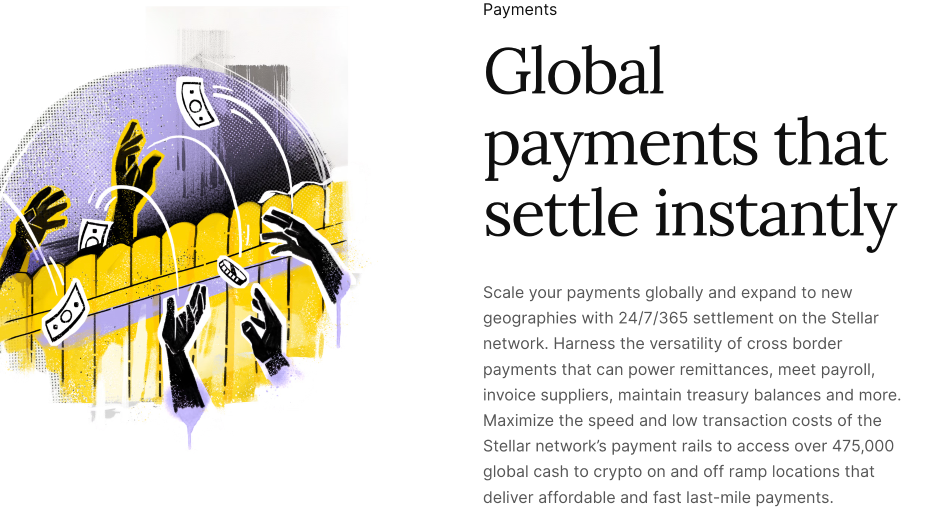
Stellar intends to act as a bridge between fragmented financial systems, connecting wallets, fintechs, and financial institutions so value can flow seamlessly across borders and currencies. The network’s operating thesis centers on interoperability. This approach bypasses traditional banking rails, which often involve multiple intermediaries, multi-day settlement windows, and opaque fee structures.
- Stellar is not positioned to replace banks; it provides rails for banks, fintechs, and cash-to-crypto ramps to integrate and interoperate without rebuilding infrastructure.
- XLM exists as a bridge currency and anti-spam mechanism, but the network's primary function is facilitating multi-currency transfers, not speculative asset trading.
Financial Inclusion
Stellar’s inclusion story works best when you look at it as a set of practical levers—each one removing a different kind of friction.
Firstly, many Stellar-integrated wallets operate as lightweight mobile apps requiring only internet connectivity, not bank accounts. This matters for the 1.4 billion adults globally who remain unbanked but own smartphones and can hold and transfer digital value without needing to meet KYC thresholds designed for traditional accounts.
Secondly, anchors issue stablecoins or tokenized fiat directly on Stellar, enabling users to avoid volatile cryptocurrencies while benefiting from blockchain settlement speed. A small business owner in Mexico can accept peso-backed tokens from customers, convert a portion to USDC for international supplier payments, and hold the rest in local currency—all within one ecosystem.
Thirdly, traditional remittance corridors lock users into specific pairings, but Stellar's decentralized exchange allows pathfinding through any liquid asset pair. A Nigerian exporter paid in naira-backed tokens can settle invoices with a Chinese manufacturer using yuan-backed tokens, routed automatically through XLM if no direct market exists.
And last but not least, Stellar's architecture accommodates compliance by design—anchors handle KYC/AML at the edges while the public ledger remains permissionless. This separation allows cash agents or pawn shops to act as local fiat ramps without needing blockchain expertise.
Anchors
Circling back to anchors, they are regulated entities that issue and redeem assets on Stellar, linking on-chain token balances to off-chain value like bank deposits, cash reserves, or other blockchains' native assets. When a user deposits $100 USD with an anchor, the anchor mints 100 USD-backed tokens on Stellar; when the user redeems those tokens, the anchor burns them and returns $100 via wire transfer or cash pickup.
When using an anchor, users are required to trust the redemption promise that the anchor maintains 1:1 reserves and will honor withdrawal requests. They also put trust in the anchor's custody and settlement processes. Users do not trust anchors for on-chain transfer security—once tokens are issued, Stellar's ledger rules (enforced by validators via SCP) guarantee atomic settlement, immutability, and censorship resistance.
Stellar History and Governance
Jed McCaleb co-created Stellar in 2014 after founding Mt. Gox and co-founding Ripple, bringing his vision for accessible global financial infrastructure to a new protocol designed with non-profit principles at its core. Joyce Kim joined as co-founder and served as Executive Director, responsible for early community building, partnerships, and articulating Stellar's mission to connect financial institutions with underserved populations. Together, McCaleb and Kim established both the Stellar network and the Stellar Development Foundation.
Stellar Development Foundation (SDF)

The SDF operates as a mission-driven non-profit organization that supports the open-source Stellar network without controlling it, since the protocol itself runs on independent validators operated by global community members and organizations. SDF's stewardship focuses on funding ecosystem development, maintaining core software repositories, publishing educational resources, coordinating standards proposals through public channels, and supporting initiatives like developer grants—but it cannot unilaterally change consensus rules or reverse transactions.
What SDF influences:
- Publishing protocol upgrades and reference implementations through the Dev Hub
- Distributing grants and investment to ecosystem projects
- Maintaining network infrastructure like Horizon servers and the API Reference
- Coordinating Bug Bounty programs and security audits
- Setting development priorities based on community feedback and usage data
What SDF does not control:
- Which validators individual node operators choose to trust
- Transaction ordering or consensus outcomes on the decentralized network
- Private key management or asset custody for users
- Regulatory classification of XLM in different jurisdictions
Milestones
| Year | Event | Why It Mattered |
|---|---|---|
| 2014 | SDF created Stellar Lumens (XLM) and launched the Stellar network | Established the non-profit governance model and mission to expand financial access, differentiating Stellar from for-profit blockchain projects through its foundational structure |
| 2015 | Stellar protocol upgraded to use new consensus mechanism | Shifted away from Ripple's consensus approach, cementing Stellar's independent technical identity and laying groundwork for the Stellar Consensus Protocol (SCP) |
| 2017 | Lightning Network integration announced | Demonstrated interoperability ambitions, signaling that Stellar's governance priorities included cross-network compatibility rather than isolated ecosystem development |
| 2018 | SDF partnered with IBM for cross-border payments | Validated enterprise adoption potential and shifted ecosystem focus toward institutional use cases, influencing grant priorities and development resources |
| 2019 | SDF burned 55 billion XLM, reducing total supply from 105B to ~50B | Permanently fixed maximum supply at approximately 50 billion XLM and clarified SDF's role in token economics, removing uncertainty about future inflation and demonstrating commitment to transparent stewardship over the asset's economic model |
| 2021 | Soroban smart contracts platform announced | Expanded governance scope to include decentralized application infrastructure, requiring new standards processes and ecosystem coordination beyond payment-focused mission |
| 2023 | Soroban launched on mainnet | Transformed Stellar from payment network into programmable blockchain, requiring SDF to balance original financial inclusion mission with developer ecosystem growth and technical complexity |
Stellar Consensus Protocol (SCP) Explained
The gist of the consensus model used in Stellar, called SCP, is it enables network agreement without mining by using a federated Byzantine agreement model where validators reach consensus through overlapping trust configurations. Rather than competing for block rewards through computational work, validators cooperate within flexible quorum structures to finalize transactions in 3-5 seconds.
Validator Nodes
A validator node on the Stellar network participates directly in consensus by proposing, voting on, and finalizing transaction sets. Unlike passive infrastructure, validators actively exchange messages during the consensus rounds to collectively agree on ledger state.
The main roles of Stellar network maintainers are: Validator node runs the full consensus protocol, votes on transaction sets, and signs off on ledger entries. Full node (non-validating) tracks the ledger and validates history but does not participate in consensus voting. Watcher/client connects to the network to submit transactions and query ledger data without storing full blockchain history.
Source: Edge Blog
Importantly, running a validator is independent from issuing assets or operating an anchor. An organization can issue stablecoins without running consensus infrastructure, and validators can participate in network security without touching asset issuance.
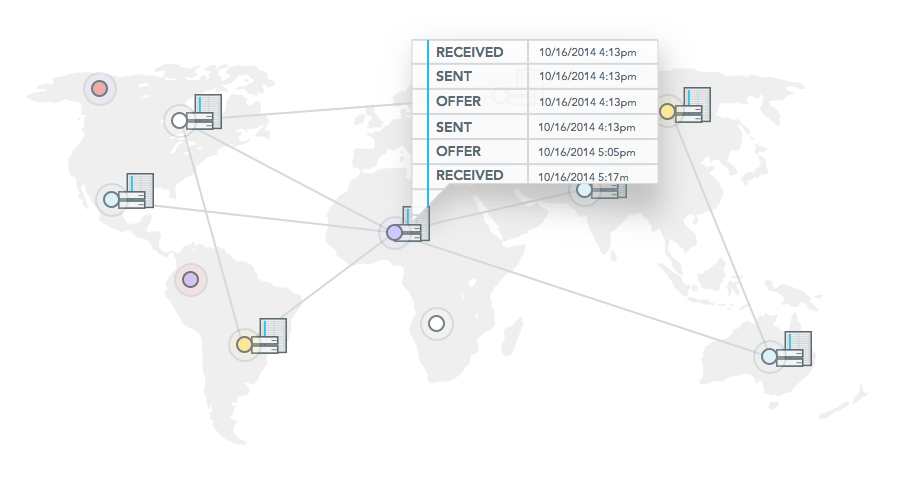
A lot happens behind the scenes in the five seconds it takes a transaction to go from submission to finality: first, a user signs and broadcasts a transaction to any Stellar node. The receiving node relays the transaction across the peer-to-peer network. Validators include the transaction in their proposed transaction sets for the next ledger close, then exchange votes through multiple ballot rounds, converging on a single agreed transaction set. Once quorum agreement is reached, validators commit the transaction set to the ledger. The new ledger is closed, and the transaction becomes immutable with immediate finality.
Quorum Slices
Another important context in SCP workings is quorum slice, which is the specific set of other validators that a given validator requires to reach agreement. Quorums emerge when enough validators' slices overlap, creating network-wide consensus without a single central authority.
Consider a toy network with validators A, B, C, D, and E. Validator A might configure its quorum slice as {B, C}, meaning A will only accept consensus if both B and C agree. Validator D could choose {A, C, E}, requiring agreement from A, C, and E. Overlap is the entire point: if overlap is weak, the network risks splits where different groups finalize conflicting ledgers.
XLM Tokenomics: Supply, Fees, and Distribution
Utility
XLM serves two distinct economic roles within the Stellar ecosystem: protocol-required functions and market-driven use cases. At the protocol level, XLM pays network transaction fees and is needed to meet minimum account balance requirements; these are hard-coded necessities that keep the Stellar network operational and spam-resistant. On the market side, XLM often acts as a bridge currency in cross-border transactions, facilitating liquidity between asset pairs that lack direct trading markets.
When do you actually need XLM in your wallet? Three scenarios: base reserve when creating a new Stellar account, maintaining trustlines for custom assets (each trustline increases reserve), and submitting any transaction (every operation costs a small fee in XLM).
Transaction Fees
Stellar charges transaction fees in stroops, the smallest unit of XLM: one stroop equals 0.0000001 XLM. The base fee is set at 100 stroops per operation, or 0.00001 XLM. It’s a flat fee, not a percentage of the transaction’s value.
Fees exist for spam resistance but also network prioritization under load. During congestion, validators prioritize transactions with higher fees, though Stellar's throughput typically prevents this from becoming a daily issue.
Minimum Account Balance
The minimum account balance functions as both a spam-prevention mechanism and a ledger-growth control tool. Every Stellar account must maintain a base reserve of 1 XLM just to remain active on the network. The required reserve increases as you add complexity:
- Additional trustlines: Each trustline adds 0.5 XLM to your required reserve
- Open offers on the decentralized exchange: Each offer increases the reserve by 0.5 XLM
- Additional signers: Multi-signature configurations add 0.5 XLM per signer
- Data entries: Storing arbitrary data on-chain raises the reserve by 0.5 XLM per entry
- Claimable balances: Creating claimable balances adds 0.5 XLM to the reserve calculation
Supply
Initial distribution of XLM. Source: GH22 on Binance Square
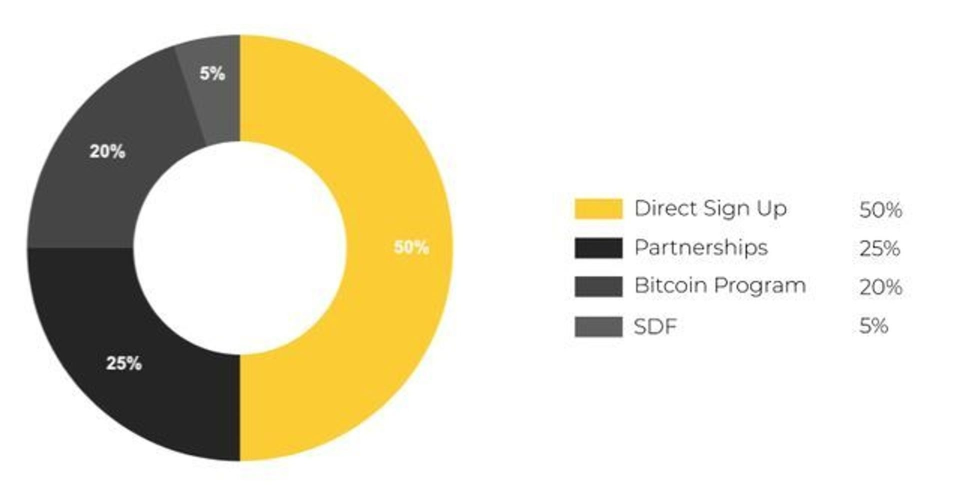
At launch in 2014, the SDF minted an initial supply of 100 billion XLM but in November 2019, the Foundation executed a one-time burn event that permanently destroyed 55 billion XLM, reducing the total to 50 billion XLM. Since no mining exists and no new issuance mechanisms remain active, the 50 billion XLM currently in existence represents the absolute maximum that will ever circulate.
Before 2019, Stellar operated with a built-in inflation mechanism that increased the total supply by 1% annually. In October 2019, the Stellar network community voted via protocol upgrade to remove the inflation mechanism entirely, paired with the 55 billion XLM burn. That created a fixed-supply model with clearer long-term tokenomics.
Transactions, Payments, and Asset Exchange on Stellar
Each transaction on Stellar carries one or more operations—payment, asset conversion, trustline creation—and pays a nominal base fee in XLM. Let’s take a closer look at how they’re made.
Cross-Border Transfers
Crypto-to-Crypto Transfer (No Anchor):
- The sender opens their wallet or application and selects the recipient's Stellar address.
- The wallet constructs a payment operation specifying the digital assets (e.g., USDC issued by Circle) and amount.
- The transaction is signed locally with the sender's private key and broadcast to the network.
- Validators process the transaction in the next ledger close, deducting the asset from the sender's balance and crediting the recipient.
- The recipient's wallet detects the incoming balance change and displays the received funds.
Fiat-In/Fiat-Out Remittance via Anchors:
- Sender deposits fiat currency (e.g., EUR) with an on-ramp anchor that performs KYC/AML verification.
- The anchor issues an equivalent tokenized asset on Stellar (e.g., EURT) and credits the sender's wallet.
- Sender initiates an on-ledger transfer, often using a path payment that converts EURT to PHPT via XLM or another bridge asset.
- The recipient receives PHPT in their Stellar wallet.
- Recipient redeems PHPT with an off-ramp anchor, passing through the anchor's compliance checks.
- The anchor transfers local fiat currency to the recipient's bank account through cash-to-crypto ramps.
- Both anchors maintain audit trails and handle regulatory obligations.
Tokenized Assets
A tokenized asset on Stellar is an issued currency represented by an alphanumeric asset code (up to 12 characters) and the public key of the issuing account. These are not XLM; they are liabilities created by issuers who promise redemption or utility.
Before receiving or holding a tokenized asset, a user must create a trustline. Creating a trustline implies trust (it’s in the name) in the issuer's solvency and redemption policy, and it increases your reserve requirement.
Examples of Tokenized Assets:
- Fiat-Backed Stablecoins: Such as Circle's USDC or various euro-denominated tokens.
- Reward and Loyalty Points: Redeemable inside a merchant ecosystem.
- Tokenized Deposits: Bank-issued representations of deposits for settlement and reconciliation.
Ecosystem, Partnerships, and Roadmap (2026)
Stellar's documented partnerships, observable protocol updates, and active decentralized finance applications collectively define the network's practical utility as of 2026. The Roadmap for 2026 and beyond is publicly communicated development priorities from the SDF and visible ecosystem directions rather than guaranteed future releases.

Photo by Sable Flow on Unsplash
Since this guide focuses on the fundamentals of Stellar and XLM, for live Stellar price analysis and forecast, refer to Stellar (XLM) price prediction by our team.
Partnerships
Most Stellar partnerships fall into one of three broader categories: On/off-ramps and anchors bridge traditional currencies and blockchain assets through issuance, redemption, reserve backing, and compliance workflows. Wallets and user access partners such as Freighter, Lobstr, and others shape onboarding, asset display safety (code+issuer), and memo handling. Institutions and fintech integrations leverage 2–5 second finality for cross-border settlement, compliance tooling, and multi-signature account controls.
In 2025, SDF onboarded Franklin Templeton, U.S. Bank, PayPal, and RedSwan to the ecosystem as institutional partners. Stellar’s payment solutions were introduced to Moneygram, Visa, and Wirex.
Network Updates
Payments remain the main use case for Stellar’s platform, and as you would expect, they are catching up to the evolution in the digital payment space. The most recent introduction to the suite of Stellar solutions is the 402x protocol for AI-agentic payments. Simply put, Stellar is adapting to AI agents increasingly expected to perform financial transactions without friction from the current Web infrastructure. The protocol is supported by Cloudflare, Coinbase, Google, and Visa, among other adopters.
Speaking of adapting, the 2025 end-of-year report mentions another major venue: quantum computing resistance. Even though the consensus of computer scientists is that quantum computing is years away, once available, it will have the potential to undo most current cryptography. Obviously, this is not great for cryptocurrencies such as Stellar, so at least some of the minds behind the project will be occupied with future-proofing the network against this existential threat.
DeFi
Decentralized finance on Stellar encompasses issued assets trading on-chain order books, liquidity pools for automated market making, decentralized exchanges (DEXs) utilizing Stellar's native trading engine, bridges for cross-chain asset movement, and wallets that combine payment and exchange functions. In other words, possible applications are more diverse than simply sending value.
As of 2026, the official Stellar ecosystem participant directory lists 155 projects labeled as “DeFi”. They include cross-chain bridges (Allbridge), liquidity management protocols (Aquarius, HiYield), oracles (Band, Dia), decentralized exchanges (Cables, Phoenix), Web3 and crypto escrow (eascrow, Mica), real-world assets (Excellar), borrowing (Hedgehog), and even play-and-learn apps (Dogstar, Gladius).
However, not even the fact of being included in the official directory means that the app will be active by the time you read the guide. Similarly, the number of apps can change to the upside too. Whether the amount of applications with real usefulness and use grows on Stellar will determine its longevity and value.
XLM vs Other Cryptocurrencies
Comparing XLM not just to its direct competitor XRP but to other major cryptocurrencies might be a good idea to get a better grasp on which niche it occupies, as well as a perspective to appreciate its benefits.

| Stellar (XLM) | Ripple (XRP) | Ethereum (ETH) | Bitcoin (BTC) | |
|---|---|---|---|---|
| Primary design goal | Cross-border payments + tokenized asset issuance | Institutional settlement (banks, remittance corridors) | General-purpose smart contracts + DeFi primitives | Store of value + censorship-resistant settlement |
| Typical users | Anchors, remittance providers, asset issuers | Banks, payment processors, enterprise partners | Developers, DeFi protocols, NFT platforms | Long-term holders, macro investors, OTC traders |
| Core transaction model | Account-based payments with asset exchange built-in | Payment-focused with liquidity optimization | General computation (Turing-complete VM) | UTXO-based value transfer |
| Native asset role | Anti-spam fee + minimum account balance (0.5 XLM), optional bridge currency | Bridge currency for liquidity (ODL corridors) | Gas for computation + staking collateral | Unit of account + settlement medium |
| Consensus mechanism | Federated Byzantine Agreement (SCP) | Probabilistic consensus (XRP Ledger Consensus Protocol) | Proof-of-Stake (Gasper FFG + LMD GHOST) | Proof-of-Work (SHA-256) |
| Finality/settlement expectation | ~2–5 seconds (irreversible after ledger close) | ~3–5 seconds (probabilistic confirmation) | ~12 minutes (2 epochs for economic finality) | ~60 minutes (6 confirmations standard) |
| Fee predictability | Fixed base fee (0.00001 XLM), surge pricing rare | Dynamic but low (fractions of a cent) | Variable (gas auctions, EIP-1559 burn) | Auction-based (mempool congestion spikes) |
| Energy profile | Negligible (no mining, quorum-slice voting) | Negligible (no mining, validator agreement) | Low post-Merge (~99.95% reduction vs PoW) | High (ASIC farms, global electricity draw) |
| Interoperability approach | Anchors issue tokenized fiat/crypto; DEX native | RippleNet partnerships, ODL corridors | Bridges (LayerZero, Wormhole), token standards (ERC-20) | Wrapped tokens (WBTC), Lightning for scaling |
| Best-fit use cases | Remittances, stablecoin rails, multi-currency accounts | Bank-to-bank settlements, treasury operations | DeFi protocols, NFT marketplaces, DAO governance | Long-term savings, macro hedging, final settlement layer |
How to Buy and Store XLM
XLM purchases usually start on exchanges. Centralized exchanges (CEXs) like Kraken and Coinbase offer direct fiat-to-XLM onramps, deep liquidity, and predictable order execution—at the cost of KYC, withdrawal limits, and platform risk.
Crypto-only onramps such as ChangeHero and Changelly serve users who already hold crypto and want quick swaps. If fiat on-ramp or off-ramp is available, users buy Stellar lumens with a third-party provider. Broker-style apps like PayPal and Revolut simplify buying but may restrict withdrawals or charge premium fees, which matters if you plan on self-custody.
The Stellar network has one operational “gotcha” you should treat as non-negotiable: the memo field. Exchanges commonly use shared deposit addresses and rely on memos to credit the correct user. Omitting a memo can turn a simple deposit into a support ticket marathon.
XLM Wallets
Wallet choice for any cryptocurrency is really a security choice. If you'd like to learn more than what the brief below sums up, feel free to read our guide on how to set up a crypto wallet. Keep in mind that not every crypto wallet app supports XLM by default.
- Custodial wallets (exchange wallets) are convenient, but the platform holds your keys.
- Non-custodial software wallets such as Freighter and Lobstr put you in control, but you must protect your seed phrase.
- Hardware wallets like Ledger and Trezor keep keys offline, offering top-notch security and peace of mind, with more setup steps and cost.
Stellar has a specific requirement to keep in mind: the minimum balance reserve. Every Stellar address must maintain at least 1 XLM, plus 0.5 XLM reserves for each trustline and other entries. When funding a new wallet, send extra XLM so you do not strand your account below reserve.
Risks and Key Considerations
XLM and Stellar bring a real-world payments focus, and that comes with a distinct risk profile: market volatility, regulatory dependencies around anchors and stablecoins, and network/ecosystem risks tied to validators, wallets, and issuers.
Volatility
XLM is influenced by both broad crypto market cycles and by Stellar-specific catalysts like partnerships, roadmap updates, and exchange listing decisions. Furthermore, here is how liquidity conditions on the platform where you do your XLM trading matter: thinner order books increase slippage and widen spreads, especially during weekends and news-driven spikes.
Watch 24-hour volume swings, bid-ask spreads, and on-chain activity proxies like daily active accounts and payment operation counts via Stellar explorers.
Regulatory Factors
Regulatory risk has two layers: classification of XLM itself, and regulation of businesses that transmit value using Stellar (anchors, exchanges, wallets, fintechs). Cross-border use adds multi-jurisdiction complexity, sanctions screening obligations, and travel-rule-style compliance requirements in many corridors.
Before using XLM in your country, verify:
- Exchange licensing and accessibility
- Tax reporting expectations
- Bank transfer limits or prohibitions related to crypto
- Anchor availability and stability via the Anchor Directory
- Custody rules and insolvency treatment for custodial platforms
- Memo and travel-rule compliance expectations for large transfers
Network Risks
Stellar’s availability depends on validator uptime and quorum configuration. Moreover, ecosystem dependency is real: the network can be healthy while anchors, issuers, or wallets are down, and users will still experience “failure” at the interface layer.
Conclusion
Stellar’s performance for fast, low-cost cross-border payments is a real usability advantage. At the same time, XLM’s volatility and the regulatory and operational dependencies around anchors are not details you can ignore. The good news is that the core mechanics are predictable: fixed base fees, a clear reserve model, and a fixed 50-billion-XLM supply.
If you found our beginner’s guide useful, check out the ChangeHero blog for more. Follow ChangeHero on X, Facebook, and Telegram for daily updates and more content.
Frequently Asked Questions
What is the difference between XLM and XRP?
XLM and XRP are separate cryptocurrencies running on different blockchain networks. XLM is the native token of Stellar, managed by the Stellar Development Foundation, while XRP powers Ripple's payment protocol, governed by Ripple Labs. Though both originated from similar visions—Jed McCaleb co-founded both projects before splitting to create Stellar—they now operate as distinct ecosystems with different governance structures, consensus mechanisms, and development roadmaps.
What is Stellar used for?
Stellar and XLM are primarily used for cross-border payments, remittances, micropayments, tokenized asset issuance, liquidity provision for currency pairs, and peer-to-peer transfers across different fiat currencies.
How many XLM are there?
XLM is not inflationary today because the supply is capped at 50 billion tokens following a 2019 burn event.
What are the fees for using Stellar?
The Stellar network charges a base transaction fee of 0.00001 XLM per operation, which applies to network validation and prevents spam.
Is Stellar mined?
You cannot mine XLM because the Stellar network doesn't use proof-of-work or distribute block rewards. Stellar has no mining—all XLM were created at launch, and validators reach consensus without receiving newly minted tokens.
Where can you buy XLM?
You can acquire XLM through centralized cryptocurrency exchanges, mobile broker apps with built-in fiat on-ramps, or on-chain decentralized exchange protocols that support Stellar's native trading pairs.
Disclaimer
This article is for educational purposes only and does not constitute financial, tax, or legal advice. Cryptocurrency markets are volatile, and regulations vary by jurisdiction. All supply figures, circulation data, and exchange rates are time-sensitive; always verify current numbers with primary sources like the Stellar Development Foundation or reputable exchanges before making decisions.