
Complete Guide to Cryptocurrency Mining in 2025


Cryptocurrency mining can seem intimidating from the outside: loud machines, complex math, bewildering lingo. Underneath all that, though, it’s just a system for keeping decentralized money fair and honest.
Throughout this guide, we’ll walk through what crypto mining is, how Bitcoin mining works, what kind of hardware and software you need, and how to evaluate whether mining is profitable or legal where you live. We’ll also look at advanced strategies, risks, environmental impact, and what the future of mining might look like.
Introduction to Cryptocurrency Mining
What is Cryptocurrency Mining?
Despite what the name might evoke, this process does not involve heavy-duty machinery and production of something physical. Cryptocurrency mining is the process of validating transactions and adding new blocks to a blockchain network using computers and processors. In simple terms, miners compete to solve complex mathematical puzzles. The first miner to find a valid solution earns the right to add the next block of transactions to the blockchain and receives cryptocurrency rewards in return.
Mining matters because blockchains like Bitcoin operate without banks or central authorities. Instead of a bank verifying payments, a distributed network of miners ensures every transaction is legitimate and that nobody can break the rules. Mining creates a permanent, tamper-resistant record of all transactions and keeps the whole system secure and functional.
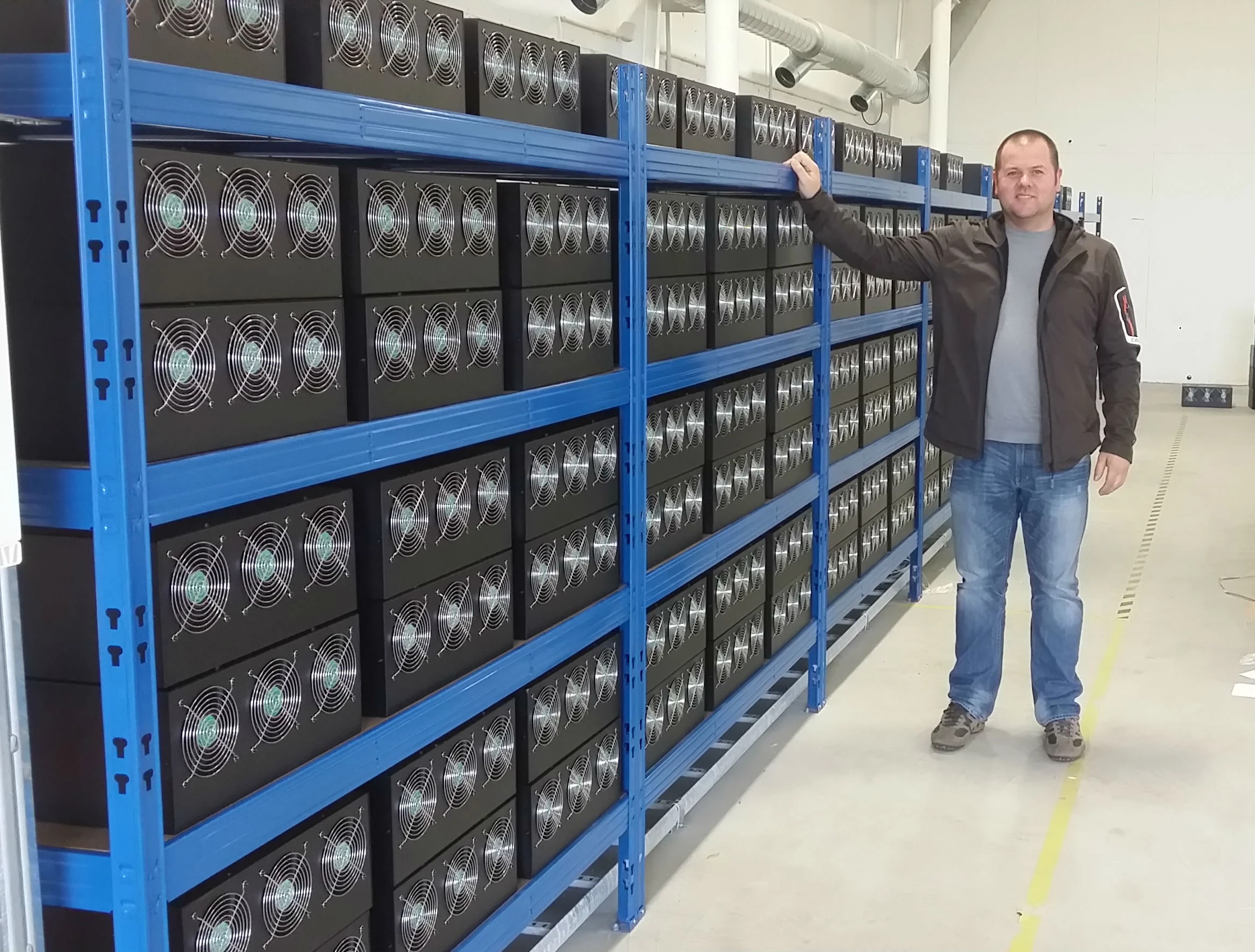
This process runs on a consensus mechanism called Proof of Work (PoW). Miners use specialized hardware, sometimes called a Bitcoin mining rig or Bitcoin mining machine, to perform trillions of calculations per second for this single purpose. They’re essentially guessing random numbers until they find one that produces a valid result under the network’s difficulty rules. Because rewriting history would mean redoing all this work, past transactions become practically impossible to alter.
Source: Wikimedia, by Marco Krohn - Own work, CC BY-SA 4.0
When a miner successfully solves the puzzle, they broadcast their candidate block to the network. Other nodes verify the solution and the transactions inside the block. If everything checks out, the block is permanently added to the blockchain. The miner is paid with freshly created coins (the block reward) plus transaction fees from users. Following Bitcoin’s fourth halving event on April 20, 2024, that block reward is now 3.125 BTC.
Mining is a trait of some but not all cryptocurrencies; not all cryptocurrencies use it. Some networks, like Ethereum after 2022, switched to Proof of Stake (PoS), which relies on validators staking coins instead of miners doing computational work. For Bitcoin and many other coins, though, mining is still the backbone of security and decentralization.
How Does Crypto Mining Work?
Crypto mining is how blockchain networks approve and sort transactions and create new coins without a central authority. From sending BTC to the fact becoming irreversible, here is how it unfolds.
- Step 1: Transactions enter the mempool.
When someone sends Bitcoin, that transaction doesn’t instantly land on the blockchain. It first enters a waiting area called the mempool (short for memory pool), alongside thousands of other pending transactions. Miners draw from this pool to build the next block. - Step 2: Miners select and bundle transactions.
With the mining software, miners choose which transactions to include. They usually prioritize those with higher fees because fees are part of their income. A Bitcoin block can hold about 1 MB of data—roughly 2,000 to 3,000 basic transactions. - Step 3: The cryptographic race begins.
This is where Bitcoin mining hardware does the heavy lifting. Miners use specialized machines called ASICs (Application-Specific Integrated Circuits) to guess a number called a nonce. They combine the block’s data with this nonce and run it through Bitcoin’s hashing algorithm to create a hash, unique digital fingerprint. - Step 4: Mining rigs compete for the winning hash.
Every miner on the network is racing to find a nonce that produces a hash below the network’s current target (we’ll define that target in a moment). Modern Bitcoin mining rigs perform trillions of guesses per second. The first miner to find a valid hash wins the right to publish their block. - Step 5: The winning block is broadcast and verified.
The winning miner broadcasts their block to the network. Other nodes verify that the transactions are valid and that the hash meets the difficulty target. If it all checks out, the block is added to the blockchain. The miner receives the block reward plus all transaction fees from that block. - Step 6: The process repeats every ~10 minutes.
Bitcoin’s mining difficulty automatically adjusts so that, on average, a new block is added roughly every 10 minutes—regardless of how much computing power joins or leaves the network. This built-in feedback loop is what allows Bitcoin to maintain a predictable issuance schedule in any circumstances.
Most individual miners today join a Bitcoin mining pool instead of mining solo to improve their chances. Pools combine hash power from many miners and share rewards proportionally, making income more predictable, though still influenced by hashprice (revenue per unit of hash rate) and operating costs.
The Role of Miners in a Blockchain Network
Source: Arina Habich / Alamy
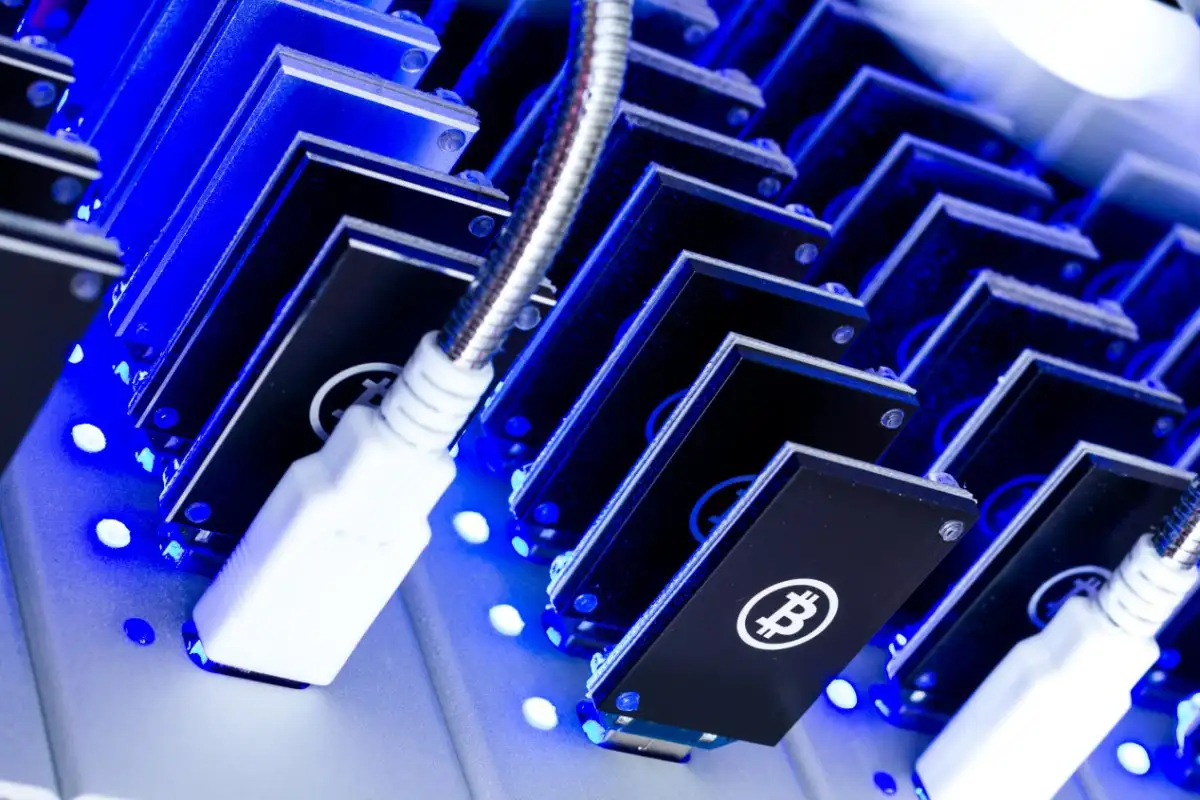
Miners are the backbone of Proof of Work blockchain networks. They validate transactions, secure the ledger, and keep everything running without a bank, government, or company in charge.
Miners are not payment processors; they’re validators. Every time they add a block, they’re essentially stating, “I’ve verified these transactions, and they’re legitimate.” The rest of the network trusts this process because it’s cryptographically provable and publicly auditable.
Security is where their role really shines. To manipulate Bitcoin’s blockchain, an attacker would need to control more than 50% of the network’s total computing power in a so‑called 51% attack. With Bitcoin’s enormous hash rate spread across miners worldwide, acquiring that much power is economically and logistically unrealistic.
The incentives align this security with miner economics. Miners spend money on Bitcoin mining hardware (ASIC machines) and electricity to keep their rigs running. In return, they earn block rewards and transaction fees. The payout for success, plus fees, keeps thousands of miners online and competing, which in turn keeps Bitcoin secure.
Key Concepts in Crypto Mining
Admittedly, crypto mining is rife with complicated jargon but it takes knowing a few core terms to turn crypto mining from “mystery math” or magic money source into something more intuitive.
Hash and Target Hash
Let’s start with something that will help any crypto user, even without the full context of mining. A hash is the output of a cryptographic hash function—a one-way function that turns any input (like transaction data) into a fixed-length string of characters. Even a tiny change in the input—changing one letter—produces a completely different hash.
Bitcoin, for instance, uses SHA‑256 (Secure Hash Algorithm 256-bit), which outputs a 64-character hexadecimal string. Hash functions are deterministic (same input, same output) but practically impossible to reverse.
The target hash is more specific to the process in the sense it is the puzzle miners must beat. The network sets a numerical target, and miners must find a hash that is numerically lower than this target. Conceptually, it’s like rolling a dice with many, many sides and hoping your roll lands under a certain threshold. As the target decreases, finding such a hash becomes harder.
The network adjusts this target over time to control difficulty; lower target, harder puzzle, vice versa. This difficulty mechanism keeps blocks arriving roughly every 10 minutes, regardless of how many miners are participating.
Nonce and the Mining Process
Typical client–server communication during a nonce-based authentication process including both a server nonce and a client nonce By en:User:Cameltrader - Own work, CC BY-SA 3.0
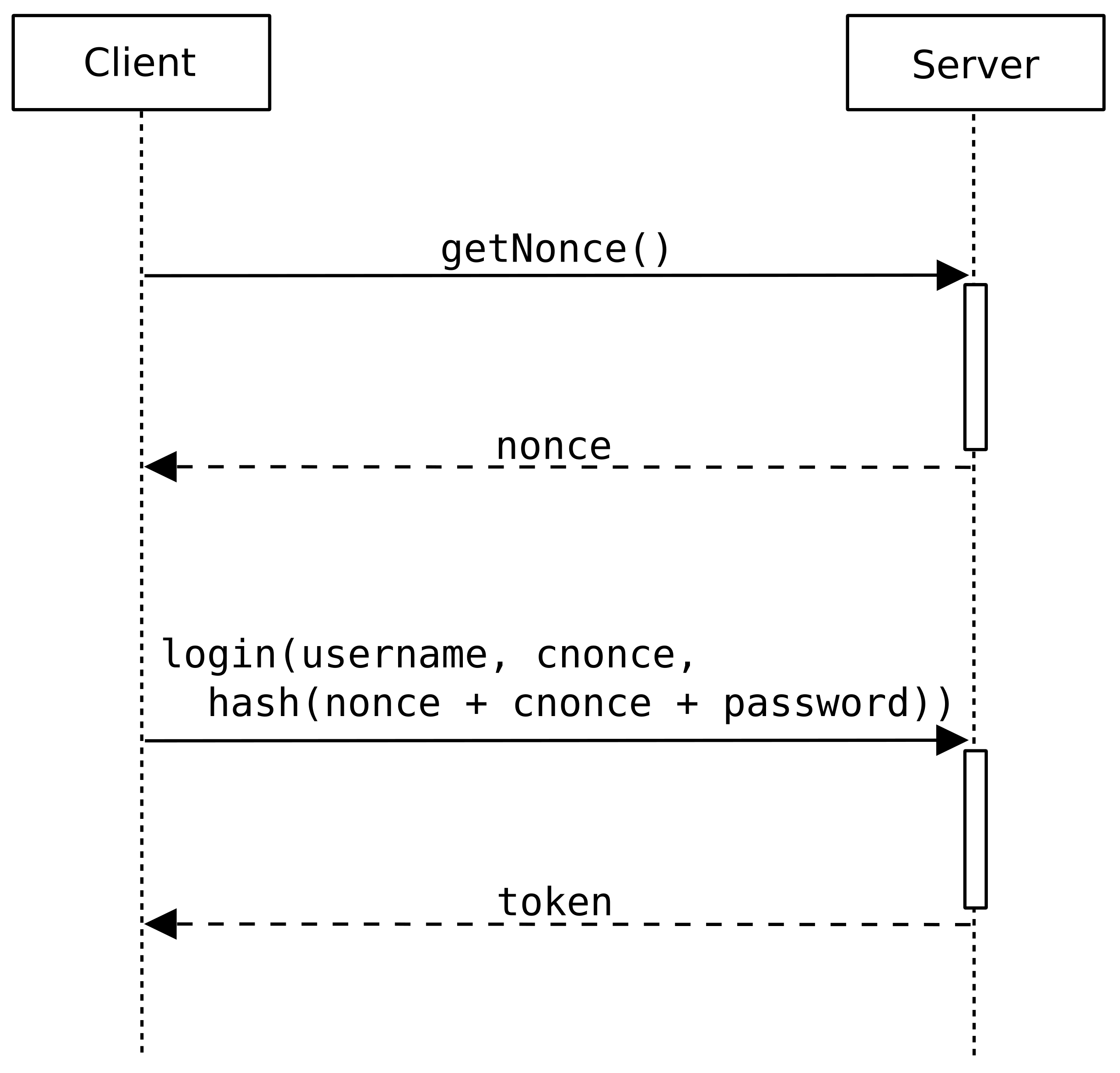
To search for a valid hash, miners tweak a value called a nonce (short for “number used once”). Here’s the idea.
Miners construct a block that includes:
- The list of selected transactions
- A timestamp
- A reference (hash) to the previous block
- The merkle root (a combined hash of all transactions in the block)
- A nonce value
They take this block header, run it through SHA‑256, and see if the resulting hash is below the target. If it’s not, they increment the nonce and try again. Over and over. Millions or billions of times per second.
Modern Bitcoin mining machines are purpose-built to test billions of nonce values each second. When one miner’s machine eventually generates a hash that satisfies the target, they broadcast that block to the network. If nodes verify it, they earn the block reward.
In simple terms, the nonce is the “guess” miners keep changing until the resulting hash is “good enough” under the rules.
Mining Difficulty and Adjustments
Bitcoin’s mining difficulty is a measure of how hard it is to find a hash below the current target. The protocol adjusts difficulty every 2,016 blocks—about every two weeks—to keep the average block time close to 10 minutes.
Technically, this adjustment is done by recalculating the target hash value. A higher difficulty means a lower target, which makes finding a valid hash harder.
This auto-adjustment is crucial for two reasons:
- It keeps Bitcoin’s issuance schedule predictable.
- It makes attacks expensive. As more hash power joins the network, difficulty rises, making the network harder to overwhelm.
For individual miners, high difficulty means fierce competition. Profitability becomes a question of who can use the hash power most efficiently and at the lowest electricity cost.
Block Rewards and Transaction Fees
Miners are paid in two main ways:
- The block reward (newly created coins)
- Transaction fees (tips users attach to their transactions)
In Bitcoin, the block reward used to be 50 BTC, halving approximately every four years. In other words, they get slashed in half to slow down the rate at which new Bitcoin is released into circulation. After the fourth halving on April 20, 2024, the reward stands at 3.125 BTC per block.
Miner or transaction fees are the second income stream. When users send Bitcoin, they usually but not necessarily include a fee to encourage faster confirmation. Miners naturally choose higher-fee transactions first to maximize revenue.
As block rewards keep halving, transaction fees are expected to play an increasingly important role in miner income. After the 2024 halving, for example, the “hashprice”—daily revenue per 1 TH/s of mining power—dropped to around $0.05, forcing miners to lean more on energy efficiency and fee income to stay profitable.
Consensus Mechanisms and Crypto Mining
Source: Chapter Eleven - Cryptographic consensus mechanisms☆☆Introduction to blockchain., Shubhani Aggarwal, Neeraj Kumar, Pethuru Raj, Advances in Computers vol.121 (2021)
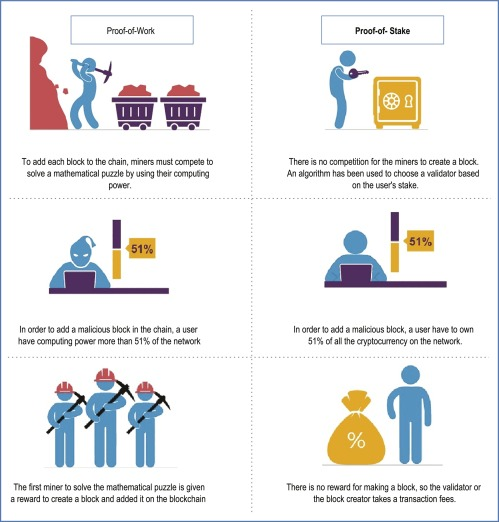
At a high level, consensus mechanisms are the rulebooks that tell a blockchain who gets to add the next block and which transactions are valid. As the name implies, those are hard-coded methods that dictate how a consensus, agreement in the network is reached between all or most participants. They replace the need for a central authority. In the mining world, two mechanisms dominate the conversation: Proof of Work (PoW) and Proof of Stake (PoS).
Proof of Work (PoW)
Proof of Work is Bitcoin’s original consensus mechanism and still the dominant model in mining.
PoW is widely considered to be secure after a certain participation threshold, which not a lot of blockchains are actually able to reach. When they do, the big security advantage is economical: the cost of a consensus attack. To try rewriting history or censoring transactions, an attacker would need to control more than 50% of the network’s total hash rate (hence the name “51% attack”). In practice, that means buying or renting enormous amounts of Bitcoin mining hardware and paying massive electricity bills. For Bitcoin, the cost of attempting such an attack is typically far greater than any realistic gain.
The trade-off of this algorithm is energy usage. Modern PoW mining often uses specialized ASIC hardware like the Bitmain Antminer S21 Pro, which achieves around 17.5 Joules per Terahash (J/TH) of efficiency. Powering thousands of these machines adds up to industrial-scale energy consumption, and in the end, only one gets the reward.
Critics point to this energy use as a downside; supporters argue it’s exactly what creates strong security guarantees. The energy spent on PoW is what makes Bitcoin expensive to attack.
Proof of Stake (PoS)
Proof of Stake takes a different route entirely and is not even mining per se. It also relies on economical incentives but instead of burning energy on top of that, it uses capital at risk.
Compare what we described above to PoS:
- Validators lock up (put at stake, hence the name) a certain amount of the network’s native token.
- The protocol selects validators to propose and attest to new blocks based on their stake and other factors.
- If validators act maliciously, part or all of their staked funds can be slashed (destroyed).
Because there’s no mining race and no need for specialized hardware, PoS is far more energy-efficient. A laptop or regular server can participate as a validator; there’s no requirement for a power-hungry Bitcoin miner machine.
Ethereum’s transition from PoW to PoS in 2022 is the most high-profile example. By switching off GPU mining and moving to validators, Ethereum reportedly cut its energy consumption by over 99% while maintaining security through economic penalties for bad behavior.
Comparison of Consensus Mechanisms
Here’s how PoW and PoS stack up side by side:
| Aspect | Proof of Work (PoW) | Proof of Stake (PoS) |
|---|---|---|
| Security Model | Based on computational power and energy cost | Based on economic stake and slashing |
| Energy Consumption | High (requires specialized mining hardware) | Low (no mining race) |
| Barrier to Entry | Requires ASICs/GPUs and cheap electricity | Requires owning and staking coins |
| Decentralization Risks | Hardware and energy access can centralize mining | Wealth concentration can centralize validation |
| Attack Cost | Need 51% of network hash rate | Need 51% of staked supply (usually even more due to higher consensus quorum) |
For mining specifically, we’re talking about PoW networks. When people ask “how to mine crypto,” they’re almost always referring to Proof of Work coins like Bitcoin and many altcoins. PoS networks use validators and staking rather than mining hardware.
Cryptocurrency Mining Beyond Bitcoin
Source: Wikimedia by Vysulo - Own work, CC BY-SA 4.0
Logically, Bitcoin isn’t the only game in town, especially if you’re looking at different hardware or strategies.
Ethereum Mining: A Historic Note
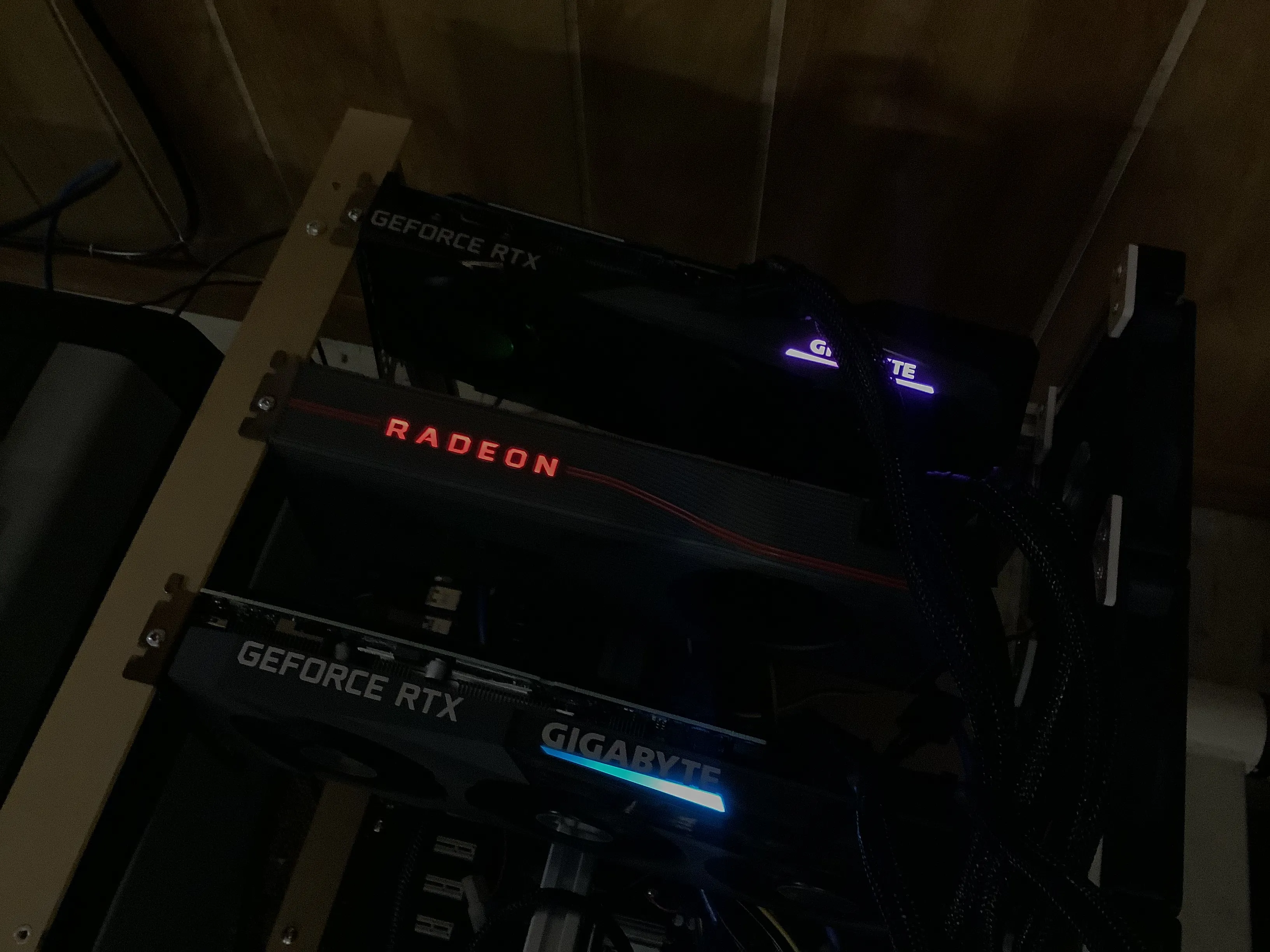
Ethereum used to be one of the biggest PoW mining networks, but as mentioned, that has changed. Before “The Merge,” Ethereum used Ethash, a memory-hard algorithm that favored GPUs (graphics cards) over CPUs and even ASICs. Ether miners built GPU farms that validated Ethereum blocks and earned ETH rewards, similar in spirit to Bitcoin mining but with different hardware and parameters.
With The Merge, Ethereum switched from PoW to PoS. Mining ended completely on the main Ethereum chain. There are no more block rewards for solving puzzles; instead, validators stake ETH and earn rewards for proposing and attesting to blocks.
The process was not a surprise to anyone: in fact, it was coded into the protocol from the very start. Nevertheless, when the time came, miners who had invested in Ethereum-focused GPU rigs had to pivot anyway. Many switched to other GPU-friendly PoW coins like Ethereum Classic, Ravencoin, or other altcoins. Others sold their hardware or repurposed it for non-mining workloads. The most stubborn ETH miners remained on the PoW chain, hard-forking it, adopting the name EthereumPoW (ETHW) but by late 2025, the coin barely shows any signs of life.
Altcoin Mining Opportunities
With Ethereum moving on, altcoin mining did not go extinct. Hundreds of altcoins still use various PoW algorithms and offer mining opportunities, often with lower competition than Bitcoin.
Some well-known mineable altcoins and their algorithms:
- Litecoin — Scrypt (originally designed to be ASIC-resistant, though Scrypt ASICs now exist); merge-mined with Dogecoin (DOGE)—a two-in-one deal!
- Monero — RandomX (CPU-optimized, ASIC-resistant)
- Ravencoin — KAWPOW (GPU-friendly)
- Zcash — Equihash (memory-oriented)
Besides technical differences, different algorithms favor different hardware:
- SHA‑256 (Bitcoin) → ASICs
- Scrypt → ASICs (though less intense arms race than SHA‑256)
- RandomX → CPUs
- Many others → GPUs
The benefits of altcoin mining include lower difficulty, potentially lower hardware costs, and more flexibility, especially if you already own GPUs or CPUs that you don’t regularly use.
It’s not all benefits, of course. Altcoins are generally more volatile and less liquid than Bitcoin. You might mine more coins, but their price can swing dramatically, and converting them to fiat or stablecoins can be less straightforward, if even possible.
Types and Methods of Crypto Mining
Now that you understand how mining works conceptually, the next question is more practical: how do you participate?
Solo Mining
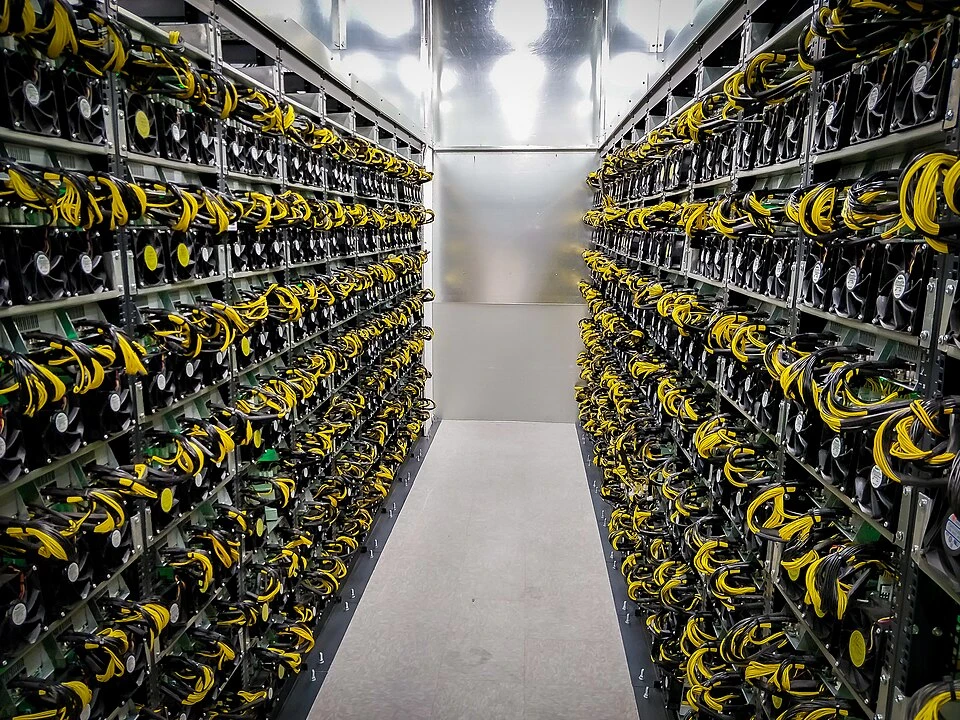
As the name implies, solo mining means you mine completely on your own. You set up your Bitcoin mining rig, run full node and mining software, but also compete directly with the entire network.
To make it at least minimally feasible, you’ll need:
- At least one high-performance ASIC Bitcoin miner machine
- Stable internet and power
- Mining software and a full node (if you want to verify independently)
- A Bitcoin wallet to receive any rewards
The upside is clear: if you mine a block, you keep 3.125 BTC or more. No pool fees, no sharing.
Source: Wikimedia, by MikeBogosian - Own work, CC BY-SA 4.0
The downside is also clear: with today’s Bitcoin mining difficulty, your odds as a small solo miner are extremely low. You could mine for months or years without ever finding a block.
Solo mining makes the most sense for very large operations with significant hash rate (effectively behaving like a pool), and miners targeting smaller PoW altcoins with lower difficulty
Mining Pools
Mining pools are collectives of miners who combine (pool together, if you will) their hash power and share rewards. Here’s how it works:
- You connect your miner’s hash power to a pool server instead of solo mining.
- The pool’s software distributes work across all connected miners.
- When anyone in the pool finds a block, the reward goes to the pool.
- The pool then pays each participant based on their contributed hash rate.
This approach smooths out income. You won’t get the occasional huge payout of a solo block, but you increase your chances of smaller, more frequent payouts that reflect your share of the pool’s total hashing power.
Pools typically charge a fee (often 1–3%) for coordination, infrastructure, and support. Popular Bitcoin mining pools include Foundry USA, AntPool, and F2Pool.
How to Choose a Mining Pool
Evidently, not any mining pool delivers the same results in terms of returns and experience. Some things you should consider:
- Pool size and hash rate:
Larger pools find blocks more frequently, leading to steadier payouts. Extremely large pools, however, can raise decentralization concerns if they control too much of the network’s hash rate. - Fee structure:
Pools charge different fixed or variable fees. A lower fee is better all else equal, but reliability and transparency matter more than saving a fraction of percent. - Payout method:
Common systems include:- PPS (Pay Per Share): you get paid for each share submitted, regardless of block finds—stable income.
- PPLNS (Pay Per Last N Shares): you get paid only when the pool finds blocks, but you may earn more on average if the pool performs well.
- Minimum payout thresholds:
If it’s too high, your rewards accumulate slowly and sit in the pool before you can withdraw. - Location and latency:
Pools with servers closer to you usually provide lower latency and more consistent share submission. - Reputation and transparency:
Look for clear statistics dashboards, detailed documentation, and responsive support. Community feedback matters here.
In short, you want a pool that communicates clearly, pays reliably, and aligns with your risk and payout preferences.
Cloud Mining
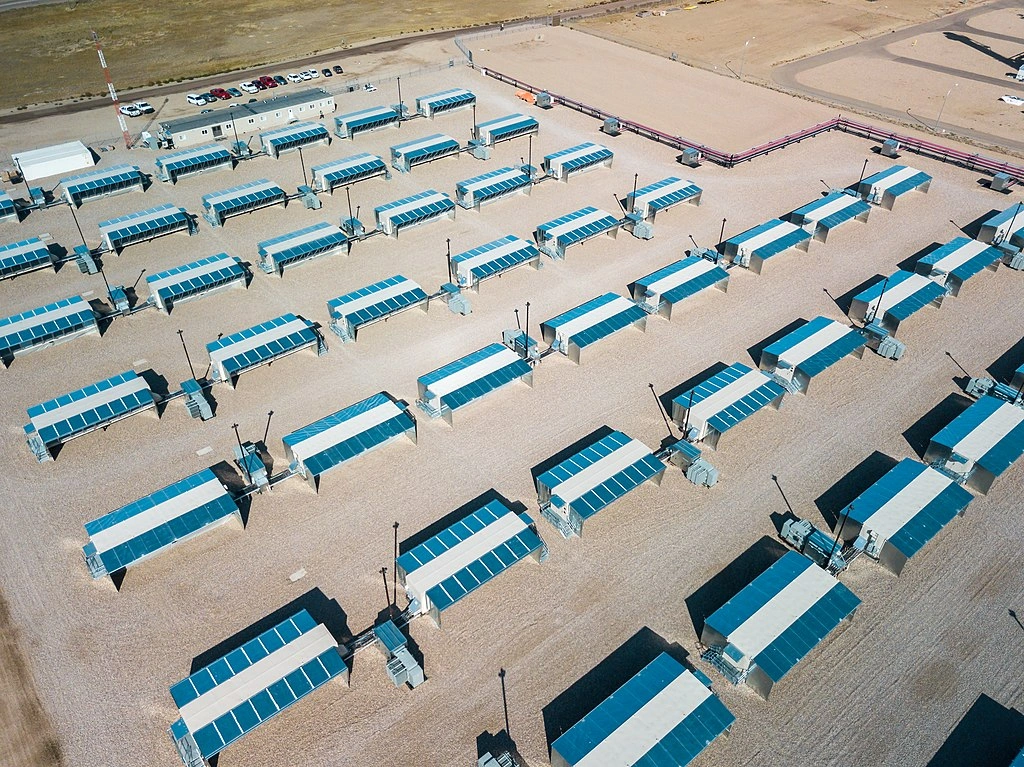
Here is where it gets even less certain. Cloud mining services let you rent hash power operated by someone else. So, instead of buying and running your own Bitcoin mining hardware, you purchase a contract specifying hash rate (e.g., TH/s), duration (e.g., 12 months), and fees and maintenance costs. In return, you receive payouts based on the performance of that rented hash power.
The appeal is obvious: no hardware purchases, no noise at home, no dealing with heat, electricity, or maintenance. Platforms like NiceHash and various cloud mining providers offer this model.
Source: By Curtis Huisman/Flickr, CC BY 4.0
The reality is more complicated: many contracts become unprofitable when difficulty rises or Bitcoin’s price drops; you have limited transparency into actual operations. And most egregiously of all, a lot of offerings in the space are poorly managed or outright scams.
Before signing any cloud mining contract, you must carefully calculate expected earnings at current hashprice and difficulty, contract cost with embedded fees, and break-even timeline and risk scenarios. Most experienced miners view cloud mining as high-risk compared to buying hardware or simply buying and holding Bitcoin. If a deal sounds too easy and guaranteed, be extra cautious.
Bitcoin Mining Equipment and Hardware
Learning about machines that take part in the process can be equally insightful to get a better understanding of it. After all, it’s what largely determines whether mining is viable or just an expensive noise generator.
Choosing the Right Mining Rig
The first big decision when thinking about how to mine crypto is choosing between ASIC and GPU mining hardware. As mentioned before, the coin choice majorly factors into it:
- ASIC miners (Application-Specific Integrated Circuits):
Purpose-built machines for specific algorithms (like SHA‑256 for Bitcoin). They deliver huge hash rates and excellent efficiency but can’t be repurposed for other uses. They’re the standard for Bitcoin mining. - GPU miners (Graphics Processing Units):
Versatile graphics cards that can mine many different algorithms (and be used for gaming or compute jobs). They’re far less efficient for Bitcoin and essentially obsolete for serious SHA‑256 mining but still relevant for some altcoins.
For Bitcoin mining specifically, ASICs have completely outpaced GPUs years ago. Using GPUs on Bitcoin now is like racing a bicycle against Formula 1 cars.
The performance metric that matters most is efficiency, measured in Joules per Terahash (J/TH). Lower J/TH means less electricity to produce the same amount of hash—in other words, lower operating costs.
Essential Mining Hardware
Current-generation Bitcoin mining machines aim to balance raw hash rate with energy efficiency. Top-tier models churn out hash rates exceeding 200 TH/s (200 trillion hashes per second). That’s hundreds of thousands of times faster than early Bitcoin CPUs.
Typical specs for high-end ASICs include:
- Hash rate: 150–400 TH/s
- Power consumption: 3,000–5,500 watts
- Efficiency: 15–25 J/TH
- Operating temperature: requires robust cooling (fans, airflow, or immersion systems)
- Expected lifespan: 3–5 years under good conditions
Because mining rigs run 24/7, reliability is as important as peak performance. Premium manufacturers usually offer better build quality and warranties, which can matter a lot over the lifespan of your machines.
Mining Hardware Evolution
Source: Wikimedia, by Someone Not Awful - Own work, CC BY-SA 4.0
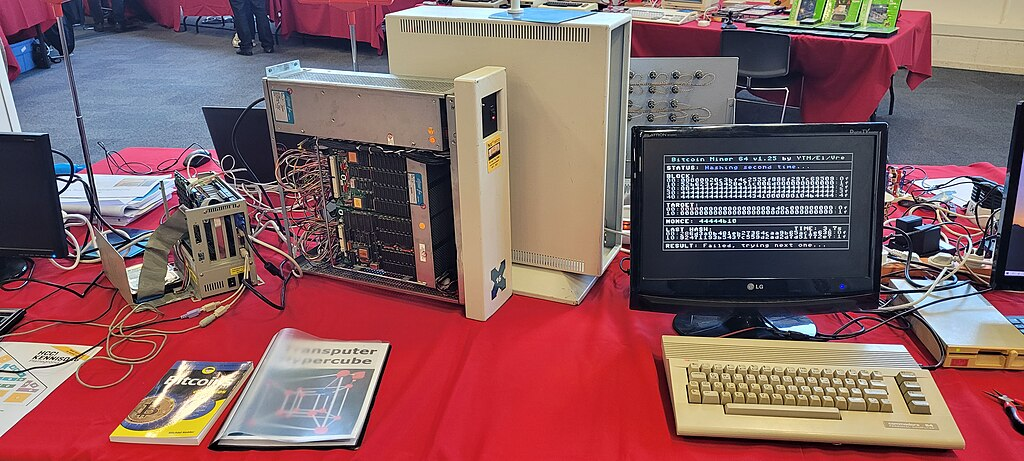
Bitcoin’s mining hardware has gone through several distinct eras, each one making the previous obsolete.
- CPU Mining (2009–2010):
In the earliest days, Satoshi Nakamoto and the first users mined Bitcoin with standard computer processors. Anyone with a regular desktop could participate. - GPU Mining (2010–2013):
Miners realized that graphics cards could perform many hashing operations in parallel. GPU rigs boosted hash rates by 50–100x compared to CPUs. This era also saw the birth of early Bitcoin mining pools. - FPGA Mining (2011–2013):
Field-Programmable Gate Arrays offered better efficiency than GPUs and were programmable. They were a transitional step toward full custom hardware. - ASIC Mining (2013–Present):
ASICs changed everything. These chips are designed solely for Bitcoin’s SHA‑256. Early ASICs delivered 5–10 GH/s. Today’s top models exceed 200,000 GH/s (200 TH/s), making CPUs and GPUs hopelessly outmatched for Bitcoin.
As hardware improved, Bitcoin’s mining difficulty climbed, making the network progressively harder to compromise. At the same time and for the same reason, mining shifted from a hobby you could run on your home PC to a capital-intensive business dominated by industrial-scale crypto farms.
What You Need to Start Mining Cryptocurrency
So what does it actually take to start mining—beyond enthusiasm?
Mining Hardware Setup
For Bitcoin, mining realistically means ASICs, even in a pool. Beginner-friendly ranges for ASICs often fall between $2,000 and $15,000 per unit, depending on hash rate, efficiency, brand and model, and even market conditions (bull vs bear markets).
But the miner itself is only part of the setup. You’ll also need:
- Sturdy shelving or rack systems (these machines are heavy!)
- Reliable, high-capacity power circuits and quality power supplies
- Stable, low-latency internet
- Adequate cooling and ventilation (fans, ducting, or more advanced solutions)
- A suitable physical location (garage, warehouse, hosting facility)
GPU rigs still have a role for certain altcoins but are generally not competitive for Bitcoin itself.
Electricity and Operating Costs
Mentioned only briefly so far, electricity is in fact the make-or-break factor for most miners. A single modern ASIC draws roughly 3,000–3,500 watts continuously. At 3,500 W, that’s 3.5 kW. Over a day at an electricity rate of $0.10 per kWh, that’s ≈$252 per month in power for just one machine.
After the April 2024 halving, which is supposed to make Bitcoin more valuable in the long term, the drop in hashprice to around $0.05 per TH/s per day left many miners on thin margins. If your electricity rate is high, mining can become unprofitable quickly.
Serious miners seek locations with very cheap electricity, negotiate industrial rates with utilities and co-locate near renewable sources like hydro or wind where excess energy is available. In fact, cheap and subsidized electricity is more of a reason more miners shift to environmentally-friendlier energy sources than concerns about the ecology.
Economics of Crypto Mining
Mining looks attractive because it turns electricity and hardware into cryptocurrency. Whether that’s actually worth it depends on the underlying economics.
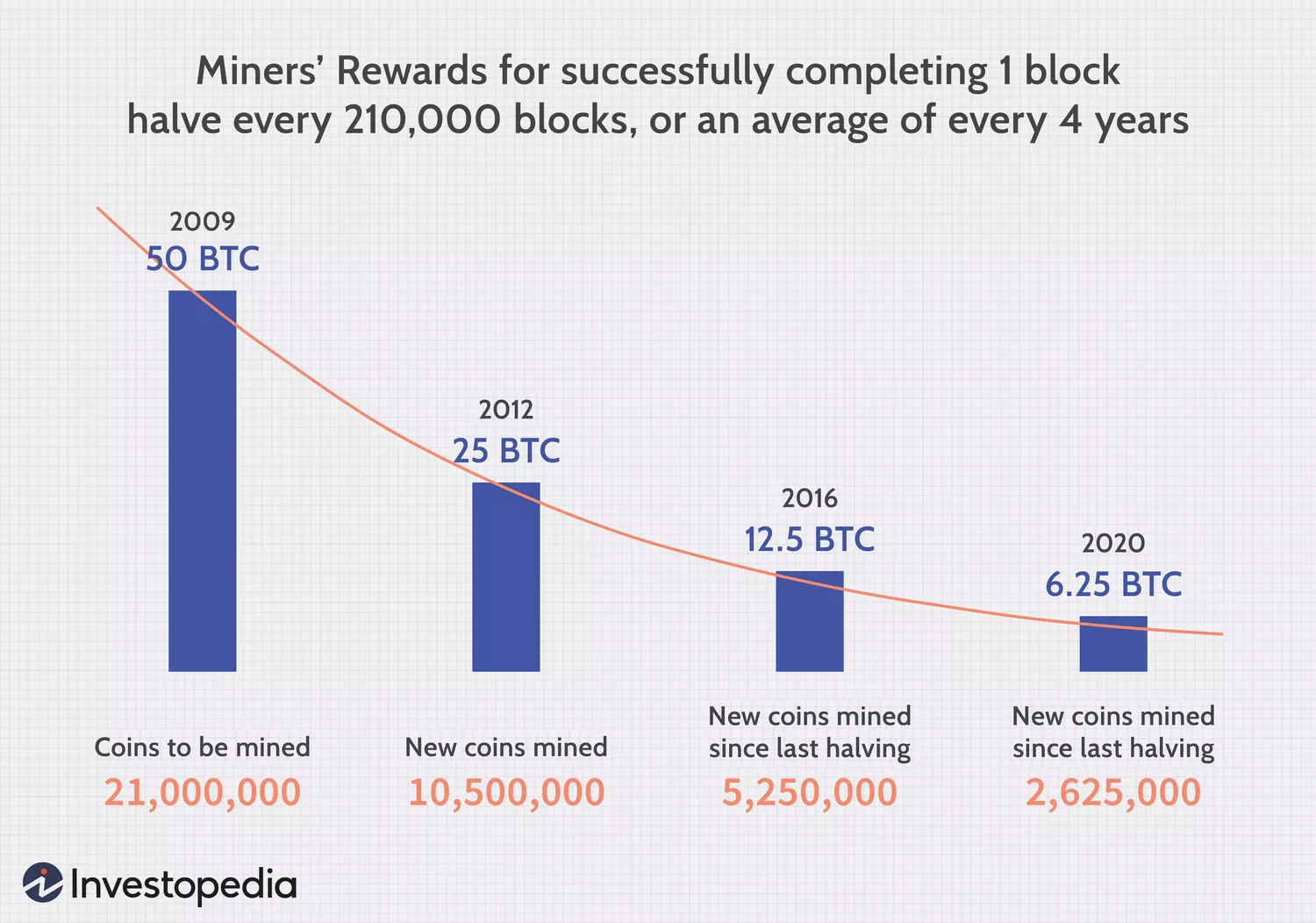
Image by Sabrina Jiang © Investopedia 2021
Incentives for Miners
Miners are paid to secure the network, process and confirm transactions by adding new blocks—quite an important job! Their compensation comes from the block reward (new coins) plus transaction fees from the transactions included in the block they add.
You can think of the block reward as a base salary and the fees as tips. The more demand there is for block space (i.e., the more people are transacting and willing to pay higher fees), the more “tip income” miners receive.
Bitcoin Supply and Demand Dynamics
An important detail that we can now bring up is that Bitcoin has a hard supply cap of 21 million coins. This is written into the protocol and enforced by every full node.
As of 2025, around 19.9 million BTC have already been mined, leaving roughly one million to be issued over the next 100+ years. New supply comes only from block rewards, which decrease over time via halving events.
When demand for Bitcoin increases while supply remains fixed or grows more slowly, basic economics suggest upward price pressure. This scarcity is a big part of why people compare Bitcoin to “digital gold.”
For miners, Bitcoin’s price is crucial. Earning 3.125 BTC per block means very different things at $30,000 vs. $60,000 per BTC. Their profitability is tied to both your technical performance and market conditions.
Issuing New Coins and Halving Events
Bitcoin’s issuance schedule is controlled through halving events. Roughly every 210,000 blocks (~4 years), the block reward is cut in half: from 50 to 25 in 2012, to 12.5 BTC in 2016 and so on.
Each halving significantly reduces the flow of new Bitcoins entering the market and momentarily cuts miner income (in BTC terms) in half. Although it forces miners to re-evaluate whether their hardware and electricity costs still make sense, these events are predictable and known in advance.
Is Crypto Mining Worth It?
Whether crypto mining is “worth it” comes down to a simple inequality: mining revenue > mining costs. But each side of that equation has moving parts.
High-end machines offer strong efficiency, but they also require substantial upfront investment and good electricity rates to make sense. If your electricity costs are high, you’re fighting an uphill battle, especially after halving events. Many home miners in such regions discover that buying Bitcoin directly is more cost-effective than mining it.
On the other hand, large-scale farms with industrial rates below $0.05–$0.06 per kWh, or access to cheap renewable energy, can still operate profitably, especially if they optimize cooling and negotiate favorable power contracts.
Profitability and Legality of Bitcoin Mining
Now let’s address two of the biggest practical questions: “Is Bitcoin mining profitable?” and “Is Bitcoin mining legal where I live?”
Is Bitcoin Mining Profitable?
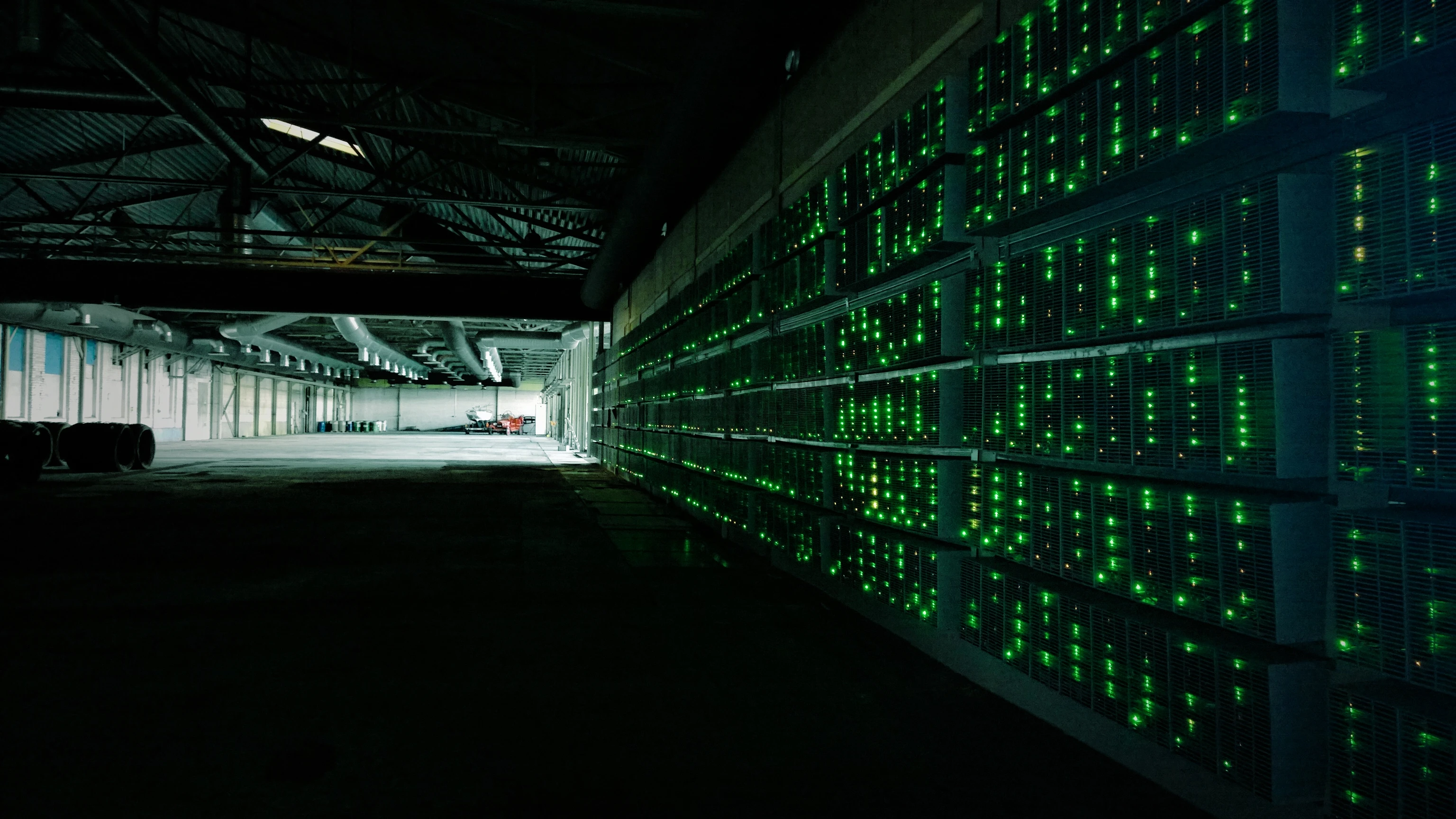
As of 2025, Bitcoin mining profitability is highly location- and hardware-dependent.
Source: Marko Ahtisaari/Flickr, CC BY 2.0
The April 2024 halving immediately squeezed margins for miners without very efficient hardware, cheap electricity, and overall well-optimized operations. If you’re paying more than about $0.06 per kWh, you may struggle to turn a consistent profit unless Bitcoin’s price rises significantly.
Mining farms in regions with abundant renewable energy or special industrial rates can maintain profitability. As opposed to home miners on residential rates, who often find conditions challenging, especially if they didn’t buy hardware at a favorable price.
Mining tends to be most attractive during bull markets and most painful during prolonged price declines. Many miners adjust operations, scaling up or down, based on these cycles.
Legal Considerations in Bitcoin Mining
Globally, most jurisdictions treat Bitcoin mining as a legal business activity, but the rules around it vary widely. Typical legal and regulatory considerations include:
- Business registration:
You may need to register as a business entity if you mine at scale or intend to treat mining as a commercial operation. - Electrical and zoning permits:
High-power setups can require special electrical work and compliance with local building or zoning codes. - Tax reporting:
Mined coins are usually treated as income when received and may be subject to capital gains taxes when sold. - Financial regulations:
In some regions, regular conversion of mined coins into fiat currencies may trigger additional tax reporting or licensing requirements, especially if you serve customers or run a hosting business.
Energy regulations are also becoming more relevant. Some regions monitor or restrict high-consumption activities or require environmental disclosures.
Where Bitcoin Mining is Illegal
Ergo, not every country is friendly to mining. At least 11 countries, including China, Egypt, and Iraq, have an absolute ban on cryptocurrency mining.
Once the world’s mining capital, China banned all cryptocurrency mining in 2021, citing financial and environmental concerns. Egypt prohibits crypto-related activity on religious and regulatory grounds. Partially similarly, Iraq bans mining and trading also to protect its monetary system.
Other countries with strict restrictions include:
- Algeria: Broad ban on cryptocurrency usage and mining.
- Bangladesh: Banking rules effectively prohibit crypto activities.
- Morocco: Ban on mining and trading since 2017.
- Nepal: Mining is treated as illegal under financial regulations.
- Qatar: Prohibits crypto activities under central bank policies.
Some jurisdictions live in a gray area where mining isn’t explicitly illegal but lacks a clear legal framework, creating risk for anyone looking into this endeavor.
Tax Implications and Record Keeping
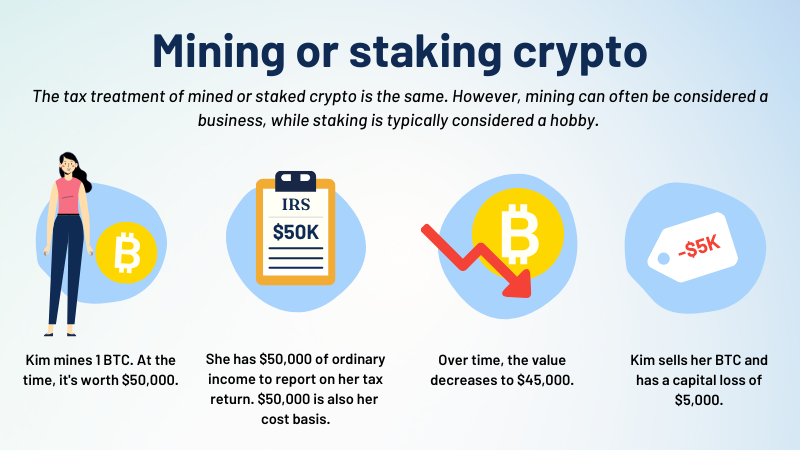
Tax treatment of mining varies, but some patterns are common across many countries. Typically, mined coins are taxed as income at their fair market value when you receive them. If you later sell those coins for more than their value at receipt, the difference is treated as a capital gain. But if you sell for less, you may realize a capital loss.
Source: Gordon Law
To stay compliant (and to maximize your deductions), good record-keeping is non-negotiable. For larger operations or any scale that would justify the cost, specialized crypto accounting software can automate much of this. Tax authorities are paying closer attention to crypto, so documentation becomes your best defense in case of audits.
By the way, many operational costs—electricity, depreciation, rent, repairs—can often be deducted as business expenses, but you’ll need clean records and, ideally, professional advice.
Geographic and Regulatory Landscape
Where you mine can be just as important as how you mine. Mining-friendly jurisdictions tend to combine low electricity costs and good accessibility, stable and transparent regulations, and access to infrastructure and talent.
Examples of mining-friendly jurisdictions include:
- United States:
Certain states like Texas, Wyoming, and North Dakota are especially friendly, with competitive electricity prices and relatively clear rules. Some programs even pay miners to power down during grid stress events. - Canada:
Provinces with abundant hydroelectric resources, like Quebec and parts of Alberta, attract miners with cheap, renewable power and cool climates. - Kazakhstan:
Offers low electricity rates, though regulatory changes and power shortages have introduced new challenges. - Iceland:
Geothermal and hydro power, combined with naturally cold weather, create ideal conditions, though total capacity is limited. - Paraguay:
Hydroelectric energy and low power costs have drawn increasing mining interest.
Regulations for mining vary widely by region:
- North America:
The U.S. and Canada generally allow mining but treat it as a business activity subject to taxation, reporting, and, in some cases, environmental rules. - European Union:
Most EU countries permit mining but may impose additional taxes or environmental requirements. Policy discussions around energy usage are active. - Asia-Pacific:
It’s a mix—from supportive hubs like Singapore to restrictive environments like China, which has a full mining ban. - Middle East:
Some countries (e.g., UAE, Bahrain) are open to crypto businesses, while others maintain strict prohibitions. - Latin America:
Several countries are open or actively encouraging crypto adoption (e.g., El Salvador), but regulatory frameworks can be less mature.
The global trend is toward more nuanced regulation rather than blanket bans in many regions.
Risks and Downsides of Crypto Mining
No matter what anyone tells you, mining isn’t just about upside. There are serious financial and operational risks you should weigh before getting in.
Financial Risks and Profitability
Mining profitability can turn on a dime because of factors outside your control. For one, Bitcoin’s price can swing dramatically, amplifying or erasing margins even if your hash rate and power costs stay the same. Electricity rates can change, too. Regulations can add new costs. Difficulty can spike if a lot of hash power suddenly comes online.
A machine that looks great today may be borderline in 18–24 months as mining difficulty rises and more efficient models arrive. Even highly efficient units will eventually be outclassed.
In fact, many miners operate on slim margins where a 10% rise in electricity or a sizable difficulty increase can flip them from profit to loss. It’s very much a business, not a guaranteed passive income stream.
Operational Challenges and Hardware Wear
Source: de Vries, Alex; Stoll, Christian (December 2021). "Bitcoin's growing e-waste problem". Resources, Conservation and Recycling.
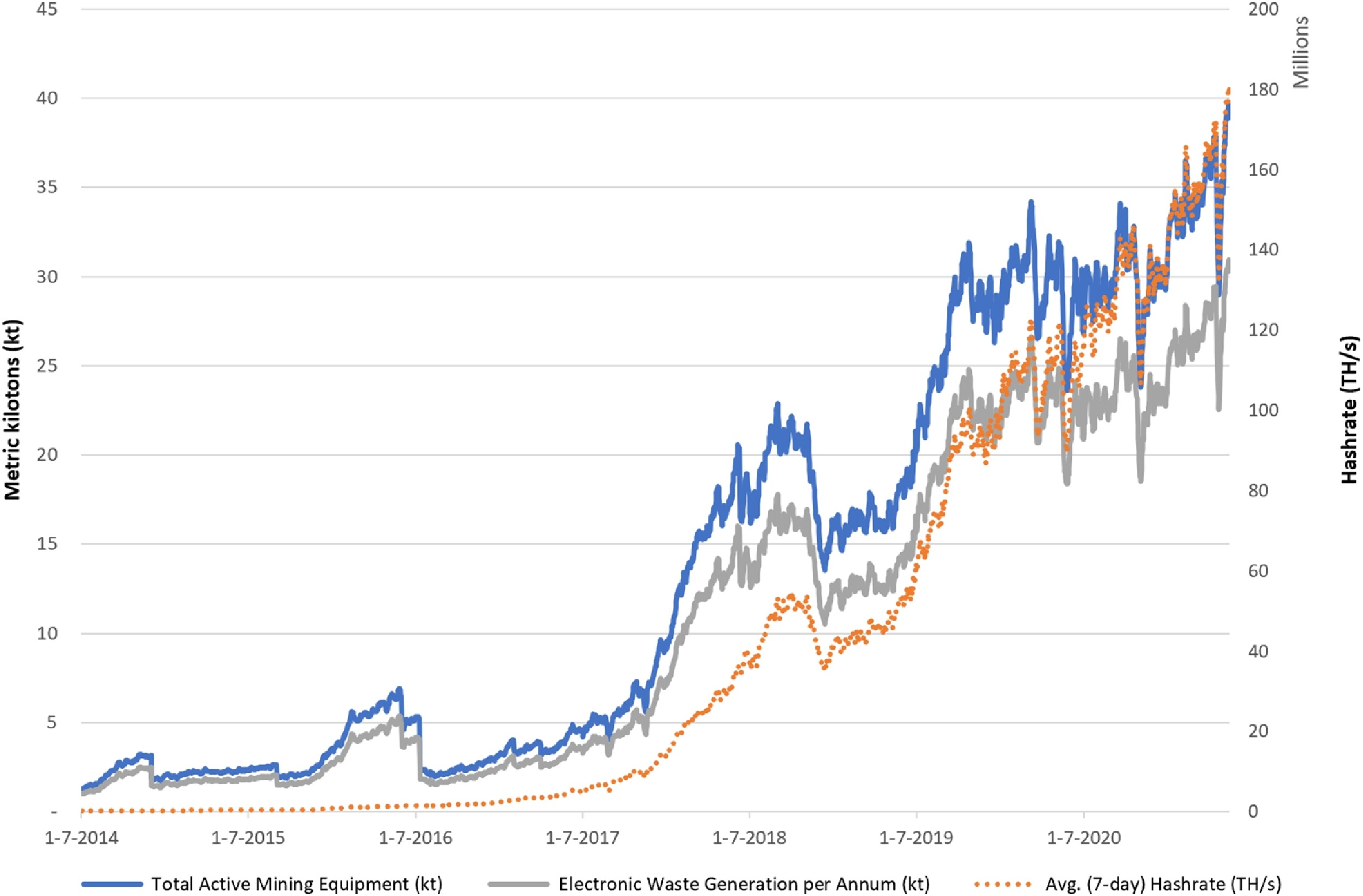
Another common misconception is that running a Bitcoin mining rig is “set and forget.” This just cannot be the case when hardware is pushed near its limits around the clock.
First of all, the noise and heat: ASICs run hot and loud. Poor cooling can lead to thermal throttling, shutdowns, or permanent damage. Fans, power supplies, and chips can and will eventually fail under constant stress. And downtime means lost revenue plus repair costs.
Moreover, dust accumulation impairs cooling, while humidity and poor airflow can further shorten equipment life. Typical ASIC lifespan is 2–3 years under continuous operation before efficiency degradation or failures make them less competitive. In other words, it’s not a question of if your hardware will fail, but when—and whether you’ve prepared for that.
Environmental Impact of Crypto Mining
The guide can’t be considered complete without addressing a major point of contention that mars mining’s reputation. Energy usage and environmental impact are still some of the most debated aspects of Bitcoin mining today.
Mining’s Energy Consumption
It comes as no surprise running thousands of high-powered Bitcoin mining machines 24/7 consumes a lot of energy. Each rig might draw 3,000–5,500 watts; scaled across large Bitcoin mining farms, total consumption rivals that of heavy industrial facilities; all for a chance to get 3.25 bitcoins a time.
Mining hardware is getting more efficient with every generation, but overall network usage remains significant because miners collectively keep adding more hash power.
Why is this controversial? Many grids still rely on fossil fuels. When miners plug into regions powered mainly by coal or natural gas, the associated carbon emissions can be substantial.
This is not the most obvious but an important lens when asking “is Bitcoin mining profitable?” because externalized environmental costs eventually feed back into regulations, electricity pricing, and public pressure.
Sustainable Mining Practices
The good news is that mining doesn’t have to be so dirty. In fact, there are strong economic incentives to go green!
Many miners now seek hydroelectric power from dams with excess capacity, geothermal energy in regions like Iceland and El Salvador, wind and solar projects with surplus generation and stranded energy sources, like flared gas that would otherwise be wasted.
Using renewable or otherwise wasted energy can lower electricity costs for cheaper production or subsidies; improve public perception and regulatory relationships, which is not irrelevant; and maybe, reduce exposure to fossil fuel price swings. After the 2024 halving, the drive to find the cheapest possible power pushed even more miners toward renewables and innovative energy partnerships.
Security Concerns in Crypto Mining
Mining is an undertaking that involves real money, expensive hardware, and critical infrastructure. That and many other factors naturally attract attackers.
Mining Pool Security
Mining pools are appealing targets for attacks since they concentrate hash power and payout management. Potential risks include 51% attacks, which might be a concern in smaller networks, or pool operator compromise.
The former is about a vector of attack if a pool or colluding group controls more than half of a coin’s total hash rate, they can theoretically reorganize recent blocks and double-spend. For Bitcoin, this is extremely unlikely due to the enormous total hash rate, but some smaller PoW coins are more vulnerable.
The latter poses a risk if an attacker takes control of a pool, they could redirect payouts, misreport statistics, or sabotage operations.
Luckily, you can protect yourself when using a Bitcoin mining pool by choosing pools with strong reputations and transparent stats, enable two-factor authentication (2FA) where available while using unique, strong passwords and taking advantage of features like payout address whitelists.
Hardware Security
Your Bitcoin mining hardware is not just costly but valuable both as equipment and as a potential access point to your funds. Security layers that protect it from threats include physical security, firmware integrity and supply chain vigilance.
- Locks, access control, cameras, and secure facilities prevent theft of equipment and valuables.
- Miners run firmware that controls their behavior. Malicious firmware can redirect your rewards to someone else silently. Always:
- Download firmware updates only from official sources.
- Verify checksums when possible.
- Be very cautious with third-party firmware unless you fully trust and understand it.
- Counterfeit or tampered miners occasionally show up in secondary markets. Buy from reputable dealers, inspect hardware upon arrival, and test behavior before placing units into production.
Spending a bit more time and care upfront can save months of invisible revenue loss later.
Network Security Implications
Miners’ security matters not just to themselves—granted they contribute directly to network-wide security. Therefore, damage to a mining operation with denial of service (DDoS) or routing (eclipse) attacks can send ripples across the network, potentially threatening its integrity and value as a whole.
It’s in the miner's responsibility to mitigate these by using reliable ISPs and consider redundancy, VPNs or secure tunnels where appropriate, and connecting to well-managed pools with robust infrastructure. Your operation, even if small, is part of the broader defense system that keeps Bitcoin running securely.
Illegal and Malicious Crypto Mining
There is also one thing giving mining a bad reputation that needs mentioning. Not all crypto mining is done by people who own the hardware or pay the electricity bill: some attackers hijack other people’s devices to mine for themselves.
Cryptojacking
Called cryptojacking, this is unauthorized crypto mining on someone else’s device without consent. Cryptojacking commonly comes in a browser-based form and locally via malware.
- Malicious or undisclosed JavaScript that runs in your browser when you visit certain sites, using your CPU to mine until you close the tab, and
- Malware installed on your system that runs in the background, mining constantly, respectively.
Browser-based cryptojacking surged around 2017 with services like Coinhive, which allowed sites to embed JavaScript miners. Some sites were transparent, offering an ad-free option in exchange for resource use. Many, however, installed scripts quietly.
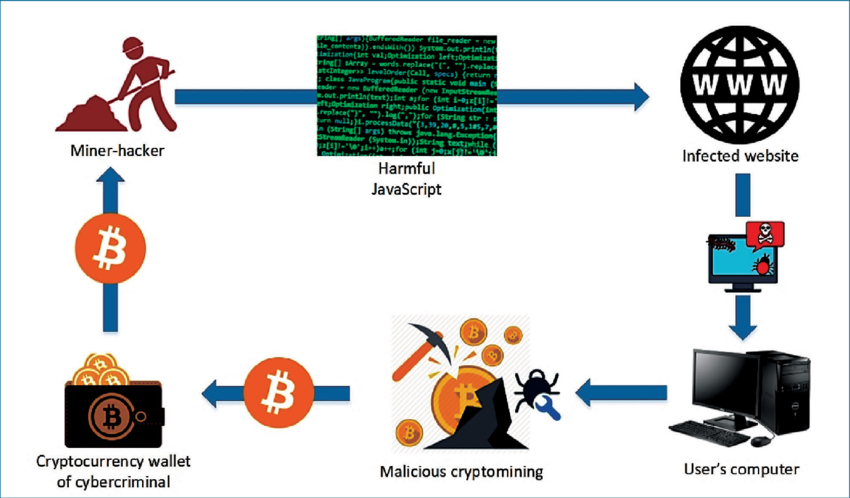
Source: Cryptojacking: Definition, Implementation, Effects and Protection Against That Form of Cyberattack. Is Malicious Cryptomining a Manifestation of the Crisis Behaviour of Individual Miners During Cryptocurrency Rush?
If your CPU usage spikes to 80–100% on specific sites, fans ramp up and devices overheat during simple browsing, or battery drains unusually fast on laptops or phones, those are all signs of browser cryptojacking. Extensions like MinerBlock and Anti-WebMiner, as well as general ad blockers, can help detect and block these scripts.
Mining Malware
Mining malware is more persistent and dangerous than browser scripts on sites you can close.
You can get it from a phishing email with malicious attachments, pirated software, compromised websites or ads, or even from an exploit targeting unpatched systems. Once installed, the malware runs a hidden miner that uses your CPU or GPU, often attempting to evade detection by throttling activity or obfuscating names; it may spread across your network to other vulnerable devices.
Mining malware can be removed by running updated antivirus and anti-malware scans, identifying and killing suspicious processes, and if the infection is deep, restoring from clean backups, provided you have them. Act quickly if you suspect infection—the longer it runs, the more damage and cost it can cause.
How to Protect Yourself from Illegal Crypto Mining
Preventing unauthorized mining combines standard cybersecurity hygiene with a few crypto-specific tips.
Best practices:
- Keep your OS, browsers, and plugins updated.
- Use reputable ad blockers and, if needed, dedicated anti-mining browser extensions.
- Run comprehensive antivirus or endpoint security software.
- Be cautious with email attachments and downloads—especially pirated software or “free” mining tools.
- Regularly review system performance and resource usage.
If you run legitimate mining hardware, it’s wise to isolate your mining network from your everyday devices. That way, a compromise on one side doesn’t automatically affect the other.
Remember: legitimate crypto mining is transparent and consensual. Anything else is theft of computing resources and, increasingly, a criminal offense.
Conclusion
Crypto mining in 2025 is a mature, competitive, and rapidly evolving industry. Anyone can join but not anyone is guaranteed to profit, though. With the right understanding of how it works, realistic expectations, and careful planning, you can decide whether mining fits your risk tolerance, budget, and long-term goals.
To keep learning about blockchain and crypto, bookmark ChangeHero Blog. Follow us onX, Facebook, Telegram and be the first to get notified.


