
What Can You Buy With Bitcoin and Cryptocurrency In 2026?


As a digital currency that is not tied to any single bank or country, Bitcoin enables people to buy goods and services just like regular money does—on paper. In the 2026 economic landscape, where inflation headlines, tighter regulations, and faster payments are all happening at once, that “independent money” pitch stops being abstract and starts being practical. If you can hold Bitcoin in a wallet, you can potentially spend it globally, online, and sometimes in-person, without needing the merchant to share your banking rails or even be in the same payment network.
Adoption is the reason this is getting easier, not harder. More businesses have started to accept Bitcoin directly or indirectly (usually via payment processors that convert BTC to local currency at checkout). That matters because it widens the everyday “shop” use cases beyond the early-days novelty purchases. Think less “because I can” and more “because it’s convenient,” especially for cross-border payments, freelancers, travelers, and anyone who already keeps part of their savings in BTC.
The institutional angle is the other big signal. When a significant portion of the supply sits with entities that have compliance departments and auditors, the market starts behaving differently: more custody options, more integrations, and more mainstream expectations around how you can move and secure your Bitcoin.
So, what can you actually buy with Bitcoin by 2026? The list is no longer limited to gift cards and a handful of tech stores. People use BTC to spend on travel, digital subscriptions, services, and everyday purchases wherever merchants accept crypto checkout—plus a growing menu of indirect routes (cards, apps, and conversions) that make the process feel familiar.
What You Can Buy With Bitcoin
Electronics and Technology

Bitcoin buys electronics through direct checkout at crypto-friendly retailers or through payment processors that convert BTC at the register (so the merchant still receives fiat). Newegg is the classic example here: shoppers can pay with Bitcoin at checkout, and the flow typically runs through a processor like BitPay for pricing, confirmation, and settlement. That matters because electronics purchases are often time-sensitive (limited stock, quick price changes), and processor rails tend to make the experience feel closer to a card payment.
The category itself is broad: laptops, GPUs, PC parts, monitors, networking gear, the “small but pricey” stuff like smartphones and wearables, and everyday computers and accessories you’d otherwise buy with a card. Overstock is another recognizable name that has historically supported crypto payments, and even when a given retailer pauses or changes integrations, the bigger trend remains: merchants keep experimenting with Bitcoin because demand doesn’t come only from hobbyists anymore.
Bitcoin’s buyer experience for electronics is usually about balancing speed and certainty. A direct on-chain payment may require waiting for confirmations, while processor-assisted checkouts can lock the exchange rate for a short window and guide you step-by-step. For higher-ticket tech (say a premium laptop), that rate lock can be the difference between “smooth purchase” and “why did the total change?”
Practical tip (because nobody wants a checkout headache): electronics merchants often require exact payment amounts. Using a wallet that supports fee control and “send exact” features can save you from underpaying by a few cents and having to contact support for a manual reconciliation.
Gift Cards
Bitcoin buys gift cards in two main ways: directly from a retailer that accepts BTC or, more commonly, through gift card platforms that let you pay in Bitcoin and receive a code instantly: services like eGifter, Gyft, and Purse.io are frequently cited in this “bridge spending” category. This is the “unlocks everything” category because even when a store doesn’t take crypto at the register, gift cards effectively bridge the gap.
The flow is simple: you pay a quoted BTC amount, the platform confirms the payment (sometimes instantly via a processor, sometimes after on-chain confirmation), and you receive a digital gift card code you can redeem like any other. Gift cards are especially popular for everyday spending because they’re granular—buying a $25 or $100 card is psychologically easier than spending BTC directly on a full shopping cart.
In practice, gift cards can cover a lot of normal life: electronics and app stores, groceries, clothes, rides, and entertainment. They’re also handy for subscriptions where you’d rather not link a card (or you’re trying to keep spending compartmentalized). And yes, it’s a bit like using a pre-paid debit card, except your funding rail is Bitcoin.
The important detail is to watch the transaction type. Some platforms route payments through providers like BitPay, which can offer a smoother experience (rate lock, clear payment instructions, and fewer “did it go through?” moments). Others rely on direct Bitcoin payments, which can be perfectly fine, but you’ll want to budget time for confirmations if you need the gift card immediately.

A word of caution: gift cards are usually final sale, and codes are effectively bearer assets. Buy from reputable platforms, double-check the URL, and avoid deals that look “too discounted to be real.” In crypto, that’s often the plot twist.
Travel and Accommodation
Bitcoin buys travel either directly with crypto-friendly travel portals, through hotels/airlines that accept BTC via processors, or indirectly by purchasing travel gift cards. Travel is where Bitcoin feels surprisingly practical: flights and hotels are high-value, globally priced, and typically booked online—exactly the environment where digital payment methods thrive.
Mechanically, most mainstream travel merchants that “accept Bitcoin” do so via a third-party payment processor such as BitPay. That means the traveler pays in Bitcoin, while the merchant typically receives fiat settlement, reducing volatility exposure. It also tends to come with a time-limited quote (you’ll see a BTC amount and a countdown), which is helpful when you’re booking a fare that could reprice at any second.
What can you actually cover? Think flights, hotel nights, car rentals, and sometimes experiences like tours or attraction passes depending on the platform—basically your trip’s things to do as much as the booking itself. For accommodation, some properties accept crypto at the front desk, but the more repeatable pattern is paying online at booking. If you’re mixing travel budgets—say, paying for a hotel in BTC but keeping flights on a points card—Bitcoin can slot into the parts of the itinerary you want to fund from crypto.
Travala is a well-known crypto-friendly travel booking platform, and it’s often used as the “go-to” example for paying with Bitcoin for hotels and other travel services. The appeal is straightforward: you can book without relying on your card issuer’s fraud filters, and you can pay from anywhere without waiting for bank transfer cutoffs.
Expedia is another name that comes up in this space, and it’s frequently cited in discussions about major brands and Bitcoin payments. The mechanism is typically not “send BTC to Expedia’s wallet” but rather paying through an intermediary or checkout option that supports Bitcoin. From a traveler’s perspective, that distinction matters mostly for refunds and changes. Some travelers also use Bitcoin-friendly flight booking services like CheapAir, where BTC is positioned as a practical alternative when you want to avoid card declines or cross-border payment friction.
A real-world scenario: you find a hotel deal you want to lock in today. Paying through a processor-supported checkout can give you a clear conversion rate, a defined payment window, and a receipt that looks like any other transaction record (handy for expense tracking). On the other hand, if you pay directly on-chain, confirm times and network fees matter—nobody wants to lose a reservation because the mempool got crowded.
One more practical note: always read refund policies. Travel is refund-heavy, and crypto refunds may be processed as fiat refunds, BTC refunds, or credits depending on the merchant and processor.
Food and Drink

Bitcoin buys food and drink most reliably through indirect routes—gift cards and payment processor integrations—because restaurants and grocery stores often run on standardized point-of-sale systems. Still, the menu is bigger than people expect: coffee shops, fast-casual spots, online food delivery, and specialty food retailers can all be reachable with Bitcoin if you use the right rail.
Direct payments typically show up in crypto-friendly local businesses, where the owner is comfortable receiving BTC (or where they convert immediately). In these cases, a simple QR code invoice is common: you scan, send, and get a confirmation. When Bitcoin payments are routed through a processor, the merchant gets a more familiar experience (settlement, reports, and minimal exposure to price swings), which can make adoption easier for higher-volume, low-margin food businesses.
Here’s a noteworthy detail: spending Bitcoin on food tends to be less about “replacing cash” and more about choice. Some people use BTC as a budgeting tool (convert a fixed amount into a gift card each month), while others do it because they earn in crypto and want to reduce conversion steps. Either way, the path of least friction tends to win.
A practical example: if you want to pay for weekly groceries using Bitcoin, you can buy a grocery gift card in a predictable amount, store it in your phone, and keep your BTC spending controlled. The implication is simple: you get the convenience of normal retail rails without waiting for every supermarket chain to add a “Pay with Bitcoin” terminal option.
Online Services and Subscriptions
Bitcoin buys online services cleanly because the internet is where Bitcoin has always felt native. You’ll see acceptance for VPNs, web hosting, domain services, cybersecurity tools, SaaS products, creator tools, and sometimes streaming or digital subscription bundles—either directly or via payment processors. Some providers also group these under web services, and you’ll occasionally see higher-tier options like dedicated servers priced with crypto-friendly invoices.
The mechanics usually look like this: the service creates an invoice in BTC, you pay from your wallet, and the subscription activates once payment is detected. Processor-assisted checkouts can add card-like structure: automatic rate calculation, clear payment status, and merchant reporting. For recurring subscriptions, some services prefer one-time invoices you renew manually (because “pulling” funds from a Bitcoin wallet would not be the same as charging a card). So don’t be surprised if you’re asked to re-pay each billing cycle.
This category is also where privacy-minded users pay attention. Some online services accept Bitcoin specifically because it can reduce the need to share card details (though it does not make you anonymous by default—something to bear in mind). If you want to keep things tidy, using a fresh address per invoice and tracking payments in your wallet can make reconciliation easier.
The important detail is merchant type: direct acceptance often appears in crypto-native companies, while mainstream SaaS providers are more likely to add Bitcoin via a processor. BitPay-style flows lower the barrier because the business doesn’t need to manage BTC treasury risk or accounting complexity, and the customer gets a familiar checkout experience.

A simple scenario: you pay for a year of web hosting with Bitcoin. You get a receipt, the host gets a fiat settlement via a processor, and you avoid international card issues (a common pain point for global customers). The implication is convenience: fewer payment declines, fewer banking borders, and more options for people who live “between” currencies.
Luxury Goods
It might not come as a surprise that Bitcoin buys luxury goods through a mix of direct acceptance (mostly luxury-focused retailers) and third-party processors that help high-end merchants avoid holding BTC. This is where the “Bitcoin can buy real things” narrative becomes very concrete: watches, jewelry, designer fashion, fine art, and collectible pieces can all be priced for crypto buyers, especially in markets that cater to global customers. In some cases, luxury sellers also accept crypto for alternative stores of value like gold and other precious metals, with silver being another commonly cited option in that niche.
The “how” tends to be more structured than a typical checkout. High-ticket luxury purchases may involve an invoice, identity verification, and a processor-led payment page that locks the exchange rate for a limited time. Crypto payment gateways are common in this world because they offer predictable settlement and compliance-friendly records—two things luxury retail cares about more than crypto ideology.
Overstock is a useful reference point in the broader “big retail accepts crypto” conversation, but luxury often lives on specialized storefronts and concierge-style sales. The buyer experience may include a sales rep, a quote in BTC, and a timed payment request. In other words: you’re not always clicking “Buy now” like you would for electronics on Newegg.
Here’s the key part: luxury is one of the few categories where buyers may prefer to spend Bitcoin because the purchase is discretionary and high-value. If you’re converting BTC to fiat anyway, paying directly can reduce steps. On the other hand, some buyers simply like the symbolism of paying for a watch with Bitcoin (it’s a flex, but a quietly nerdy one).
One practical implication: always confirm return policies and refund methods before paying. Luxury returns can be complicated even with cards; with Bitcoin payments, the merchant may refund via the processor in fiat, store credit, or BTC at a specified rate. Getting that in writing can save you a headache later.
Automotive Purchases
For automotive purchases, Bitcoin can work in a few distinct lanes: direct payments to crypto-friendly dealers, third-party processor invoices, and indirect routes like gift cards for services. The “automotive” label is bigger than just buying a car, too: it can include maintenance packages, detailing, parts, and sometimes motorcycles or specialty vehicles depending on the seller.
For direct vehicle purchases, the process usually resembles a wire transfer more than a typical checkout. A dealer (or broker) issues an invoice in BTC, you send the payment, and the sale proceeds once the payment is confirmed and reconciled. When a processor is involved, it can streamline the accounting and reduce volatility exposure for the seller by converting BTC at the point of payment.

Here’s the important detail: compliance and paperwork are unavoidable with cars. Even if Bitcoin is the payment rail, you’ll still handle title, registration, taxes, and identity checks like any other purchase. In that sense, Bitcoin doesn’t remove the rules—it just changes how the money moves.
Automotive spending also highlights why merchants prefer processors over direct. Car prices are large enough that sellers often want immediate settlement and clear documentation, and processors can provide both. Buyers benefit, too: a clean invoice, a locked conversion rate for a short window, and a receipt trail that’s easier to keep for personal records.
For smaller automotive needs, gift cards can cover things like service appointments or parts purchases at retailers that don’t accept Bitcoin directly. It’s not as exciting as buying a car in BTC, but it’s often the more repeatable use case.
Real Estate
Can you buy a house with BTC? Yes! Bitcoin buys real estate most often through negotiated deals rather than a simple “Pay with” button, because property transactions involve escrow, legal contracts, and strict identity checks. Still, real estate is one of the most attention-grabbing categories for Bitcoin spending: homes, condos, land, and even commercial property can be purchased with BTC when all parties agree on terms.
The “how” typically works in one of three ways. First, a seller may accept Bitcoin directly, with the payment handled alongside standard closing steps. Second, a buyer may use a third-party processor or settlement partner to convert Bitcoin to fiat for the closing, while still funding the purchase with BTC. Third, the parties can structure the deal so Bitcoin is part of the consideration (for example, a portion in BTC and a portion in fiat), depending on local rules and risk preferences.
Volatility and timing matter even more in real estate than in almost any other category. Closings can take weeks, and a BTC-denominated price can drift far from the seller’s expectations. That’s why many deals peg the price to fiat and convert at a defined moment, or use processor-like rails to lock the effective rate close to closing.
A real-world example: a buyer wants to purchase a property but holds wealth in Bitcoin. Instead of selling BTC weeks in advance and wiring fiat, the buyer can coordinate conversion and settlement closer to closing, reducing exposure to timing risk and banking delays. The implication is optionality: Bitcoin can function as a funding source even when the final settlement must fit traditional real estate rails.
Safety note (because you want boring paperwork here): work with professionals who understand both escrow and crypto settlement, and make sure contract language clearly defines pricing, conversion timing, and what happens if a transaction is delayed.
Charity and Donations
In the form of charity donations, Bitcoin buys impact, and this category is one of the simplest to execute because the “product” is immediate: you send BTC, the organization receives value. Many nonprofits accept Bitcoin directly via a donation address, while others rely on processors to handle conversion, receipts, and back-office reporting.

The “how” can be as straightforward as scanning a QR code on a donation page. Processor-based pages often provide a clean invoice, show a live BTC amount, and generate a donation receipt the nonprofit can match to its records. That’s especially useful for organizations that want crypto support but don’t want to manage private keys or treasury exposure. Donors sometimes use Bitcoin for causes tied to health fundraising, including specific campaigns like cancer research and patient support, where global reach and speed can matter.
This use case calls for transparency and verification. Because Bitcoin transactions are recorded on-chain, donors can verify that a transaction was sent, though they still need the charity’s reporting to confirm how funds are used. Reputable organizations usually provide clear donation instructions, supported networks, and guidance on confirmations.
Safety reminder: always verify the charity’s official domain and donation address. Donation scams love urgency, and “send BTC to help” is an easy story to fake.
High-Interest and Unusual Purchases
What about the less regular purchases? Bitcoin can work here when merchants decide that accepting BTC is a feature, not a side option. This category is a catch-all for niche services, collectibles, limited releases, and “internet-native” commerce where buyers already think digitally. Sometimes the transaction is direct; other times it runs through a processor to make the checkout easier for both sides.
What counts as “unusual”? Think specialized collectibles, bespoke items, premium memberships, event access, digital services bundles, and oddball retail that caters to crypto culture. The common thread is that these merchants often attract global customers, and Bitcoin can be a practical way to accept payment without adding a dozen local banking methods.
This category is where you’ll feel the difference between “Bitcoin accepted” and “Bitcoin integrated.” An integrated checkout provides clear instructions, a rate lock, and instant confirmation messaging. A less mature setup might involve manual address sharing and a lot of screenshots. If you’re buying something rare or expensive, smoother rails are not just convenience but also risk reduction.
A final practical implication: unusual purchases are where scams and “too good to be true” listings cluster. Use reputable platforms, confirm the merchant’s identity, and treat irreversible payments with respect. Bitcoin is powerful, but it won’t save you from a bad seller (sadly, that’s still on us).
How to Spend Bitcoin: The Main Payment Paths
Direct Wallet-to-Wallet Payments
Bitcoin supports direct wallet-to-wallet payments when you send BTC from your secure wallet to a recipient’s Bitcoin address. No checkout page, no “merchant” middleman—just you, the network, and the recipient. That simplicity is exactly why people use it for things like paying freelancers, splitting a group expense, tipping creators, or reimbursing a friend who covered dinner.

Something worth keeping in mind: direct payments shift responsibility to you. Before you hit “Send,” confirm the address carefully (copy-paste beats retyping), and verify it out-of-band if it’s a large payment (a quick message like “confirm the first/last 6 characters” saves headaches). If your wallet supports it, create a fresh receiving address for each payment, and keep your backups safe (seed phrase offline, never shared). A secure wallet routine also includes basic device hygiene: update your wallet app, avoid random browser extensions, and double-check you’re not on a spoofed website when you’re grabbing an address. For higher-value transfers, consider extra security measures like using a hardware wallet, enabling PIN/biometric locks, and avoiding public Wi‑Fi when broadcasting transactions.
The flow is usually the same across wallets: paste the recipient address, choose the amount in BTC (or your local currency equivalent), pick a network fee level, then broadcast. On-chain confirmations aren’t instant, so it’s normal for a direct Bitcoin transfer to show as “pending” until miners include it in a block. For small, casual transactions, many recipients accept “seen in mempool” (unconfirmed) as good enough—but for higher-value payments, it’s still better to wait for confirmations.
One more practical safety tip: do a tiny test payment first when you’re paying a new address for the first time. It feels a bit overcautious until it isn’t.
QR Code Payments (In-Person and Online)
Bitcoin QR code payments make sending BTC easier because the QR code typically contains the payment address, and sometimes the exact amount. Instead of juggling long strings of characters, you just scan and confirm—contactless, but with blockchain payments under the hood.
In-person, the flow is straightforward: a merchant shows a QR code on a terminal or phone screen, you open your wallet app, tap “Scan,” and point your camera at the code. Your wallet then fills in the destination address automatically (and may auto-fill the amount). You check the amount, check the fee, and approve. Online, it looks similar: a checkout page shows a QR code and/or a “Bitcoin:” payment link, and you scan from your phone or pay from a wallet extension.
Security still matters, even when it’s “just a scan.” The important detail is to verify what your wallet displays after scanning: the address and the amount are the ground truth, not the QR image itself. If you’re paying at a physical location, watch for tampered QR stickers placed over a legitimate code. For online payments, avoid scanning QR codes from unknown emails or DMs—phishers in particular turn “quick pay” into “quick drain.”
If you need receipt-style proof, your wallet will show a transaction ID after sending. That’s your on-chain paper trail, whether you’re buying something from a merchant or paying a friend back later.
Payment Processors (Merchant Checkouts)
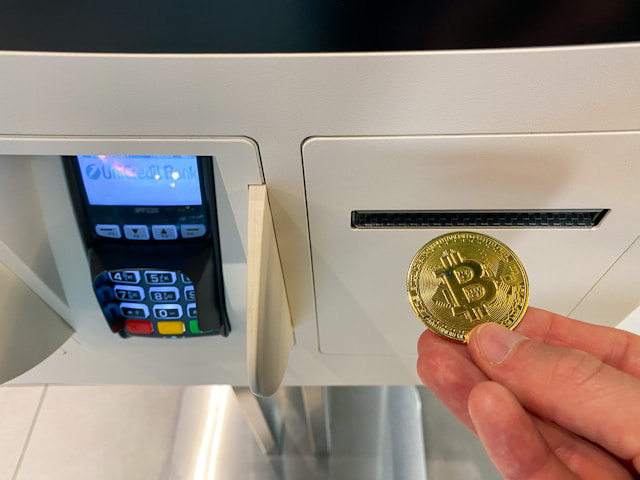
Photo by rc.xyz NFT gallery on Unsplash
Bitcoin payment processors streamline merchant checkout by sitting between the customer’s BTC payment and the merchant’s accounting system. In practice, the processor generates an invoice, monitors the network for payment, and then settles to the merchant in a way the business can handle—often with options to receive Bitcoin, stable fiat, or a mix. This is where crypto starts to feel more like regular ecommerce: familiar checkout steps, cleaner reporting, and fewer manual “did it arrive yet?” messages.
The big advantage is volatility management. Bitcoin can swing in price, and a merchant selling thin-margin products doesn’t want to gamble on what BTC is worth 20 minutes later. According to Deutsche Bank’s “Outlook for digital assets 2026,” payment processors can mitigate Bitcoin’s price volatility during checkout by locking in rates and handling conversion/settlement mechanics for the merchant. That means the customer pays in BTC, but the merchant can receive a predictable amount in their preferred currency—less stress, fewer pricing games.
From the buyer’s side, the steps are easy: choose “Pay with Bitcoin” at checkout, scan the QR code or click the payment link, then send the exact invoice amount before the timer expires (processors often set a window so the exchange rate stays valid). After the processor detects the transaction, the merchant confirms the order.
Two popular names you’ll see in the wild are BitPay and Coinbase Commerce. Both are designed to help merchants accept Bitcoin without building custom infrastructure, and both typically offer invoice-style payments that reduce human error (no guessing amounts, fewer wrong-address problems). On the other hand, processors may add extra rules: strict payment windows, specific amount matching, and sometimes network/fee guidance so payments are confirmed on time. For merchants, the back office functionality can include reconciliation tools, basic analytics, and exports that make accounting less painful.
If you want the smoothest experience, treat it like paying a utility bill: send the exact amount, don’t “round,” and don’t reuse an old invoice.
Bitcoin Debit Cards
Bitcoin debit cards let you spend Bitcoin at traditional point-of-sale locations by converting BTC at the moment of purchase (or by drawing from a balance that was converted earlier). To you, it looks like a normal card tap or swipe; to the merchant, it’s usually just a standard card transaction in local currency. That’s the convenience hook: you can buy groceries, pay for a ride, or handle everyday spending without asking whether the merchant accepts Bitcoin directly.
The “how” depends on the card program, but the core idea is the same: you hold Bitcoin in an associated account, and the provider handles the conversion step so the merchant receives fiat. Building on that, these cards are often the easiest bridge between crypto and the “cash register world,” especially in places where QR crypto acceptance isn’t common.

Fees and conversion rates are the gotcha. A Bitcoin debit card can involve:
- FX markups if you spend in a different currency than your card’s base currency
- ATM fees (if the card supports cash withdrawals)
- Conversion spreads between BTC and fiat at the time of sale
- Network or service fees charged by the card issuer/provider
The important detail is that the rate you get is not always the “headline” Bitcoin price you see on charts, because providers may include a spread for instant conversion and settlement. If you’re watching your budget, check the card’s fee schedule and look for how it quotes exchange rates at purchase time.
From a safety angle, treat it like any payment card: use strong account security, keep app access locked down, and freeze the card if your phone is lost. And remember the privacy tradeoff: card purchases are typically tied to an account identity and transaction history, which is very different from a simple wallet-to-wallet payment.
Gift Card Platforms
Bitcoin gift card platforms let you turn BTC into brand-specific gift cards, which is a surprisingly practical way to spend crypto without needing a merchant to accept it directly. Instead of paying a store in Bitcoin, you buy a gift card (denominated in your local currency or a set value) and then use that gift card like anyone else.
The most common types of gift cards you’ll find include:
- Retail gift cards (clothing, electronics, general shopping)
- Food and delivery gift cards (restaurants, takeout, grocery delivery)
- Entertainment subscriptions (streaming, gaming credits)
- Travel and experiences (hotels, flights, ride services—depending on the platform)
- Mobile top-ups in some regions (more “phone credit” than a classic gift card)
Why do people like this route? It’s fast, it’s familiar, and it can be a workaround when you want to spend Bitcoin but the merchant doesn’t support blockchain payments at checkout. It can also be useful for budgeting. Some platforms also let you reload balances (or repurchase the same brand card repeatedly) so your spending routine stays consistent.
Still, read the fine print. Some gift cards have expiration policies, region locks, or redemption restrictions, and customer support can be more “gift card world” than “crypto world.” Furthermore, it wouldn’t hurt to double-check the card’s currency and country compatibility before you pay with Bitcoin, because reversing a gift card purchase is often not as straightforward as refunding a typical ecommerce order.
Converting Bitcoin to Cash
Bitcoin converts to cash when you sell BTC for fiat and withdraw it to a bank account, payment app balance, or pick it up through a cash-out method supported by your service provider. Conceptually, it’s simple: you’re swapping one asset for another. Practically, the details—fees, processing times, and anonymity—are where the experience differs.

Fees usually come in layers. You may see a trading fee (for selling Bitcoin), a spread (difference between buy/sell prices), and sometimes, a withdrawal fee to move fiat out. Processing times also vary: a sale can be instant inside a platform, but bank withdrawals can take longer depending on rails and local banking hours. On the other hand, some services offer faster payouts for a higher fee—convenience with a price tag.
Anonymity is the tradeoff many people miss. Direct wallet-to-wallet blockchain payments can be done without sharing your name with the recipient, but cash-out routes often involve identity checks and account verification. That’s not inherently bad—it’s just a different privacy model. If you’re converting Bitcoin to cash through regulated services, expect that the transaction is linked to your account identity and may be traceable through financial records.
If you want to minimize surprises, do three checks before converting: the total fee breakdown, the estimated arrival time of the cash withdrawal, and whether you’re comfortable with the identity requirements for that specific cash-out method. That way, your “spend Bitcoin” plan doesn’t turn into a weekend-long waiting game.
Advantages and Challenges of Spending Bitcoin
Advantages
Bitcoin enables fast, borderless transactions that can move value from one country to another without relying on a bank’s opening hours (or anyone’s opinion about your payment). The important detail is that the Bitcoin network does not care whether you’re paying a café in Seoul or a freelancer in Belgrad—your wallet signs the payment, the network confirms it, and the recipient gets BTC.
Fees can also be a real perk, especially compared to card rails. With many card payments, the merchant quietly eats interchange and processing fees; with Bitcoin, the fee is usually a transparent network fee paid by the sender, and it’s not inherently tied to the size of the transaction. In practice, a merchant using BitPay can accept Bitcoin while receiving settlement support (and, depending on their setup, converting to fiat), which can reduce the “international card payment” headache for both sides.
Privacy is another reason people like spending Bitcoin, with a small but important caveat (Bitcoin is pseudonymous, not anonymous). You don’t hand over your name, billing address, and card number to buy a digital service; you broadcast a transaction from an address. For everyday buyers, that can feel like paying with cash online—less personal data sprayed around, fewer databases to trust, fewer “oops, we leaked your info” emails.
There’s also a perception shift happening in 2026: 17.9% of BTC supply is held by public/private companies (per Pantera Capital’s 2026 note). That corporate ownership can make Bitcoin feel more “institutional” to consumers (ergo, less fringe and more established), which helps retail use in a simple way: people are more willing to spend an asset they believe will still be recognized tomorrow.
Limitations

All that being said, Bitcoin spending collides with one big, unavoidable issue: price volatility. When you pay with Bitcoin, the transaction is final, but the value of the BTC you spent can swing before you’ve even finished your coffee. For buyers, that creates “pricing whiplash”: you might feel like you overpaid if BTC jumps 8% the next day. For merchants, volatility turns into accounting stress—if they hold BTC, revenue can shrink between the sale and payroll; if they instantly convert, they lose the upside and pay conversion spreads.
This is where payment processors show up: a merchant might accept Bitcoin at the register but settle in local currency to avoid keeping volatile inventory on the balance sheet. The trade-off is subtle but real: you get Bitcoin acceptance and smoother cashflow, but you reintroduce an intermediary and their policies into what is otherwise a peer-to-peer system.
Regulatory and legal constraints add another layer of friction, and they vary by region, sometimes dramatically. In one country, spending Bitcoin is treated like a normal payment; in another, it may trigger tax reporting as a disposal of an asset, or merchants may face stricter compliance expectations. Here’s the key part: even if Bitcoin is borderless, regulation isn’t. A traveler might be able to pay with BTC at a hotel that supports crypto, yet find that local regulatory rules or banking partners limit the merchant’s ability to process or settle those transactions reliably.
Corporate ownership cuts both ways here, too. Knowing that almost 20% of BTC supply sits with companies can reassure some consumers, but it can also make others worry that Bitcoin is becoming an “institutional asset” first and a daily money tool second—especially when volatility spikes and the news cycle turns every price move into a headline. In practical terms, Bitcoin works great for certain transactions (cross-border, online, privacy-conscious purchases), but it still asks both buyers and merchants to manage volatility and navigate uneven legal terrain.
Key Considerations, Risks, and Legality of Buying with BTC
Price Volatility and Timing Risk
There is no beating around the bush: Bitcoin changes price quickly, and that volatility can turn a “normal” purchase into an unexpectedly expensive one (or a bargain) depending on timing. When you spend BTC, you are effectively choosing a conversion rate at a specific moment, and that rate may look very different an hour later. That’s the key part: you’re not just buying a product—you’re also locking in a Bitcoin-to-fiat exchange decision.
The mechanism is simple but sneaky. Merchants typically price items in fiat (USD, EUR, etc.) and calculate the BTC amount at checkout using a live rate; payment processors may hold that rate for a short window, but the market can move in seconds. Network conditions add timing risk too: if fees are low and confirmations are slow, your payment may sit longer in the mempool, and you may worry about whether the merchant will still honor the quoted amount (some do, some don’t).

This is not just “crypto folklore,” either. The CME Group’s 2026 discussion of Bitcoin’s “undertow” highlights how Bitcoin price volatility can influence the broader crypto market and, by extension, the timing risk you feel at the cash register. In plain terms: Bitcoin can swing, and everything priced off it can wobble with it.
So what can you do? A few practical habits help mitigate risks:
- Decide your “spend vs hold” rule before checkout (for example, only spend BTC you already earmarked for spending).
- Use a quote lock when available (some gateways lock the exchange rate briefly).
- Avoid high-volatility moments (big macro news, sharp market moves) if your purchase is optional.
- Keep extra BTC for fees so you don’t have to scramble and re-quote mid-checkout.
Say, if you’re buying a laptop and the BTC price drops right after you pay, you may feel like you “overpaid” in hindsight. If it pumps right after, you’ll feel the opposite. Either way, the outcome is emotional (and sometimes financial), so timing discipline is a real form of consumer protection.
Scams, Fraud, and Chargeback Limitations
Bitcoin transactions are irreversible, and that one fact changes the fraud game completely. Credit cards come with chargebacks, disputed transactions, and issuer-side consumer protections; Bitcoin generally does not. Once you broadcast a transaction and it confirms, you can’t call a bank and pull the funds back—so scam prevention has to happen before you hit “Send.”
The most common fraud patterns around spending crypto are usually boring, not elaborate. Fake merchant sites, “too good to be true” discounts for paying in Bitcoin, QR-code swaps (where a scammer replaces a legitimate address with their own), and customer-support impersonation are the classics. Some scams also lean on urgency: “Pay within 10 minutes or your order is canceled,” which pushes you to skip verification steps.
To reduce fraud risks when paying with Bitcoin, treat the checkout flow like you would a wire transfer:
- Verify the website domain (typos and lookalikes are common).
- Confirm the receiving address carefully (and re-check after pasting; malware can swap clipboard contents).
- Be cautious with “DM-only” invoices on social platforms.
- Prefer merchants that show a consistent invoice format (amount, address, and expiry timer) and provide an order ID.
- Start small with a test purchase if the merchant is new to you.
A real scenario, for example: you scan a QR code on a screen at checkout, but the code was replaced (physically or digitally) and routes funds to a scammer. With a card, you might dispute it. With Bitcoin, you’re negotiating with a thief. Not fun, and not usually successful—so prevention is the only reliable remedy.
Privacy, Data Sharing, and KYC/AML

What every BTC user should be aware of is that Bitcoin offers pseudonymity, not invisibility, and compliance rules can add identity checks on top. On-chain, transactions are public, addresses are visible, and patterns can be analyzed. Off-chain, many services that help you spend Bitcoin (exchanges, payment processors, big merchants) operate under KYC/AML requirements, meaning they may collect personal data to verify who you are and where funds come from.
That trade-off surprises beginners because “crypto is private” is an easy myth to pick up. In practice, privacy depends on how you acquire BTC, how you store it, and how you spend it. Paying directly from a self-custody wallet can reduce the amount of personal data shared with intermediaries, but the merchant still sees your order details (shipping address, email, device fingerprinting), and the transaction still lives on a public ledger. On the other hand, paying via a regulated platform can be smoother and more “consumer-friendly,” but you’re accepting tighter compliance screening. And because many online shops monetize user data, it’s also worth remembering that ecommerce tracking can include targeted advertising tied to the devices and browsers you use, even when you pay with Bitcoin.
KYC (Know Your Customer) and AML (Anti-Money Laundering) procedures can include identity documents, proof of address, and sometimes transaction monitoring. Their goal is to reduce fraud and financial crime, but the practical outcome is that your spending activity may be linkable to your real-world identity.
A good mental model is “layers of exposure.” The Bitcoin network exposes transaction data; merchants expose purchase metadata; platforms expose identity metadata. The more layers you stack, the less privacy you typically get (but the more compliance-friendly your payment becomes).
If you care about privacy without stepping into sketchy territory, keep it simple:
- Use reputable services and read what data they collect.
- Separate spending wallets from long-term holdings.
- Assume invoices and addresses can be linked if reused or shared.
Taxes, Reporting, and Record-Keeping
What is more, Bitcoin spending can be a taxable event, and that’s where many people get caught off guard. In many jurisdictions, using Bitcoin to buy something is treated like disposing of an asset, not like spending cash. Translation: if your BTC increased in value since you acquired it, the purchase can trigger capital gains tax (even if you never touched a bank account).
The “how” in “how do I deal with this” is straightforward accounting. You have a cost basis (what you paid for the Bitcoin), and you have a disposal value (what that Bitcoin was worth in fiat at the time you spent it). The difference is your gain or loss. That means buying coffee with BTC can create a tiny taxable line item—annoying, sure, but it’s part of staying compliant.

Record-keeping is your best friend here, because the hard part isn’t the math—it’s the documentation. You typically want to keep:
- Date and time of acquisition (and amount of Bitcoin acquired)
- Date and time of spending/disposal
- Fair market value at the moment of purchase (in your local currency)
- Transaction ID (TXID) and wallet address notes (for your own tracking)
- Receipts/invoices from the merchant
A practical strategy is to treat each spend like an expense report. Save the invoice, label the transaction in your wallet (many wallets let you add notes), and export your transaction history periodically. If you use multiple wallets or platforms, consolidate records early—doing it the night before taxes is a special kind of self-inflicted pain.
If you’re unsure about your local reporting rules, that’s your cue to consult a tax professional. The goal isn’t paranoia—it’s clean compliance and fewer surprises later.
Regional Restrictions, Merchant Policies, and Compliance
Wherever you are, Bitcoin use depends on local laws, and “legal” is not a universal setting you can toggle on. Some countries treat Bitcoin as property, some as a financial asset, some restrict payments, and some regulate the businesses that touch it (exchanges, payment processors, custodians). Even when owning Bitcoin is allowed, using it for payments can run into compliance rules for merchants, especially around AML screening and consumer disclosures.
Merchant policy is the other half of the equation, and it’s where real-world friction shows up. One store might accept Bitcoin but only through a specific payment processor. Another might accept it only for digital goods (no shipping, so fewer fraud risks). Some merchants price in fiat and auto-convert, while others accept BTC directly and require a certain number of confirmations before they finalize your order. That impacts timing, customer support, and your stress level.
Here are common merchant-specific policies that affect spending:
- Confirmation requirements: “We ship after 1–3 confirmations,” which can change delivery speed.
- Refund rules: refunds may be issued in fiat, in BTC at a new rate, or as store credit (read this carefully).
- Invoice expiration: if you miss the payment window, you may need to re-initiate the checkout.
- Source-of-funds screening: some processors may flag or reject transactions for compliance reasons.
A practical scenario: you pay in Bitcoin, the merchant’s processor auto-converts, and later you request a refund. The merchant may refund the fiat value, not the BTC amount, which can feel unfair if the BTC price moved. But from their perspective, it’s a compliance and accounting decision as much as a customer-service decision.
The safe play is boring but effective: check local rules, read the merchant’s Bitcoin payment and refund policies, and keep receipts. Bitcoin makes spending possible; compliance and policy determine how smooth (or messy) it will be.
Conclusion

Bitcoin enables people to spend crypto across more categories than ever, from electronics and travel to real estate and luxury goods. That’s the practical opportunity: you can move from “Bitcoin as an investment” to “Bitcoin as money” when a merchant is willing to accept it (directly or through a middle layer). Electronics and travel tend to be the easiest on-ramp because pricing is standardized and checkout flows are already optimized for cards and digital wallets.
That being said, spending Bitcoin still comes with friction, and most of it is predictable. Volatility can turn a normal purchase into a mini risk-management exercise. Legal and regulatory constraints matter because what’s perfectly fine in one jurisdiction can be restricted, taxed differently, or require extra compliance steps in another. And the technical basics—address formats, network fees, transaction finality—aren’t optional if you want to spend safely. One typo in an address and there’s no friendly “undo” button.
Feel free to share more ideas about merchants who accept Bitcoin payments with other crypto enthusiasts in the comments! Subscribe to ChangeHero on Telegram, X, and Facebook. Learn more about what you can do with cryptocurrency in the ChangeHero blog by the ChangeHero team.
Frequently Asked Questions
Can I Buy Things With Bitcoin?
Bitcoin lets you buy goods and services across electronics, travel, and even luxury categories—provided the seller accepts Bitcoin directly or through a payment processor. Not every merchant advertises it, either—sometimes “Bitcoin accepted” only shows up at checkout or on an invoice PDF.
How Can I Pay With Bitcoin?
Bitcoin enables payment through direct wallet transfers, QR-code checkout flows, and Bitcoin-linked debit cards. Which one you use depends on whether you’re paying online, in person, or trying to keep the merchant experience as close to “normal card checkout” as possible.
What Are the Tax Implications of Spending Bitcoin?
Bitcoin creates tax implications in many jurisdictions because spending it is often treated as disposing of an asset, not just making a payment. In plain English: when you buy something with Bitcoin, you may be triggering a taxable event, even if you never “cashed out” to a bank account.
The general principle is capital gains (or losses). If the Bitcoin you spend is worth more at the time of purchase than what you originally paid for it (your cost basis), the difference can be taxable. If it’s worth less, you may have a capital loss.
If you use a Bitcoin debit card, the tax logic often still applies because you’re effectively selling Bitcoin to fund the card transaction. If you’re not sure how your country treats it, a local tax professional is worth the money—because penalties are almost always worse.
Why Do Some Purchases with BTC Fail or Get Canceled?
Bitcoin purchases fail or get canceled when the payment doesn’t match the invoice terms, the transaction doesn’t confirm in time, or the merchant’s policies reject the order. Most of the drama comes down to timing and assumptions—yours, the merchant’s, and the network’s.
Transaction processing times are a big consideration. Bitcoin works in blocks, so a transaction can be fast, slow, or “stuck,” depending on network congestion and the fee you chose. If a merchant sets a payment window (say, 10–15 minutes) and your transaction is still unconfirmed when the timer expires, the order may auto-cancel—even if you did everything “right.”
Can I Reverse a Bitcoin Payment?
Bitcoin makes payments generally irreversible once confirmed, meaning you can’t “chargeback” a transaction the way you can with a card. That’s part of Bitcoin’s design: no central party can undo a valid transfer, and that finality is great for merchants—but it puts more responsibility on you. Even if a transaction is unconfirmed, reversing it is not a standard feature of Bitcoin. You might be able to mitigate a mistake before confirmation in some wallet setups (for example, by using fee-bumping tools), but that’s not the same as a guaranteed cancellation. Once it’s confirmed, the only real remedy is cooperation from the recipient.


