
Crypto Exchange With Lowest Fees (2026)

Key Takeaways
- 🔘 “Lowest fees” isn’t a number—it’s a stack. Maker/taker rates, fiat onramps, conversion markups, withdrawal policies, and spreads/slippage all hit your P&L, often harder than the headline 0.10%.
- 🔘 Winner for pure spot fee efficiency: MEXC at 0.0% maker / 0.05% taker (baseline, no token requirement) is built for limit-order, high-turnover execution.
- 🔘 Best all-around low-fee baselines: Binance and Bybit start at 0.10% maker/taker, then get cheaper with VIP volume tiers (and token discounts like BNB/KCS if you’re willing to take token volatility).
- 🔘 Best “clean” savings model: Coinbase One (subscription) can compress spot trading costs to 0% under its conditions—useful if your monthly activity justifies the fixed fee.
- 🔘 Best for simple conversions + rails: Revolut X is genuinely commission-free on supported assets, but the trade-off is limited coin selection versus dedicated exchanges.
- 🔘 Zero-fee platforms aren’t free. “0% fee” usually means the cost moved into the spread, routing, eligibility rules, or minimums—0% fee ≠ 0% cost.
- 🔘 Do the boring stuff that saves real money: use limit orders, consolidate volume to unlock tiers, choose cheaper rails (ACH/SEPA over cards), and pick low-fee chains for withdrawals (e.g., TRON/BSC/Polygon vs Ethereum when appropriate)—and don’t ignore security/compliance just to save a few basis points.
Contents
- 1. Core Fee Types (What You Actually Pay)
- 2. Blockchain Network Fees (Gas) vs Exchange Fees
- 3. Zero-Fee Exchanges: How They Work (and Where Costs Hide)
- 4. Lowest-Fee Exchanges in 2026 (Spot Trading)
- 5. Lowest-Fee Exchanges in the USA (2026)
- 6. Fee Reduction Strategies: Practical Ways to Pay Less
- 7. Considerations, Risks, and Drawbacks to Keep in Mind
- 8. Tax Considerations
- 9. What Often Gets Missed
Crypto exchange fees don’t just “add up.” They quietly rewrite your P&L trade after trade. In 2026, that matters more than ever because fee models are changing fast—some platforms simplified their pricing, some made what used to be promotions permanent, and others reshuffled VIP tiers as competition and regulation tightened.
This guide focuses on what you actually pay. We looked at maker-taker spreads, withdrawal costs, deposit methods, and the hidden charges that don’t show up in a neat fee table—verified via exchange documentation, API data, and real trading tests. The goal is simple: help you trade more efficiently without getting surprised later.

Photo by Beth Jnr on Unsplash
One quick reality check before we dive in: exchange fees are dynamic. Platforms adjust pricing based on market conditions, regulatory developments, and competitive positioning. Everything below reflects fee structures as of early 2026, but exchanges can change terms with minimal notice (and they often do).
A note on the numbers: unless otherwise specified, calculations assume mid-tier trading volumes—not the highest VIP tiers, not one-off promos, and not “you must hold $50,000 worth of a token” scenarios. Market volatility can also change the practical cost of percentage-based fees, and network congestion can swing withdrawal costs dramatically.
The important detail is matching your trading style to the platform that minimizes your cost profile—whether you’re risk-averse and trying to preserve capital, or more speculative and optimizing for execution speed.
Core Fee Types (What You Actually Pay)
Crypto exchanges charge fees in layers. If you only look at the headline “0.10%,” you’re basically pricing a flight by only checking the ticket and ignoring baggage, seat selection, and airport transfers. Let’s look into the actual cost stacking.
Trading fees (Maker vs Taker)
Trading fees most commonly follow a maker-taker model, based on how you interact with the order book.
- Maker fees apply when you place a limit order that doesn’t fill immediately. You make the market by adding liquidity to the order book.
- Taker fees apply when you fill existing orders and take liquidity as a result, usually via market orders or aggressive limit orders.
You’ll see the pattern in which makers help the exchange keep markets liquid, so they tend to get rewarded with lower fees (sometimes even rebates). Takers pay more because they “consume” that liquidity.
Most popular exchanges like Binance and KuCoin start at 0.10% maker/taker fees, which is fairly standard. But there are exceptions: MEXC is more aggressive with 0.0% maker fees and 0.05% taker fees—especially appealing for high-frequency traders and algorithmic execution.
Your 30-day trading volume also matters. Most platforms use tiered schedules: trade more, pay less. Some also offer discounts if you hold their native tokens, which is relevant if you’re running quantitative strategies that depend on predictable costs.
Fiat Onramp/Offramp Fees (Bank Card, ACH, Wire)
Despite the fact that most crypto investors and traders need to make deposits and withdrawals with fiat currencies, those can be the “silent killer” of low-fee strategies.
- Credit/debit card deposits often run 3–4% on platforms like Coinbase (card networks price in chargeback risk).
- Bank transfers like ACH (US) and SEPA (EU) are usually cheaper—often free or around 1–2%—but slower (typically 3–5 business days).
- Wire transfers often come with flat fees ($10–25) and faster settlement than ACH.
If you’re moving larger amounts, bank transfers almost always beat cards. If you need instant funding to react to volatility, you’d often find yourself paying for speed or funding cross-border accounts.
Conversion Fees (Instant Buy/Sell Vs Advanced Trade)
Photo by Marcel Strauß on Unsplash
Even looking all the same, not all “buy” buttons are priced equally. Instant buy/sell options (common on Coinbase and Kraken) often include convenience pricing—sometimes 1.5–2% on top of base trading fees. Opposite to that, advanced trading interfaces (spot order books with limit orders) usually charge only maker/taker fees.
The trade-off between this pair of options is effort. You need to understand order types and market depth to make use of the more advanced and economical tools. But if you trade more than a few hundred dollars at a time, learning them is one of the highest-ROI moves you can make—and so much more so if you later add API access for automation.
Deposit And Withdrawal Fees (Exchange-Charged)
Crypto deposits are almost always free, at least when it comes to paying the platform. Withdrawals are where you will really start to feel it, though.
Exchanges pay blockchain network fees to process withdrawals, but they may mark those up. A Bitcoin withdrawal could cost 0.0005 BTC even when actual network fees are lower. Ethereum and ERC-20 withdrawals can spike during congestion, and smaller-cap altcoins may have fixed withdrawal fees that look small in USD but can be huge percentage-wise if you’re withdrawing a small amount.
Also watch for account-level constraints like a daily withdrawal limit. In fast markets, that can matter more than the fee itself.
Spreads, Slippage, and Price Impact: Hidden Costs
Being referred to as the hidden costs, these aren’t always listed as “fees,” but they can hurt your strategy even more.
- Spread is the gap between bid and ask prices. On liquid pairs like BTC/USDT on Binance, spreads can be tiny but on low-liquidity pairs, spreads can hit 1–3%.
- Slippage happens when your order executes at worse prices than expected, often because liquidity isn’t deep enough.
- Price impact is how much your order moves the market—especially on mid-cap tokens.
The fix isn’t complicated, just easy to forget: check volume and market depth before trading. High volume and tight spreads usually signal healthier liquidity. Thin books translate to hefty hidden costs, especially on niche pairs.
Blockchain Network Fees (Gas) vs Exchange Fees
They may end up in the same category of “costs” when you account for your gains and losses, but exchange fees and blockchain network fees are two completely different layers.
- Network fees (A.K.A. gas) go to validators or miners to compensate them for processing transactions on-chain.
- Exchange fees go to the platform for facilitating trades, withdrawals, and services, which may or may not be on-chain.
Once you separate these, your cost estimates and planning get much more accurate.
Exchange Fees Vs Network Fees
| Factor | Blockchain Network Fees (Gas) | Exchange Fees |
|---|---|---|
| Who receives it | Validators/miners on the blockchain | The exchange platform |
| Variability | Highly volatile (depends on network congestion) | Usually fixed or percentage-based |
| Predictability | Low (can spike during high traffic) | High (displayed upfront in fee schedule) |
| Impact on speed | Higher fees can prioritize your transaction | No direct impact on transaction speed |
| Your control | You can adjust gas in some wallets | No control (set by platform) |
| When you pay it | Every on-chain transaction (deposits, withdrawals, swaps) | Trades, withdrawals, rarely deposits |
Chain Selection for Deposits and Withdrawals
Although it is not always up to you, for the cases when you can choose, your chain choice can make a “cheap exchange” feel expensive—or the other way around.
Withdrawing USDT is the classic example: you might be offered Ethereum, Tron, or BSC. Ethereum can run $5–20 in network fees during congestion. Tron or BSC might be under $1. Speed differs too, and newer options like Solana or Polygon can feel next-generation compared to traditional rails. Just don’t forget about the lack of native interoperability between different blockchains for the time being.
Here’s the key part: the withdrawal fee an exchange shows you is often a combined estimate (their handling + network). If network congestion spikes between initiation and processing, some exchanges absorb it; others delay the withdrawal until fees settle.
When "Free Withdrawals" Aren't Actually Free
“Free withdrawals” can be real—and still not be a bargain. Someone always pays at least the network fee, so the cost may be shifted elsewhere (i.e. usually, onto you).
Crypto.com, for example, may offer “free” withdrawals at times but compensate with wider spreads. Others only cover certain chains (free Tron withdrawals, charged Ethereum withdrawals). Or they enforce minimum withdrawal amounts that push you to move more crypto than you planned.
A truly low-cost withdrawal is low total cost: reasonable exchange policy + low network fee on the chain you’re using.
Zero-Fee Exchanges: How They Work (and Where Costs Hide)
Building on the previous section, zero-fee crypto exchanges don’t run on good vibes. They still need revenue—just not from a visible trading commission.
Platforms like Exolix, Figure Markets, and Bleap often use non-custodial swap services that route trades through liquidity pools. These blockchain-based exchanges commonly monetize the spread embedded in the rate you see.
The important detail is this: “0% fee” doesn’t mean “0% cost.”
Zero-Fee Business Models
Some platforms remove per-trade fees via:
- Subscription-based programs, where you pay monthly for certain zero-fee benefits (often with volume limits).
- Cashback mechanisms, where a slice of spread revenue comes back as rewards (Bleap uses partnerships with liquidity providers for this).
- Non-custodial swap aggregation, where services like Exolix and Figure Markets route across decentralized venues, balancing speed and pricing while capturing arbitrage.
The appeal is supposed to be predictable pricing, if not saving on costs. But if a platform shuffles the expenses so that the “fee” goes away, it does not always make the total sum lower.
Spreads and Routing Costs
The spread most often becomes the “hidden fee.” When a traditional exchange might show 0.1% as a line item, a zero-fee platform may present a rate that’s effectively 0.15% worse, built into the quote.
When using an aggregator, routing can add friction too. If your swap requires multiple hops across networks or venues, each hop can introduce small slippage. Smart routing reduces this, but it never fully disappears.
Limitations, Eligibility, and Exclusions
Photo by Maxim Hopman on Unsplash
By now, it’s clear that even if the fees are zero, it’s very likely conditional. Other factors that can make you eligible or exempt from those are:
- Volume minimums gating access (e.g., needing $10,000 monthly volume).
- Jurisdiction rules restricting eligibility.
- Low-liquidity altcoins exclusion (spreads would need to widen too much).
If you sift through enough offers, you’d notice that stablecoin pairs usually qualify first because tight spreads can still be profitable at scale.
Lowest-Fee Exchanges in 2026 (Spot Trading)
For spot trading, fees can be as low as 0%—but the “headline rate” is only step one. Tiering, token discounts, liquidity, and spreads decide what you actually pay, especially across diverse products.
Binance
As mentioned before, Binance starts at 0.10% maker/taker. Volume tiers can reduce fees down to 0.02% for top traders. Holding BNB (A.K.A. Binance Coin) adds a 25% discount when you pay fees in BNB, bringing effective fees to ~0.075% for many traders even at the casual level.
Kraken
Kraken begins at 0.16% maker and 0.26% taker for spot, which is a bit higher initially but it gets cheaper with volume, and the fee schedule is very transparent. For beginners who want to understand true costs (including exchange rate mechanics), Kraken’s structure feels more user-centric than many high-volume venues.
Coinbase
Coinbase One subscription for $29.99 a month offers 0% crypto trading fees on spot transactions under certain conditions. If you’re trading enough, the subscription can be a clean way to compress costs—especially compared to standard tiers.
Revolut X
Revolut X is the digital bank’s dedicated crypto trading platform that offers commission-free spot trading for standard users and no platform fees for Premium, Metal, and Ultra subscribers. Coin selection is more limited than on actual cryptocurrency exchanges, but for supported assets the zero-fee structure is genuinely zero (as with Coinbase, the cost is shifted to subscription), and the built-in multi-currency rails are convenient for frequent conversion needs.
ChangeHero
While not exactly spot trading per se, instant crypto exchanges with ChangeHero come with a 0.5% commission per swap. This may look way higher than previously mentioned maker and taker fees but that fee covers more than trading. With all costs, from depositing, on-ramping and withdrawing included, this more often than not ends up being the more economical option.
The team also frequently runs weekly total waiver campaigns for fees in certain assets—to stay updated on them, follow ChangeHero on social media.
Bybit
Another popular exchange that built a large user base with its generously low trading fees, Bybit offers 0.10% maker/taker on spot with tiered reductions. Similarly to BNB, holding BIT can unlock further discounts on top of those. Liquidity on Bybit is generally strong, so the “real fee” often stays close to the published one (unless you choose the most esoteric markets).
MEXC
Promotional banner on MEXC Global
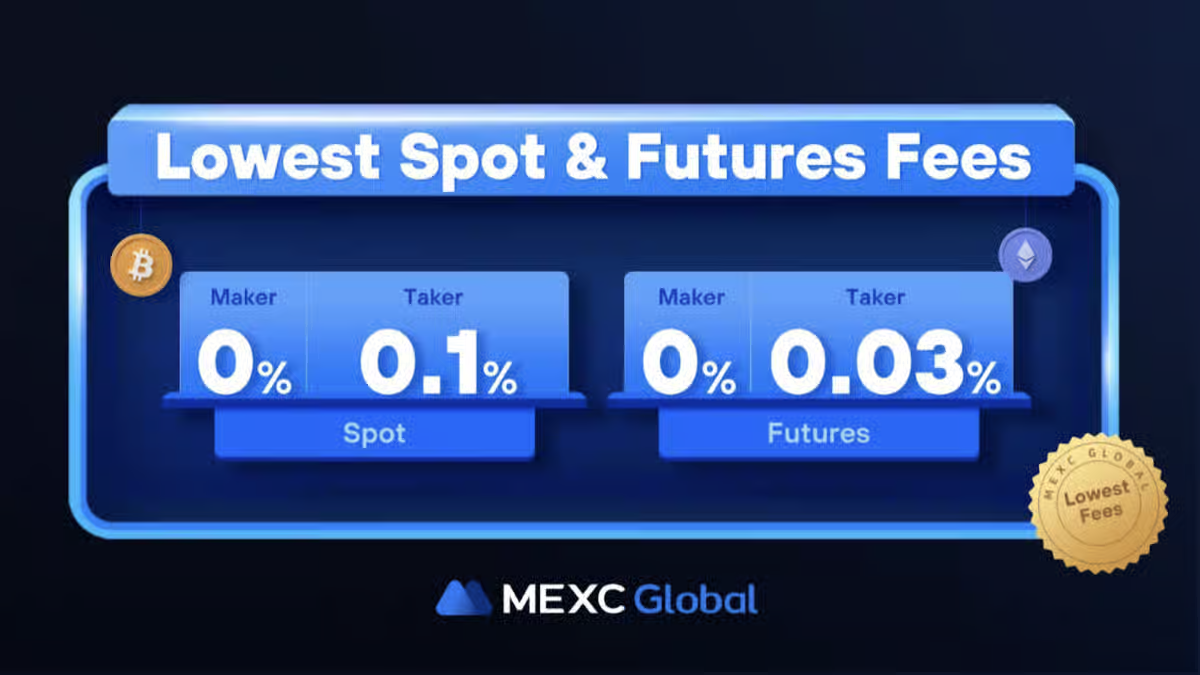
Unlike other highlighted platforms, MEXC uses an asymmetric model: 0.0% maker and 0.05% taker as baseline rates. Some traders might appreciate that no token is required to access those numbers, meaning you do not need to handle the risks associated with these tokens. If you trade with limit orders (and you should, when possible), this can be extremely inexpensive for high-turnover spot strategies.
OKX
OKX starts at 0.08% maker and 0.10% taker, with tiering and OKB-based discounts that can reduce fees significantly—up to 40% from token discounts, plus volume-based reductions (down to 0.02% for certain high tiers).
What should your takeaway be? The “lowest-fee exchange” will almost always depend on how (and how much) you trade. MEXC stands out for limit orders, Coinbase One and Revolut X for subscription-style savings, and ChangeHero for simple conversions.
Lowest-Fee Exchanges in the USA (2026)
It’s even more complicated for the exchanges operating in the United States. State licensing and compliance overhead directly influence pricing, product access, and which platforms you can legally use.
Binance and KuCoin maintain the lowest maker/taker fees according to Bleap Finance's analysis, but availability and operational status in the USA requires extra caution due to evolving regulatory pressure.
State Availability and Geo-Restrictions
Coinbase and Kraken operate nationwide with broad licensing coverage. Gemini is licensed in most states but has limited functionality in Hawaii and New York due to the states’ additional requirements.
Offshore access is where things get messy. For one example, Binance.US operates separately from Binance International, and Binance International restricts US IP addresses after 2023–2024 scrutiny.
The takeaway is simple: even the lowest-fee platform isn’t helpful if you can’t legally use it in your state.
KYC Requirements
Regulated US exchanges require KYC (Know Your Customer) before trading—government ID, proof of address, and sometimes facial verification. Coinbase, Gemini, and Kraken treat this as baseline compliance with FinCEN expectations, and the KYC process affects onboarding speed and feature access.
International platforms used to offer lighter verification for small limits, but US users largely can’t rely on that anymore. Binance.US requires full verification. Some instant exchanges request less information for smaller transactions or do not require it upfront at all, but often at the cost of higher spreads or blocking you when you do try to proceed with identity verification.
Fee vs Compliance Tradeoffs (Pricing Differences by Product)
All of this is to say compliance costs show up in pricing, especially outside of spot trading. Coinbase Advanced lists 0.40% maker / 0.60% taker at typical volumes, and Kraken lists 0.16% / 0.26% for similar tiers. Derivatives can be more complex due to CFTC rules; Kraken’s futures fees (0.02% maker / 0.05% taker) run through separate entities with stricter geo-limits.
In short, you often pay a few extra basis points for regulated access, consumer protections, and clean tax reporting. In return, you avoid the legal gray zones tied to unlicensed platforms—along with the expectations around AML compliance.
Fee Reduction Strategies: Practical Ways to Pay Less

Photo by Braňo on Unsplash
Whether you trade regularly or not really, “saving on fees” usually isn’t a one-time decision. It’s a system, and here are the most reproducible levers.
Volume Tiers and VIP Programs
As seen with Binance’s fee structure, they reduce as your 30-day volume increases. VIP tiers often begin around $50,000 monthly and scale up.
The best part is that whale status is not needed to reap the benefits. Even the first tier can shave 10–20% off your trading costs. Consolidating volume on one exchange platform matters for this strategy a lot: splitting across five venues can keep you stuck in the worst tier everywhere.
Token Discounts and Membership Perks
Another model such as one present on Bybit offers discounts tied to native tokens like BIT. The process is usually as simple as one toggle in settings plus maintaining a token balance.
This comes with a catch: token volatility. So, if you’re holding a token not as a part of your portfolio but only for fee discounts, do the math monthly to confirm that savings beat the price risk.
Order Type Selection (Limit vs Market)
Limit orders often cost less than market orders to incentivize you to add liquidity. The fee difference can look small, especially on an exchange with the lowest fees in its niche; that is, until you trade size.
Planned entries and exits favor limit orders massively, while market orders are best kept for situations where speed matters more than cost. That’s often the preference of conservative traders who don’t want avoidable execution drag.
Cheaper Onramps and Payout Methods
Similarly to the previous tip, slow and steady wins the race. Bank transfers (ACH, SEPA) are usually cheaper than cards. Wire transfers can be useful for speed but add flat costs.
For crypto withdrawals, stablecoins on cheaper networks can keep fees under $1 (TRON for USDT, Stellar for USDC), while Ethereum mainnet can cost far more during congestion.
Cheapest Ways to Swap Crypto (Router vs Direct, Stablecoin Pairs)
Where you can route and plan your transactions, keep in mind that stablecoin routes (BTC → USDT → ETH) often cost less than direct pairs (BTC → ETH) because stablecoin pairs have deeper liquidity and tighter spreads.
Routers can add small routing costs on top of network fees for various purposes like liquidity mining. Direct swaps via platforms like ChangeHero (0% fee swaps on select pairs) can remove exchange fees—but network fees and spread still exist.
DEX vs CEX Total Cost: When Each is Cheaper
Centralized exchanges (CEX) usually win on smaller trades where gas would dominate (e.g., a $100 Ethereum mainnet swap with $15 gas is painful). Their decentralized counterparts (DEX) can win on large trades where CEX percentage fees become meaningful.
To add to a tip about choosing more cost-effective networks, Layer-2 networks like Arbitrum and Optimism reduce on-chain costs dramatically (often sub-$1) without having you leave the ecosystem, and some chains market themselves as more eco-friendly thanks to lower energy profiles and higher throughput.
Considerations, Risks, and Drawbacks to Keep in Mind

Photo by Marcos Paulo Prado on Unsplash
Low fees are nice. Losing access to your funds is not. If you treat this as a pure pricing decision, you’re missing the risk layer that can erase years of “fee savings” in one incident.
Counterparty Risk and Custody Tradeoffs (CEX vs Self-Custody/DEX)
While they more often can afford to keep your trading fees low, centralized exchanges control your private keys. That’s convenient—until it isn’t. When an exchange fails (FTX is the obvious 2022 example), users can lose access entirely, along with everything kept on that exchange.
Self-custody and DEXs remove that counterparty risk because you hold the keys and you are solely responsible for your funds. So, on the other hand, you become your own support team. Lose the seed phrase and it’s permanent.
Jurisdictions matter, both where you and your exchange are. Unlicensed exchanges can freeze accounts or restrict regions with little to no warning. Licensed venues typically provide clearer legal recourse, but you still need to confirm regional availability and licensing status (with FCA, FinCEN, or MAS, where applicable).
Proof-of-reserves help to not lose sleep over whether the platform where you trade is solvent, but it’s often nothing more than a snapshot, not a real-time guarantee. Watch out for signs like withdrawal delays, loss of fiat rails, or evasive communication. If an exchange advertises ultra-low fees but avoids transparency, that’s a signal.
Security Measures and Common Failure Modes
Security failures aren’t always dramatic hacks. Sometimes it’s basic operational weakness: API key mishandling, poor cold storage practices, or social engineering against support.
Protect yourself by enabling 2FA (app-based, not SMS), using withdrawal whitelists (it’s a measure against address poisoning), and think twice before handing your account’s API keys to third-party bots casually. Missing hardware security key support or IP whitelisting is a meaningful security gap that should make you more wary of any exchange.
Low-Fee Platform Red Flags (Too-Good-To-Be-True Pricing etc.)
To cap the section off, a lightning round of tips: if you see ultra-low maker fees, no volume requirements, and zero KYC, pause. Either the model is subsidized (can work for a while but may not survive) or revenue comes from practices you won’t like.
Other red flags: anonymous leadership, no clear headquarters, new domains, and unreliable withdrawal options. Scale-based low fees (like Binance or Kraken) are one thing; a no-name exchange undercutting everyone usually cuts corners where it hurts.
Tax Considerations
We get the demand for the lowest fees, they aren’t fun. But they can also reduce your taxable gains if you track them properly.
In the United States, the IRS generally treats trading fees as part of cost basis, not a separate deduction (unless you qualify as a professional trader). The UK’s HMRC and Australia’s ATO follow similar logic: fees adjust acquisition cost or disposal proceeds, affecting capital gains.
Documentation is the non-negotiable part. If you can’t prove the fee, you can’t claim it.
Fees increase your cost basis when buying and reduce your proceeds when selling—both lowering realized gains.
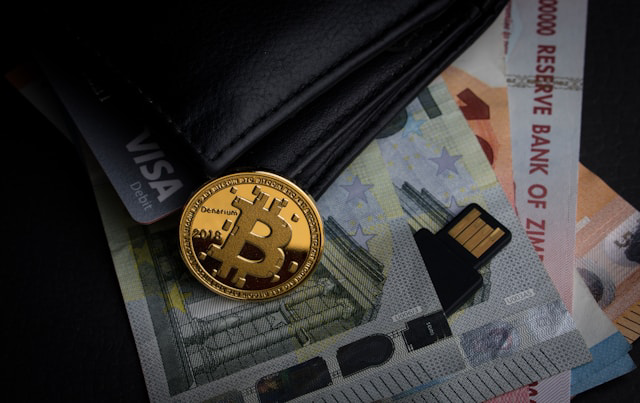
Photo by Aleksi Räisä on Unsplash
Example: buy 1 BTC for $50,000 with a $50 fee → cost basis $50,050. Sell for $60,000 with a $60 fee → proceeds $59,940. Taxable gain becomes $9,890, not $10,000. On a single trade, it’s small. Across hundreds of trades, it matters.
Most exchanges support CSV and API exports, which tax tools like Koinly, CoinTracking, and ZenLedger can import.
According to emerging standards tracked by CryptoTaxGuidelines, reporting requirements are tightening. MiCA in the EU and the OECD’s CARF framework are pushing toward more granular reporting, including itemized fees.
Until everything is standardized, the safest habit is boring but effective: export quarterly, keep statements, and don’t rely on an exchange to store your history forever.
What Often Gets Missed
Published fee tables are the starting point. Real costs show up when volatility hits, when you withdraw, and when something goes wrong.
Spreads and Slippage Reports
During volatile periods, spreads widen. A platform charging 0.1% can become a 0.5% “real cost” environment just from price gaps.
Slippage hurts most on thin books. A $10,000 market order on a mid-cap token can fill across multiple levels, ending 2–3% worse than your intended entry. On paper, your fee looks fine. In practice, liquidity was the expense.
Withdrawal Fee Surprises and Network Mismatch Issues
Network congestion can turn a modest withdrawal into an expensive one. Some exchanges adjust fees dynamically but don’t make it obvious until you’re mid-flow.
Network mismatch is the avoidable mistake: withdrawing USDT via ERC-20 when TRC-20 is available can turn a small transfer into a 2–5% haircut. Always confirm the chain dropdown matches the receiving wallet, and consider batching withdrawals.
Customer Support, Disputes, and Chargeback Outcomes
When a fee dispute happens, support quality becomes part of your cost.
Users report situations where unexpected fees were partially reversed after multiple days of communication, while others hit UI issues and received template responses for weeks. With card onramps, chargebacks can freeze accounts for 30–90 days regardless of outcome—so the “convenience fee” isn’t just the percentage you pay up front.
Good platforms make records easy to export, respond quickly, and don’t turn basic issues into a scavenger hunt.
Frequently Asked Questions
Which crypto exchange has the lowest fees in 2026?
Binance and KuCoin lead the pack with matching 0.10% maker/taker fees on standard accounts, making them the most cost-effective options for most traders (Source). MEXC takes things further with 0.0% maker fees, meaning you can place limit orders without paying trading fees at all (Source). OKX offers competitive rates at 0.08%/0.10%, while Bybit and MEXC hover around the same territory with slight variations based on your trading volume. Base rates can drop further through VIP tiers or native token discounts.
Which platform has the lowest withdrawal fees?
Withdrawal fees depend more on the coin and network than the exchange alone. Many exchanges keep stablecoin withdrawals cheap on lower-cost networks (like Tron or Polygon), while Bitcoin and Ethereum withdrawals fluctuate with network conditions. Always check the specific asset’s withdrawal fee before moving funds, and confirm you’re using the intended chain.
Is the cheapest option always the best?
No. Low fees won’t help if the platform has weak security, frequent outages, poor liquidity, or support that disappears when something breaks. Sometimes paying slightly more for better execution, deeper order books, and clearer compliance is the cheaper decision long-term.
What other exchange fees exist besides trading fees?
Card deposit fees, fiat withdrawal fees, conversion markups on instant buy/sell, margin/futures fees, spreads, slippage, and sometimes subscription charges. Some platforms also price “extra services” like tax reporting.
Are fees lower on decentralized exchanges?
DEXs may charge around 0.25–0.30% per swap, but you also pay network fees (gas). On Ethereum, that can make small trades expensive. On the other hand, Layer-2 networks and alternative chains (Polygon, Arbitrum, Solana) can bring total DEX costs way down—sometimes under $1.
How do spreads affect total cost?
Spreads are the bid/ask gap. Tight spreads mean you trade closer to the actual market price. Wide spreads on thin order books become a hidden fee that can exceed the published maker/taker rate—especially with market orders.
What is the difference between exchange fees and network fees?
Exchange fees are paid to the platform for executing trades and providing services. Network fees are paid to blockchain validators/miners for processing transactions on-chain. Exchange fees are usually predictable; network fees can spike with congestion.
What do real users report about hidden fees?
The most common complaints are conversion rate markups (“zero fee” but worse pricing), withdrawal fees that jump during congestion, minimum withdrawal requirements, and fee changes without clear notices—often tied to VIP tiers or token discount rules.