
Best Crypto Affiliate Programs: Review and Comparison


Key Takeaways
- 🔘 Don’t chase headline commissions—chase retention. A “50% revenue share” is not worth much if it does not meaningfully convert for any reason; opposite to that, a modest recurring share from a trusted usable platform compounds.
- 🔘 Know the payout model you’re signing up for: Revenue share (ongoing % of trading fees), CPA (fixed bounty after a milestone like KYC + deposit), or hybrid (upfront + recurring). Your audience behavior decides which one wins.
- 🔘 Cookie duration and attribution are not details. A 30-day cookie vs lifetime tracking can change your income curve, and cookies can be overwritten or wiped—referral codes and stronger tracking reduce leakage.
- 🔘 With the crucial considerations in mind, our team has conducted research of the crypto affiliate programs in 2026 and found the best offers. Top programs in this guide (and what they’re good at):
- ▫️ Binance: tiered up to 50% lifetime commission, massive product breadth, monthly payouts, no withdrawal minimum.
- ▫️ Bybit: derivatives-heavy, up to 30% lifetime share, daily USDT payouts (after threshold), strong fit for high-fee-volume traders.
- ▫️ ChangeNOW: non-custodial instant exchange platform with single-tier referral program, giving participants of the affiliate program 0.4% of the volume of each swap made with their link.
- ▫️ MEXC: aggressive up to 60% revenue share, weekly USDT payouts, converts well for altcoin and new-listing audiences.
- ▫️ ChangeHero: the straightest pipeline to qualifying actions, granting access to the widest-possible audience; competitive 40% revenue share.
- ▫️ WhiteBIT: flexible CPA or up to 40% lifetime revenue share, strong EU/CIS fit, weekly payouts with fiat-friendly rails.
- ▫️ Coinbase: simple referral bonuses—best for beginners and brand trust, weak for long-term passive income.
- ▫️ Kraken: up to 20% rev share or CPA, security-first positioning, useful for international traffic where other exchanges are restricted.
- ▫️ Ledger: 10% per hardware wallet sale, high-intent security offer, 30-day cookie, monthly payouts via bank/PayPal.
- 🔘 Compliance is part of your content strategy, not a footer. Jurisdiction rules, KYC/AML friction, prohibited tactics (spam, incentivized traffic, brand bidding), and ad platform policies can get you terminated or paid $0.
- 🔘 Protect your income like a portfolio. Program terms change fast (commission cuts, cookie changes, clawbacks), so diversify (don’t let one program exceed 40–50% of revenue), build direct channels (email/newsletter), and track real performance via EPC (earnings per click).
Contents
- 1. How the Affiliate Revenue Models Work
- 2. Crypto Affiliate Program Basics
- 3. Binance
- 4. Bybit
- 5. ChangeNOW
- 6. MEXC
- 7. ChangeHero’s Affiliate Program
- 8. WhiteBIT
- 9. Coinbase
- 10. Kraken
- 11. Ledger
- 12. Key Considerations (Risks, Legality, and Compliance)
- 13. Highest-Paying Options and Payout Structures
- 14. How to Choose the Right Crypto Affiliate Program
- 15. Conclusion

Source Refersion
Crypto affiliate programs have quietly turned into one of the most practical ways to earn in the digital currency space. You recommend a platform you genuinely think is useful, someone signs up or trades through your link, and you get paid.
The important detail is that “getting paid” can mean very different things depending on the program. Some pay a one-time bounty, others pay recurring commissions for as long as your referral keeps trading, and a few mix both. And because crypto is a fast-moving industry, affiliate terms can change just as quickly as token prices—sometimes for reasons that have nothing to do with your content and everything to do with acquisition budgets, regulation, or a platform protecting its margins after a wave of crypto loss.
So choosing from the best crypto affiliate programs isn’t just about chasing a headline like “50% commission.” A high rate doesn’t help if the product is hard to use, the onboarding is painful, or your referrals churn in a week. On the other hand, a “modest” recurring share from a trusted exchange can grow into steady income that compounds over time.
You also have more choices than ever. Beyond exchanges, there are programs for hardware wallets, DeFi tools, tax software, trading bots, educational products, and merchant services (especially if your audience includes online businesses that want to accept crypto). In simple terms: niche offers often convert better than broad ones, because you’re matching a real audience need instead of trying to sell “crypto” as a concept.
How the Affiliate Revenue Models Work
Crypto affiliate marketing runs on a simple loop: you send targeted traffic, the platform tracks it, and you earn when a qualifying action happens.
When a visitor clicks your unique custom affiliate link, the affiliate system stores tracking information—usually through cookies in the user’s browser. If that person then signs up, verifies an account, deposits, or places a trade (whatever the program defines as “qualifying”), the platform attributes the action to you and credits a commission. That attribution is also what enables campaign tracking across your marketing efforts.
Here’s the key part: most crypto exchanges lean on two core payout structures.
- Revenue share model: you earn a percentage of the trading fees your referrals generate over time. This is how affiliates build meaningful referral income that can become passive income if your users stay active.
- Cost-per-acquisition (CPA) model: you earn a fixed payout when a referral completes a defined milestone (like KYC + first deposit).
The roles break down pretty clearly. Affiliates handle distribution: content creation, community building, and traffic via blog posts, videos, social media, influencer marketing, email marketing, or a newsletter. The platform handles the infrastructure: referral tracking, commission calculations, payouts, and promotional materials.
Most programs give you an affiliate portal or affiliate dashboard where you can monitor clicks, signups, and earnings using real-time analytics and real-time tracking, then export result data for ROI analysis. By the way, many affiliate partners treat these portals like performance marketing SaaS—because the better the dashboard and attribution, the easier it is to scale what’s working.
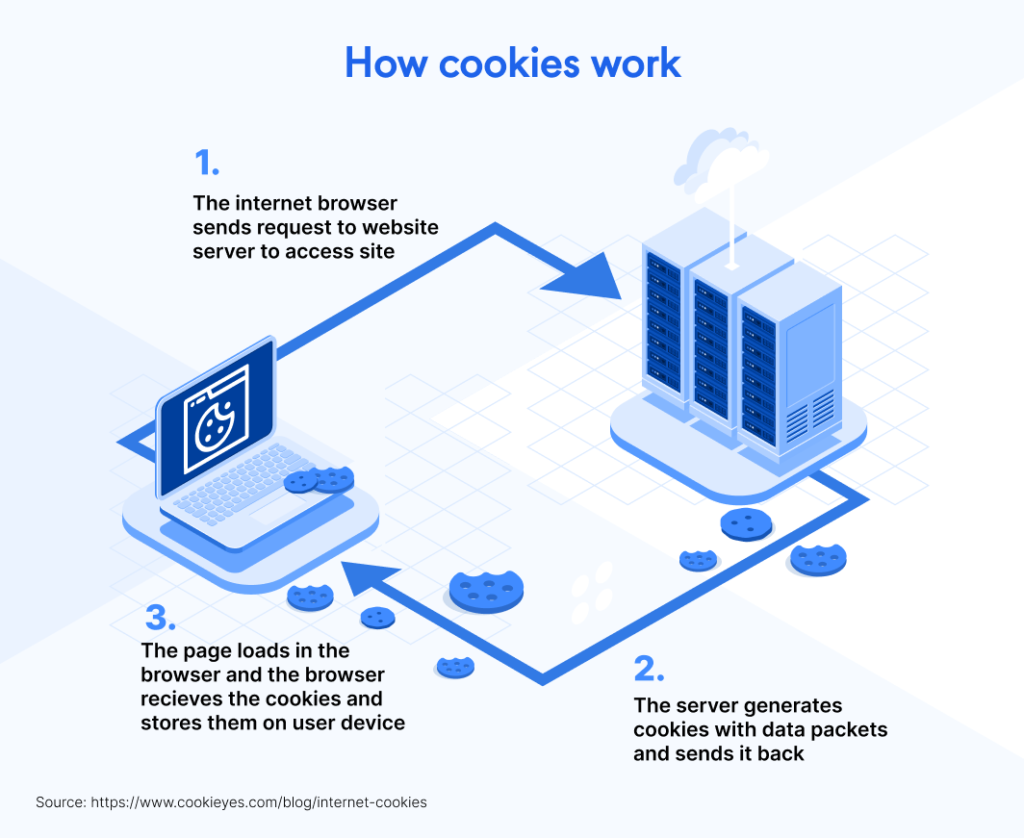
Cookie duration matters more than it sounds. A 30-day cookie window means someone can click today and sign up three weeks later, and you still get credited. Some programs offer lifetime cookies, which effectively turns attribution into a lifetime reward rather than a one-off win.
Optimizing profits requires strategic thinking. The affiliates who do well don’t just push links—they match offers to intent. High-commission products help, sure, but what really moves the needle is:
- targeting active traders (they generate fees),
- building trust with content marketing (tutorials, comparisons, explainers),
- and recommending platforms as a trusted solution to an actual problem your reader has right now.
Payout methods also vary. Binance and Coinbase commonly pay in cryptocurrency to your account, while other programs offer bank transfers or PayPal for larger affiliates. Payment thresholds often sit around $50–$100 before withdrawals unlock—small detail, big impact if you’re just getting started.
The real advantage is compounding. Once your content ranks, gets shared, or becomes part of your audience’s decision-making, the affiliate program revenue model can keep generating returns with minimal ongoing effort—assuming the platform’s affiliate reporting is solid and payouts are reliable.
Crypto Affiliate Program Basics
Before we get into specific platforms, you’ll want a quick overview of the mechanics that show up across most crypto affiliate programs. This is the stuff that determines how you get paid, how reliably you get credited, and what kind of marketing strategy makes sense.
Commission Types
Most programs use one (or a mix) of these three models:
Fixed commissions pay a set amount per conversion—say, $50 per new verified signup. This fixed commission plan is predictable, but it doesn’t scale with larger deposits or higher trading activity.
Percentage-based commissions pay you a portion of what the user generates. For example, if trading fees are 0.5% and you earn a 20% revenue share, you effectively receive 0.1% of every trade. Over time, the exchange fee structure becomes the silent factor that decides how much you actually earn.
Tiered commissions reward volume. You might start at 20% for your first 50 referrals, then climb to 30% or 40% once you pass certain thresholds. Some programs also add volume-based bonuses when you hit a performance milestone.
Cookie Duration
Cookie file duration determines how long your link “counts” after the click.
A 30-day cookie means someone can click now, think about it, and register in 25 days—still your referral. Many crypto affiliate cookies fall between 7 and 90 days, with 30 days being common.
Here’s the catch: cookies aren’t bulletproof. They can be overwritten if the user clicks another affiliate link, and they can disappear if the user clears cache, uses privacy tools, or flips browsers. That’s why some programs also rely on referral codes as a backup attribution method.
Payout Methods
Most programs pay in cryptocurrency, fiat currency, or both.

Source: Hodlnaut
Crypto payouts (like Bitcoin or USDT) are fast and direct, but you inherit volatility and conversion decisions.
Fiat payments via bank transfer or PayPal are easier for budgeting and tax reporting, but processing can take 5–14 business days and may include conversion fees.
Minimum payout thresholds matter, too. A $50 threshold supports faster cash flow; a $500 threshold can feel like a waiting room if your traffic is still growing.
Tracking and Attribution
Tracking usually combines cookies, unique referral codes, and tracking pixels. When a user converts, the platform checks the stored affiliate ID and credits you.
Multi-device behavior complicates things (click on mobile, sign up on desktop). Some platforms use device fingerprinting or email matching to connect the dots, but gaps happen—especially with cookie blockers and privacy-focused browsers. As a result, server-side attribution and manual codes have become more common. Less elegant, more reliable.
Note:
Affiliate terms, commission rates, and payout rules change frequently; the information summarized below is applicable at the time of publishing. Users should always verify current conditions directly in the program’s affiliate dashboard before committing to a program.
Binance
Binance runs one of the most established referral programs in crypto, and its scale is the main selling point. Affiliates earn through a tiered revenue share model, with commissions up to 50% of trading fees generated by referred users.
Binance also leans into the lifetime commission structure: once you refer a user, you continue earning from their trading activity indefinitely. Payouts are typically in BNB (Binance Coin) or USDT, processed monthly, with no minimum withdrawal threshold and no earnings cap.
Another practical advantage is product breadth. Your referrals can use spot trading, futures, margin trading, staking, and the Binance Card—meaning more activity types that can generate commission.
Bybit
Bybit is built around derivatives trading, and its affiliate program reflects that focus. Partners can earn up to 30% of trading fees, with the exact rate tied to monthly trading volume thresholds and trading volume payouts.
Payouts are processed in USDT daily once you meet the minimum withdrawal threshold, which can be a big deal if you care about cash flow. Bybit also offers dedicated account managers for top performers and provides promotional materials tailored to derivatives audiences, including trading tools designed to automate common workflows.
One strategic advantage is user behavior. Futures and perpetuals traders often generate larger fee volumes than spot-only users, and the lifetime commission model keeps you earning as long as those referrals keep trading.
ChangeNOW
ChangeNOW is a non-custodial cryptocurrency exchange service focused on instant swaps without mandatory user registration. The platform aggregates liquidity across multiple sources and enables fast crypto-to-crypto exchanges with a streamlined user flow. One of its core differentiators is the ability for users to complete transactions without creating an account, reducing friction compared to traditional centralized exchanges.
In addition to its swap service, ChangeNOW offers several integration formats for partners, including referral links, exchange widgets, and API access. Although deeper integrations are available, the referral link model remains the simplest entry point for affiliates who want to monetize crypto-related traffic without technical implementation.
Affiliate Program Details
The ChangeNOW affiliate program uses a revenue-sharing model. By default, partners receive 0.4% of the transaction volume generated through their unique referral link. This percentage applies to each completed swap and is calculated from the transaction amount. According to the official program information, the partner fee can be adjusted upon request through a personal manager, depending on cooperation terms and volume.
Commissions are paid in cryptocurrency, and affiliates can withdraw earnings through the partner dashboard. Withdrawals are available in multiple supported cryptocurrencies. While the platform references flexible withdrawals and profit management tools in the dashboard, exact details, such as fixed payout schedules or standardized minimum withdrawal thresholds, are not prominently disclosed in a simplified summary format.
The program follows a single-tier structure, meaning affiliates earn directly from users they refer, without multi-level compensation layers.
Strategic Advantages
ChangeNOW’s affiliate program is particularly suited for content creators, review sites, crypto blogs, and communities that benefit from low-friction conversion flows. Because users are not required to register before swapping, the barrier to completing a transaction is lower than on many centralized exchanges, which can support higher conversion rates in certain traffic segments.
The program’s key advantage is ease of access: referral links can be generated instantly without technical resources and deployed across websites, YouTube descriptions, newsletters, or social media. For more advanced partners, widget and API integrations enable embedded exchange functionality, but these tools extend the referral model rather than being required for participation.
MEXC
MEXC is often positioned as an affiliate-friendly exchange because the program is straightforward and aggressive on revenue share. The platform offers up to 60% revenue share on trading fees, which is one of the highest baseline rates you’ll see.
MEXC processes payments in USDT weekly and tends to keep the minimum payout threshold low, which helps smaller affiliates stay liquid while they build momentum. The platform’s large altcoin catalog is also part of the appeal: if your audience likes emerging listings or hunts for new tokens during a token listing cycle, MEXC can convert well.
The Crypto.com Affiliate Program shares a similar structure but caps commissions lower, which is why MEXC often gets attention from affiliates focused purely on payout percentages.
ChangeHero’s Affiliate Program

ChangeHero Affiliate Program Login Page and registration
It’s not only centralized exchanges providing these offers. ChangeHero offers a similar program for instant, registration-free, beginner-friendly crypto swaps. Creating an account and starting trading is quite a commitment that the referred need to make before you start earning. What ChangeHero’s referral links do is redirect a user to the official website where they can dive into swapping with no delay, and you will receive 40% from the revenue their exchange made.
With ChangeHero’s widgets, the same conditions apply by default but the referred visitors won’t need to leave your website. It is a handy tool that lets anyone exchange crypto instantly that can be embedded with little to no technical knowledge.
The referrals are tracked with a referral code, present in a link or widget code. As long as the redirected users proceed with it, all of their exchanges are eligible, which can be verified in your dashboard. When the 0.001 BTC threshold is reached, accrued rewards in Bitcoin can be withdrawn.
For the full rundown about it, read the guide detailing everything about the ChangeHero affiliate program!
WhiteBIT
WhiteBIT offers a multi-tiered affiliate program that includes both CPA (Cost Per Acquisition) and revenue share options. You can either earn flat payouts for verified signups or choose a percentage-based model paying up to 40% of trading fees indefinitely.
The platform is strongest in European and CIS markets, so geographic fit matters here. Payouts are available in USDT, BTC, or EUR and are typically processed weekly, which is a nice balance between speed and stability.
WhiteBIT’s banking integration can also help conversions with newer users: fiat deposits and withdrawals reduce friction, which matters if your audience is transitioning from traditional finance and wants a smoother fiat-to-crypto purchase flow.
Coinbase
Coinbase keeps its referral program simple. Instead of revenue share, the structure generally revolves around flat bonuses for both the referrer and the referee once the new user completes qualifying transactions. These bonuses often range from $10 to $50 depending on promotional periods.
This setup tends to work best for affiliates targeting complete beginners who prioritize brand recognition and regulatory compliance over advanced features. The trade-off is that you typically won’t build a long-term passive income stream from ongoing trading activity. You’re optimizing for faster initial payouts instead.
Coinbase usually processes rewards in cryptocurrency once the referred user meets the transaction threshold, often within days.
Kraken
Kraken offers a dual-track affiliate structure: either a revenue share option (up to 20% of trading fees) or a CPA model with fixed payments per qualified signup. Payouts are typically in BTC, ETH, or USD, processed monthly after minimum thresholds are met.
Kraken tends to appeal to security-conscious traders and institutional-leaning users, and that changes how you market it. If your audience cares about regulatory compliance, transparency, and a conservative approach to custody, Kraken can convert well—especially for skeptical users who don’t want hype.
Another advantage is reach. Kraken operates in multiple jurisdictions where other platforms are restricted, which helps creators monetize international traffic.
Ledger
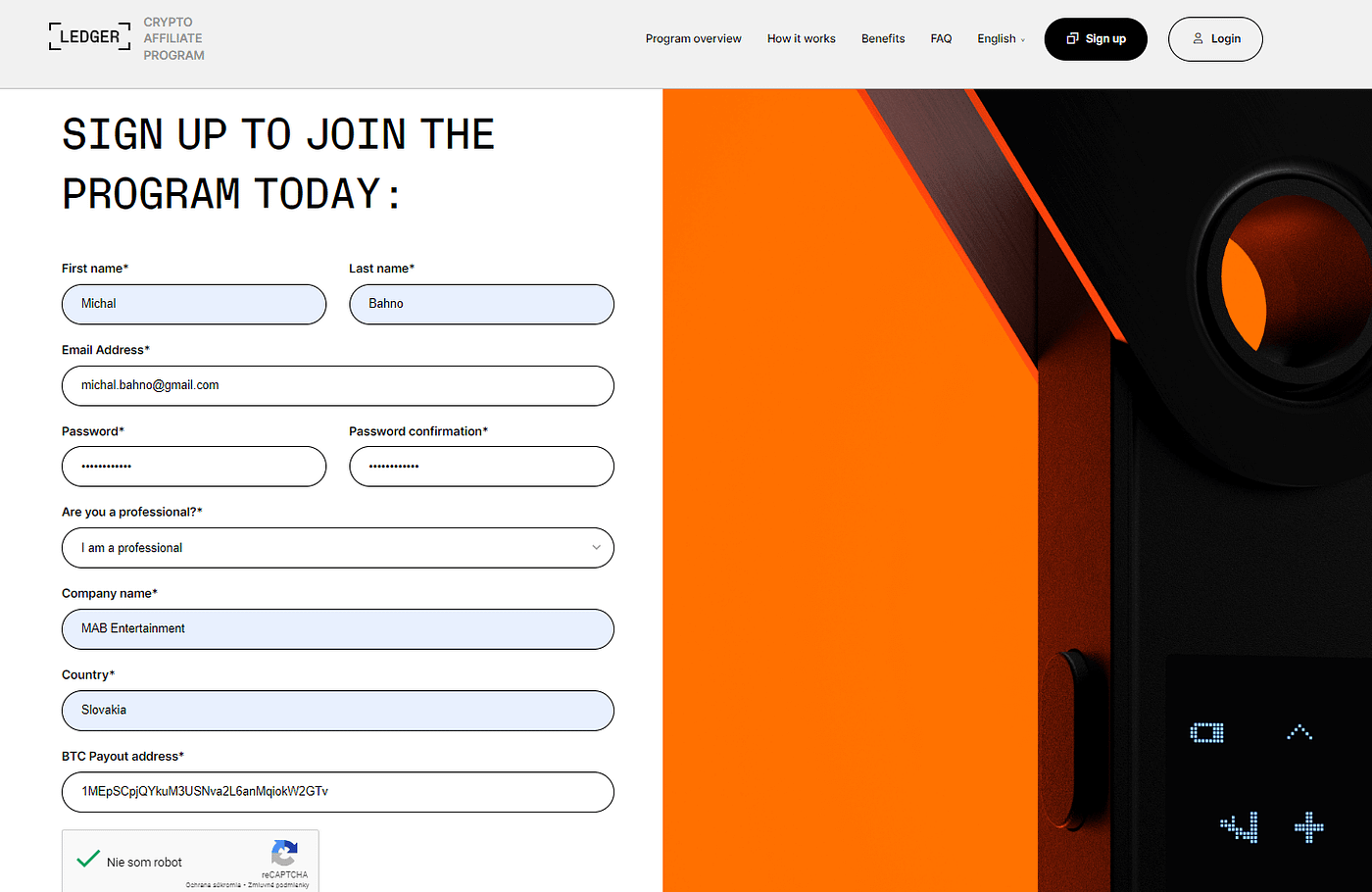
Source: "The Ledger Affiliate Program: A Comprehensive Review" by Mike Banho Mudesi on Medium
Ledger’s affiliate program is product-based rather than volume-based: you earn commissions of 10% on referred purchases of Ledger devices and accessories. Payouts are monthly via bank transfer or PayPal once you reach the minimum threshold.
This arrangement is the best of both worlds: instead of reselling, Ledger affiliates redirect the referred to an official seller, which is the best practice for hardware wallet security.
Ledger also provides a strong set of promotional assets—guides, comparisons, and educational materials—which makes it easy to integrate into security-focused content. If you teach self-custody (and why it matters), a hardware wallet recommendation fits naturally as a core safety step for users who want to store crypto offline.
The important detail is cookie duration: Ledger attributes referrals for 30 days after the click. That’s shorter than a lifetime commission model, but hardware wallets are typically higher-intent, one-time purchases, so the per-conversion payout can still be attractive.
Key Considerations (Risks, Legality, and Compliance)
Crypto affiliate programs sit inside one of the most heavily regulated (and most scrutinized) corners of digital marketing. A single violation—sometimes even an accidental one—can lead to termination, withheld payouts, or reputational damage that’s hard to undo.
So before you promote any exchange, wallet, or service, you’ll want to treat compliance like part of your content strategy, not an afterthought.
Regulatory Restrictions by Country or State
Rules vary sharply by jurisdiction, not only service’s terms. In the United States, certain states (like New York and Texas) apply strict licensing requirements that can limit what platforms can legally offer—and what you can reasonably promote. In the EU, MiCA (Markets in Crypto-Assets) pushes for clear consumer protections and risk warnings, which affects your disclosures and phrasing.
Some countries ban crypto trading outright, which makes affiliate marketing non-starter territory. The UK’s Financial Conduct Authority also requires prominent risk warnings in many crypto promotions. If you have a global audience, you’ll need to know where your traffic comes from—and whether those regions are listed as a prohibited jurisdiction under a program’s geographical restriction.
Regulatory compliance isn’t optional. It’s the foundation of sustainable affiliate work in crypto.
KYC/AML Requirements and Marketing Implications
Platforms with strict Know Your Customer (KYC) requirements often convert slower because users must upload ID, confirm addresses, and sometimes complete selfie checks. If your audience is privacy-focused, that friction can be the deciding factor between “sign up” and “close tab.”
There’s also program risk: if an exchange later faces regulatory action for weak compliance, affiliates can get caught in the blast radius through account suspensions or sudden policy shifts. And major ad networks are far less tolerant of exchanges that aren’t licensed or don’t enforce verification properly.
Prohibited Traffic Sources (Spam, Incentivized, Brand Bidding)
Most programs prohibit the same set of tactics, and they enforce these rules aggressively:
- Incentivized traffic (paying or rewarding users to sign up) usually violates terms because it attracts low-quality users who don’t trade.
- Brand bidding (running search ads on trademarked terms like “Binance login” or “Coinbase wallet”) is a fast track to removal.
- Spam tactics, misleading ads, and cookie stuffing can trigger termination and even legal action.

The clean route is also the durable route: content marketing, education, and honest recommendations.
Advertising Policy Risks
Paid ads can work in crypto, but the rules are strict and inconsistent across many popular platforms such as Meta’s and Google’s networks.
Google Ads often requires certification and region-specific compliance, Meta has evolving restrictions (especially around DeFi and lending), and TikTok policy enforcement can be unpredictable. Even when you follow the stated rules, ads can get pulled—sometimes because the promoted platform becomes controversial or faces regulatory pressure.
The takeaway is simple: your ad accounts are only as safe as the platforms you promote.
Financial Risk Disclosures: Volatility, Loss Risk, No Investment Advice
Many jurisdictions require explicit warnings about volatility and loss risk. In the EU and UK, these warnings often need to be prominent—not hidden in tiny footer text.
If you publish educational content, include a disclaimer that you’re not providing financial advice. Avoid language that implies guaranteed profit or downplays risk. The safest (and most honest) approach is to remind users that they can lose their entire investment and that past performance doesn’t predict future results.
Tax Reporting and Recordkeeping Considerations
Affiliate commissions are taxable income in most jurisdictions, and crypto income often receives extra attention from tax authorities.
If you’re paid in cryptocurrency, you’ll typically need to record the fair market value at the time of receipt. Later conversion or sale may trigger capital gains tax obligations. Many platforms also report payments above certain thresholds.
Keep detailed records: dates, amounts, wallet transaction IDs, and program statements. Setting aside ~25–35% for taxes is a common safety buffer, and working with an accountant who understands crypto can save you from expensive mistakes.
Brand-Safety and Reputation Risk (Scams, Insolvency, User Complaints)
Keep in mind that your audience connects your name to whatever you recommend. If a platform you introduce them to later faces insolvency or is exposed as fraudulent, affiliates often take the reputational hit—sometimes even legal exposure if their content reads like a guarantee rather than a review.
To reduce risk:
- stick with platforms that show transparent operations,
- monitor user complaints on Reddit, Trustpilot and the like,
- diversify across multiple reputable programs,
- and watch for warning signs like withdrawal delays, sudden terms changes, or leadership turnover.
If something changes, update your content and be transparent. Trust is your main asset here.
Program Changes: Commission Cuts, Cookie Changes, Terminations
Program terms can change quickly: commission cuts during bear markets, shortened cookie windows, new thresholds, new attribution models, or even sudden termination clauses. Some agreements also include clawback language if a user is flagged for suspicious activity.
Diversification helps. As a rule of thumb, avoid letting one program account for more than 40–50% of your affiliate income, and build direct channels (like an email list) so you can pivot if terms change overnight.
Highest-Paying Options and Payout Structures
At a high level, payout structures fall into a few recognizable buckets. Once you know which bucket matches your traffic and your audience intent, selecting programs gets much easier.

Bitcoin-Focused Programs
These offers often convert well because Bitcoin buyers tend to be higher-intent and more “research-driven.” Some exchanges structure Bitcoin affiliate tiers that pay more for Bitcoin-related activity than for altcoin-only conversions. Hardware wallet brands like Ledger and Trezor also benefit from Bitcoin-heavy audiences, because self-custody is commonly part of the Bitcoin learning path.
The key advantage is audience quality: more experienced users often generate sustained trading volume, which makes revenue share models more valuable over time.
Revenue Share
Revenue share pays a percentage of the fees your referrals generate, often in the 20%–50% range.
In simple terms, if your referral generates $100 in monthly trading fees and your share is 40%, you earn $40 per month from that one person. Scale that across dozens (or hundreds) of active users, and the model starts compounding.
Programs like Bybit and ChangeHero use lifetime revenue share structures, which means older content can keep paying long after you publish it. The trade-off is patience: revenue share tends to grow slowly before it grows loudly.
CPA Payouts
CPA (Cost-Per-Acquisition) pays a fixed amount for a defined conversion, usually verification plus a deposit or first trade.
Crypto CPA payouts range widely—$10 on the low end to $600 in premium, region-targeted funnels. CPA is best for affiliates with high-volume traffic and predictable conversion rates. It’s also easier for forecasting because you know the payout per conversion upfront, but your upside per user is capped.
Hybrid Payouts
Hybrid models combine CPA with revenue share: you get an upfront payout and then an ongoing percentage.
Binance’s hybrid structure is a typical example—$10–$15 CPA plus 20%–40% lifetime revenue share. By the way, OKX and Crypto.com also run hybrid tiers, though the exact terms depend on volume and program level.
This structure balances short-term cash flow with long-term residual income, which is why many affiliates prefer it once they’re scaling content.
Payout Thresholds
Thresholds commonly fall between equivalents of $50 and $500. Quite a range, isn’t it? There are benefits to either.
Lower thresholds help smaller affiliates access earnings sooner. Higher thresholds show up in programs with larger payouts per conversion, but they can slow down your reinvestment cycle if your volume is inconsistent.
Payment Schedules
Payment schedules range from weekly to monthly (Net-30 and Net-60 are common). Some programs also delay initial payouts for 60–90 days to account for refunds, fraud checks, or chargeback risk.
Crypto-native programs frequently pay in USDT or Bitcoin, while others default to bank transfers. The method matters because it affects processing time, fees, and how you track taxes.
How to Choose the Right Crypto Affiliate Program
Picking the right program is part math, part audience psychology, and part risk management. The most reliable earnings come from alignment: the right offer for the right reader at the right moment.
Evaluation Criteria
Start with reputation. Before promoting Binance, Coinbase, WhiteBIT, or any crypto exchange, look at operational history, withdrawal reliability, and customer support sentiment, and make no assumptions based on brand image alone. If you find users can’t access funds or support is consistently poor, your commissions won’t compensate for the credibility hit.

Photo by Imkara Visual on Unsplash
Next, evaluate the commission structure in context. Revenue share can outperform CPA if your referrals trade actively. Cookie durations also matter where present: lifetime tracking is usually stronger than a 30-day window if your audience takes time to decide.
Ease of use is a conversion lever. For a start, test the onboarding yourself. If KYC is confusing or the UI is hostile to beginners, your conversion rate will inevitably show it.
Then check marketing allowances. Some programs restrict paid traffic, certain keywords, or even whole channels. Read the terms carefully—policy violations can erase commissions.
Finally, check alignment with your values and messaging. If your content advocates decentralization, promoting a platform that conflicts with that stance creates cognitive dissonance your audience will surely notice.
Exchange vs Brokerage vs Wallet
Different categories fit different content styles:
- Centralized exchanges like Binance fit trading-focused content and often offer strong revenue share, but they typically involve custodial accounts and full KYC flows.
- Brokerage-style platforms convert well with beginners who want simplicity, often via a mobile-first funnel like the Crypto.com app (usually with different fee/spread trade-offs).
- Wallet programs (especially hardware wallets) fit security content. For many readers, pairing an exchange with a Non-custodial wallet is the natural next step in learning self-custody.
Profitability and EPC Considerations
Earnings per click (EPC) is what turns “good on paper” into “good in practice.” Calculate EPC by dividing total earnings by total clicks.; this bakes in conversion rates, user quality, and payout reliability.
A program paying 15% with a 5% conversion rate can outperform a program paying 25% with a 1% conversion rate. Track conversion rates per program, and project earnings based on realistic user behavior—not best-case scenarios.
Match program type to your goals, too:
- If you want compounding income, prioritize revenue share.
- If you need predictable cash flow, CPA can help.
- If you want both, hybrid models are the middle ground.
Conclusion
Crypto affiliate programs blend traditional performance marketing with the unique momentum (and unique risks) of digital asset platforms. In this guide, we covered how the model works—commission structures, cookie durations, tracking and attribution, and why the same “high payout” can mean very different real-world outcomes depending on product quality and user retention.
The big differentiator is the dual earning potential. Many programs combine one-time payouts for signups with recurring revenue share from trading activity, which is how genuine passive income gets built in crypto affiliate marketing.
On the other hand, crypto comes with stricter compliance requirements and faster-moving rules. You may also find that some readers are better served by a decentralized trading platform when they prioritize permissionless access over custodial convenience—so matching the right product to the right audience is everything.
Your next step is simple and practical: shortlist 2–3 programs that fit your audience’s experience level and geography, read the terms (especially prohibited marketing practices and payout thresholds), and test performance with tracked links. Then keep a close eye on each market update that affects disclosures or attribution rules.
Long-term, the affiliate strategy that wins in crypto is built on transparency, regulatory compliance, and real value—not quick commission grabs.
Frequently Asked Questions
How Do I Choose the Best Crypto Affiliate Program?
Compare commission models first: revenue share, CPA (cost per acquisition), or hybrid. Revenue share builds over time as your referrals trade. CPA pays a one-time fee after a defined action like KYC plus a first trade or deposit.
Then check payout methods and thresholds. Some programs pay in crypto (Bitcoin, USDT, stablecoins), others in fiat via bank transfer or PayPal. Also look at minimum thresholds—$500 minimum payouts can be frustrating if your monthly volume is modest.
Finally, vet reputation and support. Look for transparent dashboards, responsive affiliate managers, and consistent user feedback about withdrawals and customer service. A program with clean reporting and stable policies is usually worth more than a slightly higher commission rate with constant headaches.
Can I Join Multiple Crypto Affiliate Programs at Once?
Yes, and it’s often the smarter approach. Most programs allow you to promote competitors, which helps you diversify income and reduce reliance on a single platform.
It also lets you segment recommendations: beginners may want simplicity, while advanced traders want derivatives tools. The only caution is operational complexity—multiple dashboards, schedules, and links—so keep your stack focused. Three to five aligned programs usually beats fifteen random ones.
What's the Difference Between an Exchange and a Brokerage?
An exchange matches buyers and sellers through an order book. You place orders, and the platform connects you with other market participants. Examples include Binance, Kraken, and Coinbase Pro. Exchanges often have lower explicit fees.
A brokerage sells to you at a quoted price and handles execution behind the scenes. That simplicity helps beginners, but it often comes with higher spreads or embedded fees. eToro and Robinhood are common brokerage-style examples. ChangeHero works similarly on the surface but is more of a crypto-native solution.
Frequent traders usually prefer exchanges for cost efficiency. Beginners may prefer brokerages for ease of use.
