
Best Crypto Presales: Find, Vet & Invest Safely


Disclaimer
This article is not a piece of financial advice. When dealing with cryptocurrencies, remember that they are extremely volatile and thus, a high-risk investment.
Always make sure to stay informed and be aware of those risks. Consider investing in cryptocurrencies only after careful consideration and analysis and at your own risk.
Key Takeaways
- 💸 “Best presale” = balance, not max upside: prioritize credible execution, transparent tokenomics, and buyer protections over hype and countdown timers.
- 💸 Start with mechanics (because that’s where losses happen): verify how funds are collected (contract vs multisig vs custody), allocation rules (FCFS/lottery/tiers), and vesting/unlocks (cliff vs linear vs immediate) before you connect a wallet.
- 💸 Tokenomics is the product in presales: demand needs real token sinks (fees, access, proof services, subscriptions), and supply needs sane emissions + distribution + liquidity planning—otherwise the chart becomes an unlock schedule.
- 💸 Liquidity is not guaranteed just because “listing” is mentioned: treat every presale as illiquid until proven otherwise, and assume slippage + delayed listings are part of the base case.
- 💸 Scam defense is operational, not philosophical: confirm official domains/contract addresses, ignore “support” DMs, and treat any request to send funds manually or “fix allocation” as a trap.
- 💸 The 2026 watchlist spans real categories, not one narrative: Deepsnitch AI (on-chain fraud detection), ZKP Crypto (ZK infrastructure), TRD Network (AI-powered DePIN) and IPO Genie (synthetic IPO-style exposure with heavy structure risk).
- 💸 Risk management is the edge: keep presales as a satellite allocation, pre-plan exits around unlock events, and use a repeatable tracking sheet (raise pace, holder concentration, liquidity depth, unlock timeline) instead of vibes.
Crypto presales give investors early access to new tokens before they reach the open market. In 2026, that matters more than it did a few cycles ago, because the cryptocurrency market has matured into a crowded mix of blue-chip assets, fast-moving narratives, and very real competition for attention (and liquidity). Market cap still drives headlines, but it doesn’t always capture what’s happening on the edges, where new apps, chains, and decentralized finance experiments try to earn users before they earn valuation.

A crypto presale is basically an early-stage token sale where a project offers tokens to buyers before a public listing or broad distribution. If you’ve been around long enough, you’ve seen the “initial coin offering” era, the backlash, and the evolution since then. Today’s presales often look more structured, but the core idea is the same: you’re buying exposure to a network or product before the rest of the market can price it in.
Investors keep showing up for a few straightforward reasons. First, price discovery hasn’t happened yet, so the upside can be bigger if the project later attracts real demand and liquidity. Second, presales can function like “early access passes” to new tech—think governance rights, utility inside an app, or incentives tied to launching a DeFi protocol. And third, there’s the simple psychological pull: getting in early feels like finding a door that’s still unlocked while everyone else is waiting in line.
Here’s the key part, though: presales are not a cheat code. The same factors that create potential high returns also amplify risk. A token sale can happen long before there’s a finished product, stable tokenomics, or meaningful adoption. Liquidity can be thin (or delayed), vesting can limit your ability to exit, and smart contract bugs or messy allocations can turn “promising” into “painful” quickly. In other words, presales reward due diligence—reading the token distribution, understanding what the token actually does, and sanity-checking whether the project’s claims make sense in the broader crypto ecosystem.
More about Crypto Presales
Crypto presales sell new tokens to early supporters before a token hits public trading. They typically run as a structured token sale (sometimes framed as a crowdsale) where a project raises funding, bootstraps a community, and tests demand at an earlier valuation. Early timing can mean better pricing at the cost of bigger risk if the launch never delivers.
The value proposition is simple: presales let you buy before the market gets a chance to reprice the token. If the project ships, listings go smoothly, and the community sticks around, a lucky early entry can vastly outperform a later spot buy. On the other hand, presales concentrate uncertainty: you are betting on an idea, a team, and a roadmap, often before there is meaningful product traction. Another important detail is that “early” usually also means “less liquid,” because you may not be able to sell until unlocks begin.
Most presales break into stages, and each stage comes with different access rules and expectations:
- Private sale: limited allocation, usually smaller circles (partners, early community members), often stricter terms and longer lockups.
- Seed/strategic round: still early, but more structured; allocation and vesting schedules tend to be spelled out clearly (read them).
- Public presale round: broader participation, sometimes a whitelist gate, sometimes first-come-first-served.
- Final public round / launchpad-style sale: higher visibility, tighter timelines, and often more competition for allocation.

Access can be differentiated in surprisingly “social” ways. Some projects prioritize community involvement (such as quests, activity, referrals), while others use staking mechanics—stake a platform token, earn a tier, get a larger whitelist allocation. It’s neither good or bad inherently, but it does change incentives and can even push people to take extra exposure just to qualify.
Here’s something that often gets overlooked: tokenomics and presales are inseparable. How? Presales shape initial token distribution (who holds how much, and under what vesting), and they influence liquidity when trading goes live. If a large share of supply goes to early buyers with short lockups, sell pressure can spike as soon as right after listing. And if liquidity is thin, even small sells can move prices aggressively—fun on the way up, painful on the way down.
Participation methods also follow a familiar pattern. Many presales require a whitelist application (sometimes including KYC), after which you receive an allocation or a purchase cap. The actual purchase often runs through smart contracts: you connect a wallet, sign a transaction, and swap accepted funds for the presale allocation. That on-chain flow is convenient, but it also means you need to verify contract addresses and transaction details because mistakes are permanent.
Top Crypto Presales to Watch in 2026
Deepsnitch AI
Deepsnitch AI targets on-chain fraud detection with an AI-first utility token that is supposed to pay for a tiered access to the dashboard with monitoring, alerts, and automated risk scoring. The protocol aims to sit in the stack right between everyday users and the smart contracts they interact with: bridges, DEX routers, lending pools, and the “mystery airdrop” links your friend swears are real.
The core idea is simple: Deepsnitch AI treats transaction flows like patterns, not one-off events. In practice, that means it watches wallets and contract interactions for familiar “shapes” of scams—drainer approvals, malicious proxies, copycat token launches, and suspicious contract upgrades—then flags them before the damage is done. A good use-case-related question to ask here is: does it block, warn, or insure? Deepsnitch AI typically positions itself as a warning and policy layer (think “seatbelt,” not “ambulance”), with optional automation for advanced users.
Tokenomics matter a lot for a security tool, because the product is only as good as its incentives. Their currently outlined model is subscriptions and API access are paid in the utility token. If the whitepaper leans heavily on “AI magic” or is not mapping token sinks (who buys the token and why), those are yellow flags—even if the UI looks slick.
For 2026 relevance, Deepsnitch AI fits a market reality: decentralized finance keeps expanding, and so does the attack surface. As of right now, the team expects to ship the product in any form only after the currently ongoing presale concludes, so take it as a warning sign. The potential market impact is straightforward, though: fewer successful drains and more cautious signing behavior, which is exactly what DeFi needs to keep onboarding regular people without expecting them to be cybersecurity professionals.
TRD Network
Source: TRD's Presale Official Web Page
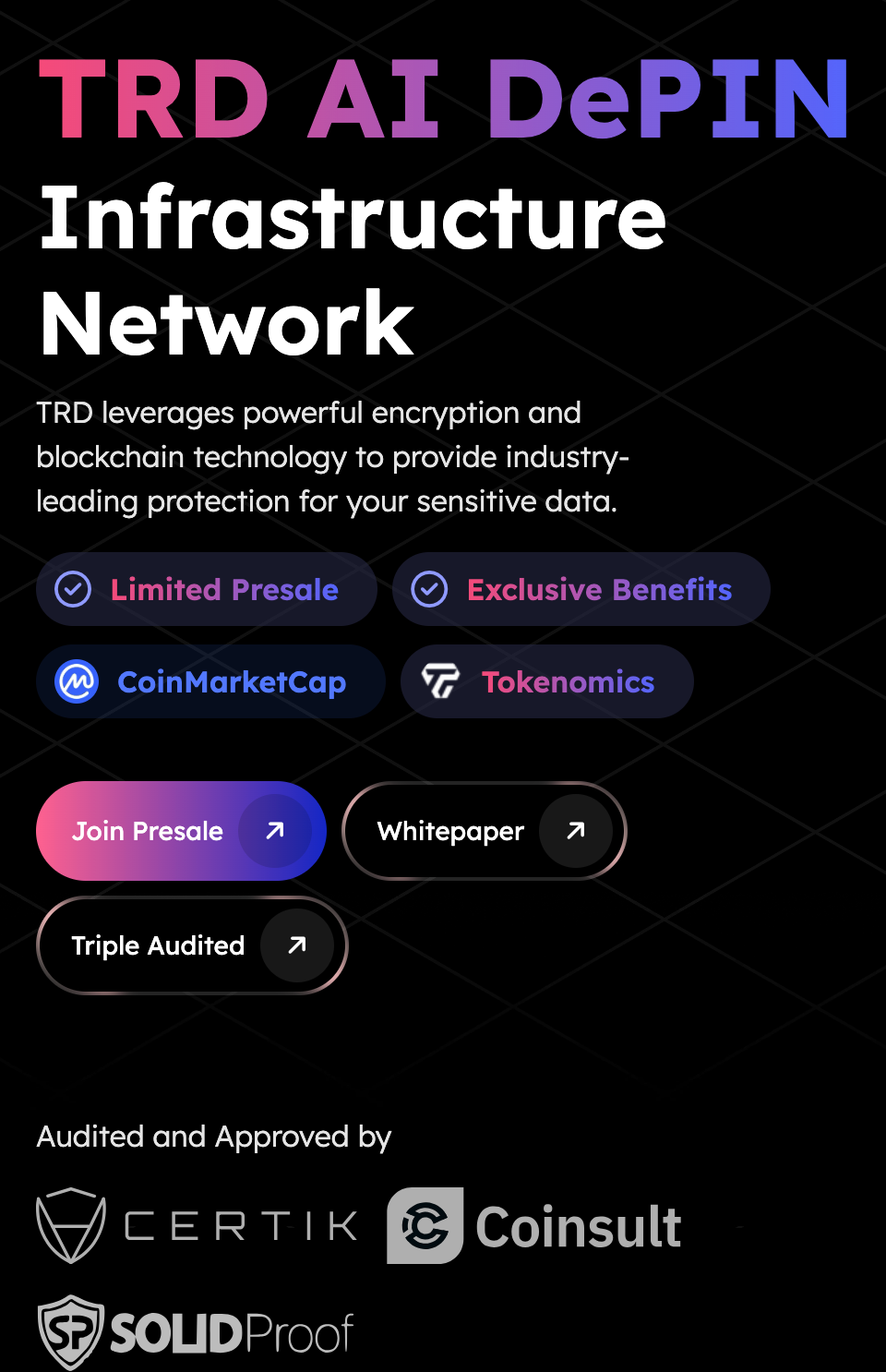
Another project that is currently holding a presale for native tokens is TRD Network: AI-integrating DePIN (decentralized physical infrastructure network) ecosystem. What it does in simple words is offer a suite of solutions that use artificial intelligence to identify cyberthreats in real time, predict and efficiently use decentralized networks in a cost-effective manner and help it scale.
If it sounds a bit too familiar to the previous project, consider that the scope of TRD Network encompasses not just decentralized finance but makes bold claims about the entire digital economy, digital identities, assets, and data on top of assets. The goal sounds nebulous but what the team actually seems to be building is an ecosystem of financial products; whether or not it can onboard the intended global audience remains to be seen.
Some other points of concern can be gleaned from the roadmap and third-party token vetting resources. For one, marketing efforts seem to come before development and release of the titular network on the timeline. As for token security, the single yellow flag highlighted by GoPlus is a tax modification function in the smart contract that the owner still has access to (not malicious outright but could be abused); however, anything else seems not to raise the alarm, which is corroborated by audits, including Certik’s.
Our verdict: consider research into the project using our guide’s further sections.
IPO Genie
What better proves the demand for presales than the fact a platform for those is successfully raising funds in a presale of their own? Somewhat similarly to the previous entries, IPO Genie is currently holding a presale for its token IPO that will provide tiered access to deals and voting rights.
IPO Genie aims to tokenize IPO-style access and speculation using smart contracts, bringing a familiar TradFi narrative into a crypto-native wrapper. That’s a spicy premise in 2026, because “pre-IPO access” is one of those topics that always attracts attention—and just as reliably attracts regulatory and settlement complexity. So the presale’s credibility comes down to architecture and constraints, not hype.
At a high level, IPO Genie frames itself as a platform where users can get exposure to “IPO-like” events via tokenized allocations, derivatives, or synthetic representations. Token distribution is publicly available, and the team's share of the total supply is supposed to be locked for two years; the thing is, it is 5%, yet the 50% of the supply dedicated to the presale does not seem to be restricted in any way.
Potential market impact is real if IPO Genie makes access cheaper and more global (even if only synthetic), because it taps into demand that exists far outside crypto. Just keep your feet on the ground: any presale in this niche should be evaluated like a risk engine, not a meme. If the smart contracts and collateral logic aren’t clear, you’re not buying “IPO access”—you’re buying uncertainty.
ZKP
Source: ZKP's official Web page
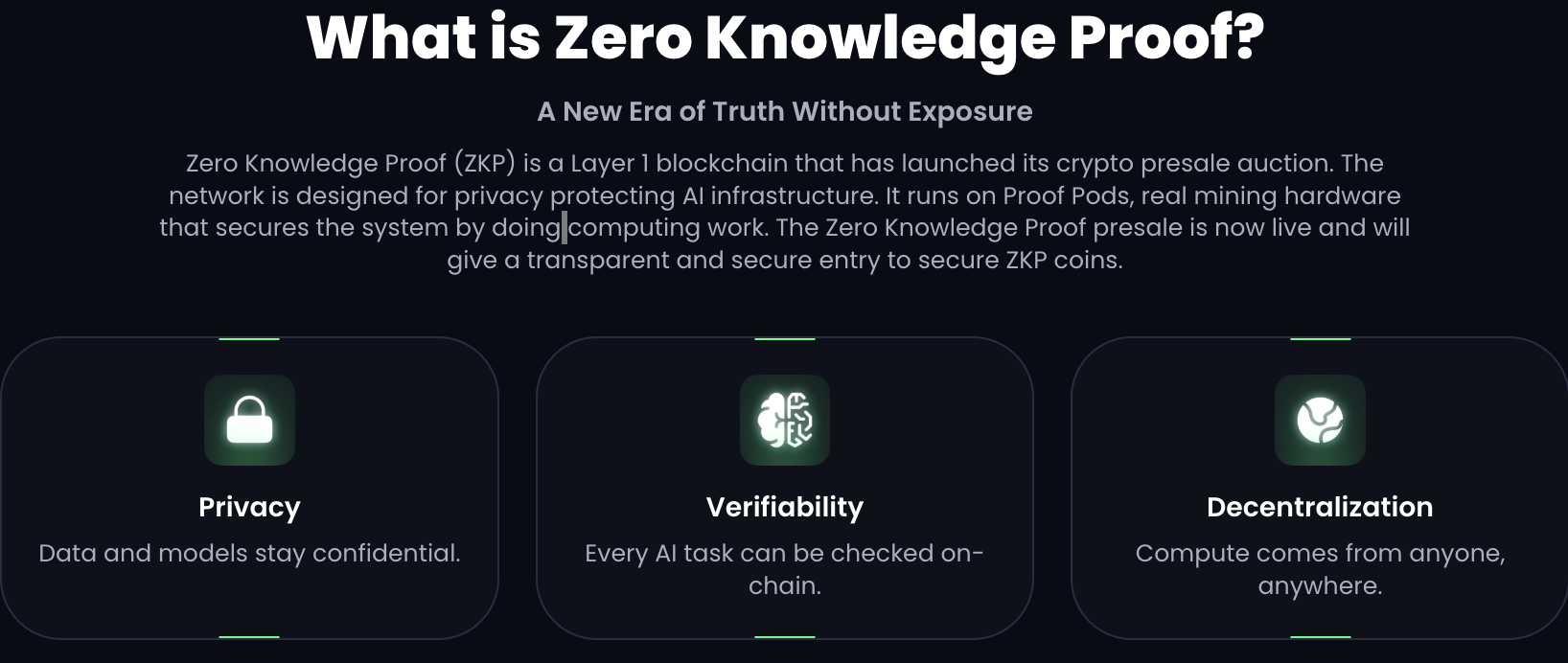
As evident from the name, the project called Zero Knowledge Proof focuses on zero-knowledge proofs as a product layer, with a utility token designed to incentivize securing the network. In 2026, ZK has become one of the main ways blockchains keep fees reasonable while keeping security assumptions tight, but it’s as much a buzzword, so further inspection is a must.
The “what” is usually one of three things: a ZK rollup, a ZK coprocessor, or a toolkit that helps apps generate and verify proofs. The “how” is where it gets interesting. ZKP systems let you prove something happened (a balance is sufficient, a trade is valid, a user meets criteria) without revealing the underlying data. That can reduce data leakage, improve compliance-friendly privacy, and shift heavy computation off-chain while still anchoring truth on-chain.
For a presale, the unique selling points should be concrete, not mystical. This project takes this idea and runs with it: before any perks of the project, they promote the presale’s fairness and accessibility. Additionally, dedicated hardware devices to mine the ZKP tokens are available for sale. Despite not being particularly highlighted in the marketing, the technical foundation seems to be there, and the name of the project coinciding with the technology is not (entirely) an attempt to capitalize on its legitimacy. That being said, while we cannot give you a definitive “yes” or “no” whether you should buy into this presale, we do advise to exercise caution.
How to Find Crypto Presales
What we managed to highlight might seem underwhelming: just four presales? Of course, this is far from everything going on right now in this space! If you feel confident enough in not being swept by FOMO and take on due diligence yourself, let us arm you with the methodology, tips and tricks.
Presale Sites
Crypto presale sites list token sales in one place so you can browse upcoming deals without chasing dozens of separate announcements. The big advantage is speed: you can compare timelines, minimum contributions, and participation steps (like a whitelist) before you even connect a crypto wallet. The trade-off is obvious too: “listed” does not mean “vetted,” so treat these as discovery tools, not a safety stamp.
Photo by DICSON on Unsplash
Here are a few major presale websites people use in 2026, plus how to get more signal and less noise:
- CoinMarketCap — ICO Calendar
CoinMarketCap’s calendar works like a public bulletin board for token sale listings, usually with a short project summary and key dates. The unique feature is familiarity: many users already track prices there, so hopping into the calendar is frictionless.
Usage tip: sort by upcoming and open each project’s official links in a new tab; your goal is to find the primary token sale page and participation instructions (especially whitelist rules), not just read the teaser. - CoinGecko — ICO / Token Sale listings
CoinGecko’s presale-style listings tend to be straightforward, focusing on basic project info and where the sale is happening. It’s handy for cross-checking whether a project is consistently described across multiple public directories.
Usage tip: use CoinGecko as a “second opinion” on dates and token details; mismatched numbers between directories are a small red flag that saves you time. - CryptoRank — ICO & Token Sales
CryptoRank is more “research-first,” often presenting token sale rounds and timelines in a way that’s easier to compare across projects. If you’re trying to understand when tokens unlock and how rounds are structured, this format helps.
Usage tip: look for round structure and vesting/unlock notes; a token sale with aggressive unlocks is like a party where everyone leaves at once—expect volatility.
The important detail is workflow: shortlist 5–10 presales, then verify each one on the project’s own site before you connect any crypto wallet or sign anything.
Presale Aggregators
Crypto presale aggregators compile listings from multiple sources so you can scan the info array faster. Think of them as “meta-calendars”: they still don’t replace due diligence, but they reduce the odds you’ll miss a token sale simply because you weren’t watching the right corner of the internet that week.
Two widely used aggregator-style platforms are:
- ICO Drops
ICO Drops organizes sales into categories (for example: upcoming, ongoing, ended) and typically presents a compact snapshot you can skim. Its main value is speed—one scroll can surface a lot of candidates for deeper research.
How to leverage it: use it as your top-of-funnel list, then click out to official pages and confirm participation steps like whitelist windows, accepted chains, and contribution methods. - ICO Bench
ICO Bench functions as an index of token sales with structured project pages. Aggregator pages are useful for comparison because they standardize what you’re looking at (sale dates, short descriptions, and basic metadata).
How to leverage it: treat the listing as a checklist; when details are missing or vague, that’s your cue to slow down and verify elsewhere.
Notable tools and filters vary by platform, but the general flow is more or less consistent: filter for upcoming sales, narrow by category/industry if available, and build a repeatable review sheet (team, tokenomics, chain, whitelist requirements, and how funds are handled). Once more, don’t confuse aggregation with verification—scammers love being “discoverable,” too.
Launchpads

Photo by Bill Jelen on Unsplash
Crypto launchpads run presales as a structured process, usually with gatekeeping (tier systems, staking requirements, or a whitelist) and a defined participation flow. Instead of sending funds to a random address, you typically connect a crypto wallet, complete eligibility steps, and join the token sale through the launchpad interface. It’s more organized, but you’re also trusting the launchpad’s rules, smart contracts, and selection standards.
Three established launchpads you’ll see mentioned often:
- Binance Launchpad
Binance Launchpad is tightly integrated into the Binance ecosystem and typically requires a Binance account with completing associated identity checks. Participation is often based on holding or committing assets per the event’s rules.
Process reality: expect a set registration window, eligibility calculations, and a defined distribution method. Read every rule twice—small timing mistakes can mean missing allocation. - Bybit Launchpad
Bybit Launchpad follows a similar exchange-driven model, where access is tied to your Bybit account status and the specific event mechanics. The key benefit is a familiar interface and clear, step-by-step participation screens.
Process reality: plan ahead for deposit/holding requirements and snapshots; “I’ll do it later” is how most people miss the window. - CoinList
CoinList is known for hosted token sales with structured compliance requirements. Participation commonly involves account verification and region eligibility checks (the unglamorous part of crypto that still matters).
Process reality: be ready for onboarding and queues; hosted token sales can be competitive, and a last-minute signup is basically volunteering to lose.
Sure, a launchpad reduces some chaos, but no, it’s still not something that removes risk! The profile is distinct here, though: allocation systems can favor larger holders, token distributions can be delayed, and post-sale liquidity can be thin—so the first day of trading can feel like a treadmill set to “sprint.” Also, always confirm you’re on the correct domain/app before connecting your crypto wallet; fake launchpad pages are a classic trap.
Community Channels
Crypto community channels surface presales early because builders and power users talk before aggregators update. That’s the upside. The downside is also the same thing: communities are noisy, biased, and sometimes gamed by marketers. Your job is to engage like a researcher, not like someone shopping in a hurry.
Three high-signal community resource types to watch:
- X (Twitter) threads and Lists
X is where many teams and analysts post first: teaser threads, token sale timelines, and whitelist tasks. Curated Lists help you avoid doomscrolling and keep presale intel in one lane.
Engagement tactic: ask specific questions in replies (chain, sale mechanics, whitelist dates, KYC requirements) and watch how the team answers. Clear, consistent answers beat hype every time. - Telegram groups (project + ecosystem chats)
Telegram is still the “front desk” for many projects, with pinned messages about token sale steps, wallet connection guides, and whitelist announcements. It’s also where impersonators thrive.
Engagement tactic: only trust pinned and officially linked messages, and never accept “support” DMs. If someone rushes you to connect a crypto wallet or “fix” your allocation, that’s not support—that’s fishing. - Discord servers (community + role-gated channels)
Discord is common for whitelist campaigns, where roles unlock participation instructions. You’ll often see dedicated channels for announcements, FAQs, and step-by-step tasks.
Engagement tactic: read the rules channel first, then use search inside the server for “whitelist,” “token sale,” and “allocation.” Re-asking answered questions is the fastest way to get ignored.

Here’s the key part: communities are best for leads, not final decisions. Use them to find opportunities, then validate everything through official documentation and on-chain reality before you commit funds.
How to Evaluate a Crypto Presale
The next step after finding an opportunity is (not should be, is) verifying its legitimacy.
Legitimacy Signals
A crypto presale shows legitimacy through verifiable claims, consistent documentation, and behavior that matches how real teams ship products. That sounds obvious, but presales are noisy by design—big promises, fast timelines, and a lot of “limited spots” urgency. So your job is to check whether the project’s story holds up when you poke it in three places: the whitepaper, the token sale terms, and the way the team communicates risk.
Here’s a practical criterion to start with: Can you independently verify the key claims without trusting screenshots? If the presale says it will integrate with a cryptocurrency exchange, launch cross-chain liquidity, or power decentralized finance features, those details should be specific enough to validate (integration steps, timelines, dependencies, and what’s already built). Vague language like “top-tier exchange soon” with no mechanics is a wish, not a plan.
Red flags matter here, because scams rarely fail on “ideas.” They fail on shortcuts. Watch for:
- Anonymous or untraceable operators paired with aggressive marketing (“doxxed later,” “team reveal after TGE”).
- Pressure tactics in the token sale (“only 30 minutes left,” “DM for allocation,” “send funds manually”).
- No clear legal or risk disclosures while promising guaranteed returns (anything that reads like “safe yield” without explaining where it comes from).
- Inconsistent numbers across materials (supply, pricing, vesting, or liquidity plans changing depending on where you read it).
- Overpowered admin control implied in messaging (“we can pause trading whenever needed”) without explaining safeguards.
A good reality check is to treat the presale like a restaurant opening: a glossy menu is nice, but you want to see the kitchen, the permits, and whether the staff can answer basic questions without changing the story mid-sentence. If the simplest questions trigger hostility or hand-waving, that’s your signal.
Team and Governance
A crypto presale earns trust when the team is identifiable, relevantly experienced, and transparent about who can change what after the token sale. In practice, the question is: Do you know who is responsible, and do you know how decisions are made when things go wrong?
Start with team backgrounds. If the project claims to build smart contracts for decentralized finance, the core team should show credible engineering and security experience, not only known names or marketing wins. Ideally, you can match names to a track record: prior products shipped, open-source contributions, or at least consistent public presence.
Next, governance. Many presales talk about “community-led” decision-making, but early on, most projects are effectively centralized (and that can be fine). What you need is clarity:
- Who controls the treasury and liquidity decisions?
- Who can upgrade smart contracts (or pause them)?
- Is there multi-signature approval, timelocks, or any friction before critical changes?
- What decisions will be on-chain vs. off-chain, and when does that transition happen?

Here’s why this matters. Without transparent governance, investors can’t model risk. A team that can unilaterally change tokenomics, mint supply, or redirect liquidity is like a startup where the founders can rewrite shareholder terms after you wire money—possible, but not something you should accept casually.
Tokenomics
It describes how a token’s supply, incentives, and demand loops are designed to create sustainable value—not just a price spike after the token sale. What is the token for, and what forces create demand that isn’t purely speculative? If the only answer is “it will go up because we’ll market it,” pause: vibes are not tokenomics.
Efficient presale tokenomics usually has three qualities: utility that’s actually needed, incentives that don’t self-destruct, and constraints that prevent runaway dilution. Utility can mean paying fees, accessing features, governance rights, or collateral use in decentralized finance, but it must be tied to real user behavior. If users can do the same thing without the token, demand will be optional (and optional demand disappears fast).
Incentives are where things get tricky. High APYs and big rewards can bootstrap activity, but they can also create mercenary liquidity—people show up, farm, and leave. So look for an explanation of where rewards come from. Are they funded by emissions (inflation), by protocol revenue, by partnerships, or by a temporary subsidy that ends? The important detail is whether the model still works when rewards plateau.
Supply mechanics also need to be legible. The whitepaper should state:
- Total supply and whether it’s fixed or can expand
- Emission schedule (if any) and why that pace is chosen
- Burn mechanisms (if any) and what triggers them (fees, buybacks, penalties)
- How liquidity is planned (and under what conditions it’s added or removed)
A useful analogy: tokenomics is like plumbing. If water (tokens) floods the system faster than drains (demand sinks) can handle, you’ll get a mess—usually in the form of selling pressure and collapsing confidence. Clean and functional tokenomics won’t guarantee success, but messy tokenomics almost certainly guarantee failure.
Token Distribution
Following the previous factor up, token distribution reveals who can influence price, governance, and liquidity after launch. The core question is: Can a small group dominate the market or voting power, even if the project looks “community-driven” on the surface? Concentration risk is one of the fastest ways for a promising presale to turn into a painful chart.
Ideally, distribution is designed to reduce manipulation incentives while still funding development. It usually means avoiding extreme allocations to insiders and ensuring that the token sale doesn’t create a situation where early buyers have vastly better pricing than everyone else with no lockups. If your entry price is 10–50x worse than an early round with immediate liquidity, you’re simply providing someone else’s exit.
Look for a clear breakdown in the whitepaper: team, advisors, treasury, ecosystem incentives, liquidity provisioning, and public sale. Then ask a more practical follow-up: Do these buckets align with the project’s actual needs? A “marketing” allocation that rivals the development budget is a hint about priorities.

Source: Sui Foundation Blog
Good distribution policies typically aim for:
- No single wallet (or cluster) able to swing governance easily
- Sufficient liquidity for healthy trading without making liquidity providers the real owners
- Ecosystem allocations that are released based on measurable milestones (grants, integrations, user incentives) rather than vague promises
- Transparent rules for treasury spending (who approves, what’s reported, how often)
Distribution is more than fairness—it’s market structure. If ownership is too concentrated, price can be pushed up and down with relatively small capital, and that volatility scares away real users and any serious cryptocurrency exchange listing teams that care about orderly markets.
Vesting Schedules
Speaking of allocations, a vesting schedule protects token stability by controlling when large allocations become sellable. The presale question to ask is simple: When do insiders and early buyers get liquid, and how does that compare to when real demand is expected to exist?
Vesting matters because crypto markets are reflexive. If traders expect a big unlock next week, they often sell ahead of it. If the unlock hits and liquidity is thin, price drops harder, confidence drops next, and suddenly the project is fighting a perception problem instead of building. That’s why “no vesting” is rarely investor-friendly, even if it sounds appealing at first glance.
Healthy vesting typically combines:
- A cliff (a period where nothing unlocks) for the team and advisors
- Gradual linear unlocks rather than big one-time releases
- Clear schedules for each allocation bucket (team, treasury, token sale rounds, ecosystem)
- Alignment with delivery (unlocks that occur after product milestones or adoption targets are plausible)
One more point is vesting should match the project’s go-to-market reality. If the roadmap implies a long build (say, complex smart contracts and decentralized finance integrations), but the team tokens unlock heavily in the first few months, incentives are misaligned. You’re basically funding a sprint while paying for a marathon.
Live Product Readiness
A crypto presale looks stronger when there is a minimum viable product (MVP) or proof of concept that demonstrates the team can execute. The evaluation question: What can users do today, and what is still hypothetical? Presales are inherently forward-looking, but execution risk is the part you’re actually pricing.
An MVP doesn’t need to be perfect. In fact, if it’s too polished but the token sale details are messy, that can be its own kind of mismatch. What you want is evidence of real engineering work: a working dApp flow, testnet deployment, demo transactions, or a limited feature set that proves the core mechanic. For decentralized finance projects, that might be a simple lending/borrowing loop, a staking module, or a basic liquidity mechanism—something that shows the token’s role isn’t an afterthought.
Live readiness considerably reduces timeline uncertainty: a team that has shipped a prototype is more likely to ship the next version. Secondly, it lets you evaluate user experience and security posture early. Thirdly, it clarifies tokenomics. When a product exists, you can actually see where fees come from, how incentives are paid, and what demand drivers might look like.

Photo by Slidebean on Unsplash
A presale without an MVP can still succeed, but it’s closer to venture-style risk. If you’re not intentionally taking that risk, an MVP is your best “show me” filter.
Smart Contract Audits
A crypto presale reduces technical risk when its smart contracts are audited and the results are addressed, not ignored. The question to ask is: Has an independent party reviewed the code that will hold funds, mint tokens, manage liquidity, or control upgrades—and did the team fix what was found? One overlooked vulnerability can erase the entire project faster than any bear market.
Audits matter because smart contracts are not “apps you can patch later” in the normal sense. Once deployed, they can be immutable or difficult to upgrade safely. Bugs in token contracts, vesting contracts, or liquidity management can lead to:
- Drained funds (classic exploit)
- Infinite minting or broken supply limits (tokenomics collapse)
- Locked assets due to faulty logic (users can’t withdraw)
- Admin key abuse or upgrade attacks (governance failure)
And yes, even “small” issues can snowball. A minor access-control mistake can become a critical vulnerability if an attacker can call privileged functions. The important detail is that security is a process: audit → fixes → re-review → monitoring. If a project treats an audit like a marketing badge, that’s a warning.
So do not take the fact a project was audited at face value. When you read it, look for specifics:
- Which contracts were audited (token, vesting, staking, treasury, bridges)?
- Were critical findings present, and were they resolved?
- Are there clear admin controls, and are they constrained (multi-sig, timelocks)?
- Does the team mention ongoing security practices (bug bounty, monitoring)?
A good mental model: audits are like building inspections. Passing one doesn’t mean the house can’t flood, but skipping it and hoping for the best is negligence.
Market Fit
A crypto presale has better odds when the product solves a real problem for a reachable audience and can compete in a crowded field. The evaluation question is: Who will use this, why now, and why this team instead of existing alternatives? Without market fit, tokenomics and audits won’t save the project—they’ll just make the failure more organized.
Start with user adoption logic. If the presale claims it will attract users in decentralized finance, ask what the user journey looks like and what the switching incentives are. DeFi users already have habits, wallets, and preferred protocols. So the project must offer at least one strong advantage: better yields from real revenue, lower fees, superior UX, unique collateral, safer risk controls, or novel integrations. “We’ll build a community” is not a distribution strategy.
Competitive analysis is your friend here. The whitepaper should name the category (DEX aggregator, lending market, perpetuals, restaking, payments, etc.) and explain positioning. If it avoids naming competitors entirely, that’s like a startup pitching “the Uber of X” while pretending Lyft never existed. On the other hand, thoughtful comparison—trade-offs included—signals maturity.

Concrete market-fit checks:
- What metric defines success (TVL, active wallets, volume, retention), and is the target realistic?
- What is the go-to-market channel (partnerships, integrations, influencer marketing, exchange listings)?
- Does the token improve the product’s competitiveness, or does it add friction?
- Is liquidity acquisition addressed as a long-term plan, not a one-time event?
The key part is that adoption must be cheaper to gain than it is to maintain. If the only path to users is subsidizing them forever with emissions, the model tends to weaken once incentives drop.
Community Quality
A crypto presale builds resilience when its community is engaged, informed, and able to contribute beyond hype. The evaluation question: Is the community creating signals (feedback, testing, education), or only noise (price talk, memes, referral spam)? Communities can be a moat, but they can also be a mirage.
Quality shows up in how people talk when price is not the topic. Look for communities discussing product updates, bug reports, governance proposals, and practical guides. If every conversation circles back to “when listing,” “when moon,” or “next listing,” that’s usually a speculative crowd—not a user base.
Useful metrics and behaviors to check:
- Engagement ratio: meaningful comments and questions vs. raw follower counts (10,000 silent followers is not strength)
- Response quality: do mods and team members answer technical questions clearly and consistently?
- Contributor activity: community-built tutorials, translations, testing participation, or DAO discussions
- Governance participation: early votes, proposal feedback, and clarity around decision-making
- Retention signs: steady activity over weeks, not just spikes around the token sale
Community quality matters because it affects liquidity behavior, too. Informed holders are more likely to understand vesting, unlocks, and tokenomics, which reduces panic-selling cascades. Hype-only crowds tend to do the opposite—fast in, fast out, and loud about it.
Key Considerations: Risks and Legality
Common Presale Risks
Droning on about “presales are risky” is not exactly helpful; it wouldn’t hurt to actually name the pitfalls and demystify the threats so you can avoid them better. Crypto presales compared to public sales and trading tend to amplify investor mistakes through thin information, rushed decision-making, and technical friction.
Trading habits are the first weak spot. Presales are built around urgency (whitelists, short windows, tiered pricing), which nudges people into skipping basic checks like verifying the official contract address or reading the exact terms of the sale (vesting, cliffs, wallet limits). The risk isn’t only “price goes down”; it’s “you bought something different than you thought you bought,” or “you can’t sell when you planned to.” That is not a chart problem.
Technology is the second weak spot, especially for newcomers. A presale often requires self-custody, switching networks, adding a custom token, and approving smart contract permissions. Approving unlimited spend, falling for a fake front-end, or sending funds to a non-recoverable address can all come down to a single wrong click and turn a normal investment risk into a permanent loss. Plus, blockchain finality is great until it’s your typo on the wrong chain.

Then there’s execution risk from the project itself. Teams can change tokenomics midstream, pause claims, adjust eligibility rules, or run into smart contract bugs that delay distribution. Even when nothing malicious happens, timelines slip. If your plan assumes “buy today, list next week, sell quickly,” a two-month delay can wreck the strategy (and your patience).
Finally, opportunity cost is real. Presale capital is usually idle during lockups, while established assets continue to move. If you’re taking stakes in a token sale, you’re also taking stakes against time.
Scams and Fraud
Vetting and research are further complicated because crypto presales attract scammers: hype → wallet connection → transaction signing → funds gone. The red flags tend to repeat though, which is good news because patterns are easier to spot than one-off tricks. The bad news is that scammers are excellent at making the trap look “official,” right down to cloned websites and near-identical social handles or token names.
A common fraud pattern is the fake presale page. The user clicks an ad or a pinned message, connects a wallet, and signs a transaction that is not a purchase at all—it’s a token approval or direct transfer. Another classic is the “airdrop/claim” bait that requests permissions first and drains later. Scammers like immediate success but they love delayed theft because it disconnects the cause (a signature) from the effect (a drained wallet), and people blame themselves for “getting hacked” rather than recognizing a permission they granted.
Impersonation is the other threat to address. You’ll see fake support accounts offering to “fix” failed purchases, asking for seed phrases (only scammers do it!), or pushing a “manual contribution address.” Real token sales don’t need your recovery phrase. If a presale requires DMs to participate, treat it like a stranger asking for your card PIN—polite decline, immediate exit.
Rug-pull mechanics also plague presales: tokens launch, liquidity gets seeded, and then liquidity is pulled or selling is restricted via blacklist/tax logic. A token can look tradable on day one and still be engineered so only insiders can exit. The investor-facing symptom is brutal: you “buy,” the chart pumps, but your sell fails or you receive almost nothing due to punitive transfer taxes. Do you recall us pointing this out in one of the project reviews?
Liquidity and Listing Risks
Liquidity determines whether your presale position is an investment or a waiting room. A token can “launch” and still be effectively illiquid if there’s no meaningful trading depth, if the spread is huge, or if the only market is a low-volume pool where a modest sell nukes the price.
The most common scenario is delayed listings. A team promises a DEX pool and “CEX talks,” but the token sale ends and nothing happens for weeks. During that gap, you can’t exit—even if the broader market turns risk-off overnight. On the other hand, even an on-time listing can disappoint if liquidity is tiny. You might see a price that looks great on paper, but when you try to sell, you get heavy slippage and a much worse fill. The chart says one thing; your wallet balance says another.

Low-volume trading is a quieter version of the same problem. Imagine a presale token listing with a small pool and a few early buyers. Price spikes because buys are easier than sells. Now you want out. If your position size is bigger than the pool can absorb, you crash it. In thin markets, your “exit” becomes the event everyone remembers (and not fondly).
Liquidity risk also hides inside tokenomics. If a large percentage of supply is locked for the team and early rounds, circulating supply can be tiny at launch, which makes price easier to move, up and down. “Listing” is not the finish line; tradable, reliable liquidity is.
Practical takeaway: treat every presale as illiquid until proven otherwise. If your plan requires a fast sale, you need confirmation of real liquidity (not just a listing announcement) and a strategy for slippage.
Regulatory Risk
Regulation shapes presales because a token sale sits right on the fault line between “product” and “financial instrument.” What’s allowed, what must be disclosed, and what platforms can legally support varies sharply across jurisdictions—and it can change faster than a project can ship its roadmap.
In the US, the big risk is classification. If regulators view a token sale as an unregistered securities offering, consequences can include enforcement actions, exchange delistings, and restrictions on who can buy. That matters even to non-US investors because many global platforms respond to US pressure by geo-blocking, tightening KYC, or refusing to list certain assets. In plain terms: a token can become harder to trade not because the tech failed, but because the compliance burden got too heavy.
Europe is more structured in 2026, with clearer frameworks that push projects toward defined disclosure, licensing, and consumer-protection standards. That’s helpful, but it also creates a “compliance or exit” reality: projects may limit access in certain countries, restrict marketing, or redesign the token sale to fit legal categories.
Asia is not one market; it’s many. Some jurisdictions are innovation-friendly with licensing regimes, others impose strict limits on retail participation or on exchange operations. That creates a practical risk for presale investors: where the project operates and where it can list are tied to regulatory posture. A token might be fine to develop, but difficult to distribute broadly.
Future legislative change is the wildcard. Rules around stablecoins, exchange registration, and marketing disclosures can indirectly hit presales by reducing on-ramps, limiting promotional channels, or forcing stronger identity checks. The key part is that legal risk doesn’t just threaten the project; it can trap your liquidity and narrow your exit options.
Portfolio Sizing
Portfolio sizing is one of the surefire ways to reduce presale risks. These events are high-variance by design: a small number of winners can run hard, but many token sale outcomes range from “flat” to “dead on arrival.” Sizing is how you survive the misses long enough to catch the hits.

Treat presales as a satellite position and set a max presale allocation for your overall portfolio based on risk tolerance, not excitement level. If a total loss would change your monthly finances, or if a 70% drawdown would make you panic-sell the bottom, the position is too large.
Then, instead of one big bet, spread stakes across a few independent theses (in different sectors, on different chains, with different timelines). That way, a single smart contract bug, delayed listing, or regulatory snag doesn’t wipe the whole experiment. It also helps you avoid “averaging down” on a sinking presale just because you feel committed.
Liquidity should influence sizing too. If you expect low liquidity at launch, you must assume you’ll exit in pieces, not all at once. Thus, smaller positions are not just safer but more realistically tradable. And don’t forget operational overhead: each presale adds wallet interactions, claims, and tracking.
Exit Planning
Realistically, investors do not buy into projects early to hold indefinitely. The reason exit planning matters is simple: most presale profits (when they happen) are concentrated into short, chaotic windows around listing, first liquidity events, and major announcements. If you decide what to do after the price starts moving, you’ll be negotiating with adrenaline.
Start with constraints: lockup periods, vesting schedules, and claim mechanics. If tokens unlock in tranches, you have several opportunities. Keep in mind that each unlock is also a potential sell-pressure event, because thousands of holders receive tokens at the same time. Planning means deciding in advance what percentage you’ll sell at each unlock, and under what conditions you’ll hold. It helps to define triggers, for example: “Sell X% into the first strong liquidity window,” “Recover initial capital once price reaches Y,” or “Exit if volume stays below Z for N days after listing.”
Liquidity and slippage need tactical thinking. In thin markets, limit orders may not exist (or may be unreliable), so you might need to scale out slowly, accept partial fills, or wait for deeper liquidity. On the other hand, waiting can backfire if momentum fades. That trade-off is why pre-committing matters.
Finally, plan for the boring scenario: no listing on time, weak demand, or a market downturn. A good exit plan includes a “time stop”: a point where you reassess because opportunity cost is too high. Presales reward patience sometimes, but they also reward decisiveness when the original thesis breaks.
Conclusion
Counterintuitively, crypto presales reward disciplined research more than fast clicks. That is the big takeaway for 2026: a token sale can still produce outsized upside, but only if you treat it like a real investment process and not a lottery ticket with a countdown timer.

Looking ahead, the presale market will likely keep shifting toward narrative-driven cycles (AI, modular infrastructure, real-world assets), with more products trying to prove utility early instead of promising it later. Trends like AI-style tooling (AI-driven analytics, security monitoring, or on-chain intelligence) can make due diligence faster, but they won’t replace judgment: tools flag anomalies, humans decide what they mean.
The forward-looking move, then, is to stay adaptable without getting reckless. Keep learning how smart contracts work, keep your process repeatable, and treat every token sale as a fresh case study—because the market will change, and your diligence has to change with it.
Read more news and guides by the ChangeHero team in our blog! If you want to get updates, follow ChangeHero on social media: X, Facebook, and Telegram.
Frequently Asked Questions
Which Early-Stage Token Launches Offer the Best Risk–Reward?
Early-stage token launches offer the best risk–reward when tokenomics, market timing, and team credibility align in a way that makes upside plausible without making downside inevitable. That sounds obvious, but in presales it’s easy to fall in love with a narrative and forget the math.
Start with market conditions, because even great projects can launch into a buzzsaw. In risk-on environments (strong liquidity, rising majors, active on-chain volume), new listings tend to get more attention and tighter spreads, which can make price discovery less brutal. In risk-off periods, you often get the opposite: thinner liquidity, faster dumps, and fewer buyers willing to “wait for the roadmap.” The important detail is that market conditions don’t change the project’s quality—they change how forgiving the market is while the project proves itself.
Next comes project novelty, but not the “new buzzword” kind. Useful novelty is when a project introduces a defensible angle: a unique data advantage, a workflow that actually saves users time, or a product wedge that can be expanded later. If novelty is just branding, the risk–reward profile quietly flips (more hype risk, less durable demand).
Finally, look hard at team credibility. You’re not just assessing whether people are smart; you’re assessing whether they can ship and operate in public. Things like consistent communication, clear ownership of milestones, and straightforward explanations of tokenomics (allocation, emissions, lockups, and the role of the utility token) tend to correlate with fewer nasty surprises later. A good rule of thumb: if the team can’t explain their tokenomics simply, the market will “explain it” for them (usually with a sell-off).
What Utility Does Deepsnitch AI Offer Traders?
Deepsnitch AI offers traders utility by turning noisy market inputs into structured signals and workflows that reduce reaction time and decision fatigue. In practice, the best “AI for trading” tools don’t magically predict prices—they help you notice what matters faster, and act with fewer unforced errors.
One core feature traders typically look for is real-time monitoring across the assets or watchlists they care about, with configurable alerts. Instead of staring at charts all day, a trader can set triggers around volatility spikes, unusual volume, or rapid sentiment shifts and only zoom in when something breaks the pattern. Building on that, signal summarization (condensing a messy set of indicators into a readable explanation) can help you avoid the classic trap of overfitting: seeing ten conflicting indicators and still clicking “buy” because the candle looks pretty.
Another practical benefit is trade planning support. Think of it like having a checklist that doesn’t get tired: entry zones, invalidation levels, and risk sizing prompts. A simple example: if a token pumps 25% in minutes, an assistant that flags “high slippage risk + thin liquidity + elevated funding” can nudge you to scale in, wait for confirmation, or skip entirely. Not glamorous, but profitable habits rarely are.
Deepsnitch AI-style utility also becomes more relevant around presales and launches, where tokenomics and early liquidity conditions can be chaotic. If the tool helps you track unlock events, liquidity additions, and post-launch volatility regimes, you’re not guessing—you’re managing timing. And timing, in crypto, is basically a second form of risk management.
Where Can Presale Tokens Be Tracked After Launch?
Presale tokens can be tracked after launch using a mix of decentralized on-chain explorers and centralized market data platforms, because each one answers a different question. On-chain tools tell you what is happening; aggregated trackers tell you how the market is reacting.
On the decentralized side, a block explorer is your first stop for truth. Once you have the token contract address, you can verify transfers, holder distribution, and whether large wallets are moving tokens around. That matters right after launch, when rumors fly and people confuse “price is down” with “liquidity got pulled” (two very different problems). Here’s the key part: on-chain tracking also helps you sanity-check tokenomics in motion—emissions, treasury movements, and whether the circulating supply matches expectations.
For DEX activity, DEX analytics dashboards are typically where traders monitor liquidity pools, volume, price impact, and swaps in near real time. If a token is “up” but the pool is tiny, your exit might be theoretical. Watching liquidity depth and recent swap sizes makes the situation painfully clear (in a good way).
On the centralized side, major price aggregators and exchange tickers are useful once listings go live. They provide normalized charts, market caps, and sometimes circulating supply estimates—helpful for quick comparisons and alerts. On the other hand, centralized data can lag or mis-estimate supply early on, especially if the vesting period and unlock mechanics are complex. So, the best workflow is hybrid: confirm the fundamentals on-chain, then use aggregated platforms for convenience and broader visibility.
A simple routine works well: save the contract address, track holders and liquidity daily for the first week, and set alerts for big transfers to exchanges or known liquidity wallets. Boring? Yes. Effective? Also yes.
How Do Vesting Schedules Affect Returns?
Vesting schedules affect returns by controlling when supply becomes sellable, which directly impacts liquidity timing, volatility, and your realistic ability to take profits. In other words, your return is not just “entry vs. price”—it’s “entry vs. price at the moment you are actually allowed (and able) to sell.”
A short vesting period (or no vesting) increases flexibility, but it also increases the risk of early dumping. If a large portion of tokens unlocks near launch, even a good listing can get swamped by sell pressure from early buyers, insiders, or incentive recipients. That doesn’t automatically mean the project is bad—it means the market has to absorb supply before price can stabilize.
Longer vesting, on the other hand, can support healthier price action by reducing immediate sell pressure. The trade-off is obvious: your capital is tied up longer, and your plan must match that lockup. If you need liquidity in three months but your tokens vest over twelve, you’re not investing—you’re volunteering to be stressed.
The important detail is to read vesting as part of tokenomics, not as a footnote. Ask: who is vesting (team, advisors, private round, community incentives)? Are there cliffs (nothing unlocks, then a big chunk unlocks at once) or linear unlocks (steady release)? Cliffs create event risk; linear schedules create ongoing pressure that’s easier to model.
A concrete way to think about it: vesting is like a restaurant’s reservation system. If everyone is allowed to show up at 7 PM, you get chaos. If tables are staggered, service is smoother. Markets behave similarly when unlocks are staggered versus clustered.
What Signals Indicate Live Product Readiness?
Live product readiness shows up when a project can demonstrate stable functionality, clear user value, and operational maturity—not just a pretty interface and a countdown timer. Presales love big promises; readiness is about proof.
On the technical side, look for a working product that real users can access in realistic conditions. That means core features function end-to-end, not just a demo video. Reliability signals include transparent updates, resolved bug reports, and capacity planning (because “it broke due to demand” is still “it broke”). If smart contracts are involved, readiness also includes sensible deployment practices (versioning, staged rollouts, and clear documentation). No need for perfection, but you want evidence of disciplined engineering.
On the product side, the key indicator is whether the utility token has an actual job on day one. Does the token unlock features, power access, reduce fees, or coordinate incentives in a way users would miss if it were removed? If the token’s role is vague until “phase 3,” that’s not readiness—that’s a placeholder.
On the market receptivity side, watch for organic usage signals: growing active users, repeat usage, and a community that asks operational questions (pricing, limits, integrations) rather than only price questions. Here’s a quick gut check: if the only reason people care is “because it’s early,” the product isn’t carrying its weight yet.
Put together, launch-ready projects don’t just say they’re building—they can show what’s built, explain why it matters, and support real users without everything catching fire. That’s the kind of “boring” readiness that tends to age well.