
The Best Crypto to Buy Now: March 2026 Picks


Key Takeaways
- 🔘 “Best” in March 2026 = thesis + strategy, not a magic ticker. Match the coin to a job (store of value, smart contract utility, payments, infrastructure, or a product narrative) and to your time horizon, risk tolerance, and custody plan.
- 🔘 Volatility isn’t evenly distributed—and it will test your psychology. In Feb 2026 drawdowns were brutal across the stack (BTC -47.5%, ETH -60.7%, SOL -69.5% peak-to-trough), and smaller caps can swing 10–25% on a “normal” BTC move.
- 🔘 Execution is a hidden cost center: liquidity, slippage, spreads, fees, and taxes. Use limit orders, split size, check price impact before swapping, and remember: a “cheap chain” can still mean expensive execution if the pair is illiquid.
- 🔘 Top picks (March 2026 shortlist):
- ▫️ Ethereum (ETH): Blue-chip smart contract backbone—DeFi liquidity + tokenization positioning, rollup-centric scaling, durability over “cheapest fees.”
- ▫️ Solana (SOL): High-throughput growth chain—consumer-grade UX and trading-heavy activity, but higher beta when sentiment flips.
- ▫️ XRP: Cross-border payments lane—more about institutional value transfer (and regulatory/ETF headlines) than general DeFi utility.
- ▫️ Chainlink (LINK): Oracle infrastructure—the plumbing that makes DeFi and tokenized assets work with reliable real-world data.
- ▫️ Render (RNDR) and FET: High-risk, high-reward AI + blockchain bet—treat as a speculative sleeve with strict sizing and a real exit plan.
- 🔘 The framework that keeps you out of hype traps: check on-chain activity (steady vs spiky), tokenomics (emissions, unlocks, dilution), exchange coverage, and what would falsify the narrative (measurable adoption, not vibes).
- 🔘 Security is not optional homework. Use cold storage for long-term holdings, keep a smaller hot-wallet “working balance,” verify addresses, revoke approvals, avoid blind signing—and remember: one bad signature can beat any bull market.
Crypto markets reshape portfolios fast in February 2026. Prices have been snapping between “risk-on” rallies and sudden pullbacks, and that whiplash matters because it changes what “best crypto to buy” even means from week to week (and sometimes from hour to hour). If you’ve been watching headlines and feeling like the narrative switches mid-sentence—same. The important detail is this: moments like these reward investors who can separate short-term noise from long-term structure.
Photo by Jonathan Borba on Unsplash
So what does the market landscape look like right now? It’s crowded, segmented, and oddly full of opportunity at the same time. The largest networks still set the tempo, but capital also rotates into smaller ecosystems when fees, speed, user experience, or new applications start to matter more than brand recognition. On the other hand, hype cycles can still inflate tokens with thin fundamentals, which is why “best” in March 2026 is less about a single ticker and more about matching a coin to a clear thesis: store of value, smart contract utility, payments, infrastructure, or a specific product-driven narrative.
Right now or any time later, strategy matters as much as selection. A strong pick can become a weak buy at the wrong entry, and a boring asset can be a great buy if it fits your time horizon, risk tolerance, and custody plan (yes, wallet safety counts as strategy). Think of it like choosing a vehicle—engine quality matters, but so does the road you’re actually driving.
Disclaimer: This content is for informational purposes only and does not constitute financial, investment, or trading advice. Crypto is volatile, and you can lose money. Always do your own research and consider professional guidance for your situation.
The State of Crypto Investing: March 2026
Cryptocurrency investing rewards preparation and punishes autopilot. The goal here is simple: map out the best cryptocurrencies to buy in March 2026 with a clear, repeatable way to think about the market—not just a list of names and vibes. Crypto moves fast on a normal day, and in 2026 it can feel like the “normal day” never ends. Narratives rotate, liquidity shifts, and yesterday’s winner can become tomorrow’s cautionary tale.
March 2026 is a checkpoint month for many investors—close enough to the new year that major themes have had time to show their hand, but early enough that positioning still tends to be flexible. Newcomers often use this moment to build a first portfolio without chasing every headline. More experienced investors use it to rebalance into strength or quietly cut exposure when risk starts creeping up. The important detail is that opportunity in crypto is rarely just “coin goes up.” It’s also timing, volatility tolerance, and knowing whether you’re buying a long-term thesis or a short-term trade.
Building on that, this guide doesn’t treat cryptocurrencies as identical chips in the same casino. We’ll look at market trends shaping demand, including how decentralized finance keeps evolving (and how that changes which tokens capture real usage versus pure hype). We’ll also cover how altcoins tend to behave when market sentiment flips: sometimes outperforming dramatically, sometimes underperforming just as dramatically, and often doing both within the same month.
By the end of this rating, you’ll leave with a simple evaluation framework to compare projects without drowning in jargon. That means understanding what to look for in token utility, liquidity, risk factors, and adoption signals, plus how to translate those observations into strategies that match your goals (DCA, breakout trades, or conservative “sleep at night” positioning).
Further Market Context

Photo by Anastasia Zolotukhina on Unsplash
Volatility and Drawdowns
Bitcoin drives market volatility in February 2026 through rapid risk-on/risk-off rotations across market capitalization tiers. In simple terms, large caps like Bitcoin and Ethereum often set the direction, and then altcoins amplify the move once the trend looks “confirmed.” When the tape flips, that leverage works in reverse, and drawdowns stop feeling like a chart pattern and start feeling like a mood.
Ethereum adds its own kind of volatility because it sits at the crossroads of spot demand, staking flows, and on-chain trading activity. When traders rotate out of risk, they don’t just sell ETH—they also unwind positions that depend on Ethereum liquidity (DEX liquidity pools, leveraged perps, and collateralized lending). Drawdowns aren’t only about price falling; they’re also about forced selling and shrinking liquidity at the same time (a nasty combo).
Solana, on the other hand, often shows “beta behavior” in these environments: it can outperform when sentiment is strong, and underperform when investors de-risk. In February 2026, that pattern matters because many portfolios are built like a pyramid: Bitcoin at the base, Ethereum as the core, and higher-volatility altcoins on top. When the top wobbles, investors sell the edges first to protect the base, and sentiment can sour quickly even if Bitcoin is only modestly down. That fragility shows up clearly in peak-to-trough terms: Feb 2026 coverage noted Bitcoin’s year-to-date peak-to-trough decline at -47.5%, Ethereum’s at -60.7%, and Solana’s at -69.5%.
What is more, volatility is not evenly distributed. A 5% move in Bitcoin can translate into a 10–25% swing in smaller-cap altcoins as market capitalization drops and order books thin out. So when you ask what the best crypto to buy now is in March 2026, you’re also asking how much drawdown you can tolerate before you become your own worst enemy (technically, panic-selling counts as a strategy—just not a good one).
Liquidity and Slippage
Ethereum provides deep liquidity in February 2026, but liquidity is still fragmented across venues (CEXs, DEXs, and bridges) even in that dominant ecosystem, and that fragmentation is where slippage likes to hide. Liquidity means how easily you can buy or sell without moving the price. Slippage is what happens when your order is too big for the available bids/asks at your chosen venue, so you get a worse fill than expected. In calm markets, you barely notice it; in fast markets, it becomes a fee you didn’t agree to pay.
Bitcoin generally has the most reliable liquidity, especially for spot trading, because it attracts the widest set of participants and the thickest order books. That doesn’t mean slippage disappears, it simply means you have to work harder to create it (for example, by market-buying a large amount during a sharp move). For most retail-sized orders, Bitcoin’s liquidity tends to make execution more predictable, which is a real advantage when volatility spikes.
Photo by Maxim Hopman on Unsplash
Solana’s liquidity profile can be strong on major exchanges, yet slippage can jump on long-tail pairs and during sudden demand surges. This is where the “headline token vs. actual trading pair” trap shows up: you might see SOL is liquid, but the specific route you’re using (SOL → smaller altcoin, or altcoin → stablecoin) may have shallow depth. The result is a double hit—slippage on the way in and slippage on the way out—while the price is moving against you.
Now, altcoins are where slippage becomes a personality trait rather than an occasional annoyance. Lower market capitalization tokens can show sharp price impact even on modest trades, especially when liquidity providers pull back during volatility. A simple safety habit helps here: use limit orders when possible, break larger orders into smaller chunks, and check the expected price impact before you click “swap” (because your wallet won’t refund you for impatience).
Fees, Spreads, and Taxes
Bitcoin trading costs rise or fall in March 2026 based on a mix of network fees, exchange fees, and the spread you pay without noticing. Network fees are what you pay to move assets on-chain. Exchange fees are what platforms charge for execution. Spreads are the gap between the buy and sell price that quietly taxes every trade. Traders often obsess over the visible fee and ignore the spread, but the spread is frequently the bigger leak—especially when liquidity gets thin.
Ethereum is the classic example of “fees as a market condition,” because network congestion can make on-chain activity expensive at the worst possible moments. If a volatile day pushes more users to swap, bridge, or rebalance on Ethereum, transaction fees can spike and turn small trades into bad trades. That changes investor behavior, because people delay moves, avoid rebalancing, or consolidate activity onto fewer transactions (which can increase risk if you’re trying to exit quickly).
Solana usually appeals to cost-sensitive traders because transaction fees tend to be low, but spreads can still widen if the specific market pair is illiquid. So yes, the chain can be cheap while the trade is expensive. The important detail is that “cheap network” does not automatically mean “cheap execution,” particularly for altcoins where market makers step away during stress.
Taxes are the final layer that turns “profit” into “maybe not,” and early 2026 rule changes, such as new reporting requirements or modified treatment for certain transactions, can affect both individuals and institutions differently. Even without quoting a specific jurisdiction, the practical takeaway is consistent: more rules tend to mean more paperwork, tighter timelines, and fewer gray areas. If you’re actively trading Bitcoin, Ethereum, or Solana (rather than buying and holding), cost planning has to include taxable events, not just fees—because the tax bill doesn’t care that your gains were eaten by spreads and slippage.
Top 6 Crypto to Buy Now (March 2026)
Ethereum (ETH)

Ethereum barely needs any introduction but for the sake of completeness: it powers decentralized finance at scale and secures most tokenized assets activity on public blockchain rails. That dominance is not just a popularity contest; it’s structural. Ethereum is where the deepest liquidity sits, where the biggest DeFi protocols tend to launch first, and where “serious” tokenization pilots usually end up when institutions want predictable security assumptions and battle-tested infrastructure.
Even with some scaling issues somewhat present, Ethereum keeps stretching without snapping. Network upgrades and rollup-centric scaling have turned Ethereum into a settlement layer: activity moves to Layer-2s for cheaper fees, while Ethereum mainnet stays the security anchor. In plain terms, it’s like moving day-to-day shopping to faster side streets, while the highway (Ethereum) still connects everything and sets the rules.
Ethereum’s tokenized assets narrative also has real “stickiness.” When real-world assets (bonds, funds, invoices, stablecoins) become tokenized, the chain that wins is often the one with the most reliable smart contract standards, custody integrations, and audit culture. Ethereum has that reputation, and reputation is a moat in finance.
The trade-off? Ethereum is not trying to be the cheapest chain in the room. ETH’s investment case in March 2026 is more about durability: the broadest developer base, the most composable DeFi ecosystem, and the strongest positioning for tokenization to grow from “pilot” into “default.” If you want blue-chip smart contract platform exposure, Ethereum is usually the boring answer.
Solana (SOL)
Solana delivers high-throughput blockchain performance and positions itself as a credible alternative to Ethereum for consumer-grade apps. Speed is the headline, but the important detail is what that speed enables: more transactions, more responsive on-chain experiences, and lower friction for things that feel “app-like” (trading, gaming, social, payments) rather than “spreadsheet-like.”
Solana’s market standing in March 2026 is tied to its ability to keep expanding use cases beyond a single narrative. When a chain supports fast order-book trading, smooth NFT or gaming interactions, and cheap microtransactions without constant user workarounds, developers can build products that normal people actually stick with. That is Solana’s core attribute: performance that makes blockchain feel less like a slow checkout line.
Competition-wise, Solana isn’t trying to copy Ethereum’s rollup-heavy model; it’s competing on a different promise—monolithic performance and a cohesive user experience. Think of it as choosing between a modular office building (Ethereum with multiple L2 floors) and a high-speed campus (Solana) designed to keep everything close together. Both can work. The investor question is which environment attracts more builders and users over the next cycle.
For investment potential, SOL tends to behave like a “growth chain” bet. When on-chain activity spikes—especially in trading-heavy moments—high-performance ecosystems can capture attention fast. The risk is also straightforward: if performance advantages narrow or ecosystem growth slows, Solana’s premium narrative can cool off quickly. Still, as an Ethereum alternative with a real footprint, Solana belongs on a March 2026 shortlist.
XRP

XRP supports cross-border payments through Ripple’s network approach and keeps its identity tightly linked to moving value between institutions. That’s a different lane from decentralized finance, and honestly, that’s the point. XRP’s core thesis is not “build a thousand DeFi apps,” but “make money movement faster and cheaper where legacy rails are clunky.”
Mechanically, XRP is designed for efficient value transfer: quick settlement, predictable costs, and a focus on interoperability in payment flows. In a real-world scenario, it’s the difference between wiring funds through multiple correspondent banks (slow, fee-stacked, sometimes opaque) versus pushing value across a dedicated digital rail with clearer finality. When businesses care about treasury efficiency, those minutes and fees add up.
Regulation is the plot twist XRP investors watch closest. Shifts in regulatory clarity can expand who is willing to touch XRP exposure, and product wrappers matter here. If spot ETFs launch and gain traction, that can change the demand profile: easier access, more traditional capital participation, and less “crypto-native only” constraint. Of course, ETF momentum cuts both ways—flows can be fickle, and headlines can move price faster than fundamentals.
In the short run, XRP can also trade like a technical levels market: it traded at $1.49 and was down approximately 1% on Feb 17, 2026, while also testing the $1.47 level. XRP’s market position in March 2026 is best understood as payments infrastructure exposure rather than a general-purpose smart contract bet.
Chainlink (LINK)
Chainlink connects smart contracts to real-world data and remains the default decentralized oracle network in many blockchain ecosystems. Smart contracts are powerful, but they are also famously “blind” unless an oracle tells them what’s happening outside their own chain. Prices, interest rates, proof-of-reserves, weather events, shipping updates—none of that arrives magically. Chainlink is the messenger that makes those inputs usable.
Reliable data is not a nice-to-have, it’s the foundation for serious decentralized finance and for tokenized assets that need real-world verification. If a lending protocol uses the wrong price feed, liquidations can cascade; if a tokenized asset product can’t prove backing, trust evaporates. Chainlink’s value proposition is minimizing those failure modes through decentralized data delivery, robust node infrastructure, and widely adopted standards.
Advancements in integrating real-world data with smart contracts tend to compound, because every new integration can become a reusable building block. Picture LEGO pieces: once a chain, an app, and an oracle standard align, new products can snap together faster. That compounding effect is why Chainlink keeps showing up in serious conversations about “bringing the world on-chain.”
For investment potential, LINK often benefits when the market rotates from pure speculation to infrastructure narratives—especially when builders ship, and when institutions explore blockchain-based settlement and reporting. The risk is that infrastructure can be underappreciated in hype cycles.
AI-Related Cryptocurrencies: Render (RNDR) & Artificial Superintelligence Alliance (FET)
In one of the more recently emerged category of AI crypto coins, RNDR and FET have built the most solid reputation so far. You'll see why even from the brief review that follows.
Render (RNDR) connects people who need heavy graphics compute with people who have spare GPU power. In plain terms, it’s a marketplace for rendering—think 3D scenes, motion graphics, and virtual production—where blockchain coordinates who does the work and who gets paid, and AI raises the stakes by making compute a core commodity again.

AI doesn’t just “use graphics cards,” it virtually devours them. Training and running models (especially multimodal ones that generate video, images, and 3D assets) competes for the same GPU resources that artists and studios rely on. RNDR’s market application is to smooth that supply-demand crunch by letting creators and compute providers meet in the middle, with on-chain tracking for jobs, payouts, and reputation-style signals.
Smart contracts matter here because they can automate escrow-like payments (deliver the frames, receive the tokens), which is exactly what you want when your “product” is digital work delivered across the internet.
The distinctive attribute is the focus on real production pipelines, not just abstract compute. If AI-generated content keeps pushing demand for rendering and simulation, RNDR sits in a spot where “creative tools” and “AI infrastructure” overlap—an overlap that tends to attract both builders and investors. On the other hand, compute markets can be brutally competitive, so the network effect is the real prize: more GPU providers improve pricing and availability, and more buyers improve utilization (nobody wants idle hardware).
Where this can get interesting in decentralized finance is collateral and cash-flow thinking. If a GPU operator has predictable RNDR-denominated revenue, DeFi primitives can, in theory, build around it (streaming payments, tokenized receivables, or lending against future compute earnings). That’s not a guarantee, of course, but it’s the kind of “boring finance” layer that can turn a niche token into part of a broader crypto ecosystem.
Secondly, the Artificial Superintelligence Alliance token, previously known as Fetch.ai (FET) focuses on autonomous agents—software that can act on your behalf to find, negotiate, and execute tasks. Instead of you manually comparing prices, scheduling resources, or hunting for liquidity across apps, agents can do that work with AI decision-making, while blockchain and smart contracts give the process a verifiable paper trail.
The “what” is straightforward: an agent is a bot with rules and goals. The “how” is where it becomes crypto-native. On-chain components can define identity, permissions, and settlement, while AI handles the messy real-world optimization (choosing the best route, timing, counterparty). That matters because markets are noisy, humans are slow, and APIs don’t always play nicely across platforms.
Fetch.ai’s market application tends to land in places where coordination is expensive: mobility, energy, supply chains, and, yes, decentralized finance. In DeFi, an agent could monitor lending rates, rebalance a portfolio, or search for more efficient execution paths across decentralized exchanges—then trigger smart contract interactions when preset conditions are met. If that sounds like automated trading, it can be. The broader point is automation of decision + automation of settlement in one loop.
The distinctive attribute investors usually care about is composability. If agents can plug into multiple dApps, data sources, and blockchains, the network becomes more valuable as usage grows (more tasks, more counterparties, more incentives to build better agents). The important detail is that agent systems live or die by reliability and security: if an agent can move funds, it must be constrained (permissions, limits, audited contract calls), because “set it and forget it” can turn into “set it and regret it” in about five minutes.
Investment Strategies for the Best Crypto Coins to Invest

Photo by Sable Flow on Unsplash
Long-Term Investing
As far as crypto is concerned, Bitcoin is a classic example that rewards patience more often than adrenaline. Long-term investing in crypto is basically “pick your horses, then stop poking them every hour” (which can be harder than it sounds). The goal is to hold through cycles by choosing networks and tokenized assets with fundamentals that can survive both hype and boredom.
So what counts as strong fundamentals in March 2026? Start with measurable adoption and clear utility. For Ethereum, that might mean real demand for smart contracts (apps that actually get used), a healthy developer ecosystem, and evidence that users are willing to pay for blockspace. For Solana, you might focus on sustained activity across consumer apps and decentralized finance, plus whether the chain keeps delivering a smooth user experience at scale.
Instead of evaluating a coin like a meme stock, use a simple metrics checklist and you’ll avoid 80% of the pain:
- Network usage: active addresses, transactions, and fee revenue over time (not a one-week spike).
- Developer traction: commits, active repos, and ecosystem growth (especially for smart contracts).
- Token economics: supply schedule, emissions, and what actually creates demand for the token.
- Security and decentralization: validator distribution and credible track record under stress.
- Real integrations: Chainlink-style adoption is a good example—being embedded as infrastructure can be more durable than being “the app of the month.”
The benefit is obvious: fewer taxable events, fewer mistakes, and more upside if the thesis plays out. The challenge is psychological. Altcoins can underperform for long stretches, and even Bitcoin can drop hard in a risk-off year. A practical workaround is to pre-define what would make you exit (e.g., a key metric rolling over for months, not one scary candle) and to rebalance on a schedule rather than on vibes.
Short-Term Investing
In this radically different strategy, Solana in particular creates opportunity when volatility creates motion. Short-term investing (trading) aims to profit from those swings, but it also turns your portfolio into a machine that demands attention, rules, and emotional discipline—no exceptions.
Most short-term strategies fall into a few buckets:
- Trend following: ride momentum and exit when it breaks (works best when the market is directional).
- Range trading: buy support, sell resistance (works until it doesn’t—breakouts can be quite painful).
- Event-driven: trade around catalysts (listings, launches, macro days), with tight risk limits.
- Mean reversion: fade overextended moves (requires strict stops, because trends can stay irrational).
Basically, short-term investing is mostly risk management disguised as strategy. You can be “right” about the market and still lose if your position is too big or your exit rules are fuzzy. Use hard guardrails: define your entry, your invalidation point, and your target before you click buy. A simple template is a minimum 1:2 risk/reward (risk $1 to make $2), and skipping setups that can’t offer it.

Photo by Jakub Żerdzicki on Unsplash
A concrete example: if Ethereum breaks above a well-watched level and you’re playing a breakout, your stop might sit just below the breakout zone (your thesis is “breakout holds”). If it snaps back inside, you’re out—no debating with the chart like it owes you closure. For extra safety, many traders split exits (take partial profit at 1R or 2R) so a winning trade doesn’t turn into a loss because of greed.
Benefits: faster learning, more flexibility, and the ability to profit in both directions. Challenges: fees, slippage, taxes, and the very human tendency to revenge-trade. If you can’t follow a plan when you’re tired, short-term might be a “later” strategy, not a “now” strategy.
Portfolio Construction
Portfolio construction in crypto is diversification with a purpose, not a random pile of tickers. You want exposure to different drivers of returns—store of value narratives, smart contracts platforms, decentralized finance, infrastructure, and tokenized assets—so one theme blowing up doesn’t take your whole portfolio with it.
A clean way to build is to start with “core” and “satellites.” The core is what you’d be comfortable holding through a deep drawdown. Bitcoin often sits here because its role is clearer and its liquidity is deep. Ethereum can also be core because it is a foundational smart contracts network with broad ecosystem gravity. Satellites are higher-risk, higher-upside bets—think select altcoins tied to specific trends or infrastructure, like Chainlink as a data/oracle layer used across decentralized finance.
Here’s a practical diversification checklist:
- Core value and liquidity: Bitcoin, Ethereum.
- Smart contract ecosystems: Ethereum, Solana (different design trade-offs, different ecosystem strengths).
- Infrastructure and “picks-and-shovels”: Chainlink and similar services that many apps depend on.
- DeFi exposure: tokens linked to trading, lending, or liquidity (higher risk; size accordingly).
- Tokenized assets: projects tied to on-chain representations of real-world value (treat as a theme, not a guarantee).
On the other hand, diversification can be fake. If your “diverse” portfolio is five tokens that all move like the same beta trade, you still have one risk factor: market sentiment. A quick test is to imagine a broad crypto sell-off. If everything you own drops together, you’re diversified by logo, not by behavior.
Rebalancing, as opposed to it, is your quiet superpower. Set a schedule (monthly or quarterly) or rules (rebalance when an asset drifts beyond a band). That forces you to trim what ran up and add to what lagged—basically “buy low, sell high” without needing a perfect top signal.
Position Sizing
Position sizing is deciding how big each trade or investment should be so one mistake doesn’t wipe out months of progress. In crypto, this matters even more because the range of outcomes is wide—especially with altcoins.

Photo by Carlos Muza on Unsplash
The cleanest approach is risk-based sizing: you decide how much of your portfolio you’re willing to lose if your idea is wrong, then size the position around that. Many investors use a 0.5%–2% portfolio risk per position as a starting band (more conservative for short-term trades, more flexible for long-term holds). The mechanics look like this:
- Pick your entry and your stop/invalidation level.
- Calculate the distance between them (your per-coin risk).
- Set your portfolio risk (e.g., 1%).
- Size the position so that if the stop hits, you lose that 1%—not 10%.
Here’s the key part: position size is not the same as conviction. You can be highly confident and still size modestly because the market can be irrational longer than your margin for error. For example, you might allocate a larger long-term weight to Ethereum than to a smaller DeFi token, not because the smaller token is “bad,” but because its downside tail is fatter and liquidity can vanish when everyone runs for the door.
A practical habit: cap any single satellite altcoin to a maximum percentage of your portfolio, and reserve your largest weights for assets with the deepest liquidity and most robust adoption signals (typically Bitcoin and Ethereum, with Solana or Chainlink sized according to your risk tolerance).
Risk Management
Finally, risk management is the set of practices that keep you in the game when markets gap down, narratives flip, and liquidity gets thin.
Start with stop-loss orders for any position that has a clear invalidation point (most short-term trades already do it, anyway). A stop-loss is not a prediction; it’s an emergency exit. Place it where your thesis is wrong, not where it feels comfortable. If you’re trading Solana momentum and the trend breaks, your stop belongs under the structure that defines the trend—not “a little lower, just in case.”
For long-term positions, risk management often looks different. You may use:
- Rebalancing bands to prevent one winner from becoming your whole portfolio.
- Staggered entries/exits (DCA in, scale out) to reduce timing risk.
- Cash or stable allocation as dry powder (boring, but boring is useful).
Portfolio hedging is the more advanced layer. Hedging means taking a position that offsets some downside—often by using derivatives or inverse exposure—so a sudden drop doesn’t force you to sell your long-term holdings at the worst possible time. The important detail is that hedges cost money (premiums, funding, opportunity cost), so they should be used intentionally: around known risk windows, when leverage in the market is frothy, or when your portfolio is heavily tilted toward high-beta altcoins and decentralized finance.
Finally, treat counterparty and custody risk as part of risk management, not as “admin.” If you’re holding smart contracts exposure, DeFi positions, or tokenized assets, assume technical risk exists and size accordingly. Risk isn’t just price—it’s also execution, liquidity, and the chance that a system behaves differently under stress. That’s not paranoia. That’s just surviving crypto with your capital intact.
Key Considerations, Risks, and Legality

Photo by Frederic Köberl on Unsplash
Market Risk and Leverage Risk
Crypto prices move fast because liquidity is fragmented, narratives rotate weekly, and sentiment is reflexive (price pumps → more buyers → higher price… until it snaps). Market risk is the baseline: you can be right about the tech and still lose money because the market decides it’s risk-off.
History is very clear on this. In May 2021, Bitcoin fell sharply and the broader market followed—many large-cap altcoins dropped even harder. In 2022, multiple cascading failures (including major centralized lenders and funds) turned “temporary dips” into long drawdowns across the board. The lesson isn’t “never buy.” It’s that timing and sizing matter more in crypto than most people expect.
In March 2026, the market risk conversation wasn’t only qualitative—it was also visible in stretched technicals and volatility measures. For example, Bitcoin was reported trading -2.88 standard deviations below its 200-day moving average, with RSI below 21, both of which reflect an unusually oversold state for a major liquid asset. That combination (deep dislocation plus “not max panic” volatility) is part of why February 2026 trading conditions could feel unstable without necessarily looking like the most extreme moment of the cycle.
Leverage risk is market risk with a trapdoor. When you trade with borrowed funds (margin or perpetual futures), losses don’t just hurt—they can forcibly close your position via liquidation. During fast crashes, liquidations create a feedback loop: price drops → leveraged longs liquidate → forced selling pushes price lower → more liquidations. That’s how you get sudden wick candles that look like a glitch but are actually market structure.
Mitigation is boring (and effective):
- Use no leverage until you can explain liquidation math confidently.
- If you do use it, keep leverage low, set invalidation levels, and assume slippage during high volatility.
- Avoid oversized positions around known catalysts (CPI prints, rate decisions, major token unlocks), because liquidity can disappear right when you need it.
Custody Risk, Hacks, and Scams
Self-custody—managing your own blockchain addresses—protects you from some risks and introduces others. Centralized platforms can freeze withdrawals, get hacked, or collapse. Self-custody can go wrong through seed phrase loss, malware, fake apps, or signing malicious transactions. Pick your risk—then manage it.
Notable incidents show the spectrum. Mt. Gox (2014) remains the classic exchange failure story: customers learned the hard way that “my coins on an exchange” can turn into “my claim in a bankruptcy.” Coincheck (2018) and other exchange breaches demonstrated that even large platforms can be targets. On the DeFi side, bridge exploits (like Wormhole, 2022 and Ronin the same year) highlighted how cross-chain infrastructure can become a single point of failure.
Scams are the everyday version of the same problem. Common patterns include:
- Seed phrase “support” scams (anyone asking for it is stealing, full stop).
- Drainer contracts disguised as NFT mints or airdrop claim pages.
- Fake wallet extensions and spoofed domains that look identical to the real ones.

Industry responses have improved prevention, but they don’t eliminate risk. Exchanges strengthened cold storage practices, bug bounty programs expanded, and insurance funds became more common for certain products. In DeFi, audits, formal verification, time-locks on upgrades, and on-chain monitoring tools help—but smart contracts don’t become safe just because they’re popular.
Practical defenses that have proven to actually work:
- Use a hardware wallet for meaningful amounts and keep a clean “hot wallet” for experimentation.
- Verify URLs, contracts, and app publishers (bookmark official domains; don’t Google your way into phishing).
- Treat approvals like giving someone a credit card—review what you’re signing, and revoke permissions you no longer need.
Stablecoin and Depegging Risk
Dollar-pegged stablecoins aim to track $1, but “aim” is doing a lot of work there. Depegging happens when markets doubt redemption, reserves, or mechanisms—sometimes briefly, sometimes catastrophically.
The big cautionary tale is TerraUSD (UST) in May 2022. UST was an algorithmic stablecoin that relied on a mint/burn mechanism with a LUNA token. When confidence broke, redemptions spiraled, the peg collapsed, and the system couldn’t recover. The aftermath wasn’t just price damage—it reshaped how many investors evaluate stablecoin design.
Even fiat-backed stablecoins can wobble. In March 2023, USDC briefly traded below $1 after reserve-related concerns during a US banking shock. The peg later recovered as clarity improved, but the episode showed a key reality: a stablecoin can be “good” and still depeg under stress because markets price uncertainty instantly.
Here’s the important detail: depegging risk isn’t only about the stablecoin—it’s also about what you’re doing with it. In decentralized finance, stablecoins are often used as collateral, liquidity, or a base asset for yield, and even “blue chip” options like Tether can face temporary dislocations in extreme stress scenarios. If a stablecoin drops to $0.97, a leveraged position can liquidate even if the peg returns later.
Risk-reduction habits for this scenario:
- Understand the stablecoin type: fiat-backed, overcollateralized crypto-backed, or algorithmic.
- Diversify stable exposure (don’t keep 100% of “cash” in one coin).
- When using stablecoins in DeFi, plan for temporary depegs with conservative health factors and collateral buffers.
Smart Contract and Protocol Risk
Smart contracts execute exactly what they’re coded to do—and that’s a problem when the code is wrong. Protocol risk is the chance that a vulnerability, design flaw, or governance failure leads to lost funds, bad debt, or broken pegs inside decentralized finance systems.
Vulnerabilities are discovered in a few common ways:
- White-hat researchers reviewing code and reporting issues privately. Best case scenario, and you will see why.
- Attackers probing live contracts for edge cases, especially around price oracles, reentrancy, or permission checks.
- Failures triggered by “weird” market conditions like extreme volatility that breaks assumptions about liquidity and collateral behavior.
A classic mechanism is the oracle issue: if a protocol reads a manipulated price feed (or a thinly traded market), an attacker can borrow or drain assets against inflated collateral. Another is upgrade risk: if a protocol can change code via an admin key, the contract might be secure today and vulnerable tomorrow (or simply altered in ways users didn’t expect).

Photo by Bernard Hermant on Unsplash
Successful protocols don’t rely on one magic safety step. They layer defenses:
- Multiple audits (from different firms) plus public code reviews.
- Bug bounties that make responsible disclosure financially attractive.
- Time-locks and transparent governance for upgrades, so users can react.
- Circuit breakers (pauses) and caps on risky actions during abnormal conditions.
- Conservative collateral parameters and robust oracle designs.
A practical user-side mitigation is simple: treat new protocols like new restaurants. Maybe don’t order the spiciest dish on day one. Start with small amounts, prefer battle-tested contracts, and watch how a protocol behaves during market stress, not just during a bull run. You can also use the benefit of more bearish conditions to pick your positions at lower valuations, and our rating of the best altcoins for the next bull run can help!
Regulatory and Legal Considerations (By Jurisdiction)
Crypto legality in 2026 is still not one-size-fits-all. The same action—buying, staking, using a DEX, earning yield—can be treated very differently depending on where you live and which platform you use.
United States: Regulation is fragmented. Different agencies may treat the same token differently depending on whether it looks like a security, a commodity, or something else. Exchanges and brokers face licensing, custody, and disclosure expectations, while users face tax reporting rules that treat crypto as property in many contexts. Practically, this means product availability can change fast: staking programs, lending, and certain derivatives may be restricted or offered only to eligible users.
European Union: The EU has moved toward a more unified framework with MiCA (Markets in Crypto-Assets), which sets clearer rules for crypto-asset service providers and introduces requirements around stablecoins, disclosures, and consumer protections. For users, this often translates into more consistent onboarding, standardized disclosures, and clearer accountability for regulated providers across member states.
The Asia-Pacific region is a patchwork. Places like Singapore emphasize licensing and risk controls for service providers, often with strict marketing rules. Japan tends to be conservative with exchange listings and custody requirements. Hong Kong has pursued a regulated retail framework under certain conditions. Meanwhile, other jurisdictions may restrict trading, limit banking access, or change policy quickly in response to market events.
The important detail is operational: your exchange, wallet features, and even which tokens you can access may depend on your jurisdiction. Before you commit funds, check whether the platform is permitted to serve you, whether KYC is required, and whether certain products (perps, options, high-yield programs) are legally offered where you live.
Tax Reporting and Recordkeeping
Crypto taxes are where “I’ll remember it later” goes to die. Every swap, sale, staking reward, airdrop, and sometimes even a bridge transaction can create a reportable event depending on local rules. If you’re active in decentralized finance, the transaction count can explode fast.
Good recordkeeping is your safety net. At minimum, you want:
- Date/time, asset, amount, and USD value at the time of the transaction
- Fees paid (gas and platform fees)
- Counterparty or platform (exchange name, wallet address, protocol)
- Transaction hash for on-chain activity
Sadly, wallets still don’t usually magically produce tax-ready records. You often need extra tooling for that. Common practical solutions include:
- Crypto tax software that imports from exchanges via API and from wallets via public addresses, then categorizes activity (trades, income, transfers).
- Portfolio trackers that maintain cost basis and flag missing prices or duplicates.
- Spreadsheets for manual sanity checks (especially for complex DeFi actions like LP positions or multi-step swaps).

Photo by Kelly Sikkema on Unsplash
A real-world workflow that keeps people sane in 2026: using one “main” wallet for most activity, exporting exchange CSVs monthly, labeling transfers between your own wallets so they aren’t misread as disposals, and saving screenshots or notes for rare events (token migrations, chain splits, compromised wallets). If you ever get audited or need to amend filings, clean records are the difference between a weekend fix and a months-long nightmare.
Liquidity, Slippage, and Delisting Risk
Delisting risk is the extra punchline to the mentioned factors: sometimes you can’t trade the asset at all on your preferred venue, leave alone at a price you want or expect.
During high volatility, order books thin out and AMM pools get imbalanced—especially, counterintuitively, on big venues like Uniswap where pool depth can shift quickly as liquidity providers reprice risk. A market order that looks fine in calm conditions can fill at a far worse rate than expected when everyone rushes for the exit. On decentralized exchanges, slippage settings protect you from bad fills—but they can also cause failed transactions (and you still pay gas). On centralized exchanges, sudden spreads and partial fills can quietly tax your execution.
Delistings add another layer. Exchanges may remove pairs due to low volume, regulatory pressure, or project issues. If you’re holding a small-cap coin and it gets delisted, you may be forced into:
- Withdrawing to a wallet and selling elsewhere (maybe with worse liquidity),
- Converting through a less favorable pair,
- Or, worst case, being stuck with limited exit options.
Therefore, mitigation strategies that work:
- Prioritize limit orders over market orders when liquidity is questionable.
- Check 24h volume, order book depth, and spread before sizing up.
- Split large trades into smaller chunks (especially on DEXs and thin pairs).
- Keep an eye on exchange announcements and maintenance notices during market stress.
- For DEX trades, use realistic slippage tolerance and avoid trading right after major news when MEV and price swings spike.
If you plan exits when the market is calm, you won’t be improvising when candles start looking like falling knives.
Market Trends and Forecasts (2026)
Blockchain Adoption in Finance
Blockchain technology is reshaping financial services in 2026 by quietly moving from “interesting pilot” territory into day-to-day infrastructure. Banks and fintechs are increasingly using blockchain rails for settlement, reporting, and asset administration. This includes a split between public networks and more controlled private blockchains used for internal settlement and permissioned asset workflows, depending on compliance needs and counterparty requirements.
It might be true that most of this adoption looks boring on the surface: fewer flashy consumer apps, more backend systems that quietly reduce reconciliation time, counterparty risk, and operational costs.
Tokenization sits right in the middle of this shift. Instead of treating assets as entries in siloed databases, institutions are exploring tokenized representations of cash, bonds, funds, and even collateral—so ownership and transfers can be tracked with clearer audit trails. On the other hand, tokenization only works at scale when it plugs into existing compliance workflows, because finance does not “move fast and break things” like tech does.
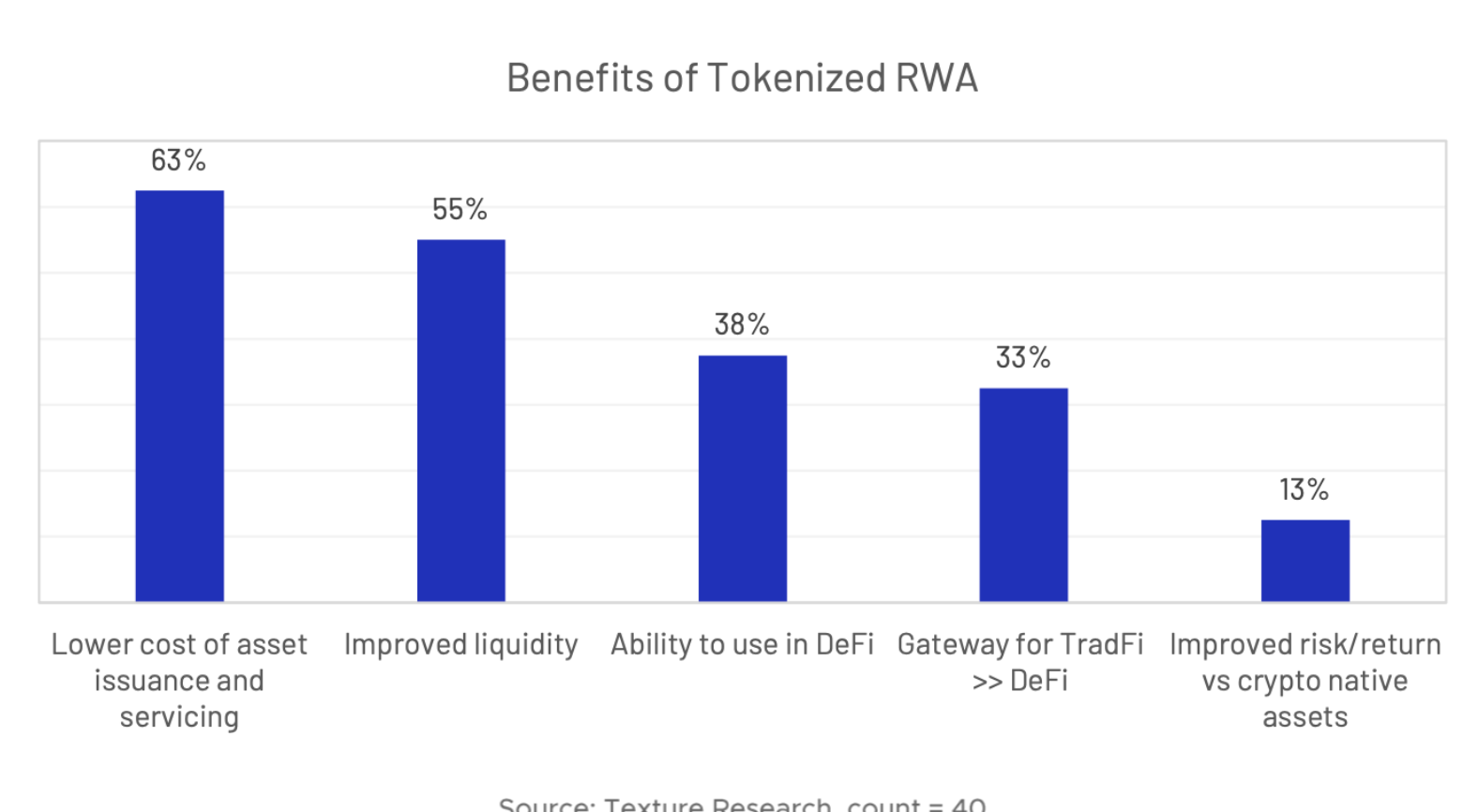
Source: Texture Capital
Regulatory steps push the trend forward in a paradoxical way. Clearer rules typically add friction upfront—KYC/AML checks, reporting duties, licensing—but they also make internal legal teams less likely to slam the brakes. When guidance becomes more concrete, pilots graduate into production, and suddenly a test program turns into a standard operating procedure.
After all, adoption rates often depend less on the chain itself and more on whether regulators, auditors, and risk committees can sign off without losing sleep.
Decentralized finance still plays a role too, just not always in the pure, permissionless form that early DeFi fans romanticized. Many financial firms borrow DeFi mechanics (automated market-making concepts, on-chain collateral logic, transparent reserves) and wrap them in controlled environments with stricter access.
Institutional Allocation
Institutional investors are continuing to increase crypto exposure in 2026 because the market is offering more familiar access points and (finally) a clearer risk narrative. The “what” is simple: crypto is no longer viewed only as an exotic trade, but as a potential portfolio sleeve that can be sized, hedged, and reported on. The “how” is more nuanced—institutions allocate when they can measure liquidity, custody risk, regulatory risk, and correlation behavior with the same discipline they use for equities or commodities.
Regulatory steps matter here as well, because mandates don’t like grey zones. Pension funds, endowments, and asset managers typically need a compliance story before a bull case. When frameworks become clearer, investment committees can evaluate products like regulated funds, structured notes, and custody solutions without treating every line item as a legal experiment.
And yes, custody is still the grown-up topic at the table: institutions want robust key management, insurance structures, segregation of assets, and operational controls that don’t rely on a single person “remembering where the seed phrase is.” For many allocators, execution also runs through familiar rails—spot ETFs, prime brokers, or a regulated brokerage account—because those wrappers fit internal controls better than direct exchange accounts.
Tokenization is another accelerant for institutional allocation because it can turn traditionally illiquid exposure into something easier to price and transfer. If a fund can issue tokenized shares or manage tokenized collateral, it may reduce administrative drag and speed up settlement cycles. That doesn’t remove market risk, but it can reduce friction—often the biggest hidden cost in large portfolios.
Decentralized finance is influencing institutions indirectly as well. Even when institutions avoid open DeFi protocols, they pay attention to the efficiency benchmarks DeFi introduced: continuous settlement, transparent reserves, and programmable risk controls. The implication for readers is practical: when institutions step in, liquidity and product diversity typically increase—but so does the market’s sensitivity to macro factors like interest rates, credit conditions, and regulatory headlines.
Market Sentiment
Crypto market sentiment in 2026 is cautious-but-engaged, with retail and institutions reacting to different triggers while still influencing the same price charts. Retail sentiment tends to swing with narratives—new bottom or relief rally talks, social media trends, and the occasional “this changes everything” headline. Institutional sentiment is usually slower and colder: it moves on risk-on/risk-off cycles, policy signals, and whether crypto exposure helps or hurts portfolio construction in a given macro regime.

Photo by Product School on Unsplash
Macro data also mattered to the narrative framing in February 2026: Santiment commentary cited a CPI report of 2.4% as cooler-than-expected, which can influence risk appetite even when crypto has its own internal drivers. Media coverage shapes both camps, but in different ways. Retail investors often absorb the emotional framing, while institutions extract the practical signal: enforcement trends, regulatory steps, and whether counterparties are tightening standards.
Building on that, socio-economic events—tightening liquidity, inflation surprises, geopolitical stress, banking sector jitters—can push crypto into two competing roles at once: a speculative asset when conditions are loose, and a hedge story when confidence in traditional systems wobbles. The market can believe both narratives in the same month, which is why sentiment sometimes looks inconsistent from the outside.
On-chain and behavior signals add another layer to sentiment. Decentralized finance affects sentiment through trust dynamics. When DeFi works smoothly, it reinforces the idea that finance can be more transparent and programmable. When it breaks (smart contract exploits, governance drama, liquidity crunches), it reminds everyone that code is law is not the same thing as code is safe.
For retail, tokenization making crypto feel less like a separate universe and more like a new wrapper for familiar assets can lower the intimidation factor. For institutions, it can make crypto-adjacent strategies easier to justify internally. The implication is straightforward: in 2026, sentiment isn’t just optimism or fear—it’s whether the ecosystem looks dependable enough for bigger money to stay put when headlines turn ugly.
Conclusion
A diversified cryptocurrency portfolio balances liquidity with upside by mixing established coins and selective altcoins for March 2026. That’s the thread tying everything together: you’re building a basket where different assets do different jobs. Large-cap cryptocurrencies typically act as the core because they tend to have deeper liquidity (easier entries and exits, tighter spreads), stronger infrastructure support, and more predictable market behavior compared to smaller tokens. On the other hand, carefully chosen altcoins can add growth potential when their use case, adoption, or token mechanics have a clear reason to exist beyond hype.
Disclaimer
This guide is designed to equip you with the frameworks, context, and safety principles needed to navigate the crypto markets more confidently. Use it as a starting point, keep learning, and always pair opportunity with risk management.
Frequently Asked Questions
Which crypto should I buy today for the long term?
Which crypto to buy today for the long term? Bitcoin and Ethereum fit best for long-term crypto buying because they combine the longest track records with the broadest real-world utility. If your goal is to hold through multiple market cycles, you’re typically looking for networks that keep attracting users, developers, and liquidity even when hype rotates to newer altcoins.
Ethereum earns its long-term spot largely because smart contracts turned it into infrastructure, not just an asset. When decentralized finance apps, tokenization projects, and on-chain marketplaces need a base layer, Ethereum is still the default reference point for security, integrations, and developer tooling. The important detail is that long-term value often follows sustained demand for blockspace (people paying fees to do things on-chain), not just a catchy narrative.
Bitcoin plays a different role. Bitcoin’s main job is to be resilient and widely recognized, which is why many investors treat it as the core holding in a crypto portfolio. It’s less about new features and more about historical performance through stress tests, custody options, and global accessibility. Think of it like digital bedrock: not exciting, but the ground you want under your feet when the weather turns.
A practical way to approach long-term buying is to separate core from satellite. Core is usually Bitcoin and Ethereum; satellite is where you might add selective exposure to altcoins (including fast movers like Solana) with a clear thesis and a strict size limit. On the other hand, if you’re relying on one short-lived catalyst, that’s not long-term investing—that’s trading in a trench coat.
Which crypto should I buy today for the short term?
Which crypto to buy today for the short term? Solana and other high-beta altcoins tend to be short-term favorites because they can move fast when sentiment flips, liquidity pours in, and a specific catalyst catches fire. That’s also why short-term buys are tricky: you’re not just choosing a coin, you’re choosing timing, triggers, and an exit plan.
Short-term catalysts usually fall into a few buckets: ecosystem launches, sudden spikes in user activity, new listings, or narrative waves (AI, gaming, memes, new DeFi mechanics). The how matters here: when liquidity concentrates into a theme, price moves can become self-reinforcing for a while, and then reverse just as quickly when traders rotate out.
For a short-term approach, think in checkpoints instead of predictions. What has to happen for your thesis to remain valid—rising volume, increasing on-chain activity, improving market structure? And what invalidates it—broken support levels, fading momentum, or negative news that hits risk appetite?
Even if you pick a strong short-term candidate, position sizing is your seatbelt. Many beginners buy “a lot” of a volatile asset and then discover that a normal pullback feels like a personal attack. If you want to trade altcoins, do it with money you can actively monitor, use clear profit-taking rules, and avoid turning a short-term idea into an accidental long-term hold.
Which crypto will boom in the future?
Solana and other high-beta altcoins tend to be short-term favorites because they can move fast when sentiment flips, liquidity pours in, and a specific catalyst catches fire. That’s also why short-term buys are tricky: you’re not just choosing a coin, you’re choosing timing, triggers, and an exit plan.
Short-term catalysts usually fall into a few buckets: ecosystem launches, sudden spikes in user activity, new listings, or narrative waves (AI, gaming, memes, new DeFi mechanics). The how matters here: when liquidity concentrates into a theme, price moves can become self-reinforcing for a while, and then reverse just as quickly when traders rotate out.
For a short-term approach, think in checkpoints instead of predictions. What has to happen for your thesis to remain valid—rising volume, increasing on-chain activity, improving market structure? And what invalidates it—broken support levels, fading momentum, or negative news that hits risk appetite?
Even if you pick a strong short-term candidate, position sizing is your seatbelt. Many beginners buy “a lot” of a volatile asset and then discover that a normal pullback feels like a personal attack. If you want to trade altcoins, do it with money you can actively monitor, use clear profit-taking rules, and avoid turning a short-term idea into an accidental long-term hold.
Which crypto should I invest in at a low price as a beginner?
Cardano and Polkadot are common low price picks for beginners because the per-coin price feels accessible while the projects are established enough to have documentation, communities, and educational resources. The key lesson is uncomfortable but useful: a low coin price does not mean cheap, and a high coin price does not mean expensive. Market capitalization and token supply are what tell you how big an asset already is.
So why do Cardano and Polkadot often work as beginner-friendly starting points? They come with structured ecosystems, clearer learning paths, and plenty of explainer content about how staking, governance, and network design work. If you want to understand smart contracts and how different chains approach scaling and security, they give you a lot to study without jumping into the noisiest corners of altcoins.
A practical beginner strategy is to treat your first buys as tuition. Start with an amount small enough that mistakes won’t hurt, then practice the boring skills: moving funds to a wallet, understanding transaction fees, and learning how liquidity affects slippage when you trade. Building on that, you can explore a tiny allocation into faster ecosystems like Solana once you’re comfortable with volatility and the speed at which narratives rotate.
If “low price” is really about budget, consider using dollar-cost averaging instead of trying to nail the perfect entry. It’s not glamorous, but it’s a simple way to reduce timing risk while you learn what you actually own. If you would like a review of even more options, read our guide to cheap altcoins to buy now.
What is the safest crypto to buy now?
Bitcoin is typically considered the safest crypto to buy because it has the longest operating history and the widest recognition across the market. “Safest,” though, does not mean “safe” in the way a bank deposit is safe. It means lower relative risk inside an asset class that can still swing hard.
Start with the asset choice: established networks like Bitcoin (and, for utility exposure, Ethereum) tend to have deeper liquidity and broader market participation than smaller altcoins. Deeper liquidity usually means you can enter and exit with less price impact, which matters more than people think—especially during sudden sell-offs.
Then come the behaviors that actually create safety: position sizing (no single bet that can wipe you out), avoiding leverage if you’re not a professional, and tight custody hygiene (hardware wallets, backups, and a plan for recovery). The important detail is that many crypto losses aren’t price losses—they’re operational losses from phishing, bad approvals, or sloppy key management.
Finally, diversify intelligently. Holding only one asset is concentration risk; holding fifteen random tokens is usually just confusion. A small, well-understood mix—often anchored by Bitcoin—tends to be the calmer path.
How much should I invest in crypto?
A sensible crypto investment amount is the portion of your portfolio you can afford to see drop significantly without it changing your life plans. That sounds dramatic, but February 2026 market conditions are still defined by fast rotations, narrative-driven rallies, and periods where liquidity dries up—so sizing has to respect that reality.
Start with your risk tolerance and timeline. If your time horizon is years, you can usually handle more volatility than if you need the money in six months. If you’re using crypto to learn, start smaller and increase exposure as your understanding of wallets, smart contracts, and decentralized finance risks improves.
Diversification also matters inside crypto. Many portfolios use a core allocation to Bitcoin and Ethereum, then a smaller sleeve for altcoins (for example, Solana for higher volatility exposure, or a measured pick like Cardano). Something to keep in mind: diversification is not a substitute for research. If you don’t know why you own it, you’ll sell it at the worst time.
If you want numbers tailored to your income, debt, and goals, talk to a licensed financial advisor. Crypto can be a legitimate part of a portfolio, but personal finance is personal for a reason.