
How to Mine Litecoins (LTC)? Is Litecoin Mining Worth It?

Key Takeaways
- Litecoin (LTC) is a Proof-of-work cryptocurrency, which means it can be mined. Cryptocurrency mining is a process of running specialized mining software to add new blocks to the blockchain.
- Mining supports the decentralized network, so it is a popular activity in the Litecoin community even on a not-for-profit basis. Nevertheless, for most miners, it is primarily a revenue source.
- LTC is best mined with ASIC (application-specific integrated circuits) miners. To break even and profit, one would need considerable computational power, so unless you can provide it, consider joining a Litecoin mining pool.
The question and the topic are in the title: you already know about Litecoin and mining but would like to learn how exactly they mesh. Anyone seeking guaranteed profit projections or turn-key purchasing recommendations or readers needing jurisdiction-specific legal or tax guidance on mining income is not the exact audience of the guide. It’s for beginners who want to understand how Litecoin mining actually works under the hood and prospective home miners researching feasibility, and tech-oriented readers. By the end of this guide, you'll be able to understand the end-to-end Litecoin mining loop, evaluate which mining method suits your situation, estimate the core costs involved, and recognize the key risks before you start.
What Is Litecoin?
The complete answer to the question “what is Litecoin?” for those wondering is there in our guide to LTC, and what follows is a highly condensed version. Litecoin is a peer-to-peer cryptocurrency that uses proof of work (PoW) as its consensus mechanism, securing its blockchain through Scrypt—a memory-hard cryptographic algorithm—so that miners compete by hashing under a difficulty target to produce valid blocks and earn newly issued coins.

Key Facts
Litecoin was created by Charlie Lee and launched in 2011 as an open-source fork of Bitcoin. Scrypt, a memory-hard PoW hashing function, is intentionally used in contrast to Bitcoin's SHA-256, making it resistant to early ASIC dominance.
Litecoin targets a 2.5-minute block time, meaning miners encounter a new block opportunity roughly four times more frequently than on Bitcoin's 10-minute schedule. To keep the supply dynamics roughly the same as in Bitcoin, Litecoin has a hard coin supply cap of 84 million LTC (again, four times the BTC supply).
The current block reward is 3.125 LTC per block, following the August 2023 halving. Litecoin's halving occurs every 840,000 blocks, approximately every four years like in Bitcoin, progressively reducing issuance over time. At this rate, the network produces approximately 576 blocks per day.
Last but not least, mining difficulty in Litecoin adjusts every 2,016 blocks (approximately every 3.5 days), stabilizing block time against changes in total network hash rate. These facts will stay relevant for more technical sections in this guide, so don’t dismiss it as trivia.
Litecoin Mining Basics
Once again, to catch up with what mining means, catch up with our previous article. From here on an explanation will follow but it will still make assumptions you are familiar with the topic.
Litecoin mining is the process by which participants use computational work to secure the network, validate transactions, and earn newly issued coins.
Proof-of-Work
First thing to know is that Litecoin uses proof of work (PoW) as its consensus mechanism. The “proof” is the point: the network needs an objective way to verify that real computational effort occurred, because that cost is what makes attacks expensive.
What the network gets from this arrangement is practical security, not ideology:
- Sybil resistance: identities don’t matter; hashpower does.
- Canonical ordering: a clear, objective chain history emerges from accumulated work.
- History protection: rewriting the past requires outpacing the honest network’s work.
What miners get in exchange is compensation—eligibility for the block reward (newly issued LTC) plus transaction fees included in that block.
PoW is often described as “solving a math problem,” which implies the result is useful or computed in a meaningful sense but it really isn’t. Miners repeatedly hash data with different inputs until the resulting hash falls below a target. The work is real; the output is simply a number that meets a threshold.
For the reference: hash is the fixed-length output produced by running data through a cryptographic algorithm; changing any input—even by one character—produces a completely different hash. Nonce is a number miners increment (or otherwise vary) on each attempt to change the hash output and hunt for one that meets the current target. Mining difficulty (with regard to difficulty target) is a network-adjusted threshold that controls how small a hash value must be to count as a valid block; it rises or falls to keep block production roughly on schedule.
Scrypt Algorithm

Secondly, Litecoin mining uses the Scrypt algorithm, not SHA-256 like Bitcoin does. That difference is not cosmetic. SHA-256 optimizes toward pure compute throughput; Scrypt was designed with internal requirements that change how hardware can be optimized.
The market reality in 2026 is straightforward: modern Litecoin mining is dominated by Scrypt-capable ASICs. The economics of proof-of-work reward competition push toward specialized hardware, and Scrypt is not an exception.
Why was Scrypt called “memory-hard”? It was designed to require meaningful amounts of memory during computation—not just raw processing speed—raising the cost of parallelization compared with designs that can be stripped down into pure compute. However, “memory-hard” or “ASIC-resistant” has never really meant “ASIC-proof.” Manufacturers eventually built Scrypt-capable ASICs that satisfy the memory requirement efficiently, and those machines now define the competitive landscape.
Supply Limit
Last but not least, Litecoin has a maximum supply of 84 million LTC—this is hard-coded like in Bitcoin, not a policy choice as with fiat currencies. This cap is inseparable from miner revenue, because new coins enter circulation through the block subsidy, and that subsidy steps down on a fixed schedule.
As the subsidy trends toward zero over halvings, transaction fees become a larger share of miner incentives and the network’s security budget. That shift is not theoretical; it is the long-run trajectory built into Litecoin’s issuance design.
Litecoin targets a new block roughly every 2.5 minutes, which works out to approximately 576 blocks per day. That cadence governs how quickly the block subsidy is distributed—and it helps you sanity-check any issuance or miner revenue figure you see.
How the Litecoin Mining Process Works
The mining loop from a miner’s POV can be described cleanly as a sequence: select transactions, build a candidate block, search for a valid hash under the difficulty target, broadcast the solution, and then let confirmations reduce reorg risk. Each step has a purpose, and each step has failure modes that matter in practice.
Transaction Selection
Pending transactions sit in the mempool—a waiting area where unconfirmed transfers queue up across the blockchain network. Miners do not include everything waiting; selection is strategic. Two common criteria are favoring transactions that pay more per byte of block space and fitting transactions within the block size limit while filtering out low-fee or invalid spam.
The output of this step is a candidate block: a proposed block with an ordered transaction set, ready for proof-of-work hashing. With mempool transactions and a reference to the most recent confirmed block as the inputs, the output of this step is an ordered transaction list ready for block assembly.
Block Construction
With transactions chosen, the miner assembles the components required to begin hashing, i.e. calculating a valid solution with the appropriate nonce (more about it a bit later).
Like any node in the network, miners also validate transactions before committing resources. This is not philosophical “consensus participation”; it is self-preservation. An invalid transaction set makes the block invalid, and an invalid block makes all that hashing worthless.
Hashing and Nonce Search
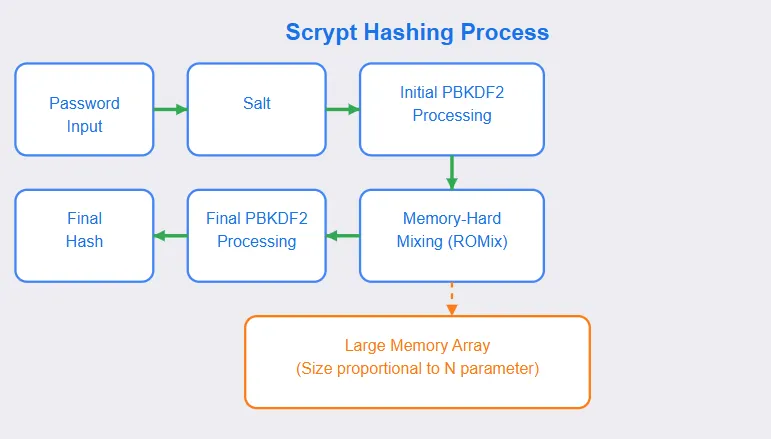
This is the computational core of proof of work consensus. The miner hashes the block structure, in Litecoin’s case using Scrypt, and checks whether the resulting output is below the current difficulty target.
If it isn’t, the miner changes the nonce (and occasionally other mutable fields) and tries again—over and over, at scale, across hardware capable of billions of attempts per second. A valid solution is reached when the resulting hash is numerically below the difficulty target. At that point, proof of work is satisfied and the block is solved.
Block Time and Difficulty Adjustment
Litecoin targets a new block approximately every 2.5 minutes. This is a target, not a guarantee. Actual block intervals fluctuate because mining is probabilistic. You don’t “know” when a valid hash will appear; you keep searching until it does.
When block times drift consistently, the protocol’s self-correcting mechanism kicks in. Difficulty is not arbitrary. It is a network-level parameter derived automatically from recent block production. When the total hash rate contributing to the blockchain network rises and blocks start to arrive too quickly, at a set interval, difficulty increases. When hash rate drops and blocks slow, difficulty decreases.
Litecoin adjusts difficulty every 2,016 blocks—approximately every 3.5 days—explicitly to steer average block discovery back toward the target block time as network hash rate changes.
Block Propagation and Confirmation
When a miner finds a valid block, the winning miner broadcasts it to peers. Those peers validate it independently—proof of work, transaction validity, and linkage to the prior block—then relay it onward. Within seconds, it propagates across the network.
A confirmation is each additional block built on top of the accepted block in the following round. One confirmation means the transaction is in a settled block; six confirmations means five more blocks have been layered on top. More confirmations reduce the risk of a reorganization (reorg), where a competing chain temporarily overtakes the accepted one.
That brings up an important edge case: an orphan block (also called stale block) is a valid, correctly solved block that loses the race because another miner produced a competing block at roughly the same time, and the competing chain becomes the longest (most-work) chain. The orphaned block, including all state changes in it, is discarded and rolled back. This is why confirmations matter: they make it progressively harder for any competing chain to overtake the settled history.
Rewards, Fees, and Halving Schedule
Mining is not “solving puzzles” for fun. It is an incentive system, and miner revenue has two components: the protocol subsidy and transaction fees.
Block Reward
When a miner successfully mines a block, the protocol grants a block reward through the coinbase transaction. This contains newly minted LTC created by the protocol. However, the reward is not immediately spendable: newly minted litecoins from the coinbase transaction require 100 confirmations before it can be spent, and the reward is only valid if your block remains part of the canonical chain. In other words, if your block becomes an orphan block, the reward is lost, in line with every other transaction being dropped from history.

The current post-halving block subsidy is 6.25 LTC per block, and with approximately 576 blocks mined per day (based on Litecoin's 2.5-minute target block time), the network issues roughly ~3,600 LTC/day via block subsidies.
Transaction Fees
Miners also collect transaction fees from transactions included in a block. Each fee equals the total value of a transaction’s inputs minus the total value of its outputs; the remainder is claimed by the miner.
Fees in Litecoin, as is the case with most cryptocurrencies, are variable. When the mempool is congested, miners prioritize higher fee-rate transactions, and fee revenue rises. When the network is quiet, fee revenue falls.
A practical working formula for miner revenue is: Miner revenue per block = (block subsidy + sum of included tx fees) × (miner's share if in a pool) − pool fee. Suppose a block contains transactions totaling 0.05 LTC in fees (a low-fee block). A solo miner earns 6.25 + 0.05 = 6.30 LTC. Now consider a high-fee block during a congestion spike, where fees total 1.20 LTC—the same miner earns 7.45 LTC from that block. These numbers are hypothetical but the point is that fee variability can materially move per-block revenue around the subsidy baseline.
Halving Schedule
Litecoin’s halving, which is nearly identical to Bitcoin halving, is driven by block height, not by date. The mining reward halves every 840,000 blocks. With a 2.5-minute target block time, that works out to roughly four years under normal conditions, but the trigger remains mechanical: when the relevant block height is mined, the protocol halves the subsidy automatically. Transaction fees are unaffected; they remain market-driven.
Two implications matter most for miner planning: subsidy revenue steps down instantly at each halving event with no transition period (albeit on foreseeable dates), and over long horizons, fees become a larger share of total miner income as the subsidy shrinks, assuming network usage supports fee demand. You can learn more about the second implication from our guide to what happens when all bitcoins are mined.
Litecoin Mining Methods
Mining method determines variance, payout timing, custody risk, and operational overhead as follows:
| Method | Hardware Ownership Required | Payout Variance | Time to First Payout | Fee Types | Custody / Control | Operational Complexity | Fraud / Termination Risk | Best-Fit Miner Profile |
|---|---|---|---|---|---|---|---|---|
| Solo Mining | Yes (own ASIC) | High | Unpredictable (weeks–months+) | None | Full (you control wallet and hashrate) | High | Low | High-hashrate operators, independence-seekers |
| Pool Mining | Yes (own ASIC) | Low–Med | Hours to days | Mining pool fee (1–3 % typical) | Partial (pool holds until payout threshold) | Low–Med | Low–Med | Hobbyist/home, small operator |
| Cloud Mining | No | Med | Days to weeks (per contract) | Contract fee + maintenance/electricity clause | Low (provider controls hardware; coins credited to account) | Low | High | Capital-only, no hardware setup |
| Hashrate Rental | No | Med | Hours to days | Rental premium + spread + conversion fee | Partial (you choose pool; payout address is yours) | Med | Med | Short-term experimenters, capital-only |
| Merged Mining | Yes (via pool) | Low–Med | Hours to days (same as pool) | Mining pool fee (same as host pool) | Same as underlying pool | Low (pool handles it) | Low | Any pool miner wanting extra yield |
Solo Mining
Solo mining means your ASIC works directly for the Litecoin network, competing against all miners and pools, without a pool smoothing payouts. Your probability of solving a block is driven by your individual hash rate relative to current network mining difficulty. If you control a small slice, you can wait months—or longer—between rewards. There is no smoothing mechanism.
Practical prerequisites you must already have in place:
- A Litecoin node or lightweight connection. Running a full node gives maximum independence; SPV reduces overhead but introduces dependency on the server you connect to.
- Stable uptime. Intermittent connectivity wastes work. Shares submitted after a block is already found are orphaned.
- A wallet address you control. Use a wallet you control the private keys to, not an exchange deposit address.
- Mining software configured for solo. Point your software at your own node’s RPC port rather than a pool stratum address.
Solo mining is mostly justified when you control enough hash rate to find blocks at least a few times per month at current mining difficulty; you want zero dependence on a third-party mining pool and accept long dry spells. You understand that long-run expected profitability can match pool mining, but short-term variance is severe. Alternatively, you can successfully solo run a test environment where payout frequency is secondary.
Pool Mining
A mining pool aggregates hash rate and distributes rewards proportionally, reducing variance compared with solo mining. The payout scheme determines how variance and fees are allocated.
The three payout schemes you will encounter:
- PPS (Pay Per Share). Fixed payout per share regardless of whether the pool finds a block that round. Higher mining pool fee (often 2–4 %) because the pool absorbs variance.
- PPLNS (Pay Per Last N Shares). Rewards depend on shares in a rolling window ending at block discovery. Higher variance than PPS, typically lower fees (1–2 %). Discourages pool-hopping.
- PROP (Proportional). Rewards split among shares in a specific round. Variance between PPS and PPLNS; more vulnerable to pool-hopping, so less common in large pools today.
Choose the pools that have published a mining pool fee percentage, payout threshold and withdrawal frequency, and overall transparent stats: hashrate, blocks found, worker-level statistics; base your selection on server location and latency (stale/rejected shares reduce effective hash rate). For Litecoin in particular, pay attention to merged mining support (Dogecoin and other auxiliary chains)
Cloud Mining
Cloud mining by definition (not always in practice) means buying hashrate or a mining contract from a provider operating the hardware. The appeal is operational simplicity; the trade-off is counterparty risk and information asymmetry.
Hosted/collocated mining vs. pure hashrate contracts:
- Hosted/collocated mining: You own or lease an identifiable ASIC in a facility. You bear depreciation and electricity, but have a claim on a physical machine.
- Pure hashrate contracts: You buy hashrate for a term with no specific hardware assigned. You receive payouts minus fees and have no physical asset claim.

How to evaluate a cloud contract before committing capital:
- Term length. Shorter terms reduce downside if profitability collapses.
- Maintenance and electricity clauses. Confirm whether power costs are fixed or variable, and whether payouts can be suspended or contracts terminated.
- Difficulty and price sensitivity. Model difficulty doubling and LTC price dropping 50 %.
- Withdrawal restrictions. Check minimums, frequency, and freeze clauses.
- KYC / identity verification. Legitimate providers require it; absence can be a signal.
Walk away if a provider promises guaranteed fixed returns regardless of difficulty or price; no verifiable company registration, physical footprint, or on-chain proof of payouts (publicly auditable history) can be found. Moreso if there is pressure to reinvest instead of withdrawal and referral commissions structurally dependent on new inflows (this is quite literally a Ponzi definition).
Hashrate Rental and Auto Mining
Both approaches let you direct Scrypt hash rate without hardware ownership, but the fee structure differs.
Model 1 — Marketplace rentals: Rent Scrypt hashpower for a period and point it to a pool via a stratum URL and worker credentials. Payouts go to your wallet. Fees hide in the rental premium; compare implied cost-per-hash to owned-hardware economics.
Model 2 — Auto-switch / auto-mining services: The platform mines whichever Scrypt coin is most profitable (Litecoin, Dogecoin, or others), then pays you in a chosen currency. Fees hide in the rental premium, conversion spread, and sometimes explicit conversion fees.
Merged Mining (Litecoin and Dogecoin)
Merged mining lets the same Scrypt proof-of-work secure multiple blockchains. For Litecoin miners, this most commonly means Dogecoin rewards on top of Litecoin rewards without additional computation. Your hash rate is not split; the work is reusable.
Litecoin and Dogecoin merged mining has been supported since 2014, and it is now standard pool infrastructure rather than an experimental feature.
If it is supported by the pool you choose, they handle AuxPoW coordination. You submit one set of shares; the pool submits work to each chain’s network. Your hardware, power draw, share submission, and mining pool fee structure remain effectively the same.
If a separate balance or payout row for auxiliary coins (e.g., DOGE), or a line showing auto-conversion into LTC, a merged-mining status indicator, a payout history entries matching auxiliary rewards and whether auxiliary payouts go to a separate wallet address or are auto-converted are not visible in your dashboard, the pool is not passing auxiliary rewards through to you, regardless of claims.
Custody & Payout Destination (Applicable Across All Methods)
Needless to say, mining only “counts” when coins reach a wallet you control. Custody mechanics determine your counterparty exposure.
Direct-to-wallet payouts send coins on-chain to your address once the payout threshold is met. After confirmations, those funds are yours regardless of what happens to the pool.
Internal account balance credits keep earnings inside the pool or provider until you withdraw. Until then, you are an unsecured creditor. Withdrawal freezes, insolvency, or account termination can delay or prevent access.
Practical implication: set the payout threshold as low as permitted, specify a wallet you control the private keys to (not an exchange deposit address), and withdraw regularly.
Setup and Operating Costs
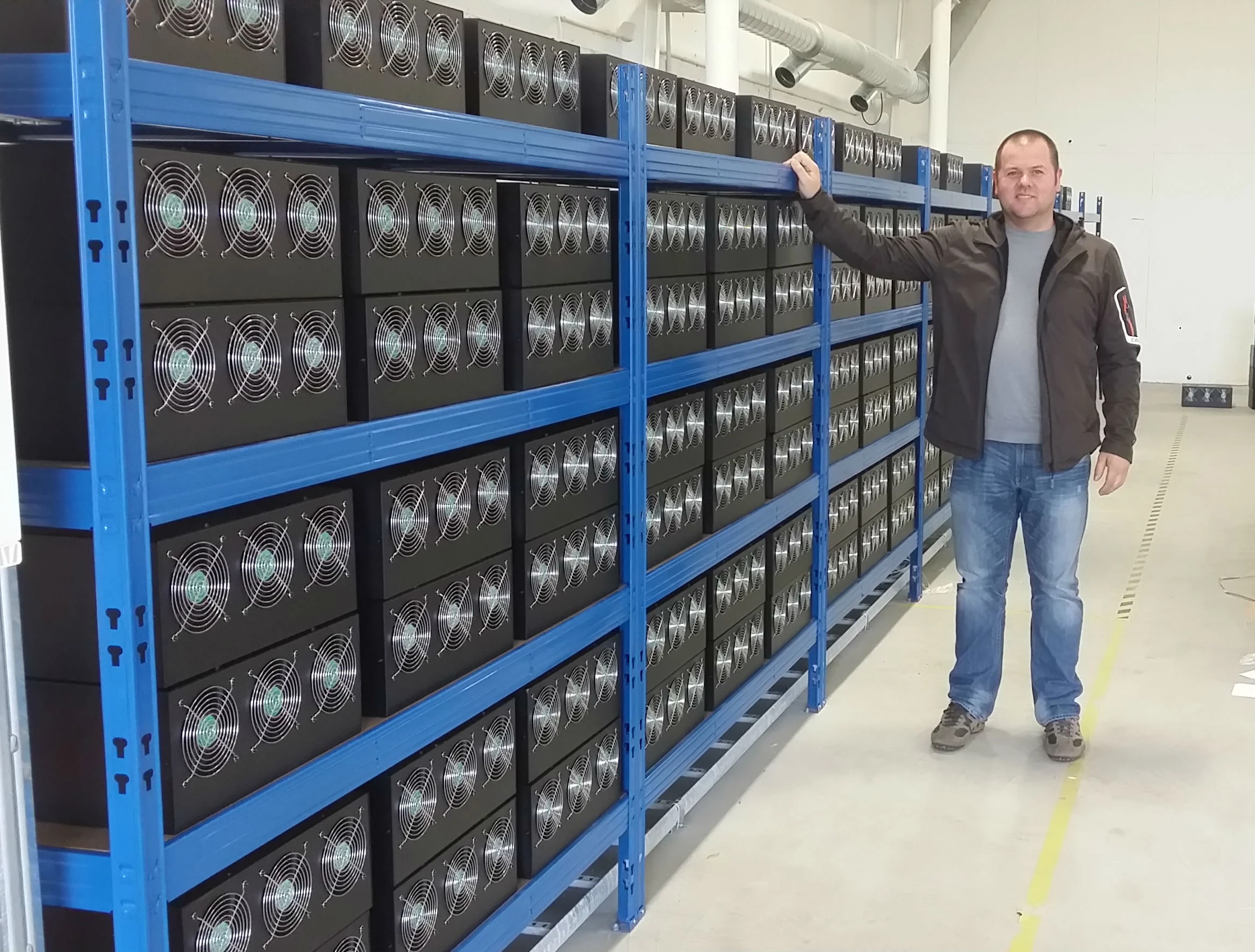
Even for mining Litecoin, hardware is only one line item. In home mining, the margin is usually decided by electricity, cooling overhead, and uptime, not by headline hashrate. In general, setup is an engineering problem first and an investment problem second.
Home Mining Setup Requirements
Before powering on and even buying an ASIC, confirm these items:
- Dedicated electrical circuit: Most Litecoin ASICs draw 1,200–3,500 W and require a 20 A or 30 A dedicated circuit. Sharing circuits increases trip and hazard risk.
- Amperage headroom: Apply the 80% rule—a 20 A circuit should carry no more than 16 A continuous load. Verify panel capacity for an additional breaker.
- Ventilation and heat exhaust: Plan ducting or exhaust that keeps ambient temperature below 35 °C (95 °F). Leave at least 12 inches clearance at intake and exhaust.
- Noise constraints: 70–80 dB at one meter is common. Confirm the space can tolerate it without conflicts.
- Stable internet connection: Wired Ethernet is the optimal choice. Wi-Fi packet loss and dropouts reduce effective uptime.
- Wallet address readiness: Verify your Litecoin wallet address before registering with a pool. Incorrect addresses cause unrecoverable loss of funds.
- Physical space and safety: Smoke detector, clearance, no carpet, away from flammables. Use a surge protector rated for wattage and a plug-in watt-meter to measure real wall draw.
Startup Costs
Separate one-time purchases from recurring overhead.
| Costs | What Belongs Here | One-Time or Recurring? |
|---|---|---|
| Hardware (ASIC) | The miner unit itself; verify it is compatible with the Scrypt algorithm used by Litecoin | One-time |
| PSU (if not bundled) | Many ASICs ship without a power supply unit; match wattage rating with at least 20% headroom above the miner's rated draw | One-time |
| Cabling and adapters | PDU cables, C13/C19 connectors, power adapters specific to your outlet type | One-time |
| Cooling and ventilation add-ons | Inline duct fans, exhaust panels, thermal monitoring sensors | One-time |
| Networking | Ethernet cable, managed switch, or powerline adapter if running a long cable run is impractical | One-time |
| First-month overhead | Pool registration (most pools are free to join but charge a fee per payout), replacement dust filters, spare fans kept on hand | Recurring / early recurring |
Commonly omitted items: Shipping and import duties can add 10–30% to the ASIC price. Surge protection is often added after the first scare. A plug-in watt-meter ($15–$30) is one of the highest ROI tools you can buy, because it prevents systematic underestimation of energy consumption.
Electricity Costs
Doing your research quickly proves that electricity is typically the largest ongoing expense. The variables with which you will calculate the cost are:
- W = Miner wattage (spec sheet or measured wall draw)
- H = Hours per day (use 24 for continuous operation)
- R = Electricity rate ($/kWh)
- C = Cooling overhead factor (optional; add 5–15% if running extra fans/AC)
Formula: Daily kWh = (W × H) / 1,000 Daily electricity cost = Daily kWh × R × (1 + C) Monthly electricity cost = Daily electricity cost × 30 | For example: A 2,000 W miner running 24/7 at $0.10/kWh with 10% cooling overhead:
|
Also keep in mind that real-world wall draw often runs 5–15% above nominal due to temperature, load variance, and PSU efficiency.
Profitability Variables
Profit equals revenue minus costs—so now that you can more or less calculate the latter, learn to determine the former too.
| Variable | Direction of Effect |
|---|---|
| LTC price | Higher price → higher gross revenue per block/share |
| Network difficulty / hash rate | Higher difficulty → fewer LTC earned per unit of hash rate → lower revenue |
| Block reward + transaction fees | Higher block reward or higher on-chain fee activity → more LTC distributed per block |
| Mining pool fee and payout method | Higher pool fee → lower net payout; FPPS pools offer more predictable income than PPLNS for smaller miners |
| Miner efficiency (J/MH or W/MH) | Lower J/MH → lower electricity cost per unit of hash rate → higher net profit |
| Uptime / downtime | Higher uptime → more shares submitted → more revenue |
| Electricity rate | Lower rate → wider profit margin |
| Merged-mining revenue | Additional revenue can improve yield without extra energy consumption |
For most home miners, electricity rate, miner efficiency (W/MH or J/MH), and LTC price dominate the calculations. Stress-test at least: base case, +20% electricity rate, and −30% LTC price. Update inputs regularly because mining difficulty adjusts approximately every 2,016 blocks.
Time-to-Mine Benchmarks for 1 Litecoin
Time to accumulate 1 LTC depends on your hash rate, current mining difficulty, and whether you mine solo or via a mining pool. Pool mining gives steadier payouts proportional to your hash rate, so “time to earn 1 LTC” is a more predictable estimate. Solo mining has high variance: you can beat the expected time or miss it by a wide margin.
These ranges reflect normal fluctuation in mining difficulty and network hash rate. Treat them as approximations, not guarantees. They also shift whenever network difficulty adjusts, so re-check with current estimates with an up-to-date mining profitability calculator before making hardware decisions.
| Hash Rate | Expected Time to Earn 1 LTC (Pool) | Solo Mining Variance | Key Assumption |
|---|---|---|---|
| 100 MH/s | ~180–360 days | Extremely high; could be years between solo blocks | Difficulty ~4,000,000, LTC price not factored |
| 500 MH/s | ~36–72 days | High; solo block found rarely without luck | |
| 1,000 MH/s | ~18–36 days | Moderate; occasional solo block possible but unreliable | |
| 3,000 MH/s | ~6–12 days | Lower variance but still significant for solo | |
| 9,000 MH/s | ~2–4 days | Solo viable with patience; still bested by pool consistency |
Key Considerations, Legality, and Risks
Mining losses are rarely caused by “bad luck” alone. They are typically caused by predictable categories: fraud, misconfiguration, heat/electrical risk, and regulatory or tax exposure. If you can’t audit these risks, you can’t responsibly model profitability.
Scams and Fraud
Scams cluster around two moments: before you pay (fake pools, fraudulent cloud contracts) and after you are running (address-manipulation malware, fake firmware).

Fraudulent pools and contracts can be filtered out by “Guaranteed ROI” language, fake or lookalike pool domains, no verifiable public hashrate stats, upfront fees with no withdrawal history, hashrate-rental wash trading metrics that show implausibly consistent hashrate, no TLS/HTTPS on dashboards or stratum endpoints, anonymous operators with no audit trail, or pressure tactics (“limited contracts left”) framing. This might sound like too much to keep in mind and too easy to overlook but once you pause and apply common sense, a lot of these red flags become more obvious and actionable.
Before Paying:
- Confirm payout address format and minimum payout rules. Litecoin uses L-prefix or M-prefix addresses. Cross-check wallet address format against official Litecoin documentation.
- Verify the pool’s stratum endpoint and TLS certificate. Use tools like openssl s_client to confirm certificate validity and domain match.
- Cross-check hashrate stats against observable block production. A pool claiming major network share should be visible in block history.
To avoid address-manipulation malware or fake firmware, watch out for clipboard hijackers that can replace pasted addresses, miner config file tampering that can likewise silently swap payout addresses, or fake firmware updates that can redirect hashrate or install backdoors. In addition to vigilance, you can use a separate payout wallet (hot wallet) for receiving mining rewards and a hardware wallet for storage of accumulated LTC; checksum-verify software/firmware and keep an offline read-only backup of your miner config for audits.
Common Mistakes
Most non-fraud losses are simply configuration errors and maintenance drift.
| Setup/Config Errors | Consequence | Prevention |
|---|---|---|
| Using the wrong Scrypt stratum URL | Miner connects, reports work, earns nothing | Verify Litecoin-specific Scrypt endpoint and port |
| Misconfigured worker naming | Pool treats rigs as one; diagnostics break | Use unique worker IDs and confirm in dashboard |
| Assuming merged-mining payouts match solo LTC rewards | DOGE appears separately; totals misread | Track LTC and merged-coin payouts separately |
| Setting pool difficulty too low | Pool throttling or flags | Use vardiff or recommended fixed difficulty |
| Incorrect PSU wiring / insufficient headroom | Reboots, instability, PSU failure | 20% headroom; verify connectors under load |
| Skipping firmware update | Stability issues or lower efficiency | Use the latest stable manufacturer firmware |
| No failover pool | Downtime = zero earnings | Configure at least one secondary endpoint |
| Operations/Maintenance Errors | Consequence | Prevention |
|---|---|---|
| Never cleaning dust | Thermal throttling, fan failure | Monthly/quarterly cadence based on environment |
| Ignoring gradual hashrate decline | Early signal of hardware failure | Alerts for sustained >5% baseline drop |
| Single household circuit overload | Breaker trips, hardware risk | Distribute load; use dedicated circuits |
| Not logging payouts | Fee drift and missed payouts go unnoticed | Record payouts, fees, timestamps |
| Assuming pool fees are static | Profit erosion | Re-check effective fee monthly |
| Reusing the same hot wallet address indefinitely | Auditing complexity | Rotate and segment by coin when possible |
| Leaving management ports open | Hasrate theft/config manipulation | Local-only access; VPN for remote access |
Troubleshooting:
- Frequent disconnects
- Likely causes: unstable internet, wrong port, pool rate limiting
- First check: ping endpoint; verify port; check router logs
- High stale shares
- Likely causes: latency, server overload, clock drift
- First check: switch to closest server; NTP-sync clock; check pool status
- Hashrate lower than spec
- Likely causes: thermal throttling, degraded board, mis-tuned settings
- First check: temperatures; per-board hash rates
- Unexpected reboots
- Likely causes: PSU instability, overheating, firmware bugs
- First check: intake temperature; firmware version; PSU behavior under load
- Zero payouts
- Likely causes: payout address mismatch, below threshold, connectivity failure
- First check: pool dashboard address; pending balance vs. threshold
Heat and Fire Risk
Your mined litecoins might be fully online but this risk is very real. Mining hardware runs at sustained high load. That makes airflow, wiring, and dust management non-negotiable.
For airflow, keep intake and exhaust separated. Recirculating hot exhaust into intake is a common cause of thermal creep. Watch ambient intake temperature, exhaust air temperature, per-board/per-chip temperatures, and PSU temperature.
Avoid extension cords and under-rated power strips. Use a dedicated circuit and consult a licensed electrician for significant continuous loads.
Dust management requires monthly cleaning in typical environments, or every two to three weeks in dusty rooms.
Your signals to stop mining immediately should be:
- Burning plastic/ozone smell
- Hot-to-touch cables/outlets
- Breaker trips repeatedly
- A fan stops spinning
- Intake exceeds rated maximum
- Sparking, smoke, discoloration
And do not forget about the noise: ASICs commonly operate in the 70–85 dB range continuously. Plan for this as a real operational risk even if it does not endanger you or your property directly. Consider acoustic enclosure placement (without compromising airflow), strategic room placement (furthest from shared walls), and operational scheduling (even if it reduces uptime and earnings).
Conclusion
Litecoin mining is a continuous, interlocking process: transactions in the mempool are bundled into candidate blocks, miners running Scrypt-based proof of work iterate through billions of nonce values to find a valid hash, the network’s mining difficulty adjusts every 2,016 blocks (roughly every 3.5 days) to keep the block time near 2.5 minutes, and once a winning block is broadcast, propagation and confirmations settle the result into the permanent chain. It translates into the real world as continuous ASIC operation, which needs careful consideration and attentive calculations.
Read more about mining, trading, and using crypto on Telegram, X, and Facebook, and follow us there! Find insights in ChangeHero blog for more guides and analyses of the crypto world.
Frequently Asked Questions
Is Litecoin Mining Still Profitable in 2026?
Litecoin mining can still be profitable in 2026, provided you earn more per day than you spend on electricity and your hardware pays itself back before it becomes obsolete.
High electricity rates combined with low uptime compress margins quickly; older ASICs with poor mining efficiency (high watts per MH/s) break profitability. A spike in network mining difficulty (adjusts every 2,016 blocks, roughly every 3.5 days) or sustained low LTC price are some external factors that can undermine performance even without miner’s fault.
A common misconception is that mining is either “profitable” or “not profitable.” In reality, profitability is recalculated against live difficulty, LTC price, and your electricity rate continuously.
How Much Hashrate Is Needed for 1 Litecoin?
There is no single hashrate number that guarantees 1 LTC. The correct answer is a formula whose inputs change: Expected LTC/day = (Your Hashrate / Network Total Hashrate) × Blocks per Day × Block Reward × (1 − Pool Fee %)
Using live network stats, look up current total network hashrate and mining difficulty on a block explorer or stats page; divide your hashrate by total network hashrate to get your expected share and multiply by (576 blocks/day × current block reward), then subtract the pool fee. Difficulty adjusts every 2,016 blocks (~3.5 days), so the hashrate required is not static.
How Long Does It Take to Mine 1 Litecoin?
In a mining pool: time to accumulate 1 LTC is 1 LTC ÷ your daily LTC earnings rate. Payouts are smaller but steadier.
Solo mining: you are waiting to find a full block yourself, which is high variance. Expected time can be calculated, but real outcomes are luck-dependent and can deviate widely.
Mining difficulty adjusts every 2,016 blocks (~3.5 days), so even expected values shift as network conditions change.
A common misconception is that larger pools increase total LTC earned. They don’t; they primarily smooth payout frequency.
Can I Mine Litecoin on a Laptop?
A laptop is not competitive for Litecoin proof-of-work mining rewards. Litecoin uses Scrypt, and the network is dominated by ASICs operating at hashrates and efficiency a laptop CPU/GPU cannot approach. Earnings would be negligible, while electricity and hardware wear are real.
Can I Mine Litecoin Without a Pool?
Yes—solo mining is technically possible. The question is whether it makes sense with your hashrate and your tolerance for variance.
A common misconception is that solo mining is “free” because it has no pool fee. In reality, variance creates real cashflow risk.
Can I Mine Litecoin and Dogecoin at the Same Time?
Yes. Litecoin and Dogecoin merged mining via AuxPoW has been supported since 2014. One unit of Scrypt work can be valid for both chains. Your hashrate does not split between them.
A common misconception is that merged mining reduces Litecoin earnings. It does not meaningfully increase power draw or consume additional hashrate; it is additional revenue from the same work.
